
Developing Competency Based PBS Training Programme The Story
Developing Competency Based PBS Training Programme: The Story So Far November 2019

Positive Behavioural Support l Values l ABA l Person-centred It’s more than just ABC…
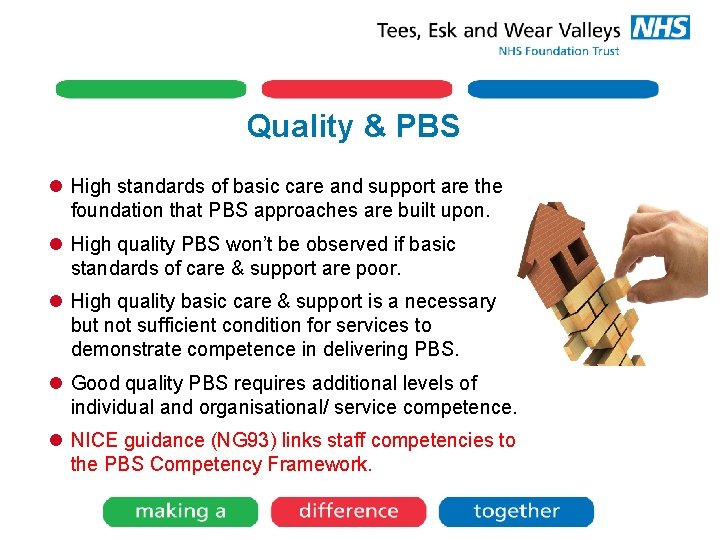
Quality & PBS l High standards of basic care and support are the foundation that PBS approaches are built upon. l High quality PBS won’t be observed if basic standards of care & support are poor. l High quality basic care & support is a necessary but not sufficient condition for services to demonstrate competence in delivering PBS. l Good quality PBS requires additional levels of individual and organisational/ service competence. l NICE guidance (NG 93) links staff competencies to the PBS Competency Framework.
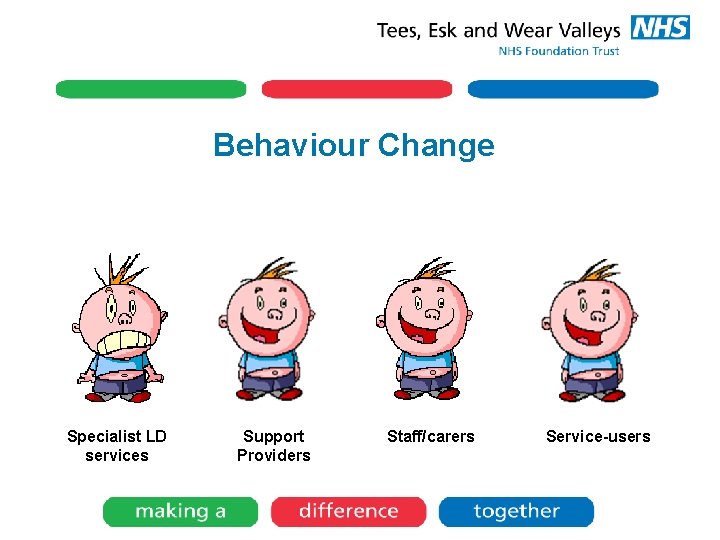
Behaviour Change Specialist LD services Support Providers Staff/carers Service-users
Specialist LD Services l Specialist LD services support people with the most complex behavioural needs (not any behavioural need) l PBS requires specialist knowledge & skills to: - Conduct FBA’S - Develop PBS plans - Support implementation l Where in specialist LD services are the knowledge and skills located? l How are the knowledge & skills developed?

Previously l Previous clinical experience…. l 1 day PBS training l 2 day PBS training (intro to FBA l BTEC PBS qualifications (levels 3, 4 & 5) l Person centred active support l Values training l And…. Degrees/MSc’s in Behaviour Analysis or similar

Context l Review of PBS pathway l NG 93 (2018) l PBS standards - Individual practitioners (2019) - Training (2017) l PBS Competency Framework (2015) l NG 11 (2015) l Regional PBS qualifications unavailable to NHS

Pathway Review l Different pathways (community & tertiary) l Highly technical pathways l “Minimum standards” approach to PBS l Revolving door referrals l Perception of PBS as something ’we do to people’ l Highly skilled practitioners l Expectation for staff with less skills to use PBS l Primarily nursing led (occasionally psychology) l Organisation commitment to PBS
Key Changes l MDT pathway (best placed person principle) l Compatible with national standards and guidance l Increased focus on quality of life l Increased focus on implementation stage of the pathway l Pathway needs to embedded within a wider structure that includes: - Access to additional resources - Supervision - Training
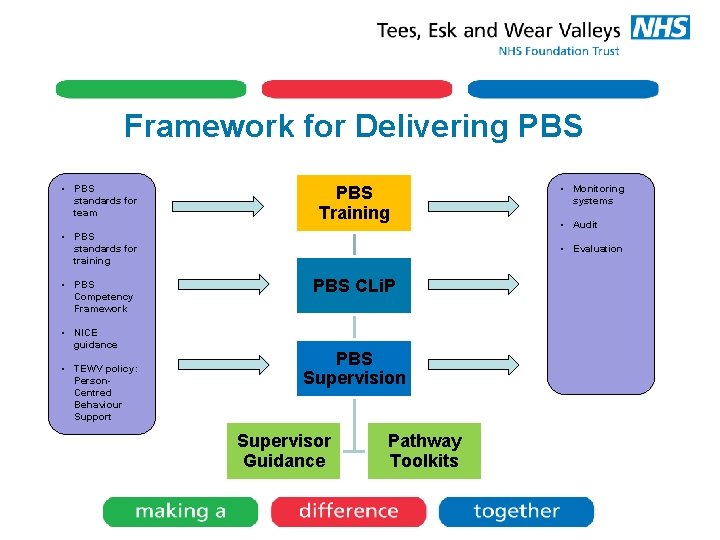
Framework for Delivering PBS • PBS standards for team PBS Training • PBS standards for training • PBS Competency Framework • NICE guidance • TEWV policy: Person. Centred Behaviour Support • Monitoring systems • Audit • Evaluation PBS CLi. P PBS Supervision Supervisor Guidance Pathway Toolkits

PBS Competency Framework (2015) Higher Intermediate Foundation

PBS Standards l Levels are linked to roles and also skills l PBS Standards for Training (2017) broadly detailed the learning requirements for each level (i. e. hours) l PBS Standards for Individual Practitioners (2019) provided further detail in relation to the level of training required for each level (i. e. qualification)

Goals l Increase knowledge & understanding of PBS as: - A values based framework - An evidence-based framework l Involve people with learning disabilities in PBS training l Emphasise the primacy of quality of life within the PBS approach l Improve confidence of staff to implement the PBS pathway l To actually improve practice (relationship between quality of service & quality of life)

Increasing Competence in PBS

Workforce Development Framework Competency level Higher Role Training Organisational PBS Lead Masters (PBS/ABA) Advanced Behaviour Practitioners Degree( PBS/ABA/ Behaviour analysis) PBS supervisor (tiers 1, 2 & 3) Intermediate PBS Supervisor (tiers 1 & 2 only) Professional diploma (PBS) Behaviour Practitioner Intermediate PBS pathway lead (tier 1 & 2) Internal (Intermediate) Foundation Direct care staff Internal (Foundation) Awareness All other staff Awareness

External Training (Qualifications) l BTEC Professional Diploma l Degree (PBS/Behaviour analysis) l Post-graduate certificate (ABA/PBS) l Masters (PBS/ABA)

Overview of the Training l The training provides staff with the opportunity to develop and demonstrate the knowledge and skills to implement PBS in practice. l It has two levels of training: Foundation & Intermediate. l Both levels of training will map onto the PBS Competency Framework (2015) and be informed by the PBS standards for training (2017). l The training is competency based & includes some assessed activities and the gathering of evidence to develop a portfolio to demonstrate the implementation of PBS to the standards detailed in the PBS competency framework.
Foundation Level l 120 hours learning l 20 hours face-to-face classroom learning l 100 hours work based activity l This level is appropriate for staff delivering direct support to service-users on a daily basis.

Units: Foundation Level Module 1: Values l Unit 1: The historical context of PBS l Unit 2: Thinking about quality of life l Unit 3: Positive values l Unit 4: Creating capable environments Module 2: Theory l Unit 1: Introduction to functional behavioural assessment l Unit 2: Approaches to formulation Module 3: Process l Unit 1: Introduction to PBS planning l Unit 2: Implementing PBS plans
Intermediate Level l 240 hours learning l 40 hours face-to-face classroom learning l 200 hours work based activity l The foundation level training provides 50% of these hours l The level of training is appropriate for staff who are going to be the Lead Professional when implementing the PBS pathway.
Units: Intermediate Level Module 1: Values l Unit 1: The historical context of PBS l Unit 2: Thinking about quality of life l Unit 3: Positive values l Unit 4: Creating capable environments l Unit 5: Improving quality of life Module 2: Theory l Unit 1: Introduction to functional behavioural assessment l Unit 2: Approaches to formulation l Unit 3: Conducting a functional behavioural assessment l Unit 4: Developing a behavioural formulation
Units: Intermediate level Module 3: Process l Unit 1: Introduction to PBS planning l Unit 2: Implementing PBS plans l Unit 3: Designing a PBS plan l Unit 4: Supporting implementation with teams

Learning l A mixture of face-to-face learning and workbased activities l Face-to-face monthly training session. l Delivered by PBS Practitioner and AJ & DN l All sessions must be attended. l ‘Active learning session’ where participants will do a poster presentation of ‘what they have learnt during the training’. l Work-based activities completed in work setting
Knowledge Competence l Units at both levels include a short ‘knowledge test’ to demonstrate knowledge competence. l Pass mark for the test will be 70%. l Test can be resubmitted and additional support provided, as required, to assist learning. l ‘Raising competence’ rather than ‘pass or fail’ model: - PDF’s of face-to-face session provided with the knowledge tests - Participants research questions - Formally sit knowledge test at beginning of next session l Demonstration of knowledge competence at foundation or intermediate level is be dependent upon passing the tests for all units.
Numbers 2019/20 l 67 staff identified l 3 staff did not start due to sickness/leaving l 3 staff discontinued l 61 currently progressing through foundation level l 7 staff have now commenced the intermediate level as well l Further 18 staff will progress to intermediate level
A Manager’s Perspective

A Learners Perspective
Issues l Initial take-up was low (general cohort) l Staff expectations about the training l Scale of the project!! l Need for administrative support l Need for flexibility to accommodate service needs l No qualification l Assessing impact of training
What Next? l Support groups to complete WBA’s l Measure the impact l Links to the training department l Develop training manual l Train other trainers l PBS training for selfadvocates
Questions?
- Slides: 30