
Developing and meeting standards Process of developing standards
- Slides: 10
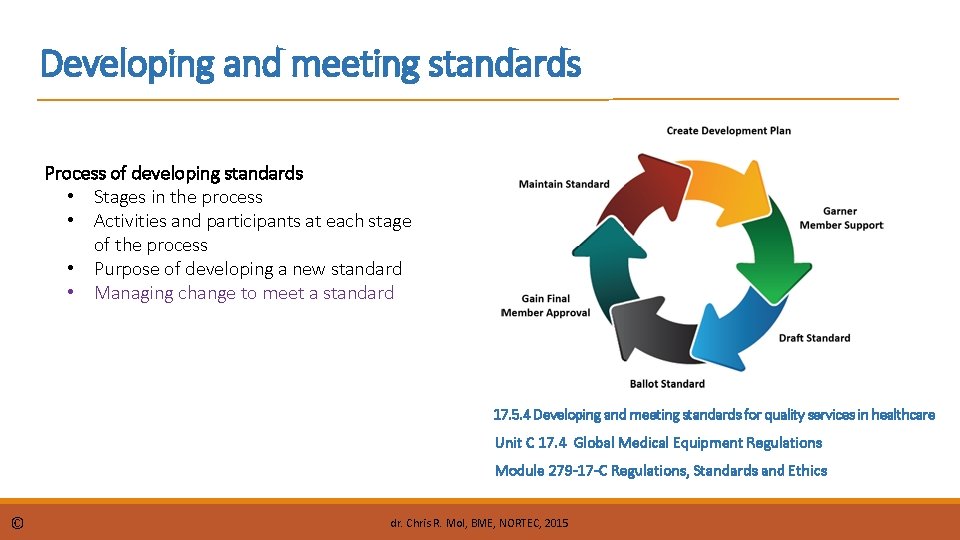
Developing and meeting standards Process of developing standards • Stages in the process • Activities and participants at each stage of the process • Purpose of developing a new standard • Managing change to meet a standard 17. 5. 4 Developing and meeting standards for quality services in healthcare Unit C 17. 4 Global Medical Equipment Regulations Module 279 -17 -C Regulations, Standards and Ethics © dr. Chris R. Mol, BME, NORTEC, 2015
Standards are made to obtain Benefits International Standards bring technological, economic and societal benefits. They help to harmonize technical specifications of products and services. Conformity to International Standards helps reassure consumers that products are safe, efficient and good for the environment For Business: • Standards help optimise operations and therefore improve the bottom line • Standards help improve quality and enhance customer satisfaction • Standards help prevent trade barriers and open up global markets • Standards help reduce negative impacts on the environment For Society With Standards, consumers can have confidence that they are safe, reliable and of good quality. For example, ISO's standards on road safety, toy safety and secure medical packaging. For government National governments can use ISO standards to support public policy, for example, by referencing ISO standards in regulations. © dr. Chris R. Mol, BME, NORTEC, 2015 Developing Standards
Development of good standards has the following attributes 1. Their development has been overseen by a ‘recognized body’ (e. g. ISO, ANSI; see later) thus ensuring that the process is transparent and not dominated by vested interests (i. e. local industries). © 2. The development process has been open to input from all interested parties and the resulting document based on consensus. Consensus means that significant agreement among the stakeholders is reached in the preparation of the standard. This process implies more than the votes of a majority, but not necessarily unanimity. 3. Good technical standards are based on consolidated results of science, technology and experience, and are aimed at the promotion of optimum community benefits. 4. Standards do not hinder innovations and must be periodically reviewed to remain in tune with technological advances. dr. Chris R. Mol, BME, NORTEC, 2015 Developing Standards
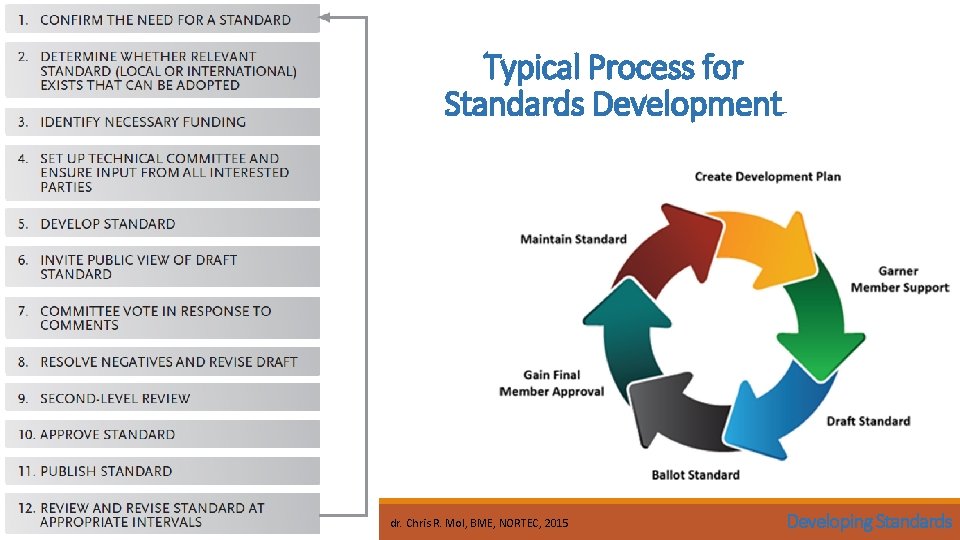
Typical Process for Standards Development © dr. Chris R. Mol, BME, NORTEC, 2015 Developing Standards
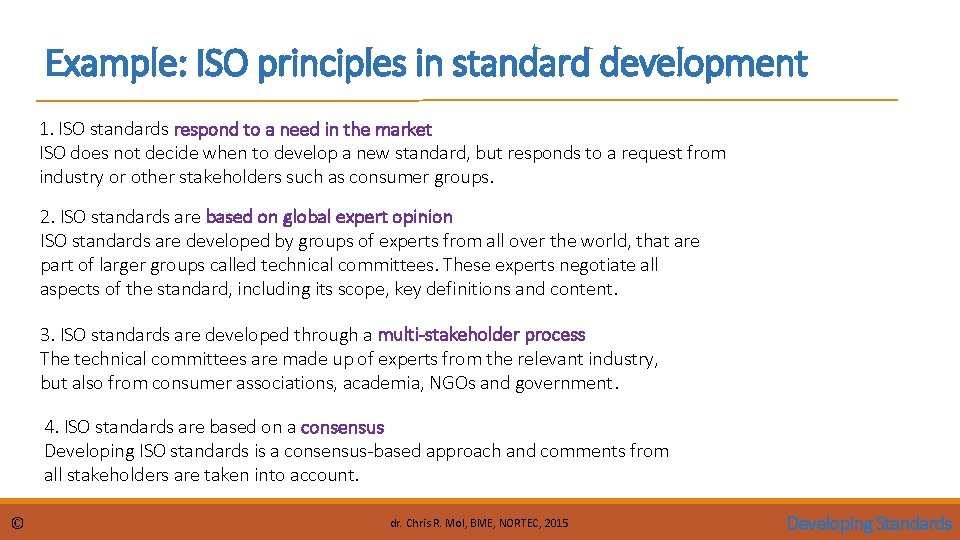
Example: ISO principles in standard development 1. ISO standards respond to a need in the market ISO does not decide when to develop a new standard, but responds to a request from industry or other stakeholders such as consumer groups. 2. ISO standards are based on global expert opinion ISO standards are developed by groups of experts from all over the world, that are part of larger groups called technical committees. These experts negotiate all aspects of the standard, including its scope, key definitions and content. 3. ISO standards are developed through a multi-stakeholder process The technical committees are made up of experts from the relevant industry, but also from consumer associations, academia, NGOs and government. 4. ISO standards are based on a consensus Developing ISO standards is a consensus-based approach and comments from all stakeholders are taken into account. © dr. Chris R. Mol, BME, NORTEC, 2015 Developing Standards
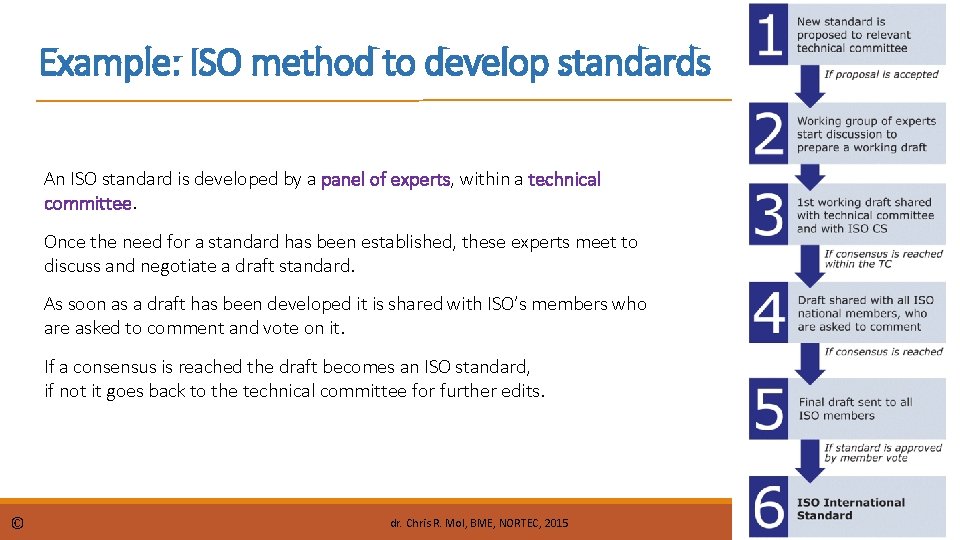
Example: ISO method to develop standards An ISO standard is developed by a panel of experts, within a technical committee. Once the need for a standard has been established, these experts meet to discuss and negotiate a draft standard. As soon as a draft has been developed it is shared with ISO’s members who are asked to comment and vote on it. If a consensus is reached the draft becomes an ISO standard, if not it goes back to the technical committee for further edits. © dr. Chris R. Mol, BME, NORTEC, 2015 Developing Standards
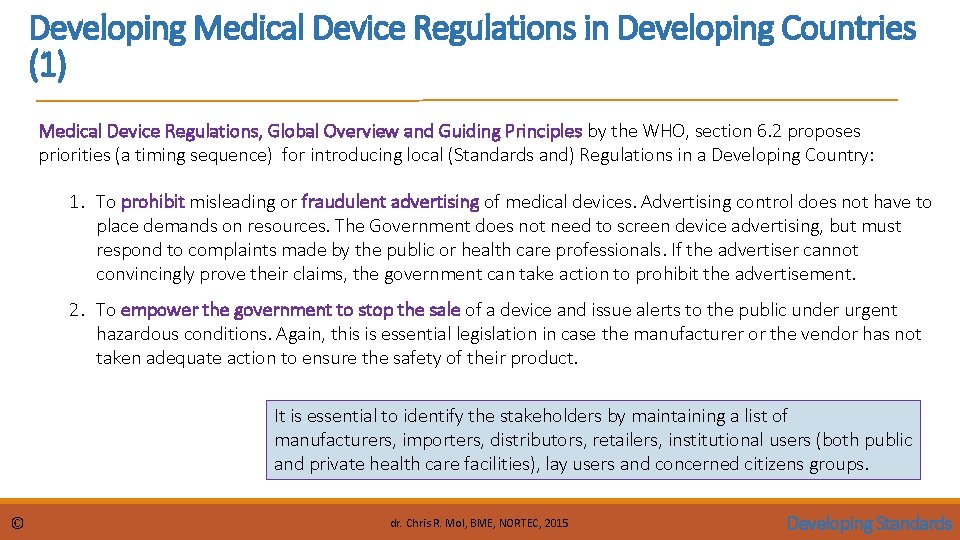
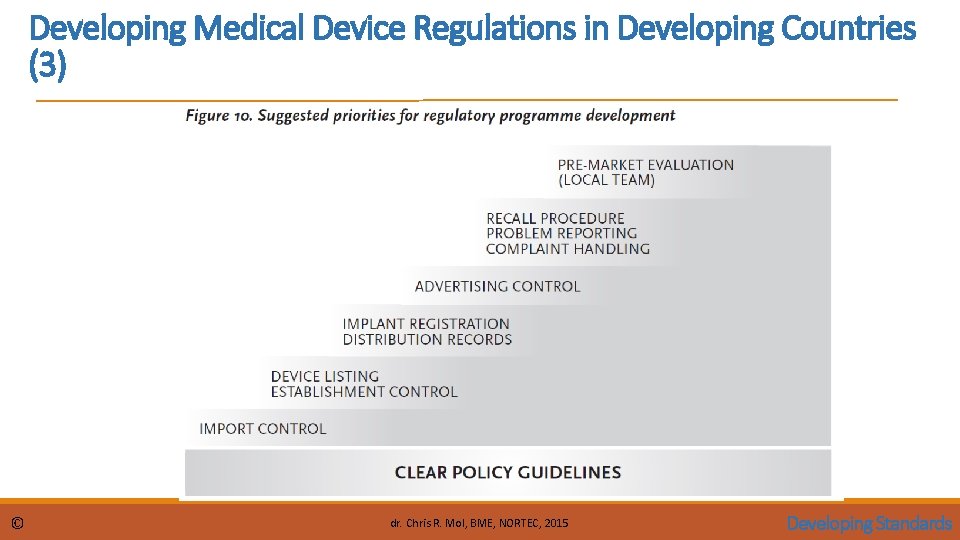
Developing Medical Device Regulations in Developing Countries (1) Medical Device Regulations, Global Overview and Guiding Principles by the WHO, section 6. 2 proposes priorities (a timing sequence) for introducing local (Standards and) Regulations in a Developing Country: 1. To prohibit misleading or fraudulent advertising of medical devices. Advertising control does not have to place demands on resources. The Government does not need to screen device advertising, but must respond to complaints made by the public or health care professionals. If the advertiser cannot convincingly prove their claims, the government can take action to prohibit the advertisement. 2. To empower the government to stop the sale of a device and issue alerts to the public under urgent hazardous conditions. Again, this is essential legislation in case the manufacturer or the vendor has not taken adequate action to ensure the safety of their product. It is essential to identify the stakeholders by maintaining a list of manufacturers, importers, distributors, retailers, institutional users (both public and private health care facilities), lay users and concerned citizens groups. © dr. Chris R. Mol, BME, NORTEC, 2015 Developing Standards
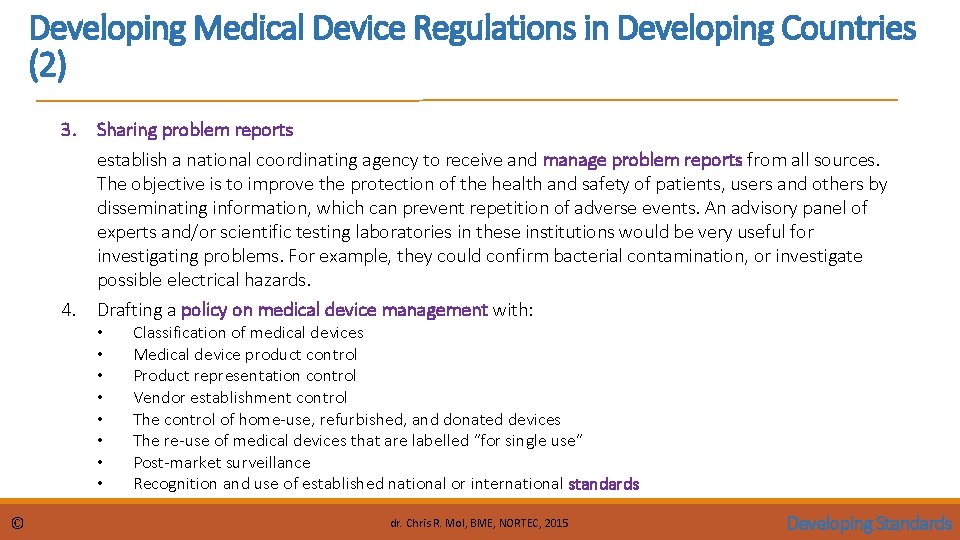
Developing Medical Device Regulations in Developing Countries (2) © 3. Sharing problem reports 4. establish a national coordinating agency to receive and manage problem reports from all sources. The objective is to improve the protection of the health and safety of patients, users and others by disseminating information, which can prevent repetition of adverse events. An advisory panel of experts and/or scientific testing laboratories in these institutions would be very useful for investigating problems. For example, they could confirm bacterial contamination, or investigate possible electrical hazards. Drafting a policy on medical device management with: • • Classification of medical devices Medical device product control Product representation control Vendor establishment control The control of home-use, refurbished, and donated devices The re-use of medical devices that are labelled “for single use” Post-market surveillance Recognition and use of established national or international standards dr. Chris R. Mol, BME, NORTEC, 2015 Developing Standards
Developing Medical Device Regulations in Developing Countries (3) © dr. Chris R. Mol, BME, NORTEC, 2015 Developing Standards
END The creation of this presentation was supported by a grant from THET: see https: //www. thet. org/