
Developing and evaluating complex interventions where to start



- Slides: 66
Developing and evaluating complex interventions: where to start? Dr Susan Kerr Dr Maggie Lawrence Mr Alan Middleton Ms Caroline Mc. Vey Ms Lorna Fitzsimmons
Symposium Overview Ø Developing and evaluating complex interventions: the new Medical Research Council (MRC) Guidance Ø A family centred approach to the management of lifestyle risk factors for recurrent stroke Ø Addressing the tobacco and alcohol-related health promotion needs of people with learning disabilities Ø Developing and testing smoking cessation support for people with severe and enduring mental health problems
Developing and evaluating complex interventions: the new MRC Guidance Why new guidance? Ø In 2000, the MRC published a Framework for the development and evaluation of randomised controlled trails (RCTs) for complex interventions to improve health Ø The Framework has been highly influential and the accompanying paper in the British Medical Journal (Campbell et al, 2000) has been widely cited Ø In 2006 it was decided that, while the initial Framework had been useful, it had a number of limitations, including: • • The fact that it had adopted a model based on the 4 phases conventionally used in drug trials The linearity implied by the diagram of the model Limited guidance on how to approach developmental and implementation phase studies The assumption that conventional clinical trials always provide the best template for the evaluation of interventions MRC (2008)
The new Guidance Ø What makes an intervention complex? Ø The development-evaluation-implementation process (i. e. the new model) Ø Developing a complex intervention Ø Assessing feasibility and piloting methods Ø Evaluating a complex intervention Ø Implementation MRC (2008)
What makes an intervention complex? Ø Complex interventions are usually described as interventions that contain a number of components Ø There are several dimensions of complexity: • The interactions between the components of the intervention/s • The number and difficulty of behaviours required by those delivering or receiving the intervention • The number of groups or organisational levels targeted by the intervention • The number and variability of outcomes • The degree of flexibility or tailoring of the intervention
Implications for development and evaluation Ø A good theoretical understanding is needed of how the intervention causes/might cause change Ø Lack of impact may reflect implementation failure rather than genuine ineffectiveness Ø It is likely that a number of primary and secondary outcomes measures will need to be developed/used Ø Ensuring strict fidelity to a protocol may be inappropriate
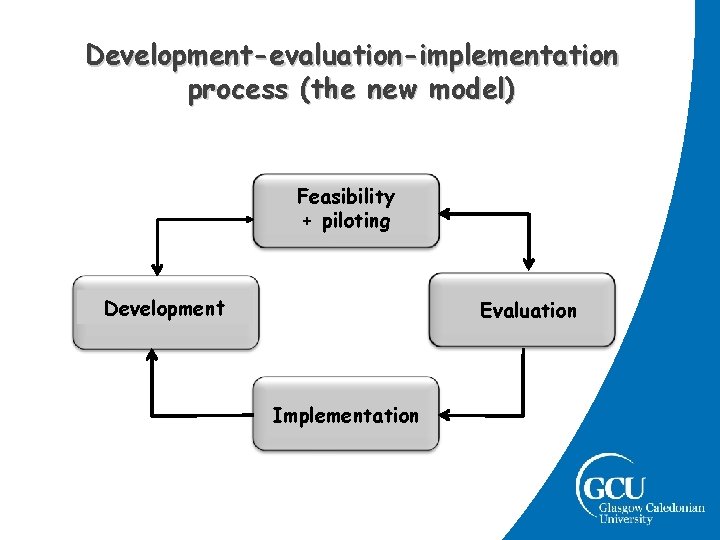
Development-evaluation-implementation process (the new model) Feasibility + piloting Development Evaluation Implementation
Developing a complex intervention ØIdentifying the evidence-base • Identify/conduct a systematic review ØIdentifying/developing theory/gathering evidence • Develop a theoretical understanding of the likely process of change, by drawing on existing evidence and theory • Supplement, if necessary, by new primary research with key stakeholders ØModelling process and outcomes • Basically designing the intervention and deciding what will be measured/assessed in terms of its effectiveness/delivery • Formal frameworks can be useful e. g. MOST (Collins et al 2005), RE-AIM (Glasgow et al 1999). • NICE (2007) has also produced guidance on the development and evaluation of behaviour change interventions
Assessing feasibility and piloting methods ØMethodological research suggests that this vital preparatory work is often over-looked or undertaken in a rather cursory manner ØEvaluations are often undermined by problems of acceptability, compliance, delivery of the intervention, recruitment/retention and smaller than expected effect sizes ØA mixture of qualitative and quantitative methods is likely to be needed e. g. to understand barriers to participation, to estimate response rates
Evaluating a complex intervention ØAwareness of the whole range of experimental and nonexperimental approaches should lead to appropriate methodological choices ØAssessing effectiveness (e. g. randomised controlled trials, non-randomised designs, case control studies) ØUnderstanding the change process – a process evaluation, generally using qualitative methods, can provide insight into why an intervention fails/works ØAssessing cost-effectiveness – an economic evaluation should be included, if possible, as this makes the results more useful for decision/policymakers
Dissemination + Implementation ØDissemination – in order to increase the chances of getting findings translated into practice, they need to be made available using methods that are accessible and convincing to decision-makers ØPassive strategies are known to be ineffective ØSuccessful implementation of an intervention depends upon changing behaviour – often of a wide range of people ØThis requires an understanding of what needs to change, the factors maintaining current behaviour and barriers + facilitators to change
Summary Ø Developing a complex intervention Ø Assessing feasibility + piloting methods Ø Evaluation Ø Implementation
References Campbell M, Fitzpatrick R, Haines A, Kinmonth AL et al (2000) Framework for the design and evaluation of complex interventions to improve health. British Medical Journal, 321: 694 -6. Collins LM, Murphy SA, Nair VN, Stretcher VJ (2005) A strategy for optimizing and evaluating behavioural interventions. Annals of Behavioural Medicine, 30(1): 65 -73 Glasgow RE, Vogt TM, Boles SM (1999) American Journal of Public Health, 89(1): 322 -7 MRC (2008) Developing and evaluating complex interventions: new guidance, www. mrc. ac. uk/complexinterventionsguidance National Institute for Health and Clinical Excellence (NICE) (2007) Behavioural change at population, community and individual levels, NICE Public Health Guidance. London: NICE
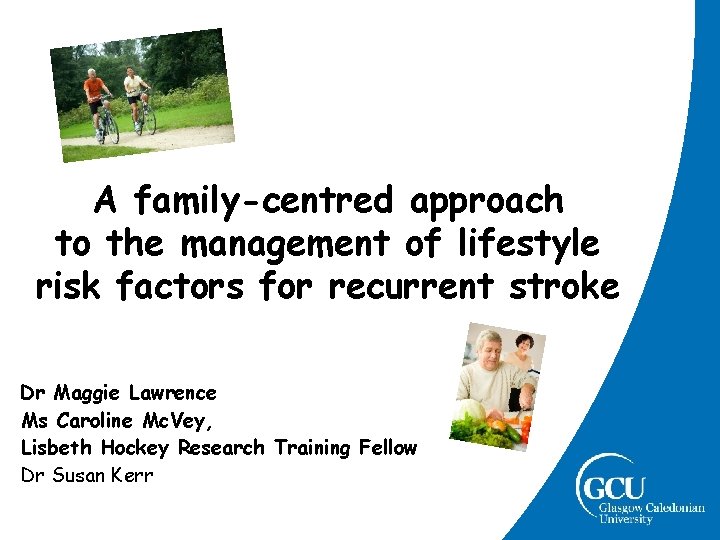
A family-centred approach to the management of lifestyle risk factors for recurrent stroke Dr Maggie Lawrence Ms Caroline Mc. Vey, Lisbeth Hockey Research Training Fellow Dr Susan Kerr
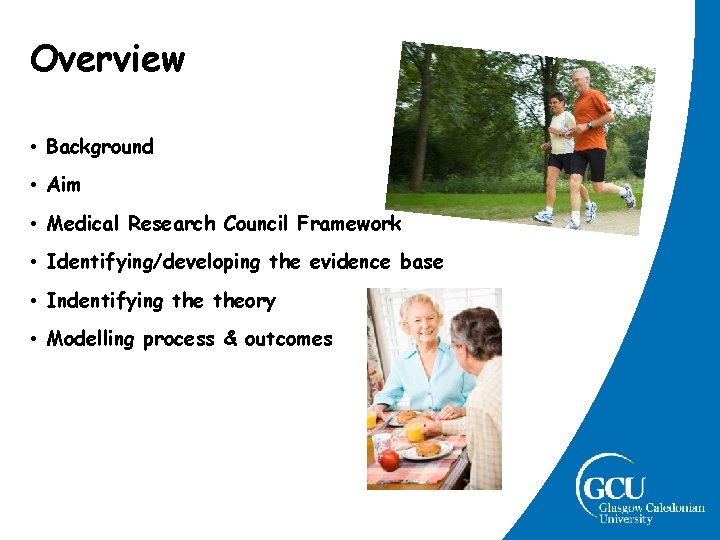
Overview • Background • Aim • Medical Research Council Framework • Identifying/developing the evidence base • Indentifying theory • Modelling process & outcomes
Background • Stroke incidence: 111, 000 first ever strokes annually in the UK • Recurrence: 25% within 5 years • increased level of disability, need for long-term care • death • Risk factors • transient ischaemic attack (TIA), age • tobacco use, excessive alcohol consumption, unhealthy diet, physical inactivity
Aim To develop a community-based, nurse-coordinated, family-centred behavioural intervention
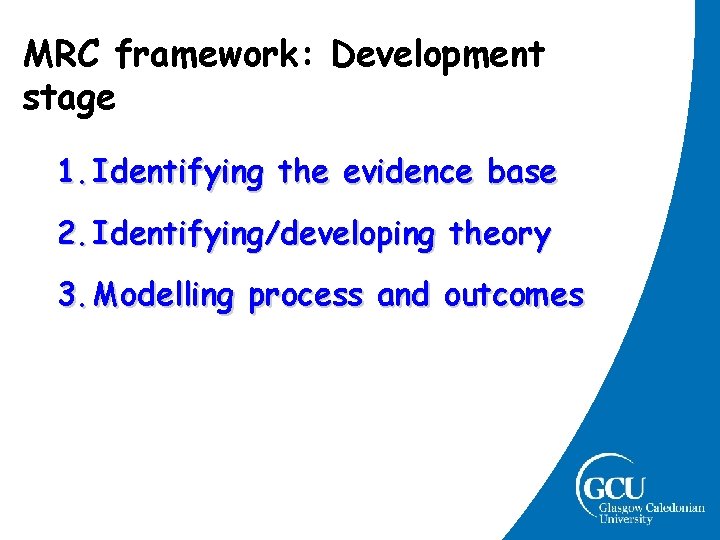
Medical Research Council Framework Development stage 1. Identifying/developing the evidence base 2. Identifying/developing theory 3. Modelling process and outcomes
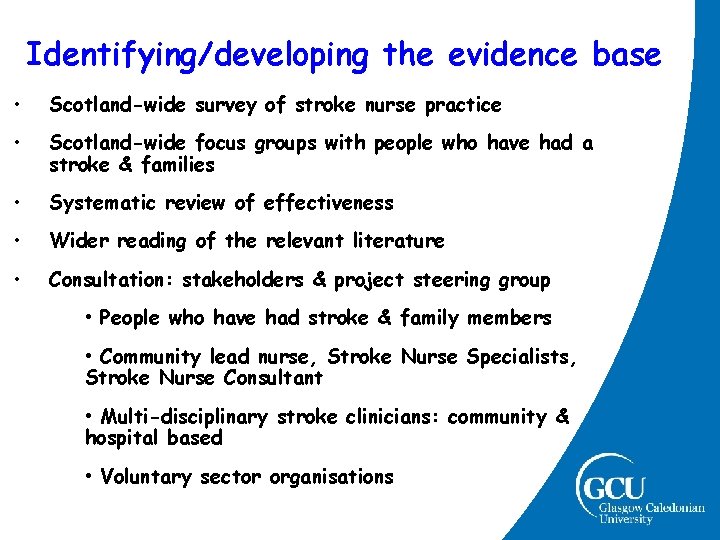
Identifying/developing the evidence base • Scotland-wide survey of stroke nurse practice • Scotland-wide focus groups with people who have had a stroke & families • Systematic review of effectiveness • Wider reading of the relevant literature • Consultation: stakeholders & project steering group • People who have had stroke & family members • Community lead nurse, Stroke Nurse Specialists, Stroke Nurse Consultant • Multi-disciplinary stroke clinicians: community & hospital based • Voluntary sector organisations
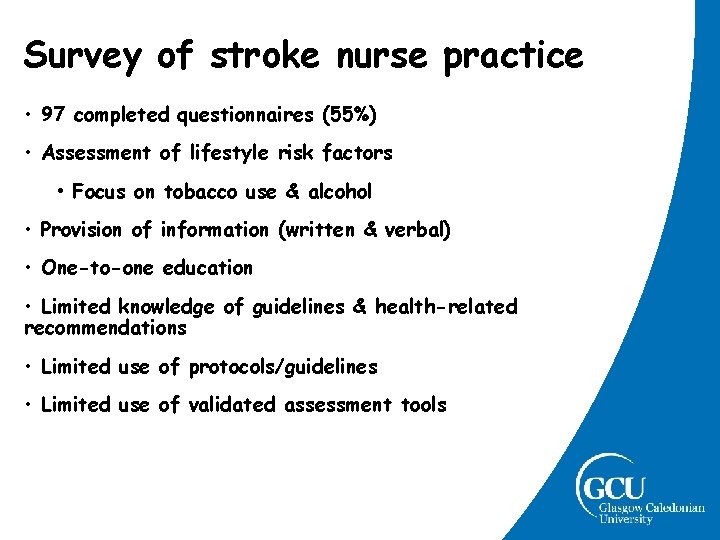
Survey of stroke nurse practice • 97 completed questionnaires (55%) • Assessment of lifestyle risk factors • Focus on tobacco use & alcohol • Provision of information (written & verbal) • One-to-one education • Limited knowledge of guidelines & health-related recommendations • Limited use of protocols/guidelines • Limited use of validated assessment tools
Focus groups: to identify & explore factors that support or hinder lifestyle change • Members of groups run by voluntary sector organisations • 29 people who have had a stroke, including 7 with aphasia & 20 family members • Little or no information; lack of easy-access formats; family members felt excluded • Effects of stroke may be barriers e. g. fatigue, impaired mobility, depression • Confusing/contradictory health promotion messages • Influence of family members • facilitate • hinder
Systematic review To assess effectiveness of previously evaluated secondary prevention lifestyle interventions which addressed one or more lifestyle risk factors for recurrent stroke
Systematic review: results • 3 papers • Shared care – hospital & GP • Nurse-led community-based • Nurse-led clinic-based • Group work; one-to-one • Medication compliance + at least one lifestyle behaviour • Little significant effect in terms of behaviour change • Lack of theoretical underpinning (self-care model, 1 paper) • Short-term interventions • Lack of overt family involvement
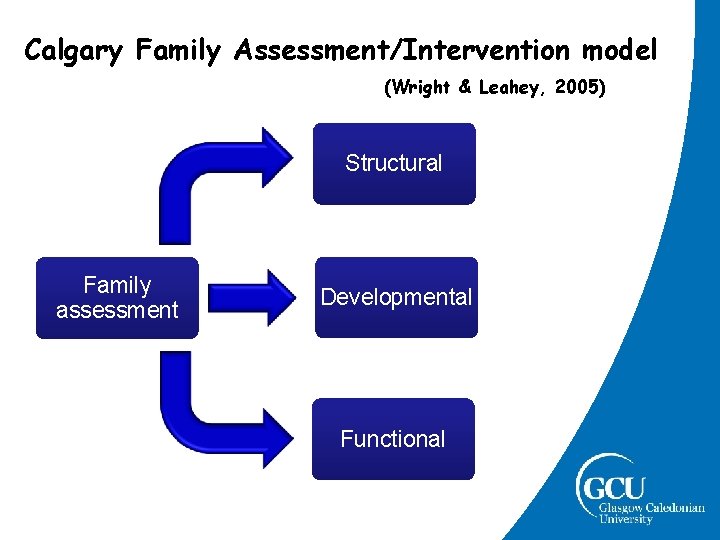
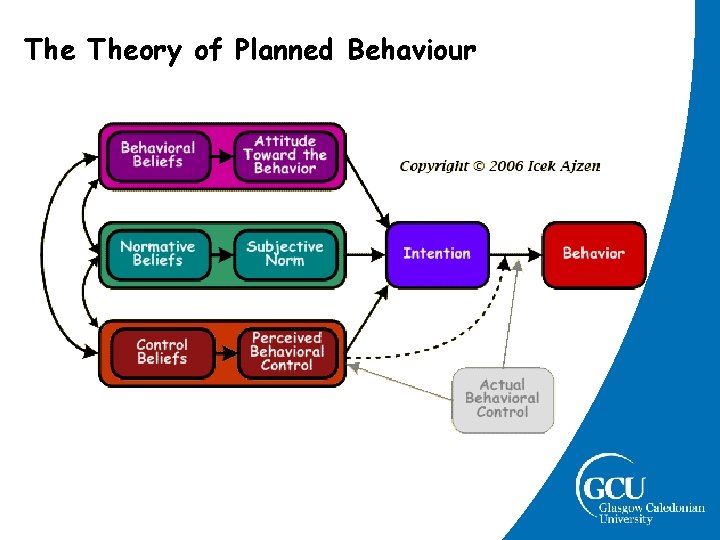
Identifying/developing theory • Calgary Family Assessment/Intervention model (Wright & Leahey, 2005) • Structural • Developmental • Functional • Theory of Planned Behaviour (Ajzen, 1991) • Attitudes • Subjective norms • Perceived behavioural control
Calgary Family Assessment/Intervention model (Wright & Leahey, 2005) Structural Family assessment Developmental Functional
The Theory of Planned Behaviour
MRC framework: Development stage 1. Identifying the evidence base 2. Identifying/developing theory 3. Modelling process and outcomes
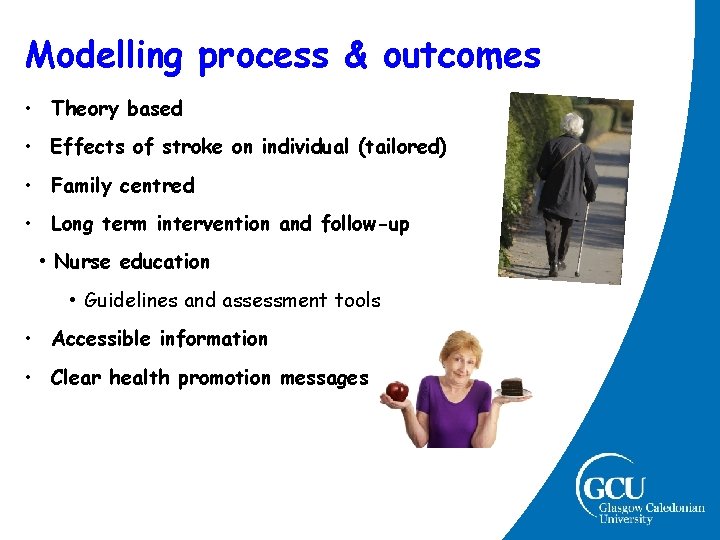
Modelling process & outcomes • Theory based • Effects of stroke on individual (tailored) • Family centred • Long term intervention and follow-up • Nurse education • Guidelines and assessment tools • Accessible information • Clear health promotion messages
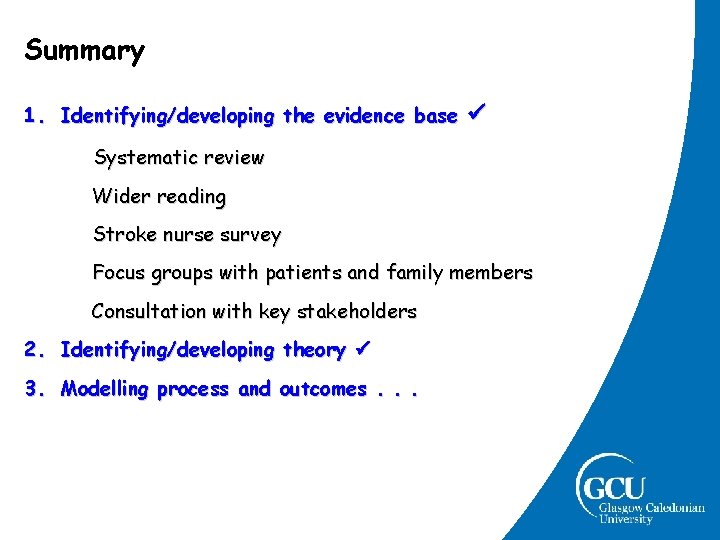
Summary 1. Identifying/developing the evidence base Systematic review Wider reading Stroke nurse survey Focus groups with patients and family members Consultation with key stakeholders 2. Identifying/developing theory 3. Modelling process and outcomes. . .
References Ajzen, I. (1991) The theory of planned behaviour. Organizational Behaviour and Human Decision Processes; 50: 179 -211. Lawrence, M. et al (2010) What is the evidence for using family based interventions to prevent stroke recurrence? Nursing Times; 106: 22 -25. Lawrence, M. et al (2009) A systematic review of the effectiveness of secondary prevention lifestyle interventions designed to change lifestyle behaviour following stroke. [peer reviewed protocol] Available from: http: //www. joannabriggs. edu. au/protocols/Protocol 298. pdf Lawrence, M. et al (2009) A summary of the guidance relating to four lifestyle risk factors for recurrent stroke: tobacco use, alcohol consumption, diet and physical activity. British Journal of Neuroscience Nursing (BJNN); 5: 471 -476. Lawrence, M. et al (2009) A survey of stroke nurses’ knowledge and practice regarding four secondary prevention lifestyle issues: Tobacco use, alcohol consumption, diet and physical activity. BJNN; 5: 518 -523. Wright, L. M. , Leahey, M. (2005) Nurses and families. 4 th ed. Philadelphia: F. A. Davis Company.
Tobacco and alcohol use in people who have a learning disability: giving voice to their health promotion needs Mr Alan Middleton Ms Lorna Fitzsimmons Dr Maggie Lawrence Dr Susan Kerr Dr Chris Darbyshire
Overview • Background • Aim • Medical Research Council Framework • Identifying the evidence base • Developing interventions
Background • Health needs of people with Learning Disabilities (NHS Health Scotland, 2004) • Lifestyles of people with Learning Disabilities • Prevalence of smoking and drinking in people with Learning Disabilities • Current evidence regarding Health Promotion interventions
Aim To develop evidence-based tobacco and alcohol-related interventions
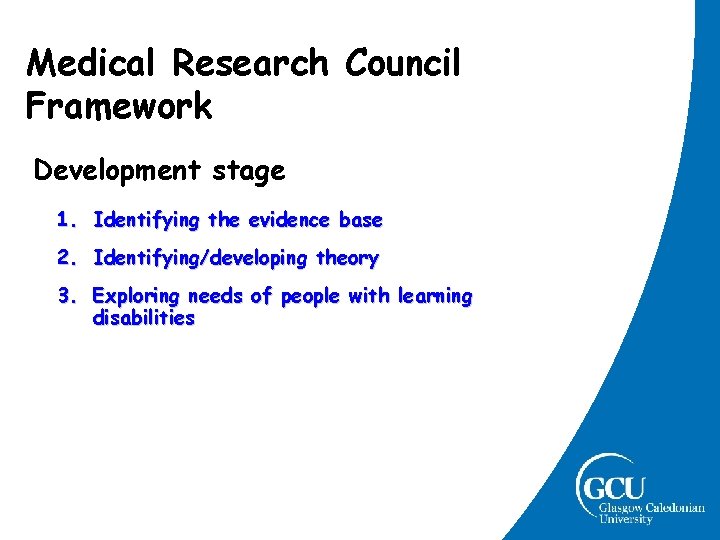
Medical Research Council Framework Development stage 1. Identifying the evidence base 2. Identifying/developing theory 3. Exploring needs of people with learning disabilities
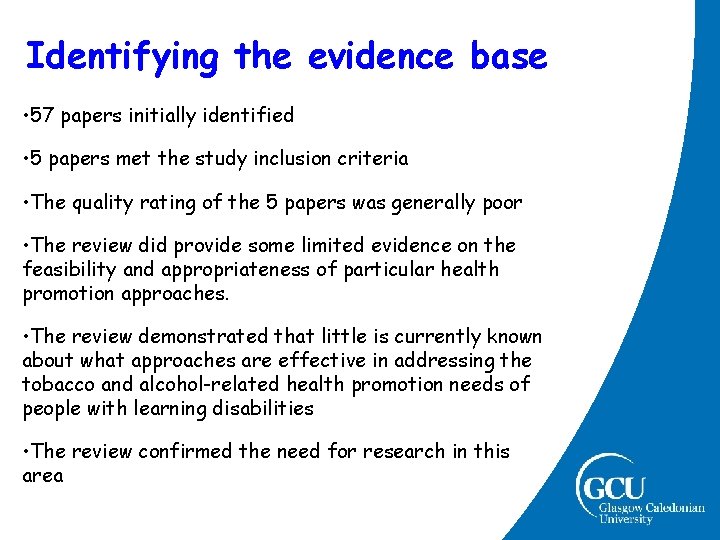
Identifying the evidence base • 57 papers initially identified • 5 papers met the study inclusion criteria • The quality rating of the 5 papers was generally poor • The review did provide some limited evidence on the feasibility and appropriateness of particular health promotion approaches. • The review demonstrated that little is currently known about what approaches are effective in addressing the tobacco and alcohol-related health promotion needs of people with learning disabilities • The review confirmed the need for research in this area
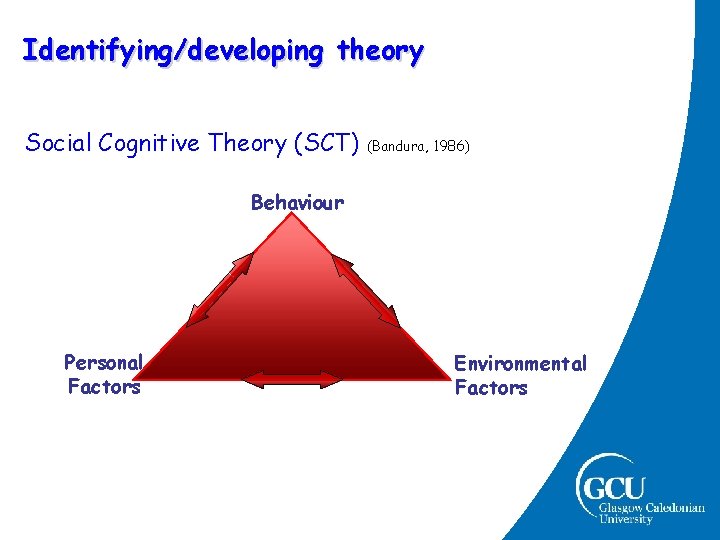
Identifying/developing theory Social Cognitive Theory (SCT) (Bandura, 1986) Behaviour Personal Factors Environmental Factors
Exploring needs of people with learning disabilities Aim: To explore the tobacco and alcohol-related health promotion needs of people with mild/moderate learning disabilities Focus on: – factors that influence the use of tobacco and alcohol in this client group – knowledge and understanding of the health risks associated with smoking and alcohol – their health promotion needs – appropriate health promotion approaches (including resources)
Exploring needs of people with learning disabilities Qualitative study – who took part? – Participants » people with LD (n=16) » carers (n=2) » professionals in community and primary care (n=15) – how did we collect the data? – Focus groups (with people with learning disabilities) – Telephone interviews (with professionals and carers) – how did we analyse the data? – Thematic analysis
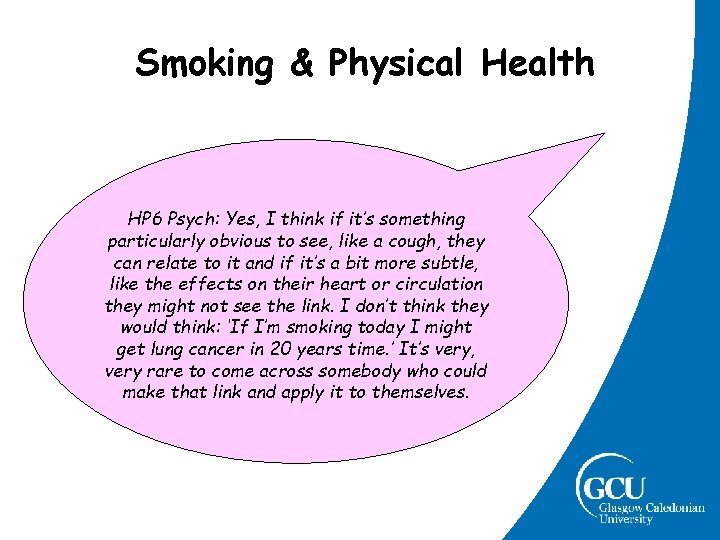
Smoking & Physical Health HP 6 Psych: Yes, I think if it’s something particularly obvious to see, like a cough, they can relate to it and if it’s a bit more subtle, like the effects on their heart or circulation they might not see the link. I don’t think they would think: ‘If I’m smoking today I might get lung cancer in 20 years time. ’ It’s very, very rare to come across somebody who could make that link and apply it to themselves.
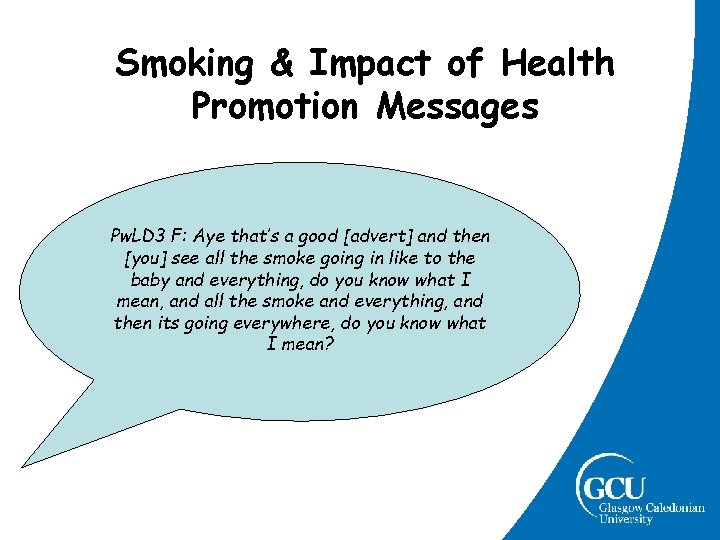
Smoking & Impact of Health Promotion Messages Pw. LD 3 F: Aye that’s a good [advert] and then [you] see all the smoke going in like to the baby and everything, do you know what I mean, and all the smoke and everything, and then its going everywhere, do you know what I mean?
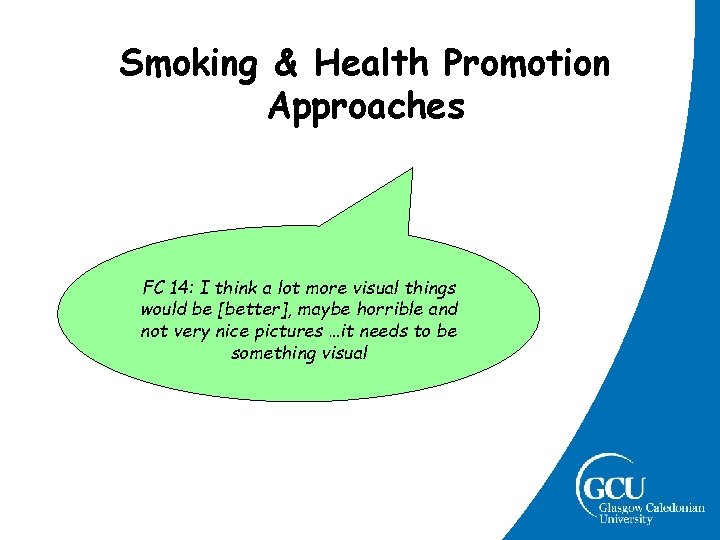
Smoking & Health Promotion Approaches FC 14: I think a lot more visual things would be [better], maybe horrible and not very nice pictures …it needs to be something visual
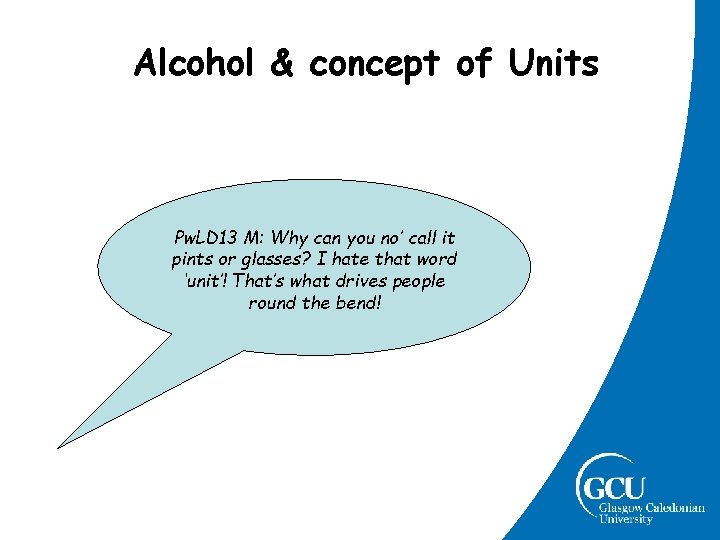
Alcohol & concept of Units Pw. LD 13 M: Why can you no’ call it pints or glasses? I hate that word ‘unit’! That’s what drives people round the bend!
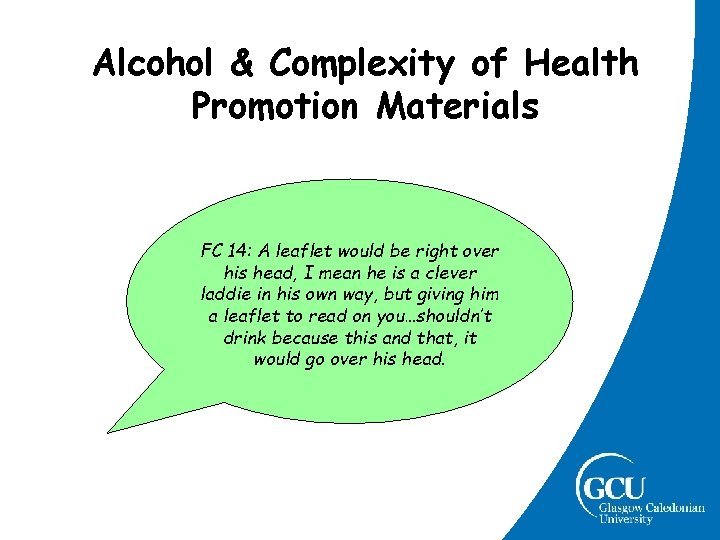
Alcohol & Complexity of Health Promotion Materials FC 14: A leaflet would be right over his head, I mean he is a clever laddie in his own way, but giving him a leaflet to read on you…shouldn’t drink because this and that, it would go over his head.
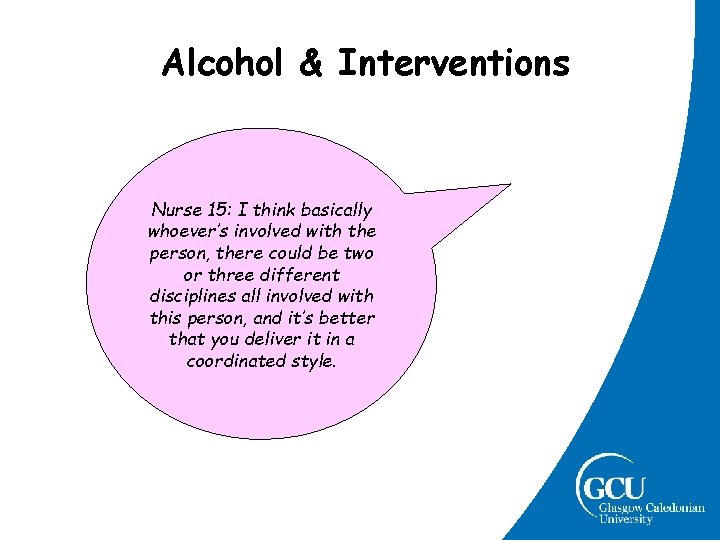
Alcohol & Interventions Nurse 15: I think basically whoever’s involved with the person, there could be two or three different disciplines all involved with this person, and it’s better that you deliver it in a coordinated style.
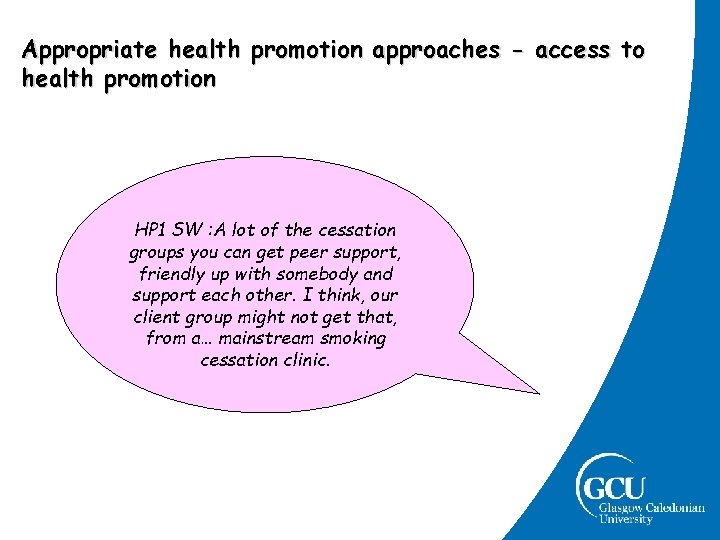
Appropriate health promotion approaches - access to health promotion HP 1 SW : A lot of the cessation groups you can get peer support, friendly up with somebody and support each other. I think, our client group might not get that, from a… mainstream smoking cessation clinic.
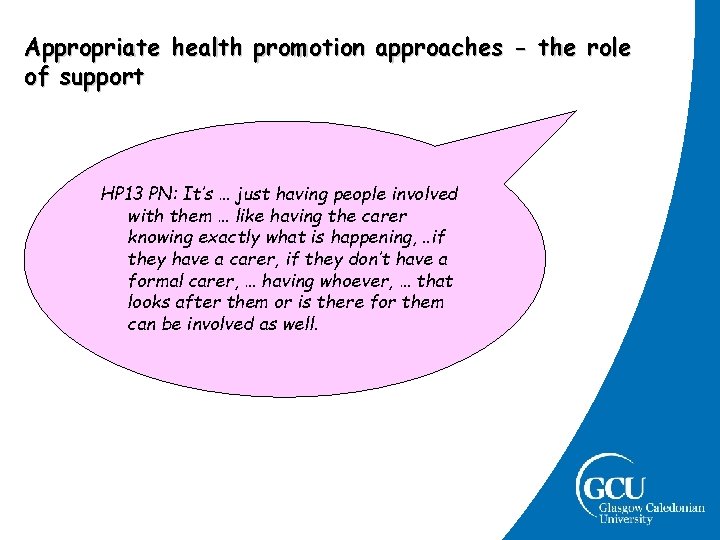
Appropriate health promotion approaches - the role of support HP 13 PN: It’s … just having people involved with them … like having the carer knowing exactly what is happening, . . if they have a carer, if they don’t have a formal carer, … having whoever, … that looks after them or is there for them can be involved as well.
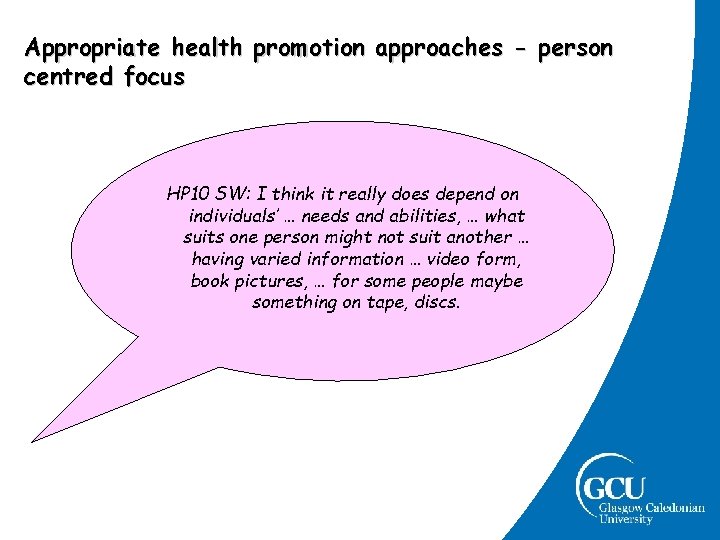
Appropriate health promotion approaches - person centred focus HP 10 SW: I think it really does depend on individuals’ … needs and abilities, … what suits one person might not suit another … having varied information … video form, book pictures, … for some people maybe something on tape, discs.
Modelling process & outcomes • Developing Interventions • Flexibility and tailoring of intervention – multiple users – multiple outcomes – adaptable ‘person centred’ • Developing in partnership
References • NHS Health Scotland, 2004. Health Needs Assessment Report. People with Learning Disabilities in Scotland. NHS Scotland: Glasgow. • Bandura, A. , 1986. Social foundations of thought and action. A social cognitive theory. Prentice Hall: Englewood Cliffs
Developing and testing smoking cessation support for people with severe and enduring mental health problems Dr Susan Kerr (PI), Prof. Robert Hunter, Dr Christina Knussen, Prof. Kate Davidson, Prof. John Norrie, Prof. Andrew Briggs, Prof. Hazel Watson, Prof. Robin Mc. Creadie, Dr Murray Lough, Dr Barry Gibson-Smith, Ms Charlotte Woods
Funding Bodies (developmental study)
Overview Ø Background Ø Developmental stage • Identifying the evidence-base • Identifying/developing theory (including primary research) • Modelling process and outcomes Ø Assessing feasibility and piloting methods
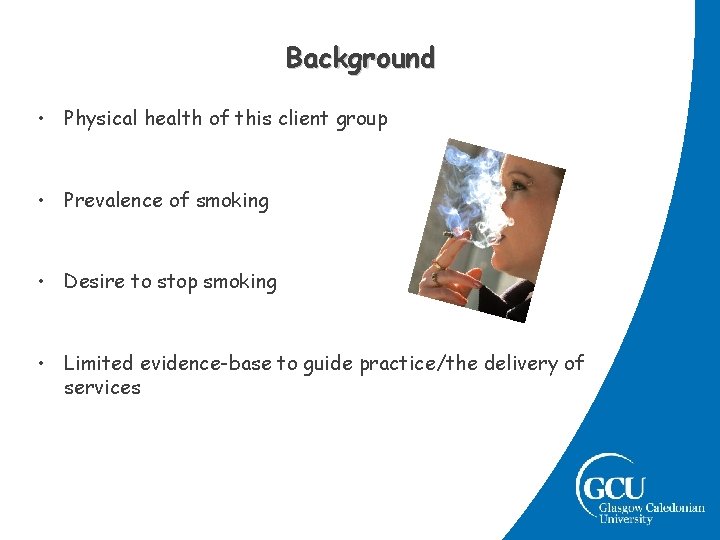
Background • Physical health of this client group • Prevalence of smoking • Desire to stop smoking • Limited evidence-base to guide practice/the delivery of services
Developmental Stage ØIdentifying the evidence base • Systematic reviews of the literature x 2; El-Guabaly et al (2002); Samele et al (2006) • Interventions – generally combined behavioural interventions + pharmacotherapy (e. g. nicotine replacement therapy) • Limited evidence to guide practice as the majority of the studies undertaken, to date, have lacked methodological rigour
Developmental Stage (contd. ) Identifying/developing theory/gathering evidence ØTheoretical understandings of behaviour/behaviour change • Social cognitive theory (Bandura 1986) ØPrimary research with key stakeholders • Setting: 3 NHS Boards in Scotland • Sample: people with moderate/severe mental health problems (n=27); health and social care professionals (n=60) • Data collection: audio-recorded individual interviews + focus group interviews ØInvolvement of other stakeholders • • • Service users’ groups Smoking cessation co-ordinators ASH Scotland NHS Health Scotland Public health pharmacist
Findings - Research with key stakeholders Barriers ØHigh level of physical + psychological dependence on nicotine ØSmoking used as an emotional coping resource ØSmoking used as a form of self-medication ØLow levels of self-efficacy ØFluctuating levels of motivation (often low) ØConcern about the negative impact on mental health if stop smoking ØSmoking habits of family + friends + professionals ØPrevious failed smoking cessation attempts ØLack of appropriate intensive behavioural support ØKnowledge, attitudes + skills of professionals
Research with key stakeholders (contd. ) Potential facilitators ØConcerns about health ØConcern about the price of tobacco (use of loose + illicit tobacco common) ØSuccessful cessation attempts in ‘significant’ others, including professionals
Modelling process and outcomes ØDevelopment of the intervention/s • • • What should the various components be? How will the intervention be delivered? Where will the intervention be delivered? Who will deliver the intervention? How long will the intervention last? ØWhat methodological approach is most appropriate? ØHow do we plan to recruit participants? ØOutcomes • What primary outcomes are we interested in? • What about secondary outcomes? • What processes will we explore?
Assessing feasibility + piloting methods Study design Ømixed methods • randomised controlled trial (exploratory) • qualitative interviews Setting + sample Ø 3 NHS Boards (Scotland) Ø 60 participants (ICD 10 criteria) Ørandom allocation to 1 of 3 groups Intervention groups (x 2) ØCognitive behavioural therapy + nicotine replacement therapy ØCognitive behavioural therapy + motivational interviewing + nicotine replacement therapy Control (x 1) ØNHS Stop Smoking Service
Assessing feasibility + piloting methods (contd. ) Primary outcome measures Øexpired carbon monoxide Øsalivary cotinine (baseline) Secondary outcome measures Øself-report smoking status Øpsychiatric symptoms Øcognitive functioning Øhealth-related quality of life Qualitative interviews ØSemi-structured telephone interviews (participants) ØSemi-structured face-to-face interviews (professionals who delivered the intervention) Economic evaluation ØCosts + effects per quitter ØCost per Quality Adjusted Life Year (QALY)
Summary Developmental phase ØIdentifying the evidence base ØIdentifying/developing theory • Primary research with key stakeholders ØModelling process and outcomes Feasibility + piloting (proposal submitted)
References Bandura A (1986) Social foundations of thought and action: a social cognitive theory. Prentice Hall, NJ. El-Guebaly N, Cathcart, J, Currie S, Brown D (2002) Smoking cessation support approaches for persons with mental illness or addictive disorders. Psychiatric Services, 53: 1166 -71. Samele C, Hoadley A, Seymour L (2006) A systematic review of the effectiveness of interventions to improve the physical health of people with severe mental health problems. Leeds: Sainsbury Centre for Mental Health.
Symposium Summary Ø Overview of the new MRC Guidance Ø Examples of 3 programmes of research lead by researchers at GCU that are utilising the framework Ø Guidance provides a useful structure for both the development and evaluation of complex healthcare interventions Ø Reference to the Guidance is useful in convincing funding bodies of the importance of developmental + feasibility/pilot work ahead of definitive trials/evaluations
Contact Details Susan Kerr - s. m. kerr@gcu. ac. uk Maggie Lawrence - margaret. lawrence@gcu. ac. uk Alan Middleton – alan. middleton@gcu. ac. uk Caroline Mc. Vey – caroline. mcvey@gcu. ac. uk Lorna Fitzsimmons - lornam. fitzsimmons@nhs. net