
Developing and Communicating Warnings Example of the UK
- Slides: 42
Developing and Communicating Warnings Example of the UK Met Office in delivery of warnings Graeme Forrester, SWFDP, Pretoria, November 2013 © Crown copyright Met Office
In this session… • • • © Crown copyright Met Office Brief Overview of the UK Warning Service Methods of communicating warnings Communicating uncertainty Assessment of Warnings Questions?
The UK National Severe Weather Warning Service (NSWWS) “Legislation supporting the Civil Contingencies Act 2004 states that (emergency) responders must have regard to the Met Office duty to warn the public and provide information and advice if an emergency is likely to occur or has taken place. ” To: The public and civil emergency authorities Why: So that mitigating action can be undertaken to reduce potential impacts. When: Ahead of the possibility of significant disruption to transport and communications, but the main driver is the potential risk to life and property. © Crown copyright Met Office
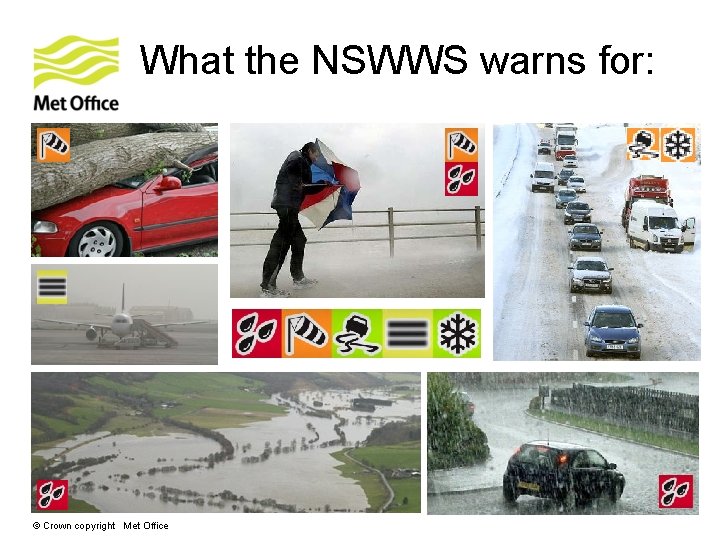
What the NSWWS warns for: © Crown copyright Met Office
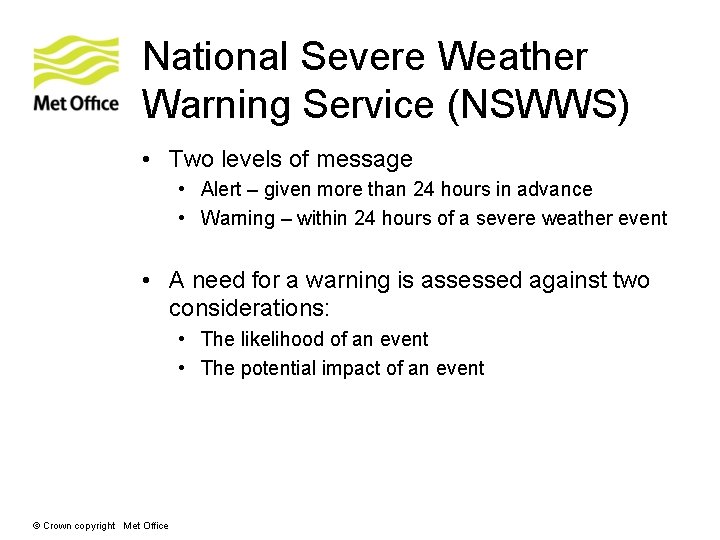
National Severe Weather Warning Service (NSWWS) • Two levels of message • Alert – given more than 24 hours in advance • Warning – within 24 hours of a severe weather event • A need for a warning is assessed against two considerations: • The likelihood of an event • The potential impact of an event © Crown copyright Met Office
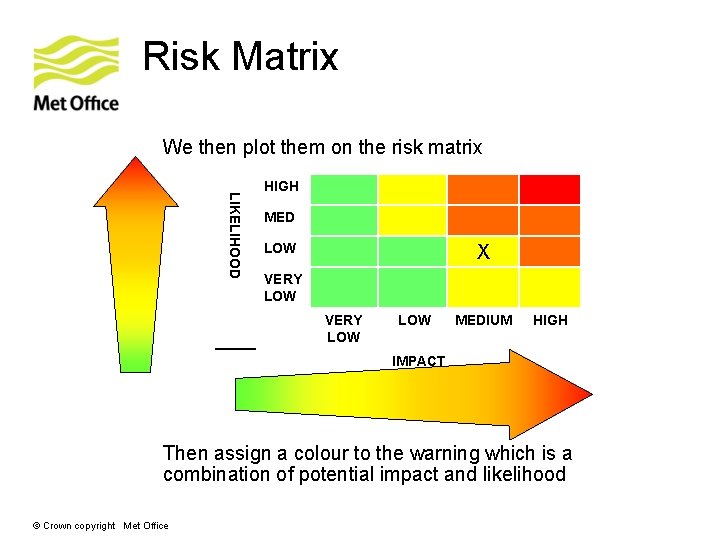
Risk Matrix We then plot them on the risk matrix LIKELIHOOD HIGH MED LOW X VERY LOW LOW MEDIUM HIGH IMPACT Then assign a colour to the warning which is a combination of potential impact and likelihood © Crown copyright Met Office
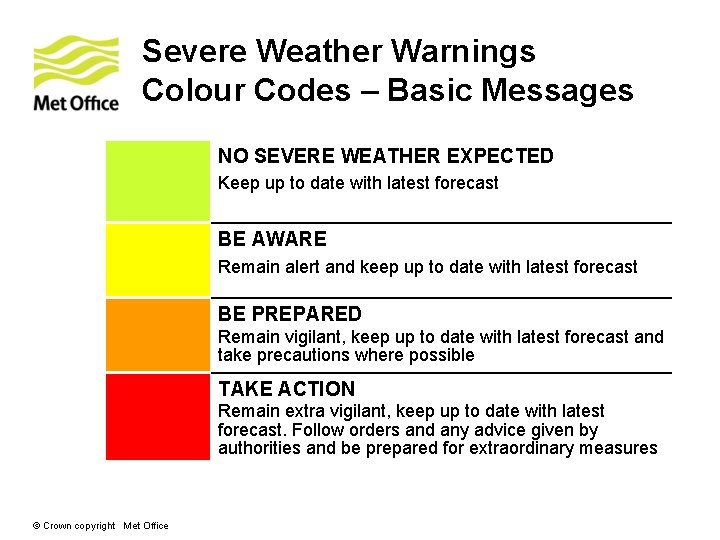
Severe Weather Warnings Colour Codes – Basic Messages NO SEVERE WEATHER EXPECTED Keep up to date with latest forecast BE AWARE Remain alert and keep up to date with latest forecast BE PREPARED Remain vigilant, keep up to date with latest forecast and take precautions where possible TAKE ACTION Remain extra vigilant, keep up to date with latest forecast. Follow orders and any advice given by authorities and be prepared for extraordinary measures © Crown copyright Met Office
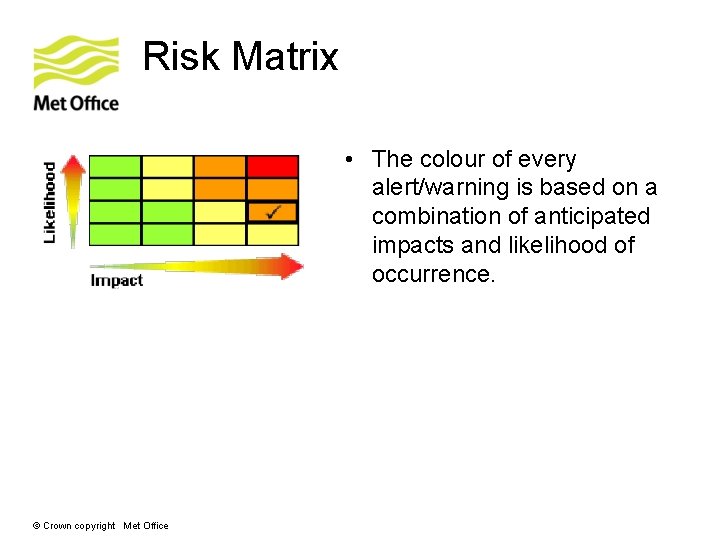
Risk Matrix • The colour of every alert/warning is based on a combination of anticipated impacts and likelihood of occurrence. © Crown copyright Met Office
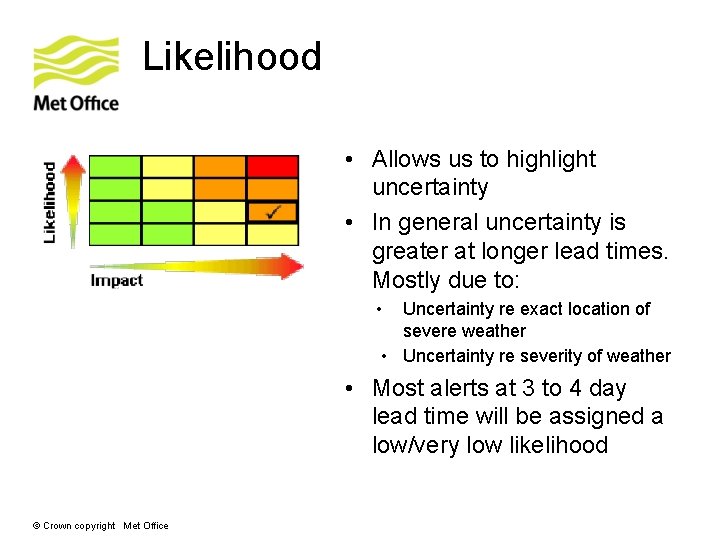
Likelihood • Allows us to highlight uncertainty • In general uncertainty is greater at longer lead times. Mostly due to: • Uncertainty re exact location of severe weather • Uncertainty re severity of weather • Most alerts at 3 to 4 day lead time will be assigned a low/very low likelihood © Crown copyright Met Office
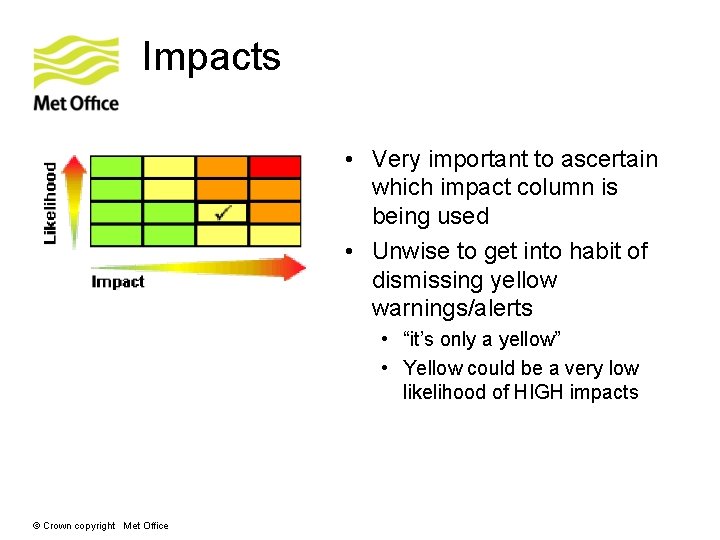
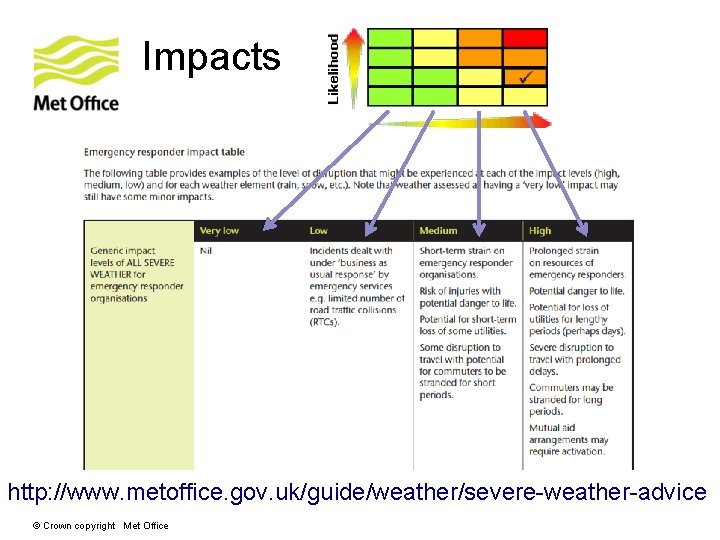
Impacts • Very important to ascertain which impact column is being used • Unwise to get into habit of dismissing yellow warnings/alerts • “it’s only a yellow” • Yellow could be a very low likelihood of HIGH impacts © Crown copyright Met Office
Impacts http: //www. metoffice. gov. uk/guide/weather/severe-weather-advice © Crown copyright Met Office
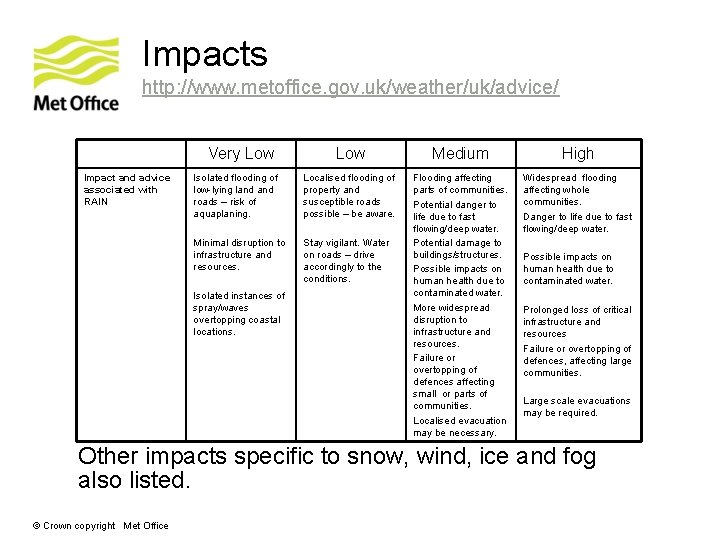
Impacts http: //www. metoffice. gov. uk/weather/uk/advice/ Very Low Impact and advice associated with RAIN Low Medium High Isolated flooding of low-lying land roads – risk of aquaplaning. Localised flooding of property and susceptible roads possible – be aware. Widespread flooding affecting whole communities. Danger to life due to fast flowing/deep water. Minimal disruption to infrastructure and resources. Stay vigilant. Water on roads – drive accordingly to the conditions. Flooding affecting parts of communities. Potential danger to life due to fast flowing/deep water. Potential damage to buildings/structures. Possible impacts on human health due to contaminated water. More widespread disruption to infrastructure and resources. Failure or overtopping of defences affecting small or parts of communities. Localised evacuation may be necessary. Isolated instances of spray/waves overtopping coastal locations. Possible impacts on human health due to contaminated water. Prolonged loss of critical infrastructure and resources Failure or overtopping of defences, affecting large communities. Large scale evacuations may be required. Other impacts specific to snow, wind, ice and fog also listed. © Crown copyright Met Office
Warning text • The text of the warning contains the key information about the weather we’re expecting, as well as giving an indication of some of the likely impacts. • The Chief Forecaster’s Assessment is a space for the Chief to elaborate a little on the expected conditions as well as explain where any uncertainties in the forecast lie. • Text needs to be clear • free of jargon • easy to understand • concise © Crown copyright Met Office
Communicating the Warnings © Crown copyright Met Office
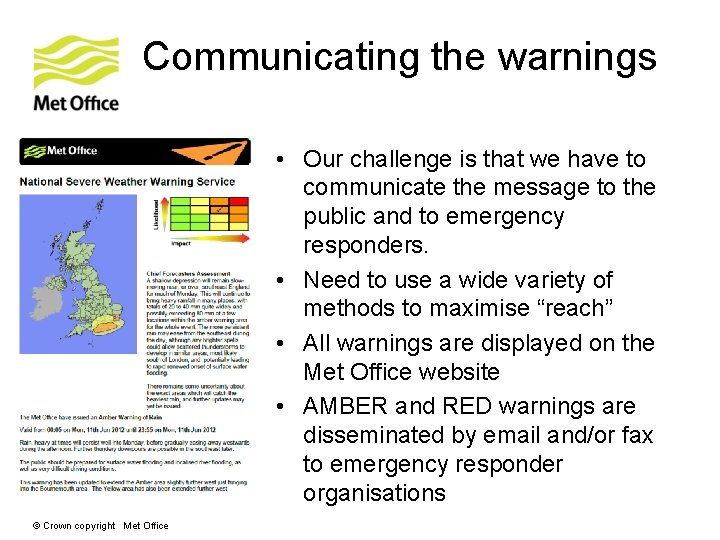
Communicating the warnings • Our challenge is that we have to communicate the message to the public and to emergency responders. • Need to use a wide variety of methods to maximise “reach” • All warnings are displayed on the Met Office website • AMBER and RED warnings are disseminated by email and/or fax to emergency responder organisations © Crown copyright Met Office
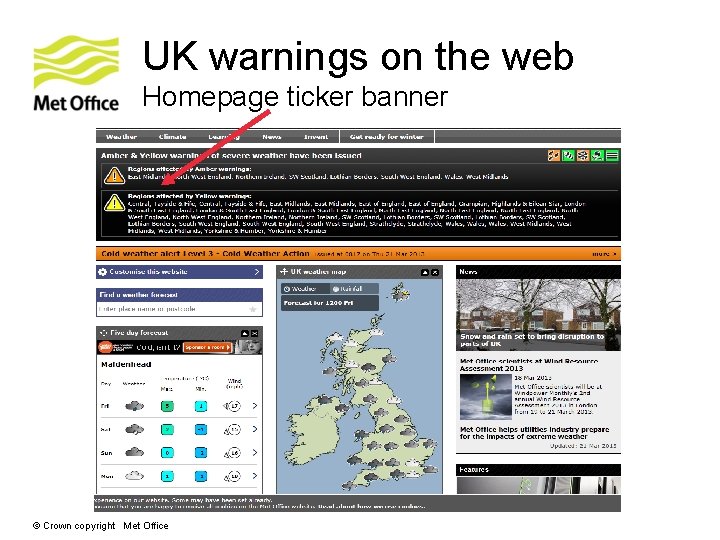
UK warnings on the web Homepage ticker banner © Crown copyright Met Office
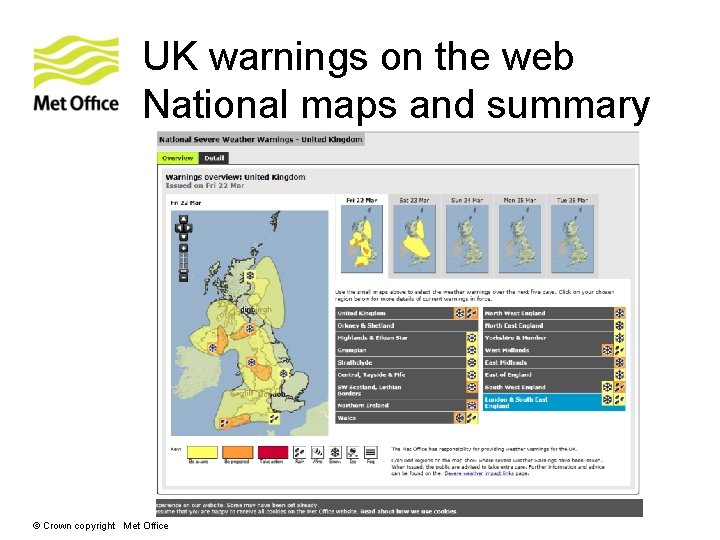
UK warnings on the web National maps and summary © Crown copyright Met Office
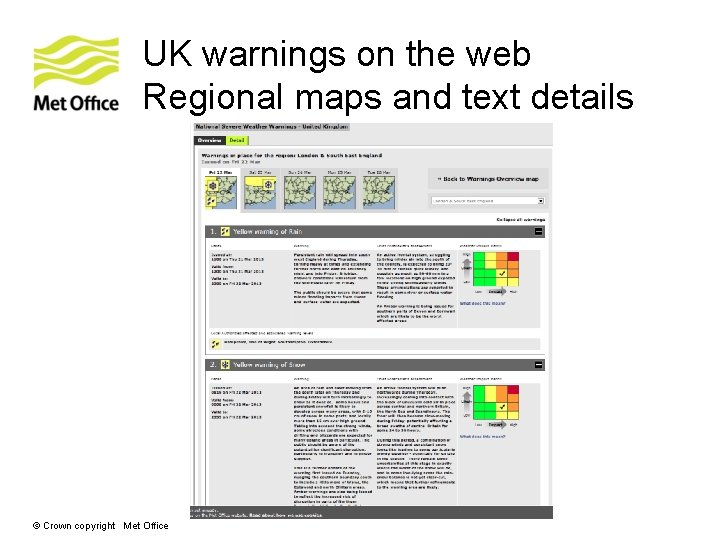
UK warnings on the web Regional maps and text details © Crown copyright Met Office
UK Warnings on the web Challenges • Other weather can be complex with different weather happening in different parts of the country! • Overlapping warning areas or two warnings for different elements (e. g. wind and snow) can look confusing, • We need to try to keep the picture as simple as possible. • But keeping the picture simple, sometimes makes the messaging more difficult! © Crown copyright Met Office
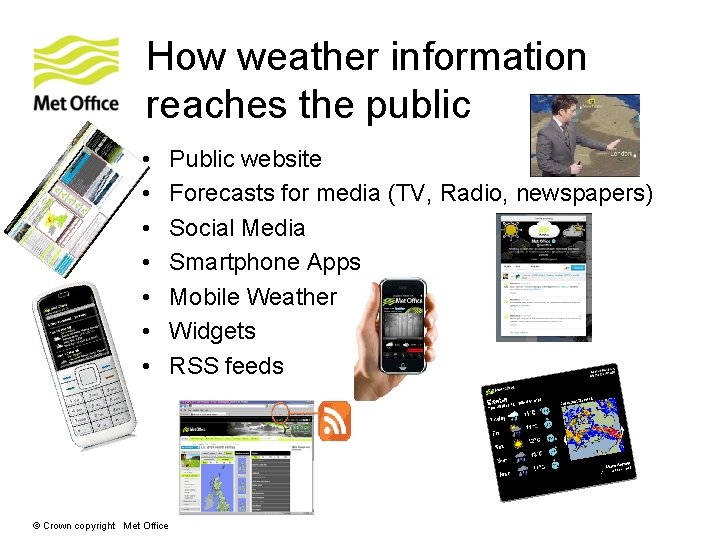
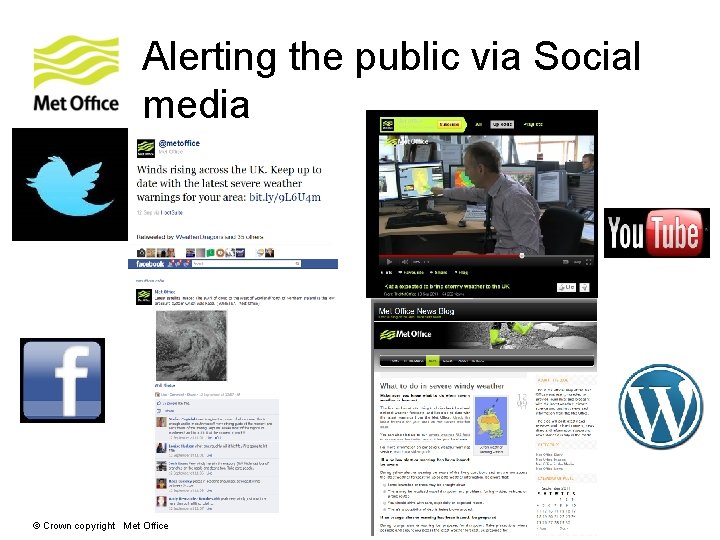
How weather information reaches the public • • © Crown copyright Met Office Public website Forecasts for media (TV, Radio, newspapers) Social Media Smartphone Apps Mobile Weather Widgets RSS feeds
Alerting the public via Social media © Crown copyright Met Office
Communicating Uncertainty © Crown copyright Met Office
Communicating Uncertainty • Interesting discussion started on this yesterday • Maybe we can continue it here! • Forecasts are inherently uncertain. • The challenge • How can we convey that uncertainty without compromising our credibility? • Is the problem different when we are communicating with the civil protection managers to that when we are communicating with the public? © Crown copyright Met Office
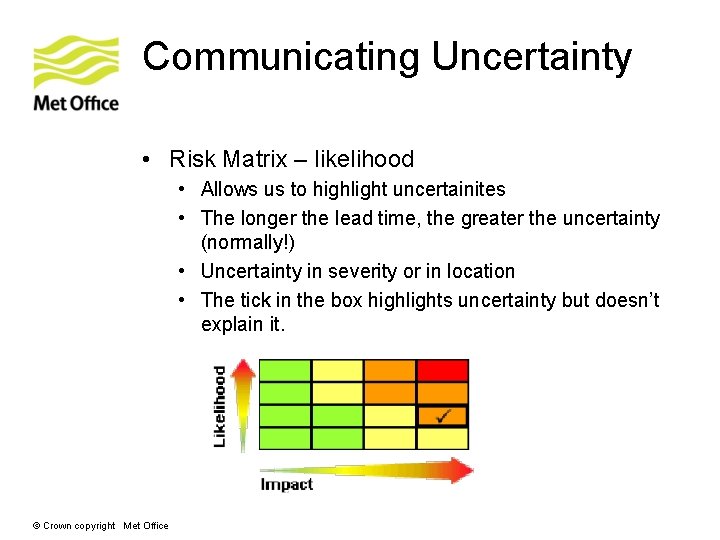
Communicating Uncertainty • Risk Matrix – likelihood • Allows us to highlight uncertainites • The longer the lead time, the greater the uncertainty (normally!) • Uncertainty in severity or in location • The tick in the box highlights uncertainty but doesn’t explain it. © Crown copyright Met Office
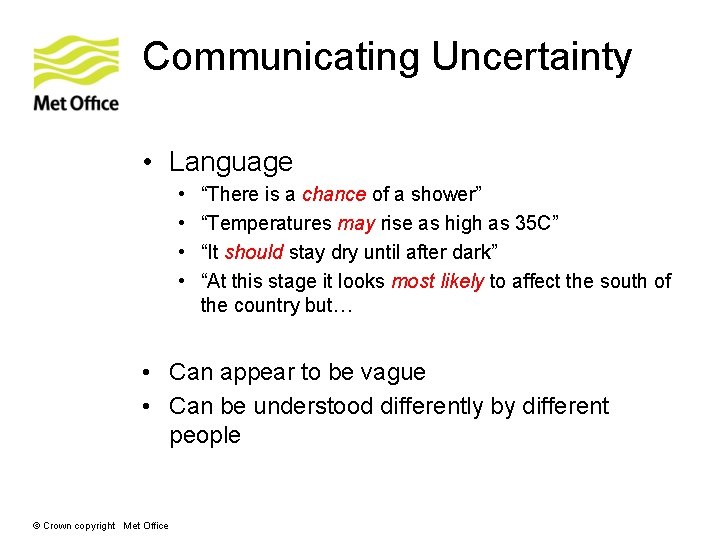
Communicating Uncertainty • Language • • “There is a chance of a shower” “Temperatures may rise as high as 35 C” “It should stay dry until after dark” “At this stage it looks most likely to affect the south of the country but… • Can appear to be vague • Can be understood differently by different people © Crown copyright Met Office
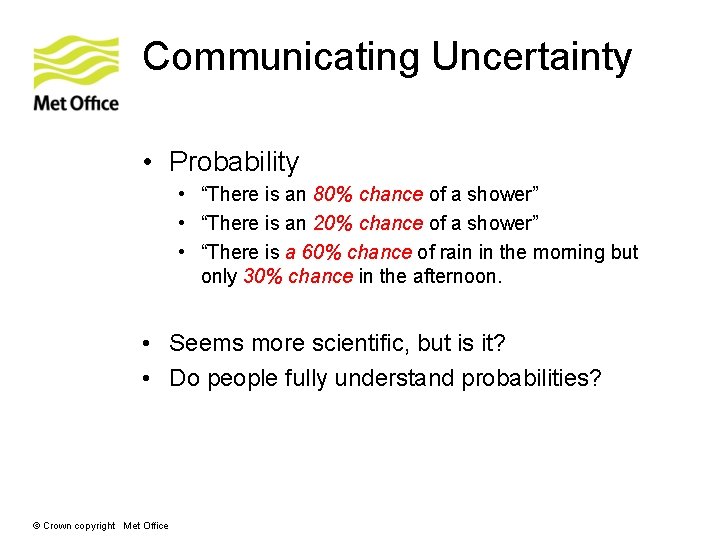
Communicating Uncertainty • Probability • “There is an 80% chance of a shower” • “There is an 20% chance of a shower” • “There is a 60% chance of rain in the morning but only 30% chance in the afternoon. • Seems more scientific, but is it? • Do people fully understand probabilities? © Crown copyright Met Office
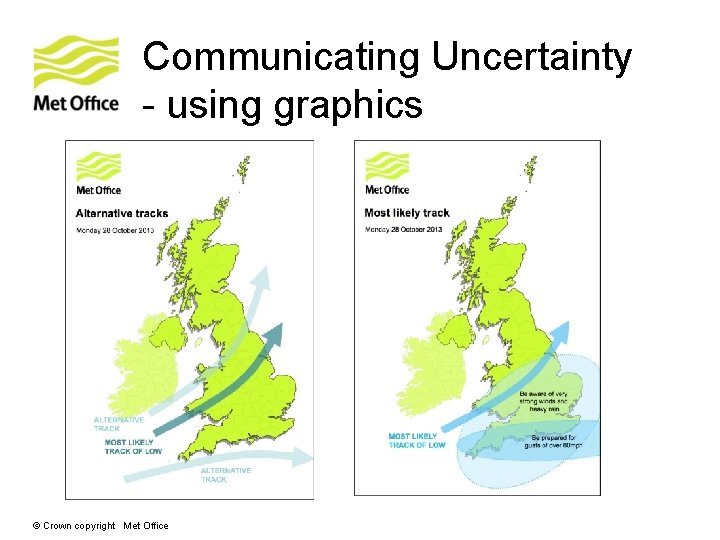
Communicating Uncertainty - using graphics © Crown copyright Met Office
Verifying/Assessing Warnings © Crown copyright Met Office
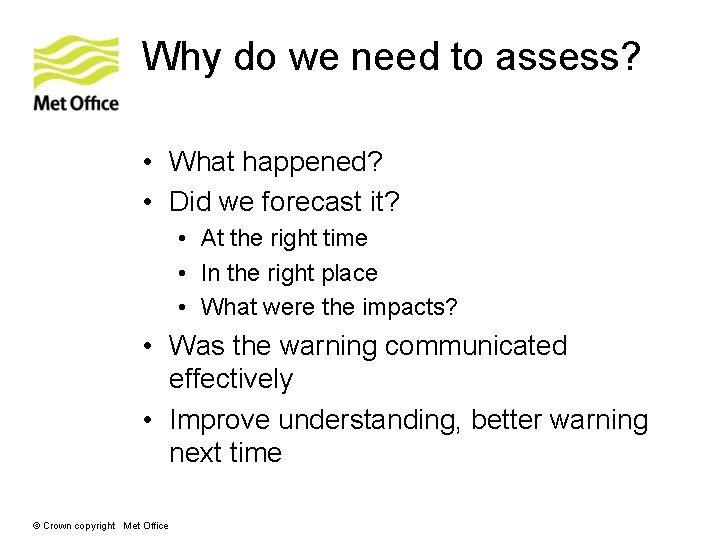
Why do we need to assess? • What happened? • Did we forecast it? • At the right time • In the right place • What were the impacts? • Was the warning communicated effectively • Improve understanding, better warning next time © Crown copyright Met Office
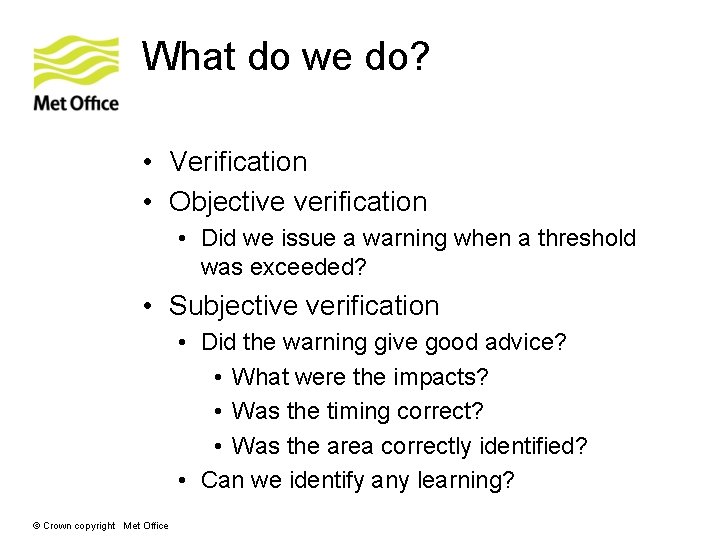
What do we do? • Verification • Objective verification • Did we issue a warning when a threshold was exceeded? • Subjective verification • Did the warning give good advice? • What were the impacts? • Was the timing correct? • Was the area correctly identified? • Can we identify any learning? © Crown copyright Met Office
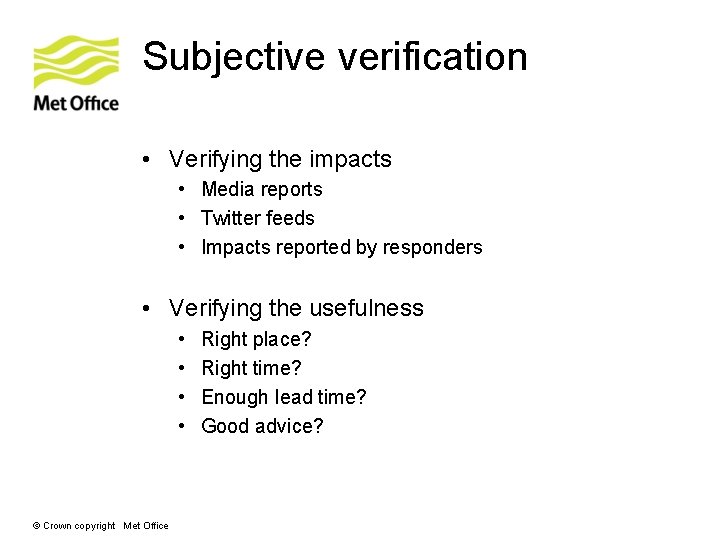
Subjective verification • Verifying the impacts • Media reports • Twitter feeds • Impacts reported by responders • Verifying the usefulness • • © Crown copyright Met Office Right place? Right time? Enough lead time? Good advice?
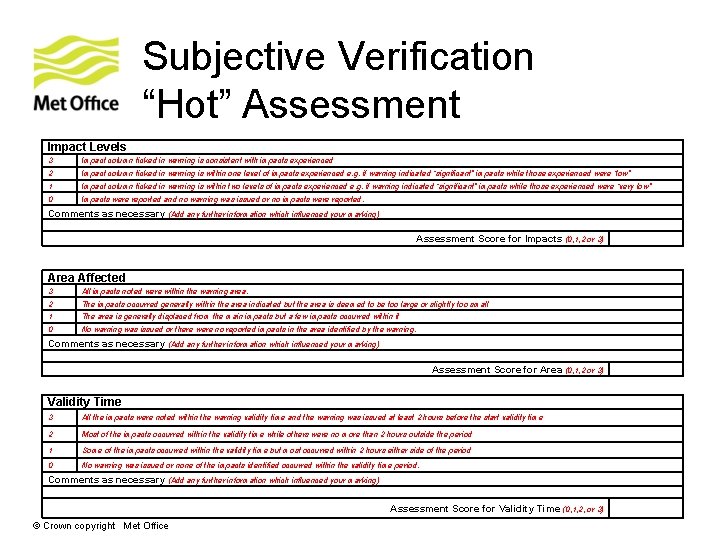
Subjective Verification “Hot” Assessment Impact Levels 3 Impact column ticked in warning is consistent with impacts experienced 2 Impact column ticked in warning is within one level of impacts experienced e. g. if warning indicated “significant” impacts while those experienced were “low” 1 Impact column ticked in warning is within two levels of impacts experienced e. g. if warning indicated “significant” impacts while those experienced were “very low” 0 Impacts were reported and no warning was issued or no impacts were reported. Comments as necessary (Add any further information which influenced your marking) Assessment Score for Impacts (0, 1, 2 or 3) Area Affected 3 All impacts noted were within the warning area. 2 The impacts occurred generally within the area indicated but the area is deemed to be too large or slightly too small 1 The area is generally displaced from the main impacts but a few impacts occurred within it 0 No warning was issued or there were no reported impacts in the area identified by the warning. Comments as necessary (Add any further information which influenced your marking) Assessment Score for Area (0, 1, 2 or 3) Validity Time 3 All the impacts were noted within the warning validity time and the warning was issued at least 2 hours before the start validity time 2 Most of the impacts occurred within the validity time while others were no more than 2 hours outside the period 1 Some of the impacts occurred within the validity time but most occurred within 2 hours either side of the period 0 No warning was issued or none of the impacts identified occurred within the validity time period. Comments as necessary (Add any further information which influenced your marking) Assessment Score for Validity Time (0, 1, 2, or 3) © Crown copyright Met Office
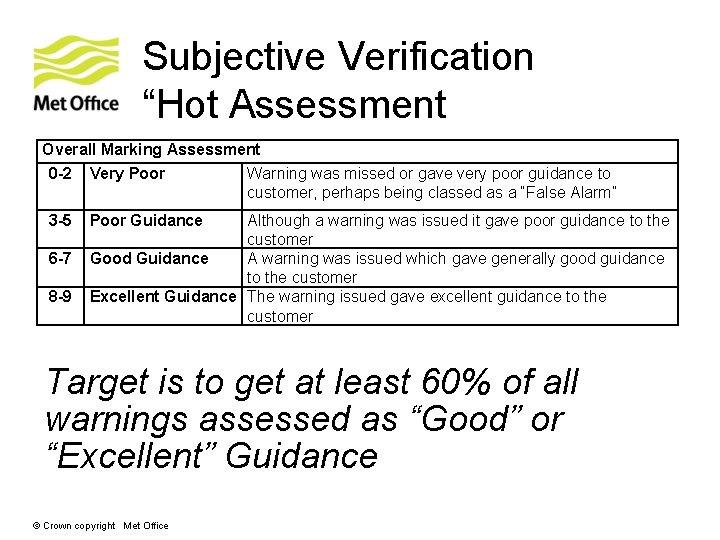
Subjective Verification “Hot Assessment Overall Marking Assessment 0 -2 Very Poor Warning was missed or gave very poor guidance to customer, perhaps being classed as a “False Alarm” 3 -5 6 -7 8 -9 Poor Guidance Although a warning was issued it gave poor guidance to the customer Good Guidance A warning was issued which gave generally good guidance to the customer Excellent Guidance The warning issued gave excellent guidance to the customer Target is to get at least 60% of all warnings assessed as “Good” or “Excellent” Guidance © Crown copyright Met Office
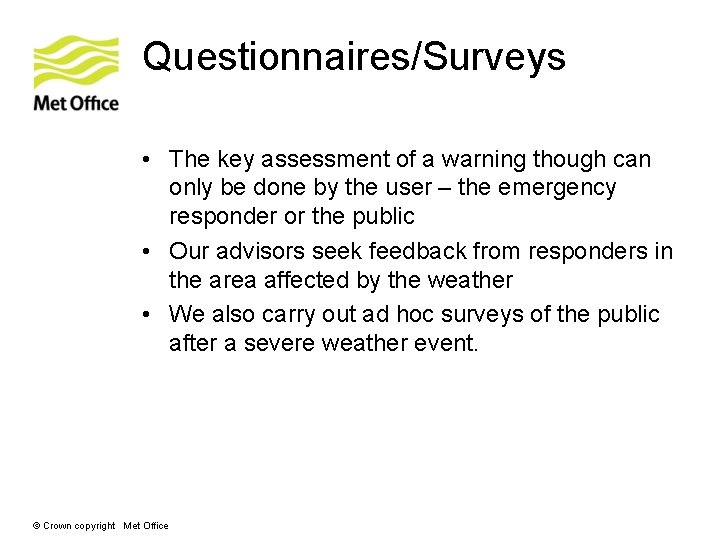
Questionnaires/Surveys • The key assessment of a warning though can only be done by the user – the emergency responder or the public • Our advisors seek feedback from responders in the area affected by the weather • We also carry out ad hoc surveys of the public after a severe weather event. © Crown copyright Met Office
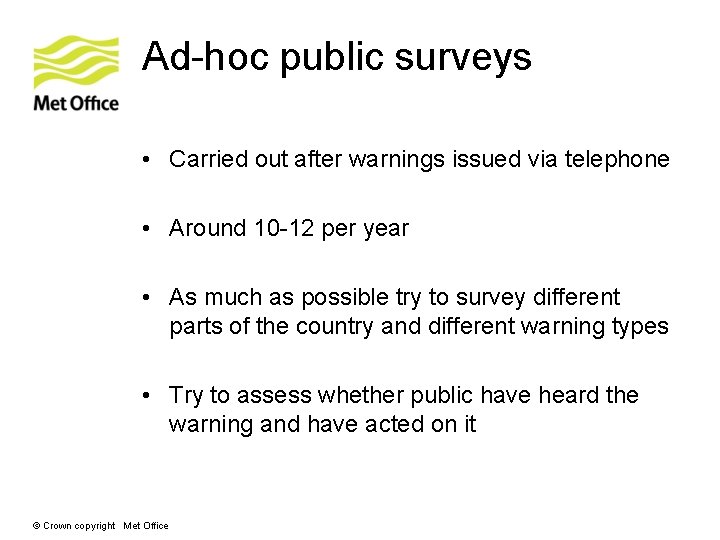
Ad-hoc public surveys • Carried out after warnings issued via telephone • Around 10 -12 per year • As much as possible try to survey different parts of the country and different warning types • Try to assess whether public have heard the warning and have acted on it © Crown copyright Met Office
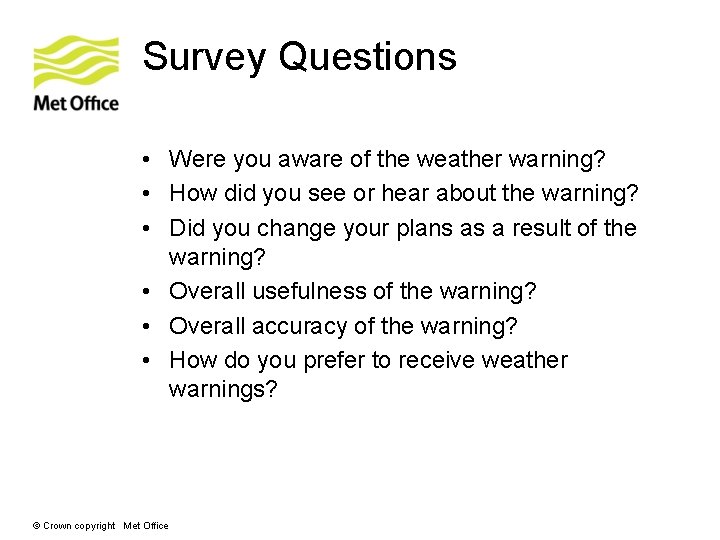
Survey Questions • Were you aware of the weather warning? • How did you see or hear about the warning? • Did you change your plans as a result of the warning? • Overall usefulness of the warning? • Overall accuracy of the warning? • How do you prefer to receive weather warnings? © Crown copyright Met Office
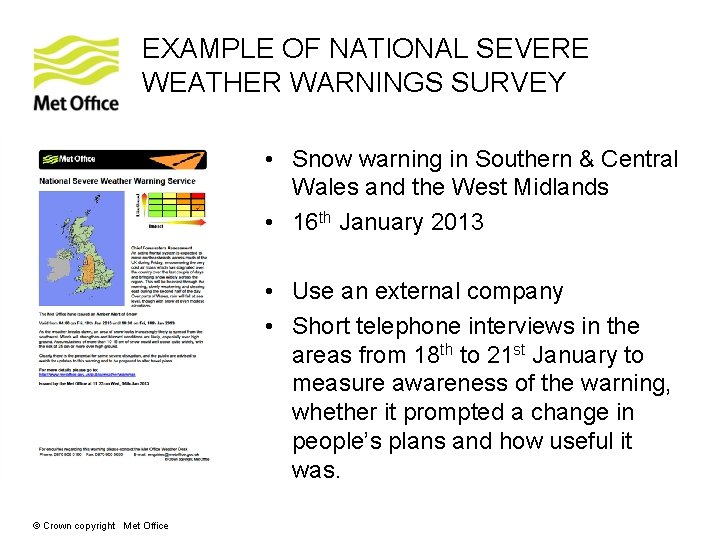
EXAMPLE OF NATIONAL SEVERE WEATHER WARNINGS SURVEY • Snow warning in Southern & Central Wales and the West Midlands • 16 th January 2013 • Use an external company • Short telephone interviews in the areas from 18 th to 21 st January to measure awareness of the warning, whether it prompted a change in people’s plans and how useful it was. © Crown copyright Met Office
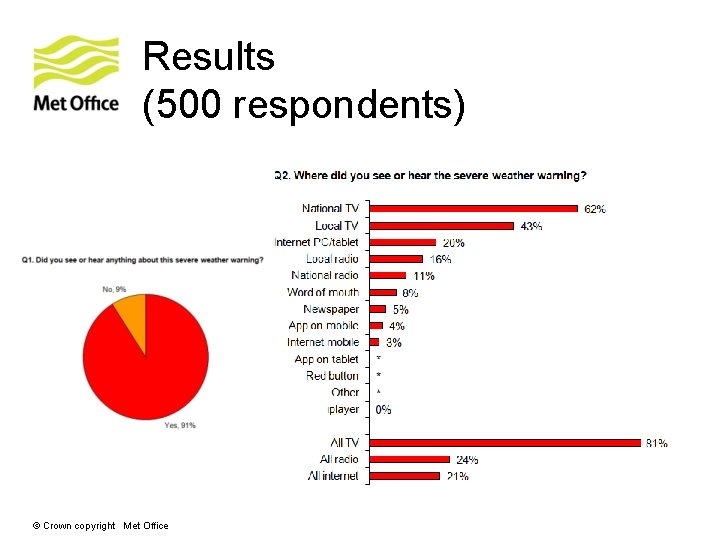
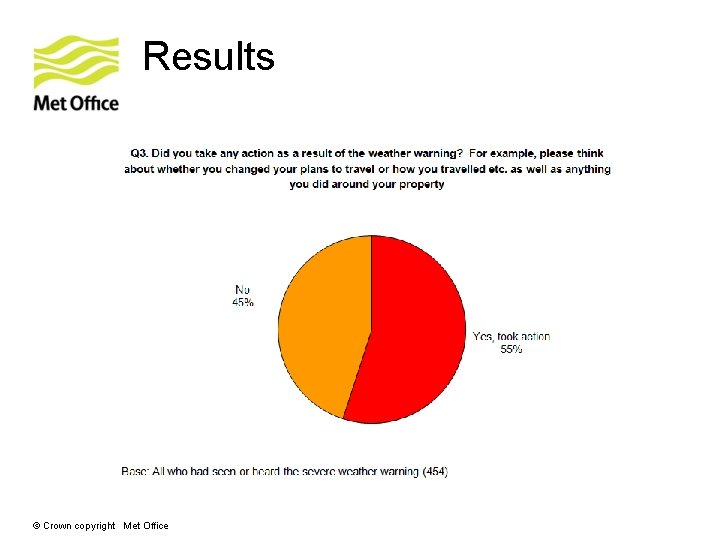
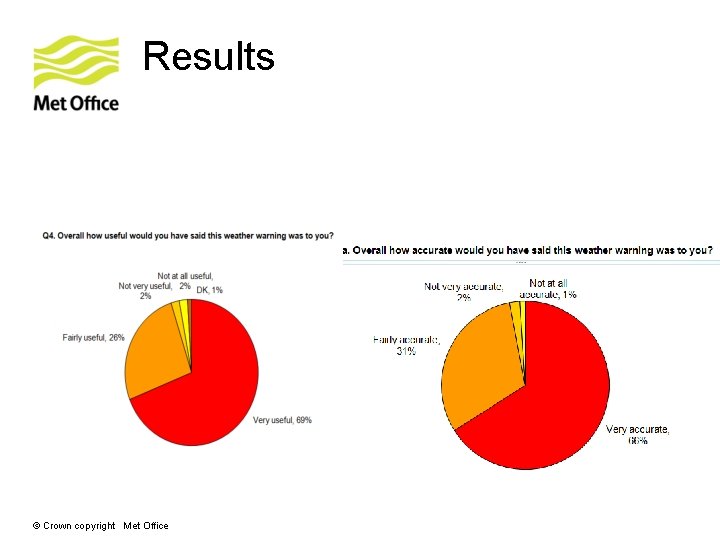
Headlines • 91% of respondants saw or heard the weather warning – mostly via TV bulletins • 55% claimed to have taken action based on the warning. • 95% thought the warning was useful • 96% thought the warning was accurate • 59% of those who did not see or hear the warning said that they would have changed their plans had they been aware of it • 63% prefer to get their warnings from TV • 8% prefer to get their warnings from radio © Crown copyright Met Office
Results (500 respondents) © Crown copyright Met Office
Results © Crown copyright Met Office
Results © Crown copyright Met Office
Questions? © Crown copyright Met Office