
Developing and applying business process models in practice
Developing and applying business process models in practice Statistics Norway Jenny Linnerud and Anne Gro Hustoft
Business Process Model (BPM) for Statistics Norway Project within our programme on improvement and standardisation of statistical production (FOSS) Progress • BMP project started in March 2008 and ended mid-August 2008 Resources • 520 man-hours were used
BPM project group The project group consisted of 9 members of the FOSS coordination group, who represent different professional areas within the process: management support, data processing, IT industry, labour market statistics, registers IT development, metadata, sample surveys, population statistics and statistical methods.
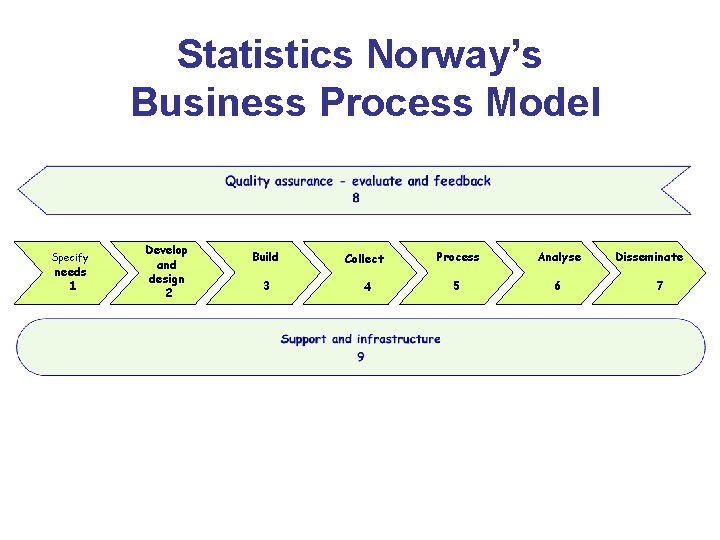
Statistics Norway’s Business Process Model Specify needs 1 Develop and design 2 Build Collect Process Analyse 3 4 5 6 Disseminate 7
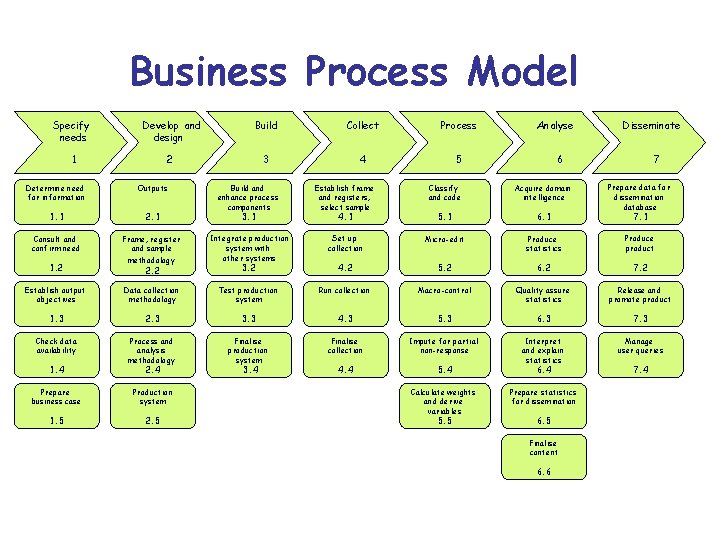
Business Process Model Specify needs Develop and design Build Collect Process 1 2 3 4 5 Determine need for information Outputs 1. 1 2. 1 Consult and confirm need Analyse Disseminate 6 7 Prepare data for dissemination database Build and enhance process components Establish frame and registers, select sample Classify and code Acquire domain intelligence 4. 1 5. 1 6. 1 Frame, register and sample methodology Integrate production system with other systems Set up collection Micro-edit Produce statistics Produce product 2. 2 3. 2 4. 2 5. 2 6. 2 7. 2 Establish output objectives Data collection methodology Test production system Run collection Macro-control Quality assure statistics Release and promote product 1. 3 2. 3 3. 3 4. 3 5. 3 6. 3 7. 3 Check data availability Process and analysis methodology Finalise production system Finalise collection Impute for partial non-response Manage user queries 4. 4 5. 4 Interpret and explain statistics 1. 2 1. 4 2. 4 Prepare business case Production system 1. 5 2. 5 3. 1 3. 4 Calculate weights and derive variables 5. 5 6. 4 Prepare statistics for dissemination 6. 5 Finalise content 6. 6 7. 1 7. 4
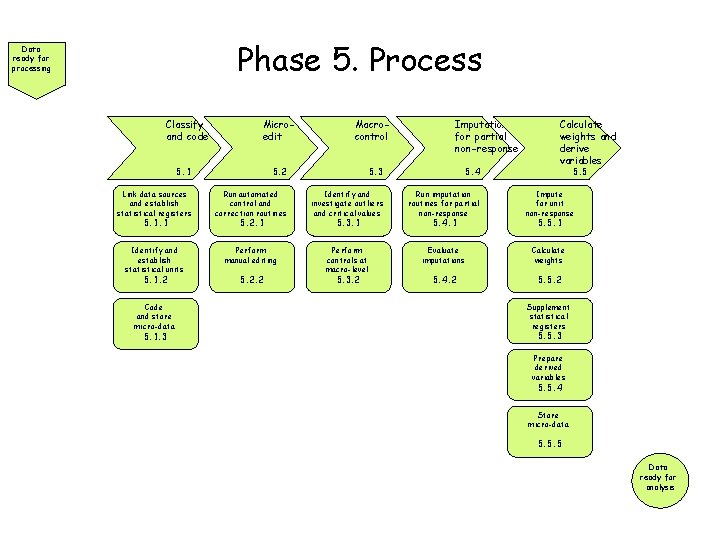
Phase 5. Process Data ready for processing Classify and code Microedit Macrocontrol Imputation for partial non-response Calculate weights and derive variables 5. 1 5. 2 5. 3 5. 4 Link data sources and establish statistical registers Run automated control and correction routines Identify and investigate outliers and critical values Run imputation routines for partial non-response Impute for unit non-response Identify and establish statistical units Perform manual editing Perform controls at macro-level Evaluate imputations Calculate weights 5. 4. 2 5. 5. 2 5. 1. 1 5. 1. 2 Code and store micro-data 5. 1. 3 5. 2. 1 5. 2. 2 5. 3. 1 5. 3. 2 5. 4. 1 5. 5. 1 Supplement statistical registers 5. 5. 3 Prepare derived variables 5. 5. 4 Store micro-data 5. 5. 5 Data ready for analysis

Comparison with Generic Statistical Business Process model Specify needs Develop and design Build Collect Process 1 2 3 4 5 Determine need for information Outputs Data collection instyument 1. 1 2. 1 3. 1 Consult and confirm need Frame, register and sample methodology Analyse 6 Establish frame and registers, select sample Standardise and anonymise Acquire domain intelligence 4. 1 5. 1 6. 1 Build and enhance process components Set up collection Integrate data 2. 2 3. 2 4. 2 5, . 2 Produce statistics Prepare draft outputs Establish output objectives Data collection methodology Run collection 1. 3 2. 3 Integrate production system with other systems Configure workflows Check data availability Process and analysis methodology Test production system 1. 2 1. 4 Prepare business case 1. 5 2. 4 Production system Processing systems and workflow 2. 5 3. 3 3. 4 4. 3 Finalise collection Load data into processing environment 4. 4 Finalise production systems Classify and code 5. 3 Micro-edit 5. 2 Macro-control 5. 3 3. 5 Edit and impute Impute for partial non-response 5. 4 Calculate aggregates Calculate weights 5. 6 and derive new variables 5. 7 5. 5 Disseminate 6. 2 Quality assure statistics Verify outputs 6. 3 Interpret and explain statistics 6. 4 Prepare statistics for dissemination Disclosure control 6. 5 Finalise content outputs for dissemination 6. 6 7 Prepare data for dissemination database Update output systems 7. 1 Produce products 7. 2 Release, 7. 3 market and promote product 7. 4 7. 3 Manage user customer queries 7. 5
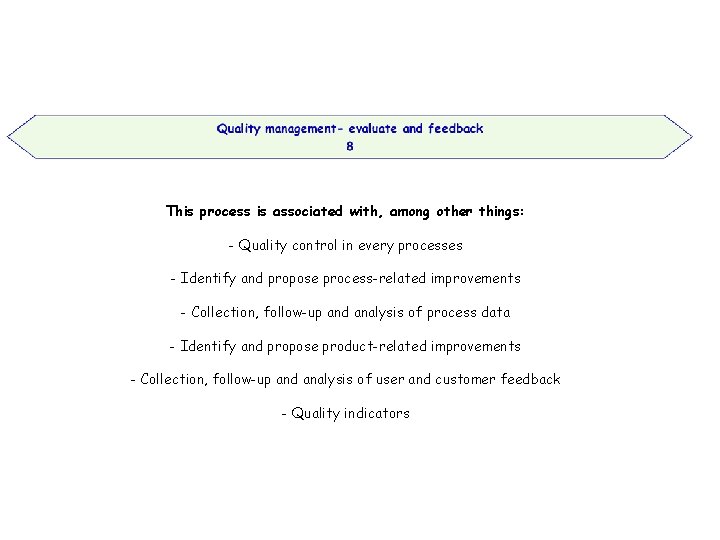
This process is associated with, among other things: - Quality control in every processes - Identify and propose process-related improvements - Collection, follow-up and analysis of process data - Identify and propose product-related improvements - Collection, follow-up and analysis of user and customer feedback - Quality indicators
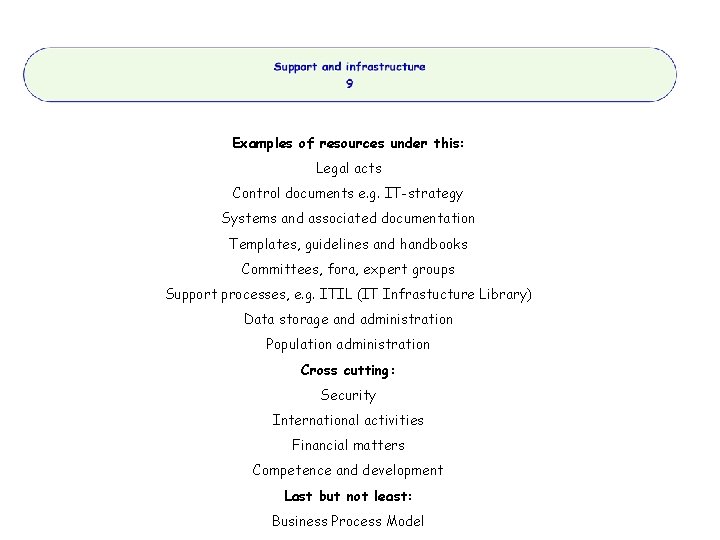
Examples of resources under this: Legal acts Control documents e. g. IT-strategy Systems and associated documentation Templates, guidelines and handbooks Committees, fora, expert groups Support processes, e. g. ITIL (IT Infrastucture Library) Data storage and administration Population administration Cross cutting: Security International activities Financial matters Competence and development Last but not least: Business Process Model

Recommendations from the BPM development project • The business process model will need to be reviewed and updated to ensure that it reflects the real state of affairs at any time. • The model originally in Norwegian was translated into English for international use. • A process guide for the model should be made available on Statistics Norway’s intranet.
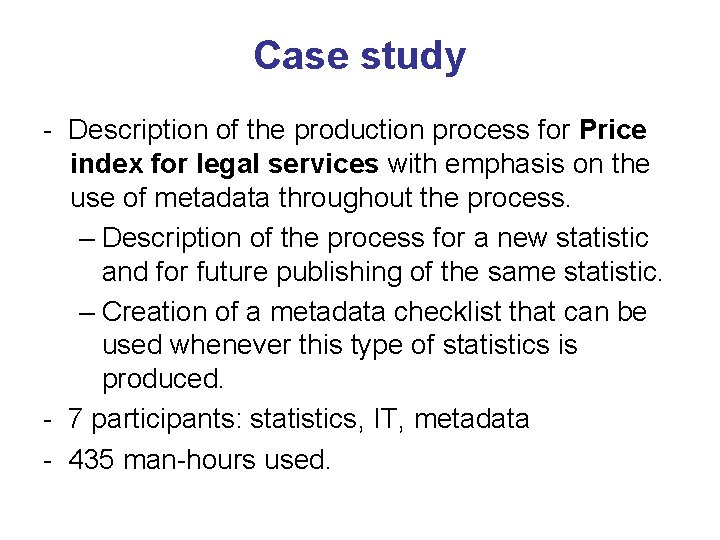
Case study - Description of the production process for Price index for legal services with emphasis on the use of metadata throughout the process. – Description of the process for a new statistic and for future publishing of the same statistic. – Creation of a metadata checklist that can be used whenever this type of statistics is produced. - 7 participants: statistics, IT, metadata - 435 man-hours used.
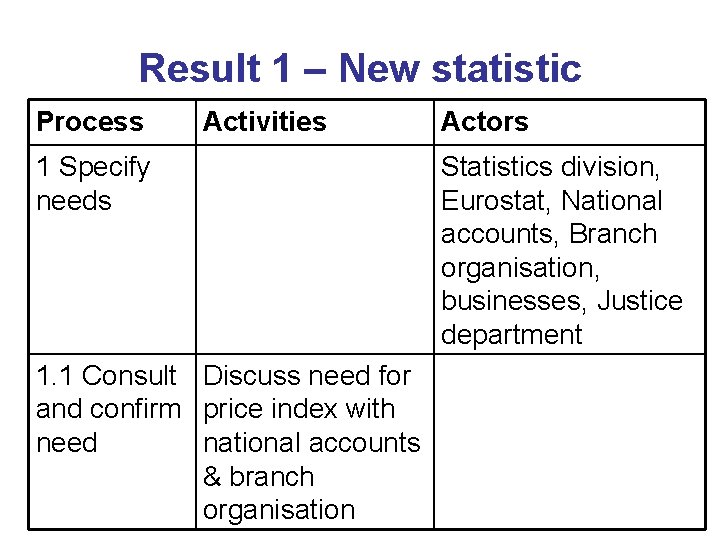
Result 1 – New statistic Process Activities 1 Specify needs 1. 1 Consult Discuss need for and confirm price index with need national accounts & branch organisation Actors Statistics division, Eurostat, National accounts, Branch organisation, businesses, Justice department
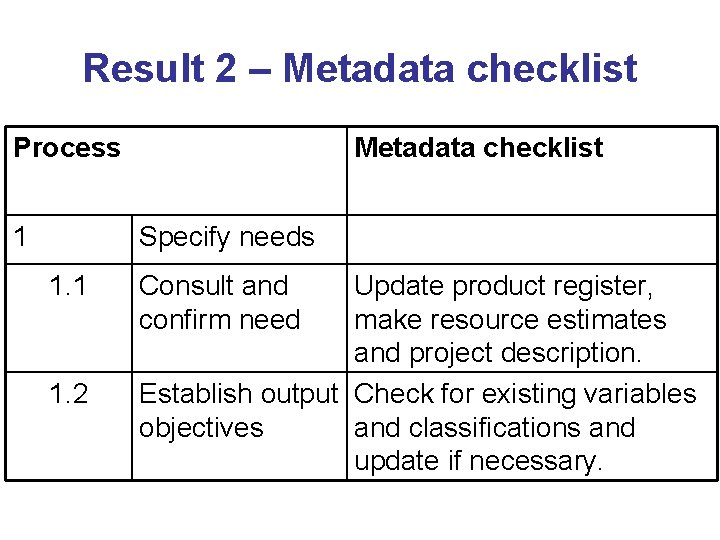
Result 2 – Metadata checklist Process 1 Metadata checklist Specify needs 1. 1 1. 2 Consult and confirm need Update product register, make resource estimates and project description. Establish output Check for existing variables objectives and classifications and update if necessary.
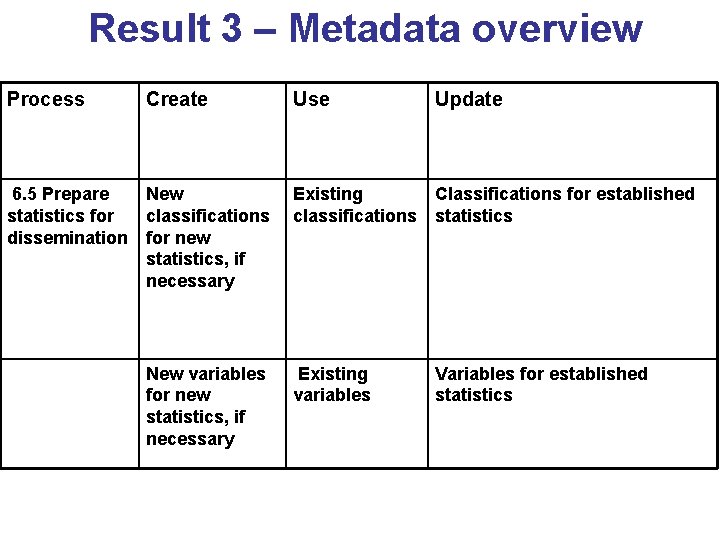
Result 3 – Metadata overview Process Create Use Update 6. 5 Prepare New statistics for classifications dissemination for new statistics, if necessary Existing Classifications for established classifications statistics Existing variables New variables for new statistics, if necessary Variables for established statistics
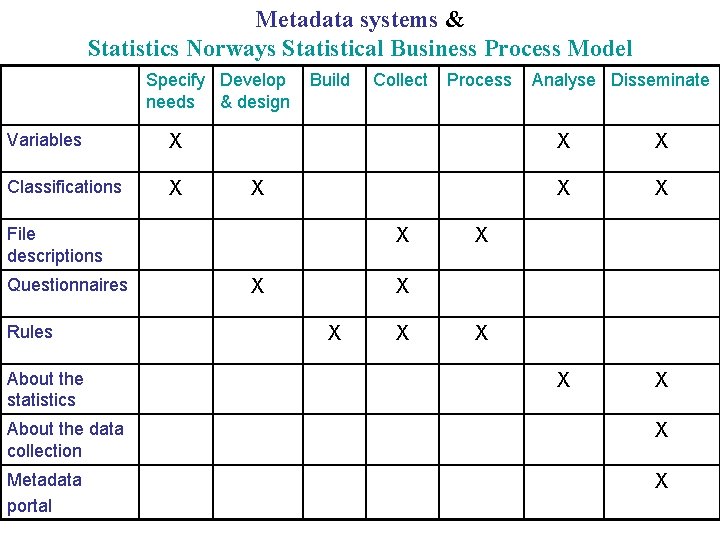
Metadata systems & Statistics Norways Statistical Business Process Model Specify Develop needs & design Variables X Classifications X Build Rules About the statistics Process X File descriptions Questionnaires Collect X X Analyse Disseminate X X X About the data collection X Metadata portal X
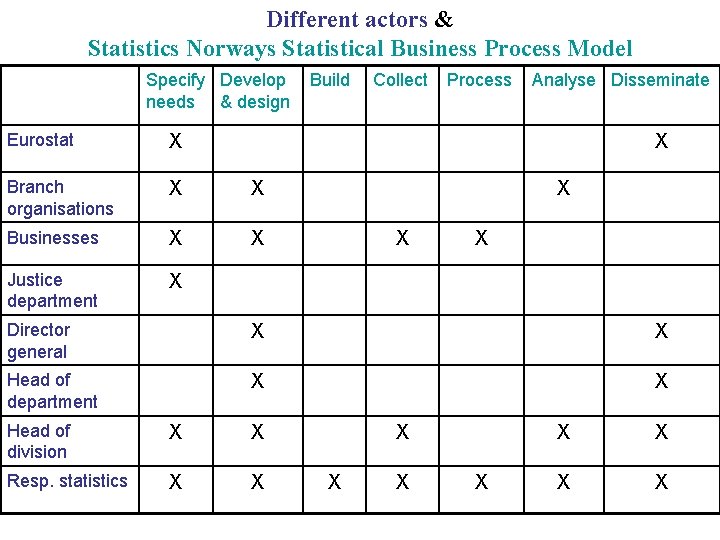
Different actors & Statistics Norways Statistical Business Process Model Specify Develop needs & design Eurostat X Branch organisations X X Businesses X X Justice department X Build Collect Process Analyse Disseminate X X Director general X X Head of department X X Head of division X X Resp. statistics X X X X X
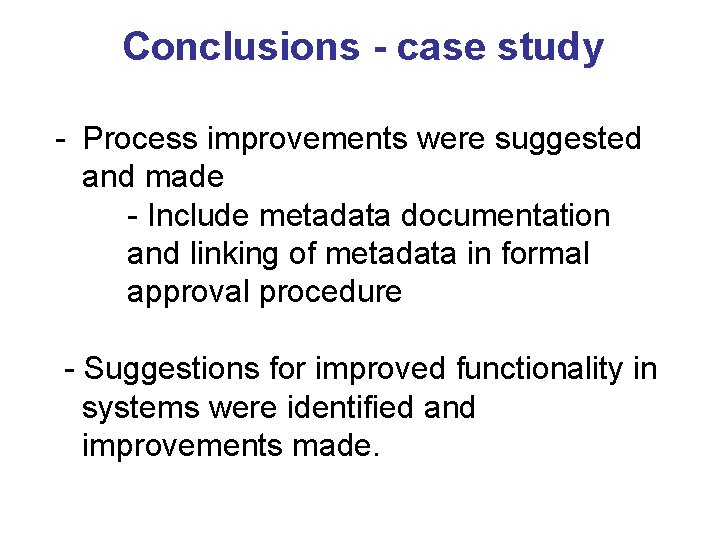
Conclusions - case study - Process improvements were suggested and made - Include metadata documentation and linking of metadata in formal approval procedure - Suggestions for improved functionality in systems were identified and improvements made.
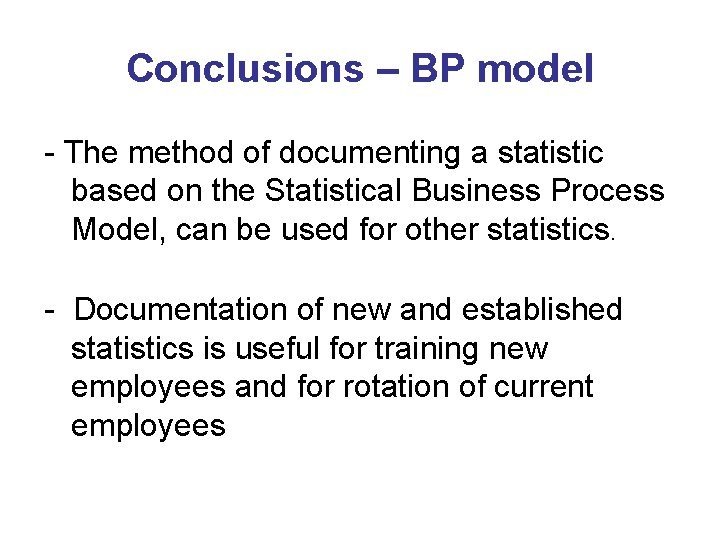
Conclusions – BP model - The method of documenting a statistic based on the Statistical Business Process Model, can be used for other statistics. - Documentation of new and established statistics is useful for training new employees and for rotation of current employees
Conclusions – BP model – cont. -The business process model is an important tool in planning, standardising and improving work processes in statistical production, and for training purposes. -The business process model is also a communication tool for standardisation and cooperation between statistical agencies and government departments.
- Slides: 19