
Developing an Instructional Strategy Instructional Design Unit 3
- Slides: 23
Developing an Instructional Strategy Instructional Design: Unit , 3 Design Phase
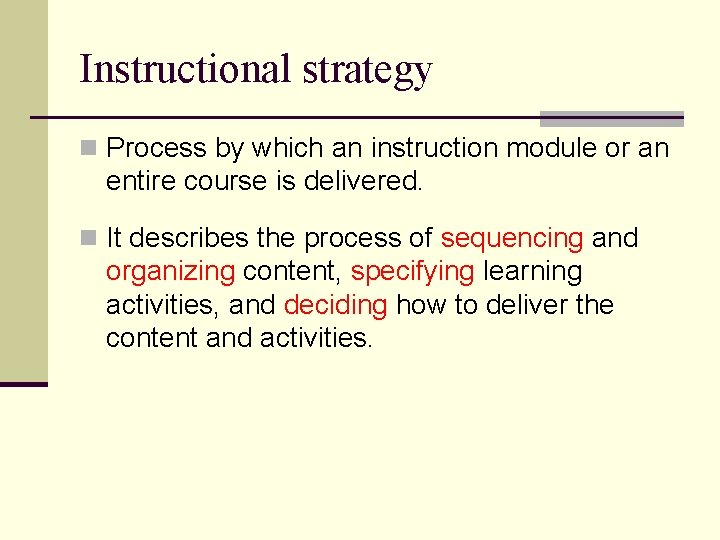
Instructional strategy n Process by which an instruction module or an entire course is delivered. n It describes the process of sequencing and organizing content, specifying learning activities, and deciding how to deliver the content and activities.
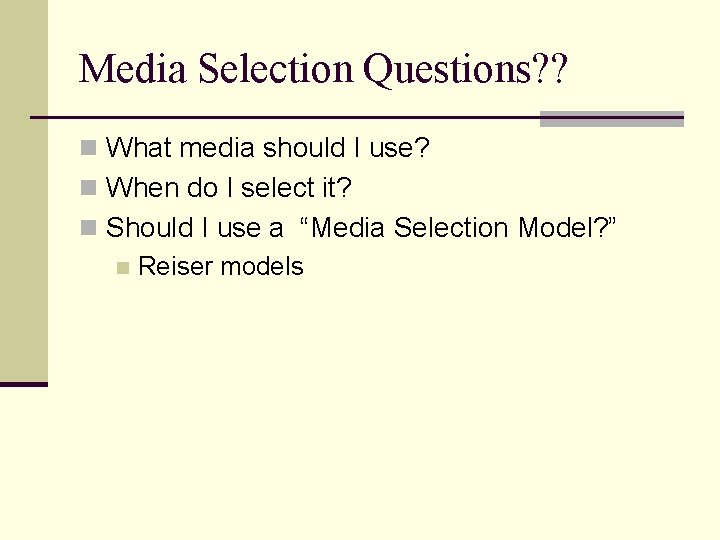
Media Selection Questions? ? n What media should I use? n When do I select it? n Should I use a “Media Selection Model? ” n Reiser models
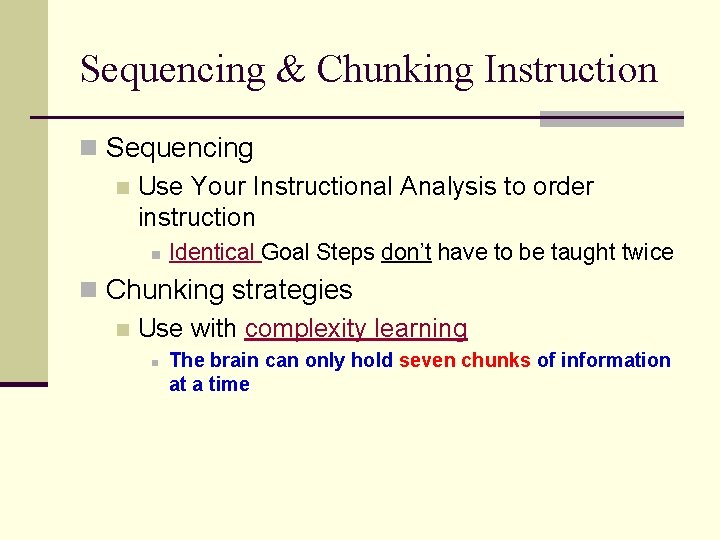
Sequencing & Chunking Instruction n Sequencing n Use Your Instructional Analysis to order instruction n Identical Goal Steps don’t have to be taught twice n Chunking strategies n Use with complexity learning n The brain can only hold seven chunks of information at a time
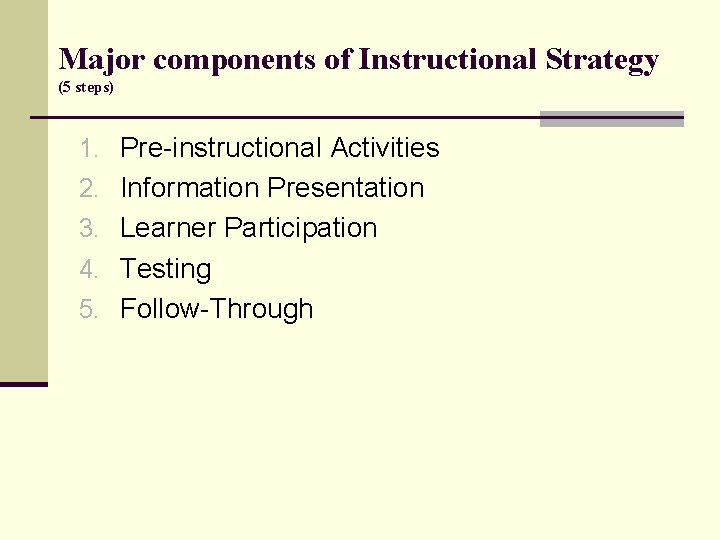
Major components of Instructional Strategy (5 steps) 1. Pre-instructional Activities 2. Information Presentation 3. Learner Participation 4. Testing 5. Follow-Through
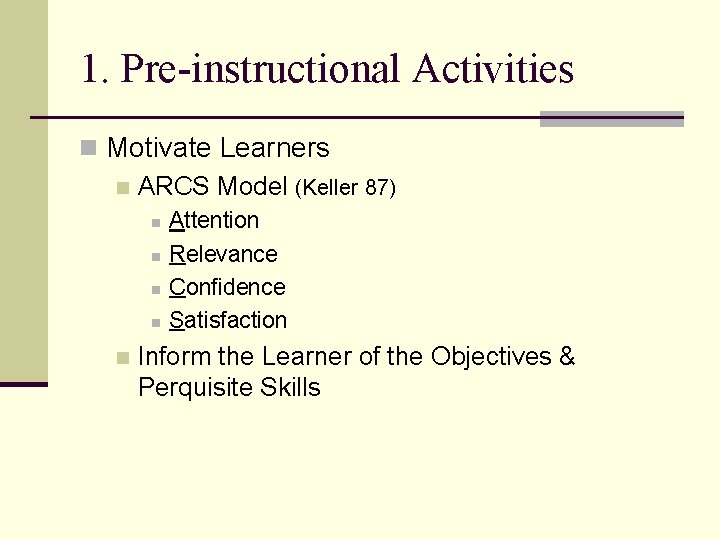
1. Pre-instructional Activities n Motivate Learners n ARCS Model (Keller 87) n n n Attention Relevance Confidence Satisfaction Inform the Learner of the Objectives & Perquisite Skills
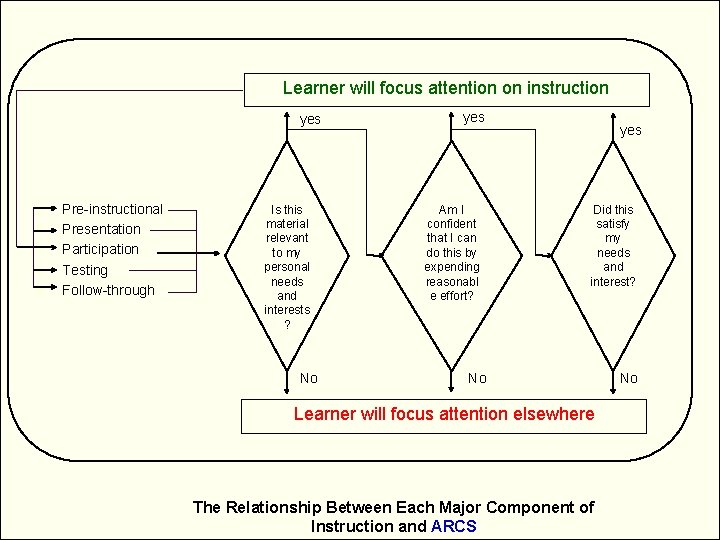
Learner will focus attention on instruction yes n n n Pre-instructional Presentation Participation Testing Follow-through Is this material relevant to my personal needs and interests ? No yes Am I confident that I can do this by expending reasonabl e effort? yes Did this satisfy my needs and interest? No Learner will focus attention elsewhere The Relationship Between Each Major Component of Instruction and ARCS No
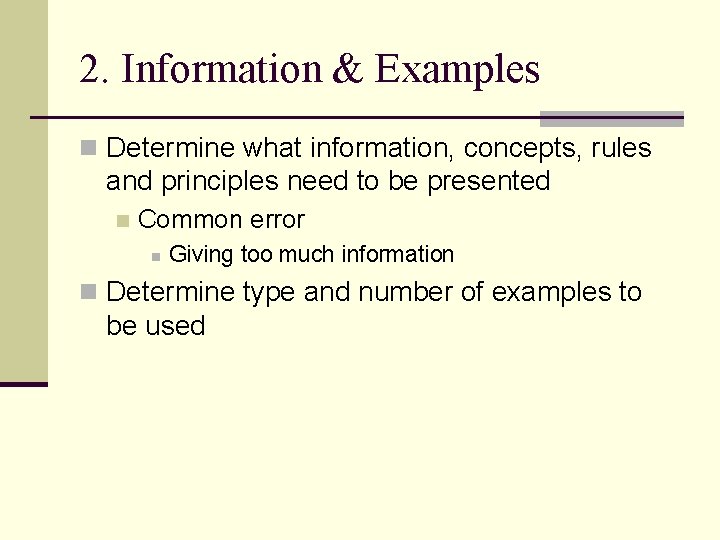
2. Information & Examples n Determine what information, concepts, rules and principles need to be presented n Common error n Giving too much information n Determine type and number of examples to be used
3. Learner Participation n Utilize plenty of Practice & Feedback
4. Testing n Test in authentic situations
5. Follow-Through Activities n Enrichment & Remediation Materials n Memory & Transfer Strategies n Transfer of Learning
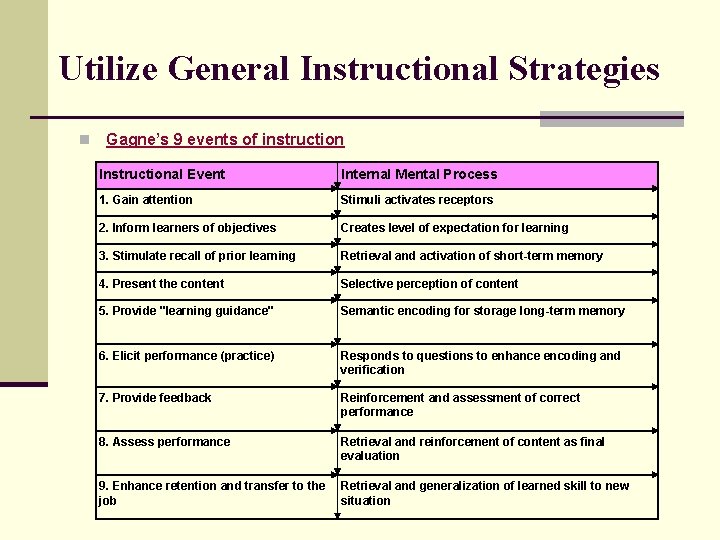
Utilize General Instructional Strategies n Gagne’s 9 events of instruction Instructional Event Internal Mental Process 1. Gain attention Stimuli activates receptors 2. Inform learners of objectives Creates level of expectation for learning 3. Stimulate recall of prior learning Retrieval and activation of short-term memory 4. Present the content Selective perception of content 5. Provide "learning guidance" Semantic encoding for storage long-term memory 6. Elicit performance (practice) Responds to questions to enhance encoding and verification 7. Provide feedback Reinforcement and assessment of correct performance 8. Assess performance Retrieval and reinforcement of content as final evaluation 9. Enhance retention and transfer to the job Retrieval and generalization of learned skill to new situation
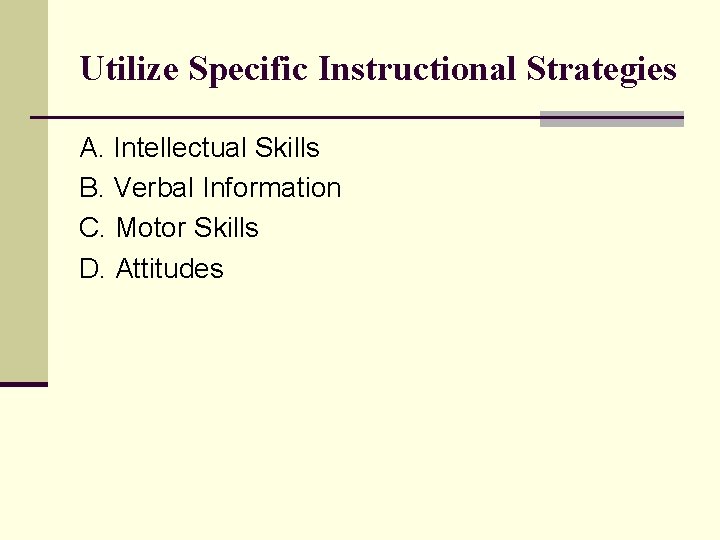
Utilize Specific Instructional Strategies A. Intellectual Skills B. Verbal Information C. Motor Skills D. Attitudes
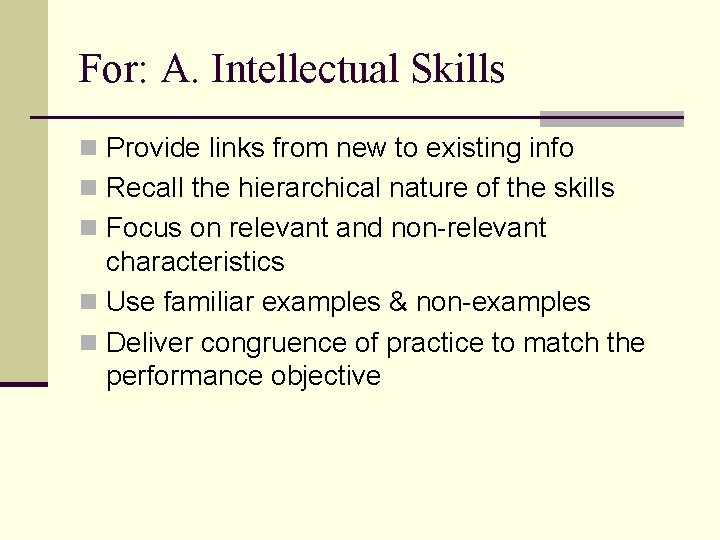
For: A. Intellectual Skills n Provide links from new to existing info n Recall the hierarchical nature of the skills n Focus on relevant and non-relevant characteristics n Use familiar examples & non-examples n Deliver congruence of practice to match the performance objective
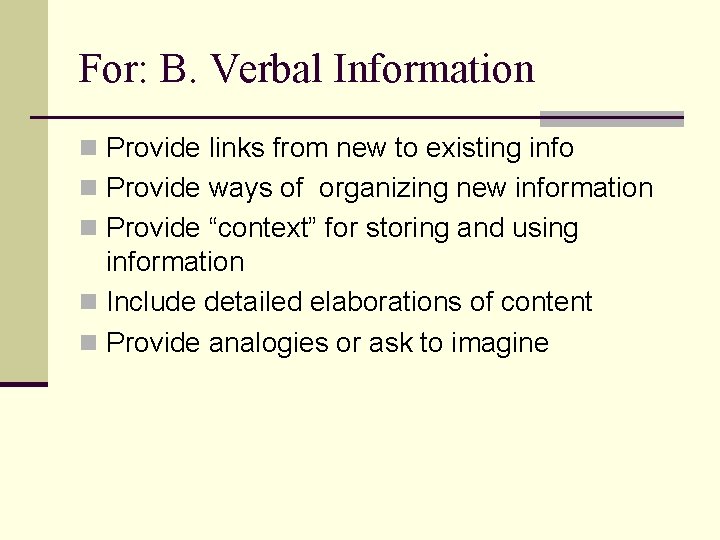
For: B. Verbal Information n Provide links from new to existing info n Provide ways of organizing new information n Provide “context” for storing and using information n Include detailed elaborations of content n Provide analogies or ask to imagine
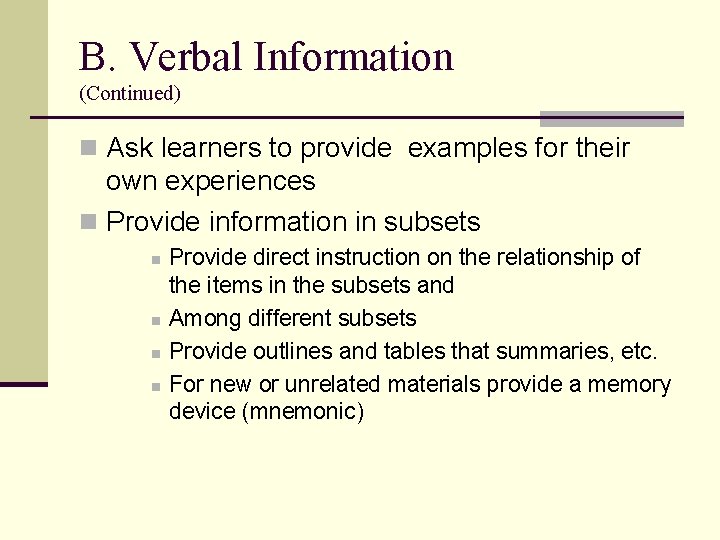
B. Verbal Information (Continued) n Ask learners to provide examples for their own experiences n Provide information in subsets n n Provide direct instruction on the relationship of the items in the subsets and Among different subsets Provide outlines and tables that summaries, etc. For new or unrelated materials provide a memory device (mnemonic)
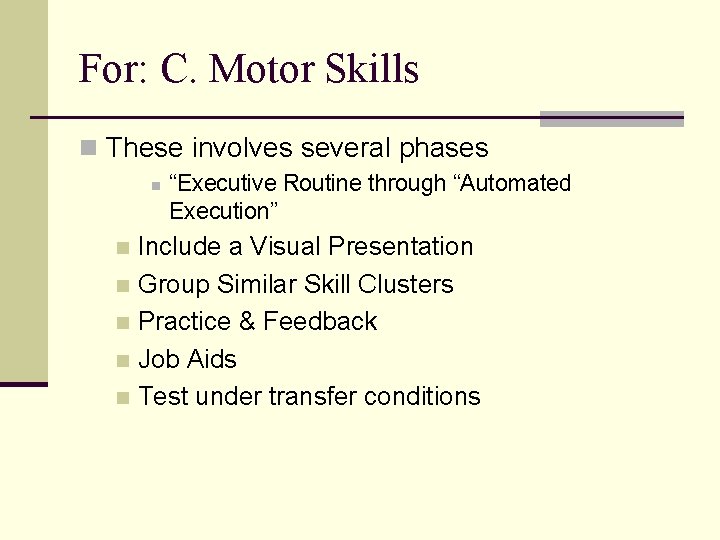
For: C. Motor Skills n These involves several phases n “Executive Routine through “Automated Execution” Include a Visual Presentation n Group Similar Skill Clusters n Practice & Feedback n Job Aids n Test under transfer conditions n
For: D. Attitudes n Consist of: n Feelings n Behaviors, n Cognitive understandings
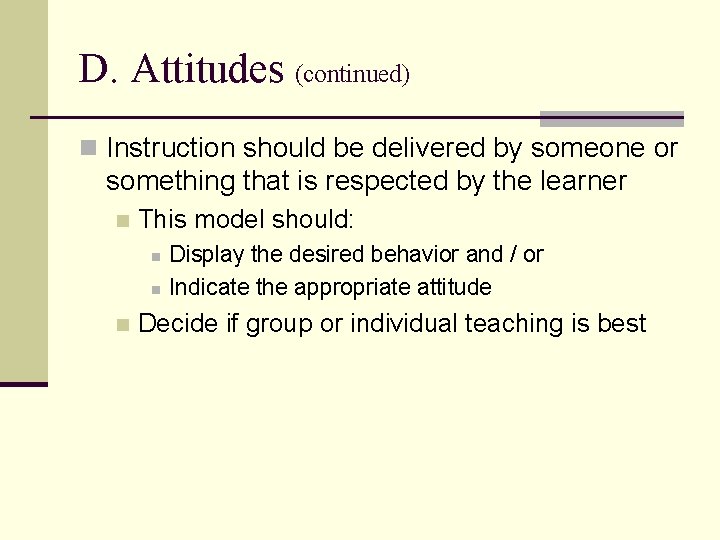
D. Attitudes (continued) n Instruction should be delivered by someone or something that is respected by the learner n This model should: n n n Display the desired behavior and / or Indicate the appropriate attitude Decide if group or individual teaching is best
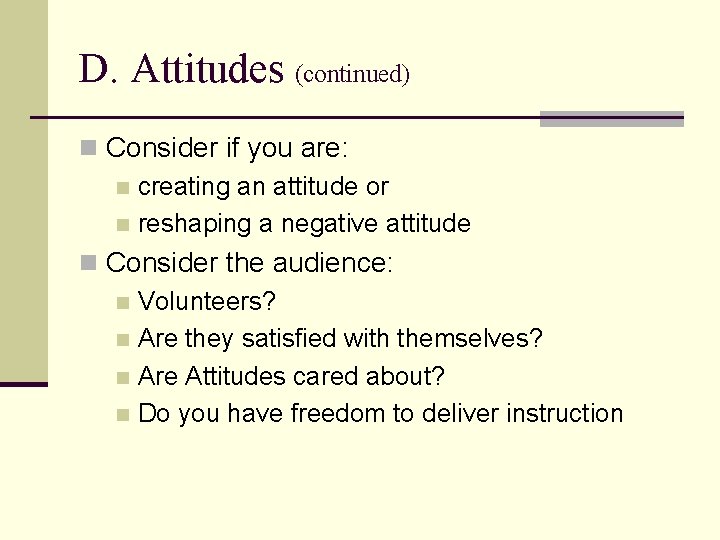
D. Attitudes (continued) n Consider if you are: n creating an attitude or n reshaping a negative attitude n Consider the audience: n Volunteers? n Are they satisfied with themselves? n Are Attitudes cared about? n Do you have freedom to deliver instruction
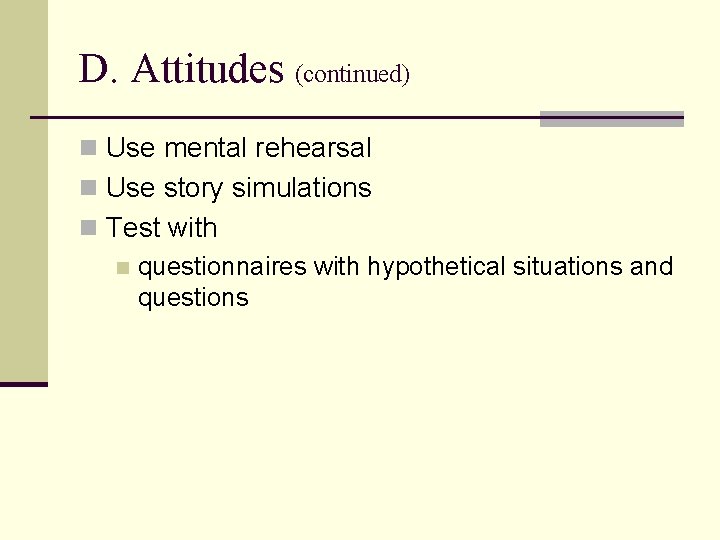
D. Attitudes (continued) n Use mental rehearsal n Use story simulations n Test with n questionnaires with hypothetical situations and questions
Go forth and create instructional content following these guidelines