
Developing an Autonomous Hovercraft for Benthic Surveying in
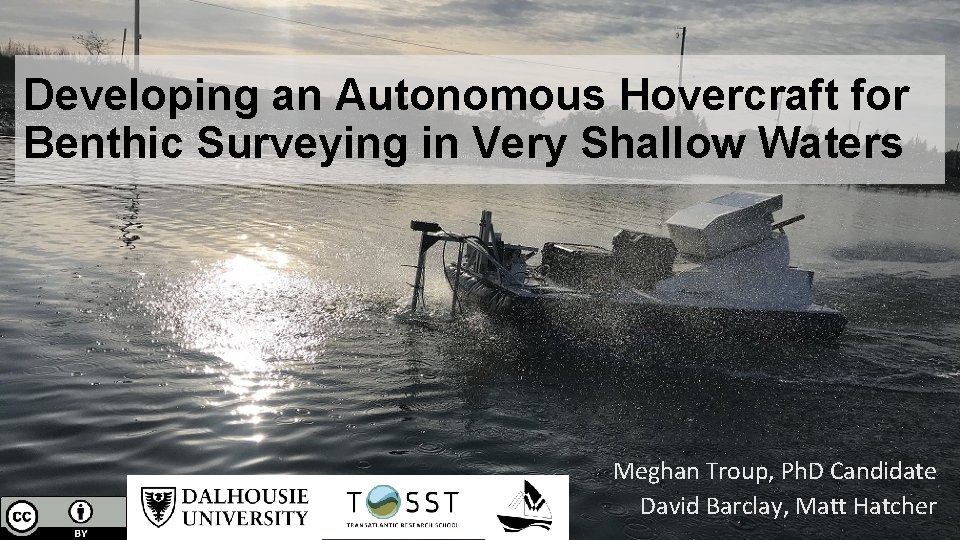
Developing an Autonomous Hovercraft for Benthic Surveying in Very Shallow Waters Meghan Troup, Ph. D Candidate David Barclay, Matt Hatcher
Mapping in Shallow Waters (<5 meters) CURRENT COMMON METHODS OF MAPPING § Optical mapping methods (Li. DAR, satellite imagery, aerial photography) are limited by cloud cover and turbidity and may lack detail in resolution § Boats, AUVs, and many ASVs have limited maneuverability in shallower waters § Manual in situ mapping or using underwater video can be inefficient and require spatial interpolation A NOVEL ALTERNATIVE: AUTONOMOUS HOVERCRAFT § Hovercrafts float on a cushion of air, allowing for near-frictionless movement over a surface § The propulsion mechanism of the vehicle is above water, limiting the amount of disturbance below § The sonar arm can be raised and lowered automatically once the hovercraft reaches a depth of at least 10 cm
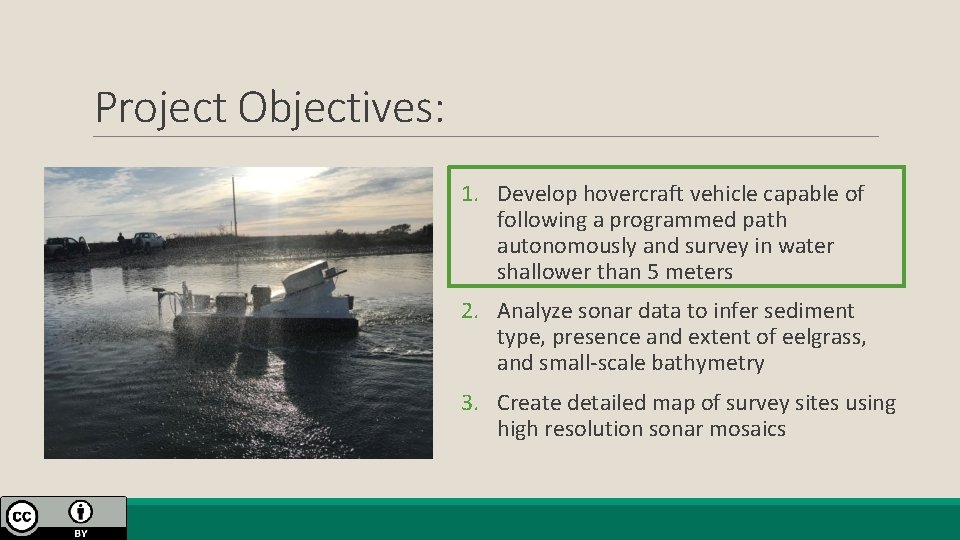
Project Objectives: 1. Develop hovercraft vehicle capable of following a programmed path autonomously and survey in water shallower than 5 meters 2. Analyze sonar data to infer sediment type, presence and extent of eelgrass, and small-scale bathymetry 3. Create detailed map of survey sites using high resolution sonar mosaics
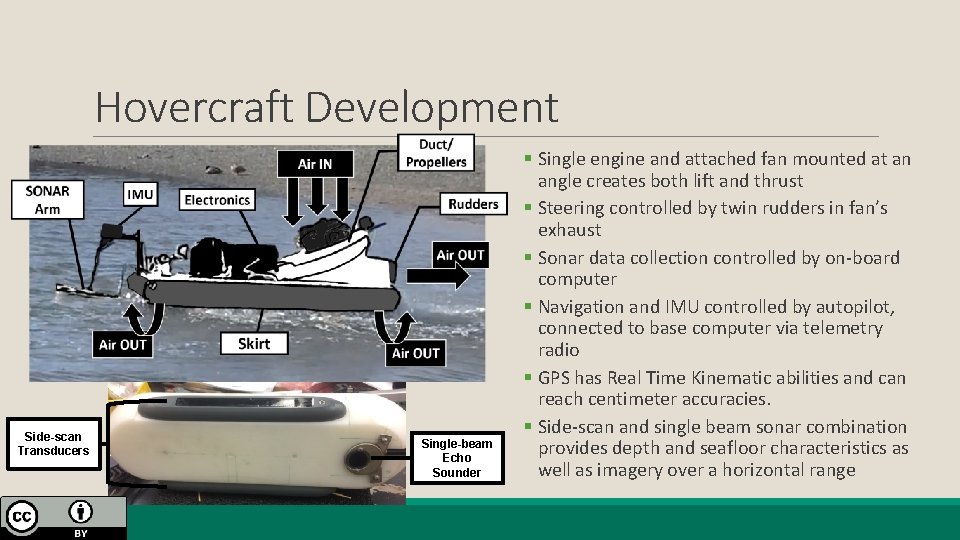
Hovercraft Development Side-scan Transducers Single-beam Echo Sounder § Single engine and attached fan mounted at an angle creates both lift and thrust § Steering controlled by twin rudders in fan’s exhaust § Sonar data collection controlled by on-board computer § Navigation and IMU controlled by autopilot, connected to base computer via telemetry radio § GPS has Real Time Kinematic abilities and can reach centimeter accuracies. § Side-scan and single beam sonar combination provides depth and seafloor characteristics as well as imagery over a horizontal range
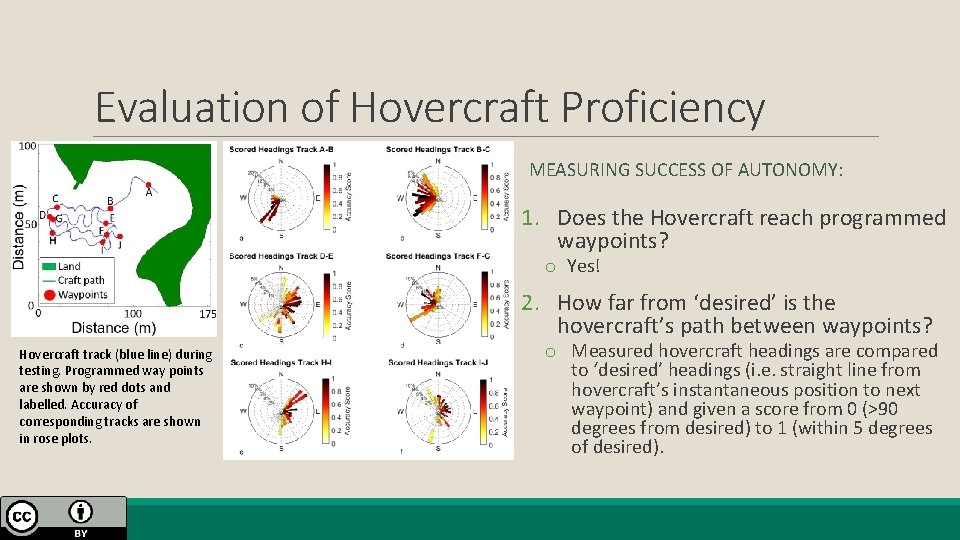
Evaluation of Hovercraft Proficiency MEASURING SUCCESS OF AUTONOMY: 1. Does the Hovercraft reach programmed waypoints? o Yes! 2. How far from ‘desired’ is the hovercraft’s path between waypoints? Hovercraft track (blue line) during testing. Programmed way points are shown by red dots and labelled. Accuracy of corresponding tracks are shown in rose plots. o Measured hovercraft headings are compared to ‘desired’ headings (i. e. straight line from hovercraft’s instantaneous position to next waypoint) and given a score from 0 (>90 degrees from desired) to 1 (within 5 degrees of desired).
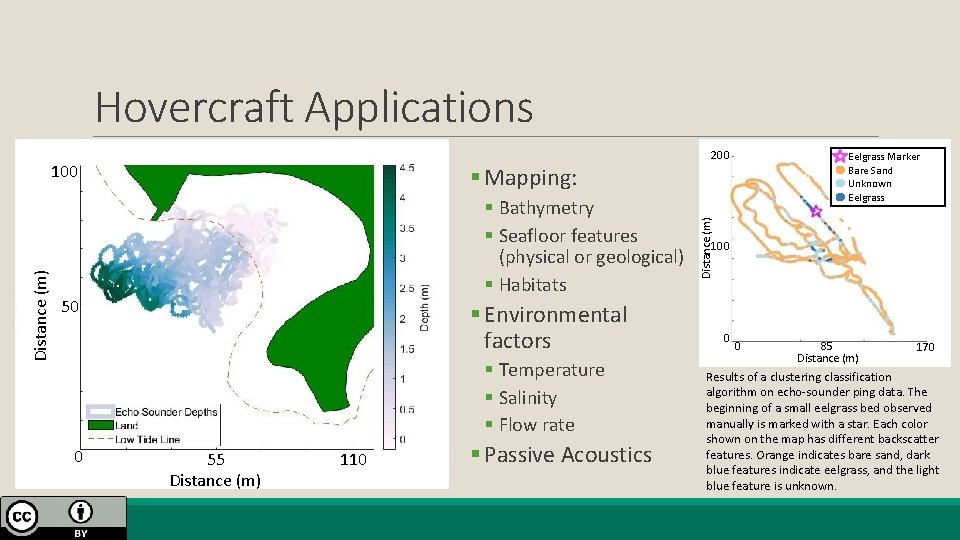
Hovercraft Applications 200 § Mapping: § Bathymetry § Seafloor features (physical or geological) § Habitats 50 § Environmental factors § Temperature § Salinity § Flow rate 0 55 Distance (m) 110 § Passive Acoustics Distance (m) 100 Eelgrass Marker Bare Sand Unknown Eelgrass 100 0 0 85 Distance (m) 170 Results of a clustering classification algorithm on echo-sounder ping data. The beginning of a small eelgrass bed observed manually is marked with a star. Each color shown on the map has different backscatter features. Orange indicates bare sand, dark blue features indicate eelgrass, and the light blue feature is unknown.
- Slides: 6