
DEVELOPING AN ALTERNATIVE MODEL OF EDUCATIONAL MANAGEMENT FOR





- Slides: 54
DEVELOPING AN ALTERNATIVE MODEL OF EDUCATIONAL MANAGEMENT FOR EXCELLENCE SCHOOLS by Widodo Ahmad Dahlan University Yogyakarta, Indonesia Inspired by Prof. Dr. Slamet. PH, MLH. MA.
OUTLINE q Firstly, we will talk about the School Based Management (SBM) in Indonesia q Secondly, we will look at the development and implementation of SBM in Yogyakarta q Finally, you will know the results of the development and implementation of SBM in Yogyakarta
OBJECTIVES q Firstly, students understand the School Based Management (SBM) in Indonesia q Secondly, students can explain the development and implementation of SBM in Yogyakarta q Finally, students can mention the results of the development and implementation of SBM in Yogyakarta
PRELIMINARY
PRELIMINARY (1) q q q In 2004, the Indonesia Government implemented the regional autonomy as the realization of the Law Number 32 of 2004 on Regional Government. The majority of central government authority delegated to the local government. With autonomy and decentralization, hoped each region including the communities will be encouraged to develop their respective areas in order to increase their competitiveness. Consequences of autonomy and decentralization also occurred in the field of education. The main goal of autonomy in education is the quality of education in Indonesia.
PRELIMINARY (2) q q Various programs to overcome the education issues have been carried out by the Indonesia government The various programs have given expectations for the sustainability and controlled quality during the crisis However, because of so rigid and centralized management, the programs did not have a positive impact. It is believed because of mismanagement So that, there is an idea of the implementation of school-based management (SBM).
PRELIMINARY (3) q q The concept of school-based management is one of the national policy as outlined in the Law Number 25 Year 2000 on National Development Strategic Plan 2000 -2004, and clearly set in the Law of National Education System Number 20, 2003. The approaches and school management using the principle of SBM officially came into effect on July 8, 2003
SCHOOL BASED MANAGEMENT (SBM)
SCHOOL–BASED MANAGEMENT (1) q q School Based Management, is a political approach that aims to redesign school management by providing power to the principal and increase community participation in efforts to improve school performance including teachers, students, principals, parents, and community. The School Based Management changes decision making system by transfering of authority in decision making and management into each local stakeholders (Chapman, J, 1990).
SCHOOL–BASED MANAGEMENT (2) q q School –based management is a management model based on uniqueness, potency, and the needs of school. With these limits, then the SBM ensures diversity in the management of the school, but must remain in the corridors of national education policy. With SBM, there is no more emphasis on uniformity and ensures diversity (Slamet PH, 2008)
THE ESSENCE OF SBM AUTONOMY EMPOWERING FLEXIBILITY
ASSUMPTIONS OF SBM (1) q q q Updates are planned and implemented centrally are often not able to fix the core of school activities, that is a learning and teaching process. Schools need an educational resource support that steady and consistent, but the central government, provinces, and districts were not able to meet this demand. Each school has a specific, unique, and different potency between one school and another school.
ASSUMPTIONS OF SBM (2) q q q Schools are not only a sub-ordination or the doer of the programs of the government, but they are as the front line that must be empowered in decision making and management independently. School knows much more their problems and needs Decision making by school will be appropriate with the school need.
THE OBJECTIVES OF SBM q q To improve the school performance using the good principles of SBM. The school performance consists of quality, effectiveness, productivity, efficiency, innovation, and financial surplus.
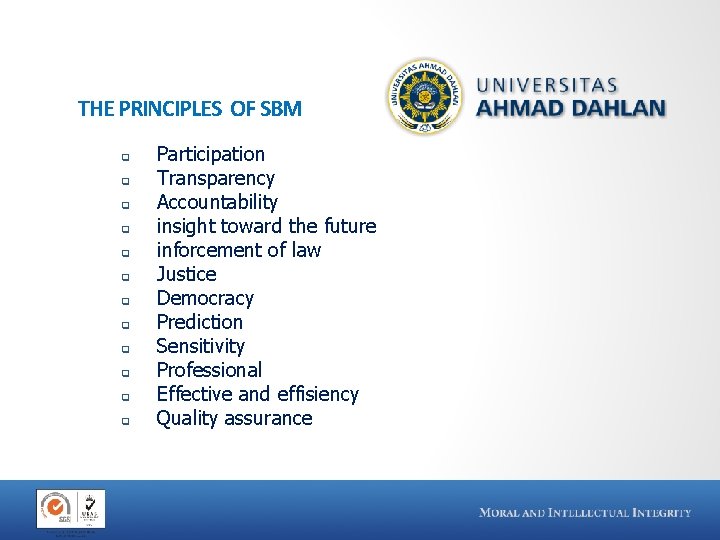
THE PRINCIPLES OF SBM q q q Participation Transparency Accountability insight toward the future inforcement of law Justice Democracy Prediction Sensitivity Professional Effective and effisiency Quality assurance
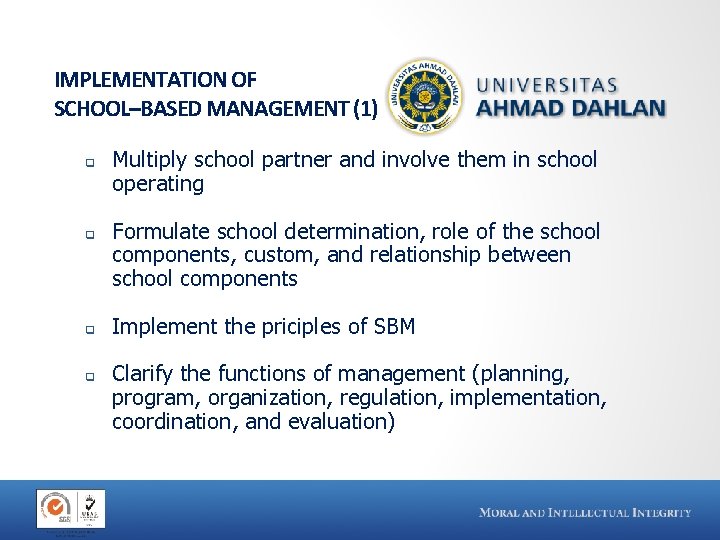
IMPLEMENTATION OF SCHOOL–BASED MANAGEMENT (1) q q Multiply school partner and involve them in school operating Formulate school determination, role of the school components, custom, and relationship between school components Implement the priciples of SBM Clarify the functions of management (planning, program, organization, regulation, implementation, coordination, and evaluation)
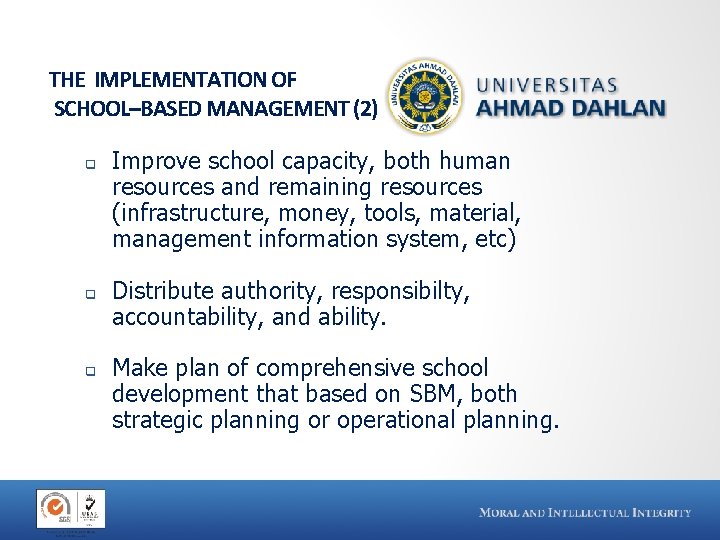
THE IMPLEMENTATION OF SCHOOL–BASED MANAGEMENT (2) q q q Improve school capacity, both human resources and remaining resources (infrastructure, money, tools, material, management information system, etc) Distribute authority, responsibilty, accountability, and ability. Make plan of comprehensive school development that based on SBM, both strategic planning or operational planning.
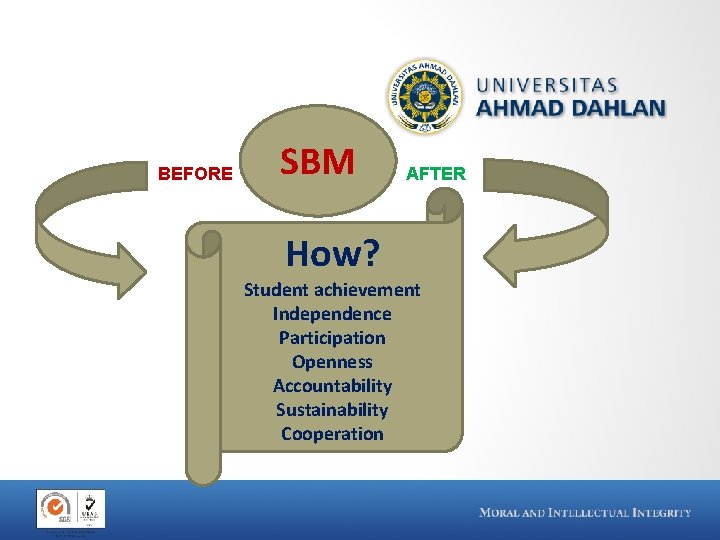
BEFORE SBM How? AFTER Student achievement Independence Participation Openness Accountability Sustainability Cooperation
SCHOOL–BASED MANAGEMENT NEEDS PARTNERSHIP WITH SOCIETY q There is a common objective q Need openness q Respect each other q There are common risk and responsibility
KINDS OF SOCIETY q Group of parents q Group of associations q Group of practitioners q Group of academicians q Group of businessmens
SOCIETY SUPPORTS q Financial support q Moral support q Service support q Material support
SBM NEED CHANGE IN: q System or structure q Culture or habit q Figure q Relationship q Role
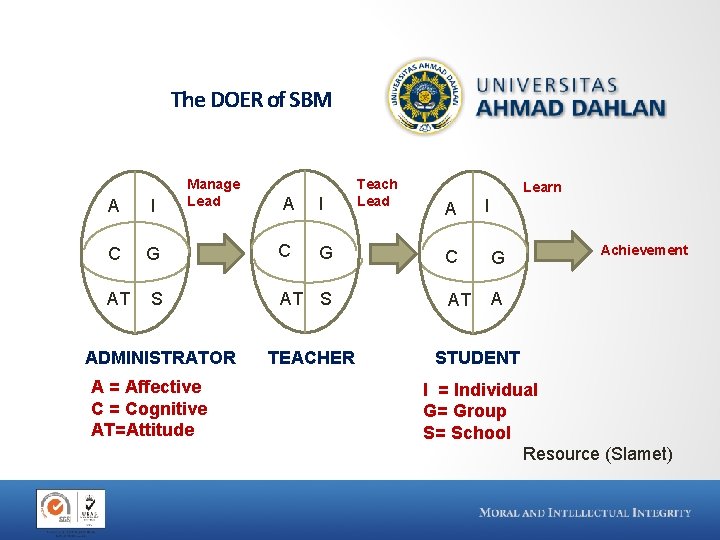
The DOER of SBM Manage Lead A I G C G S AT S ADMINISTRATOR TEACHER A I C AT A = Affective C = Cognitive AT=Attitude Teach Lead Learn A I C G AT A Achievement STUDENT I = Individual G= Group S= School Resource (Slamet)
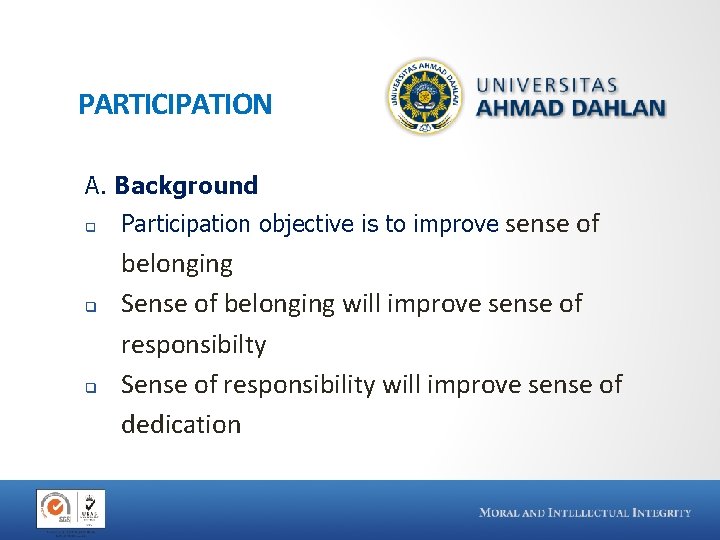
PARTICIPATION A. Background q q q Participation objective is to improve sense of belonging Sense of belonging will improve sense of responsibilty Sense of responsibility will improve sense of dedication
B. The Meaning Of Participation q Participation is the process where stakeholders are involved actively in decision making, policy making, planning, implementation, and controlling of education in school
C. The Objectives of Participation The main goals of participation improvement are: q Improve contribution q Empower potency of stakeholders q Improve role of stakeholders q Guarantee so that each decision reflect aspiration as commander
D. Efforts to improve participation q q Make regulation and guidance procedures of participation Provide infrastructure of participation and communication channel Perform (advocation, publication, transparancy, realization) respect to stakeholders Involve stakeholders in accordance with the relevance, competence, compatibility, goal that will be achieved
E. Successful Indicators of participation q q q Improvement of stakeholders contribution Improvement of stakeholders trust to school Improvement of responsibility and concern Improvement of quality and quantity Decision to really express the aspirations and ideas of stakeholders
TRANSPARENCY A. Background q School is a public service organization in the field of education that is given mandate by the society so transparency is the right of the public q Improvement of transparency is very important to build belief and trust of public towards schools
B. The meaning of transparency q q Transparency is a condition where each person related with education can know process and result of decision making and school regulation Transparency is equal to honest, do not lie, and open to the public about what schools do
C. The Objective of Transparency q Development of transparency aimed to build trust and belief of public to school that school is a clean and authoritative education service
D. Efforts of Transparency Improvement q q q Leverage various channels both direct or indirect Prepare clear regulation about manner to get information, type of information and comply procedure if information do not reach public Effort regulation which guarantee the public right to get information
E. Successful Indicators of Tranparency q q Improve belief and trust of public to school Improve participation of public to school management Inrease insight and knowledge of public to school management Decreasing of trespassing to school regulation
ACCOUNTABILITY A. Background School is given mandate by public to manage education well, so that school manager has responsibility of processes and its results to public
B. The meaning of accountability Accountability is duty to give responsibility of school management to party who has the authority and right to ask information or responsibility
C. Objective of the accountability The main objective of accountabilty is to encourage realization of school performance accountability as one of requirements to a good and trusted school realization
D. Efforts to Improve Accountability q q Make a play rule of accountability Make a guidance of behavior and a controller system of school management performance Make a school development plan and inform to public in each early budget year Make clearly key performance indicators and inform to public q Measure achievements of school performance q respond to a question and complain of the public
E. Successful Indicators of Accountability q q q Improvement of trust and satisfaction of public to school Growth of public right awareness to evaluate educational management in school Improvement of relevant activity for the value and norm that grow on public
DEVELOPMENT OF SBM IN YOGYAKARTA
PRELIMINARY 1 1. This chapter describes developing educational management of six Muhammadiyah schools in Depok, Sleman, Yogyakarta. 2. Those six schools are: a. Condong Catur Muhammadiyah Elementary School, b. Kadisoka Muhammadiyah Elementary School, c. Sleman Muhammadiyah Elementary School, d. Prambanan Muhammadiyah Elementary School, e. Pakem Muhammadiyah Elementary School, f. Condong Catur Muhammadiyah Secondary School
PRELIMINARY 2 Formerly, teachers and other employees were recruited by “the leader of Persyarikatan Muhammadiyah” or schools, then proposed to the government to be appointed as civil servants, so that schools do not bear the cost of their salaries. Muhammadiyah schools so are often named as State-Muhammadiyah Schools.
CLUSTER SYSTEM OF SCHOOLS 1 1. The six muhammadiyah schools developed school based management model with cluster system. 2. The six schools implemented the school based management with cluster system for independent and excellence schools. 3. The leader and the initiator of the project was Achmad Solikin, principal of Condongcatur Muhammadiyah School.
CLUSTER SYSTEM OF SCHOOLS 1 4. Once, Condongcatur Muhammadiyah Elementary School was an independent and excellence schools, while the other five Muhammadiyah Schools were not good schools. 5. Mr. Achmad Solikin invited the other five muhammadiyah schools to implement the School Based Management with cluster system. 6. Solikin invitation was received very well by other five Muhammadiyah schools. 7. Finally, the six Muhammadiyah school become independent and become excellence school.
PROBLEMS 1 1. Long time ago, many schools were lack of students both state and private schools, so many school were closed. On the other hand, new schools arise and they were luxuriant both number of teachers and students. Many new schools occupy the building of schools that have been closed. 2. There was no cadre formation in many schools. 3. Participation of society in development curriculum, building, and financial was not optimal. 4. Discipline culture in many schools were still low
PROBLEMS 2 5. There was no financial and educational cost standard 6. There was a lack of curriculum development 7. There was a lack of quality culture development in schools 8. Many schools had not used information and technology in learning and marketing
SOLUTIONS 1. Recruit the appropriate educational and non educational human resources for schools. 2. Optimize people’s participation 3. Build discipline culture 4. Using information and technology in learning media 5. Cost standardization 6. Developing curriculum
RESULTS OF DEVELOPMENT OF SBM IN YOGYAKARTA
RESULTS 1 1. Improvement of society trust 2. Equaity of quality 3. Independency of resources 4. Improvement of society investment 5. Innovation of learning media 6. Standardization of salary 7. Networking of school
RESULTS 2 With the selection of competent teachers and always held a planned increase in human resources, SD Muhammadiyah Condongcatur has professional teachers: (1) Four teachers have got teacher certification, (2) Champion-1 in the national contest of teacher Creativity in 2006, (3) champion 1 & 2 in academic writing competition in 2008, the district level. Sleman, (4) finalist of national contest of Creativity of teacher 2009, (4) The winner of National Level of Principal, 2009
RESULTS 3 Community participation in developing of SD Muhammadiyah Condongcatur is optimal, it can be seen in: (1) The involvement in building development, (2) The development of computer laboratories, (3) The human resource development, (4) The curriculum development and marketing to build schools
RESULTS 4 Culture of discipline teachers: (1) teacher come at: 06: 20 leave school at 14: 00, (2) digitalization of syllabi, lesson plans and instructional media. (3) Manufacture of E-Learning instructional system, and intranet / internet school (http: sdmuhccyogya. sch. id / http: //jogjabelajar. org)
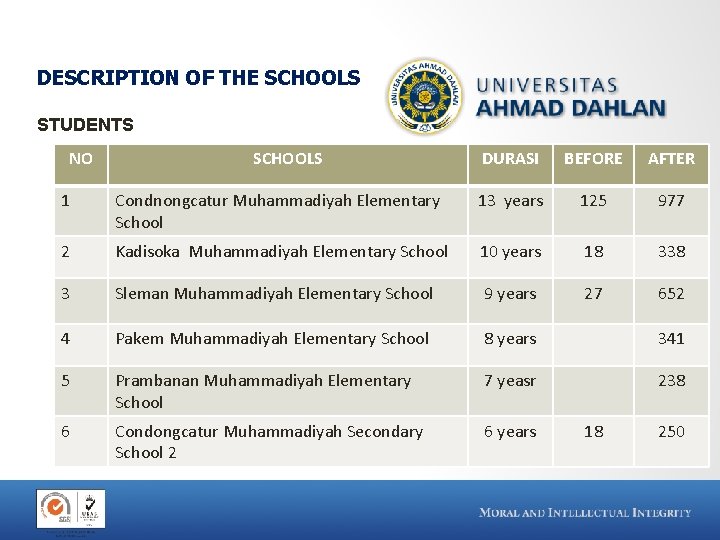
DESCRIPTION OF THE SCHOOLS STUDENTS NO SCHOOLS DURASI BEFORE AFTER 1 Condnongcatur Muhammadiyah Elementary School 13 years 125 977 2 Kadisoka Muhammadiyah Elementary School 10 years 18 338 3 Sleman Muhammadiyah Elementary School 9 years 27 652 4 Pakem Muhammadiyah Elementary School 8 years 341 5 Prambanan Muhammadiyah Elementary School 7 yeasr 238 6 Condongcatur Muhammadiyah Secondary School 2 6 years 18 250
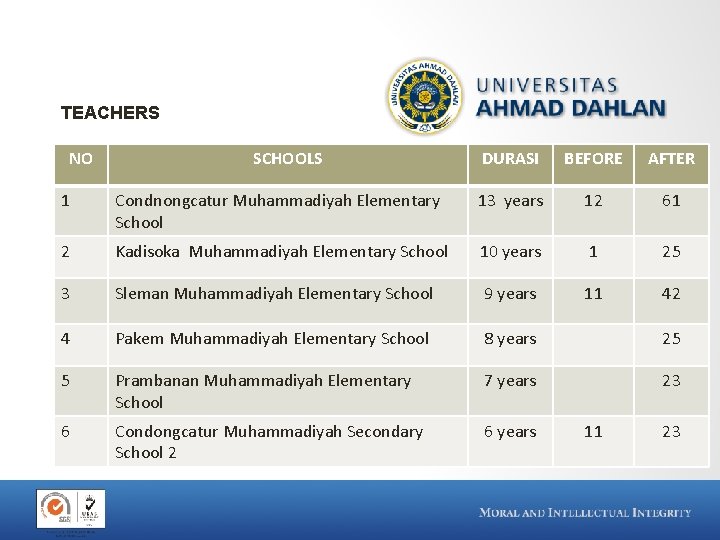
TEACHERS NO SCHOOLS DURASI BEFORE AFTER 1 Condnongcatur Muhammadiyah Elementary School 13 years 12 61 2 Kadisoka Muhammadiyah Elementary School 10 years 1 25 3 Sleman Muhammadiyah Elementary School 9 years 11 42 4 Pakem Muhammadiyah Elementary School 8 years 25 5 Prambanan Muhammadiyah Elementary School 7 years 23 6 Condongcatur Muhammadiyah Secondary School 2 6 years 11 23
THANK YOU SO MUCH