
Developing an Accessible MOOC to Teach ICT Accessibility
Developing an Accessible MOOC to Teach ICT Accessibility Christopher Lee, Ph. D Zerrin Ondin, Ph. D
Who we are? Christopher M. Lee, Ph. D. Former Department Head | Executive Director AMAC Accessibility Solutions and Research Center College of Design, Georgia Tech Zerrin Ondin, Ph. D Research Scientist AMAC Accessibility Solutions and Research Center College of Design, Georgia Tech
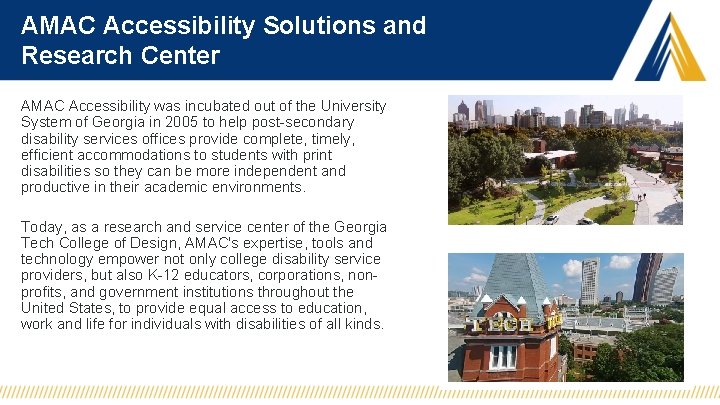
AMAC Accessibility Solutions and Research Center AMAC Accessibility was incubated out of the University System of Georgia in 2005 to help post-secondary disability services offices provide complete, timely, efficient accommodations to students with print disabilities so they can be more independent and productive in their academic environments. Today, as a research and service center of the Georgia Tech College of Design, AMAC's expertise, tools and technology empower not only college disability service providers, but also K-12 educators, corporations, nonprofits, and government institutions throughout the United States, to provide equal access to education, work and life for individuals with disabilities of all kinds.
Outline of the Presentation 1. 2. 3. 4. 5. 6. 7. 8. 9. Accessibility in Online Learning Legal Framework Why AMAC decided to provide a MOOC Content of the MOOC Design Considerations Delivery Challenges Student Enrollment Data Collection Lessons Learned
Introduction Many higher education institutions around the world have been engaging with Massive Open Online Courses (MOOCs) since their creation in 2008 with the purpose of making resources available to students globally. It is undeniable that MOOCs are providing opportunities that were not available in the past to a large number of students, but design of MOOCs requires specific attention if we want to fulfill the aim of reaching as many students as possible. This presentation will illustrate AMAC Accessibility Solutions and Research Center’s experience creating and offering the ICT Accessibility MOOC while discussing the legal framework, design considerations, delivery challenges, and lessons learned. The data gathered from students enrolled in the MOOC will also be provided.

Introduction MOOC, an acronym for Massive Open Online Course, is an online, asynchronous course available to anyone with no cost. Massive refers to the potential of extremely large enrollment globally, which brings the complexity of not knowing the profile of the students. Open means that the course is open to anyone without cost. Spector (2014) explained three strands of the concept of openness in MOOCs as no prerequisites, no cost and easy access. Having no prerequisite and no cost is easily applicable, but providing easy access may not be as uncomplicated as it sounds.

Accessibility in Online Learning Accessibility in the context of online learning means ensuring all learners can access technologies or the content and experience offered by technologies regardless of their disability (Seale & Cooper 2010). The IMS Global Learning Consortium defined accessibility of a learning environment as: ‘Accessibility is the ability of the learning environment to adjust to the needs of all learners. Accessibility is determined by the flexibility of the education environment (with respect to presentation, control methods, access modality, and learner supports) and the availability of adequate alternative-but-equivalent content and activities. Accessible systems adjust the user interface of the learning environment, locate needed resources and adjust the properties of the resources to match the needs and preferences of the user’.

Accessibility in Online Learning IMS’ definition highlights the adaptability and flexibility of learning environments and meeting the student’s needs. Nevertheless, accessibility rarely has been a priority for many online course providers. Higher education institutions are facing lawsuits due to inaccessible web content and technologies, and recently The National Association of the Deaf (NAD) has sued two universities for their inaccessible MOOCs. The prevalence of Massively Open Online Courses with a large number of students with diverse profiles makes accessibility inevitably essential.
Legal Framework In the U. S. , specifications for accessible design have been mandated through legislation. Access to information technology has emerged as a civil right through the American disability rights movement, and while technology improves, federal law has established accessible design specifications for a wide range of information technology (Thatcher et al. 2007). Today, there are significant legal incentives to ensure accessibility of Information and Communication Technology (ICT). Major legislation impacting accessibility for online courses are • • • The Americans with Disabilities Act of 1990 (ADA) Sections 504 and 508 of the Rehabilitation Act of 1973 Section 255 of the Telecommunications Act of 1996 Globally, designing accessible ICT environments is mandated by law in many countries, including the European Union (EU), Canada, Australia, New Zealand, and the Republic of Korea.
Why AMAC decided to provide a MOOC AMAC decided to offer a MOOC on Accessible ICT with the aim of reaching large number of professionals globally and to teach the fundamentals of accessibility design in the ICT field. The course emphasizes on identifying, evaluating and applying strategies and techniques for making electronic information and communication technology services and products in corporate, governmental, and not-for-profit organizations accessible to all users.
Content of the MOOC The instructional design process was accomplished in collaboration with the Center for 21 st Century Universities (C 21 U) at Georgia Tech, and their guideline was followed in terms of components to include, such as content slides, videos, homework, and quizzes. ICT Accessibility had six modules planned: 1. ICT Accessibility, 2. ICT Accessibility Design, 3. Assistive Technology, 4. Accessible Documents and Multimedia, 5. Web Accessibility Evaluation and Design, 6. ICT Accessibility Operations Modules were planned to include video lectures, quizzes, forum discussions, and resources.
Design Considerations A typical MOOC has no on-site attendance and is entirely held online. It mainly includes video lectures and interactive elements such as online tests, self-assessments, and discussion forums. Monje et al. (2015) noted that audiovisual lectures and interactive features of MOOCs may add new difficulties to the accessibility requirements, thus broadening the digital divide for people with disabilities. So, accessibility is becoming crucial for MOOCs to avoid creating extra barriers for students with disabilities all over the word. While developing the ICT Accessibility MOOC, the AMAC team complied with accessibility practices which included, but were not limited to, a MOOC learning management system that conforms with, at minimum, the Web Content Accessibility Guidelines (WCAG) 2. 0 AA, and the platform’s mobile applications did not interfere with any accessibility features around content providers (i. e. , Math. ML for digital mathematical and scientific notation and Digital Accessibility Information Systems (DAISY) standards).
Delivery Challenges - 1 Universities provide MOOCs either on their own or in collaboration with one of the platform providers. MOOC platforms are the web based e-learning systems that allow universities to schedule course curriculum, deliver varied types of assessment, and have synchronous and asynchronous communication with students (Monje et al. 2015). Companies like Coursera, Ed. X, and Udacity are the best known MOOC platform providers in the U. S. Following Georgia Tech’s agreement with one MOOC platform provider, AMAC first attempted to publish the ICT Accessibility MOOC through their platform. In accordance with AMAC’s mission to improve the human condition through equal access to technology-based and research-driven information, services and products, for individuals with disabilities, the first task was conducting an accessibility evaluation of the platform and the results were not satisfactory.
Delivery Challenges - 2 Being aware of the accessibility problems of the platform, AMAC decided to move the course to a more accessible MOOC platform for student participant experiences and to reduce legal ramifications for Georgia Tech. In the search for a more accessible MOOC platform, AMAC conducted an audit on Ed. X on November 6, 2015. The general conformance of the Ed. X website with the W 3 C's Web Content Accessibility Guidelines (WCAG) 2. 0 (Level AA) was evaluated and results were satisfactory. It was clear that time and energy had been spent enhancing the accessibility of the Ed. X platform, including effectively labeled links, images, and multiple options for accessing multimedia content such as transcripts, downloadable mp 4 files, and preventing videos from automatically playing.
Delivery Challenges - 3 Still, there were some outstanding issues that needed to be addressed to improve web accessibility, including increased contrast, improved implementation of headings for structure rather simply design, and the removal of duplicated links on some pages. The AMAC team decided to go with Ed. X based on the results of an accessibility evaluation audit in addition to the Ed. X pro-active commitment toward accessibility. The platform transition process took two months and by February 29, 2016 the course was launched as an on-demand self-paced study.
MOOC video https: //youtu. be/Iyiq. Wl_o 0 V 4
Student Enrollment ICT Accessibility MOOC was launched as an on-demand self-paced course on February 29, 2016. By October 2017: • The total enrollment of the course was 8359 • 172 countries were represented • The top three countries represented were the U. S. , India, and Nepal. • The median student age was 29 • 41% of the students reported having a college degree
Data Collection AMAC developed a pre-test, a post-test, and a course evaluation survey to gather data from students to evaluate effectiveness of the course.
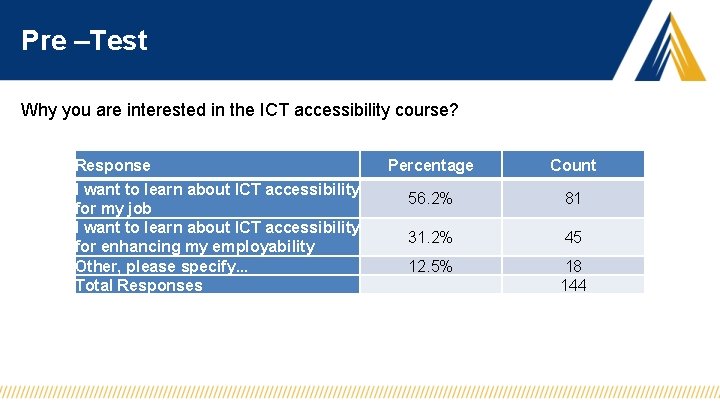
Pre –Test Why you are interested in the ICT accessibility course? Response I want to learn about ICT accessibility for my job I want to learn about ICT accessibility for enhancing my employability Other, please specify. . . Total Responses Percentage Count 56. 2% 81 31. 2% 45 12. 5% 18 144
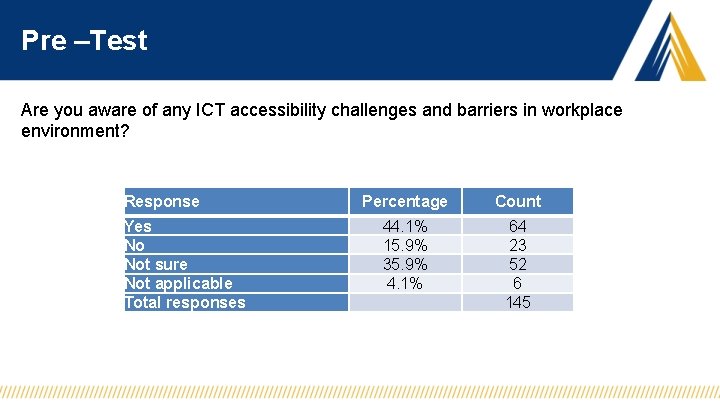
Pre –Test Are you aware of any ICT accessibility challenges and barriers in workplace environment? Response Yes No Not sure Not applicable Total responses Percentage Count 44. 1% 15. 9% 35. 9% 4. 1% 64 23 52 6 145
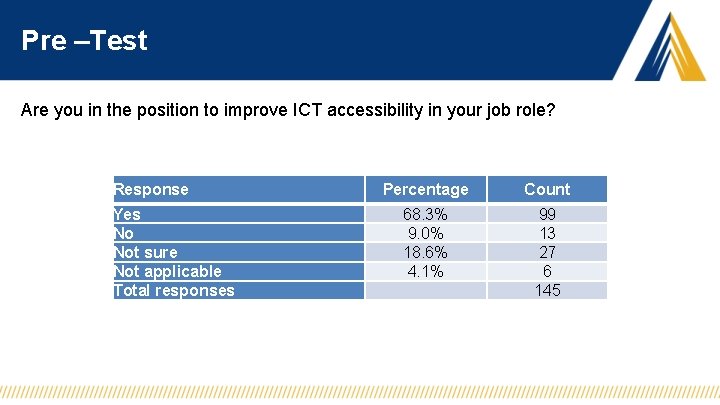
Pre –Test Are you in the position to improve ICT accessibility in your job role? Response Yes No Not sure Not applicable Total responses Percentage Count 68. 3% 9. 0% 18. 6% 4. 1% 99 13 27 6 145
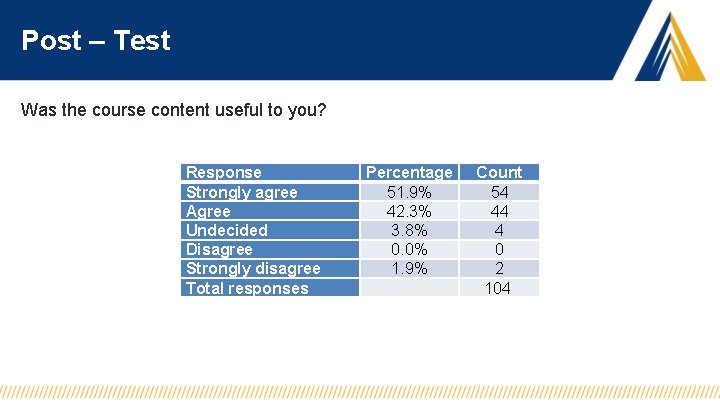
Post – Test Was the course content useful to you? Response Strongly agree Agree Undecided Disagree Strongly disagree Total responses Percentage 51. 9% 42. 3% 3. 8% 0. 0% 1. 9% Count 54 44 4 0 2 104
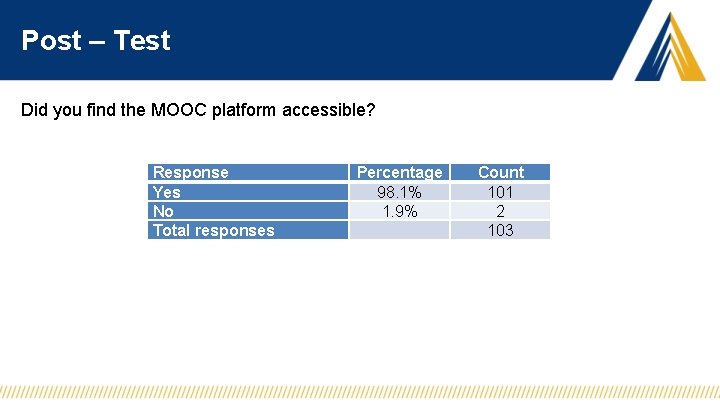
Post – Test Did you find the MOOC platform accessible? Response Yes No Total responses Percentage 98. 1% 1. 9% Count 101 2 103
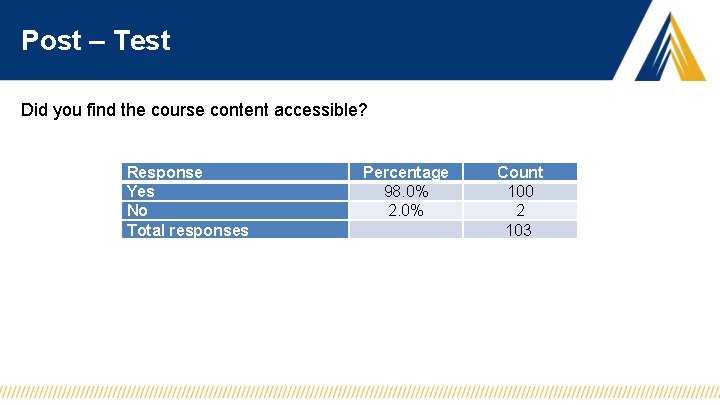
Post – Test Did you find the course content accessible? Response Yes No Total responses Percentage 98. 0% 2. 0% Count 100 2 103
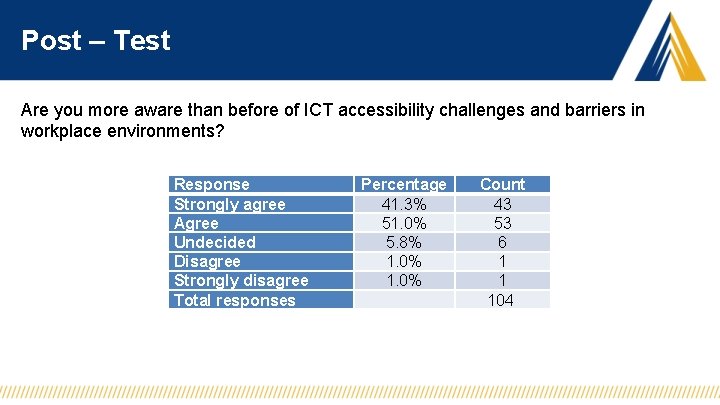
Post – Test Are you more aware than before of ICT accessibility challenges and barriers in workplace environments? Response Strongly agree Agree Undecided Disagree Strongly disagree Total responses Percentage 41. 3% 51. 0% 5. 8% 1. 0% Count 43 53 6 1 1 104
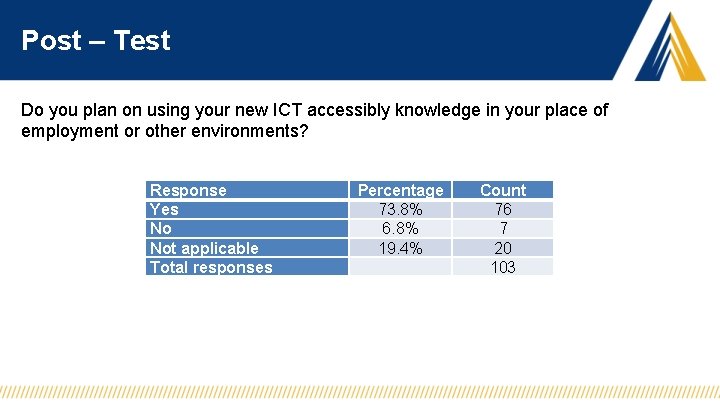
Post – Test Do you plan on using your new ICT accessibly knowledge in your place of employment or other environments? Response Yes No Not applicable Total responses Percentage 73. 8% 6. 8% 19. 4% Count 76 7 20 103
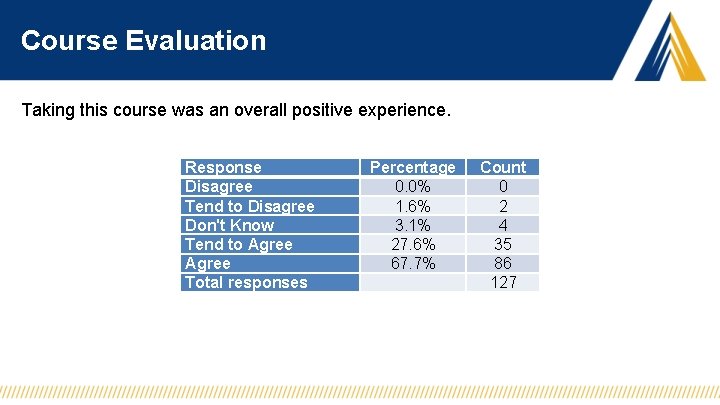
Course Evaluation Taking this course was an overall positive experience. Response Disagree Tend to Disagree Don't Know Tend to Agree Total responses Percentage 0. 0% 1. 6% 3. 1% 27. 6% 67. 7% Count 0 2 4 35 86 127
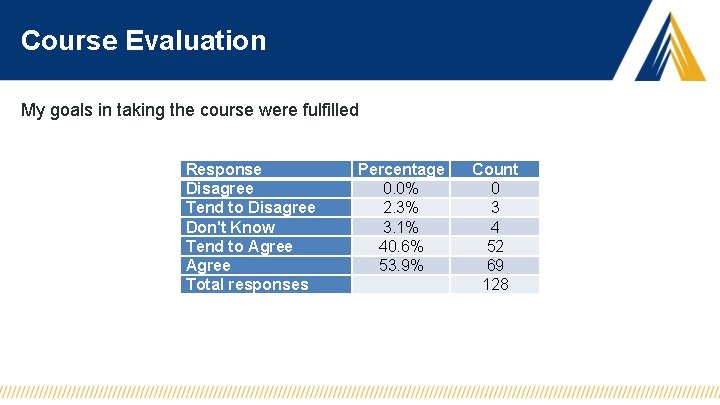
Course Evaluation My goals in taking the course were fulfilled Response Disagree Tend to Disagree Don't Know Tend to Agree Total responses Percentage 0. 0% 2. 3% 3. 1% 40. 6% 53. 9% Count 0 3 4 52 69 128
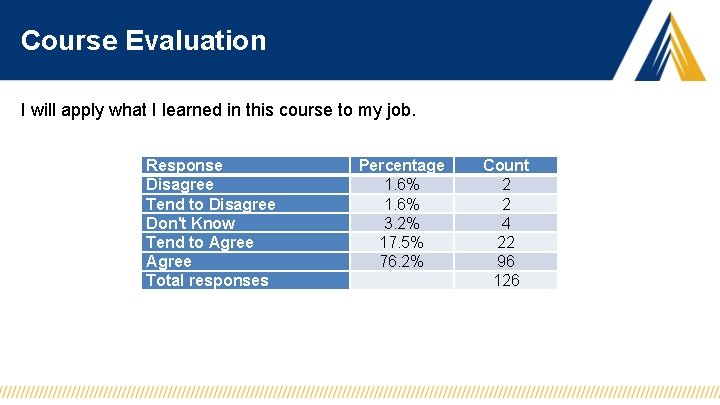
Course Evaluation I will apply what I learned in this course to my job. Response Disagree Tend to Disagree Don't Know Tend to Agree Total responses Percentage 1. 6% 3. 2% 17. 5% 76. 2% Count 2 2 4 22 96 126
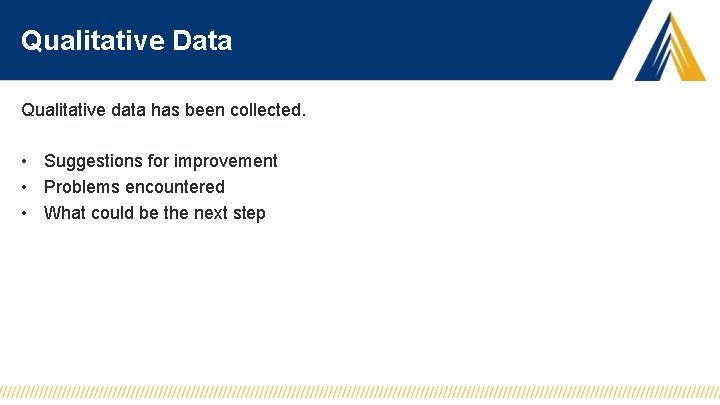
Qualitative Data Qualitative data has been collected. • Suggestions for improvement • Problems encountered • What could be the next step
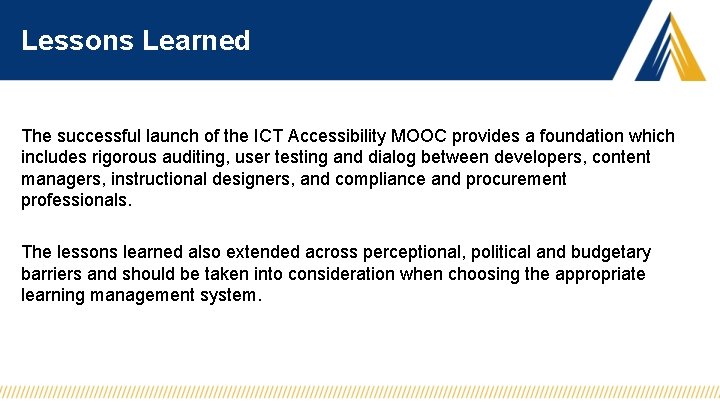
Lessons Learned The successful launch of the ICT Accessibility MOOC provides a foundation which includes rigorous auditing, user testing and dialog between developers, content managers, instructional designers, and compliance and procurement professionals. The lessons learned also extended across perceptional, political and budgetary barriers and should be taken into consideration when choosing the appropriate learning management system.
Q&A
- Slides: 32