
Developing a Workforce Using CompetencyBased Management to Improve
Developing a Workforce Using Competency-Based Management to Improve Performance in the RCMP William Pullen
Organizational Context • RCMP: Canada’s national police force (about 28, 000 in 2008). • Federal Roles: National Security, Drugs, Organized Crime, etc. • Provincial: Contract policing (except Ontario, Quebec and parts of Nfld. ) • Municipal & Rural: Contract policing (from small to very large) • Competency-Based Management (CBM) implemented 2001. Ongoing. • • • Extensive employee participation in CBM Project. Support from consultants (Hay Grp & HRSG) Organizational & Functional Competencies identified Competency Dictionary & Profiles • CBM used to improve front-line police performance 2002 – 2010 in 300+ Dets. /Units. • Today: CBM is embedded in RCMP culture • Leadership Talent Pipeline in place for Supervisors and Managers. • CBM embedded in promotional processes and police language. 2
Competency-based Management (CBM) • A way to develop a workforce by connecting strategy and behaviours. • Focus is on knowledge, skills, & abilities necessary for job success. • Establishes a common language for workforce development. • CBM Framework usually has four moving parts: • • Competency Model aligned with organizational values and strategic priorities. Interpersonal and functional competencies identified through a rigorous task analysis. A Competency Dictionary organizes and displays competencies in terms of proficiency Competency profiles that show a job’s required competencies and expected level of proficiency. • CBM enables talent management and change/transformation. 3
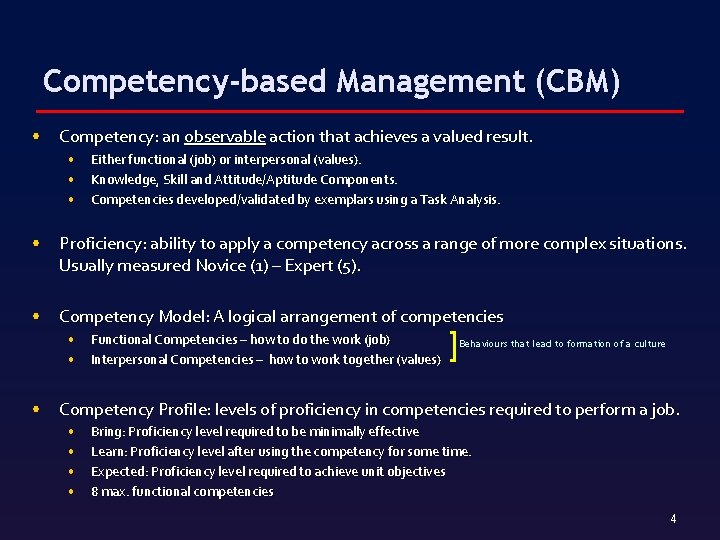
Competency-based Management (CBM) • Competency: an observable action that achieves a valued result. • • • Either functional (job) or interpersonal (values). Knowledge, Skill and Attitude/Aptitude Components. Competencies developed/validated by exemplars using a Task Analysis. • Proficiency: ability to apply a competency across a range of more complex situations. Usually measured Novice (1) – Expert (5). • Competency Model: A logical arrangement of competencies • • Functional Competencies – how to do the work (job) Interpersonal Competencies – how to work together (values) Behaviours that lead to formation of a culture • Competency Profile: levels of proficiency in competencies required to perform a job. • • Bring: Proficiency level required to be minimally effective Learn: Proficiency level after using the competency for some time. Expected: Proficiency level required to achieve unit objectives 8 max. functional competencies 4
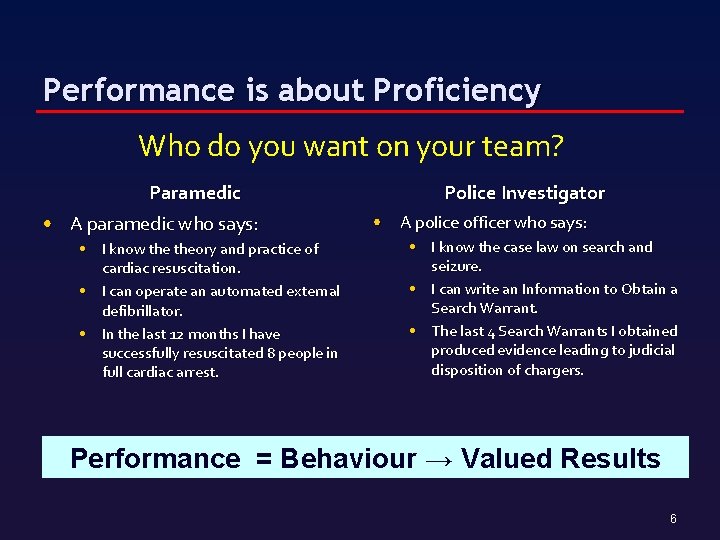
Performance is about Proficiency Who do you want on your team? Paramedic • A paramedic who says: • I know theory and practice of cardiac resuscitation. • I can operate an automated external defibrillator. • In the last 12 months I have successfully resuscitated 8 people in full cardiac arrest. Police Investigator • A police officer who says: • I know the case law on search and seizure. • I can write an Information to Obtain a Search Warrant. • The last 4 Search Warrants I obtained produced evidence leading to judicial disposition of chargers. Performance = Behaviour → Valued Results 6
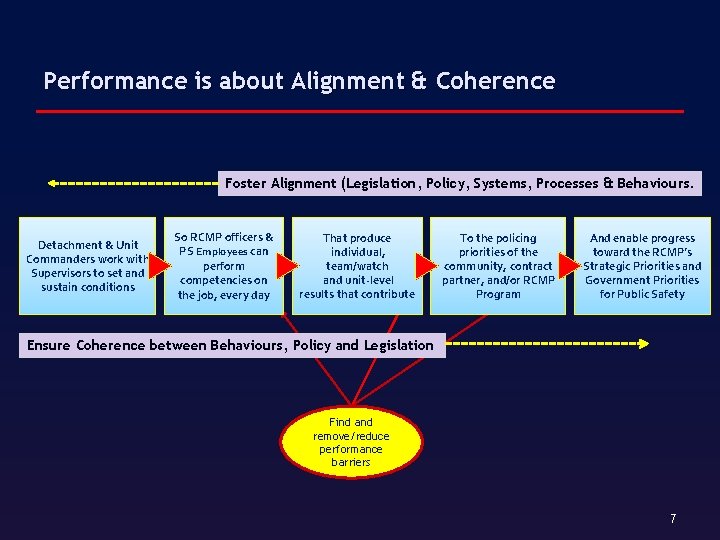
Performance is about Alignment & Coherence Foster Alignment (Legislation, Policy, Systems, Processes & Behaviours. Detachment & Unit Commanders work with Supervisors to set and sustain conditions So RCMP officers & PS Employees can perform competencies on the job, every day That produce individual, team/watch and unit-level results that contribute To the policing priorities of the community, contract partner, and/or RCMP Program And enable progress toward the RCMP’s Strategic Priorities and Government Priorities for Public Safety Ensure Coherence between Behaviours, Policy and Legislation Find and remove/reduce performance barriers 7
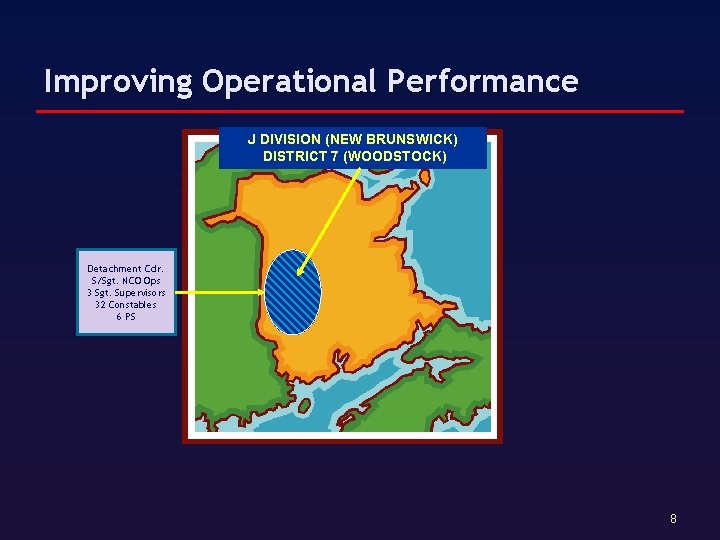
Improving Operational Performance J DIVISION (NEW BRUNSWICK) DISTRICT 7 (WOODSTOCK) Detachment Cdr. S/Sgt. NCO Ops 3 Sgt. Supervisors 32 Constables 6 PS 8
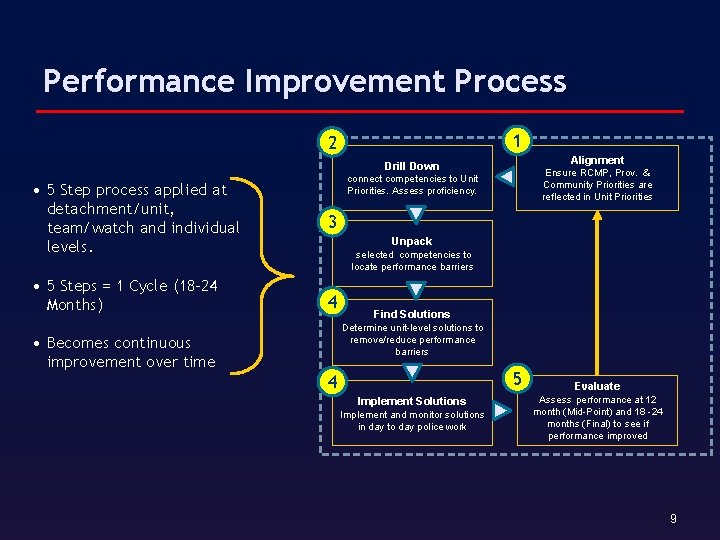
Performance Improvement Process 1 2 Alignment Drill Down Ensure RCMP, Prov. & Community Priorities are reflected in Unit Priorities connect competencies to Unit Priorities. Assess proficiency. • 5 Step process applied at detachment/unit, team/watch and individual levels. 3 • 5 Steps = 1 Cycle (18 -24 Months) 4 Unpack selected competencies to locate performance barriers Find Solutions Determine unit-level solutions to remove/reduce performance barriers • Becomes continuous improvement over time 5 4 Implement Solutions Implement and monitor solutions in day to day police work Evaluate Assess performance at 12 month (Mid-Point) and 18 -24 months (Final) to see if performance improved 9
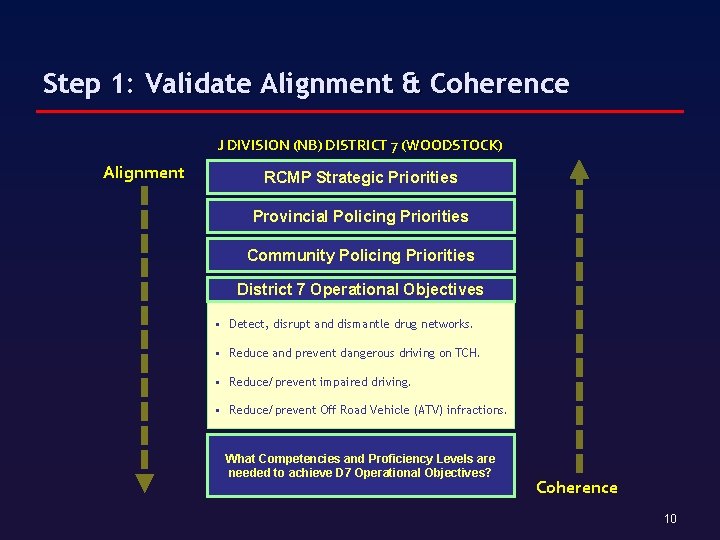
Step 1: Validate Alignment & Coherence J DIVISION (NB) DISTRICT 7 (WOODSTOCK) Alignment RCMP Strategic Priorities Provincial Policing Priorities Community Policing Priorities District 7 Operational Objectives • Detect, disrupt and dismantle drug networks. • Reduce and prevent dangerous driving on TCH. • Reduce/prevent impaired driving. • Reduce/prevent Off Road Vehicle (ATV) infractions. What Competencies and Proficiency Levels are needed to achieve D 7 Operational Objectives? Coherence 10
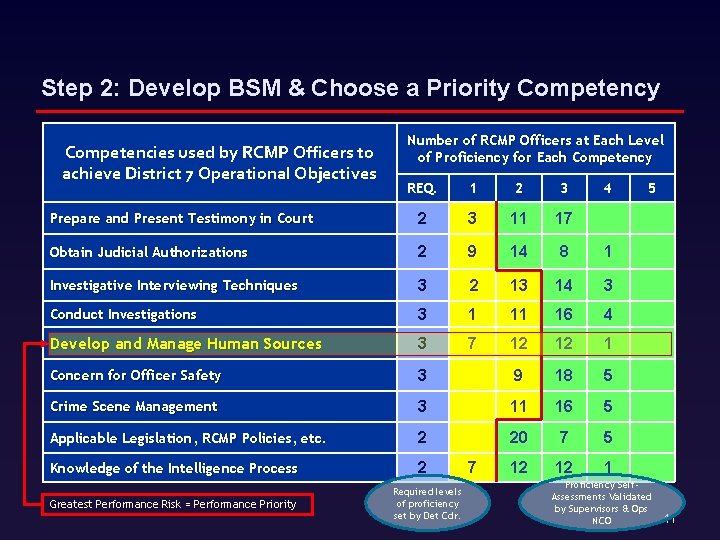
Step 2: Develop BSM & Choose a Priority Competencies used by RCMP Officers to achieve District 7 Operational Objectives Number of RCMP Officers at Each Level of Proficiency for Each Competency REQ. 1 2 3 Prepare and Present Testimony in Court 2 3 11 17 Obtain Judicial Authorizations 2 9 14 8 1 Investigative Interviewing Techniques 3 2 13 14 3 Conduct Investigations 3 1 11 16 4 Develop and Manage Human Sources 3 7 12 12 1 Concern for Officer Safety 3 9 18 5 Crime Scene Management 3 11 16 5 Applicable Legislation, RCMP Policies, etc. 2 20 7 5 Knowledge of the Intelligence Process 2 12 12 1 Greatest Performance Risk = Performance Priority Required levels of proficiency set by Det Cdr. 7 4 5 Proficiency Self. Assessments Validated by Supervisors & Ops NCO 11
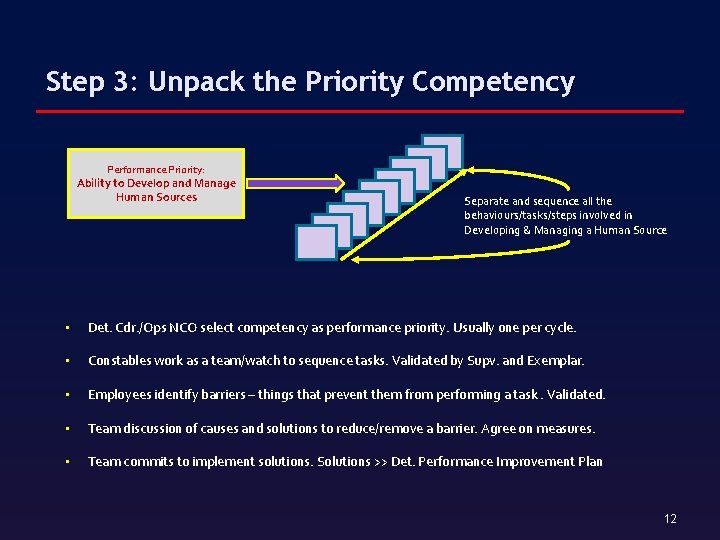
Step 3: Unpack the Priority Competency Performance Priority: Ability to Develop and Manage Human Sources Separate and sequence all the behaviours/tasks/steps involved in Developing & Managing a Human Source • Det. Cdr. /Ops NCO select competency as performance priority. Usually one per cycle. • Constables work as a team/watch to sequence tasks. Validated by Supv. and Exemplar. • Employees identify barriers – things that prevent them from performing a task. Validated. • Team discussion of causes and solutions to reduce/remove a barrier. Agree on measures. • Team commits to implement solutions. Solutions >> Det. Performance Improvement Plan 12
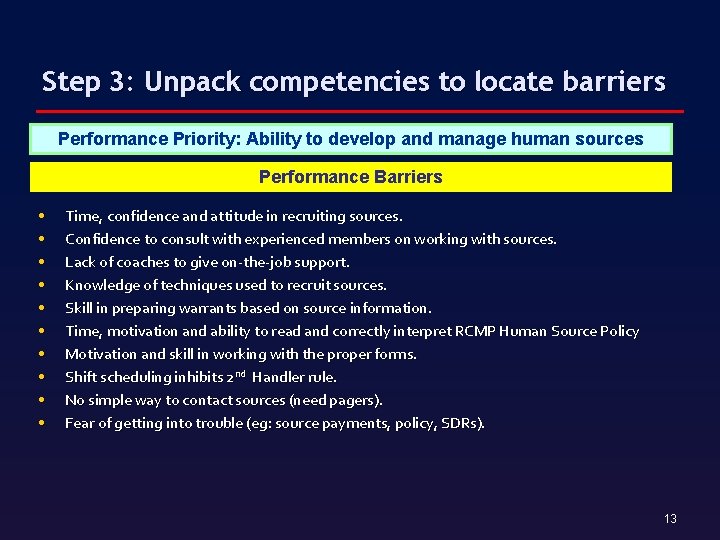
Step 3: Unpack competencies to locate barriers Performance Priority: Ability to develop and manage human sources Performance Barriers • • • Time, confidence and attitude in recruiting sources. Confidence to consult with experienced members on working with sources. Lack of coaches to give on-the-job support. Knowledge of techniques used to recruit sources. Skill in preparing warrants based on source information. Time, motivation and ability to read and correctly interpret RCMP Human Source Policy Motivation and skill in working with the proper forms. Shift scheduling inhibits 2 nd Handler rule. No simple way to contact sources (need pagers). Fear of getting into trouble (eg: source payments, policy, SDRs). 13
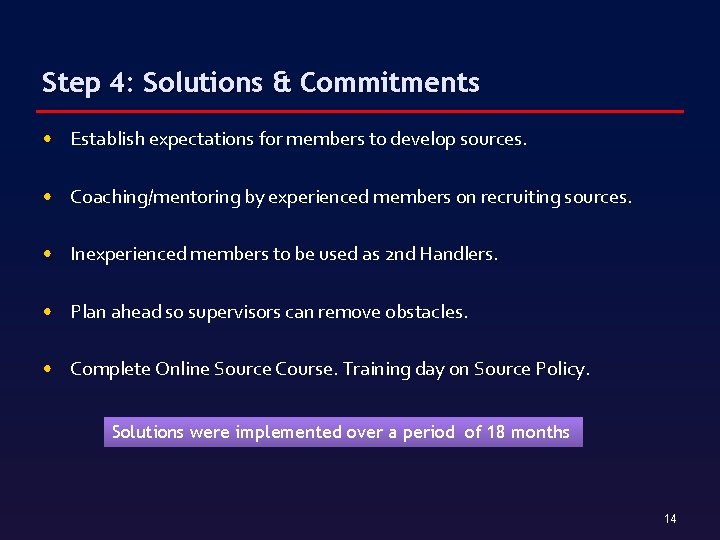
Step 4: Solutions & Commitments • Establish expectations for members to develop sources. • Coaching/mentoring by experienced members on recruiting sources. • Inexperienced members to be used as 2 nd Handlers. • Plan ahead so supervisors can remove obstacles. • Complete Online Source Course. Training day on Source Policy. Solutions were implemented over a period of 18 months 14
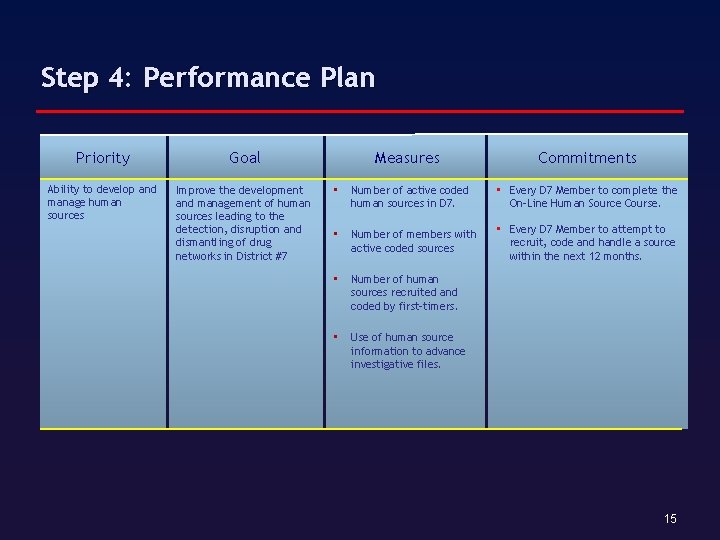
Step 4: Performance Plan Priority Goal Ability to develop and manage human sources Improve the development and management of human sources leading to the detection, disruption and dismantling of drug networks in District #7 Measures • Number of active coded human sources in D 7. • Number of members with active coded sources • Number of human sources recruited and coded by first-timers. • Use of human source information to advance investigative files. Commitments • Every D 7 Member to complete the On-Line Human Source Course. • Every D 7 Member to attempt to recruit, code and handle a source within the next 12 months. 15
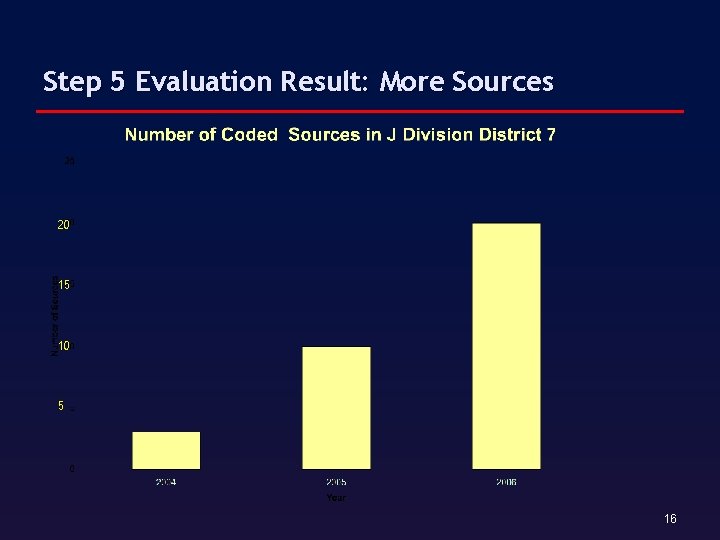
Step 5 Evaluation Result: More Sources 20 15 10 5 16
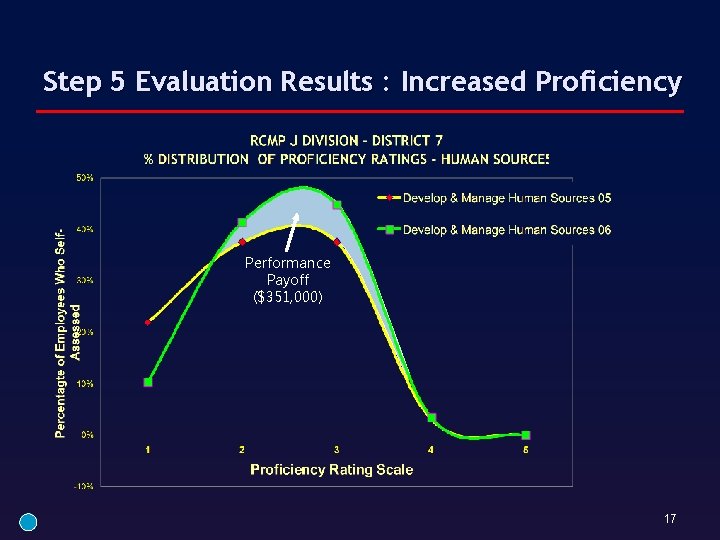
Step 5 Evaluation Results : Increased Proficiency Performance Payoff ($351, 000) 17
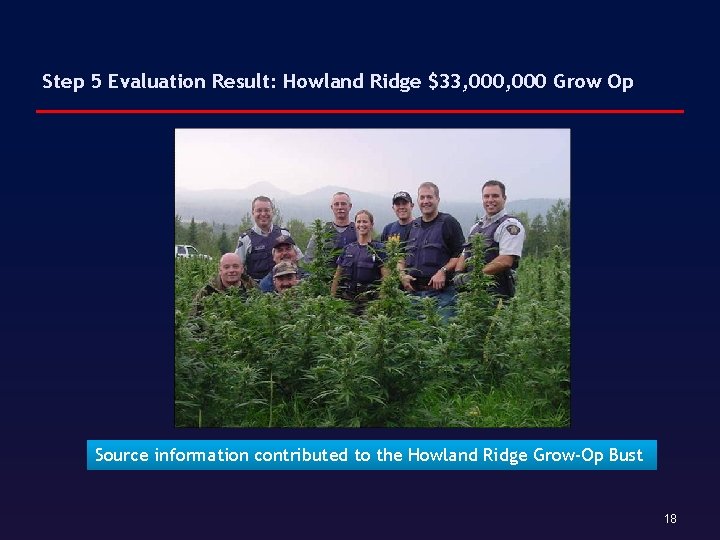
Step 5 Evaluation Result: Howland Ridge $33, 000 Grow Op Source information contributed to the Howland Ridge Grow-Op Bust 18
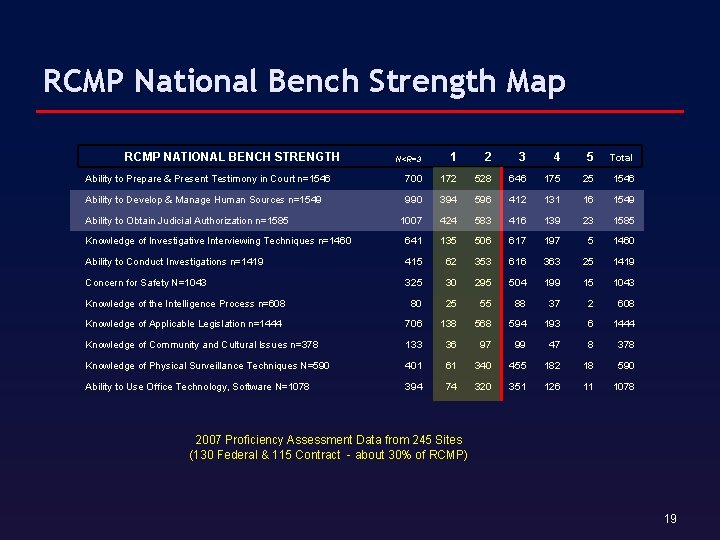
RCMP National Bench Strength Map RCMP NATIONAL BENCH STRENGTH N<R=3 1 2 3 4 5 Total Ability to Prepare & Present Testimony in Court n=1546 700 172 528 646 175 25 1546 Ability to Develop & Manage Human Sources n=1549 990 394 596 412 131 16 1549 1007 424 583 416 139 23 1585 Knowledge of Investigative Interviewing Techniques n=1460 641 135 506 617 197 5 1460 Ability to Conduct Investigations n=1419 415 62 353 616 363 25 1419 Concern for Safety N=1043 325 30 295 504 199 15 1043 Knowledge of the Intelligence Process n=608 80 25 55 88 37 2 608 Knowledge of Applicable Legislation n=1444 706 138 568 594 193 6 1444 Knowledge of Community and Cultural Issues n=378 133 36 97 99 47 8 378 Knowledge of Physical Surveillance Techniques N=590 401 61 340 455 182 18 590 Ability to Use Office Technology, Software N=1078 394 74 320 351 126 11 1078 Ability to Obtain Judicial Authorization n=1585 2007 Proficiency Assessment Data from 245 Sites (130 Federal & 115 Contract - about 30% of RCMP) 19
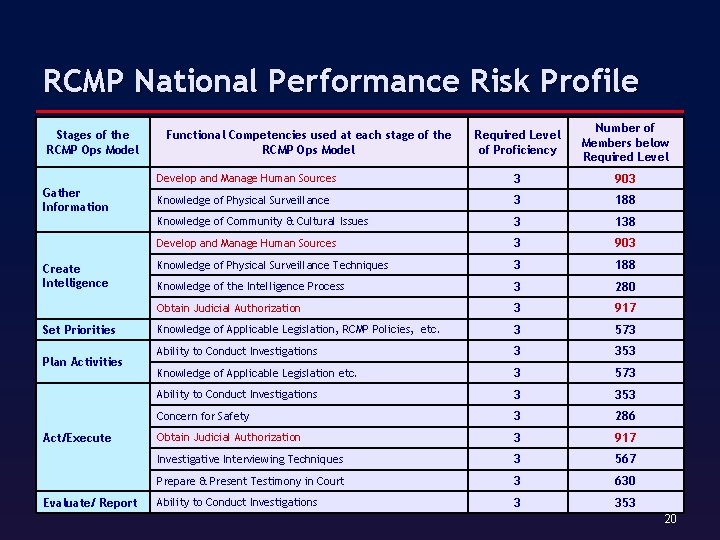
RCMP National Performance Risk Profile Stages of the RCMP Ops Model Gather Information Create Intelligence Set Priorities Plan Activities Act/Execute Evaluate/ Report Required Level of Proficiency Number of Members below Required Level Develop and Manage Human Sources 3 903 Knowledge of Physical Surveillance 3 188 Knowledge of Community & Cultural Issues 3 138 Develop and Manage Human Sources 3 903 Knowledge of Physical Surveillance Techniques 3 188 Knowledge of the Intelligence Process 3 280 Obtain Judicial Authorization 3 917 Knowledge of Applicable Legislation, RCMP Policies, etc. 3 573 Ability to Conduct Investigations 3 353 Knowledge of Applicable Legislation etc. 3 573 Ability to Conduct Investigations 3 353 Concern for Safety 3 286 Obtain Judicial Authorization 3 917 Investigative Interviewing Techniques 3 567 Prepare & Present Testimony in Court 3 630 Ability to Conduct Investigations 3 353 Functional Competencies used at each stage of the RCMP Ops Model 20
Lessons Learned • Engage people in a structured conversation about becoming better. • Faster is not better. Better is better. • HR Churn: attrition and frequent staffing actions create performance risk. • Rapid Leadership Turnover: Frequent change disconnects units and leaders. • Change Fatigue: multiple current and legacy demands on time and energy. 21

Questions or Comments?
- Slides: 21