
Developing a tennis calculator to teach probability and
Developing a tennis calculator to teach probability and statistics Tristan Barnett University of South Australia
Background Barnett T and Clarke SR (2005). Combining player statistics to predict outcomes of tennis matches. IMA Journal of Management Mathematics. 16 (2), 113 -120. Barnett T (2006). Mathematical modelling in hierarchical games with specific reference to tennis, Ph. D thesis, Swinburne University of Technology, Melbourne. Brown A, Barnett T and Pollard G (2008). A recursion method for evaluating the moments of a nested scoring system. In proceedings of the 9 M&CS. Interactive tennis calculator (2009). Strategic Games. Barnett T, O'Shaughnessy D and Bedford A (2011). Predicting a
Strategic Games www. strategicgames. com. au Home (interactive tennis calculator) Ideology The Baron’s Portfolio Who is the Baron? Sport Gambling Conflicts Sponsors Contact The Baron’s Blog
The Mathematics of Tennis Teaching concepts in probability and statistics - summing an infinite series - generating functions - Binomial theorem - Markov Chain theory Building a tennis calculator using spreadsheets - teaching backward recursion - teaching forward recursion - teaching mean, variance, skewness - teaching properties M(a. X+b)=a. M(X)+b, V(a. X+b)=a 2 V(X) - teaching the use of Excel software
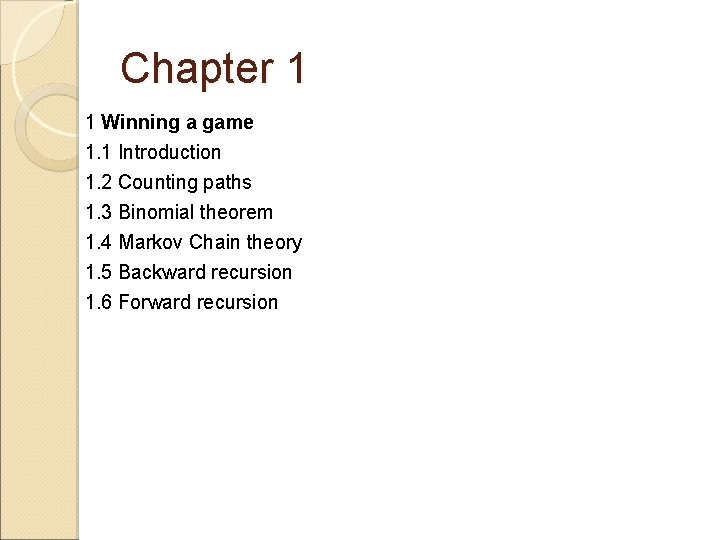
Chapter 1 1 Winning a game 1. 1 Introduction 1. 2 Counting paths 1. 3 Binomial theorem 1. 4 Markov Chain theory 1. 5 Backward recursion 1. 6 Forward recursion
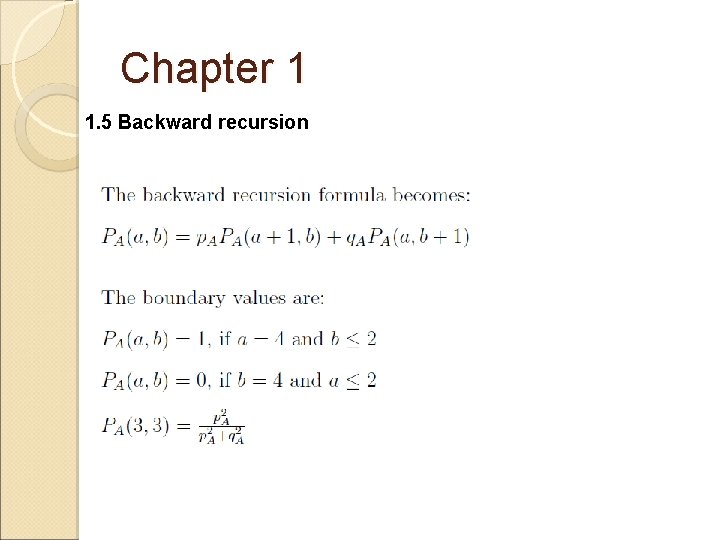
Chapter 1 1. 5 Backward recursion
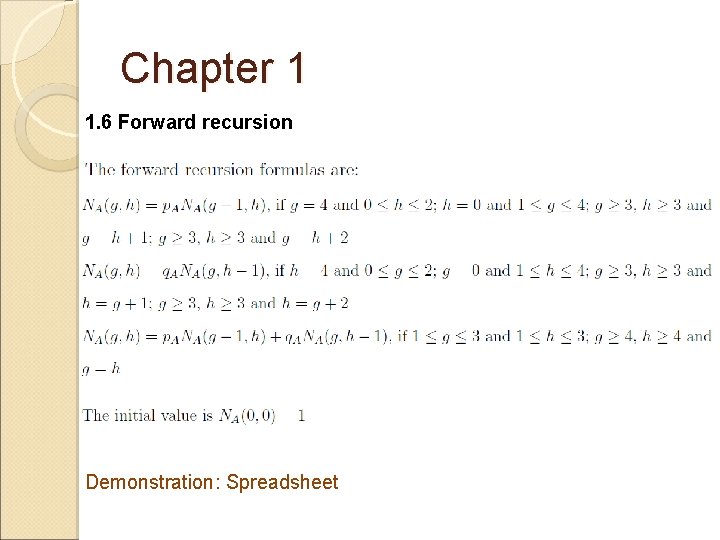
Chapter 1 1. 6 Forward recursion Demonstration: Spreadsheet
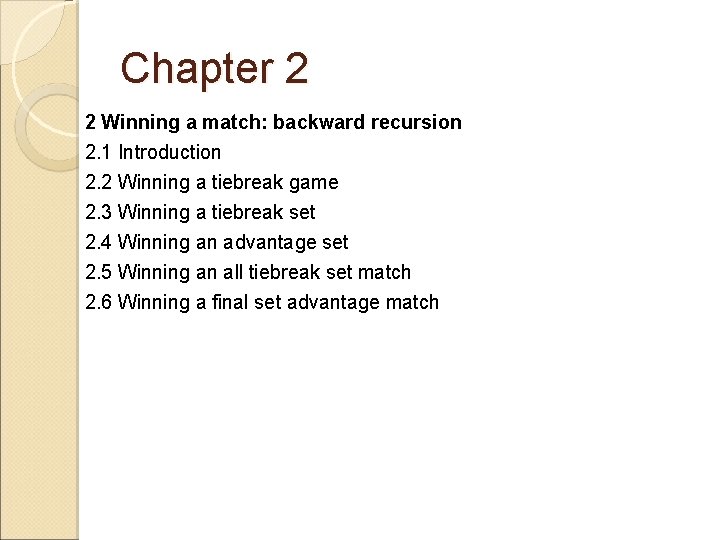
Chapter 2 2 Winning a match: backward recursion 2. 1 Introduction 2. 2 Winning a tiebreak game 2. 3 Winning a tiebreak set 2. 4 Winning an advantage set 2. 5 Winning an all tiebreak set match 2. 6 Winning a final set advantage match
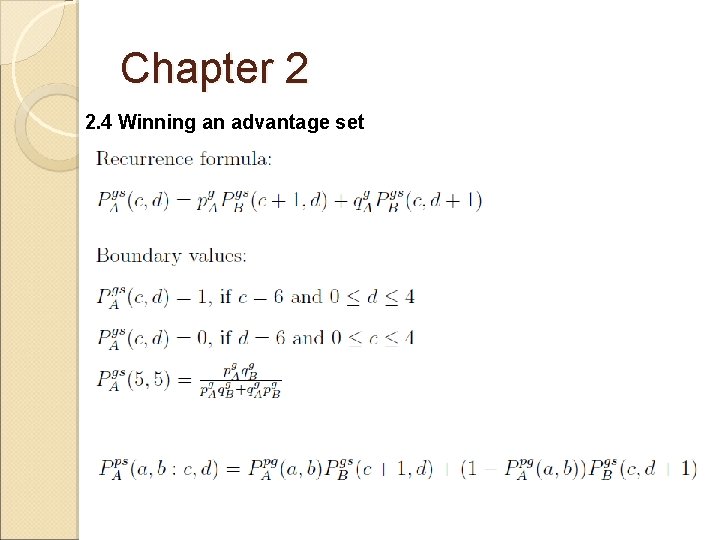
Chapter 2 2. 4 Winning an advantage set
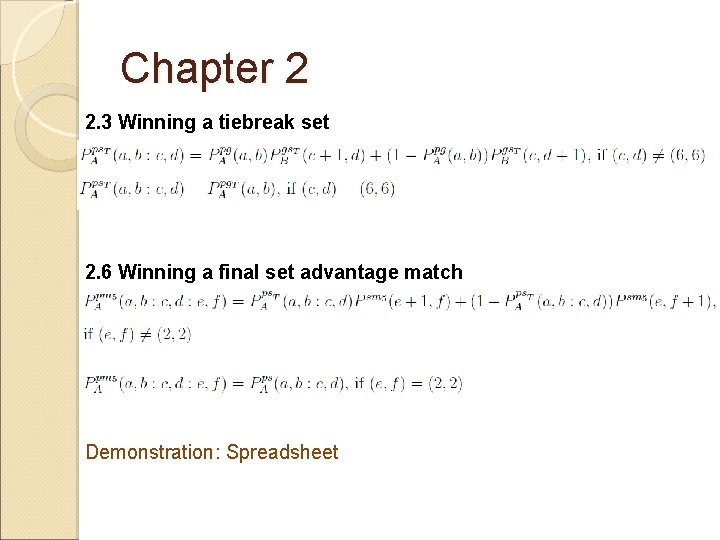
Chapter 2 2. 3 Winning a tiebreak set 2. 6 Winning a final set advantage match Demonstration: Spreadsheet
Chapter 3 Winning a match: forward recursion 3. 1 Introduction 3. 2 Winning a game 3. 3 Winning a tiebreak game 3. 4 Winning a tiebreak set 3. 5 Winning an advantage set 3. 6 Winning an all tiebreak set match 3. 7 Winning a final set advantage match
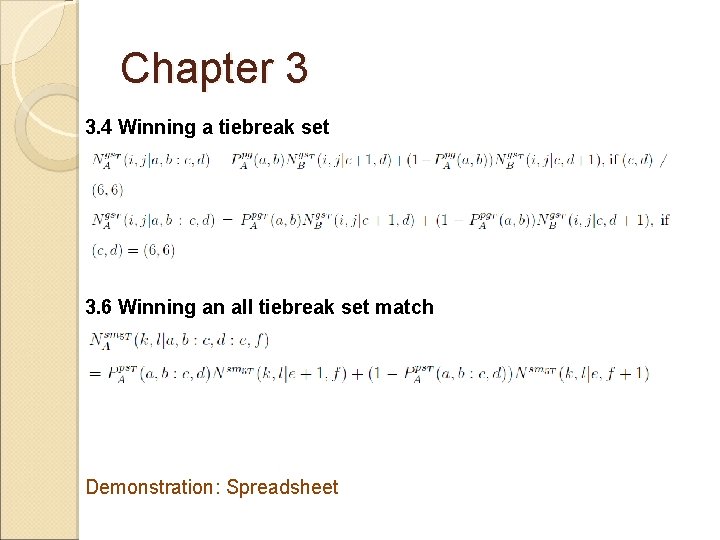
Chapter 3 3. 4 Winning a tiebreak set 3. 6 Winning an all tiebreak set match Demonstration: Spreadsheet
Chapter 4 4 Duration of a game 4. 1 Introduction 4. 2 Binomial theorem 4. 3 Generating functions 4. 4 Forward recursion 4. 5 Backward recursion
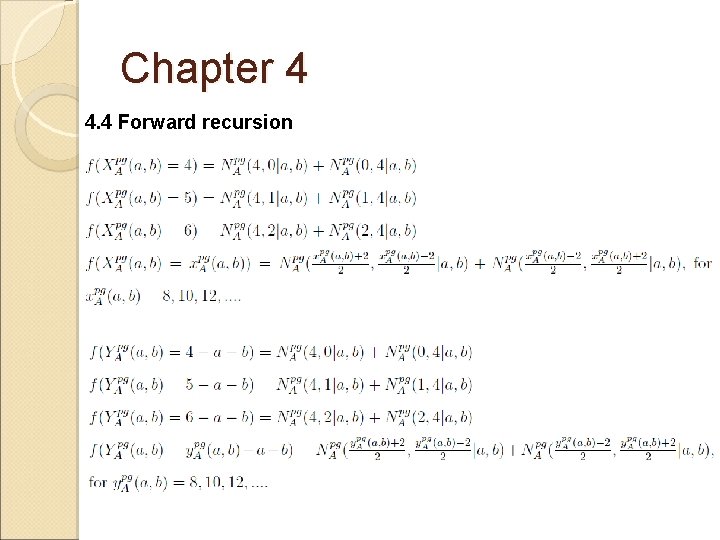
Chapter 4 4. 4 Forward recursion
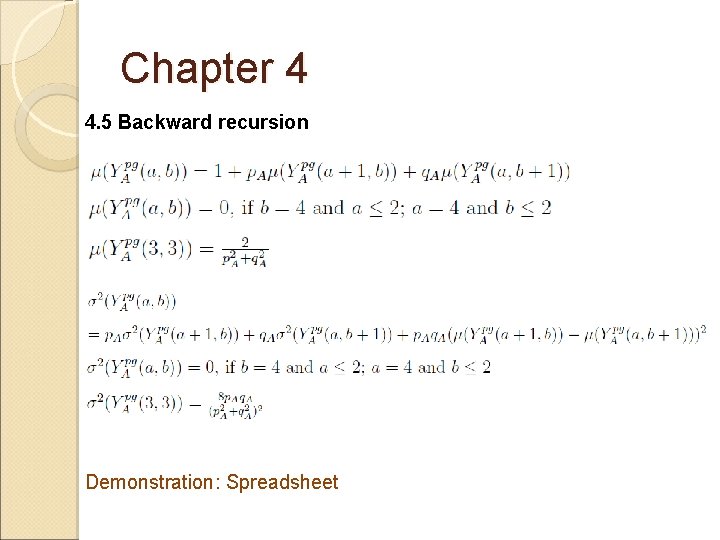
Chapter 4 4. 5 Backward recursion Demonstration: Spreadsheet
Chapter 5 5 Duration of a match: 1/2/ 5. 1 Introduction 5. 2 Number of points in a tiebreak game 5. 3 Number of games in a tiebreak set 5. 4 Number of games in an advantage set 5. 5 Number of sets in a match
Chapter 6 6 Duration of a match: 1/4/ 6. 1 Introduction 6. 2 Number of points in a game 6. 3 Number of points in a tiebreak game 6. 4 Number of games in a tiebreak set 6. 5 Number of games in an advantage set 6. 6 Number of sets in a match
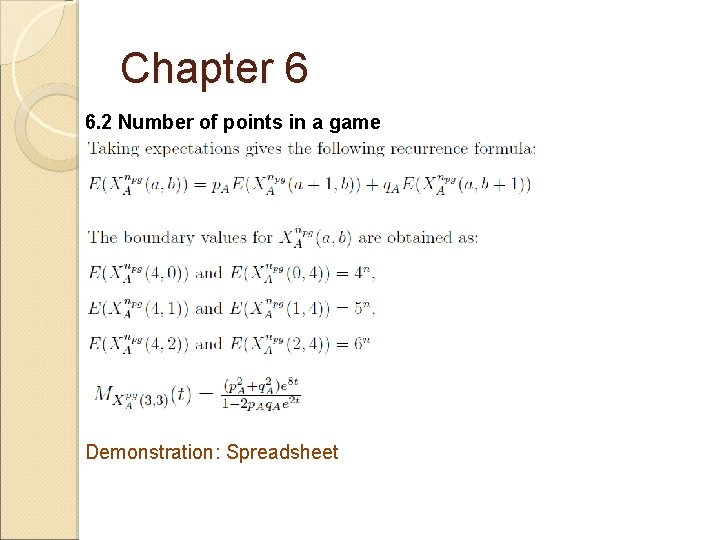
Chapter 6 6. 2 Number of points in a game Demonstration: Spreadsheet
Chapter 7 7 Duration of a match: 4/4/ 7. 1 Introduction 7. 2 Number of points in a game 7. 3 Number of point in a tiebreak game 7. 4 Number of points in a set 7. 5 Number of points in a match 7. 6 Time duration in a match
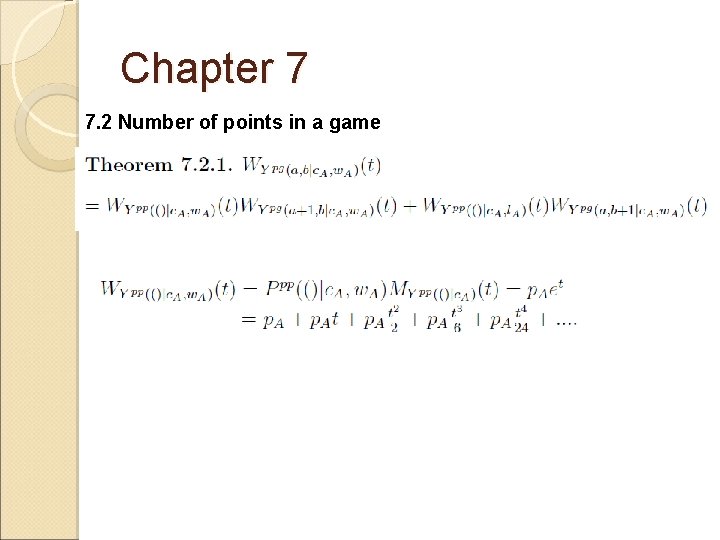
Chapter 7 7. 2 Number of points in a game
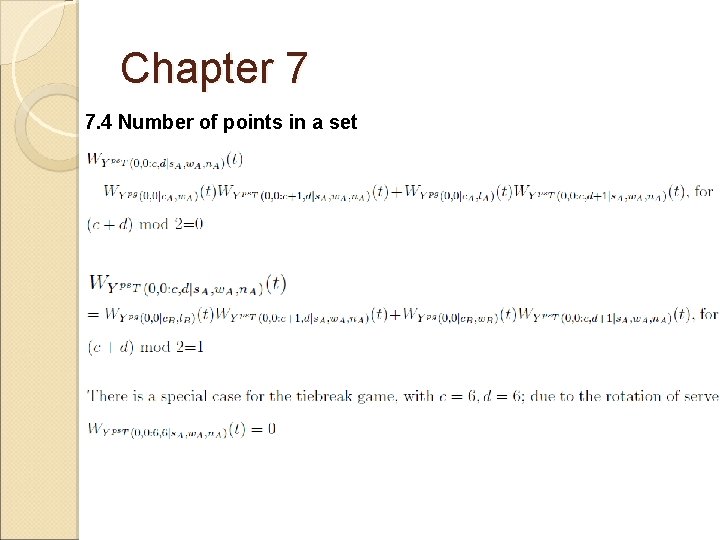
Chapter 7 7. 4 Number of points in a set
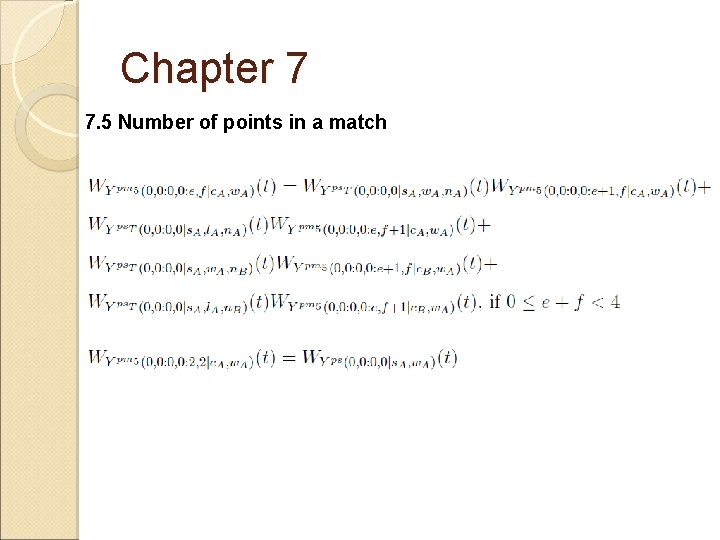
Chapter 7 7. 5 Number of points in a match
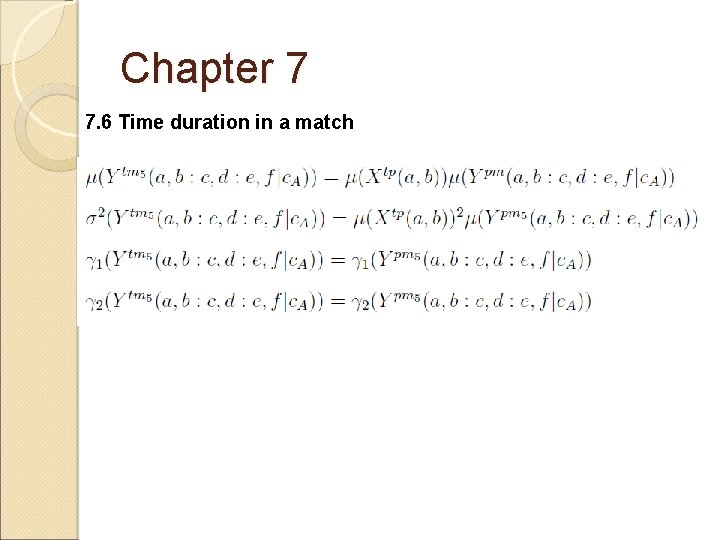
Chapter 7 7. 6 Time duration in a match
Chapter 8 8 Predictions 8. 1 Introduction 8. 2 Data Analysis 8. 3 Updating Rule 8. 4 John Isner vs Nicholas Mahut 8. 5 Sports Multimedia
- Slides: 24