
Developing a Smoking Cessation Program in the Acute

- Slides: 33
Developing a Smoking Cessation Program in the Acute Care Setting Understanding Tobacco Dependence Janis M Dauer, MS, CAC Alliance for the Prevention and Treatment of Nicotine Addiction jdauer@aptna. org
Understanding Tobacco Dependence NICOTINE l l Nicotine: Wonder Drug l l Increases alertness/attention Improves task performance Acts as stimulant & sedative Acts as antidepressant and/or anti-anxiety agent Causes adrenaline rush and release of glucose, suppresses insulin output Increases heart rate, respiration & BP
Understanding Tobacco Dependence NICOTINE l l Decreases appetite, interferes with absorption of nutrients Vasoconstrictor: decreases circulation in extremities l 90% of nicotine in cigarette smoke is absorbed in the lungs l Takes about 10 seconds to reach brain (and to feel the effects)
Understanding Tobacco Dependence NICOTINE l “Dose” easy to modify by how cigarette is smoked (1 -2 mg extracted/cigarette on average) l Each cigarette: 10 puffs taken over 5 minutes (200 Ahits@ per pack) l Short half-life results in withdrawal symptoms soon after last dose l Toxic in high doses l Cigarettes/tobacco: cheap, easy to get, portable References: 1 -4
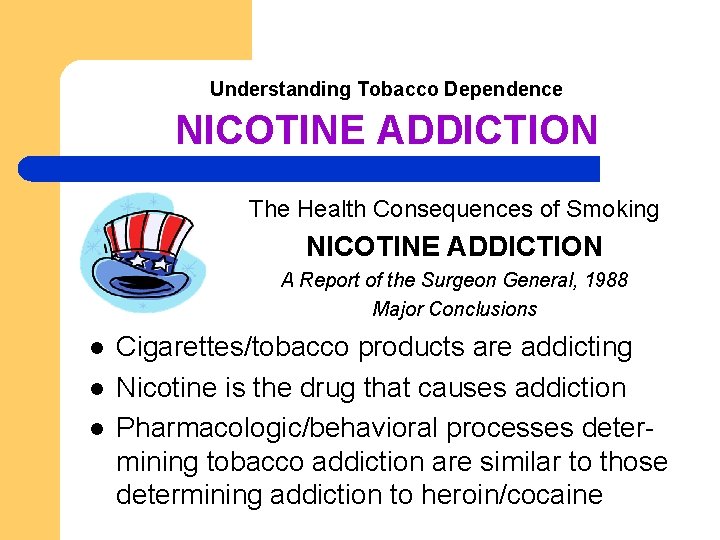
Understanding Tobacco Dependence NICOTINE ADDICTION The Health Consequences of Smoking NICOTINE ADDICTION A Report of the Surgeon General, 1988 Major Conclusions l l l Cigarettes/tobacco products are addicting Nicotine is the drug that causes addiction Pharmacologic/behavioral processes determining tobacco addiction are similar to those determining addiction to heroin/cocaine
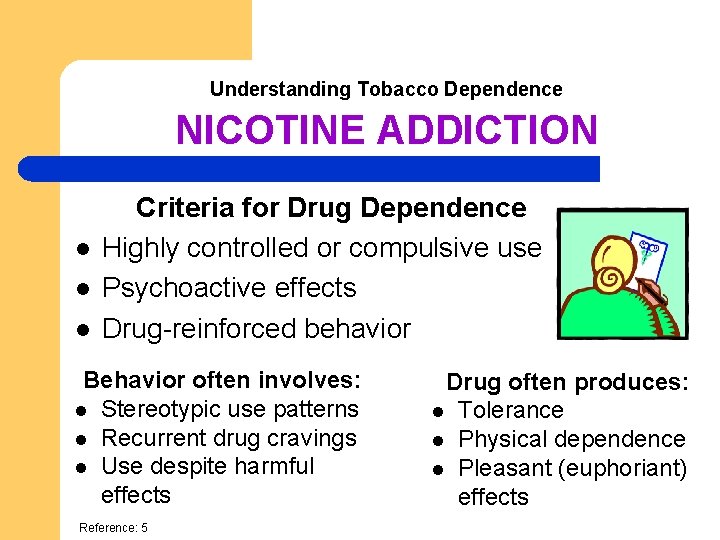
Understanding Tobacco Dependence NICOTINE ADDICTION l l l Criteria for Drug Dependence Highly controlled or compulsive use Psychoactive effects Drug-reinforced behavior Behavior often involves: l Stereotypic use patterns l Recurrent drug cravings l Use despite harmful effects Reference: 5 Drug often produces: l Tolerance l Physical dependence l Pleasant (euphoriant) effects
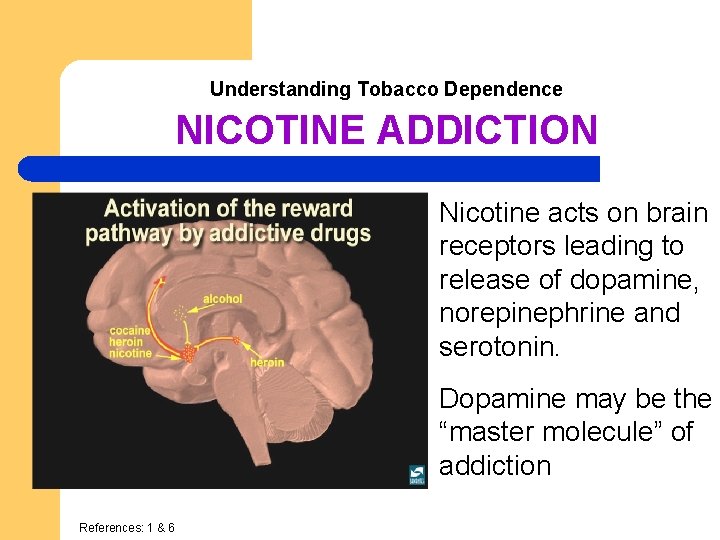
Understanding Tobacco Dependence NICOTINE ADDICTION Nicotine acts on brain receptors leading to release of dopamine, norepinephrine and serotonin. Dopamine may be the “master molecule” of addiction References: 1 & 6
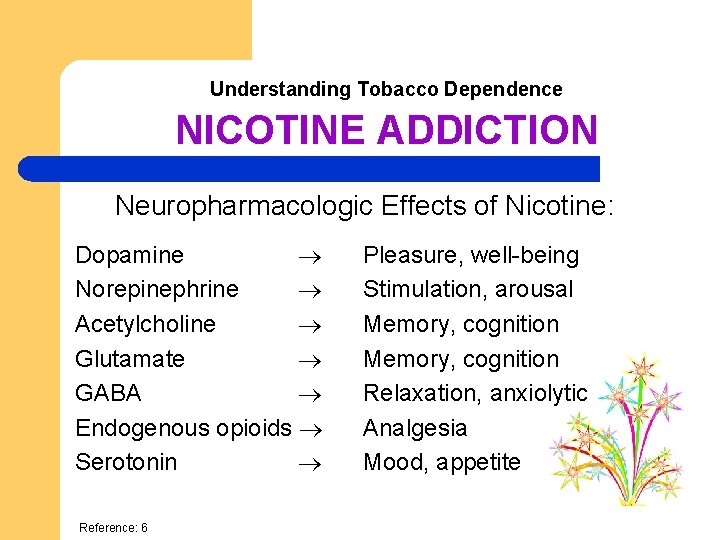
Understanding Tobacco Dependence NICOTINE ADDICTION Neuropharmacologic Effects of Nicotine: Dopamine Norepinephrine Acetylcholine Glutamate GABA Endogenous opioids Serotonin Reference: 6 Pleasure, well-being Stimulation, arousal Memory, cognition Relaxation, anxiolytic Analgesia Mood, appetite
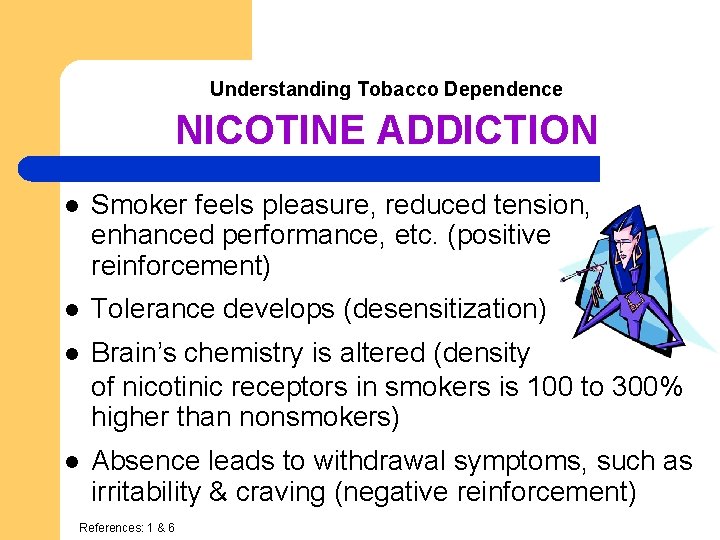
Understanding Tobacco Dependence NICOTINE ADDICTION l Smoker feels pleasure, reduced tension, enhanced performance, etc. (positive reinforcement) l Tolerance develops (desensitization) l Brain’s chemistry is altered (density of nicotinic receptors in smokers is 100 to 300% higher than nonsmokers) l Absence leads to withdrawal symptoms, such as irritability & craving (negative reinforcement) References: 1 & 6
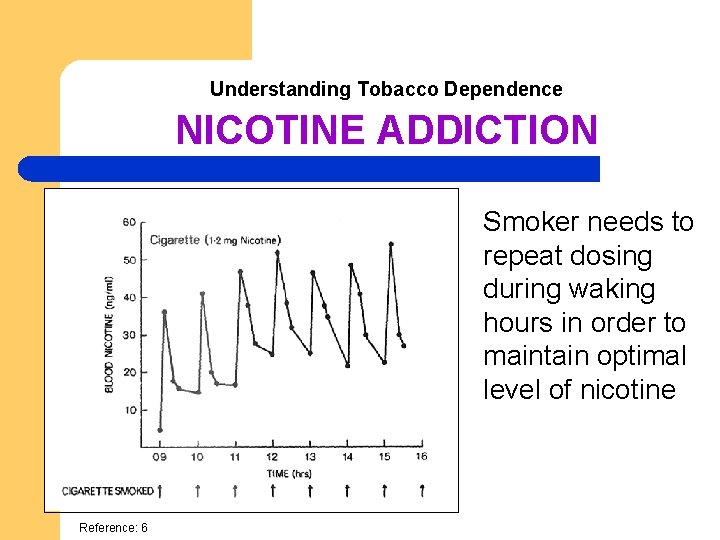
Understanding Tobacco Dependence NICOTINE ADDICTION Smoker needs to repeat dosing during waking hours in order to maintain optimal level of nicotine Reference: 6
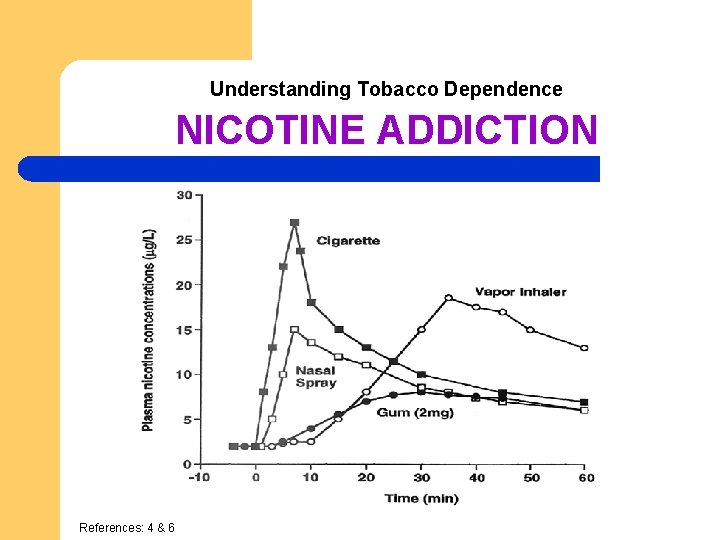
Understanding Tobacco Dependence NICOTINE ADDICTION References: 4 & 6
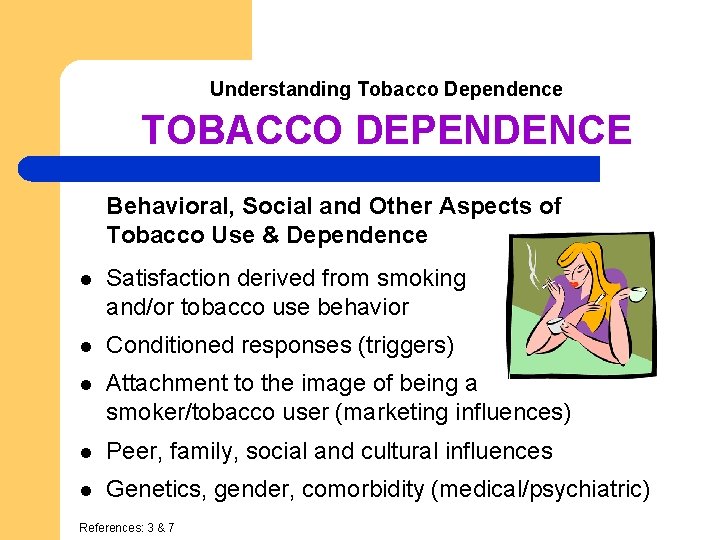
Understanding Tobacco Dependence TOBACCO DEPENDENCE Behavioral, Social and Other Aspects of Tobacco Use & Dependence l Satisfaction derived from smoking and/or tobacco use behavior l Conditioned responses (triggers) l Attachment to the image of being a smoker/tobacco user (marketing influences) l Peer, family, social and cultural influences l Genetics, gender, comorbidity (medical/psychiatric) References: 3 & 7
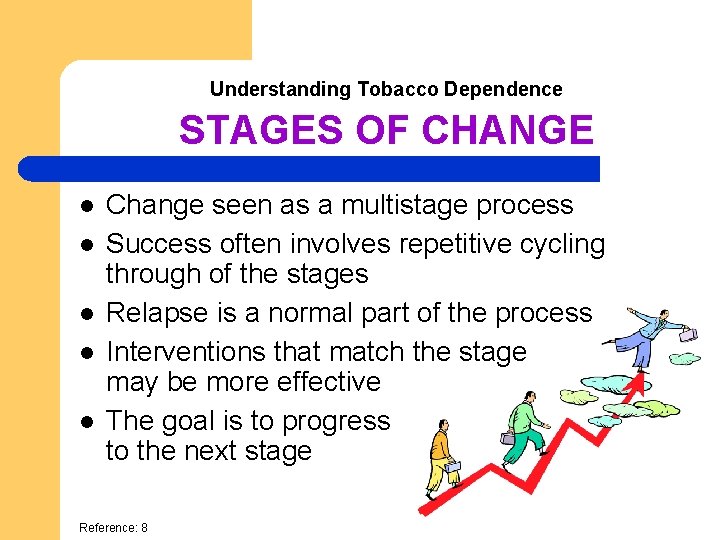
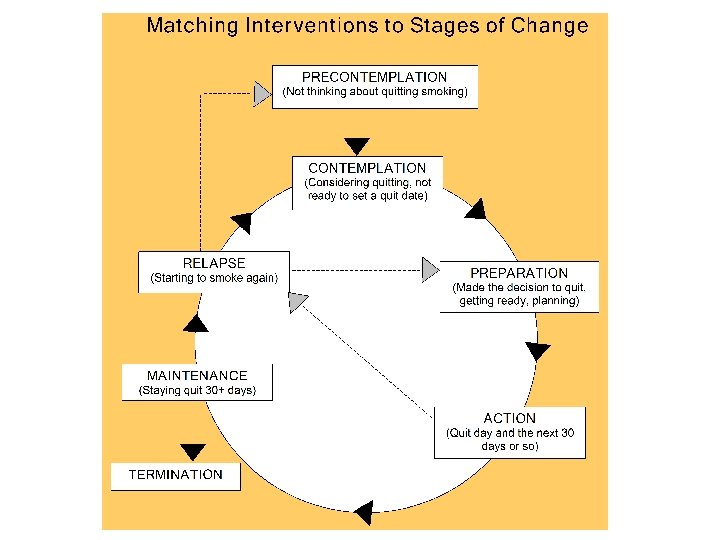
Understanding Tobacco Dependence STAGES OF CHANGE l l l Change seen as a multistage process Success often involves repetitive cycling through of the stages Relapse is a normal part of the process Interventions that match the stage may be more effective The goal is to progress to the next stage Reference: 8
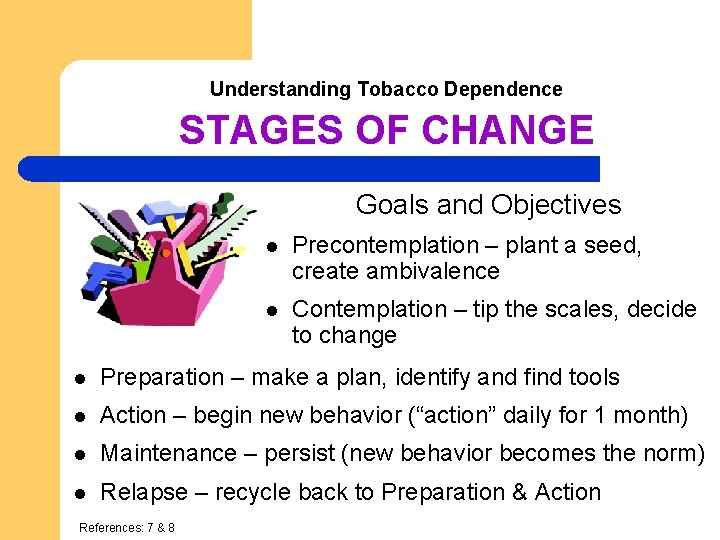
Understanding Tobacco Dependence STAGES OF CHANGE Goals and Objectives l Precontemplation – plant a seed, create ambivalence l Contemplation – tip the scales, decide to change l Preparation – make a plan, identify and find tools l Action – begin new behavior (“action” daily for 1 month) l Maintenance – persist (new behavior becomes the norm) l Relapse – recycle back to Preparation & Action References: 7 & 8
Understanding Tobacco Dependence CLINICAL PRACTICE GUIDELINE l “Smoking Cessation” clinical practice guideline published by AHCPR (now AHRQ), April 1996 l Based on 3, 000 studies published between 1975 -1994 l Updated “Treating Tobacco Use and Dependence” guideline published jointly by AHRQ, USPHS and NCI, June 2000 l Based on additional 3, 000 studies published between 1995 -1999
Understanding Tobacco Dependence GUIDELINE – KEY FINDINGS l Chronic condition, often requires repeated interventions l Effective treatments exist, therefore: l Every patient should be offered treatment (willing) or brief motivational intervention (unwilling) l Essential: institutionalizing consistent identification, documentation and treatment of every tobacco user
Understanding Tobacco Dependence GUIDELINE – KEY FINDINGS l Brief treatment is effective and should be offered to all users (minimum care) l Strong dose-response relation between intensity of counseling and effectiveness l Three types counseling especially effective: Providing practical counseling Providing intra-treatment support Helping secure extra-treatment support ü ü ü
Understanding Tobacco Dependence GUIDELINE – KEY FINDINGS l Numerous effective pharmacotherapies exist (and should be used unless contraindicated) l First-line pharmacotherapies include: Bupropion SR Nicotine patch Nicotine lozenge l Nicotine gum Nicotine inhaler Nicotine nasal spray Second-line pharmacotherapies include: Clonidine Nortriptyline
Understanding Tobacco Dependence GUIDELINE – KEY FINDINGS l Treatments are both clinically effective and cost-effective, therefore: l Insurers and purchasers should ensure that: ü Effective treatments (counseling and pharmacotherapy) are included as reimbursed benefits in all insurance plans Clinicians are reimbursed for providing treatment ü To download the Treating Tobacco Use and Dependence clinical practice guideline: http: //www. surgeongeneral. gov/tobacco Reference: 9
Developing a Smoking Cessation Program in the Acute Care Setting How to Implement an Effective Cessation Program Terrina J Thomas, MS, CHES Community Health and Prevention Sentara Healthcare tmthomas@sentara. com
How to Implement an Effective Cessation Program The 5 As l ASK - systematically identify tobacco use status of EVERY patient l ADVISE - urge all tobacco users to quit in a clear, strong and personal way l ASSESS - decide the patient’s willingness to quit (if not willing, implement 5 Rs)
How to Implement an Effective Cessation Program The 5 As l ASSIST - aid willing patients in developing a quit plan: ü Support ü Medications ü Coping/problem-solving l skills ARRANGE - schedule for follow-up
How to Implement an Effective Cessation Program The 5 Rs l RELEVANCE - help make connection to specific personal reasons to stop l RISKS - ask patient to identify potential negative consequences of continued tobacco use l REWARDS - ask patient to identify potential benefits of tobacco cessation
How to Implement an Effective Cessation Program The 5 Rs l ROADBLOCKS - ask patient to identify barriers to quitting and make a plan to address them l REPETITION - repeat motivational intervention at EVERY encounter
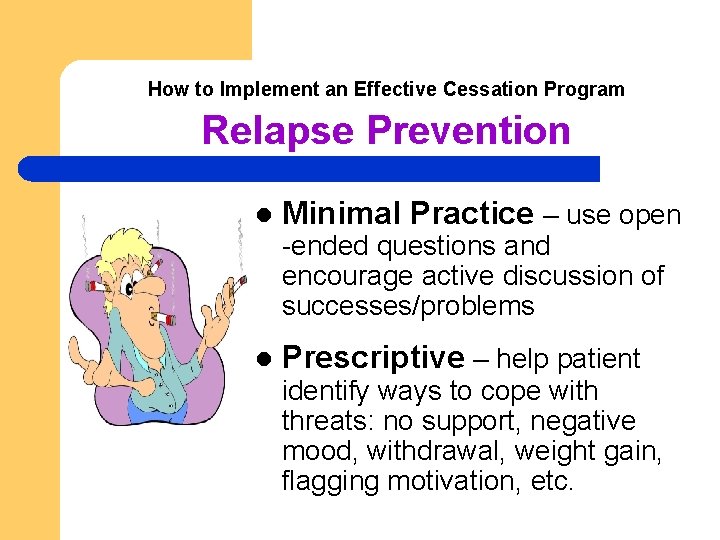
How to Implement an Effective Cessation Program Relapse Prevention l Minimal Practice – use open -ended questions and encourage active discussion of successes/problems l Prescriptive – help patient identify ways to cope with threats: no support, negative mood, withdrawal, weight gain, flagging motivation, etc.
How to Implement an Effective Cessation Program Systems Changes: 6 Strategies l Implement a tobacco-user identification system l Provide education, resources, feedback to promote interventions l Dedicate staff to provide treatment and assess delivery of treatment in staff performance evaluations l Promote policies that support and provide services
How to Implement an Effective Cessation Program Systems Changes: 6 Strategies l Insurers/MCOs should include both counseling and pharmacotherapy as paid/covered services l Insurers/MCOs should reimburse for delivery of effective treatments and include these interventions among defined duties of clinicians Fiore MC, Bailey WC, Cohen SJ, et al. Treating Tobacco Use and Dependence. Quick Reference Guide for Clinicians. Rockville, MD: USDHHS. Public Health Service. October 2000.
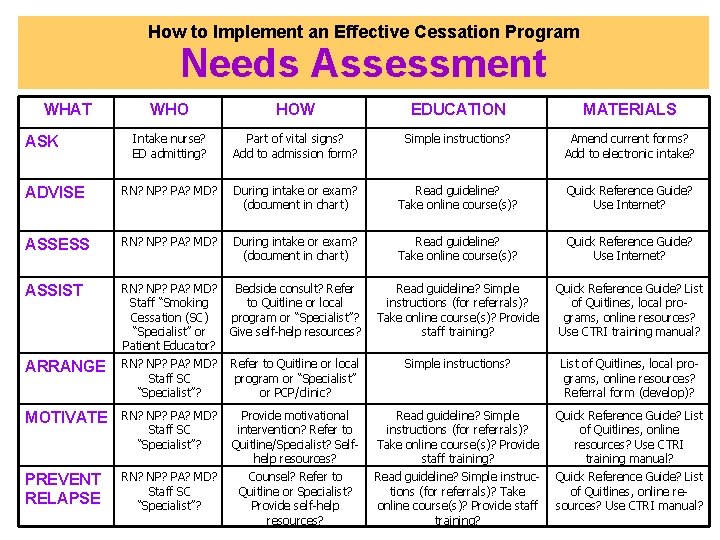
How to Implement an Effective Cessation Program Needs Assessment WHAT WHO HOW EDUCATION MATERIALS Intake nurse? ED admitting? Part of vital signs? Add to admission form? Simple instructions? Amend current forms? Add to electronic intake? ADVISE RN? NP? PA? MD? During intake or exam? (document in chart) Read guideline? Take online course(s)? Quick Reference Guide? Use Internet? ASSESS RN? NP? PA? MD? During intake or exam? (document in chart) Read guideline? Take online course(s)? Quick Reference Guide? Use Internet? ASSIST RN? NP? PA? MD? Staff “Smoking Cessation (SC) “Specialist” or Patient Educator? RN? NP? PA? MD? Staff SC “Specialist”? Bedside consult? Refer to Quitline or local program or “Specialist”? Give self-help resources? Read guideline? Simple instructions (for referrals)? Take online course(s)? Provide staff training? Quick Reference Guide? List of Quitlines, local programs, online resources? Use CTRI training manual? Refer to Quitline or local program or “Specialist” or PCP/clinic? Simple instructions? List of Quitlines, local programs, online resources? Referral form (develop)? MOTIVATE RN? NP? PA? MD? Staff SC “Specialist”? Provide motivational intervention? Refer to Quitline/Specialist? Selfhelp resources? Read guideline? Simple instructions (for referrals)? Take online course(s)? Provide staff training? Quick Reference Guide? List of Quitlines, online resources? Use CTRI training manual? PREVENT RELAPSE RN? NP? PA? MD? Staff SC “Specialist”? Counsel? Refer to Quitline or Specialist? Provide self-help resources? Read guideline? Simple instructions (for referrals)? Take online course(s)? Provide staff training? Quick Reference Guide? List of Quitlines, online resources? Use CTRI manual? ASK ARRANGE
How to Implement an Effective Cessation Program Resources for the Healthcare Professional Treating Tobacco Use and Dependence (UW-CTRI) Free 1 -hour CME/Pharmacy CE course: www. cme. wisc. edu/online/ctri Tobacco CME (funded by NHLBI) Managed by Clinical Tools, Inc; free CME courses on tobacco topics: www. Tobacco. CME. com For additional online courses: www. aptna. org/Online_Courses 1. html
How to Implement an Effective Cessation Program Resources for the Patients QUITLINES § § DC Quitline (ALF) 1 -800 -399 -5589 Great Start Quitline 1 -866 -66 -START ALA Call Center 1 -800 -548 -8252 NCI Quitline 1 -877 -44 U-QUIT LOCAL PROGRAMS American Lung Association 1 -800 -LUNG USA
How to Implement an Effective Cessation Program Resources for the Patients PRINT MATERIALS § USPHS publications (English/Spanish, free) ü Download: www. surgeongeneral. gov/tobacco ü Order: AHRQ www. ahrq. gov/clinic/tobacco/order. pdf § Sentara Quit Kit (booklet and audiotape/CD, free) Call Smoke-Free Virginia Helpline: 1 -877 -856 -5177 ONLINE RESOURCES § Freedom From Smoking www. lungusa. org/ffs § Federal Online Program www. smokefree. gov § Smoke-Free Virginia Website www. smokefreevirginia. org
Developing a Smoking Cessation Program in the Acute Care Set Questions & Answers Thank you for participating