
Developing a Robust Arabic Morphological TransducerTokenizer and Integration
Developing a Robust Arabic Morphological Transducer/Tokenizer, and Integration with XLE By Mohammed A. Attia Ph. D. Student, School of Informatics, The University of Manchester 1
Introduction Available Arabic Morphological Analyzers: n n Xerox Finite State Arabic Morphological Analyzer Buckwalter Arabic Morphological Analyzer 2

Introduction Arabic Morphological Peculiarities n Large number of prefixes and suffixes to show person, number and gender with verbs, and number and gender with nouns n Separated Dependencies n Clitics 3
A New Arabic Transducer Why? n n n n Specific domain – News Specific language – MSA Specific purpose – MT Compatibility – XLE Native script Maintenance and update Owning tools: customizability in form and content 4
Development Decision n Using finite state technology with the Advantages: n n Handling concatenative and nonconcatenative morphotactics Fast and efficient Unicode support Multi-platform support 5
Development Decision n Using the stem as the base form, which makes the solution: n Easier and faster to develop n More suitable for translation 6

Development Decision n n Separating the task of the developer and the lexicographer Making no account of diacritics Generating valid surface forms Developing a guesser to prevent the system from failing 7
System Architecture n n n Tokenizer Morphological Transducer Guesser Diacritics Normalizer Spelling Relaxation Layer 8
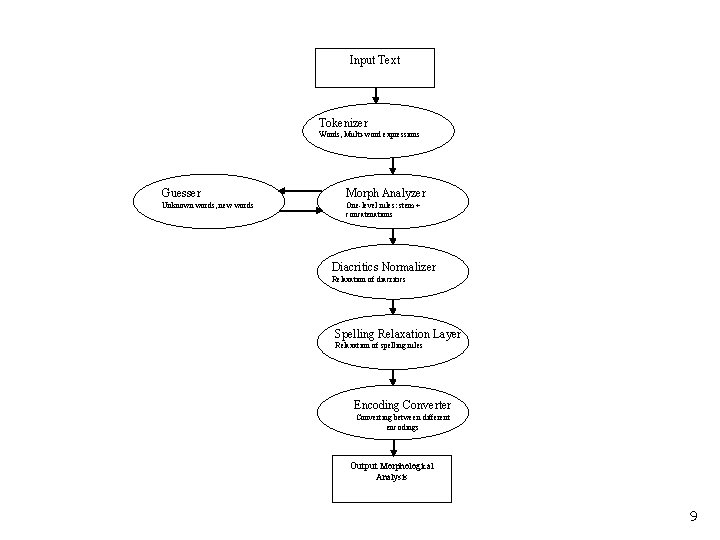
Input Text Tokenizer Words, Multi-word expressions Guesser Morph Analyzer Unknown words, new words One-level rules: stem + concatenations Diacritics Normalizer Relaxation of diacritics Spelling Relaxation Layer Relaxation of spelling rules Encoding Converter Converting between different encodings Output Morphological Analysis 9

Verb Morphotactics Possible Concatenations (Conjunctions or question Article) (Complementizers) Tense Prefixes Verb Stem Tense Suffixes (Clitic Object Pronouns) Conjunctions “ ﻭ wa” (and) or “ ﻑ fa” (then) “ ﻝ li” (to) Present tense prefixes (5) Stem Present tense suffixes (10) First person object pronoun (2) Question word “ ﺃ a” (does or did) “ ﺱ sa” (will) Past tense prefix (1) Past tense suffixes (12) second person object pronoun (5) “ ﻝ la” (then) Imperative prefix (2) Imperative suffixes (5) Third person object pronoun (5) 10
Verb Morphotactics n Statistically these (unconstrained) concatenations can generate up to: 33, 696 Forms 3 * 4 * 8 * 27 * 13 n n Flag Diacritics are used to handle separated dependencies (constrained concatenations) 2, 552 well-formed forms for transitive verbs 11
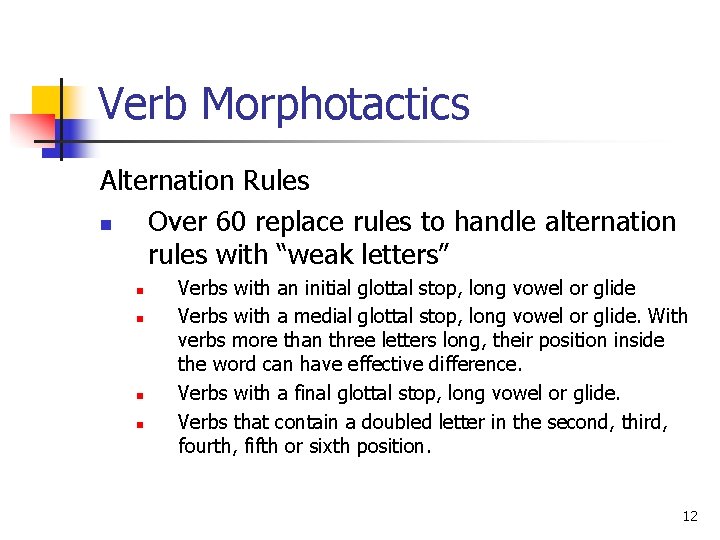
Verb Morphotactics Alternation Rules n Over 60 replace rules to handle alternation rules with “weak letters” n n Verbs with an initial glottal stop, long vowel or glide Verbs with a medial glottal stop, long vowel or glide. With verbs more than three letters long, their position inside the word can have effective difference. Verbs with a final glottal stop, long vowel or glide. Verbs that contain a doubled letter in the second, third, fourth, fifth or sixth position. 12
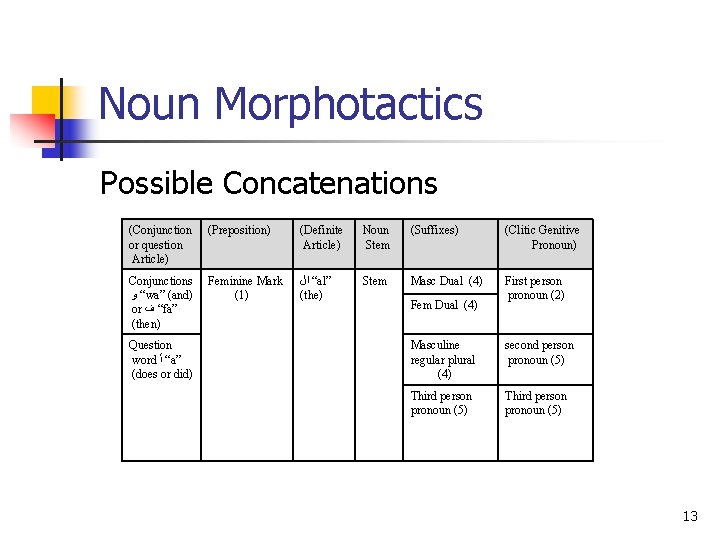
Noun Morphotactics Possible Concatenations (Conjunction or question Article) (Preposition) (Definite Article) Noun Stem (Suffixes) (Clitic Genitive Pronoun) Conjunctions “ ﻭ wa” (and) or “ ﻑ fa” (then) Feminine Mark (1) “ ﺍﻝ al” (the) Stem Masc Dual (4) First person pronoun (2) Question word “ ﺃ a” (does or did) Fem Dual (4) Masculine regular plural (4) second person pronoun (5) Third person pronoun (5) 13
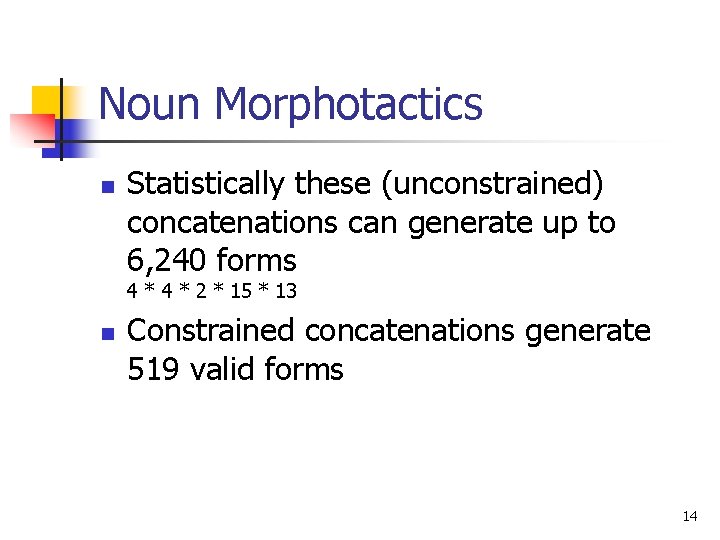
Noun Morphotactics n Statistically these (unconstrained) concatenations can generate up to 6, 240 forms 4 * 2 * 15 * 13 n Constrained concatenations generate 519 valid forms 14
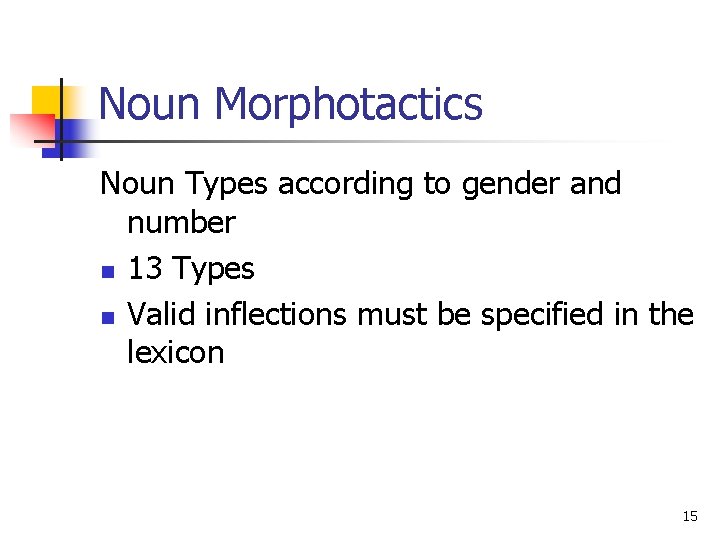
Noun Morphotactics Noun Types according to gender and number n 13 Types n Valid inflections must be specified in the lexicon 15
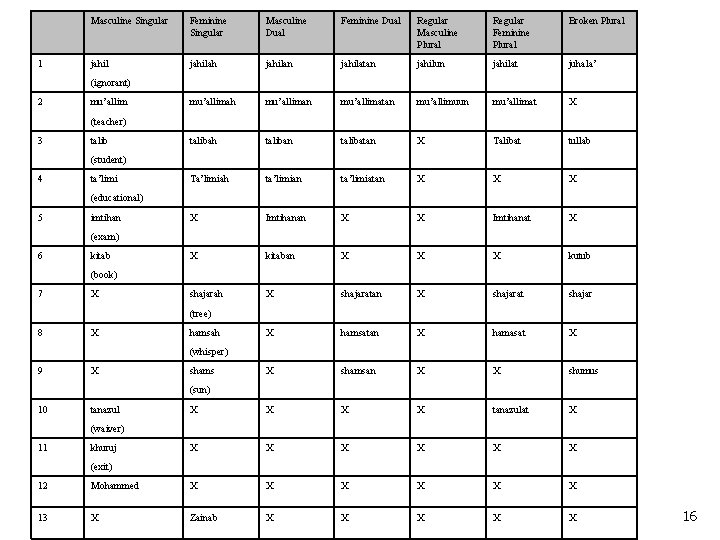
1 Masculine Singular Feminine Singular Masculine Dual Feminine Dual Regular Masculine Plural Regular Feminine Plural Broken Plural jahilah jahilan jahilatan jahilun jahilat juhala’ mu’allimah mu’alliman mu’allimatan mu’allimuun mu’allimat X talibah taliban talibatan X Talibat tullab Ta’limiah ta’limian ta’limiatan X X Imtihanan X X Imtihanat X X kitaban X X X kutub shajarah X shajaratan X shajarat shajar X hamsatan X hamasat X X shamsan X X shumus X X tanazulat X X X X (ignorant) 2 mu’allim (teacher) 3 talib (student) 4 ta’limi (educational) 5 imtihan (exam) 6 kitab (book) 7 X (tree) 8 X hamsah (whisper) 9 X shams (sun) 10 tanazul (waiver) 11 khuruj (exit) 12 Mohammed X X X 13 X Zainab X X X 16
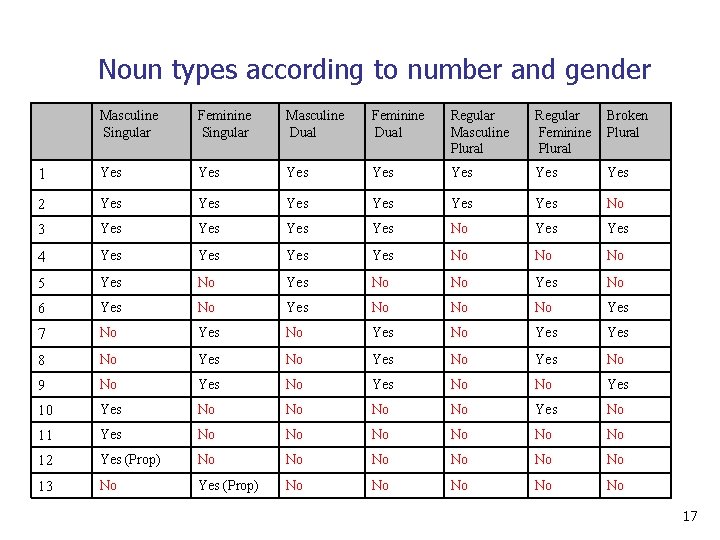
Noun types according to number and gender Masculine Singular Feminine Singular Masculine Dual Feminine Dual Regular Masculine Plural Regular Feminine Plural Broken Plural 1 Yes Yes 2 Yes Yes Yes No 3 Yes Yes No Yes 4 Yes Yes No No No 5 Yes No No Yes No 6 Yes No No No Yes 7 No Yes 8 No Yes No 9 No Yes No No Yes 10 Yes No No Yes No 11 Yes No No No 12 Yes (Prop) No No No 13 No Yes (Prop) No No No 17
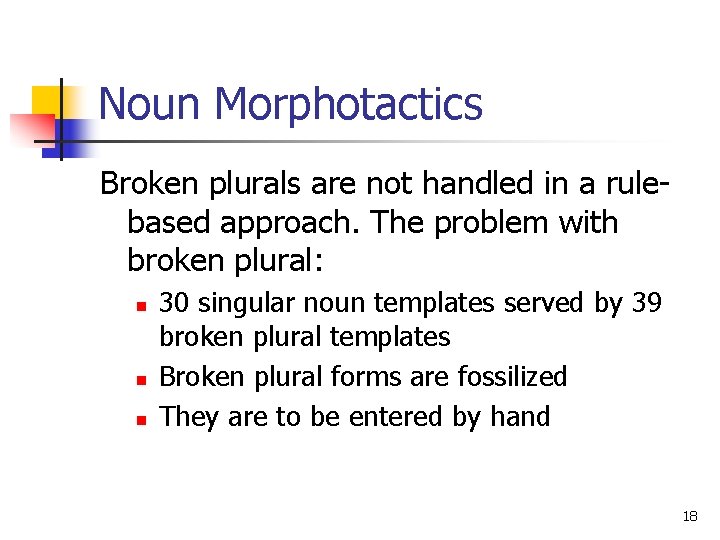
Noun Morphotactics Broken plurals are not handled in a rulebased approach. The problem with broken plural: n n n 30 singular noun templates served by 39 broken plural templates Broken plural forms are fossilized They are to be entered by hand 18
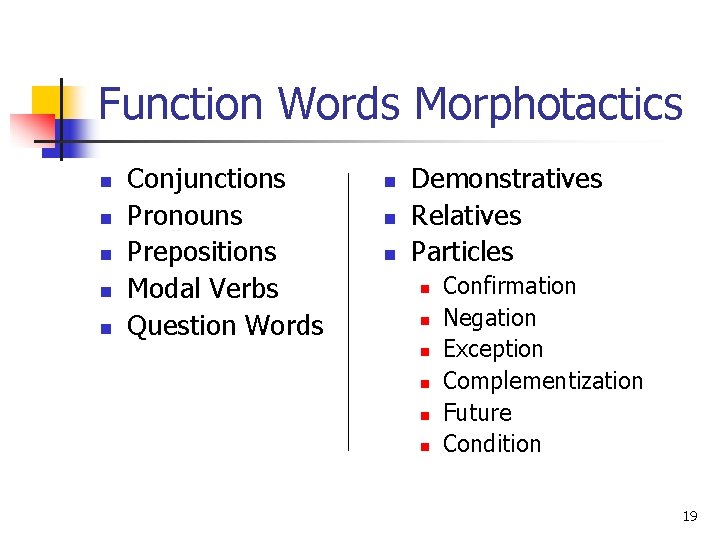
Function Words Morphotactics n n n Conjunctions Pronouns Prepositions Modal Verbs Question Words n n n Demonstratives Relatives Particles n n n Confirmation Negation Exception Complementization Future Condition 19
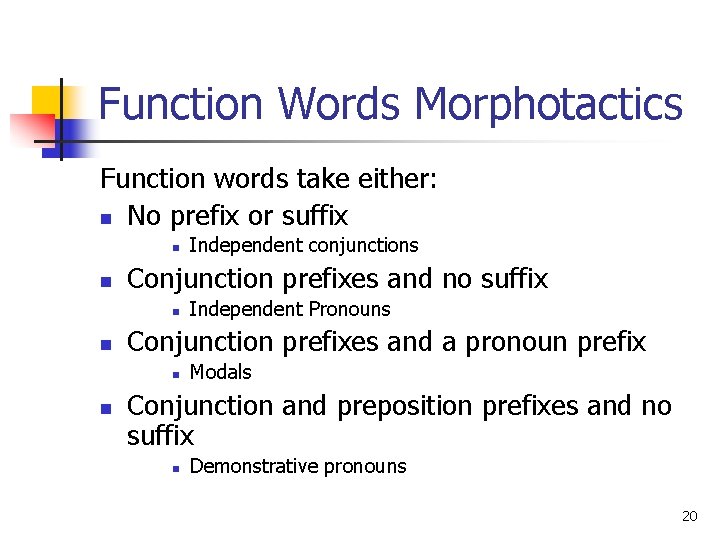
Function Words Morphotactics Function words take either: n No prefix or suffix n n Conjunction prefixes and no suffix n n Independent Pronouns Conjunction prefixes and a pronoun prefix n n Independent conjunctions Modals Conjunction and preposition prefixes and no suffix n Demonstrative pronouns 20
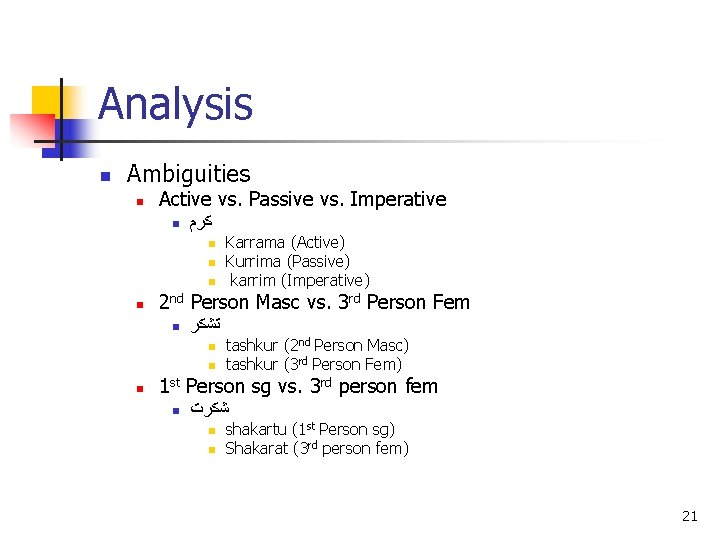
Analysis n Ambiguities n Active vs. Passive vs. Imperative n ﻛﺮﻡ n n 2 nd Person Masc vs. 3 rd Person Fem n ﺗﺸﻜﺮ n n n Karrama (Active) Kurrima (Passive) karrim (Imperative) tashkur (2 nd Person Masc) tashkur (3 rd Person Fem) 1 st Person sg vs. 3 rd person fem n ﺷﻜﺮﺕ n n shakartu (1 st Person sg) Shakarat (3 rd person fem) 21
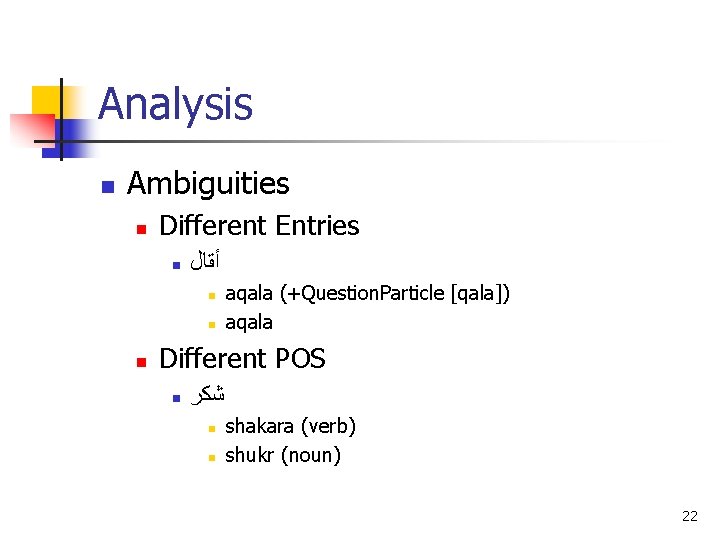
Analysis n Ambiguities n Different Entries n ﺃﻘﺎﻝ n n n aqala (+Question. Particle [qala]) aqala Different POS n ﺷﻜﺮ n n shakara (verb) shukr (noun) 22
![Analysis n ﻣﻌﻠﻢ +3 pers+noun+masc[ ]ﻣﻌﻠﻢ n ﻃﺎﻟﺐ +3 pers+noun+masc[ ]ﻃﺎﻟﺐ ﺍﻣﺘﺤﻦ ﺍﻣﺘﺤﻦ +imp[2+[](http://slidetodoc.com/presentation_image_h2/34c376ebc4342cf665980335a07a0e28/image-23.jpg "Analysis n ﻣﻌﻠﻢ +3 pers+noun+masc[ ]ﻣﻌﻠﻢ n ﻃﺎﻟﺐ +3 pers+noun+masc[ ]ﻃﺎﻟﺐ ﺍﻣﺘﺤﻦ ﺍﻣﺘﺤﻦ +imp[2+[")
Analysis n ﻣﻌﻠﻢ +3 pers+noun+masc[ ]ﻣﻌﻠﻢ n ﻃﺎﻟﺐ +3 pers+noun+masc[ ]ﻃﺎﻟﺐ ﺍﻣﺘﺤﻦ ﺍﻣﺘﺤﻦ +imp[2+[ ﺍﻣﺘﺤﻦ pers+masc+sg +past+active[3+[ ﺍﻣﺘﺤﻦ pers+sg+masc +past+active[3+[ ﺍﻣﺘﺤﻦ pers+pl+fem +past+pass[3+[ ﺍﻣﺘﺤﻦ pers+sg+masc +past+pass[3+[ ﺍﻣﺘﺤﻦ pers+pl+fem ﺷﻜﺮ +past+active[3+[ ﺷﻜﺮ pers+sg+masc +past+pass[3+[ ﺷﻜﺮ pers+sg+masc ﻓﻬﻢ +conj+pron+3 pers+pl+masc +conj+obj 3+them ﻋﻠﻢ +past+active[3+[ ﻋﻠﻢ pers+sg+masc +past+pass[ ]ﻋﻠﻢ +masc+sg n ﺍﻧﻬﺰﻡ +imp[2+[ ﺍﻧﻬﺰﻡ pers+masc+sg +past+active[3+[ ﺍﻧﻬﺰﻡ pers+sg+masc +past+pass[ ]ﺍﻧﻬﺰﻡ +masc+sg n ﺍﺳﺘﻌﺎﻥ +past+active[3+[ ﺍﺳﺘﻌﺎﻥ pers+sg+masc n n n n 23
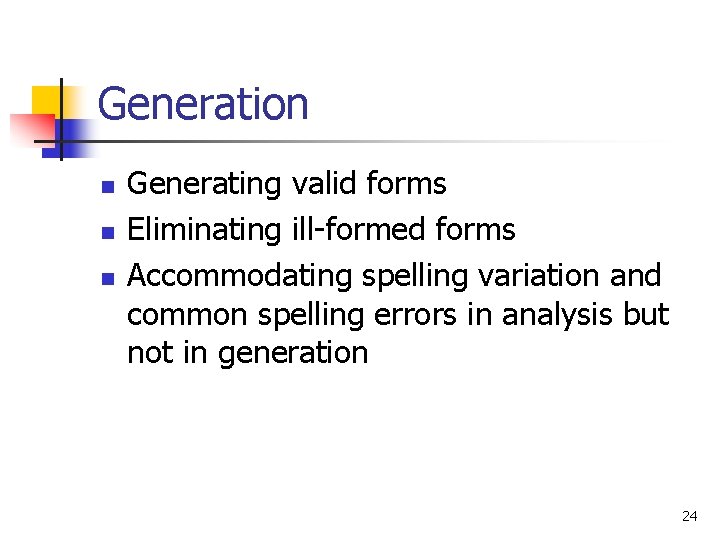
Generation n Generating valid forms Eliminating ill-formed forms Accommodating spelling variation and common spelling errors in analysis but not in generation 24
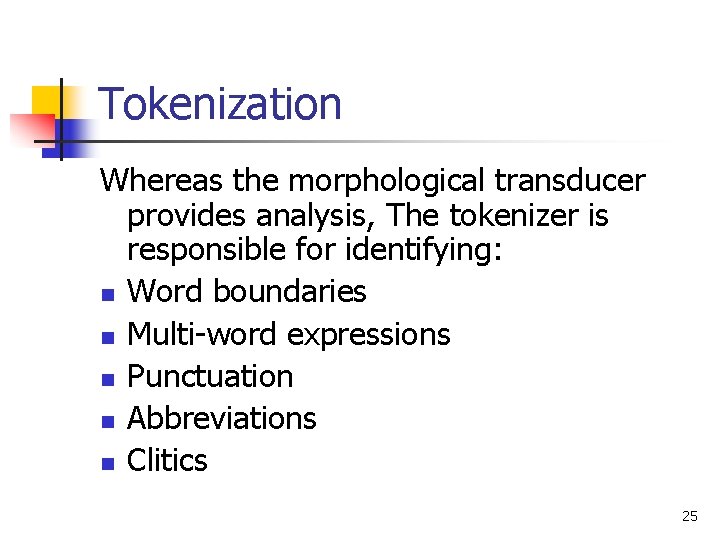
Tokenization Whereas the morphological transducer provides analysis, The tokenizer is responsible for identifying: n Word boundaries n Multi-word expressions n Punctuation n Abbreviations n Clitics 25

Tokenization and Analysis: First Approach – 2 in 1 Why they are inseparable in dealing with Arabic clitics (prepositions, pronouns, conjuctions, etc. ) n n n Clitics can be concatenated one after the other. Clitics undergo assimilation with words. Without complete morphological knowledge, you cannot tell whether some initial or final letters are part of the word or only clitics. 26

Tokenization and Analysis: First Approach – 2 in 1 Implementation n Tokenizer is responsible for deciding word boundaries, clitic boundaries as well as analysis n Morphological analyzer: accepts the output of the tokenizer as is In fact the core morphological analyzer is part of the tokenizer 27
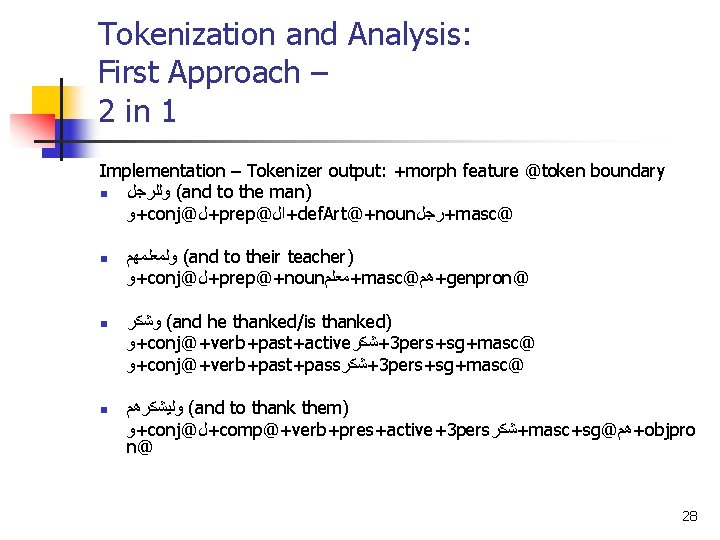
Tokenization and Analysis: First Approach – 2 in 1 Implementation – Tokenizer output: +morph feature @token boundary n ( ﻭﻟﻠﺮﺟﻞ and to the man) ﻭ +conj@ ﻝ +prep@ ﺍﻝ +def. Art@+noun ﺭﺟﻞ +masc@ n n n ( ﻭﻟﻤﻌﻠﻤﻬﻢ and to their teacher) ﻭ +conj@ ﻝ +prep@+noun ﻣﻌﻠﻢ +masc@ ﻫﻢ +genpron@ ( ﻭﺷﻜﺮ and he thanked/is thanked) ﻭ +conj@+verb+past+active ﺷﻜﺮ +3 pers+sg+masc@ ﻭ +conj@+verb+past+pass ﺷﻜﺮ +3 pers+sg+masc@ ( ﻭﻟﻴﺸﻜﺮﻫﻢ and to thank them) ﻭ +conj@ ﻝ +comp@+verb+pres+active+3 pers ﺷﻜﺮ +masc+sg@ ﻫﻢ +objpro n@ 28
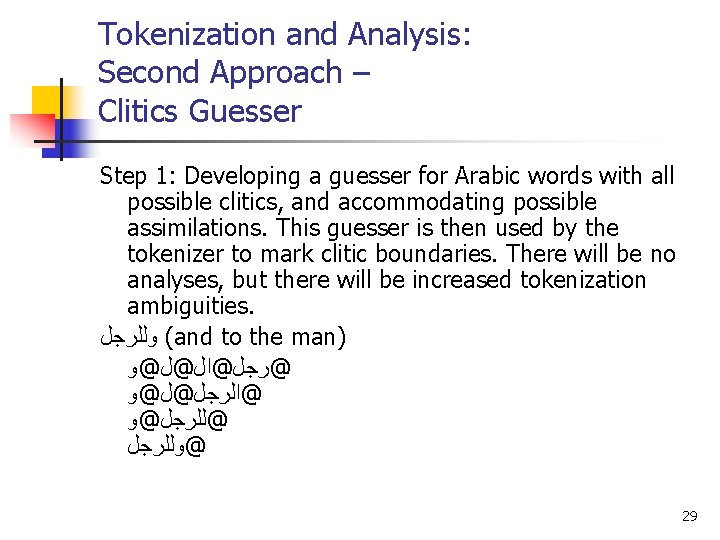
Tokenization and Analysis: Second Approach – Clitics Guesser Step 1: Developing a guesser for Arabic words with all possible clitics, and accommodating possible assimilations. This guesser is then used by the tokenizer to mark clitic boundaries. There will be no analyses, but there will be increased tokenization ambiguities. ( ﻭﻟﻠﺮﺟﻞ and to the man) @ﺭﺟﻞ@ﺍﻝ@ﻝ@ﻭ @ﺍﻟﺮﺟﻞ@ﻝ@ﻭ @ﻟﻠﺮﺟﻞ@ﻭ @ﻭﻟﻠﺮﺟﻞ 29
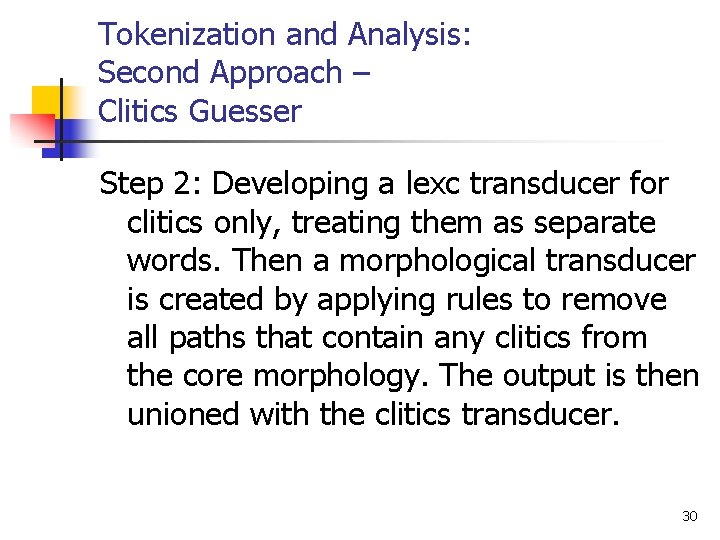
Tokenization and Analysis: Second Approach – Clitics Guesser Step 2: Developing a lexc transducer for clitics only, treating them as separate words. Then a morphological transducer is created by applying rules to remove all paths that contain any clitics from the core morphology. The output is then unioned with the clitics transducer. 30

Tokenization and Analysis: Second Approach – Clitics Guesser Advantages: 1. Keeping the core morphology intact 2. Following the usual rule of separating the tokenizer and the analyzer. 3. Trees display more nicely in XLE. Disadvantages: 1. The system has to deal with tokenization ambiguities. For a simple sentence of 3 words, I get 8 different tokeniation solutions. 2. I have to write stricter sublexical rules. 3. Treating clitics as free morphemes will create amiguities with some originally free morphemes. Sometimes there will be an ambiguity also regarding whether this clitic belongs to the previous or the following word. 31
Integration with XLE: 4 Steps n n Adding a morphology section in the grammar file and referring to it in the grammar configuration section Setting the character encoding UTF-8 in the configuration section and in the test file Writing sublexical rules Writing sublexical entries 32

Integration Problems with Arabic in XLE: n n n Arabic fonts do not display correctly in trees and charts. when printing postscript for any chart, Arabic fonts disappear. You cannot write Arabic on the shell under Mac OS, and when you do under Linux the encoding is not interpreted correctly. 33

Conclusion “Linguistic development is an endless round of observation, theorizing, formalizing and testing; and the goal, for a lexical transducer, is to create a system that correctly analyzes and generates a language that looks as much like the real natural language as possible. ” Beesley and Karttunen, Finite State Morphology. P. 287 34
Conclusion n n FST is fast, efficient and reliable. Development time can be reduced significantly for Arabic if we take the stem as the base form and ignore diacritics. 35
- Slides: 35