
Developing a Program of Family and Community Involvement

- Slides: 26
Developing a Program of Family and Community Involvement for Student Success Leadership Fair – Oak Ridge High School Dr. Andy Westerman Senior Administrator Student Enrollment Room 5 -103 (5: 15 -5: 45 pm) February 20, 2019 1
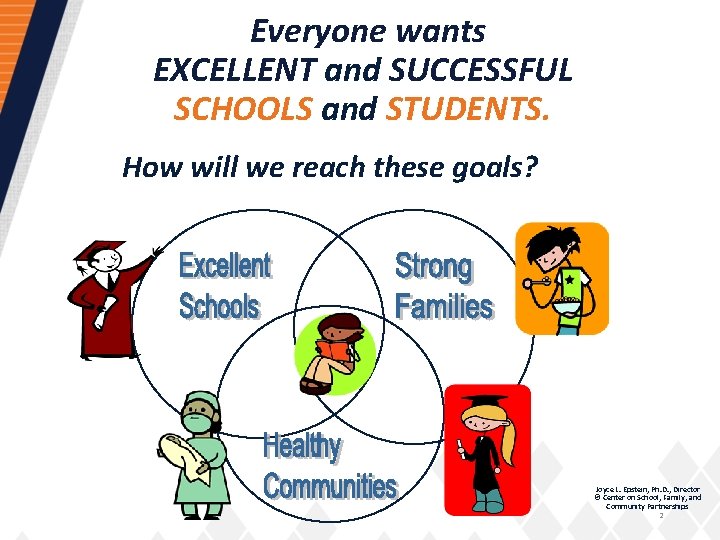
Everyone wants EXCELLENT and SUCCESSFUL SCHOOLS and STUDENTS. How will we reach these goals? Joyce L. Epstein, Ph. D. , Director © Center on School, Family, and Community Partnerships 2
What is important to know about school, family, and community partnerships? Not only THAT partnerships contribute to good schools and successful students But also WHAT is needed in an excellent partnership program? and… HOW to organize and sustain high-quality and effective programs of family and community involvement We must think in new ways about leadership for partnerships at the district and school levels 3
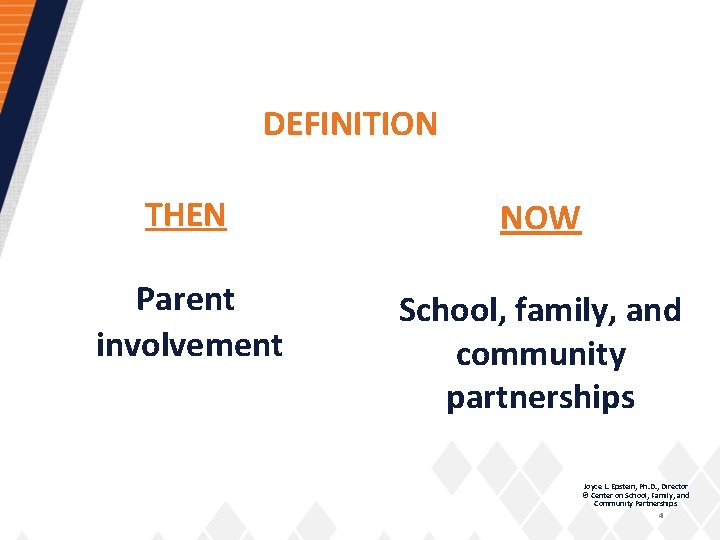
DEFINITION THEN NOW Parent involvement School, family, and community partnerships Joyce L. Epstein, Ph. D. , Director © Center on School, Family, and Community Partnerships 4
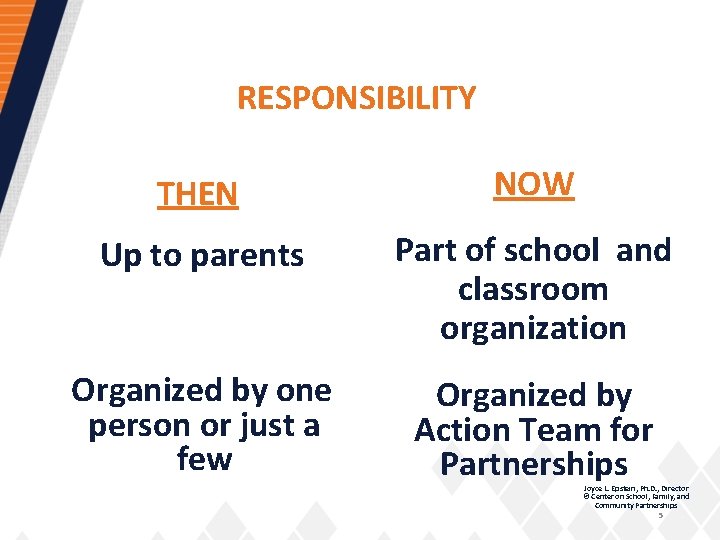
RESPONSIBILITY THEN NOW Up to parents Part of school and classroom organization Organized by one person or just a few Organized by Action Team for Partnerships Joyce L. Epstein, Ph. D. , Director © Center on School, Family, and Community Partnerships 5
Identify an Action Team for Partnerships (ATP)
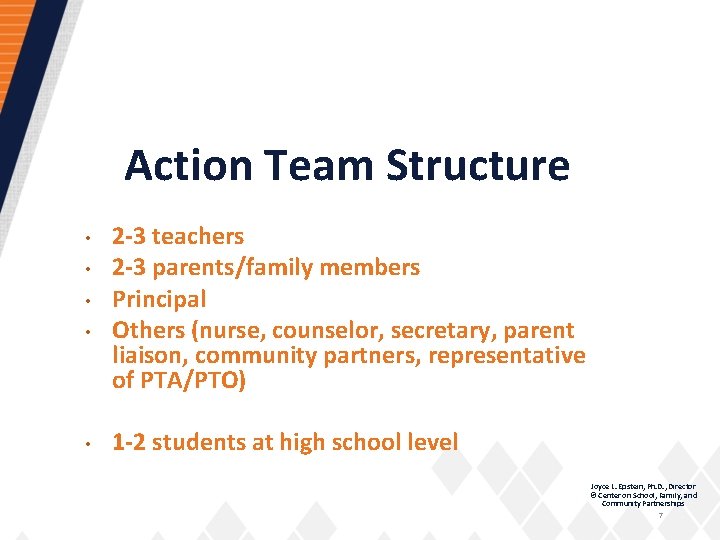
Action Team Structure • • • 2 -3 teachers 2 -3 parents/family members Principal Others (nurse, counselor, secretary, parent liaison, community partners, representative of PTA/PTO) 1 -2 students at high school level Joyce L. Epstein, Ph. D. , Director © Center on School, Family, and Community Partnerships 7
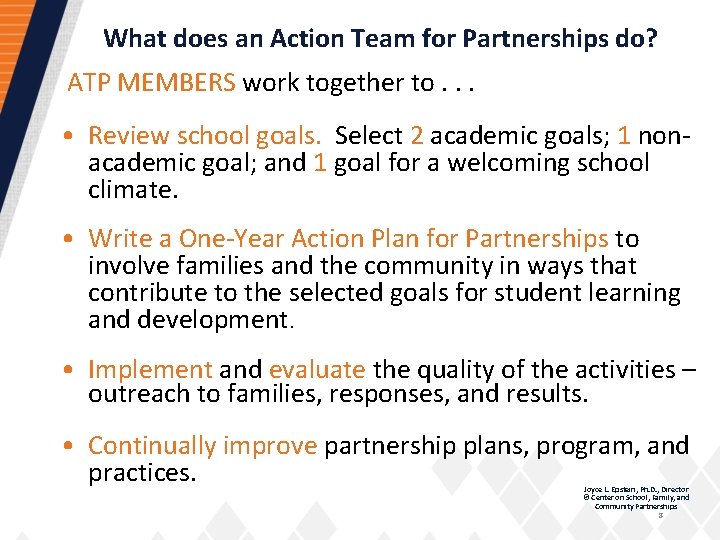
What does an Action Team for Partnerships do? ATP MEMBERS work together to. . . • Review school goals. Select 2 academic goals; 1 nonacademic goal; and 1 goal for a welcoming school climate. • Write a One-Year Action Plan for Partnerships to involve families and the community in ways that contribute to the selected goals for student learning and development. • Implement and evaluate the quality of the activities – outreach to families, responses, and results. • Continually improve partnership plans, program, and practices. Joyce L. Epstein, Ph. D. , Director © Center on School, Family, and Community Partnerships 8
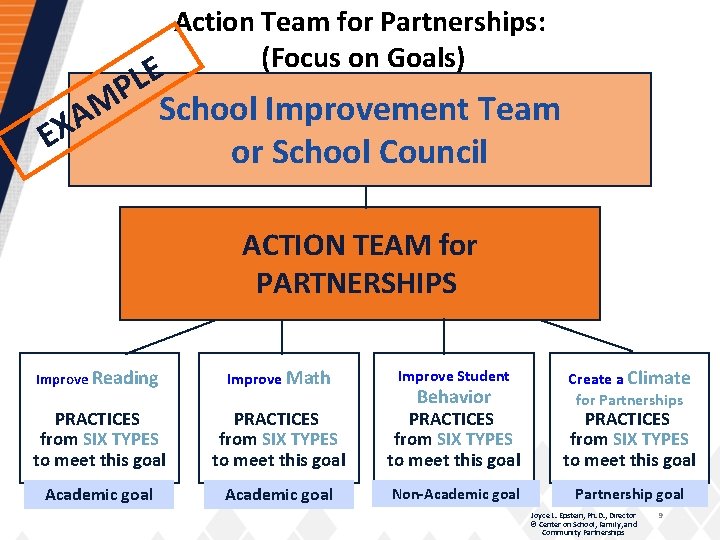
Action Team for Partnerships: (Focus on Goals) E L P M School Improvement Team A EX or School Council ACTION TEAM for PARTNERSHIPS Improve Reading Improve Math Improve Student PRACTICES from SIX TYPES to meet this goal Academic goal Non-Academic goal Partnership goal Behavior Create a Climate for Partnerships Joyce L. Epstein, Ph. D. , Director © Center on School, Family, and Community Partnerships 9
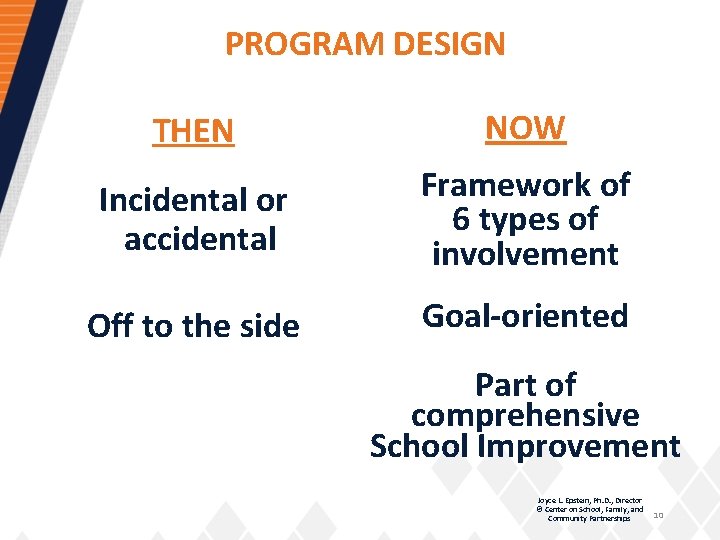
PROGRAM DESIGN THEN NOW Incidental or accidental Framework of 6 types of involvement Off to the side Goal-oriented Part of comprehensive School Improvement Joyce L. Epstein, Ph. D. , Director © Center on School, Family, and Community Partnerships 10
Use the Framework of Six Types of Involvement
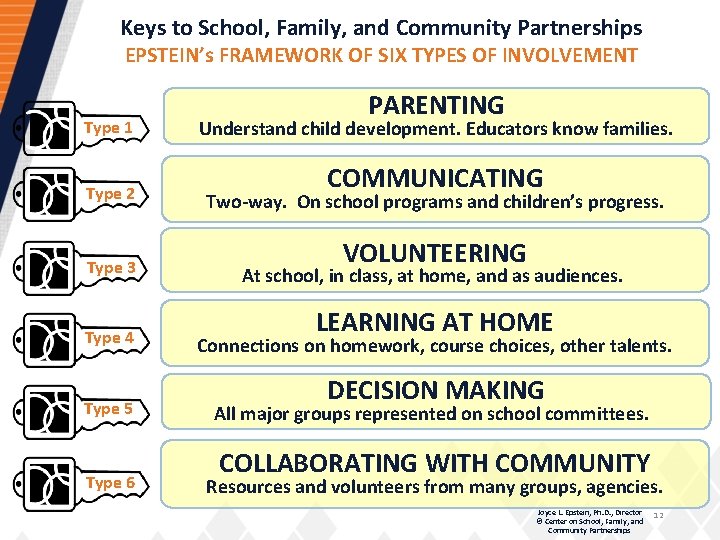
Keys to School, Family, and Community Partnerships EPSTEIN’s FRAMEWORK OF SIX TYPES OF INVOLVEMENT Type 1 Type 2 Type 3 Type 4 Type 5 Type 6 PARENTING Understand child development. Educators know families. COMMUNICATING Two-way. On school programs and children’s progress. VOLUNTEERING At school, in class, at home, and as audiences. LEARNING AT HOME Connections on homework, course choices, other talents. DECISION MAKING All major groups represented on school committees. COLLABORATING WITH COMMUNITY Resources and volunteers from many groups, agencies. Joyce L. Epstein, Ph. D. , Director © Center on School, Family, and Community Partnerships 12
Solve Challenges to Involve ALL Families
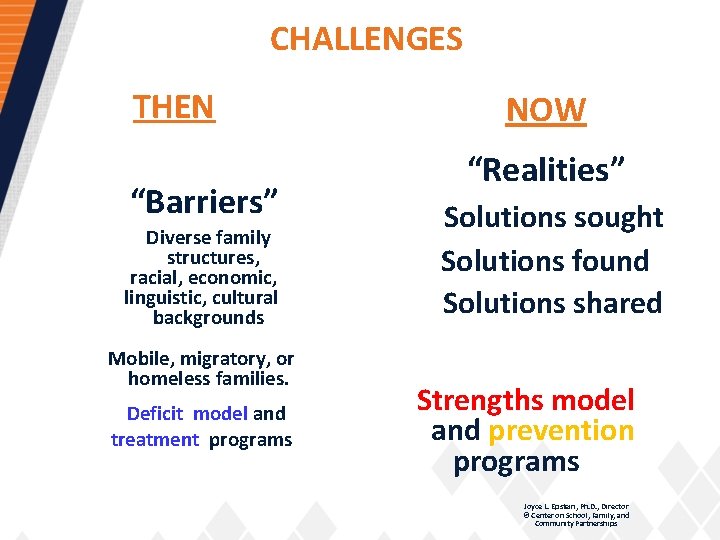
CHALLENGES THEN “Barriers” Diverse family structures, racial, economic, linguistic, cultural backgrounds Mobile, migratory, or homeless families. Deficit model and treatment programs NOW “Realities” Solutions sought Solutions found Solutions shared Strengths model and prevention programs Joyce L. Epstein, Ph. D. , Director © Center on School, Family, and Community Partnerships
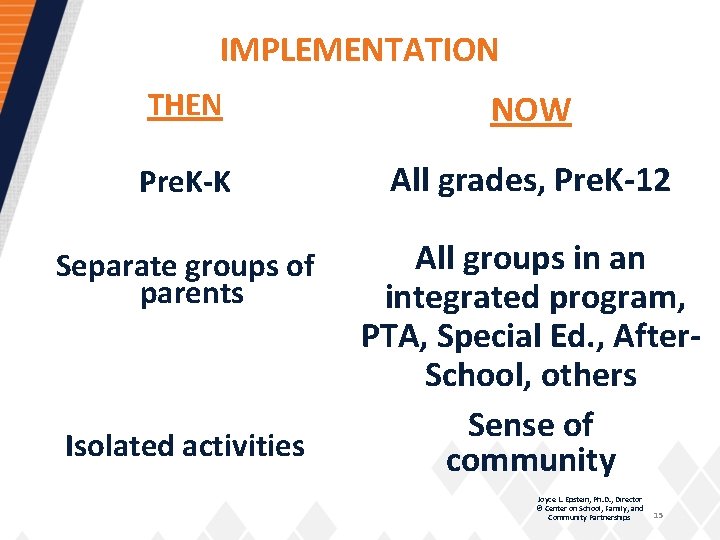
IMPLEMENTATION THEN NOW Pre. K-K All grades, Pre. K-12 Separate groups of parents All groups in an integrated program, PTA, Special Ed. , After. School, others Sense of community Isolated activities Joyce L. Epstein, Ph. D. , Director © Center on School, Family, and Community Partnerships 15
Reach Results for Student Success
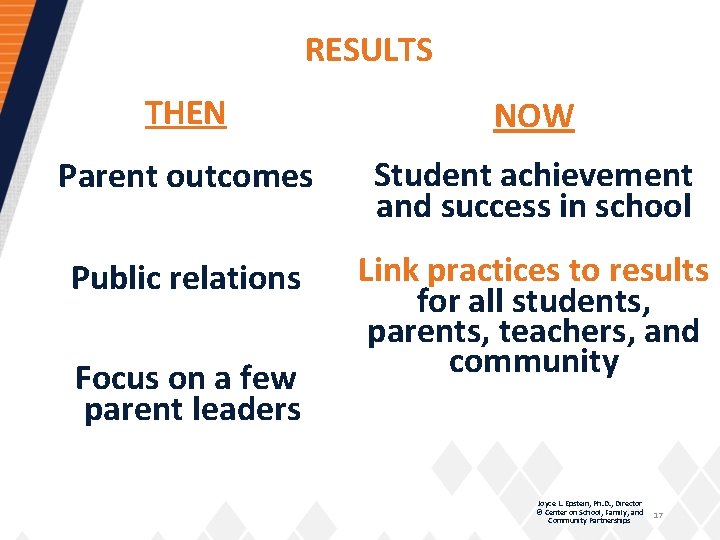
RESULTS THEN NOW Parent outcomes Student achievement and success in school Public relations Link practices to results for all students, parents, teachers, and community Focus on a few parent leaders Joyce L. Epstein, Ph. D. , Director © Center on School, Family, and Community Partnerships 17
Reach Results for Student Success
Develop an Action Plan for Partnerships Linked to Goals for Student Success Joyce L. Epstein, Ph. D. , Director © Center on School, Family, and Community Partnerships 19
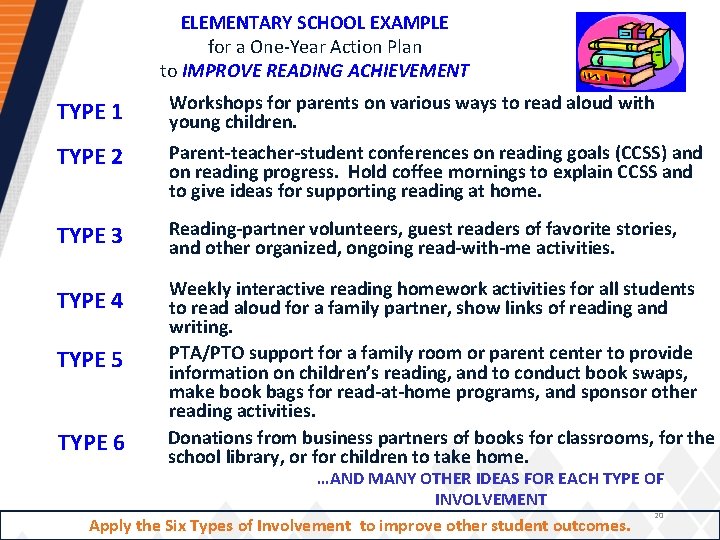
ELEMENTARY SCHOOL EXAMPLE for a One-Year Action Plan to IMPROVE READING ACHIEVEMENT TYPE 1 Workshops for parents on various ways to read aloud with young children. TYPE 2 Parent-teacher-student conferences on reading goals (CCSS) and on reading progress. Hold coffee mornings to explain CCSS and to give ideas for supporting reading at home. TYPE 3 Reading-partner volunteers, guest readers of favorite stories, and other organized, ongoing read-with-me activities. TYPE 4 Weekly interactive reading homework activities for all students to read aloud for a family partner, show links of reading and writing. PTA/PTO support for a family room or parent center to provide information on children’s reading, and to conduct book swaps, make book bags for read-at-home programs, and sponsor other reading activities. Donations from business partners of books for classrooms, for the school library, or for children to take home. TYPE 5 TYPE 6 …AND MANY OTHER IDEAS FOR EACH TYPE OF INVOLVEMENT 20 Apply the Six Types of Involvement to improve other student outcomes.
Evaluate Results
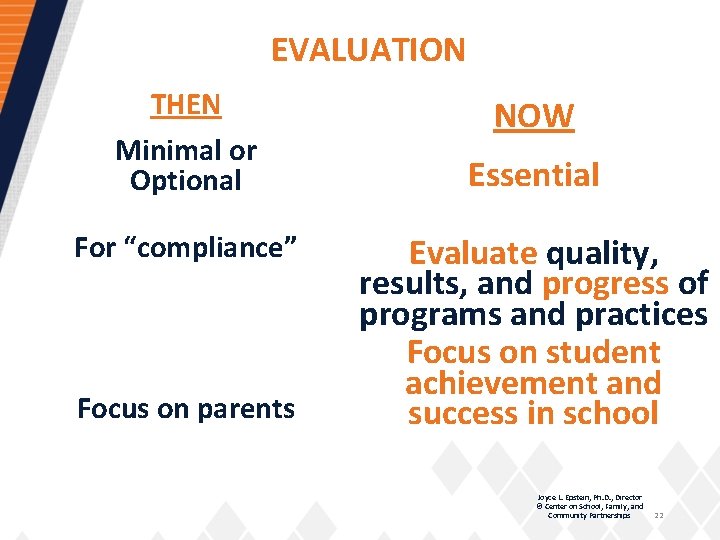
EVALUATION THEN Minimal or Optional For “compliance” Focus on parents NOW Essential Evaluate quality, results, and progress of programs and practices Focus on student achievement and success in school Joyce L. Epstein, Ph. D. , Director © Center on School, Family, and Community Partnerships 22
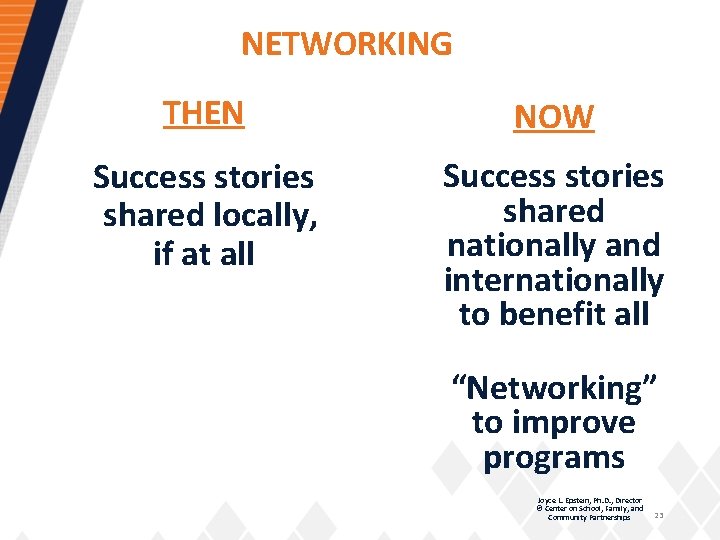
NETWORKING THEN NOW Success stories shared locally, if at all Success stories shared nationally and internationally to benefit all “Networking” to improve programs Joyce L. Epstein, Ph. D. , Director © Center on School, Family, and Community Partnerships 23
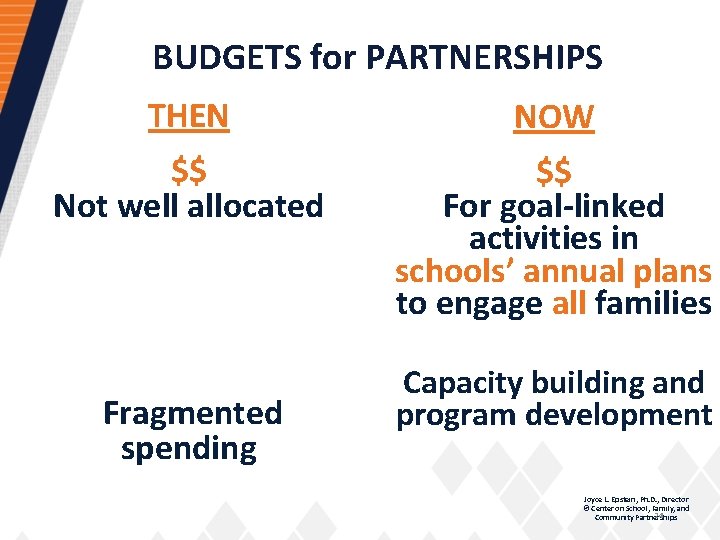
BUDGETS for PARTNERSHIPS THEN NOW $$ Not well allocated $$ For goal-linked activities in schools’ annual plans to engage all families Fragmented spending Capacity building and program development Joyce L. Epstein, Ph. D. , Director © Center on School, Family, and 24 Community Partnerships
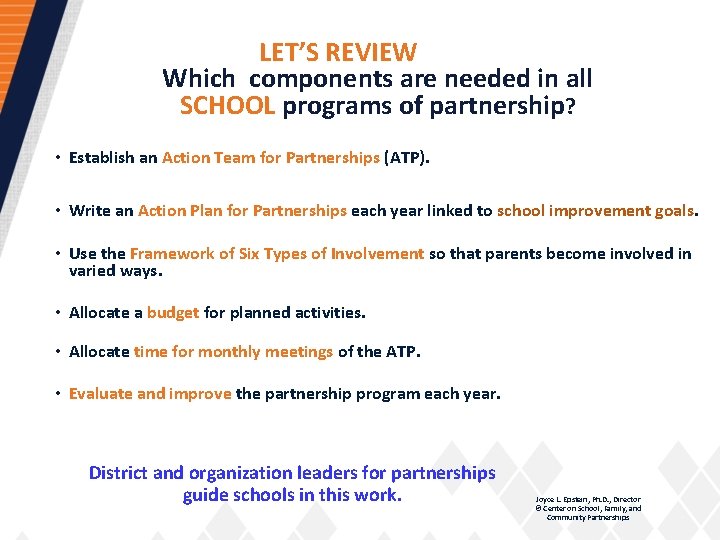
LET’S REVIEW Which components are needed in all SCHOOL programs of partnership? • Establish an Action Team for Partnerships (ATP). • Write an Action Plan for Partnerships each year linked to school improvement goals. • Use the Framework of Six Types of Involvement so that parents become involved in varied ways. • Allocate a budget for planned activities. • Allocate time for monthly meetings of the ATP. • Evaluate and improve the partnership program each year. District and organization leaders for partnerships guide schools in this work. Joyce L. Epstein, Ph. D. , Director © Center on School, Family, and Community Partnerships
For more information visit National Network of Partnership Schools www. partnershipschools. org References: Epstein, J. L. (2014). Baltimore, MD: National Network of Partnership Schools (NNPS) at Johns Hopkins University. Westerman, J. A. (2012). A comparison of Thai, Indian, Japanese, and American parents' views toward parent involvement in international schools in Thailand (Unpublished doctoral dissertation). Lehigh University.