
DEVELOPING A PEDIATRIC PALLIATIVE CARE AND HOSPICE MODEL

- Slides: 18
DEVELOPING A PEDIATRIC PALLIATIVE CARE AND HOSPICE MODEL Tristan L. Prescher Capstone Presentation 2013
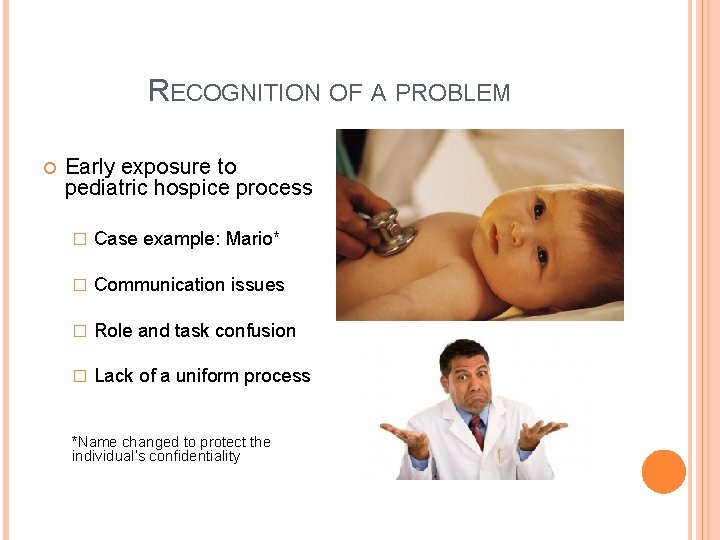
RECOGNITION OF A PROBLEM Early exposure to pediatric hospice process � Case example: Mario* � Communication issues � Role and task confusion � Lack of a uniform process *Name changed to protect the individual’s confidentiality
STATISTICS National Pediatric and Palliative Care Organization (NPPCO) � 36. 6% of hospice agencies stated they have a formal pediatric hospice in place � Out of those who did not have such programs, only 21. 7% employed specific staff adequately trained to provide pediatric services � However, 78% reported they serve children � Percentage of younger clients in hospice has been decreasing despite increases in number of hospice programs available nationwide and individuals enrolled in hospice
WHY DO I (OR YOU)CARE? Quality of care of hospice patients may suffer � Confusion impacts our ability to effectively care for our patients Individuals who could benefit from services may not be doing so � These individuals may be relying on hospital care for all of end-of-life needs (incredibly costly, inappropriate, cannot address all areas hospice program can)
STEP ONE: MEETING WITH AGRACE HOSPICE Met with VP of Clinical Services, Julie Slattery and VP of Access and Development, Denise Gloede at the Agrace Campus Expressed my interest and passion Invited to become a member of the Pediatric Palliative Care Partnership between Agrace and AFCH
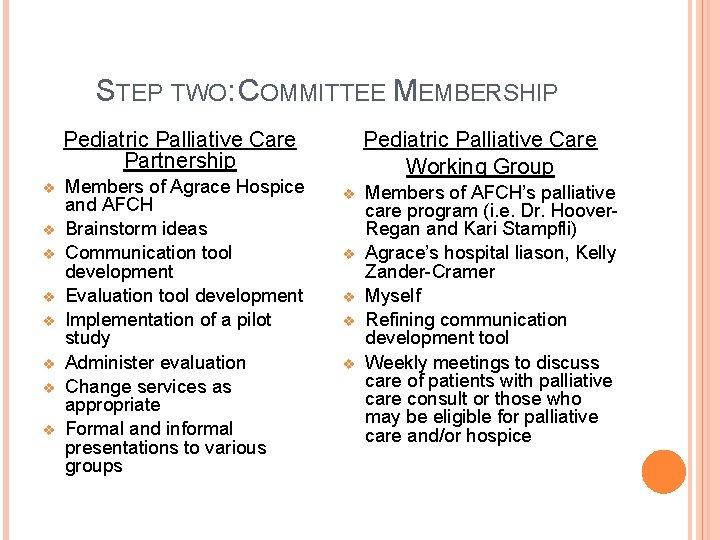
STEP TWO: COMMITTEE MEMBERSHIP Pediatric Palliative Care Partnership v v v v Members of Agrace Hospice and AFCH Brainstorm ideas Communication tool development Evaluation tool development Implementation of a pilot study Administer evaluation Change services as appropriate Formal and informal presentations to various groups Pediatric Palliative Care Working Group v v v Members of AFCH’s palliative care program (i. e. Dr. Hoover. Regan and Kari Stampfli) Agrace’s hospital liason, Kelly Zander-Cramer Myself Refining communication development tool Weekly meetings to discuss care of patients with palliative care consult or those who may be eligible for palliative care and/or hospice
PERSONAL RESPONSIBILITIES AND ACCOMPLISHMENTS IN COMMITTEES Identify empirically-supported models and tools for pediatric and palliative care � Footprints model � Seattle Children’s Hospital Decision-Making tool Utilized during initial meeting(s) about hospice involvement Presentation development for Dr. Wald Interviewing providers and families who have been involved with pediatric hospice in the past � Presenting information
PERSONAL RESPONSIBILITIES AND ACCOMPLISHMENTS IN COMMITTEES Provide input in refining communication tool Development of evaluation tool, given to families after participation Participation in pilot study and follow up ? ? ?
SEATTLE CHILDREN’S HOSPITAL DECISION-MAKING TOOL § Inclusion of Medical Home § Fill in “Medical Indicators” and other known information before visit § Available in the EMR § Copy given to hospice agency as well § Reviewed “as needed” or during extended inpatient stays
EVALUATION TOOL AFTER INITIAL MEETING(S) • Developed from Agrace’s Consumer Satisfaction Survey • Main purpose: For pilot studies • Ensures best practice is consistently used • Provides quantitative data regarding the effectiveness of our approach
CHOICE: COALITION OF HOSPICES ORGANIZED TO INVESTIGATE COMPARITIVE EFFECTIVENESS Currently 10 hospice organizations across the U. S. are involved � Share an electronic health record system � May increase to 17 Easy to combine data Participated in telephone call regarding a future paper in its early stages Paper will investigate the differences in the characteristics and outcomes of adult vs. pediatric hospice patients � Preliminary analysis
Conference former and current Maternal and Child Health Bureau Trainees Leadership, Networking and Career Development Submitted abstract on my pediatric hospice project and invited to attend Gained positive feedback from peers and developed leadership skills
STEP THREE: FACEBOOK PAGE Patients, Parents and Practitioners for Pediatric Hospice (P 4 H) � Includes links, photos, videos and other social media � Group Description
STEP FOUR: POTENTIAL FOR A FUTURE MSW PLACEMENT Idea � � Split time between Agrace and AFCH Increase knowledge and skill with inpatient pediatric social work � � When comfortable, assist Dr. Hoover-Regan and Kari Stampfli with palliative care consults Member of Pediatric Palliative Care Working Group / Partnership Gain experience with Agrace in hospice liaison role and gain community hospice experience Why? Gain knowledge and experience in two important areas of hospice and palliative care � Provide assistance to the palliative care committees � Preliminary Stages Investigating possibility with Agrace, AFCH and the School of Social Work � Stay tuned! �
STEP FIVE AND BEYOND: FUTURE GOALS (COMMITTEES) Immediate: � Administer pilot study and evaluation � Assess process and make changes as appropriate � Investigate alternative means of funding � Continue to advocate for program with those in administrative roles Long Term: � Development of an organized and effective process for seamless transition to hospice care � Physician/provider support (FTE allocation) � Hospital-wide education and appropriate physician and provider referrals
FUTURE GOALS (PERSONAL) Continue committee participation and participate in pilot study (if possible) Meet with individuals regarding future MSW placement Follow up with Agrace and Dr. Hoover-Regan regarding progress after completion of internship Maintain Facebook page and update appropriately Continue to stay involved in pediatric hospice in my community
QUESTIONS? ! COMMENTS? !
REFERENCES CHOICE: Coalition of Hospices Organized to Investigate Comparative Effectiveness. Retrieved from http: //www. choicehospices. org/home Friebert, Sarah (2009, April). NHPCO Facts and Figures: Pediatric palliative and hospice care in America [Power. Point Slides]. Retrieved from: http: //www. nhpco. org/files/public/quality/Pediatric_Facts-Figures. pdf Pediatric Advanced Care Team at Seattle Children’s Hospital. Decision-making tool: Information for families. Retrieved from: http: //www. seattlechildrens. org/clinicsprograms/palliative-careconsultation/ Toce, Suzanne & Collins, Mary Ann (2003). The FOOTPRINTS model of pediatric palliative care. Journal of Palliative Medicine, 6(6), 989 -1000.