
Developing a Narrative and Portfolio for Personnel Review


- Slides: 27
Developing a Narrative and Portfolio for Personnel Review at UIS Nathan Steele Chair, Personnel Policies Committee April 2014
Session Outcomes and Materials The purpose of this session is to: ◦ Distinguish between a narrative and portfolio ◦ Discuss components of a personnel file ◦ Explore format and ideas for writing the narrative and developing a portfolio ◦ Stimulate thinking about ways to make the best case
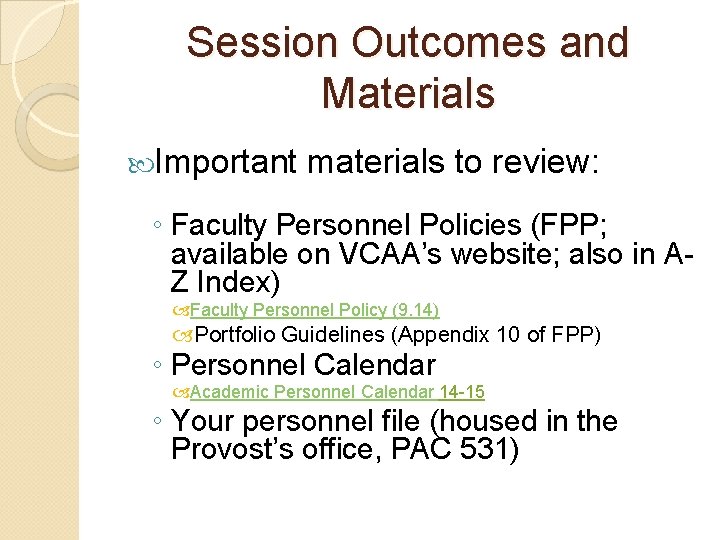
Session Outcomes and Materials Important materials to review: ◦ Faculty Personnel Policies (FPP; available on VCAA’s website; also in AZ Index) Faculty Personnel Policy (9. 14) Portfolio Guidelines (Appendix 10 of FPP) ◦ Personnel Calendar Academic Personnel Calendar 14 -15 ◦ Your personnel file (housed in the Provost’s office, PAC 531)
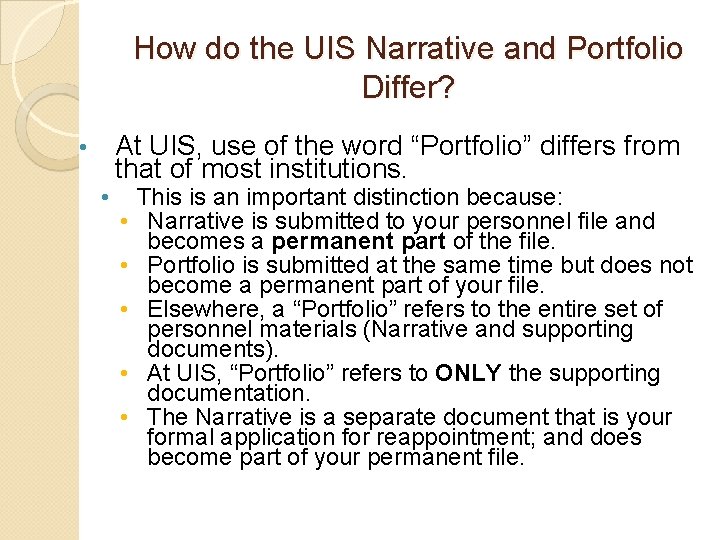
How do the UIS Narrative and Portfolio Differ? • • At UIS, use of the word “Portfolio” differs from that of most institutions. • • • This is an important distinction because: Narrative is submitted to your personnel file and becomes a permanent part of the file. Portfolio is submitted at the same time but does not become a permanent part of your file. Elsewhere, a “Portfolio” refers to the entire set of personnel materials (Narrative and supporting documents). At UIS, “Portfolio” refers to ONLY the supporting documentation. The Narrative is a separate document that is your formal application for reappointment; and does become part of your permanent file.
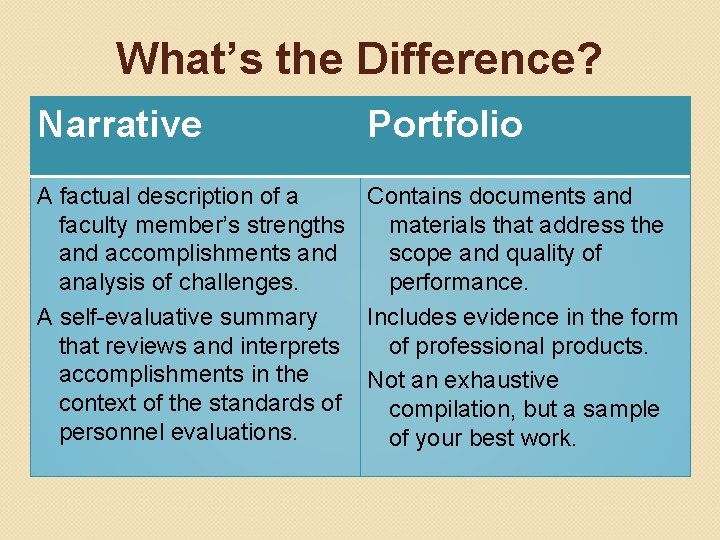
What’s the Difference? Narrative Portfolio A factual description of a Contains documents and faculty member’s strengths materials that address the and accomplishments and scope and quality of analysis of challenges. performance. A self-evaluative summary Includes evidence in the form that reviews and interprets of professional products. accomplishments in the Not an exhaustive context of the standards of compilation, but a sample personnel evaluations. of your best work.
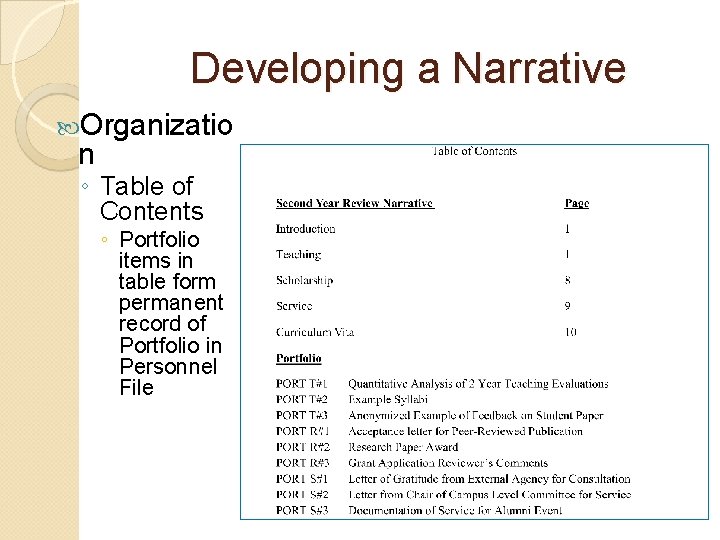
Developing a Narrative Organizatio n ◦ Table of Contents ◦ Portfolio items in table form permanent record of Portfolio in Personnel File
Developing a Narrative Organization ◦ Page limits for narratives (10, 20, 30) • Sections: • • Professional Introduction Teaching Scholarship Service • Each section following the introduction should include: • • Philosophy Statement Methodology and Strategies Long and short-term goals References to documenting evidence in the portfolio and personnel file • e. g. , “See Portfolio T#3” • Documented evidence should be reference throughout each section.
Developing a Narrative Professional Introduction ◦ Don’t assume everyone knows you. ◦ Provide the professional context of your position, a description of your background, training, and role at UIS. ◦ Summarize new developments since last review ◦ Include only the detail that you believe is critical to your professional review. Include a curriculum vita as an appendix to your narrative (it is a requirement and an important tool for reviewers) Clarify and explain disciplinary concepts for broader college and campus audience (avoid jargon!)
Statements of Philosophy Begin by asking yourself some questions: Why do I engage in teaching/service/scholarship? What are my expected outcomes? What is the conceptual framework that I use to approach these areas? What attitudes or habits demonstrate effective performance in these areas? How do I depict these in my review? What values do I hope to impart to students, colleagues, community members, and all others that I serve/teach? What themes pervade my work in these three areas?
Methodology and Strategies are: ◦ The “how” or the techniques that you use to achieve your goals. ◦ Should have a conceptual connection to your philosophy. ◦ Document the impact and/or relevance of these strategies. ◦ Describe the benefits to students, peers, colleagues, campus and/or community. ◦ Tie together strategies from all three areas under review (teaching, scholarship, service) ◦ Don’t forget service! Don’t simply list your committees Explain what you do in that role including impacts and benefits. ◦ Respond to previous review comments
Exploring Short-term and Long-term Goals ◦ Address what you expect of yourself, both short-term and long-term goals in the areas of review. ◦ Demonstrate your progress and development in terms of your goals. ◦ Address both accomplishments and challenges. ◦ Don’t be afraid to project into the future; you can re-analyze these goals in future reviews.
Linking your Narrative and Portfolio ◦ Link activities and analysis outlined in the narrative with evidence/products in portfolio and permanent file. ◦ Use indexing to guide the reader and connect the narrative with the portfolio and permanent file Don’t forget to include Portfolio Contents in Table of Contents of Narrative for permanent record in Personnel File. ◦ Use both qualitative (quotes, student products) and quantitative evidence (student evaluations, enrollments, advising numbers) ◦ Remember, make it EASY for the reader (don’t overload/overcomplicate; clarify; avoid jargon)
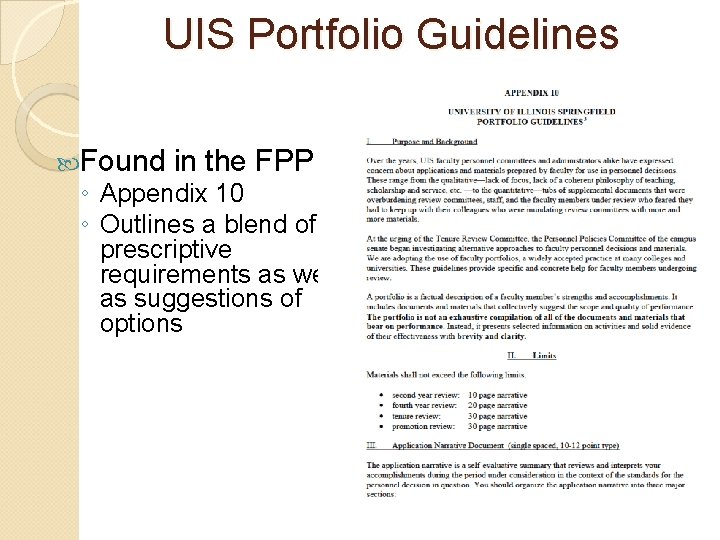
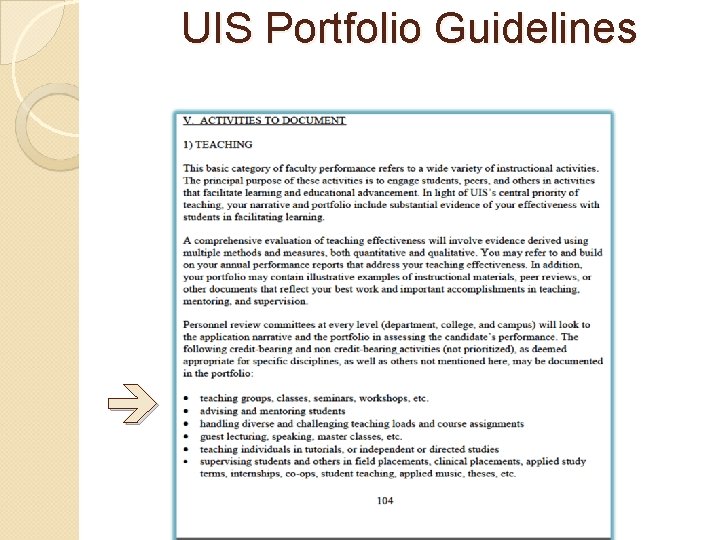
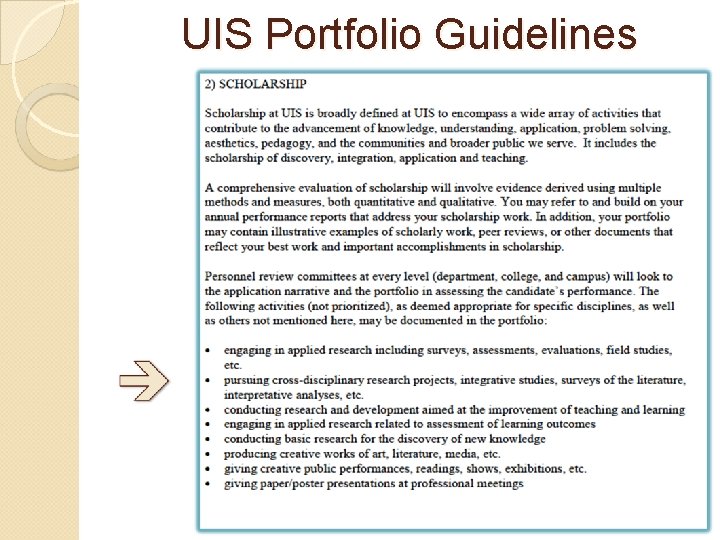
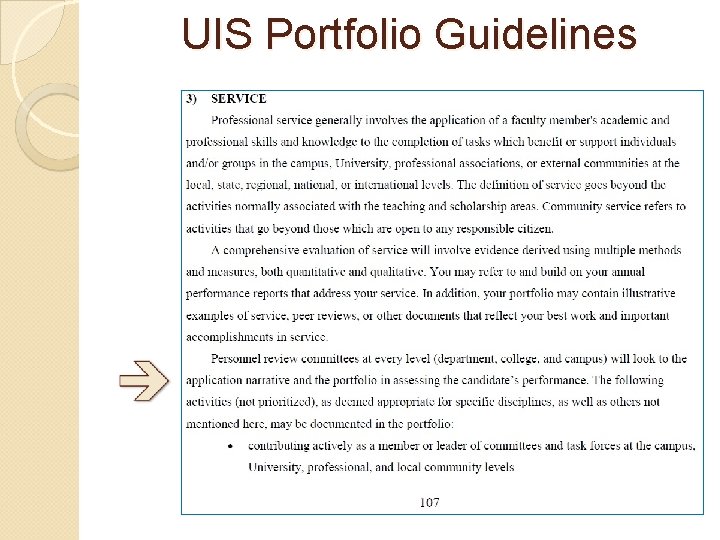
UIS Portfolio Guidelines Found in the FPP ◦ Appendix 10 ◦ Outlines a blend of prescriptive requirements as well as suggestions of options
UIS Portfolio Guidelines These guidelines are used for all tenuretrack faculty, for all levels of review. Designed to be used along with: ◦ ◦ It Article 3 (Professional Evaluation), Article 5 (Reappointment) Article 6 (Tenure) Article 7 (Promotion) is important to be familiar with the language in these areas of the FPP.
UIS Portfolio Guidelines Require the use of both a narrative and a portfolio for personnel review. Provide suggestions for and examples of what you might include in your documentation for each of the areas of review. The lists of activities are neither exhaustive, nor prescriptive.
UIS Portfolio Guidelines
UIS Portfolio Guidelines
UIS Portfolio Guidelines
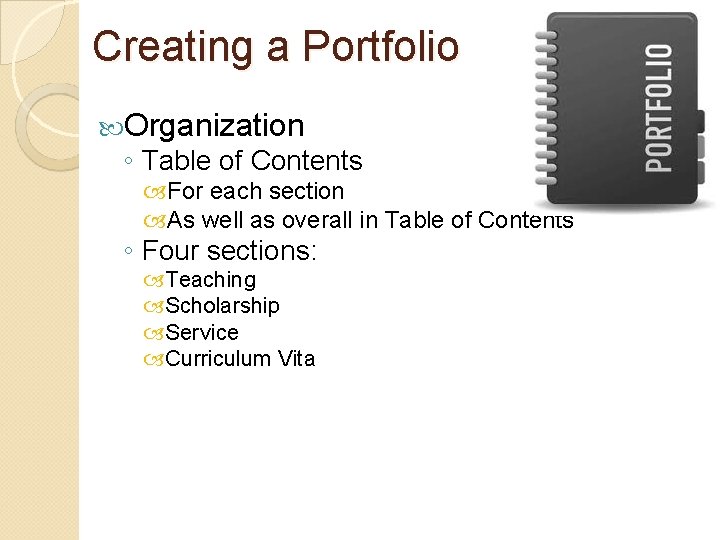
Creating a Portfolio Organization ◦ Table of Contents For each section As well as overall in Table of Contents ◦ Four sections: Teaching Scholarship Service Curriculum Vita
Creating a Portfolio Organization ◦ Include illustrative examples of your best work, important accomplishments and evidence of your progress. ◦ Balance quality and brevity with full coverage of the breadth of your work ◦ Not complete works, but several demonstrative examples (Guidelines suggest 3 -4 Items per category). Choose wisely!
Creating a Portfolio Examples of Evidentiary Material ◦ Teaching Student evaluation quantitative analysis Course Materials (Syllabi, Paper/Project Guidelines, Evaluation Frameworks) Student Products (get students’ permission; ensure anonymity) Student evaluation comments Avoid “cherry-picking. ” Give full impression. Supportive Letters Must be signed for personnel file Commendations, Awards
Creating a Portfolio Examples of Evidentiary Material ◦ Scholarship Publications, creative works, handbooks, reports Conference papers Publication offers/contracts Journal rankings Editorial statements Grant proposals Commendations, Awards Letters of support Letters/emails of acceptance for publication or presentation Evidence of formal peer review for products
Creating a Portfolio Examples of Evidentiary Material ◦ Service Letters from committee chairs/members Letters of thanks from community organizations Work products Conference Programs – indicating service role in conference (e. g. , program chair, discussant, etc. ) Training certificates Professional Service vs. Scholarship Own original work (scholarship) separate from work by virtue of expertise to support discipline (service). Look to discipline for clarification – Don’t double list!
Creating a Portfolio Deciding what goes in your Portfolio vs. Personnel File ◦ Your personnel file is an important part of the personnel process, but separate from your portfolio ◦ The distinguishing factor: Personnel file is “permanent” ◦ Your permanent file should be used only for milestones or career landmarks. ◦ Materials that are ever changing, evolving should be placed in your portfolio ◦ Think carefully about which documents you submit to your personnel file ◦ Don’t duplicate the personnel file in the portfolio
Putting it all Together – What Works? Depiction of quality experiences and reflection Relevance: Demonstrating your work’s impact on students, discipline, campus, and community Illustrating, Reflecting, and Projecting your professional development and progress at UIS Effective presentation of materials Summation at the end of each section Use your yearly performance reports as a way to keep track of your activities and help you get started on your reappointment review ◦ Do NOT direct the reviewer to your APR. Tie directly to the evidence itself. Explain the value and qualitative impact of what you do – burden of proof on applicant.
Final Tip: Ask, ASK, ASK!
Questions/Comments? Nathan Steele, Personnel Policies Committee Chair nathan. steele@uis. edu