
Developing a Mori language pronunciation tool based on
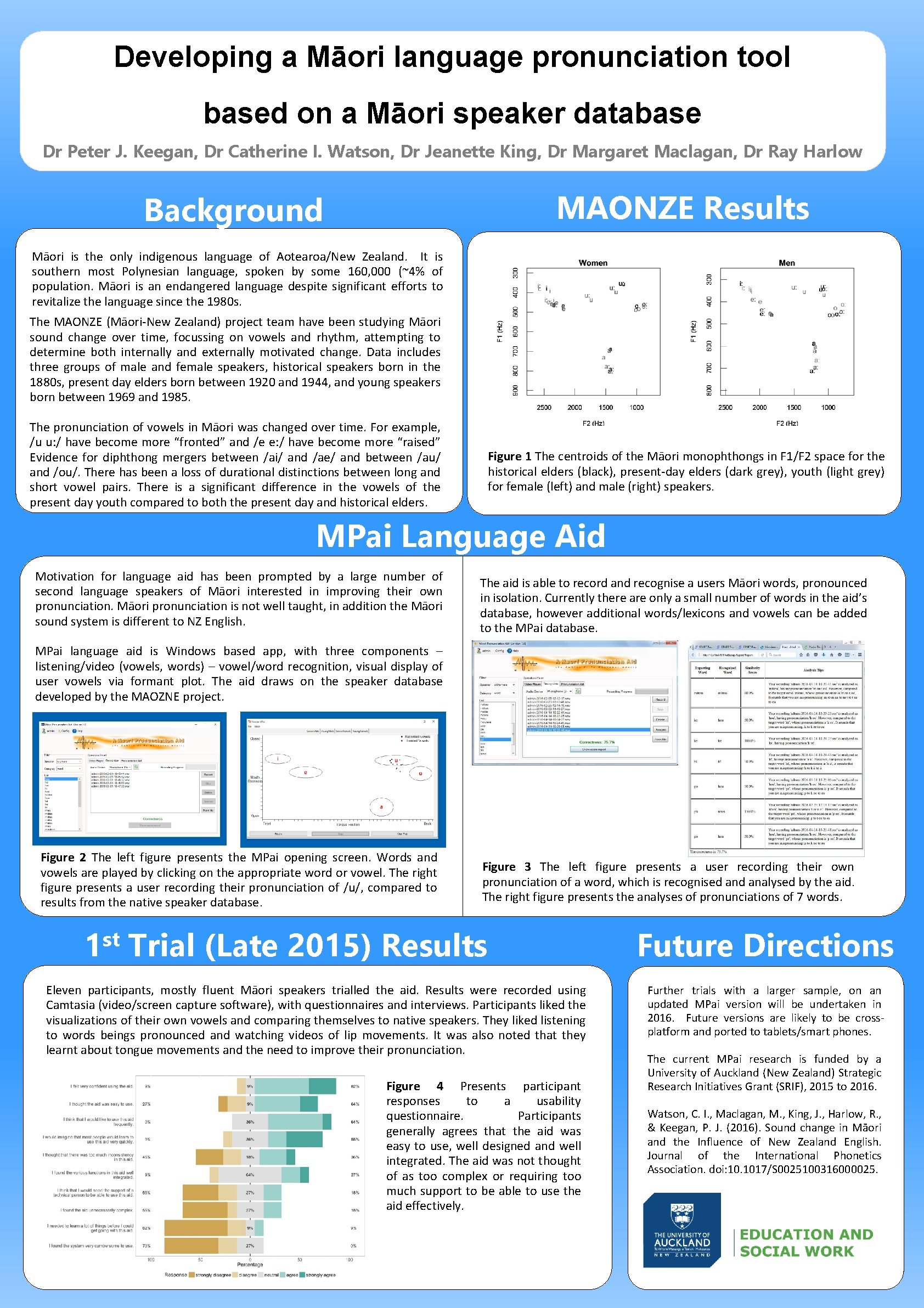
Developing a Māori language pronunciation tool based on a Māori speaker database Dr Peter J. Keegan, Dr Catherine I. Watson, Dr Jeanette King, Dr Margaret Maclagan, Dr Ray Harlow MAONZE Results Background Māori is the only indigenous language of Aotearoa/New Zealand. It is southern most Polynesian language, spoken by some 160, 000 (~4% of population. Māori is an endangered language despite significant efforts to revitalize the language since the 1980 s. The MAONZE (Māori-New Zealand) project team have been studying Māori sound change over time, focussing on vowels and rhythm, attempting to determine both internally and externally motivated change. Data includes three groups of male and female speakers, historical speakers born in the 1880 s, present day elders born between 1920 and 1944, and young speakers born between 1969 and 1985. Background The pronunciation of vowels in Māori was changed over time. For example, /u u: / have become more “fronted” and /e e: / have become more “raised” Evidence for diphthong mergers between /ai/ and /ae/ and between /au/ and /ou/. There has been a loss of durational distinctions between long and short vowel pairs. There is a significant difference in the vowels of the present day youth compared to both the present day and historical elders. Figure 1 The centroids of the Māori monophthongs in F 1/F 2 space for the historical elders (black), present-day elders (dark grey), youth (light grey) for female (left) and male (right) speakers. MPai Language Aid Motivation for language aid has been prompted by a large number of second language speakers of Māori interested in improving their own pronunciation. Māori pronunciation is not well taught, in addition the Māori sound system is different to NZ English. The aid is able to record and recognise a users Māori words, pronounced in isolation. Currently there are only a small number of words in the aid’s database, however additional words/lexicons and vowels can be added to the MPai database. MPai language aid is Windows based app, with three components – listening/video (vowels, words) – vowel/word recognition, visual display of user vowels via formant plot. The aid draws on the speaker database developed by the MAOZNE project. Figure 2 The left figure presents the MPai opening screen. Words and vowels are played by clicking on the appropriate word or vowel. The right figure presents a user recording their pronunciation of /u/, compared to results from the native speaker database. st 1 Figure 3 The left figure presents a user recording their own pronunciation of a word, which is recognised analysed by the aid. The right figure presents the analyses of pronunciations of 7 words. Trial (Late 2015) Results Eleven participants, mostly fluent Māori speakers trialled the aid. Results were recorded using Camtasia (video/screen capture software), with questionnaires and interviews. Participants liked the visualizations of their own vowels and comparing themselves to native speakers. They liked listening to words beings pronounced and watching videos of lip movements. It was also noted that they learnt about tongue movements and the need to improve their pronunciation. Figure 4 Presents participant responses to a usability questionnaire. Participants generally agrees that the aid was easy to use, well designed and well integrated. The aid was not thought of as too complex or requiring too much support to be able to use the aid effectively. Future Directions Further trials with a larger sample, on an updated MPai version will be undertaken in 2016. Future versions are likely to be crossplatform and ported to tablets/smart phones. The current MPai research is funded by a University of Auckland (New Zealand) Strategic Research Initiatives Grant (SRIF), 2015 to 2016. Watson, C. I. , Maclagan, M. , King, J. , Harlow, R. , & Keegan, P. J. (2016). Sound change in Māori and the Influence of New Zealand English. Journal of the International Phonetics Association. doi: 10. 1017/S 0025100316000025.
- Slides: 1