
Developing a more holistic approach to assessment policy
- Slides: 9
Developing a more holistic approach to assessment policy and practice Ranald Macdonald Sheffield Hallam University
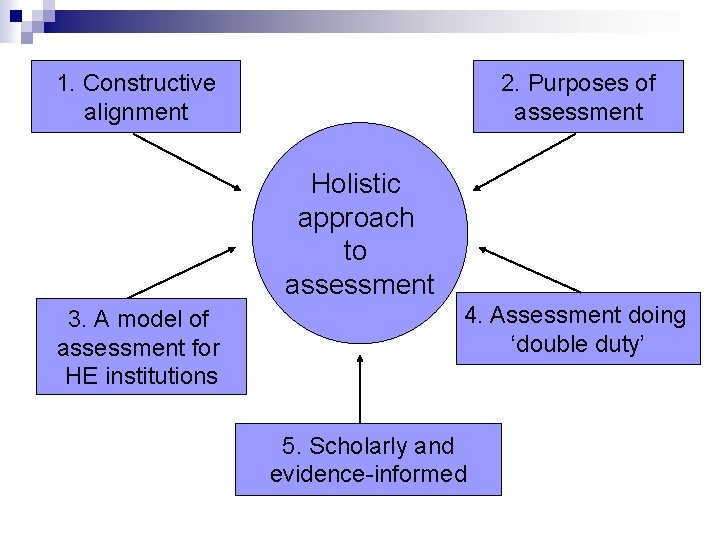
1. Constructive alignment 2. Purposes of assessment Holistic approach to assessment 3. A model of assessment for HE institutions 4. Assessment doing ‘double duty’ 5. Scholarly and evidence-informed
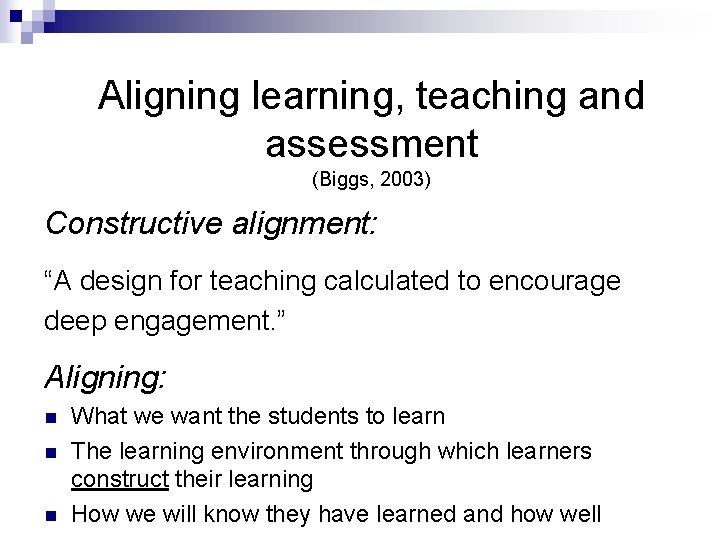
Aligning learning, teaching and assessment (Biggs, 2003) Constructive alignment: “A design for teaching calculated to encourage deep engagement. ” Aligning: n n n What we want the students to learn The learning environment through which learners construct their learning How we will know they have learned and how well
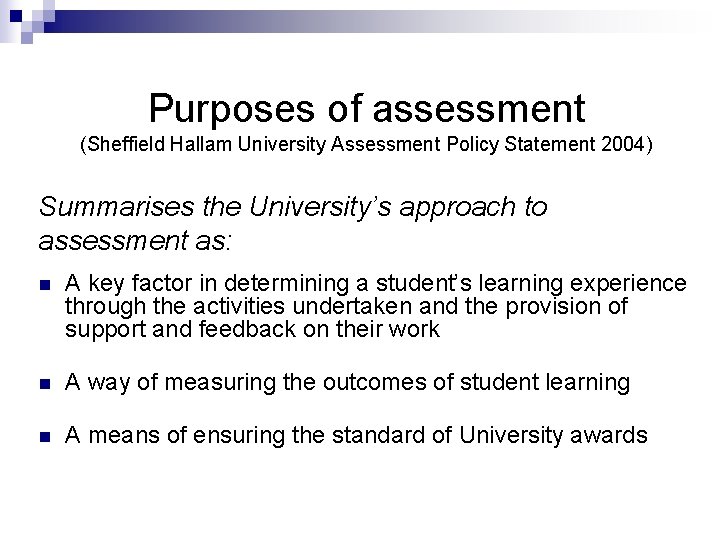
Purposes of assessment (Sheffield Hallam University Assessment Policy Statement 2004) Summarises the University’s approach to assessment as: n A key factor in determining a student’s learning experience through the activities undertaken and the provision of support and feedback on their work n A way of measuring the outcomes of student learning n A means of ensuring the standard of University awards
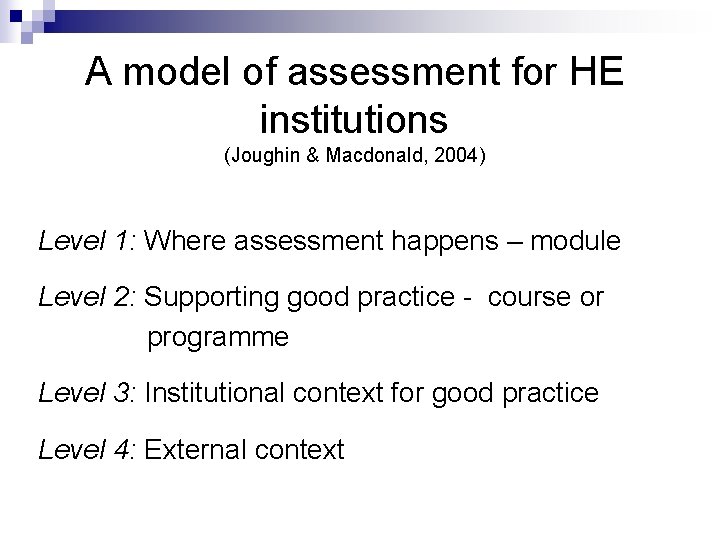
A model of assessment for HE institutions (Joughin & Macdonald, 2004) Level 1: Where assessment happens – module Level 2: Supporting good practice - course or programme Level 3: Institutional context for good practice Level 4: External context
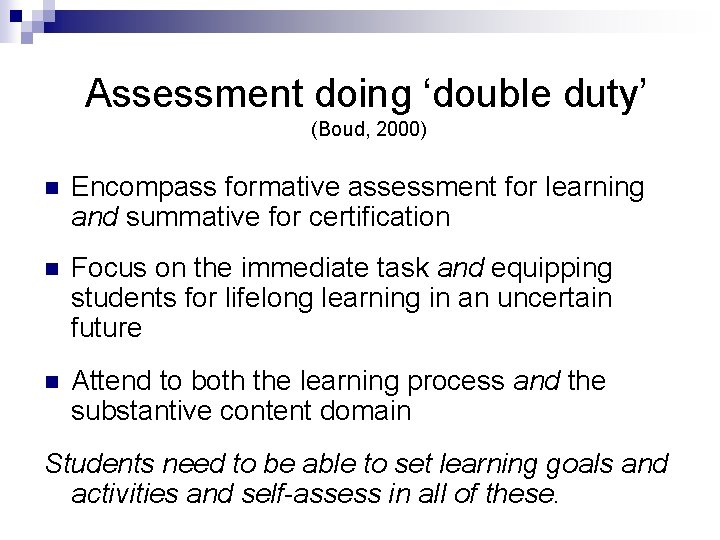
Assessment doing ‘double duty’ (Boud, 2000) n Encompass formative assessment for learning and summative for certification n Focus on the immediate task and equipping students for lifelong learning in an uncertain future n Attend to both the learning process and the substantive content domain Students need to be able to set learning goals and activities and self-assess in all of these.
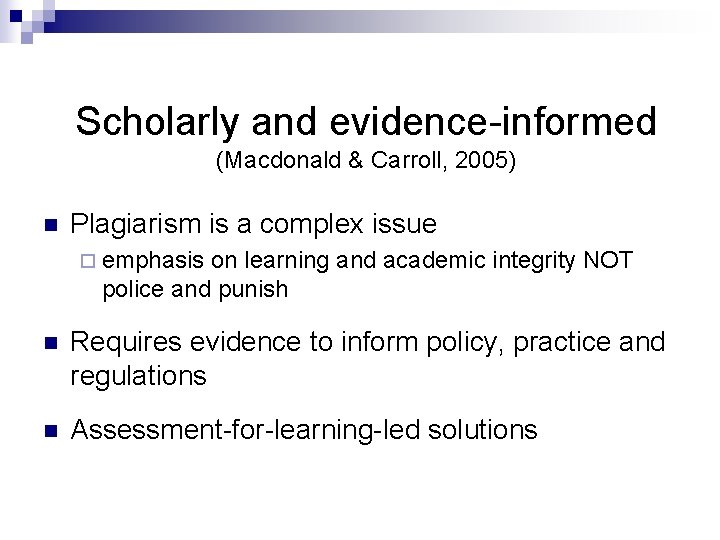
Scholarly and evidence-informed (Macdonald & Carroll, 2005) n Plagiarism is a complex issue ¨ emphasis on learning and academic integrity NOT police and punish n Requires evidence to inform policy, practice and regulations n Assessment-for-learning-led solutions
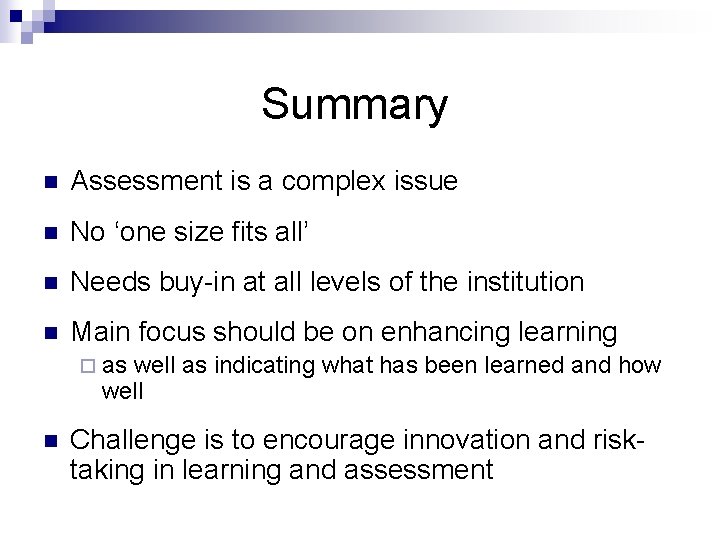
Summary n Assessment is a complex issue n No ‘one size fits all’ n Needs buy-in at all levels of the institution n Main focus should be on enhancing learning ¨ as well as indicating what has been learned and how well n Challenge is to encourage innovation and risktaking in learning and assessment
References Biggs, J (2003, 2 nd ed. ) Teaching for quality learning at university. Buckingham: Open University Press/SRHE Boud, D (2000) Sustainable assessment: rethinking assessment for the learning society. Studies in Continuing Education, 22, 2, 151 -167 Joughin, G & Macdonald, R (2004) A model of assessment in higher education institutions. http: //www. heacademy. ac. uk Macdonald, R & Carroll, J (2005) Plagiarism – a complex issue requiring a holistic institutional approach. Assessment and Evaluation in Higher Education, 31, 2, 233 -245