
Developing a logic model University of WisconsinExtension Program
- Slides: 86
Developing a logic model University of Wisconsin-Extension, Program Development and Evaluation © 2008 by the University of Wisconsin System. . 1
A logic model is… • A depiction of a program showing what the program will do and what it is to accomplish. • A series of “if-then” relationships that, if implemented as intended, lead to the desired outcomes • The core of program planning and evaluation University of Wisconsin-Extension, Program Development and Evaluation 2
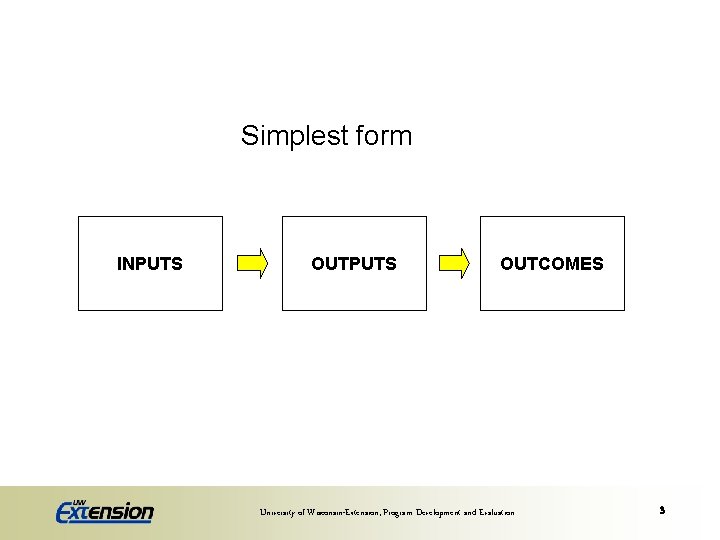
Simplest form INPUTS OUTCOMES University of Wisconsin-Extension, Program Development and Evaluation 3
Logic models can be applied to: a small program, a process (i. e. a team working together), a large, multi-component program, or even to an organization or business. University of Wisconsin-Extension, Program Development and Evaluation 4
LOGIC • the principles of reasoning • reasonable • the relationship of elements to each other and a whole MODEL • small object representing another, often larger object (represents reality, isn’t reality) • preliminary pattern serving as a plan • tentative description of a system or theory that accounts for all its known properties The American Heritage Dictionary, 2 nd Ed University of Wisconsin-Extension, Program Development and Evaluation 5
Where are you going? How will you get there? What will show that you’ve arrived? “If you don’t know where you are going, how are you gonna’ know when you get there? ” Yogi Berra 6
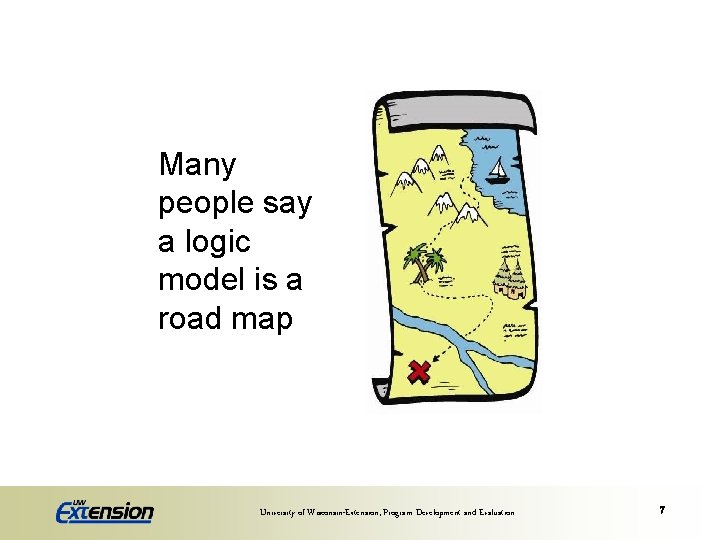
Many people say a logic model is a road map University of Wisconsin-Extension, Program Development and Evaluation 7
Logic model may also be called… • • • Theory of change Program action Model of change Conceptual map Outcome map Program logic University of Wisconsin-Extension, Program Development and Evaluation 8
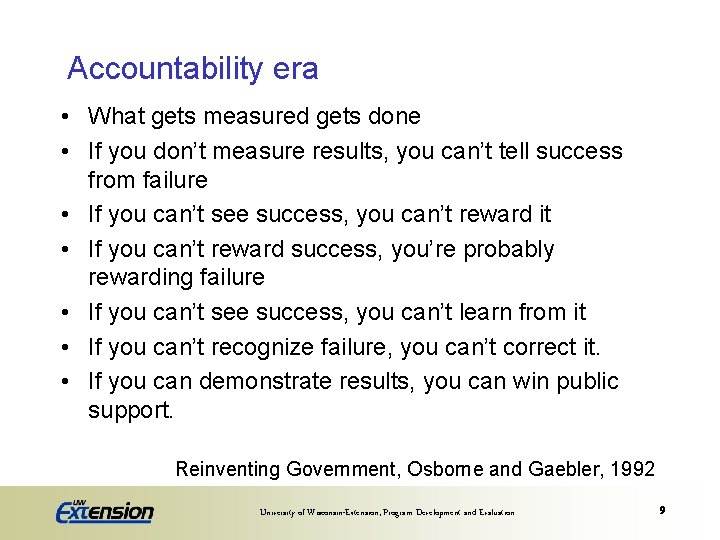
Accountability era • What gets measured gets done • If you don’t measure results, you can’t tell success from failure • If you can’t see success, you can’t reward it • If you can’t reward success, you’re probably rewarding failure • If you can’t see success, you can’t learn from it • If you can’t recognize failure, you can’t correct it. • If you can demonstrate results, you can win public support. Reinventing Government, Osborne and Gaebler, 1992 University of Wisconsin-Extension, Program Development and Evaluation 9
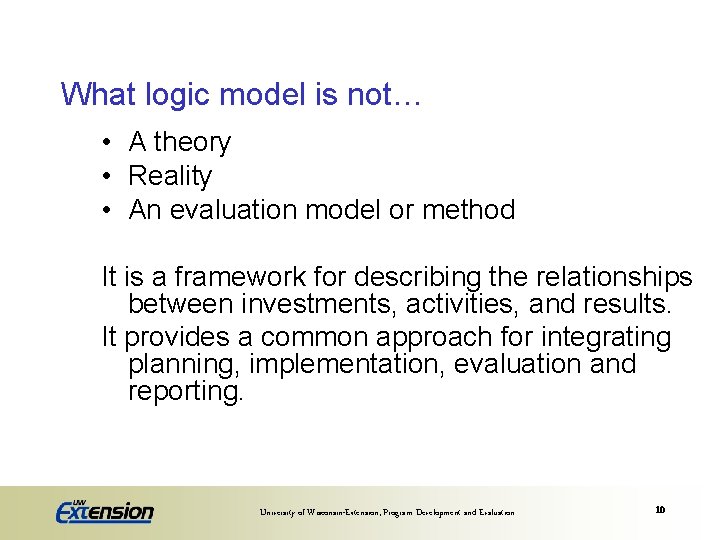
What logic model is not… • A theory • Reality • An evaluation model or method It is a framework for describing the relationships between investments, activities, and results. It provides a common approach for integrating planning, implementation, evaluation and reporting. University of Wisconsin-Extension, Program Development and Evaluation 10
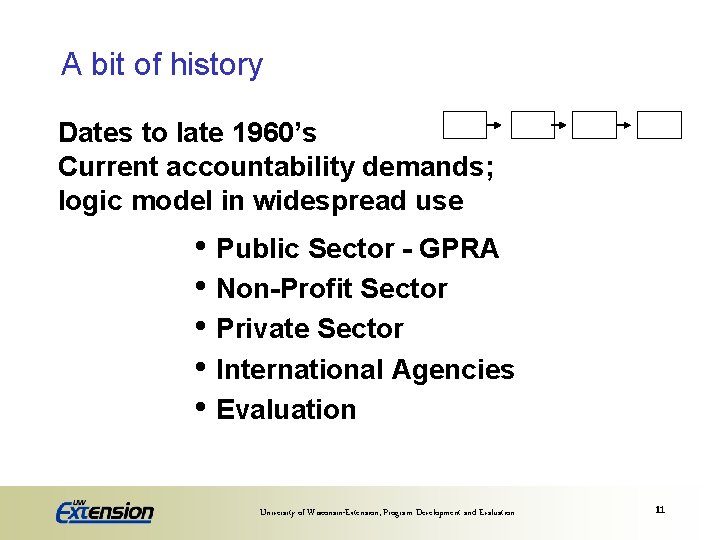
A bit of history Dates to late 1960’s Current accountability demands; logic model in widespread use • Public Sector - GPRA • Non-Profit Sector • Private Sector • International Agencies • Evaluation University of Wisconsin-Extension, Program Development and Evaluation 11
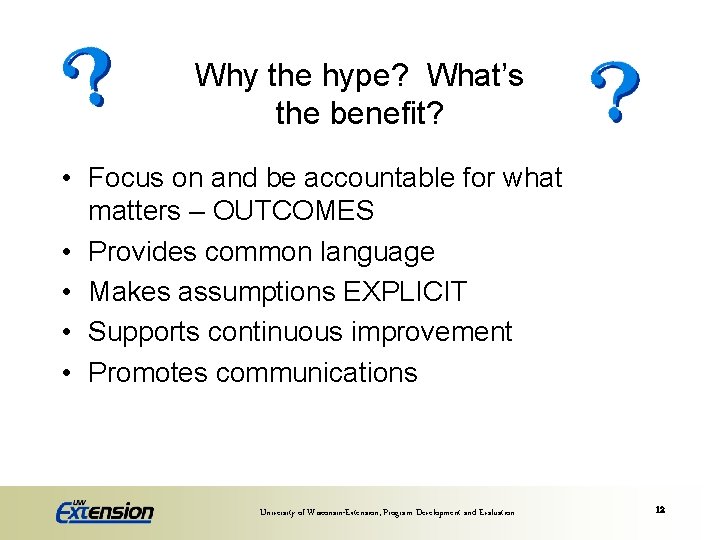
Why the hype? What’s the benefit? • Focus on and be accountable for what matters – OUTCOMES • Provides common language • Makes assumptions EXPLICIT • Supports continuous improvement • Promotes communications University of Wisconsin-Extension, Program Development and Evaluation 12
Logic modelling is a way of thinking… not just a pretty graphic “We build the road and the road builds us. ” -Sri Lankan saying University of Wisconsin-Extension, Program Development and Evaluation 13
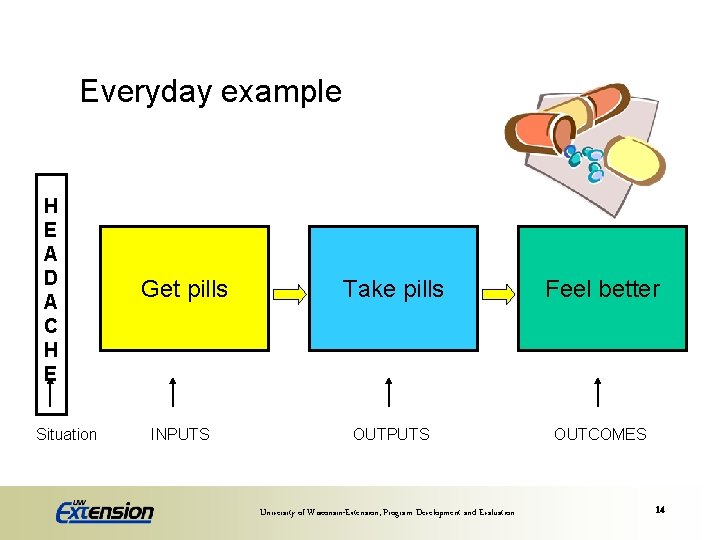
Everyday example H E A D A C H E Situation Get pills Take pills Feel better INPUTS OUTCOMES University of Wisconsin-Extension, Program Development and Evaluation 14
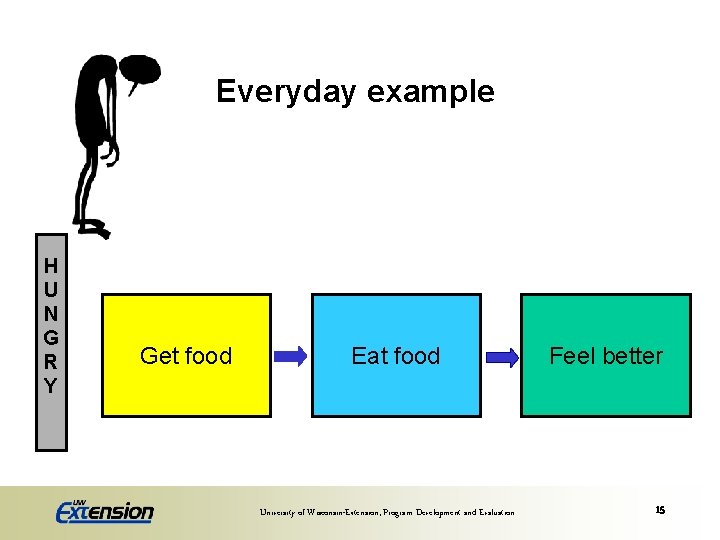
Everyday example H U N G R Y Get food Eat food University of Wisconsin-Extension, Program Development and Evaluation Feel better 15
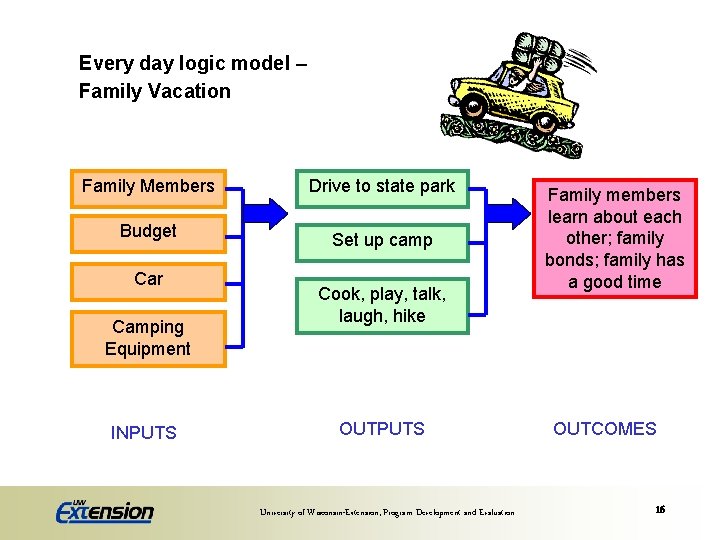
Every day logic model – Family Vacation Family Members Drive to state park Budget Set up camp Car Camping Equipment INPUTS Cook, play, talk, laugh, hike OUTPUTS University of Wisconsin-Extension, Program Development and Evaluation Family members learn about each other; family bonds; family has a good time OUTCOMES 16
Assumptions underlie much of what we do. It is often these underlying assumptions that hinder success or produce less-thanexpected results. One benefit of logic modeling is that it helps us make our assumptions explicit. University of Wisconsin-Extension, Program Development and Evaluation 17
Assumptions The beliefs we have about the program, the participants, and how the program will work. Includes ideas about: – – – – – the problem or existing situation program operations expected outcomes and benefits the participants and how they learn, behave, their motivations resources staff external environment: influences the knowledge base etc. University of Wisconsin-Extension, Program Development and Evaluation 18
Assumptions As you left the house today and came to this workshop, what were some of your assumptions about the day? Why is it important that we think about assumptions? University of Wisconsin-Extension, Program Development and Evaluation 19
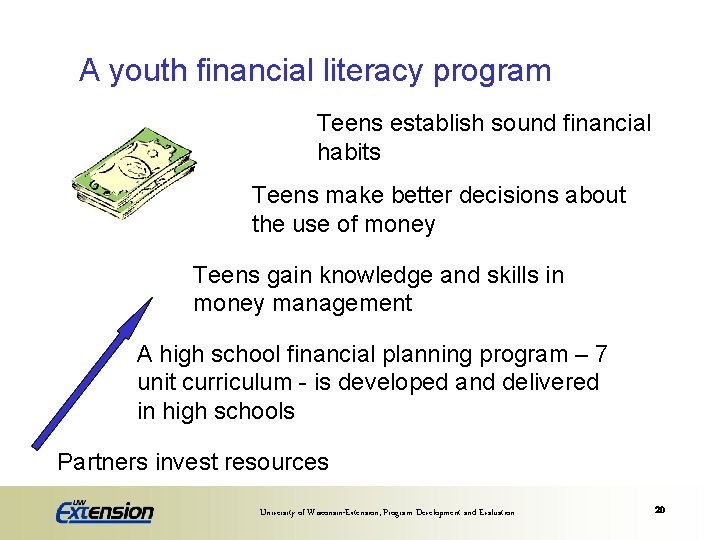
A youth financial literacy program Teens establish sound financial habits Teens make better decisions about the use of money Teens gain knowledge and skills in money management A high school financial planning program – 7 unit curriculum - is developed and delivered in high schools Partners invest resources University of Wisconsin-Extension, Program Development and Evaluation 20
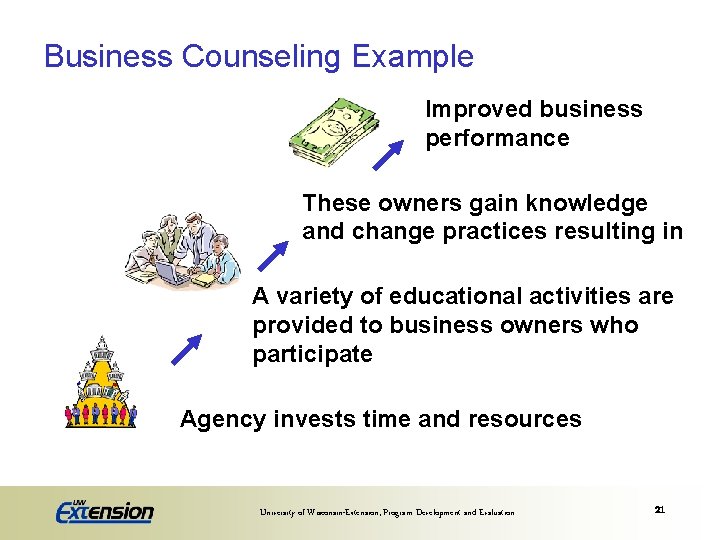
Business Counseling Example Improved business performance These owners gain knowledge and change practices resulting in A variety of educational activities are provided to business owners who participate Agency invests time and resources University of Wisconsin-Extension, Program Development and Evaluation 21
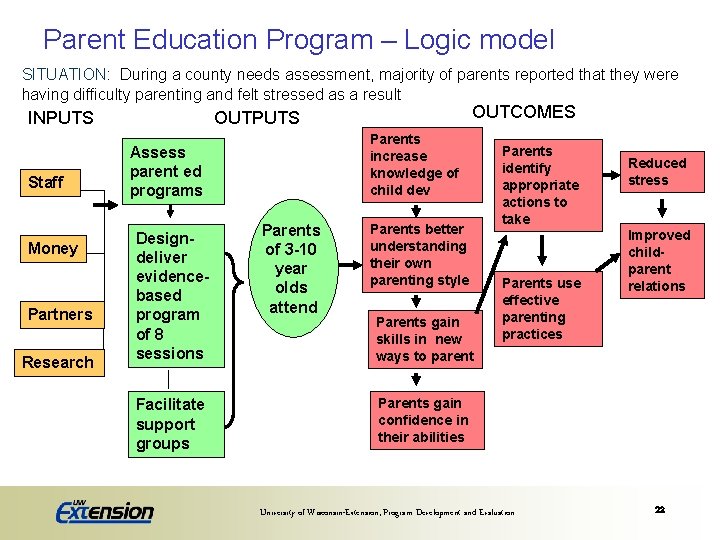
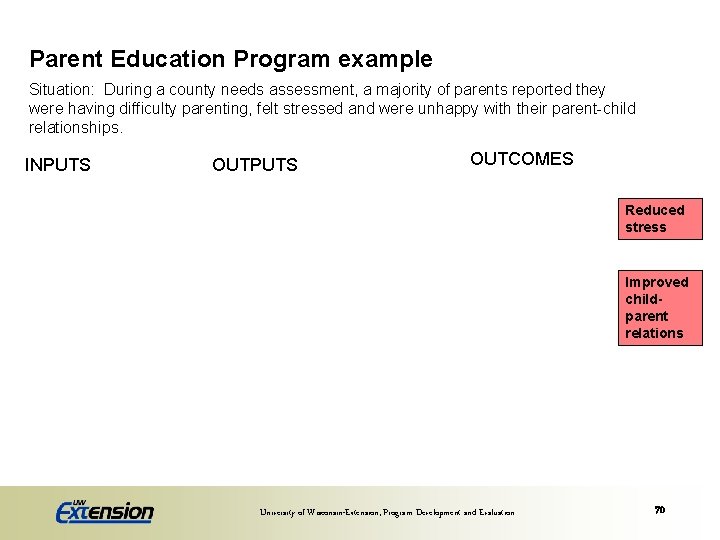
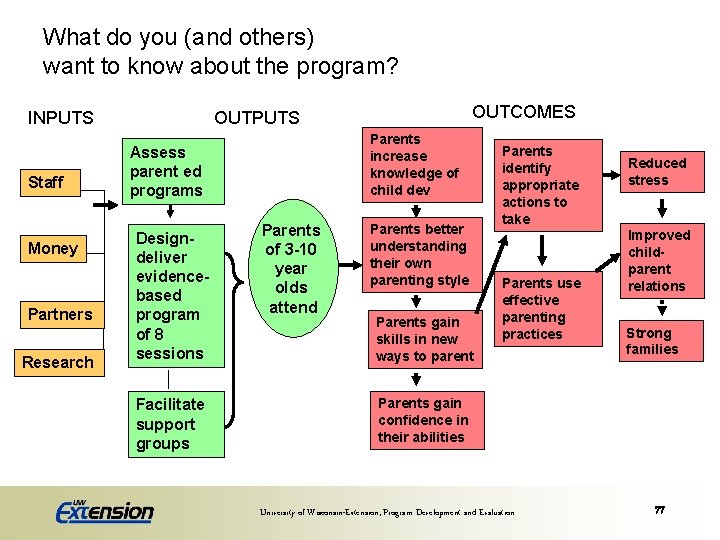
Parent Education Program – Logic model SITUATION: During a county needs assessment, majority of parents reported that they were having difficulty parenting and felt stressed as a result INPUTS Staff Money Partners Research OUTCOMES OUTPUTS Parents increase knowledge of child dev Assess parent ed programs Designdeliver evidencebased program of 8 sessions Facilitate support groups Parents of 3 -10 year olds attend Parents better understanding their own parenting style Parents gain skills in new ways to parent Parents identify appropriate actions to take Parents use effective parenting practices Reduced stress Improved childparent relations Parents gain confidence in their abilities University of Wisconsin-Extension, Program Development and Evaluation 22
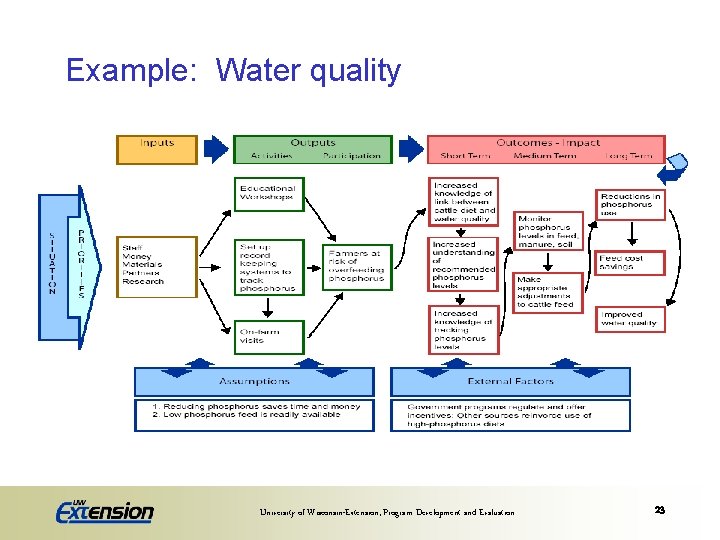
Example: Water quality University of Wisconsin-Extension, Program Development and Evaluation 23
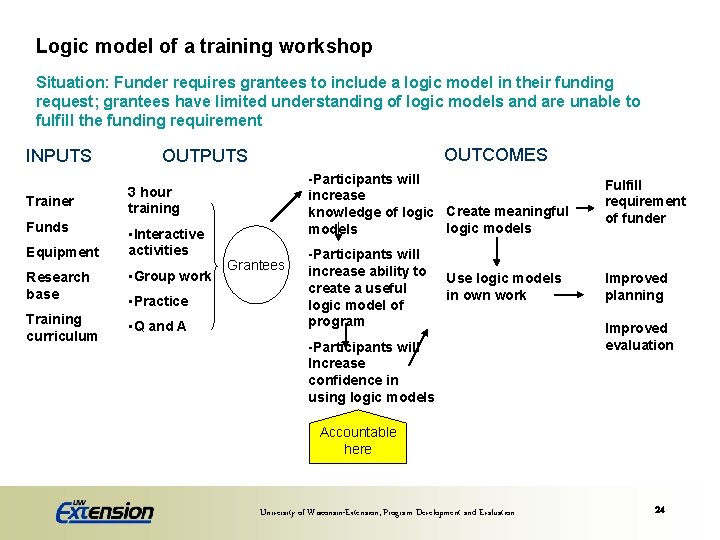
Logic model of a training workshop Situation: Funder requires grantees to include a logic model in their funding request; grantees have limited understanding of logic models and are unable to fulfill the funding requirement INPUTS Trainer Funds Equipment OUTCOMES OUTPUTS 3 hour training • Interactive activities Research base • Group work Training curriculum • Q and A • Practice Grantees -Participants will increase knowledge of logic Create meaningful logic models Fulfill requirement of funder -Participants will increase ability to create a useful logic model of program Improved planning Use logic models in own work -Participants will Increase confidence in using logic models Improved evaluation Accountable here University of Wisconsin-Extension, Program Development and Evaluation 24
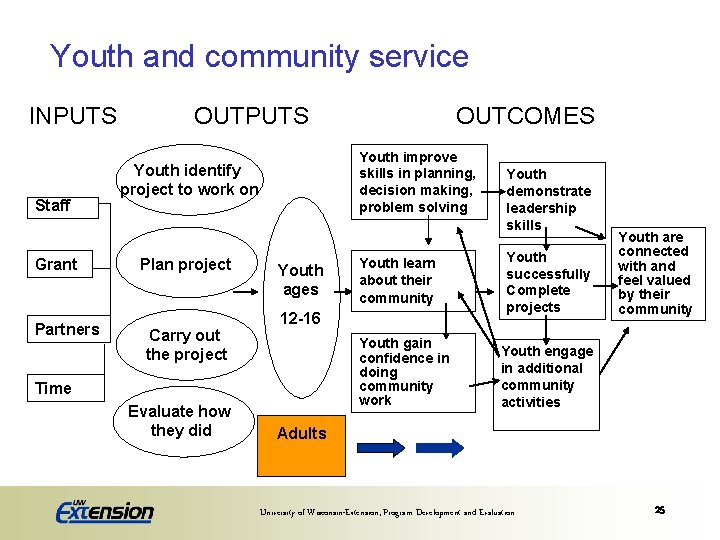
Youth and community service INPUTS Staff Grant Partners OUTPUTS Youth improve skills in planning, decision making, problem solving Youth identify project to work on Plan project Carry out the project Youth ages Youth learn about their community 12 -16 Youth gain confidence in doing community work Time Evaluate how they did OUTCOMES Youth demonstrate leadership skills Youth successfully Complete projects Youth are connected with and feel valued by their community Youth engage in additional community activities Adults University of Wisconsin-Extension, Program Development and Evaluation 25
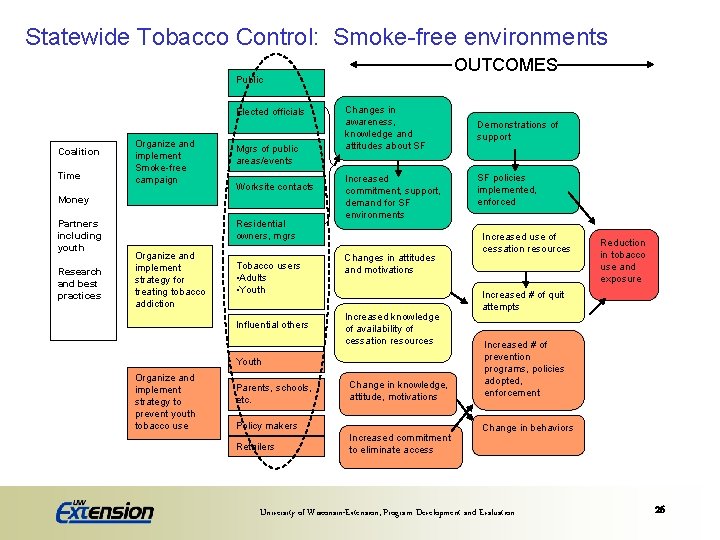
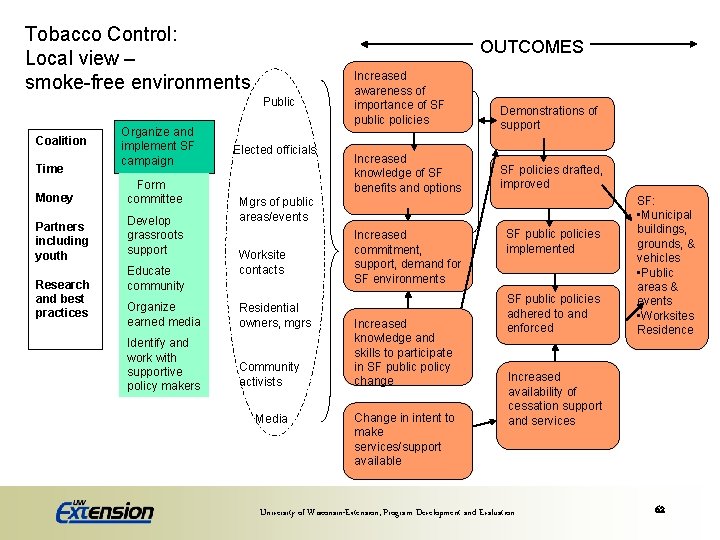
Statewide Tobacco Control: Smoke-free environments OUTCOMES Public Elected officials Coalition Time Organize and implement Smoke-free campaign Mgrs of public areas/events Worksite contacts Money Partners including youth Research and best practices Residential owners, mgrs Organize and implement strategy for treating tobacco addiction Tobacco users • Adults • Youth Influential others Changes in awareness, knowledge and attitudes about SF Increased commitment, support, demand for SF environments Changes in attitudes and motivations Increased knowledge of availability of cessation resources Youth Organize and implement strategy to prevent youth tobacco use Parents, schools, etc. Change in knowledge, attitude, motivations Policy makers Retailers Increased commitment to eliminate access Demonstrations of support SF policies implemented, enforced Increased use of cessation resources Reduction in tobacco use and exposure Increased # of quit attempts Increased # of prevention programs, policies adopted, enforcement Change in behaviors University of Wisconsin-Extension, Program Development and Evaluation 26
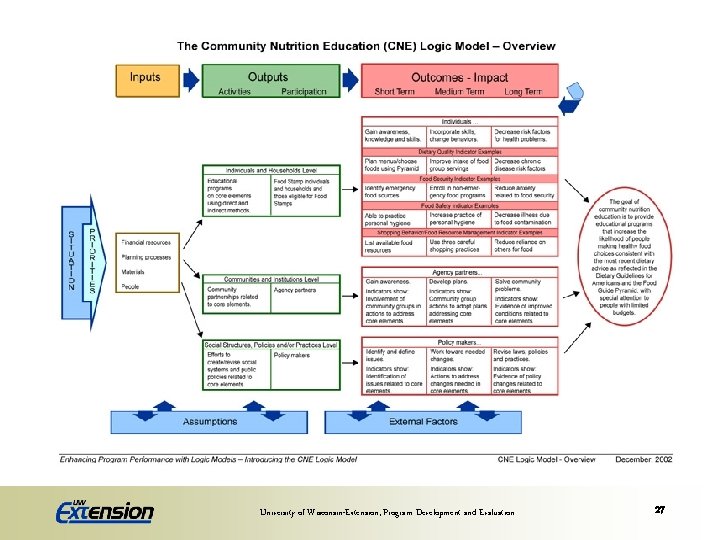
University of Wisconsin-Extension, Program Development and Evaluation 27
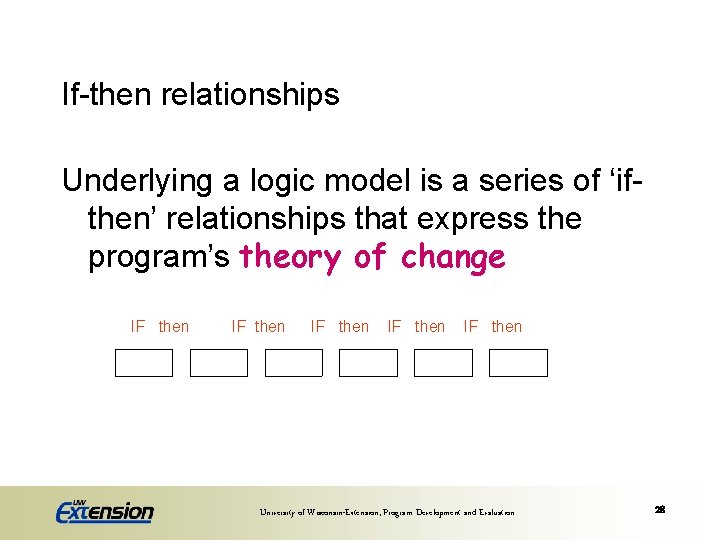
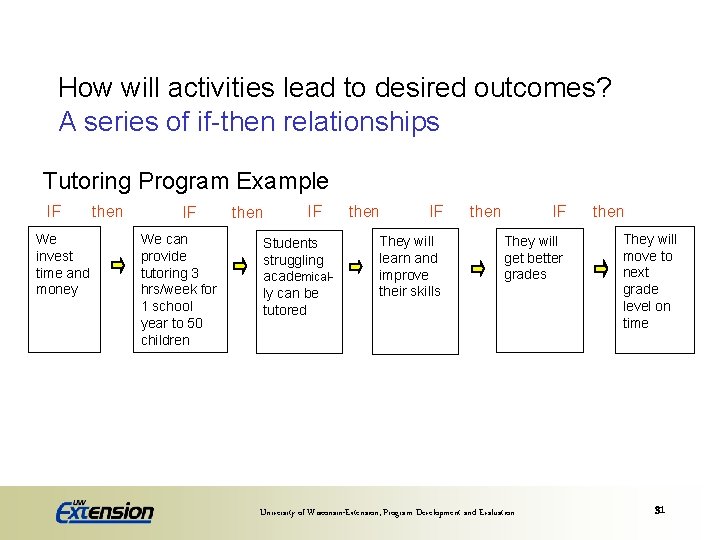
If-then relationships Underlying a logic model is a series of ‘ifthen’ relationships that express the program’s theory of change IF then IF then University of Wisconsin-Extension, Program Development and Evaluation 28
Theory of change “A theory of change is a description of how and why a set of activities – be they part of a highly focused program or a comprehensive initiative – are expected to lead to early, intermediate, and longterm outcomes over a specified period. ” (Anderson, 2000) University of Wisconsin-Extension, Program Development and Evaluation 29
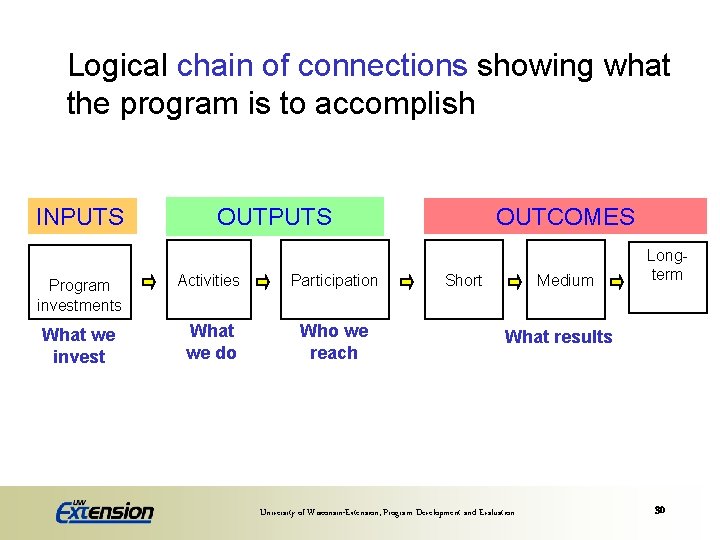
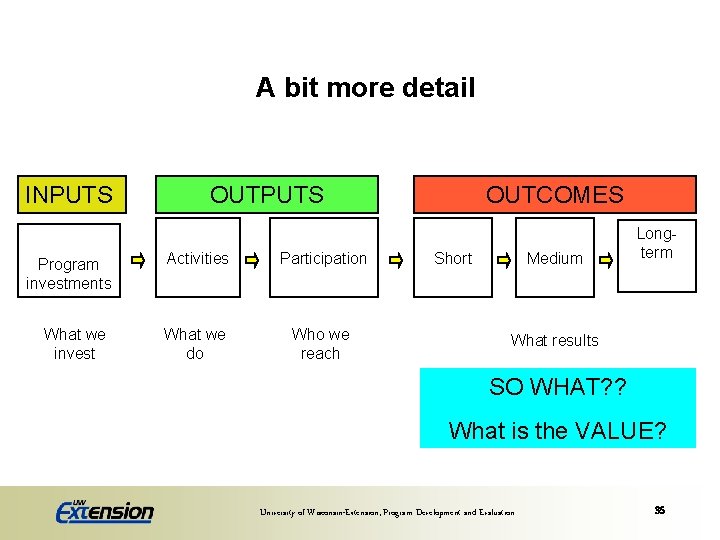
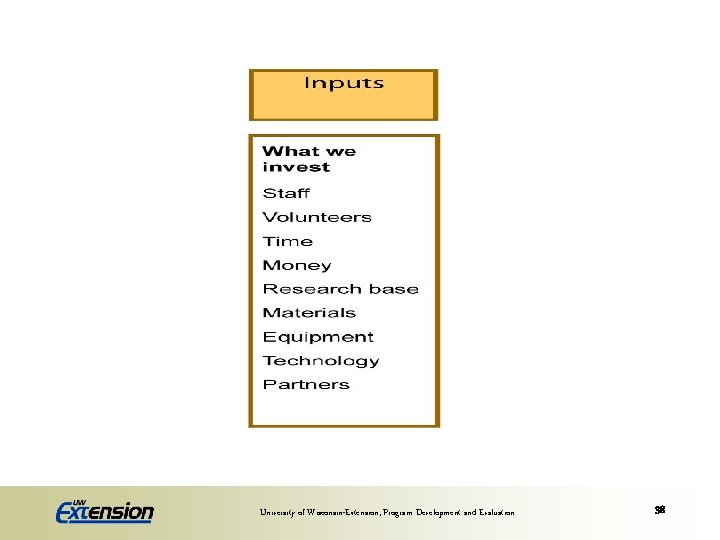
Logical chain of connections showing what the program is to accomplish INPUTS OUTPUTS Program investments Activities Participation What we invest What we do Who we reach OUTCOMES Short Medium Longterm What results University of Wisconsin-Extension, Program Development and Evaluation 30
How will activities lead to desired outcomes? A series of if-then relationships Tutoring Program Example IF We invest time and money then IF We can provide tutoring 3 hrs/week for 1 school year to 50 children then IF Students struggling academically can be tutored then IF They will learn and improve their skills then IF They will get better grades University of Wisconsin-Extension, Program Development and Evaluation then They will move to next grade level on time 31
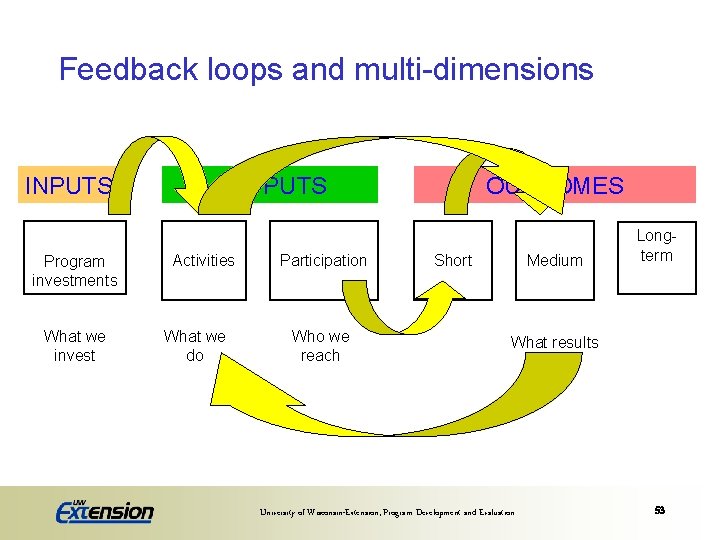
Don’t forget the arrows • Arrows and feedback loops show the links between inputs, outputs and outcomes • Arrows depict the underlying causal connections University of Wisconsin-Extension, Program Development and Evaluation 32
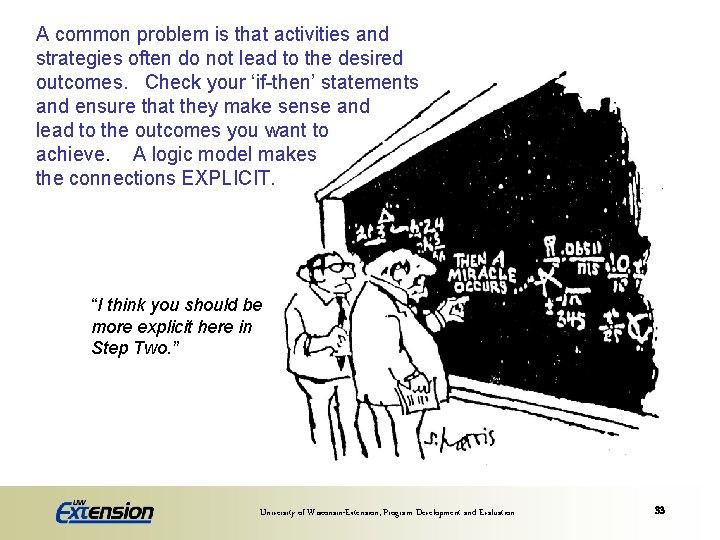
A common problem is that activities and strategies often do not lead to the desired outcomes. Check your ‘if-then’ statements and ensure that they make sense and lead to the outcomes you want to achieve. A logic model makes the connections EXPLICIT. “I think you should be more explicit here in Step Two. ” University of Wisconsin-Extension, Program Development and Evaluation 33
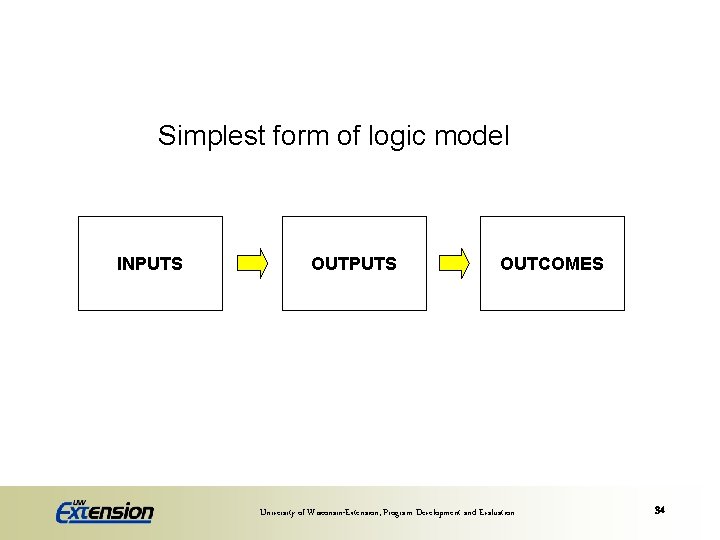
Simplest form of logic model INPUTS OUTCOMES University of Wisconsin-Extension, Program Development and Evaluation 34
A bit more detail INPUTS Program investments What we invest OUTPUTS Activities Participation What we do Who we reach OUTCOMES Short Medium Longterm What results SO WHAT? ? What is the VALUE? University of Wisconsin-Extension, Program Development and Evaluation 35
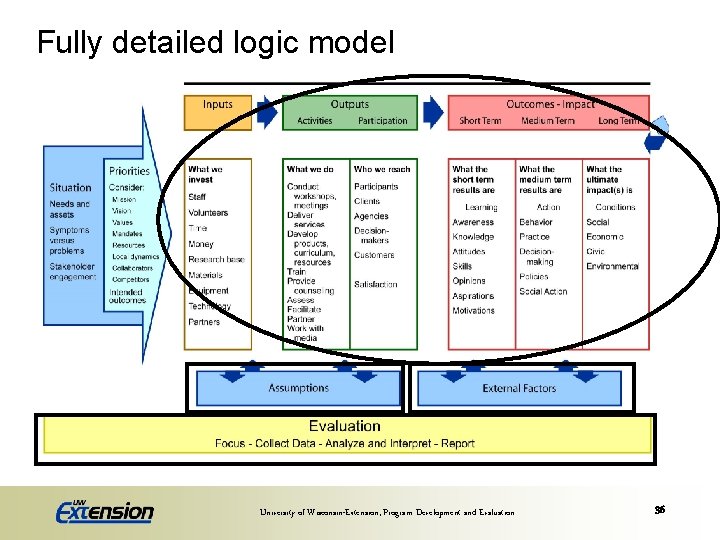
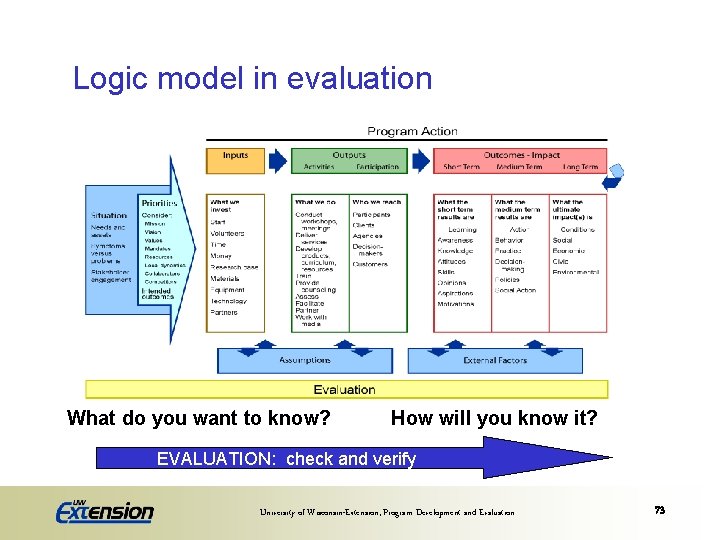
Fully detailed logic model University of Wisconsin-Extension, Program Development and Evaluation 36
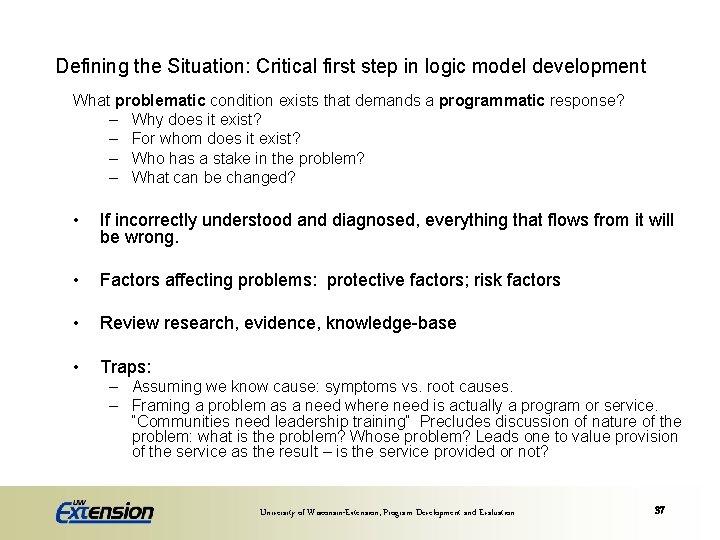
Defining the Situation: Critical first step in logic model development What problematic condition exists that demands a programmatic response? – Why does it exist? – For whom does it exist? – Who has a stake in the problem? – What can be changed? • If incorrectly understood and diagnosed, everything that flows from it will be wrong. • Factors affecting problems: protective factors; risk factors • Review research, evidence, knowledge-base • Traps: – Assuming we know cause: symptoms vs. root causes. – Framing a problem as a need where need is actually a program or service. “Communities need leadership training” Precludes discussion of nature of the problem: what is the problem? Whose problem? Leads one to value provision of the service as the result – is the service provided or not? University of Wisconsin-Extension, Program Development and Evaluation 37
University of Wisconsin-Extension, Program Development and Evaluation 38
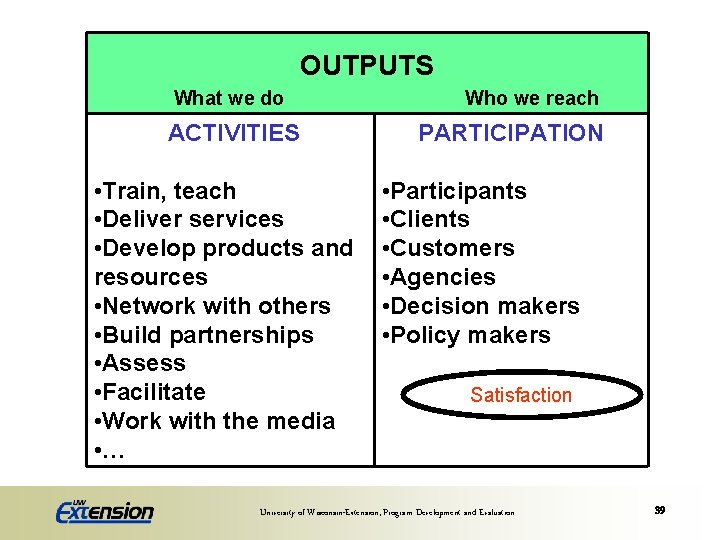
OUTPUTS What we do ACTIVITIES • Train, teach • Deliver services • Develop products and resources • Network with others • Build partnerships • Assess • Facilitate • Work with the media • … Who we reach PARTICIPATION • Participants • Clients • Customers • Agencies • Decision makers • Policy makers Satisfaction University of Wisconsin-Extension, Program Development and Evaluation 39
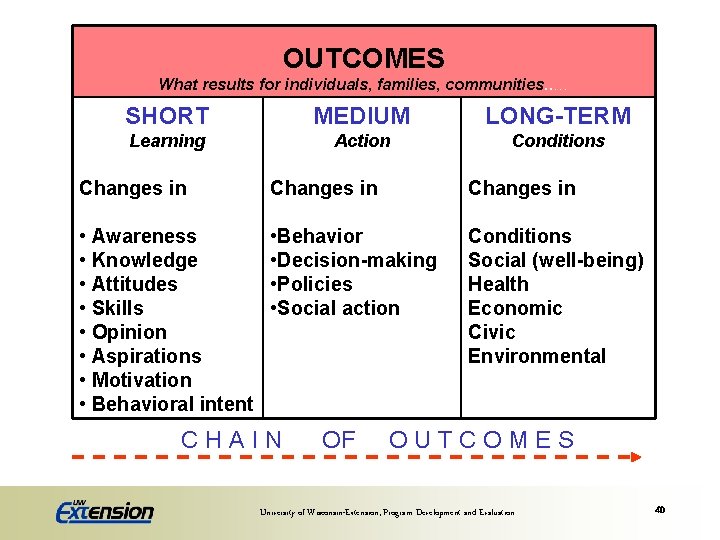
OUTCOMES What results for individuals, families, communities. . … SHORT MEDIUM LONG-TERM Learning Action Conditions Changes in • Awareness • Knowledge • Attitudes • Skills • Opinion • Aspirations • Motivation • Behavioral intent • Behavior • Decision-making • Policies • Social action Conditions Social (well-being) Health Economic Civic Environmental CHAIN OF OUTCOMES University of Wisconsin-Extension, Program Development and Evaluation 40
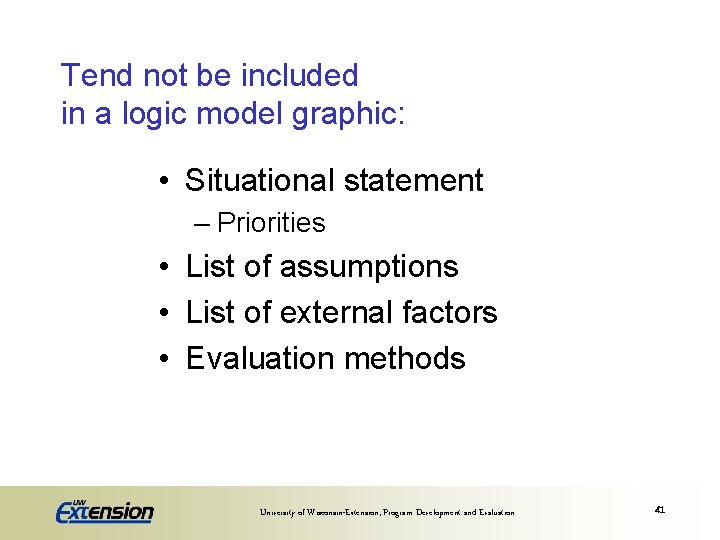
Tend not be included in a logic model graphic: • Situational statement – Priorities • List of assumptions • List of external factors • Evaluation methods University of Wisconsin-Extension, Program Development and Evaluation 41
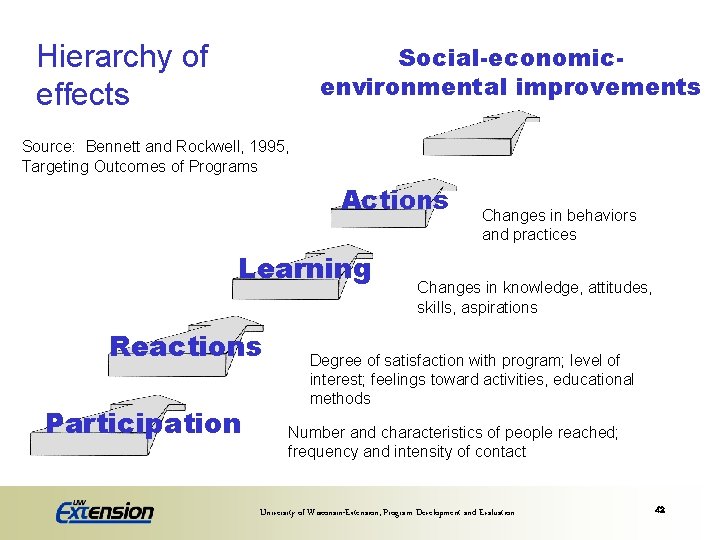
Hierarchy of effects Social-economicenvironmental improvements Source: Bennett and Rockwell, 1995, Targeting Outcomes of Programs Actions Learning Reactions Participation Changes in behaviors and practices Changes in knowledge, attitudes, skills, aspirations Degree of satisfaction with program; level of interest; feelings toward activities, educational methods Number and characteristics of people reached; frequency and intensity of contact University of Wisconsin-Extension, Program Development and Evaluation 42
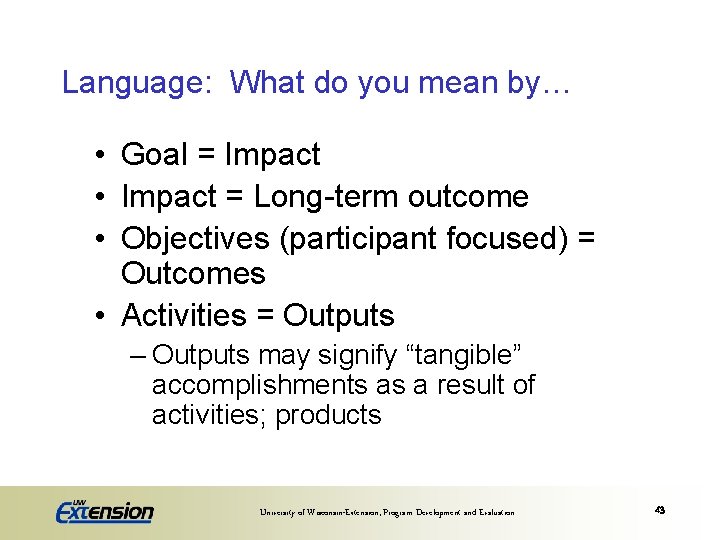
Language: What do you mean by… • Goal = Impact • Impact = Long-term outcome • Objectives (participant focused) = Outcomes • Activities = Outputs – Outputs may signify “tangible” accomplishments as a result of activities; products University of Wisconsin-Extension, Program Development and Evaluation 43
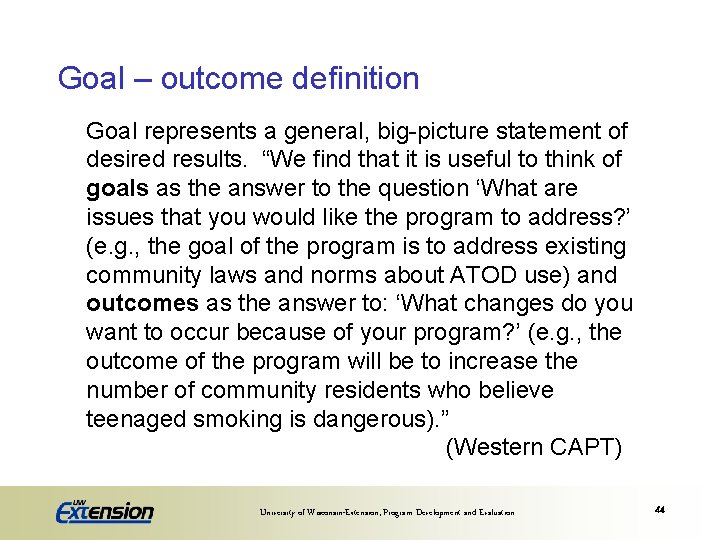
Goal – outcome definition Goal represents a general, big-picture statement of desired results. “We find that it is useful to think of goals as the answer to the question ‘What are issues that you would like the program to address? ’ (e. g. , the goal of the program is to address existing community laws and norms about ATOD use) and outcomes as the answer to: ‘What changes do you want to occur because of your program? ’ (e. g. , the outcome of the program will be to increase the number of community residents who believe teenaged smoking is dangerous). ” (Western CAPT) University of Wisconsin-Extension, Program Development and Evaluation 44
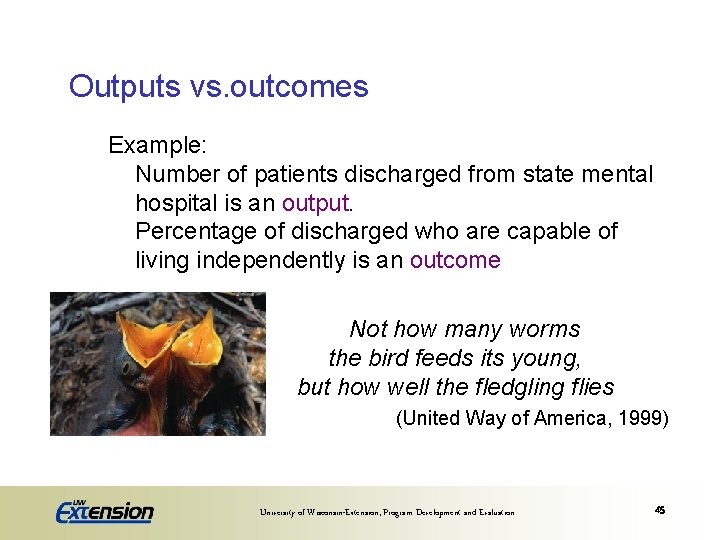
Outputs vs. outcomes Example: Number of patients discharged from state mental hospital is an output. Percentage of discharged who are capable of living independently is an outcome Not how many worms the bird feeds its young, but how well the fledgling flies (United Way of America, 1999) University of Wisconsin-Extension, Program Development and Evaluation 45
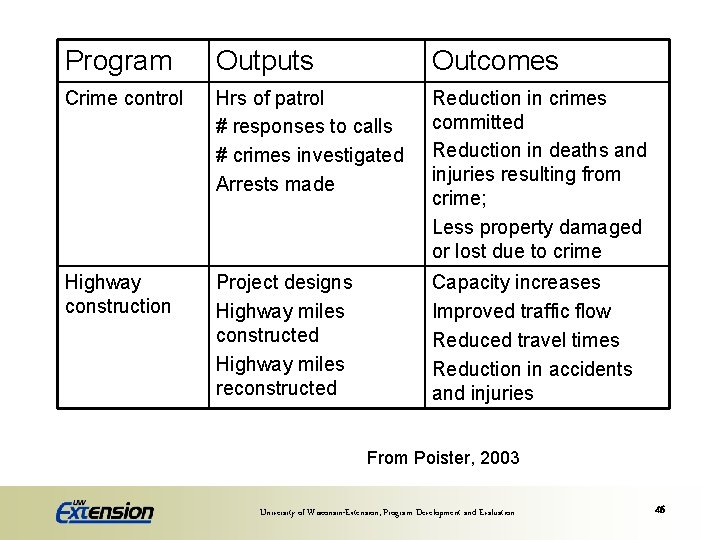
Program Outputs Outcomes Crime control Hrs of patrol # responses to calls # crimes investigated Arrests made Reduction in crimes committed Reduction in deaths and injuries resulting from crime; Less property damaged or lost due to crime Highway construction Project designs Highway miles constructed Highway miles reconstructed Capacity increases Improved traffic flow Reduced travel times Reduction in accidents and injuries From Poister, 2003 University of Wisconsin-Extension, Program Development and Evaluation 46
So, why bother? What’s in this for you? “This seems like a lot of work. ” “Where in the world would I get all the information to put in a logic model? “I’m a right brain type of person – this isn’t for me. ” “Even if we created one, what would we do with it? ” University of Wisconsin-Extension, Program Development and Evaluation 47
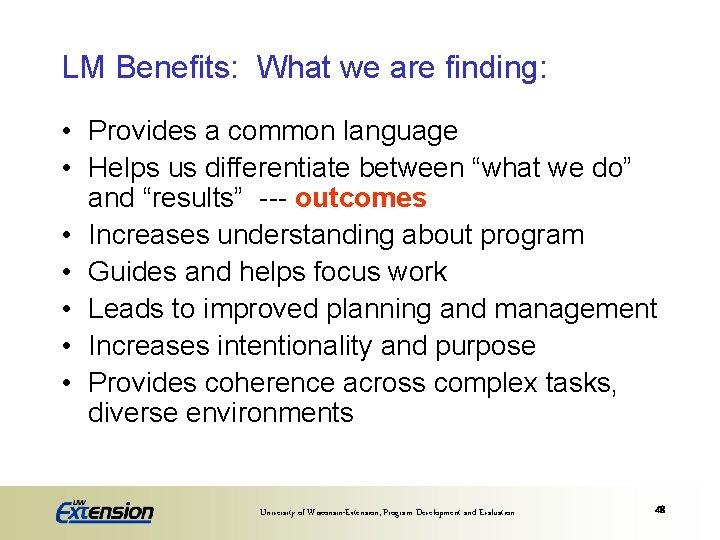
LM Benefits: What we are finding: • Provides a common language • Helps us differentiate between “what we do” and “results” --- outcomes • Increases understanding about program • Guides and helps focus work • Leads to improved planning and management • Increases intentionality and purpose • Provides coherence across complex tasks, diverse environments University of Wisconsin-Extension, Program Development and Evaluation 48
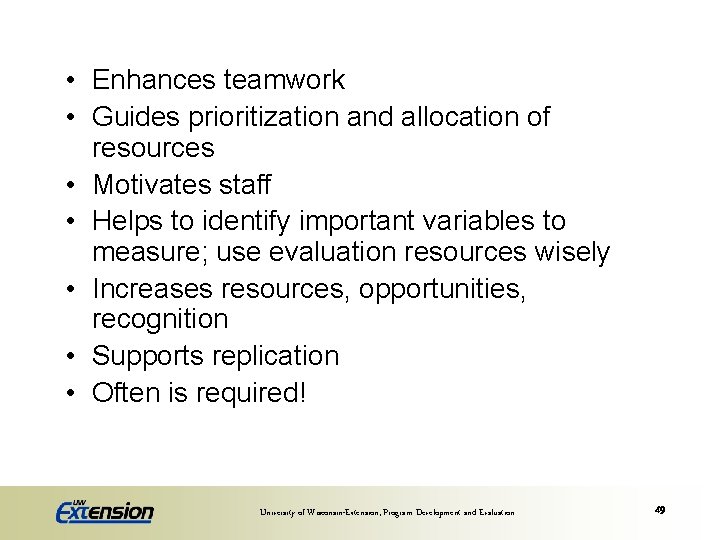
• Enhances teamwork • Guides prioritization and allocation of resources • Motivates staff • Helps to identify important variables to measure; use evaluation resources wisely • Increases resources, opportunities, recognition • Supports replication • Often is required! University of Wisconsin-Extension, Program Development and Evaluation 49
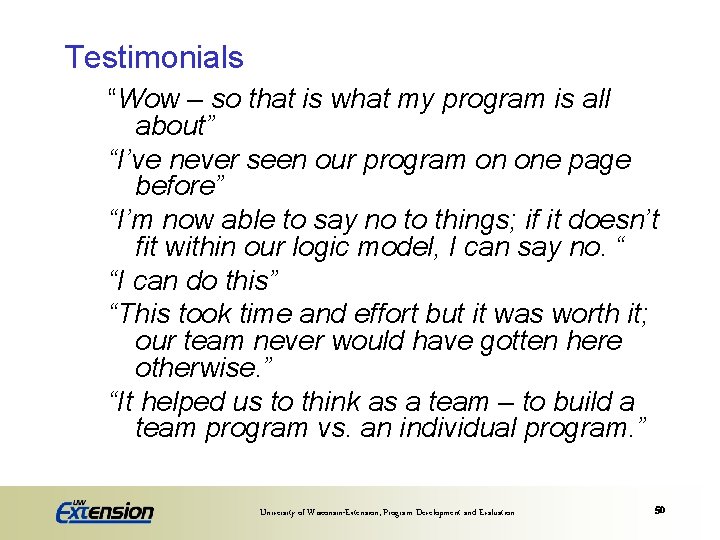
Testimonials “Wow – so that is what my program is all about” “I’ve never seen our program on one page before” “I’m now able to say no to things; if it doesn’t fit within our logic model, I can say no. “ “I can do this” “This took time and effort but it was worth it; our team never would have gotten here otherwise. ” “It helped us to think as a team – to build a team program vs. an individual program. ” University of Wisconsin-Extension, Program Development and Evaluation 50
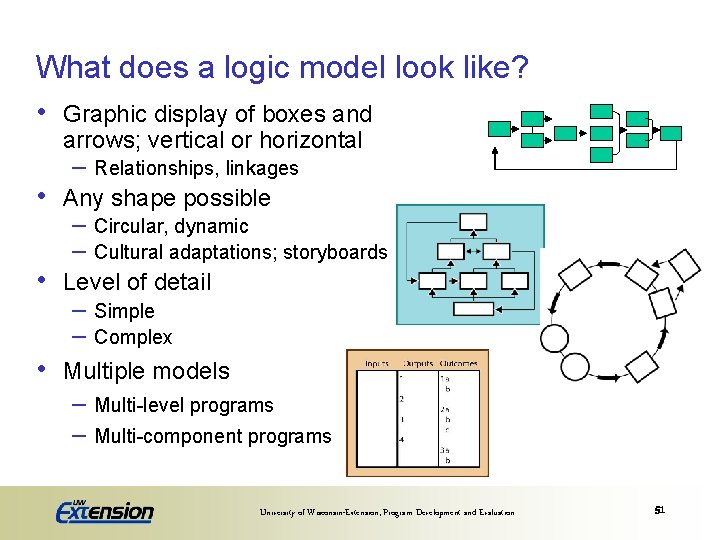
What does a logic model look like? • Graphic display of boxes and arrows; vertical or horizontal • • • – Relationships, linkages Any shape possible – – Circular, dynamic Cultural adaptations; storyboards Level of detail – – Simple Complex Multiple models – – Multi-level programs Multi-component programs University of Wisconsin-Extension, Program Development and Evaluation 51
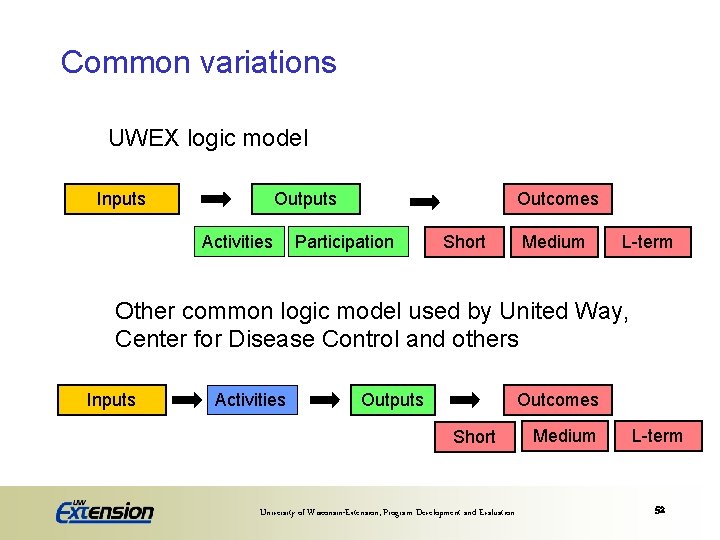
Common variations UWEX logic model Inputs Outputs Activities Outcomes Participation Short Medium L-term Other common logic model used by United Way, Center for Disease Control and others Inputs Activities Outputs Outcomes Short University of Wisconsin-Extension, Program Development and Evaluation Medium L-term 52
Feedback loops and multi-dimensions INPUTS Program investments What we invest OUTPUTS Activities What we do Participation Who we reach OUTCOMES Short Medium Longterm What results University of Wisconsin-Extension, Program Development and Evaluation 53
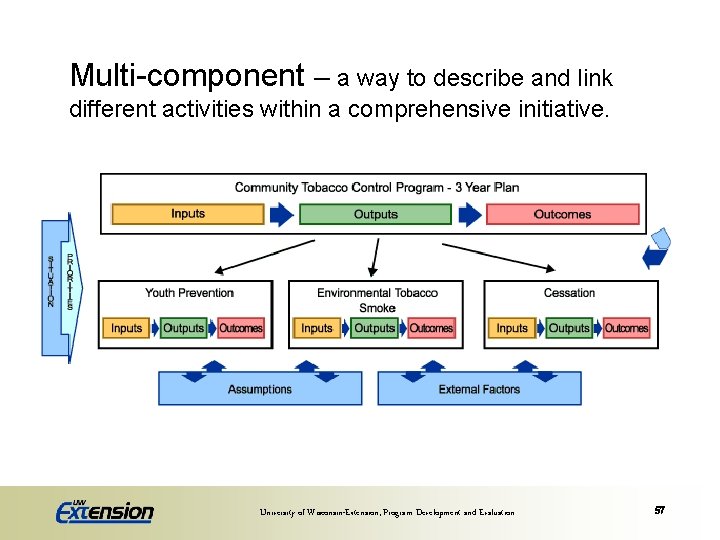
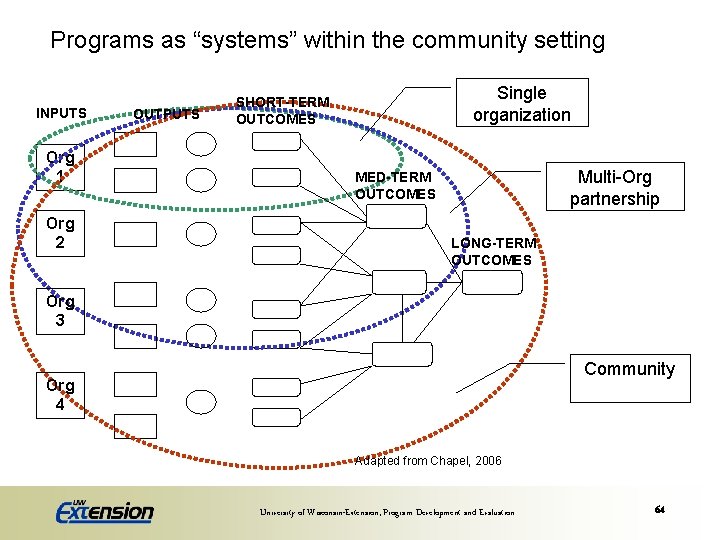
“Families” of models or “nested” models Multiple models may be needed to describe and explain complex systems or initiatives. Bring coherence across an organization – Multi-level: a way to describe and link activities across an organization to depict varying levels such as national-state-county levels OR, institution-division-unit levels. – Multi-component programs: A series of models to depict various components (goals, sites, target populations) within a comprehensive initiative. University of Wisconsin-Extension, Program Development and Evaluation 54
Nested logic models – families of logic models • View from space – big picture; overall roadmap • View from mountaintop – more detail: by component program, player, participant group • View from ground level – “you are here” University of Wisconsin-Extension, Program Development and Evaluation 55
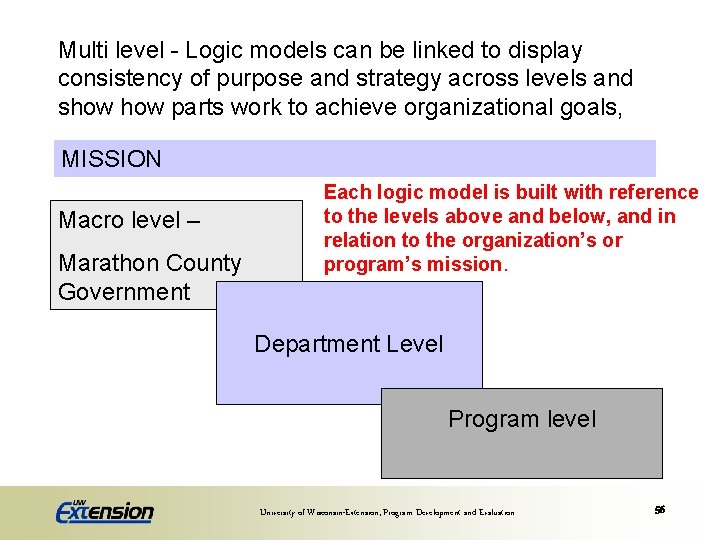
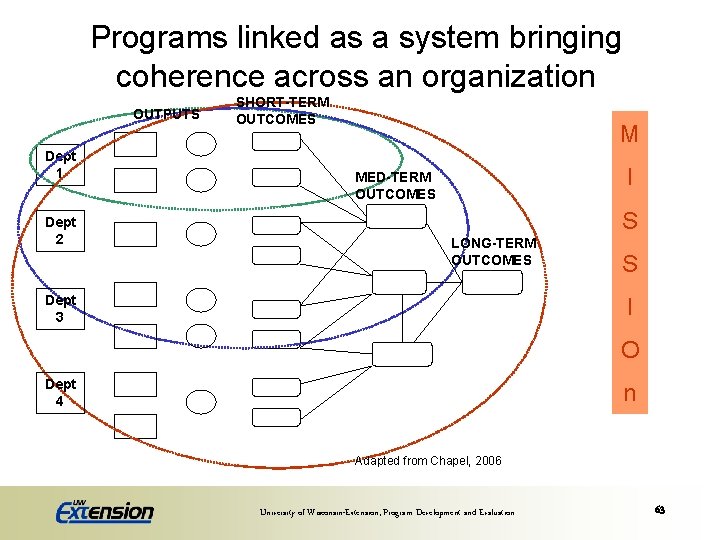
Multi level - Logic models can be linked to display consistency of purpose and strategy across levels and show parts work to achieve organizational goals, MISSION Macro level – Marathon County Government Each logic model is built with reference to the levels above and below, and in relation to the organization’s or program’s mission. Department Level Program level University of Wisconsin-Extension, Program Development and Evaluation 56
Multi-component – a way to describe and link different activities within a comprehensive initiative. University of Wisconsin-Extension, Program Development and Evaluation 57
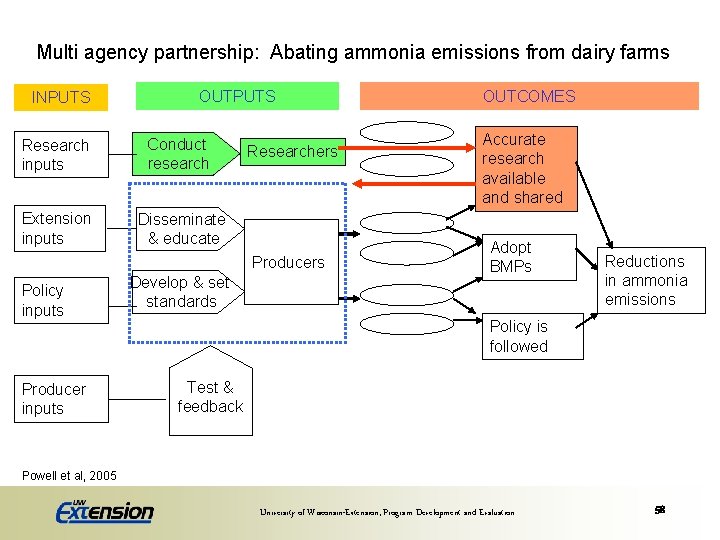
Multi agency partnership: Abating ammonia emissions from dairy farms INPUTS OUTPUTS Research inputs Conduct research Extension inputs Disseminate & educate Researchers Producers Policy inputs Producer inputs Develop & set standards OUTCOMES Accurate research available and shared Adopt BMPs Reductions in ammonia emissions Policy is followed Test & feedback Powell et al, 2005 University of Wisconsin-Extension, Program Development and Evaluation 58
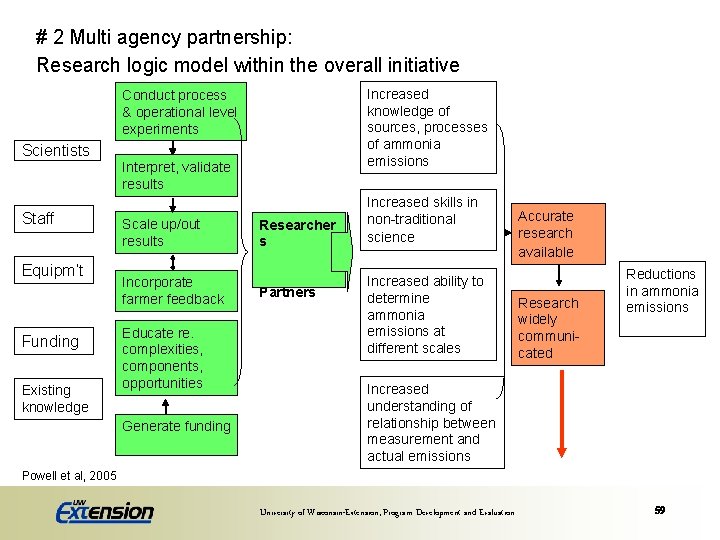
# 2 Multi agency partnership: Research logic model within the overall initiative Increased knowledge of sources, processes of ammonia emissions Conduct process & operational level experiments Scientists Staff Equipm’t Funding Existing knowledge Interpret, validate results Scale up/out results Incorporate farmer feedback Educate re. complexities, components, opportunities Generate funding Researcher s Partners Increased skills in non-traditional science Increased ability to determine ammonia emissions at different scales Accurate research available Research widely communicated Reductions in ammonia emissions Increased understanding of relationship between measurement and actual emissions Powell et al, 2005 University of Wisconsin-Extension, Program Development and Evaluation 59
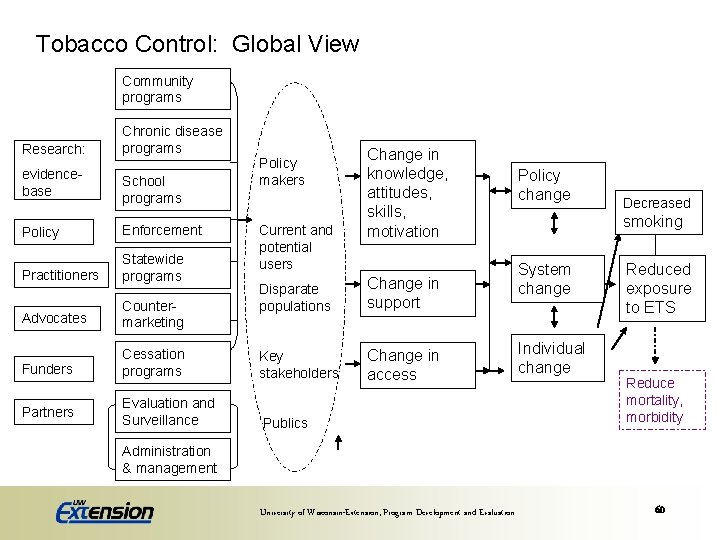
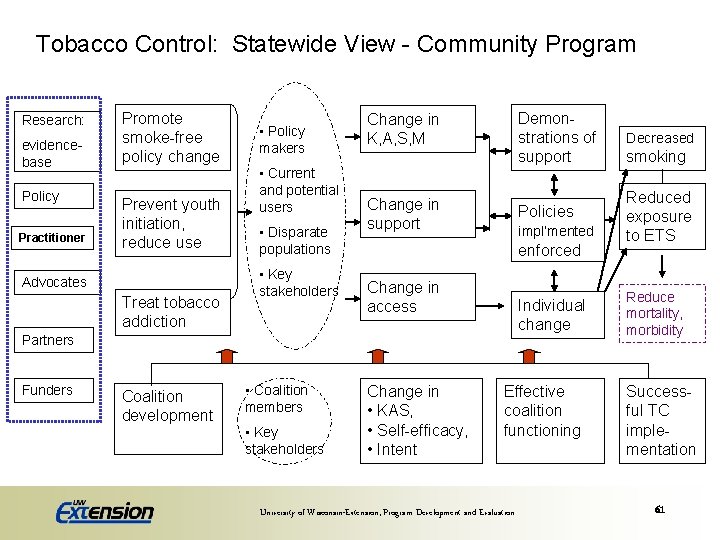
Tobacco Control: Global View Community programs Research: evidencebase Chronic disease programs School programs Policy Enforcement Practitioners Statewide programs Advocates Countermarketing Policy makers Current and potential users Change in knowledge, attitudes, skills, motivation Disparate populations Change in support Funders Cessation programs Key stakeholders Change in access Partners Evaluation and Surveillance Publics Policy change Decreased smoking System change Individual change Reduced exposure to ETS Reduce mortality, morbidity Administration & management University of Wisconsin-Extension, Program Development and Evaluation 60
Tobacco Control: Statewide View - Community Program Research: evidencebase Policy Practitioner Promote smoke-free policy change Prevent youth initiation, reduce use Advocates Treat tobacco addiction • Policy makers • Current and potential users • Disparate populations • Key stakeholders Change in K, A, S, M Change in support Coalition development • Coalition members • Key stakeholders Decreased Policies Reduced exposure to ETS impl’mented enforced Change in access Individual change Partners Funders Demonstrations of support Change in • KAS, • Self-efficacy, • Intent Effective coalition functioning University of Wisconsin-Extension, Program Development and Evaluation smoking Reduce mortality, morbidity Successful TC implementation 61
Tobacco Control: Local view – smoke-free environments OUTCOMES Public Coalition Time Money Partners including youth Research and best practices Organize and implement SF campaign Form committee Develop grassroots support Educate community Elected officials Increased awareness of importance of SF public policies Demonstrations of support Increased knowledge of SF benefits and options SF policies drafted, improved Mgrs of public areas/events Worksite contacts Organize earned media Residential owners, mgrs Identify and work with supportive policy makers Community activists Media Increased commitment, support, demand for SF environments Increased knowledge and skills to participate in SF public policy change Change in intent to make services/support available SF public policies implemented SF public policies adhered to and enforced SF: • Municipal buildings, grounds, & vehicles • Public areas & events • Worksites Residence Increased availability of cessation support and services University of Wisconsin-Extension, Program Development and Evaluation 62
Programs linked as a system bringing coherence across an organization OUTPUTS Dept 1 Dept 2 SHORT-TERM OUTCOMES M I MED-TERM OUTCOMES S LONG-TERM OUTCOMES Dept 3 S I O Dept 4 n Adapted from Chapel, 2006 University of Wisconsin-Extension, Program Development and Evaluation 63
Programs as “systems” within the community setting INPUTS Org 1 Org 2 OUTPUTS Single organization SHORT-TERM OUTCOMES Multi-Org partnership MED-TERM OUTCOMES LONG-TERM OUTCOMES Org 3 Community Org 4 Adapted from Chapel, 2006 University of Wisconsin-Extension, Program Development and Evaluation 64
Culture is… A set of socially transmitted and learned behavior patterns, beliefs, institutions, and all other products of human activity and thought that characterize a particular population, community, profession, or organization. University of Wisconsin-Extension, Program Development and Evaluation 65
Cultural appropriateness of logic model • Is a logic model culturally appropriate? • What, if anything, would help make a logic model or its use suitable for the cultural context? • What would you do? University of Wisconsin-Extension, Program Development and Evaluation 66
First things first… • Determine purpose of logic model – Who will use it? For what? • Involve others • Set boundaries for logic model – Level of specificity • Understand situation • Explore research, knowledge base, what others are doing/have done University of Wisconsin-Extension, Program Development and Evaluation 67
Limitations Logic Model… • • • Represents intention, is not reality Focuses on expected outcomes Challenge of causal attribution üMany factors influence process and outcomes • Doesn’t address: Are we doing the right thing? University of Wisconsin-Extension, Program Development and Evaluation 68
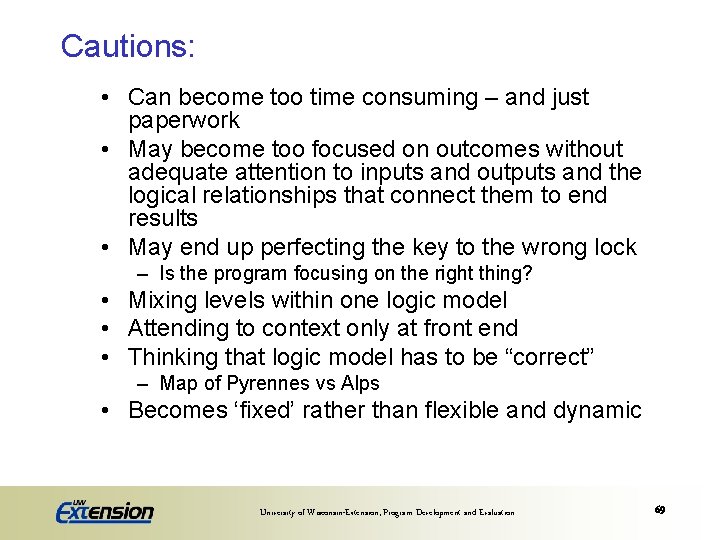
Cautions: • Can become too time consuming – and just paperwork • May become too focused on outcomes without adequate attention to inputs and outputs and the logical relationships that connect them to end results • May end up perfecting the key to the wrong lock – Is the program focusing on the right thing? • Mixing levels within one logic model • Attending to context only at front end • Thinking that logic model has to be “correct” – Map of Pyrennes vs Alps • Becomes ‘fixed’ rather than flexible and dynamic University of Wisconsin-Extension, Program Development and Evaluation 69
Parent Education Program example Situation: During a county needs assessment, a majority of parents reported they were having difficulty parenting, felt stressed and were unhappy with their parent-child relationships. INPUTS OUTCOMES Reduced stress Improved childparent relations University of Wisconsin-Extension, Program Development and Evaluation 70
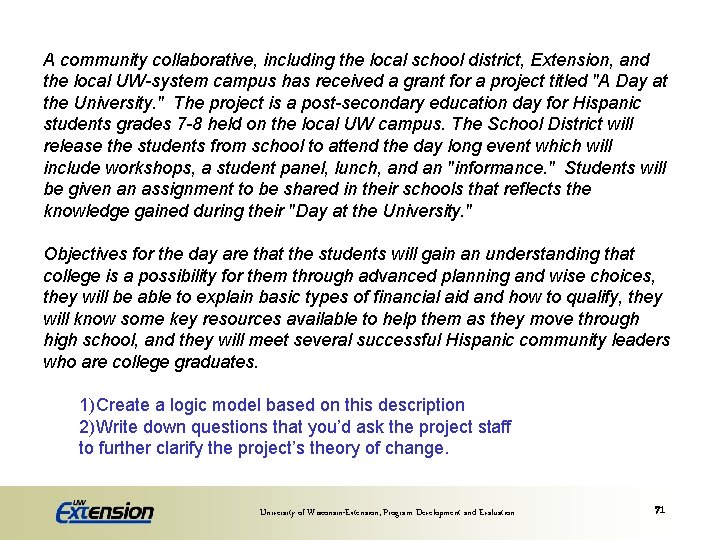
A community collaborative, including the local school district, Extension, and the local UW-system campus has received a grant for a project titled "A Day at the University. " The project is a post-secondary education day for Hispanic students grades 7 -8 held on the local UW campus. The School District will release the students from school to attend the day long event which will include workshops, a student panel, lunch, and an "informance. " Students will be given an assignment to be shared in their schools that reflects the knowledge gained during their "Day at the University. " Objectives for the day are that the students will gain an understanding that college is a possibility for them through advanced planning and wise choices, they will be able to explain basic types of financial aid and how to qualify, they will know some key resources available to help them as they move through high school, and they will meet several successful Hispanic community leaders who are college graduates. 1)Create a logic model based on this description 2)Write down questions that you’d ask the project staff to further clarify the project’s theory of change. University of Wisconsin-Extension, Program Development and Evaluation 71
Check your logic model 1. Is it meaningful? 2. Does it make sense? 3. Is it doable? 4. Can it be verified? University of Wisconsin-Extension, Program Development and Evaluation 72
Logic model in evaluation PLANNING: start ith the end in mind What do you want to know? How will you know it? EVALUATION: check and verify University of Wisconsin-Extension, Program Development and Evaluation 73
Logic Model helps with Evaluation Provides the program description that guides our evaluation process • Helps us match evaluation to the program • Helps us know what and when to measure – Are you interested in process and/or outcomes? • Helps us focus on key, important information – Prioritize: where will we spend our limited evaluation resources? – What do we really need to know? ? University of Wisconsin-Extension, Program Development and Evaluation 74
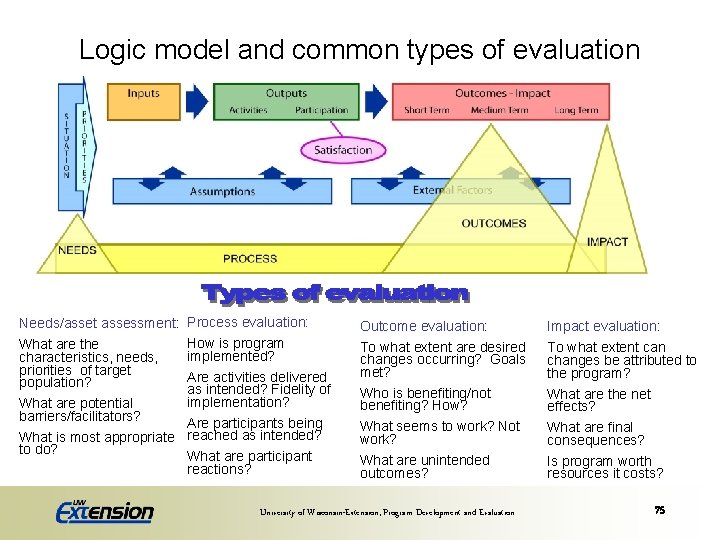
Logic model and common types of evaluation Needs/asset assessment: Process evaluation: How is program What are the implemented? characteristics, needs, priorities of target Are activities delivered population? as intended? Fidelity of implementation? What are potential barriers/facilitators? Are participants being What is most appropriate reached as intended? to do? What are participant reactions? Outcome evaluation: Impact evaluation: To what extent are desired changes occurring? Goals met? Who is benefiting/not benefiting? How? To what extent can changes be attributed to the program? What are the net effects? What seems to work? Not work? What are unintended outcomes? What are final consequences? Is program worth resources it costs? University of Wisconsin-Extension, Program Development and Evaluation 75
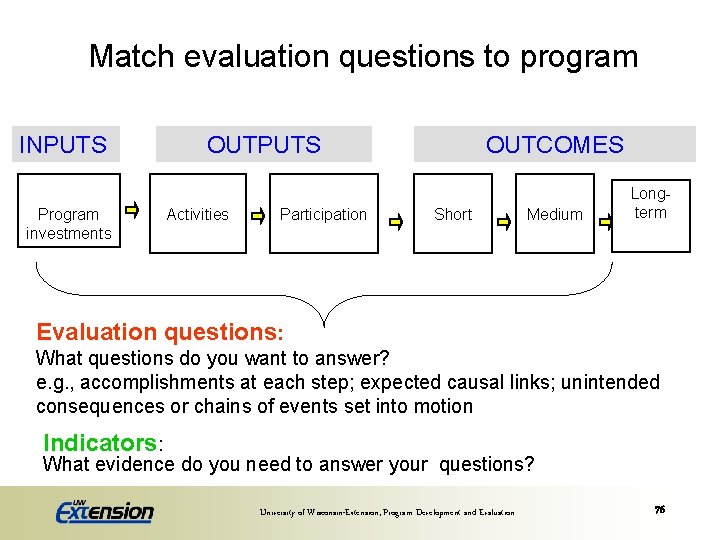
Match evaluation questions to program INPUTS Program investments OUTPUTS Activities Participation OUTCOMES Short Medium Longterm Evaluation questions: What questions do you want to answer? e. g. , accomplishments at each step; expected causal links; unintended consequences or chains of events set into motion Indicators: What evidence do you need to answer your questions? University of Wisconsin-Extension, Program Development and Evaluation 76
What do you (and others) want to know about the program? INPUTS Staff Money Partners Research OUTCOMES OUTPUTS Parents increase knowledge of child dev Assess parent ed programs Designdeliver evidencebased program of 8 sessions Facilitate support groups Parents of 3 -10 year olds attend Parents better understanding their own parenting style Parents gain skills in new ways to parent Parents identify appropriate actions to take Parents use effective parenting practices Reduced stress Improved childparent relations Strong families Parents gain confidence in their abilities University of Wisconsin-Extension, Program Development and Evaluation 77
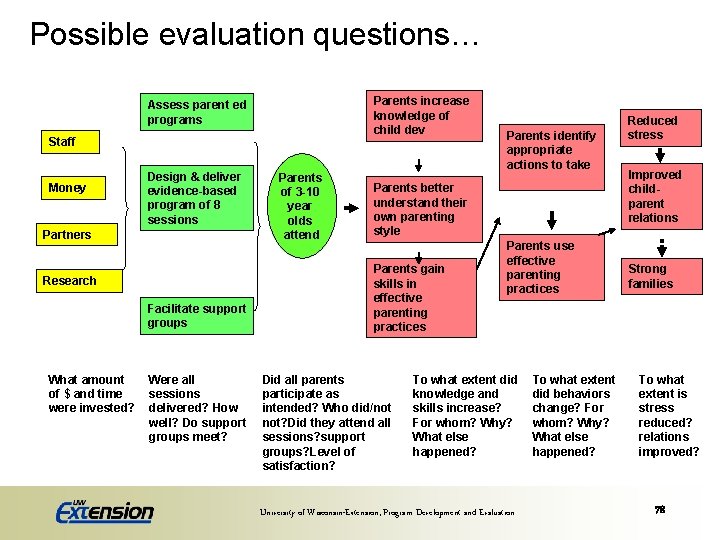
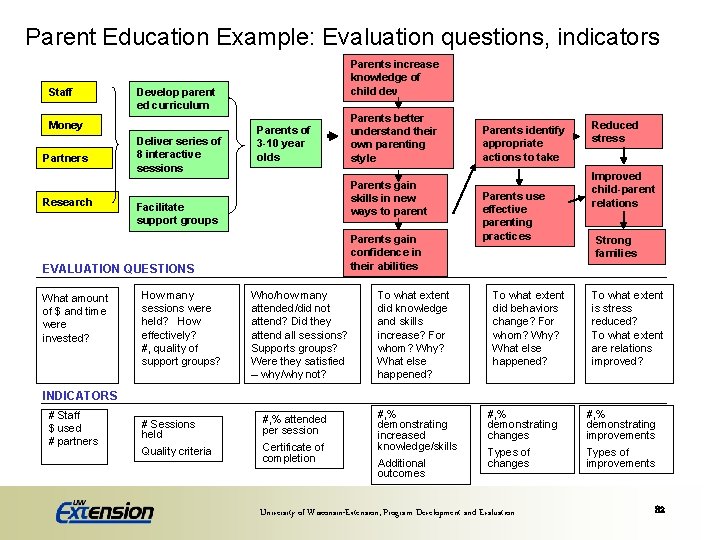
Possible evaluation questions… Parents increase knowledge of child dev Assess parent ed programs Staff Money Design & deliver evidence-based program of 8 sessions Partners Research Facilitate support groups What amount of $ and time were invested? Were all sessions delivered? How well? Do support groups meet? Parents of 3 -10 year olds attend Parents identify appropriate actions to take Parents better understand their own parenting style Parents gain skills in effective parenting practices Did all parents participate as intended? Who did/not not? Did they attend all sessions? support groups? Level of satisfaction? Parents use effective parenting practices To what extent did knowledge and skills increase? For whom? Why? What else happened? University of Wisconsin-Extension, Program Development and Evaluation To what extent did behaviors change? For whom? Why? What else happened? Reduced stress Improved childparent relations Strong families To what extent is stress reduced? relations improved? 78
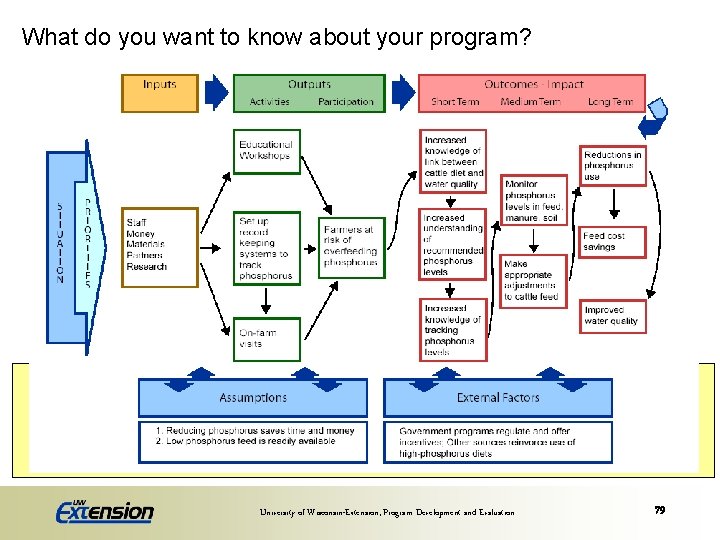
What do you want to know about your program? Evaluation: What to measure – when? What amount of $ and time were invested? What did the program actually consist of? Who actually participated in what? Did this meet our target? To what extent did knowledge and skills increase? To what extent did practices change? University of Wisconsin-Extension, Program Development and Evaluation To what extent did phosphorus reduce? Savings accrue to farmers? 79
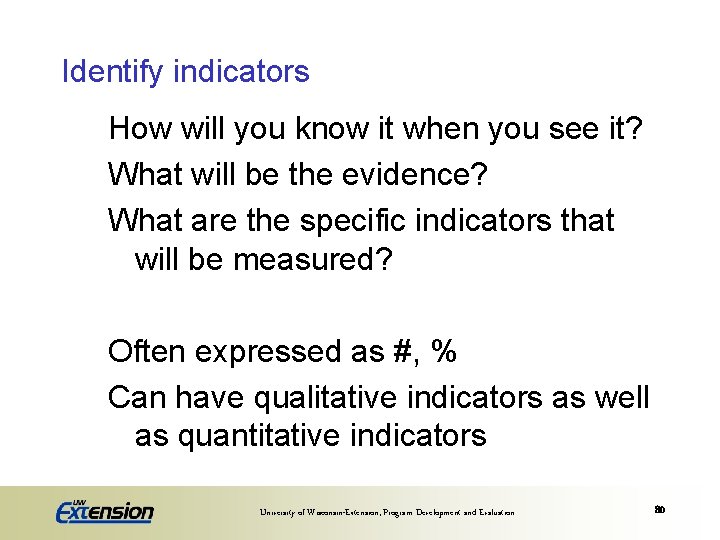
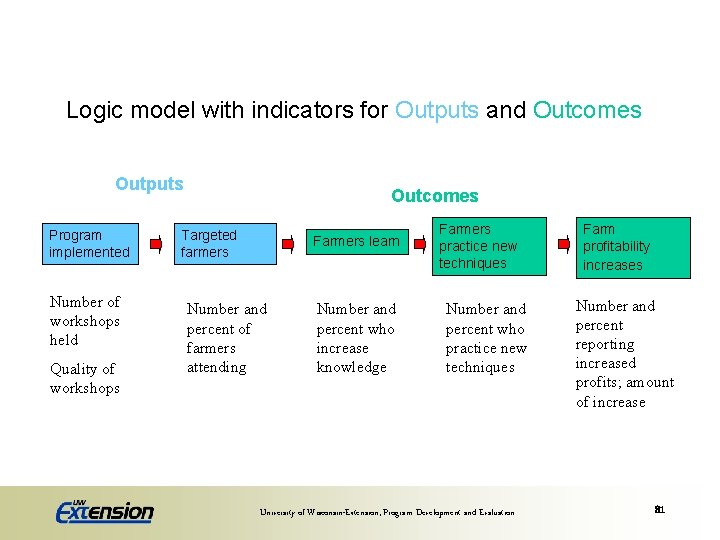
Identify indicators How will you know it when you see it? What will be the evidence? What are the specific indicators that will be measured? Often expressed as #, % Can have qualitative indicators as well as quantitative indicators University of Wisconsin-Extension, Program Development and Evaluation 80
Logic model with indicators for Outputs and Outcomes Outputs Program implemented Number of workshops held Quality of workshops Outcomes Targeted farmers Farmers learn Number and percent of farmers attending Number and percent who increase knowledge Farmers practice new techniques Number and percent who practice new techniques University of Wisconsin-Extension, Program Development and Evaluation Farm profitability increases Number and percent reporting increased profits; amount of increase 81
Parent Education Example: Evaluation questions, indicators Staff Develop parent ed curriculum Money Partners Research Parents increase knowledge of child dev Deliver series of 8 interactive sessions Parents of 3 -10 year olds Parents gain skills in new ways to parent Facilitate support groups Parents gain confidence in their abilities EVALUATION QUESTIONS What amount of $ and time were invested? How many sessions were held? How effectively? #, quality of support groups? Parents better understand their own parenting style Who/how many attended/did not attend? Did they attend all sessions? Supports groups? Were they satisfied – why/why not? To what extent did knowledge and skills increase? For whom? Why? What else happened? Parents identify appropriate actions to take Parents use effective parenting practices To what extent did behaviors change? For whom? Why? What else happened? Reduced stress Improved child-parent relations Strong families To what extent is stress reduced? To what extent are relations improved? INDICATORS # Staff $ used # partners # Sessions held Quality criteria #, % attended per session Certificate of completion #, % demonstrating increased knowledge/skills Additional outcomes #, % demonstrating changes #, % demonstrating improvements Types of changes Types of improvements University of Wisconsin-Extension, Program Development and Evaluation 82
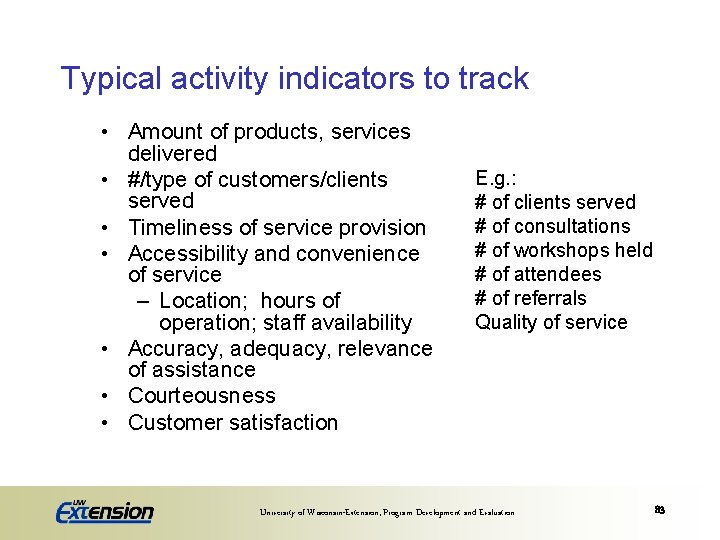
Typical activity indicators to track • Amount of products, services delivered • #/type of customers/clients served • Timeliness of service provision • Accessibility and convenience of service – Location; hours of operation; staff availability • Accuracy, adequacy, relevance of assistance • Courteousness • Customer satisfaction E. g. : # of clients served # of consultations # of workshops held # of attendees # of referrals Quality of service University of Wisconsin-Extension, Program Development and Evaluation 83
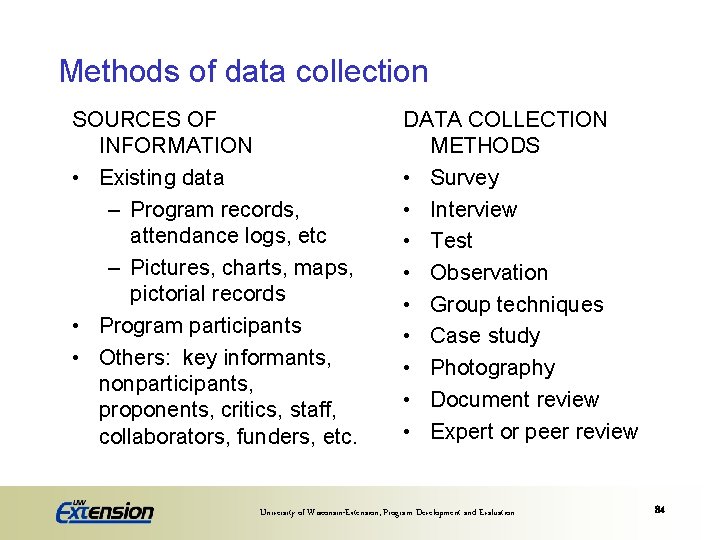
Methods of data collection SOURCES OF INFORMATION • Existing data – Program records, attendance logs, etc – Pictures, charts, maps, pictorial records • Program participants • Others: key informants, nonparticipants, proponents, critics, staff, collaborators, funders, etc. DATA COLLECTION METHODS • Survey • Interview • Test • Observation • Group techniques • Case study • Photography • Document review • Expert or peer review University of Wisconsin-Extension, Program Development and Evaluation 84
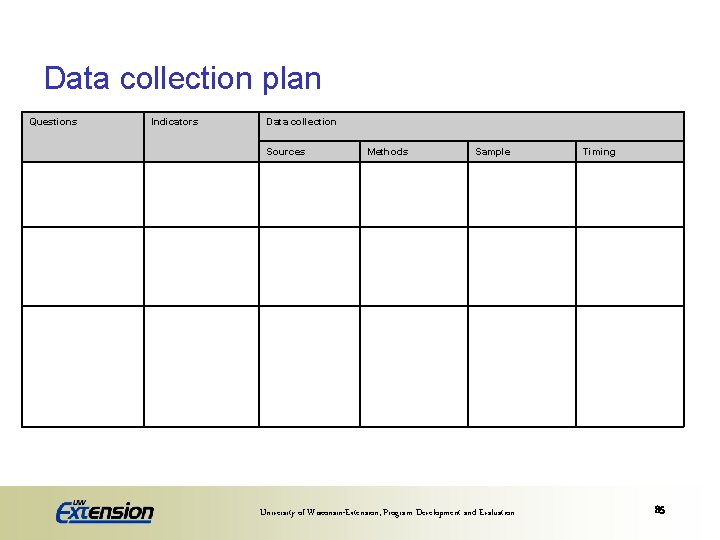
Data collection plan Questions Indicators Data collection Sources Methods Sample University of Wisconsin-Extension, Program Development and Evaluation Timing 85
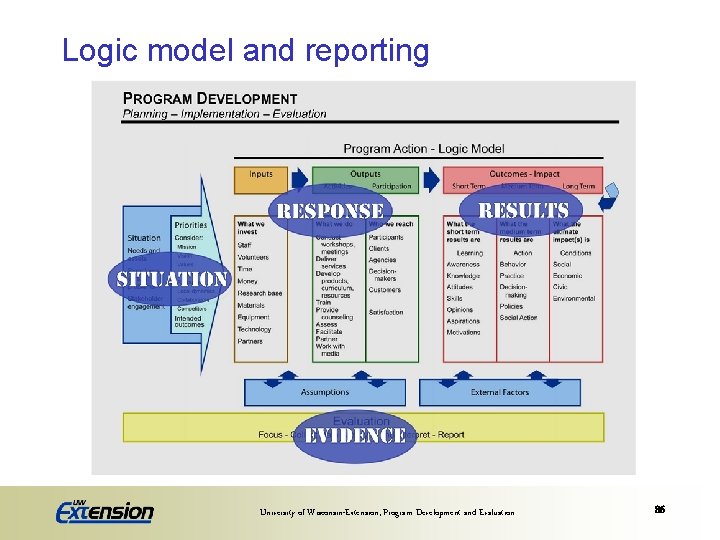
Logic model and reporting University of Wisconsin-Extension, Program Development and Evaluation 86