
Developing a Language Profile of the ELL Student

- Slides: 11
Developing a Language Profile of the ELL Student: An interview format designed for school staff to use with culturally and linguistically diverse families to obtain information about the student’s use of his/her first language
Interview Outcomes: l School staff will obtain detailed information about the student’s use of the first language from the family members’ perspectives l Families will become involved in the school system and understand that the school will learn how to best teach that student, based on their skills in the L 1
Types of Interviews n Informal: n Guide: n Standardized: Conversational style interview in which the interviewer can be highly responsive to the needs of the interviewee Uses an interview guide that provides topics or subject areas to explore The same questions are asked of each informant, more objective because there is decreased flexibility in the order and type of questions
Interview Format Decision School staff (e. g. , ESL instructor, speech-language pathologist, classroom teacher), interpreter, multicultural liaison meet to discuss appropriate type of interview format for family Cultural and linguistic issues will be considered (e. g. , a culture that does not like direct questions may prefer an informal, conversational format) Prior staff relationships with family should be considered (e. g. , it may be beneficial for the ESL instructor to be present if he or she has developed a positive relationship with the family)
Interviews need to be performed with the family members held in authority for that cultural group (e. g. , elders in some African cultures; men in Vietnamese culture) or others as appropriate Schedule the interview at a time convenient for the family member(s) that will be interviewed Preconference with the school staff and interpreter/liaisons to discuss the format of the interview and question types
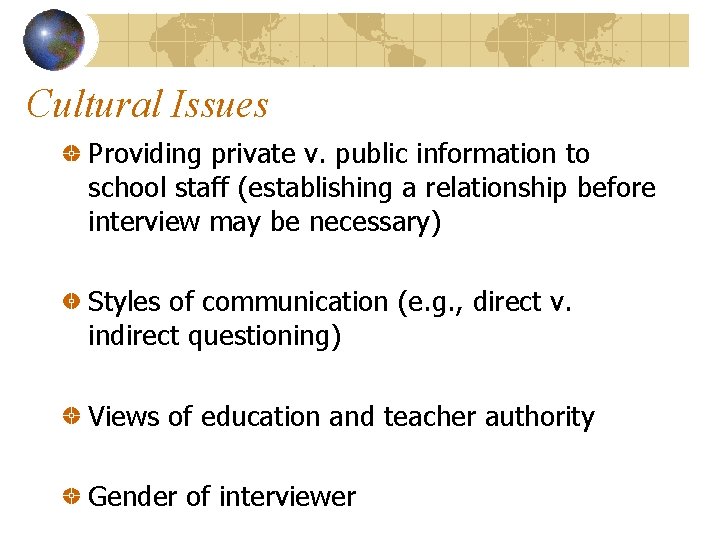
Cultural Issues Providing private v. public information to school staff (establishing a relationship before interview may be necessary) Styles of communication (e. g. , direct v. indirect questioning) Views of education and teacher authority Gender of interviewer
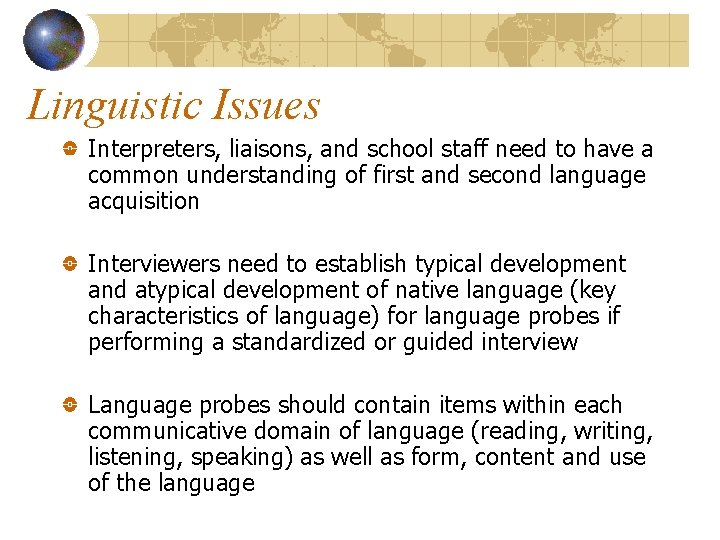
Linguistic Issues Interpreters, liaisons, and school staff need to have a common understanding of first and second language acquisition Interviewers need to establish typical development and atypical development of native language (key characteristics of language) for language probes if performing a standardized or guided interview Language probes should contain items within each communicative domain of language (reading, writing, listening, speaking) as well as form, content and use of the language
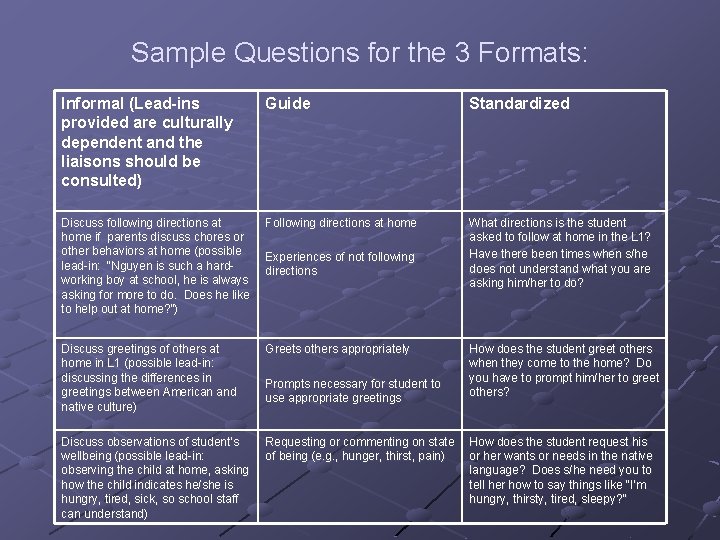
Sample Questions for the 3 Formats: Informal (Lead-ins provided are culturally dependent and the liaisons should be consulted) Guide Standardized Discuss following directions at home if parents discuss chores or other behaviors at home (possible lead-in: “Nguyen is such a hardworking boy at school, he is always asking for more to do. Does he like to help out at home? ”) Following directions at home What directions is the student asked to follow at home in the L 1? Have there been times when s/he does not understand what you are asking him/her to do? Discuss greetings of others at home in L 1 (possible lead-in: discussing the differences in greetings between American and native culture) Greets others appropriately Discuss observations of student’s wellbeing (possible lead-in: observing the child at home, asking how the child indicates he/she is hungry, tired, sick, so school staff can understand) Requesting or commenting on state of being (e. g. , hunger, thirst, pain) Experiences of not following directions Prompts necessary for student to use appropriate greetings How does the student greet others when they come to the home? Do you have to prompt him/her to greet others? How does the student request his or her wants or needs in the native language? Does s/he need you to tell her how to say things like “I’m hungry, thirsty, tired, sleepy? ”
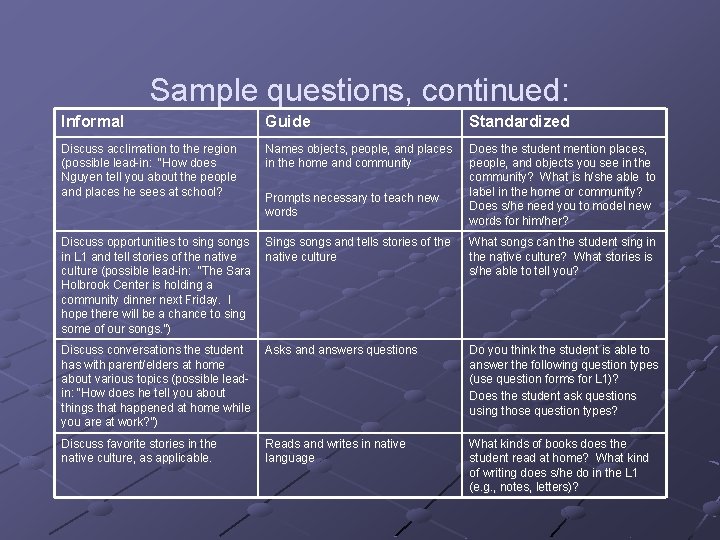
Sample questions, continued: Informal Guide Standardized Discuss acclimation to the region (possible lead-in: “How does Nguyen tell you about the people and places he sees at school? Names objects, people, and places in the home and community Does the student mention places, people, and objects you see in the community? What is h/she able to label in the home or community? Does s/he need you to model new words for him/her? Discuss opportunities to sing songs in L 1 and tell stories of the native culture (possible lead-in: “The Sara Holbrook Center is holding a community dinner next Friday. I hope there will be a chance to sing some of our songs. ”) Sings songs and tells stories of the native culture What songs can the student sing in the native culture? What stories is s/he able to tell you? Discuss conversations the student has with parent/elders at home about various topics (possible leadin: “How does he tell you about things that happened at home while you are at work? ”) Asks and answers questions Do you think the student is able to answer the following question types (use question forms for L 1)? Does the student ask questions using those question types? Discuss favorite stories in the native culture, as applicable. Reads and writes in native language What kinds of books does the student read at home? What kind of writing does s/he do in the L 1 (e. g. , notes, letters)? Prompts necessary to teach new words
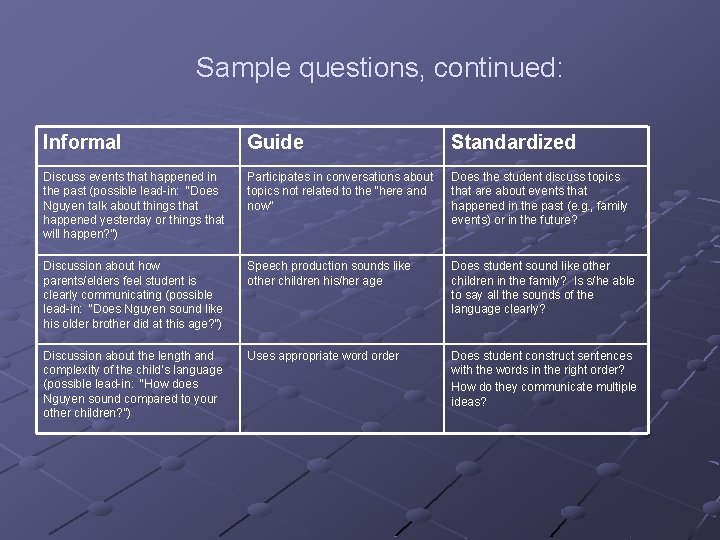
Sample questions, continued: Informal Guide Standardized Discuss events that happened in the past (possible lead-in: “Does Nguyen talk about things that happened yesterday or things that will happen? ”) Participates in conversations about topics not related to the “here and now” Does the student discuss topics that are about events that happened in the past (e. g. , family events) or in the future? Discussion about how parents/elders feel student is clearly communicating (possible lead-in: “Does Nguyen sound like his older brother did at this age? ”) Speech production sounds like other children his/her age Does student sound like other children in the family? Is s/he able to say all the sounds of the language clearly? Discussion about the length and complexity of the child’s language (possible lead-in: “How does Nguyen sound compared to your other children? ”) Uses appropriate word order Does student construct sentences with the words in the right order? How do they communicate multiple ideas?
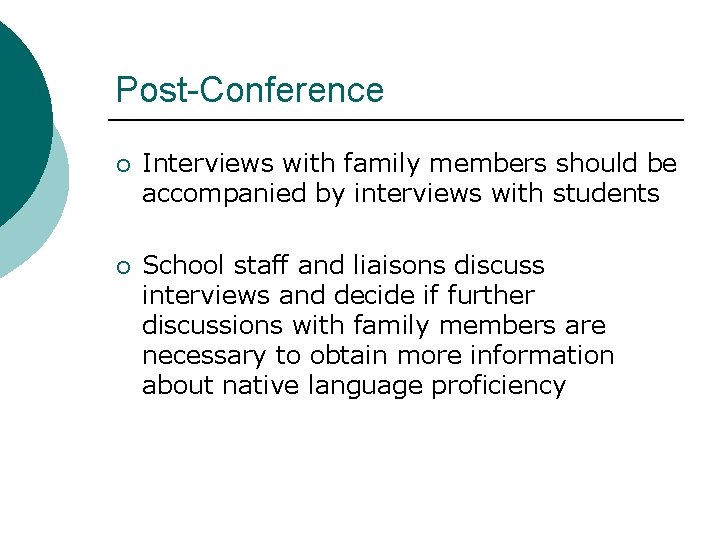
Post-Conference ¡ Interviews with family members should be accompanied by interviews with students ¡ School staff and liaisons discuss interviews and decide if further discussions with family members are necessary to obtain more information about native language proficiency