
Developing a Kelvin Probe for Measuring Surface Charge
Developing a Kelvin Probe for Measuring Surface Charge on LIGO Optics Dennis Ugolini, Robert Mc. Kinney Trinity University March LSC Meeting March 22, 2006 LIGO-G 060061 -00 -Z D. Ugolini, LSC March 2006
The Surface Charge Problem § Surface charge may build up on test masses § Sources of charge buildup » Friction with dust molecules during pumpdown » Mechanical contact with conductors (earthquake stops) » Cosmic rays (Moscow State group) § Potential concerns » Fluctuating electric fields can interfere with positioning control » Source of low-frequency suspension noise » Dust may be attracted/held to optic surface, increasing absorption LIGO-G 060061 -00 -Z D. Ugolini, LSC March 2006 2
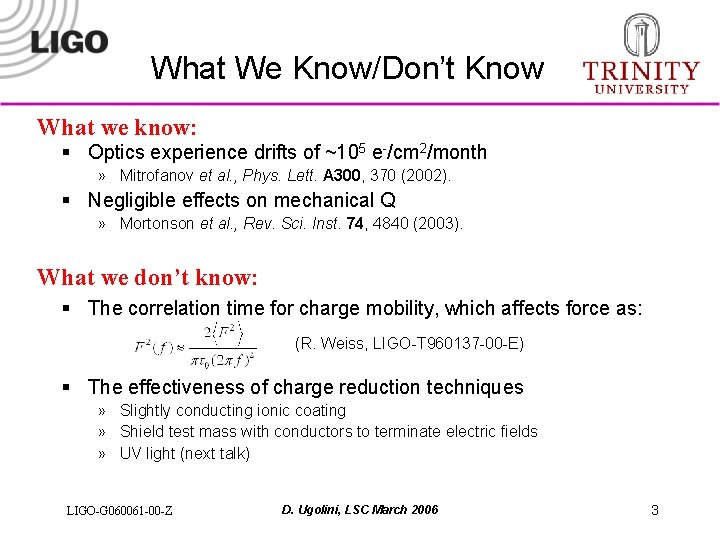
What We Know/Don’t Know What we know: § Optics experience drifts of ~105 e-/cm 2/month » Mitrofanov et al. , Phys. Lett. A 300, 370 (2002). § Negligible effects on mechanical Q » Mortonson et al. , Rev. Sci. Inst. 74, 4840 (2003). What we don’t know: § The correlation time for charge mobility, which affects force as: (R. Weiss, LIGO-T 960137 -00 -E) § The effectiveness of charge reduction techniques » Slightly conducting ionic coating » Shield test mass with conductors to terminate electric fields » UV light (next talk) LIGO-G 060061 -00 -Z D. Ugolini, LSC March 2006 3

The Kelvin Probe § The Kelvin probe measures the contact potential difference between the probe and sample § Commercial probes modulate the difference by vibrating the probe tip by PZT or voice coil -- expensive § Instead modulate difference with optical “tuning-fork” chopper LIGO-G 060061 -00 -Z D. Ugolini, LSC March 2006 4
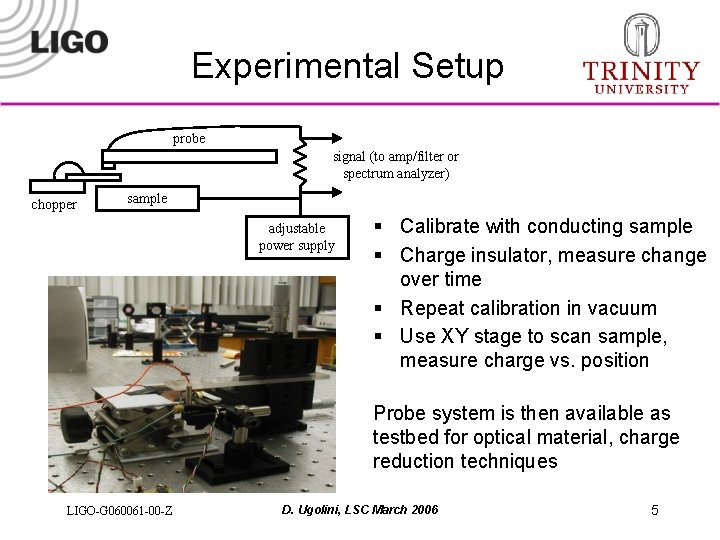
Experimental Setup probe signal (to amp/filter or spectrum analyzer) chopper sample adjustable power supply § Calibrate with conducting sample § Charge insulator, measure change over time § Repeat calibration in vacuum § Use XY stage to scan sample, measure charge vs. position Probe system is then available as testbed for optical material, charge reduction techniques LIGO-G 060061 -00 -Z D. Ugolini, LSC March 2006 5

Kelvin Probe Version 1 4 mm Copper tip Plexiglass spacer Grounded ring Plexiglass backing Grounding ring too large, coil on chopper prevented the probe from getting closer than 1 cm. 2. 5 cm LIGO-G 060061 -00 -Z D. Ugolini, LSC March 2006 6
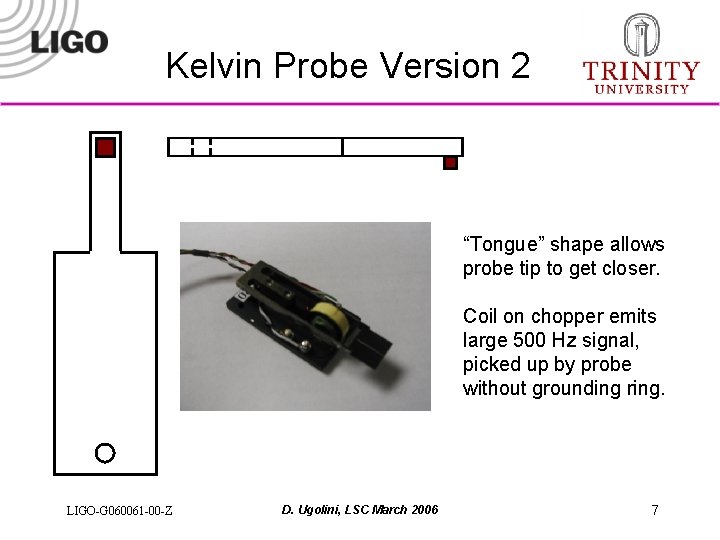
Kelvin Probe Version 2 “Tongue” shape allows probe tip to get closer. Coil on chopper emits large 500 Hz signal, picked up by probe without grounding ring. LIGO-G 060061 -00 -Z D. Ugolini, LSC March 2006 7
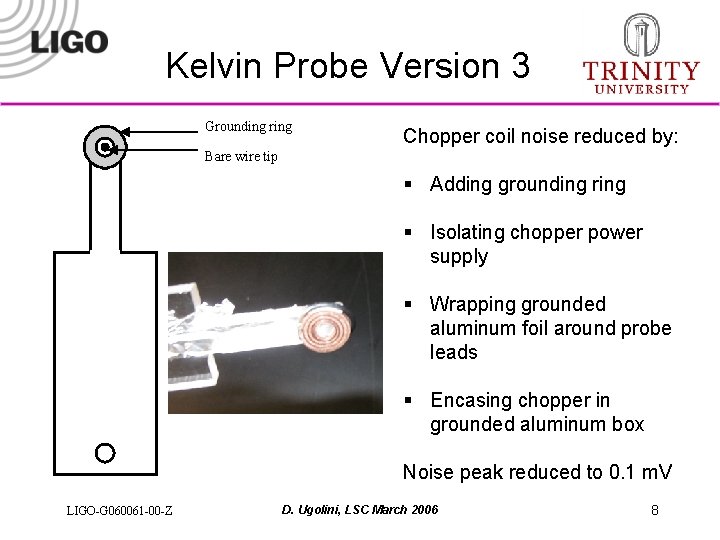
Kelvin Probe Version 3 Grounding ring Chopper coil noise reduced by: Bare wire tip § Adding grounding ring § Isolating chopper power supply § Wrapping grounded aluminum foil around probe leads § Encasing chopper in grounded aluminum box Noise peak reduced to 0. 1 m. V LIGO-G 060061 -00 -Z D. Ugolini, LSC March 2006 8
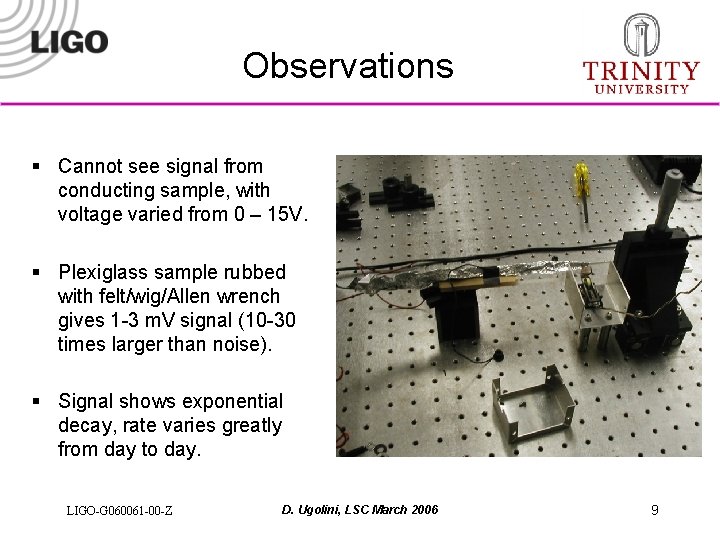
Observations § Cannot see signal from conducting sample, with voltage varied from 0 – 15 V. § Plexiglass sample rubbed with felt/wig/Allen wrench gives 1 -3 m. V signal (10 -30 times larger than noise). § Signal shows exponential decay, rate varies greatly from day to day. LIGO-G 060061 -00 -Z D. Ugolini, LSC March 2006 9
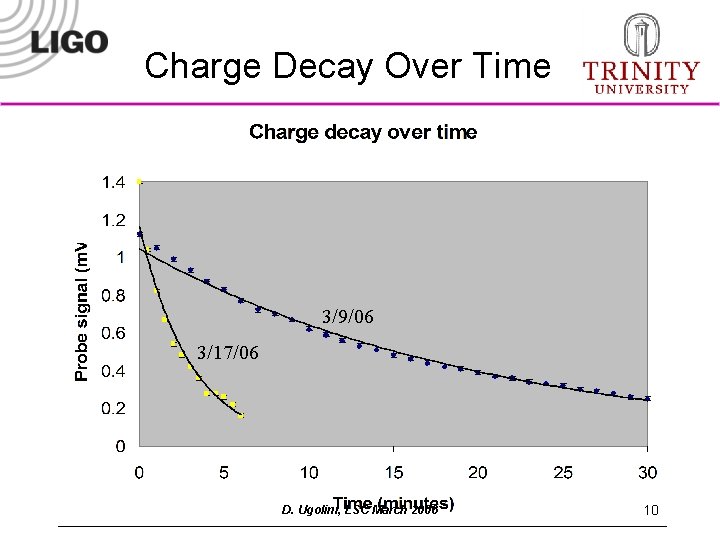
Charge Decay Over Time 3/9/06 3/17/06 LIGO-G 060061 -00 -Z D. Ugolini, LSC March 2006 10
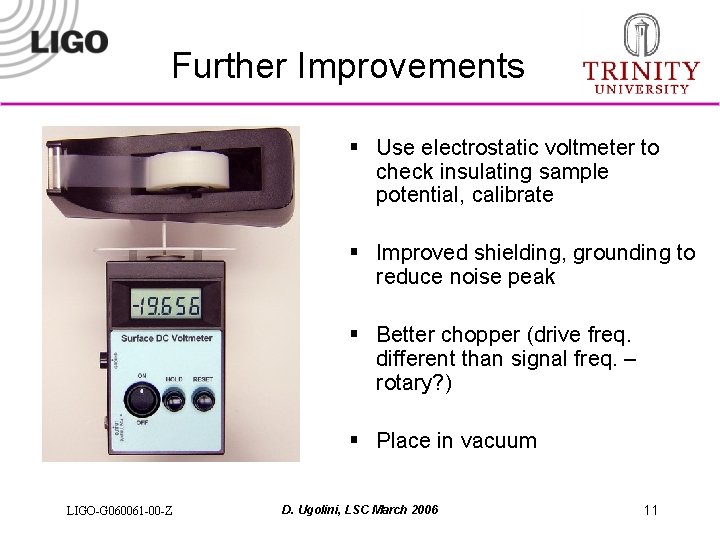
Further Improvements § Use electrostatic voltmeter to check insulating sample potential, calibrate § Improved shielding, grounding to reduce noise peak § Better chopper (drive freq. different than signal freq. – rotary? ) § Place in vacuum LIGO-G 060061 -00 -Z D. Ugolini, LSC March 2006 11
- Slides: 11