
Developing a Global Tsunami Warning and Mitigation System
Developing a Global Tsunami Warning and Mitigation System: From Commitment to Action EWC-III, Scientific and Technical Symposium Bonn, 28 March 2006 UNESCAP Thailand Trust Fund Briefing Bangkok, 28 March 2006 Patricio A. Bernal, Executive Secretary of IOC, ADG UNESCO Laura Kong, Director, IOC ITIC rev Sri Lanka Training, 3 -7 April 2006
A Call to Action … 26 December 2004 250, 000 dead, 500, 000 injured 1 million displaced $8 billion in damages “We cannot stop natural calamities, but we can and must better equip individuals and communities to withstand them. ” UN Secretary-General Kofi Annan
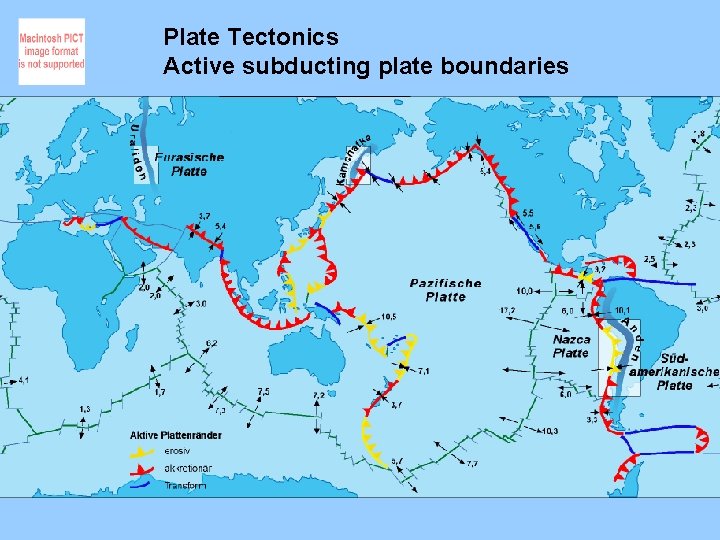
Plate Tectonics Active subducting plate boundaries
IOC ICG/PTWS • 1965 - response to 1960 Pacific-wide Chile tsunami IOC established ICG/ITSU (now ICG/PTWS) Intergovernmental Coordination Group for the Pacific Tsunami Warning and Mitigation System Øsuccessful & operational Tsunami Warning and Mitigation System • PTWC - Operational HQ • ITIC - Oversee and monitor effectiveness, Facilitate to establish new systems, preparedness, outreach
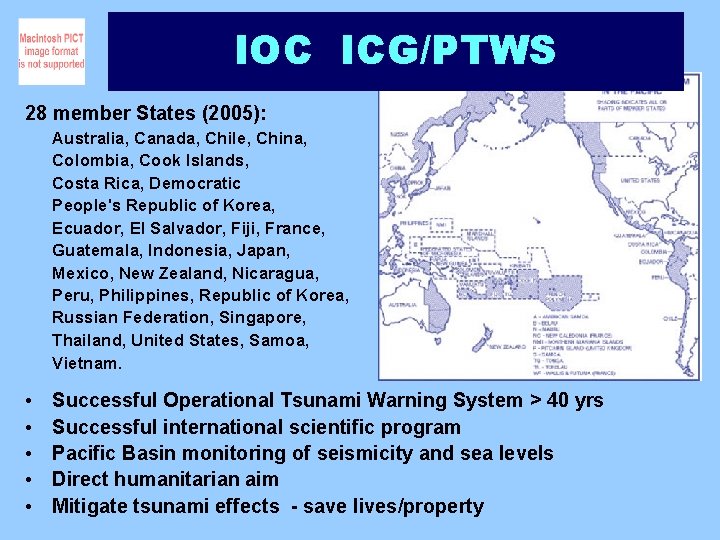
IOC ICG/PTWS 28 member States (2005): Australia, Canada, Chile, China, Colombia, Cook Islands, Costa Rica, Democratic People's Republic of Korea, Ecuador, El Salvador, Fiji, France, Guatemala, Indonesia, Japan, Mexico, New Zealand, Nicaragua, Peru, Philippines, Republic of Korea, Russian Federation, Singapore, Thailand, United States, Samoa, Vietnam. • • • Successful Operational Tsunami Warning System > 40 yrs Successful international scientific program Pacific Basin monitoring of seismicity and sea levels Direct humanitarian aim Mitigate tsunami effects - save lives/property
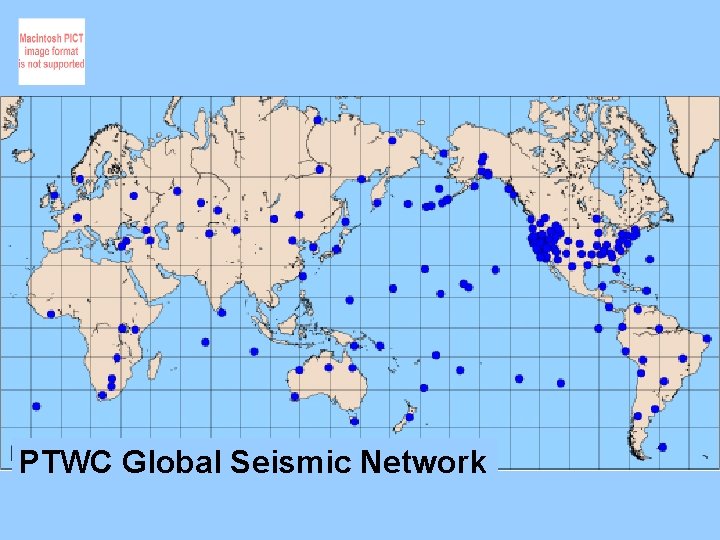
PTWC Global Seismic Network
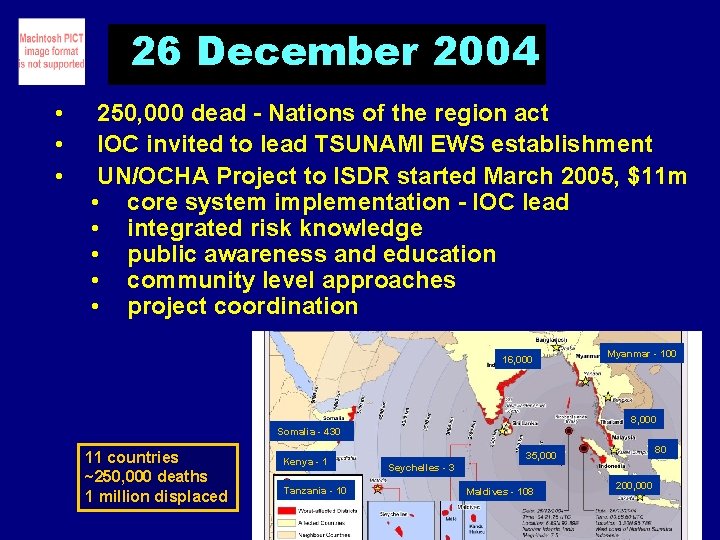
26 December 2004 • • • 250, 000 dead - Nations of the region act IOC invited to lead TSUNAMI EWS establishment UN/OCHA Project to ISDR started March 2005, $11 m • core system implementation - IOC lead • integrated risk knowledge • public awareness and education • community level approaches • project coordination 16, 000 Myanmar - 100 8, 000 Somalia - 430 11 countries ~250, 000 deaths 1 million displaced Kenya - 1 Tanzania - 10 80 35, 000 Seychelles - 3 Maldives - 108 200, 000
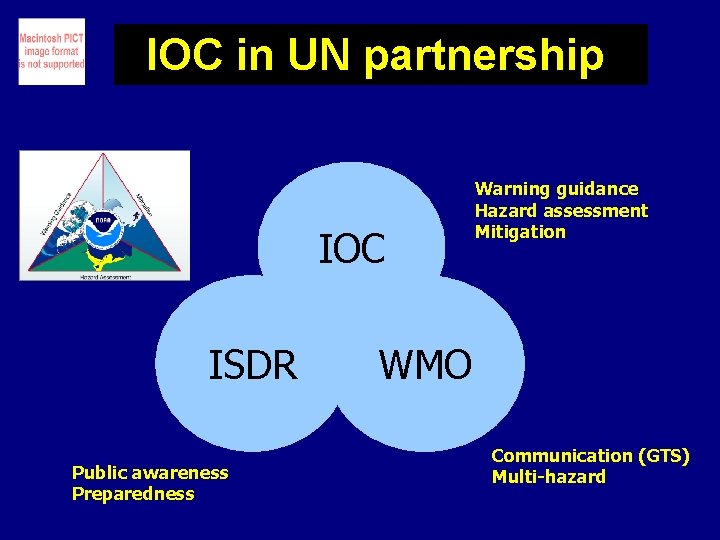
IOC in UN partnership IOC ISDR Public awareness Preparedness Warning guidance Hazard assessment Mitigation WMO Communication (GTS) Multi-hazard

IOC: Core system implementation • Governance – 2 intergovernmental coordination mtgs • Capacity building – Expert advisory missions – Startup training programme • Core system observational network – Interim advisory information service – Operational sea-level and seismic network for tsunami monitoring
What is the System? The system must be: • Fully owned by Indian Ocean countries • Based on international and multilateral cooperation • Based on open and free data exchange • Protect all countries in Indian Ocean • Transparent and accountable to all countries
How does it function? • Based on joint operation of international networks of detection connected with national tsunami warning centres • High-level commitment by country with UN governance provided under the IOC • Each nation is responsible for issuing warnings in their territory and for protecting its own population. • National centres must have strong links with emergency preparedness authorities (national, provincial and local)
Indian Ocean Where are we now? • A single system planned All countries of the Indian Ocean participate • Interim Tsunami Advisory Information from centres in Hawaii and Tokyo. • Natl 7/24 Tsunami Focal Points in 26 nations • Governance - UN/IOC through ICG/IOTWS • Full scope of task recognized: multi-nation (28), multi-year (>3 to 10+ yrs) • Joint UN implementation: IOC, WMO, ISDR, UNDP, UN-ESCAP

• March & April 2005: Considering the devastating tsunami on Dec 26 th 2004, two International Coordination meetings on the Development of an IO TWS took place in Paris and Mauritius
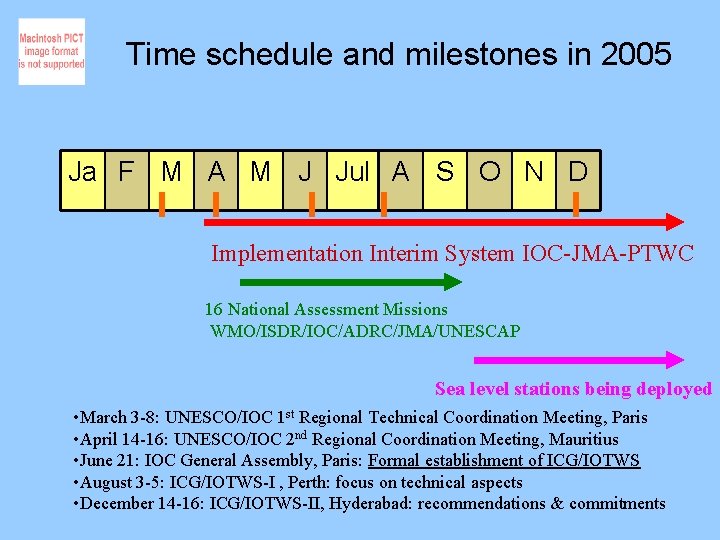
Time schedule and milestones in 2005 Ja F M A M J Jul A S O N D Implementation Interim System IOC-JMA-PTWC 16 National Assessment Missions WMO/ISDR/IOC/ADRC/JMA/UNESCAP Sea level stations being deployed • March 3 -8: UNESCO/IOC 1 st Regional Technical Coordination Meeting, Paris • April 14 -16: UNESCO/IOC 2 nd Regional Coordination Meeting, Mauritius • June 21: IOC General Assembly, Paris: Formal establishment of ICG/IOTWS • August 3 -5: ICG/IOTWS-I , Perth: focus on technical aspects • December 14 -16: ICG/IOTWS-II, Hyderabad: recommendations & commitments

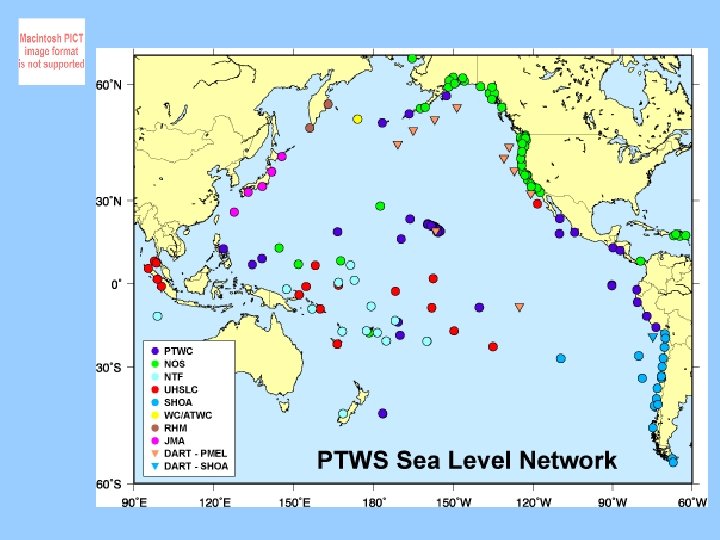
Initial System for July 2006 Based on Existing: • Network of 26 (of 29) National Information Centres [7/24] • Tsunami Focal Points [7/24] Slowly evolving into a • Network of Tsunami Warning Centres in charge of National Mitigation Plans (Assessment, Warning, Preparedness) Need to develop Regional Instrumental Networks: • Improved Seismographic network (faster and more accurate detection of earthquakes through denser network, better real-time source characterization) • Real-time network of sea-level stations (faster detection of tsunamis through denser network)


Operational Planned Core IOTWS Seismographic Network Agreed on Stations
May-Sept, 2005: 16 missions To be scheduled, 2006: 6 missions Maldives, Djibouti, East Timor, Iran, South Africa, Yemen Not requesting: Australia, France, India, Singapore, United Kingdom

IOTWS: National Assessment and Plans Nat. Asses AUSTRALIA Not required National Plan Nat. Asses National Plan Available MYANMAR Done Required BANGLADESH Done Required OMAN Done Required COMORES Done Required PAKISTAN Done Required DJIBOUTI 2006 Required TIMOR (EAST) 2006 Required FRANCE Not required Available SAUDI ARABIA INDIA Not required Available SEYCHELLES Not requested Done INDONESIA Done Available SINGAPORE IRAN 2006 Required SOMALIA Done Required KENYA Done Required SOUTH AFRICA 2006 Required MADAGASCAR Done Required SRI LANKA Done Required MALAYSIA Done Available UAE MALDIVES 2006 Required TANZANIA Done Required MAURITIUS Done Required THAILAND Done Required MOZAMBIQUE Done Required UK YEMEN Not required Required Available Not requested Not required 2006 Required

Questionnaire sections 5 Tsunami Mitigation Categories: • • Contact information Authority and coordination Warnings and tsunami monitoring Warning response and Emergency Action / Preparedness Hazard and risks Community/Individual awareness and preparedness Tsunami response to 28 march 2005 M 8. 5 earthquake off Sumatra, Indonesia Overall enhancement of national capabilities to mitigate impact of hazards (WMO)


Summary: Regional CB Needs • Assistance - harmonize existing practices / protocols Data collection, monitoring, evaluation, warning comm International standards and interoperability • Assistance to establish real-time regional / local seismic and sea level networks with real-time data acquisition, display, and analysis to support the monitoring / detection • Equipment upgrade and capacity building in Global Telecommunication System (GTS) to NMS • Training and software for numerical modeling Inundation maps, Evaluation of hazards / vulnerability
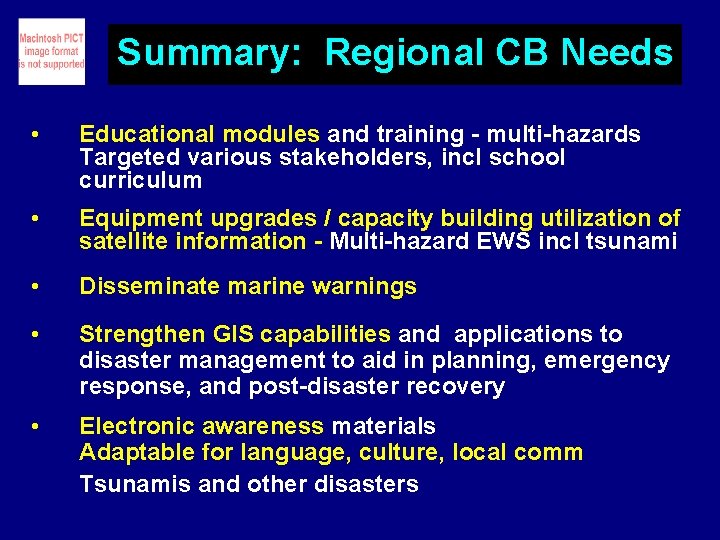
Summary: Regional CB Needs • Educational modules and training - multi-hazards Targeted various stakeholders, incl school curriculum • Equipment upgrades / capacity building utilization of satellite information - Multi-hazard EWS incl tsunami • Disseminate marine warnings • Strengthen GIS capabilities and applications to disaster management to aid in planning, emergency response, and post-disaster recovery • Electronic awareness materials Adaptable for language, culture, local comm Tsunamis and other disasters

The Challenge • We essentially know what is needed at the country level in 16 countries Work for rest of countries will be completed in 2006 (6 countries) • ICG is requesting a Comprehensive IOTWS Plan, including the Country level • Therefore, we need the development of the National Plans at the Country level.

TSUNAMI Early Warning Overview • Hazard Risk Assessment • Warning Guidance • Mitigation - Preparedness Earthquake Tsunami Warning Center National Government Local Government What is Tsunami? People Mass Media International - Regional Framework National Warning System Where is Evacuation Route? Public Awareness Cabinet Office Japan
A perfect warning will be useless if people do not know what to do in case of an emergency Awareness and preparedness at the country level is essential
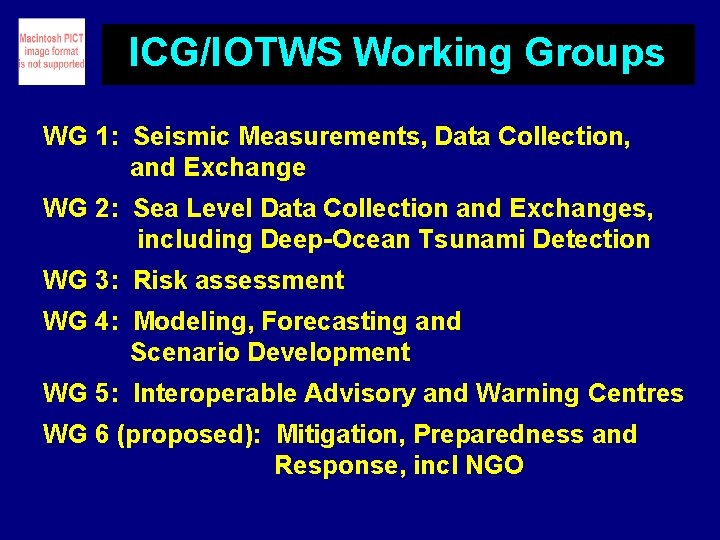
ICG/IOTWS Working Groups WG 1: Seismic Measurements, Data Collection, and Exchange WG 2: Sea Level Data Collection and Exchanges, including Deep-Ocean Tsunami Detection WG 3: Risk assessment WG 4: Modeling, Forecasting and Scenario Development WG 5: Interoperable Advisory and Warning Centres WG 6 (proposed): Mitigation, Preparedness and Response, incl NGO

WG 6: Mitigation, Preparedness and Response • MS ensure development / DM officials participate in ICG / WG, incl Red Cross/Red Crescent, NGOs, community groups, private sector • Develop overall strategy document based on initial ISDR initial draft – consistent with IOC core system implementation & WG TORs ISDR to continue to work with IOC & partners • National level, coordination with downstream stakeholders facilitated through DRR national platforms (Hyogo Framework 2005 -2015) to ensure broader based ownership

Mitigation, Preparedness and Response: Terms of Reference Focus national efforts for effective tsunami warning: • Promote, mainstream good practices into development planning / practice: policies / institutions, sectors, risk mitigation, recovery • Promote, support engagement of NTWC / experts in national platforms for DRR, all-hazard integration, DM • Provide of guidelines, tools, best practices to DM sector: public information, education, training, communications, evacuation planning / drills, emergency mgmt • Communicate ICG WG results to development and DM communities and vice versa (needs to WG)

: STAKEHOLDER COORDINATION
• June 21 -30, 2005: the 23 rd IOC General Assembly decided resolutions on the establishment of a global and three regional Intergovernmental Coordination Groups on TEWS (XXIII-12 to XXXIII-15) for - the Indian Ocean (ICG/IOTWS) - the Caribbean (ICG/CARTWS) - the NE Atlantic and Med (ICG/NEAMTWS)
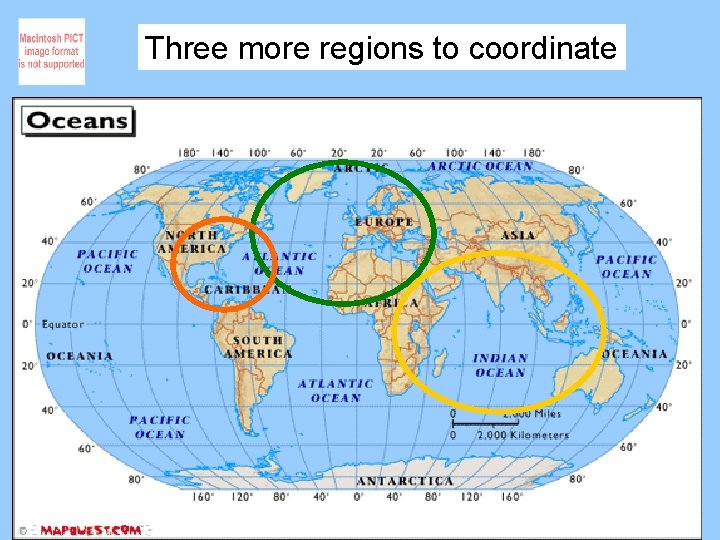
Three more regions to coordinate
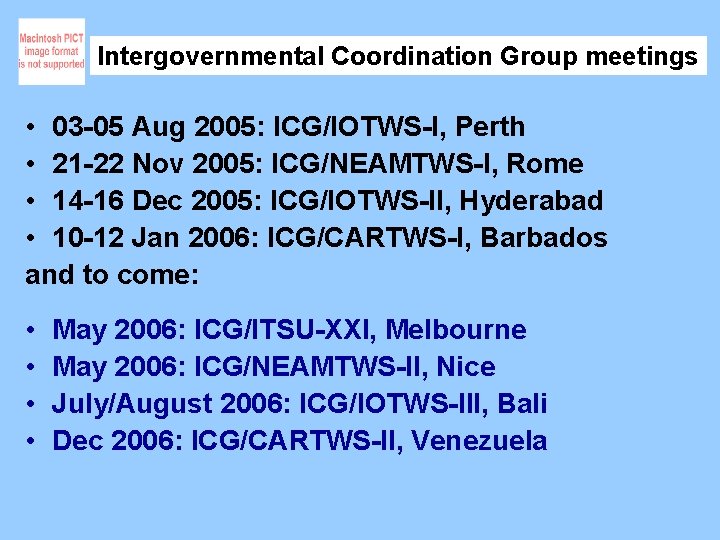
Intergovernmental Coordination Group meetings • 03 -05 Aug 2005: ICG/IOTWS-I, Perth • 21 -22 Nov 2005: ICG/NEAMTWS-I, Rome • 14 -16 Dec 2005: ICG/IOTWS-II, Hyderabad • 10 -12 Jan 2006: ICG/CARTWS-I, Barbados and to come: • • May 2006: ICG/ITSU-XXI, Melbourne May 2006: ICG/NEAMTWS-II, Nice July/August 2006: ICG/IOTWS-III, Bali Dec 2006: ICG/CARTWS-II, Venezuela
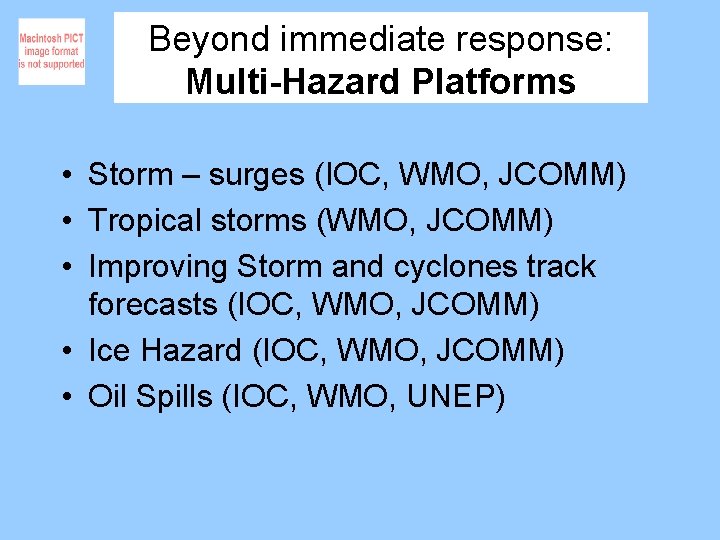
Beyond immediate response: Multi-Hazard Platforms • Storm – surges (IOC, WMO, JCOMM) • Tropical storms (WMO, JCOMM) • Improving Storm and cyclones track forecasts (IOC, WMO, JCOMM) • Ice Hazard (IOC, WMO, JCOMM) • Oil Spills (IOC, WMO, UNEP)
For further information see: http: //ioc. unesco. org/indotsunami http: //ioc 3. unesco. org/neamtws http: //ioc 3. unesco. org/cartws http: //ioc 3. unesco. org/ptws International Tsunami Information Centre http: //ioc 3. unesco. org/itic
IOC Executive Secretary: Dr. Patricio Bernal IOC Tsunami Unit: Dr. Uli Wolf Masahiro Yamamoto Bernardo Aliaga IOC ITIC / Tsunami Unit: PTWS Secretariat: Dr. Laura Kong l. kong@unesco. org www. tsunamiwave. info Chair, Vice-Chair: Chile, Canada IOTWS: ioc. unesco. org/indotsunami Secretariat: IOC Regional Office, Perth Chair: India Vice-Chairs: Indonesia, Mauritius
IOC Activities – 2006 • • • Coordinated Implementation Plan - partners ICG/IOTWS WGs (coordinate, facilitate, synergize across other regions) Upgrade/install GLOSS and other sea level, seismic network - ongoing Tsunami. Teacher - May 2006 electronic, dynamic training modules + resources (Media, Education, Public/Private Sector) Customizeable awareness materials Adapt for language, culture, local community IOC-ADRC Educational Curricula - Thailand, April 2006
IOC Activities – 2006 Capacity Building / Training - Seismology – USGS, FDSN/IRIS GSN, Africa. Array Sri Lanka, Indonesia, Thailand, Pakistan, India, Maldives, East Africa /West IO - Numerical Modeling – Expert scientists, I - Sources / Propagation, May (Malaysia, Belgium) II - Inundation / Evacuation, Sept-Dec - Tsunami. Teacher Workshops – up tp 8 countries, May - Tsunami Warning Operations and Emergency Response Indonesia, Thailand, Mozambique, Mauritius, etc - RANET Communications - warning centre to local communities - May 2006 - Risk and vulnerability assessment - use of GIS tools ESRI - IOC, April, 2006

ICG/PTWS - South China Sea • Synergies with ICG/IOTWS WGs • Interim Tsunami Advisory Information Service JMA NW Pacific Tsunami Advisory Center expands Close coordination with PTWC Start 1 April 2006 • IOC-Malaysia MOSTI, 27 -28 April, Kuala Lumpur Roundtable Symposium on Earthquake and Tsunami Hazards and Risks • Pacific-wide Tsunami Drill, 16 -17 May 2006 PTWC initiated 2 sources - Philippine (Pacific) and Chile UNDP to sponsor observers to Philippines
- Slides: 42