
Developing a Global Management Cadre 10 1 Opening
Developing a Global Management Cadre 10 -1
Opening Profile: The Expat Life What is it like to take an assignment 10 -2 abroad? Would you like to be an “expat” (expatriate)? Is it an adventure or a hardship? Experiences of those who have done a stint abroad are mixed. Experiences vary by job type, and especially by location.
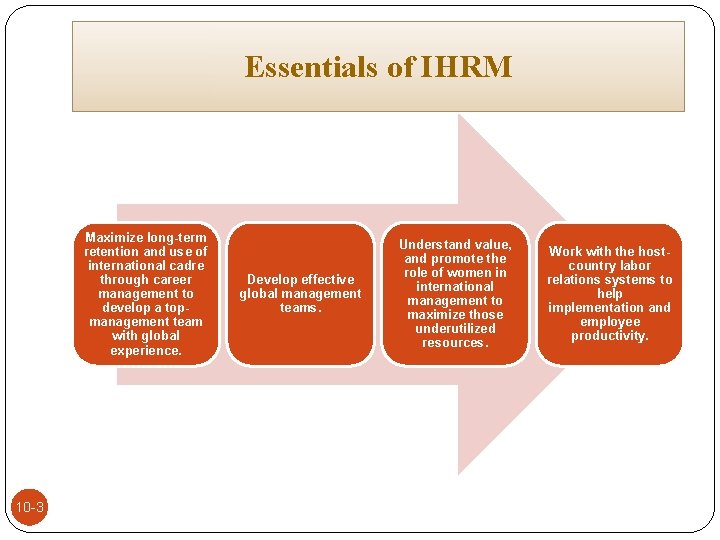
Essentials of IHRM Maximize long-term retention and use of international cadre through career management to develop a topmanagement team with global experience. 10 -3 Develop effective global management teams. Understand value, and promote the role of women in international management to maximize those underutilized resources. Work with the hostcountry labor relations systems to help implementation and employee productivity.
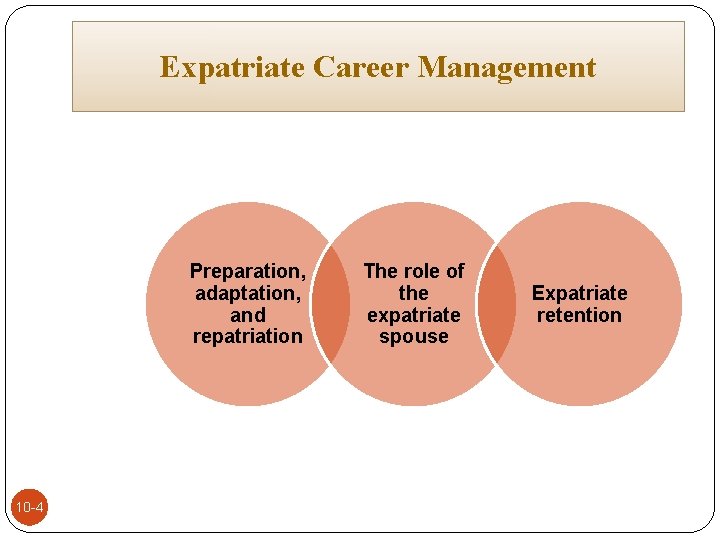
Expatriate Career Management Preparation, adaptation, and repatriation 10 -4 The role of the expatriate spouse Expatriate retention
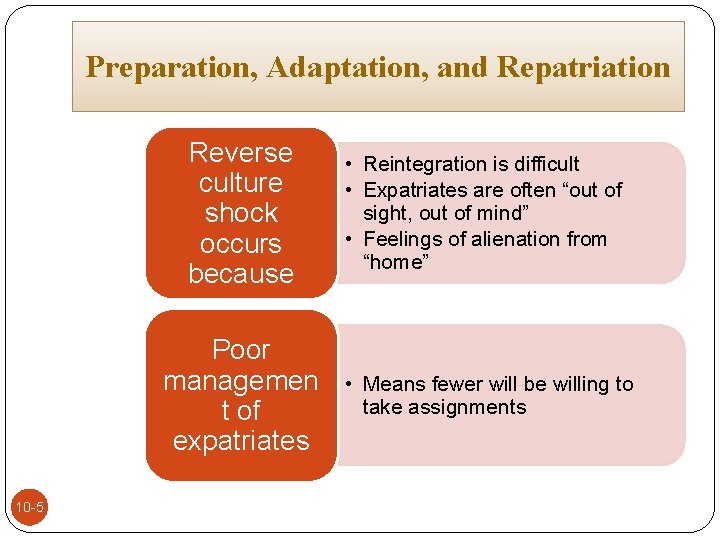
Preparation, Adaptation, and Repatriation 10 -5 Reverse culture shock occurs because • Reintegration is difficult • Expatriates are often “out of sight, out of mind” • Feelings of alienation from “home” Poor managemen t of expatriates • Means fewer will be willing to take assignments
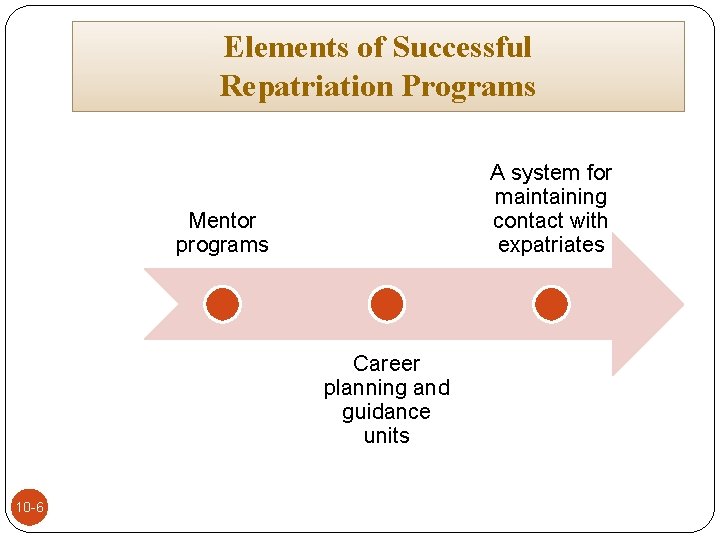
Elements of Successful Repatriation Programs A system for maintaining contact with expatriates Mentor programs Career planning and guidance units 10 -6
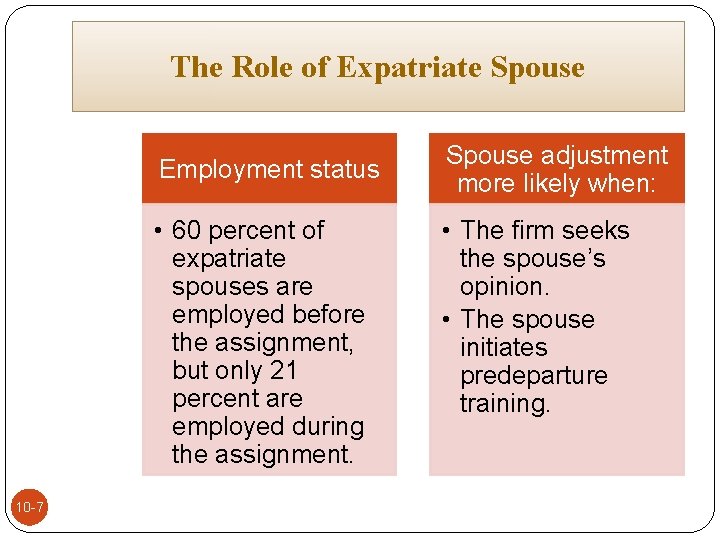
The Role of Expatriate Spouse Employment status • 60 percent of expatriate spouses are employed before the assignment, but only 21 percent are employed during the assignment. 10 -7 Spouse adjustment more likely when: • The firm seeks the spouse’s opinion. • The spouse initiates predeparture training.
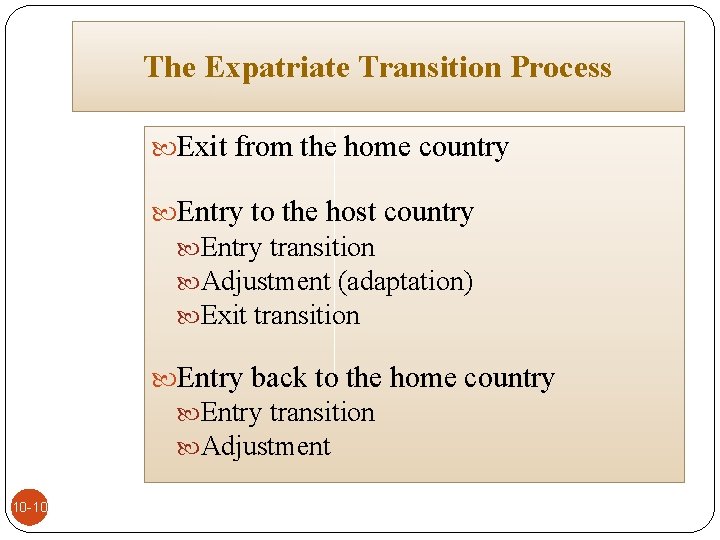
The Expatriate Transition Process Exit from the home country Entry to the host country Entry transition Adjustment (adaptation) Exit transition Entry back to the home country Entry transition Adjustment 10 -10
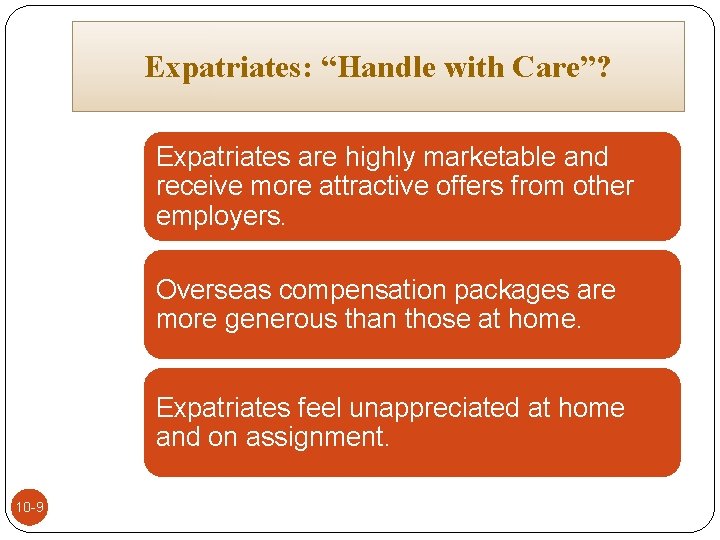
Expatriates: “Handle with Care”? Expatriates are highly marketable and receive more attractive offers from other employers. Overseas compensation packages are more generous than those at home. Expatriates feel unappreciated at home and on assignment. 10 -9
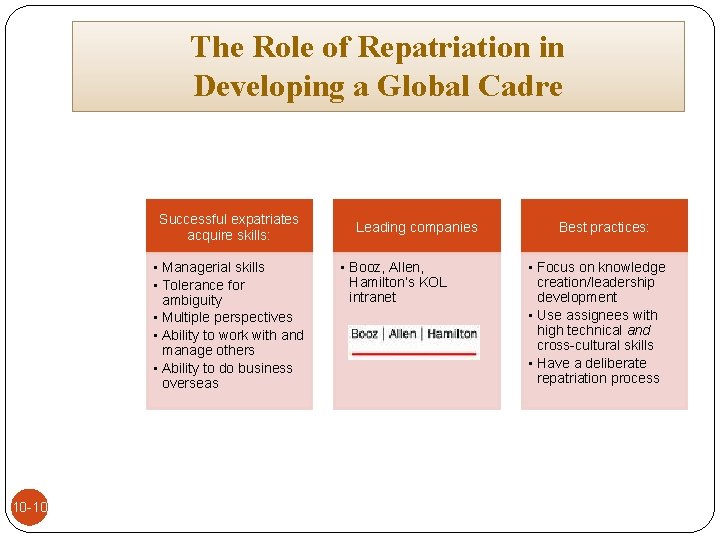
The Role of Repatriation in Developing a Global Cadre Successful expatriates acquire skills: • Managerial skills • Tolerance for ambiguity • Multiple perspectives • Ability to work with and manage others • Ability to do business overseas 10 -10 Leading companies • Booz, Allen, Hamilton’s KOL intranet Best practices: • Focus on knowledge creation/leadership development • Use assignees with high technical and cross-cultural skills • Have a deliberate repatriation process
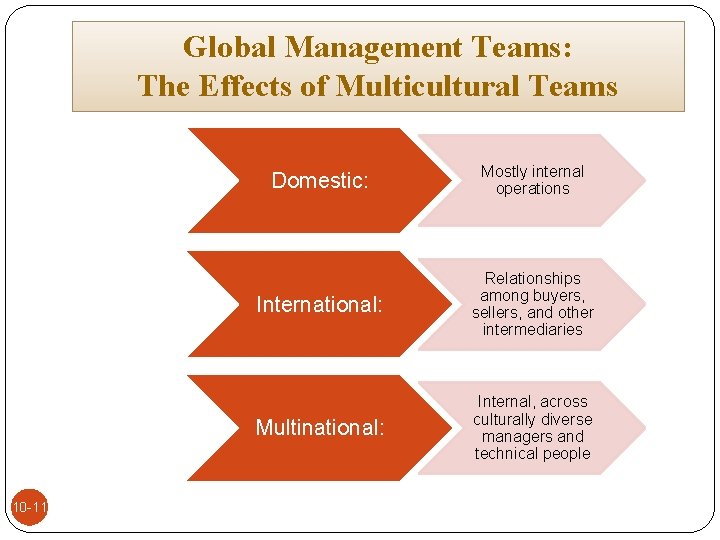
Global Management Teams: The Effects of Multicultural Teams 10 -11 Domestic: Mostly internal operations International: Relationships among buyers, sellers, and other intermediaries Multinational: Internal, across culturally diverse managers and technical people

Operational Challenges for Global Virtual Teams Geographic dispersal: the complexity of scheduling communications across multiple time zones, holidays, and so on Cultural differences: variations in attitudes and expectations Virtual Teams’ Challenges Language and communication: translation difficulties, variations in accents, semantics, and so on 10 -12 Technology: variations in availability, speed, acceptability, and so on
Virtual Teams’ Future Needs How to lead a virtual team meeting How to coach and mentor virtually How to monitor team progress How to use communication technologies How to manage team boundaries 10 -13
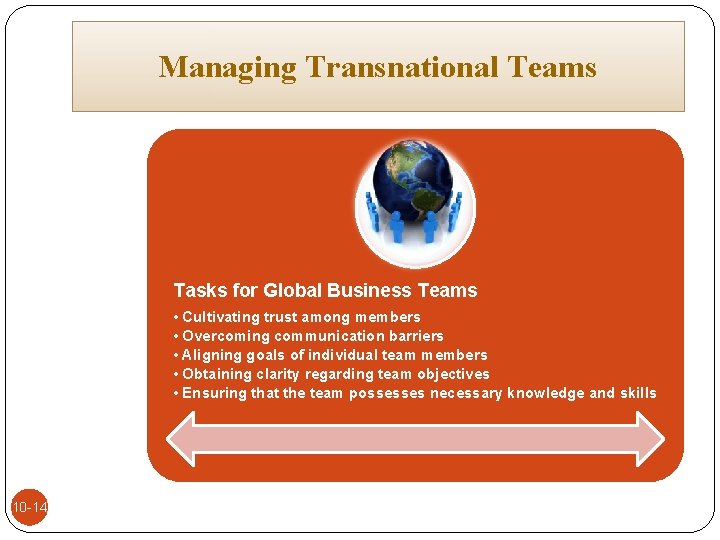
Managing Transnational Teams Tasks for Global Business Teams • Cultivating trust among members • Overcoming communication barriers • Aligning goals of individual team members • Obtaining clarity regarding team objectives • Ensuring that the team possesses necessary knowledge and skills 10 -14
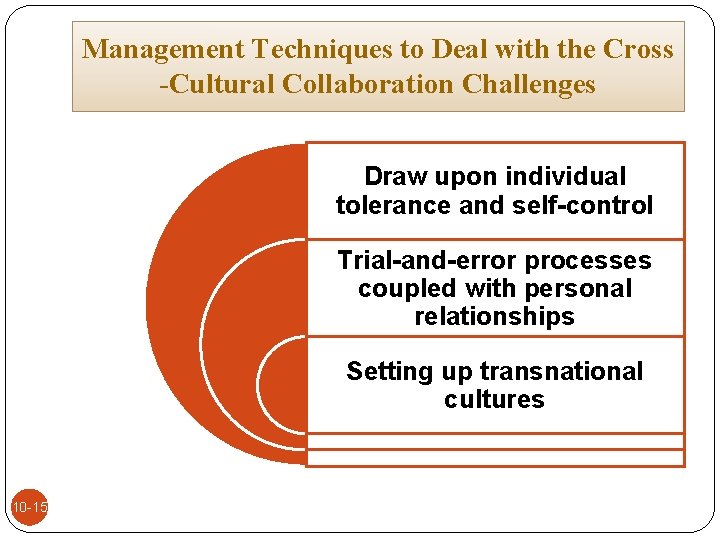
Management Techniques to Deal with the Cross -Cultural Collaboration Challenges Draw upon individual tolerance and self-control Trial-and-error processes coupled with personal relationships Setting up transnational cultures 10 -15

Management Focus: The Role of Women in International Management Indra Nooyi—CEO, Pepsi Soha Nashaat Head of Barclays Bank, Middle East 10 -16
Management Focus: The Role of Women in International Management Women are increasingly making their way into the international management cadre. Different opportunities for women may reflect the cultural expectations of the host countries. In Spain and Italy, top boardrooms remain almost exclusively male. Women occupy 22 percent of board seats in Norway and 20 percent in Sweden. 10 -17
Management Focus: The Role of Women in International Management North American women working as expatriate managers in countries around the world showed that they are— for most part— successful. Women and minorities represent a significant resource for overseas assignments—whether as expatriates or as host -country nationals. 10 -18
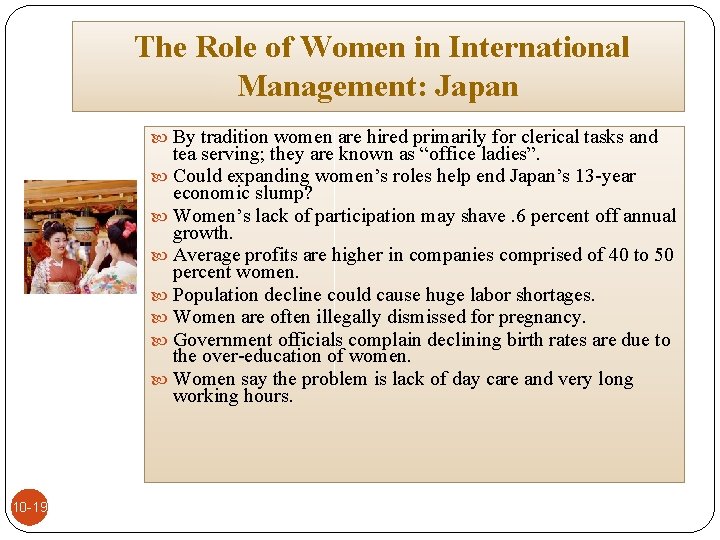
The Role of Women in International Management: Japan By tradition women are hired primarily for clerical tasks and tea serving; they are known as “office ladies”. Could expanding women’s roles help end Japan’s 13 -year economic slump? Women’s lack of participation may shave. 6 percent off annual growth. Average profits are higher in companies comprised of 40 to 50 percent women. Population decline could cause huge labor shortages. Women are often illegally dismissed for pregnancy. Government officials complain declining birth rates are due to the over-education of women. Women say the problem is lack of day care and very long working hours. 10 -19
Working Within Local Labor Relations Systems The Impact of Unions on Business Organized Labor Around the World Convergence Versus Divergence in Labor Systems Adapting to Local Industrial Relations systems The NAFTA and Labor Relations in Mexico 10 -20
The Impact of Unions on Business Labor Relations and Collective Bargaining • The process through which managers and workers determine their workplace relationship 10 -21 Three Dimensions to Consider • The participation of labor in firm affairs • The role and impact of unions • Human resource policies Labor Relations Constraints • Wage levels set by unions • Limits on the firm’s ability to vary employment levels • Limitations on the global integration of operations
Organized Labor Around the world Union membership is in decline. CHINA? ? Industrial, craft, conglomerate, and general unions Labor unions must be understood within their given contextual environment. 10 -22
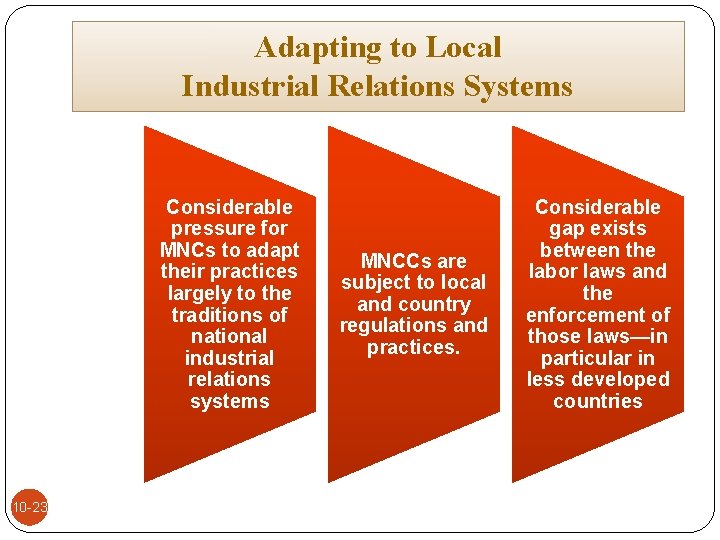
Adapting to Local Industrial Relations Systems Considerable pressure for MNCs to adapt their practices largely to the traditions of national industrial relations systems 10 -23 MNCCs are subject to local and country regulations and practices. Considerable gap exists between the labor laws and the enforcement of those laws—in particular in less developed countries
- Slides: 23