
Developing a Framework for Quantitative Literacy Counting on
- Slides: 22
Developing a Framework for Quantitative Literacy: Counting on IASSIST Wendy Watkins IASSIST 2006 Ann Arbor, MI
Alternate Title Information, Numbers and Turf
Outline o o o Addressing a Need Recent Events Making a Plan Bringing on Partners Semantics Turf Making a Plan 2 Developing the Outline Workshops 1 -5 Getting Faculty Buy-in Next Steps IASSIST Inspirations
Addressing a Need o “In today’s “world awash in numbers, ” strong quantitative reasoning skills are required in: n n n virtually all academic fields most every profession decision-making in everyday life” Corrie Taylor, ICPSR OR meeting, Oct. 2005 o According to the ALLS*, 12 of 13 provinces and territories score BELOW the MINIMUM for successful day-to-day functioning ** * Adult Literacy and Lifeskills Survey, 2003 ** Statistics Canada Daily, Nov. 9, 2005; Globe and Mail, Nov. 10, 2005
Addressing a Need (con’t) “In fact, the labour market returns to numeracy skills overshadowed the return to education. Hence, if welleducated adults were lacking in numeracy skills, they derived no benefit from any additional years of schooling. ” n Results of the 2003 ALLS reported in the Statistics Canada Daily, May 11, 2005
Recent Events o o o Release of ALLS results for Canadian numeracy Publication of special IQ issue on statistical literacy Focus of ICPSR on quantitative literacy n o o Corrie Taylor’s presentation at last OR meeting IASSIST Strategic Plan’s focus on education Integration of Learning Commons into Libraries
Making a Plan 1 o o o Use Information Literacy as a model Target graduate students Stress numeracy as the goal (not producing mathematicians) Collect materials Develop a curriculum
Bringing on Partners o o Can’t do it alone Liaison with Learning Commons n n o Good discussion of areas of mutual interest Expression of interest in developing curricula for: o Workshops on quantitative literacy o SPSS workshops o Introduction to GIS Good support from the Dean of Students
Semantics o Information Literacy ≠Quantitative Literacy Mentioning Information Literacy = n Library Stuff n Been there, done that o Don’t understand the stress on everyday quantitative skills
Turf o Mentioning Quantitative Literacy= Math and Stats n n o Grad Studies wants to set curriculum n o o Don’t understand the stress on everyday quantitative skills Want to teach calculus and statistics Don’t understand the stress on everyday quantitative skills Sound familiar? Need a different plan
Making a Plan 2 o Learning Commons geared to undergrads n n o Revamp curriculum n o Lower sights Aim at 1 st year, 1 st term Series of 5 workshop Use graduate students to deliver n n Data Centre provides expertise Grad students provides labour
Developing the Outline o Catchy title n o o A Survival Kit for the World of Numbers Combination of quantitative literacy and research process Addresses problems faced by Learning Support Introduces students to data at the earliest stage Workshops still a work in progress – many changes anticipated
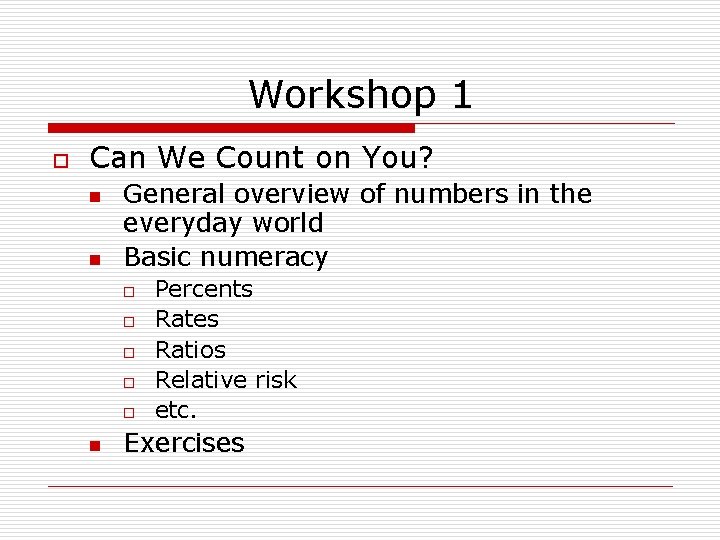
Workshop 1 o Can We Count on You? n n General overview of numbers in the everyday world Basic numeracy o o o n Percents Rates Ratios Relative risk etc. Exercises
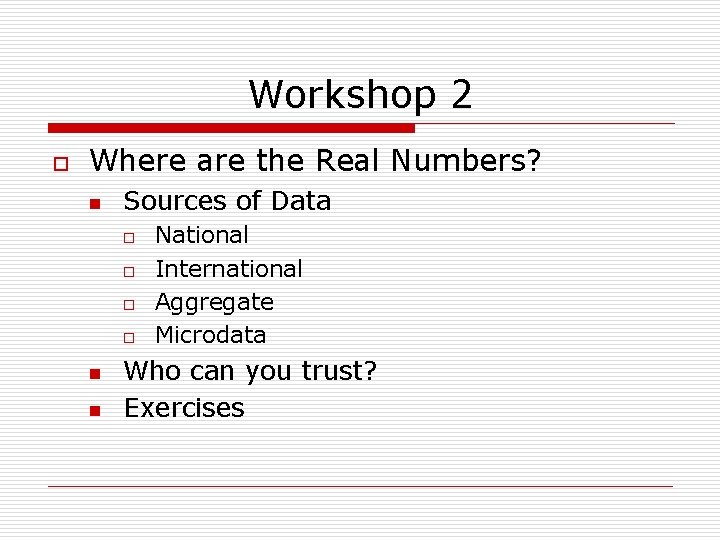
Workshop 2 o Where are the Real Numbers? n Sources of Data o o n n National International Aggregate Microdata Who can you trust? Exercises
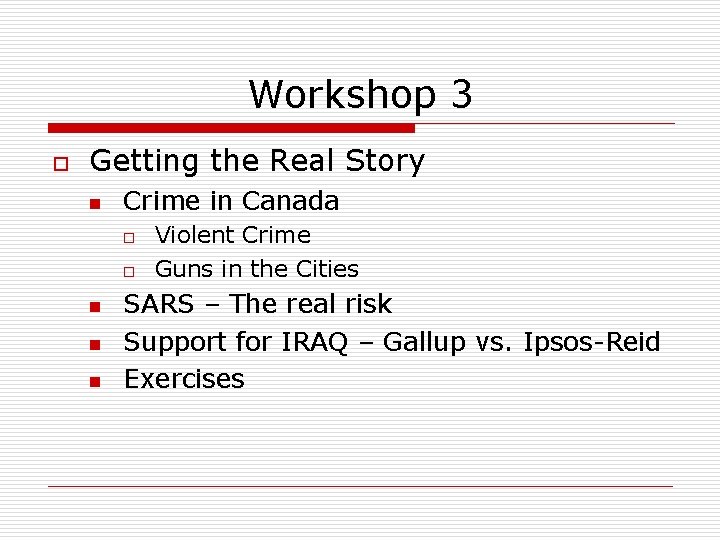
Workshop 3 o Getting the Real Story n Crime in Canada o o n n n Violent Crime Guns in the Cities SARS – The real risk Support for IRAQ – Gallup vs. Ipsos-Reid Exercises
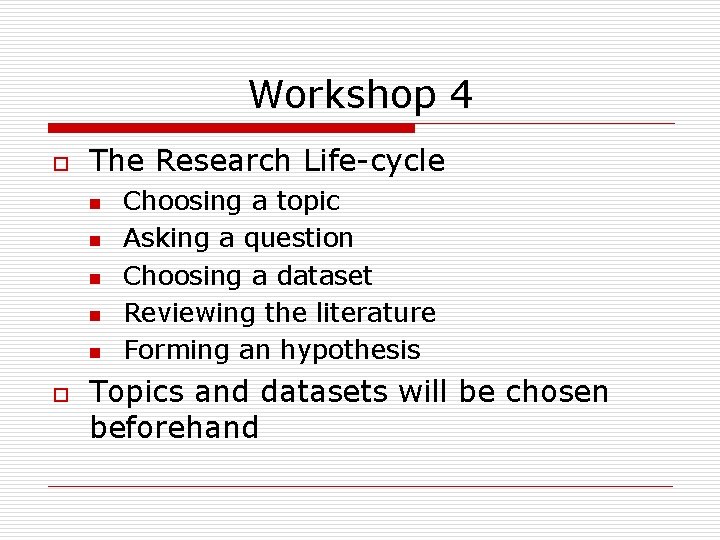
Workshop 4 o The Research Life-cycle n n n o Choosing a topic Asking a question Choosing a dataset Reviewing the literature Forming an hypothesis Topics and datasets will be chosen beforehand
Workshop 5 o Telling a New Story n n o Choosing variables Creating tables Creating graphs Writing it up Students will use Nesstar to do this
Getting Faculty Buy-in o Faculty are on-board n n o Asked for feedback n o o Workshops merely scratch the surface They are the only introduction to quantitative material at present Can we do more? Pilot project Attendance=1 grade point
Next Steps o Evaluate the workshops n n n o o Content Relevance Coverage If successful, expand 1 st-year seminar n n n Interdisciplinary Full-credit course Patterned after the University de Montréal’s success
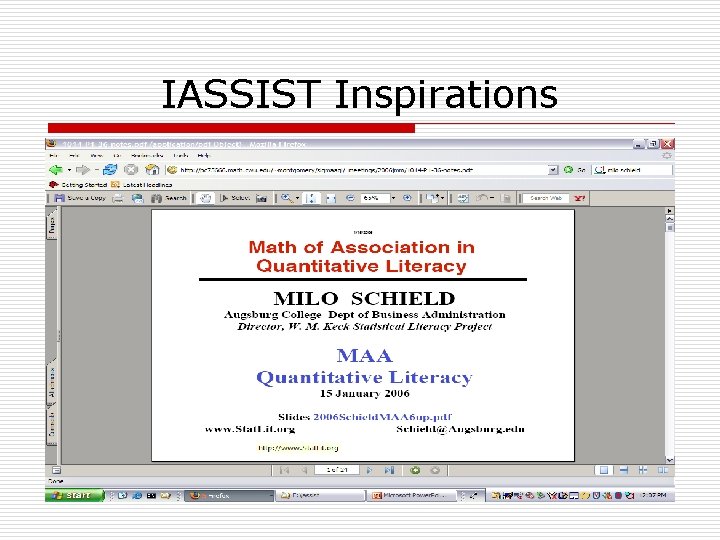
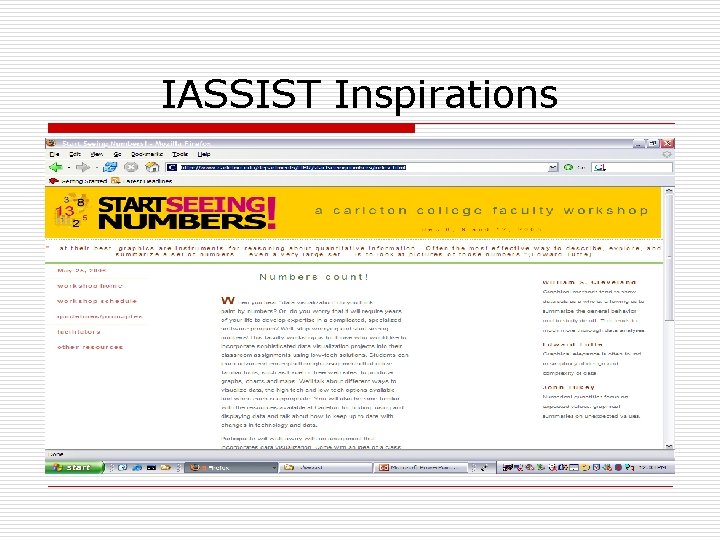
IASSIST Inspirations
IASSIST Inspirations
Questions?