
Developing a Competency Model for Highway Safety Engineers


- Slides: 42
Developing a Competency Model for Highway Safety Engineers: A Delphi Method Garrett Wheat, Ph. D.
Rationale Vehicles are the most used method of transportation Highway crashes remain too high Crashes are very expensive and should be avoided Fatalities from crashes are excessive Who designs the roads to mitigate crashes? Are the current measures meeting the needs? Will they change in 10 years?
Purpose of the Study The primary purpose of this study was to determine the core competencies needed by State DOT Highway Safety engineers as perceived by Highway Safety experts in the United States.
Objective 1 1. Identify a list of suggested competencies based on current literature, job descriptions, personal interviews, and matched training objectives that should be necessary for all Highway Safety engineers.
Objectives 2 and 3 Determine the importance of each identified competency for effective job performance of Highway Safety Engineers in the year 2020 as perceived by forward thinking Highway Safety Experts in the U. S. 3. Determine the competencies needed for effective job performance of Highway Safety Engineers in the year 2020 for which consensus of perception among Highway Safety experts can be achieved. 2.
Objectives 4 and 5 Determine the importance of each identified competency for effective job performance of Highway Safety Engineers in the year 2030 as perceived by forward thinking Highway Safety Experts in the U. S. 5. Determine the competencies needed for effective job performance of Highway Safety Engineers in the year 2030 for which consensus of perception among Highway Safety experts can be achieved. 4.
Methodology Target population Accessible population Road Safety Professionals in the US DOT Highway Safety Managers for every State’s DOT Sample Recommended Highway Safety Experts suggested by the Highway Safety Managers and those who chose to participate
Methodology Survey utilized Qualtrics Executed over 3 rounds via the Delphi Method Initially included 50 competencies in 5 competency areas found through: Researching current literature Comparing with job descriptions Personal interviews with the researcher Matched to STP training’s objectives
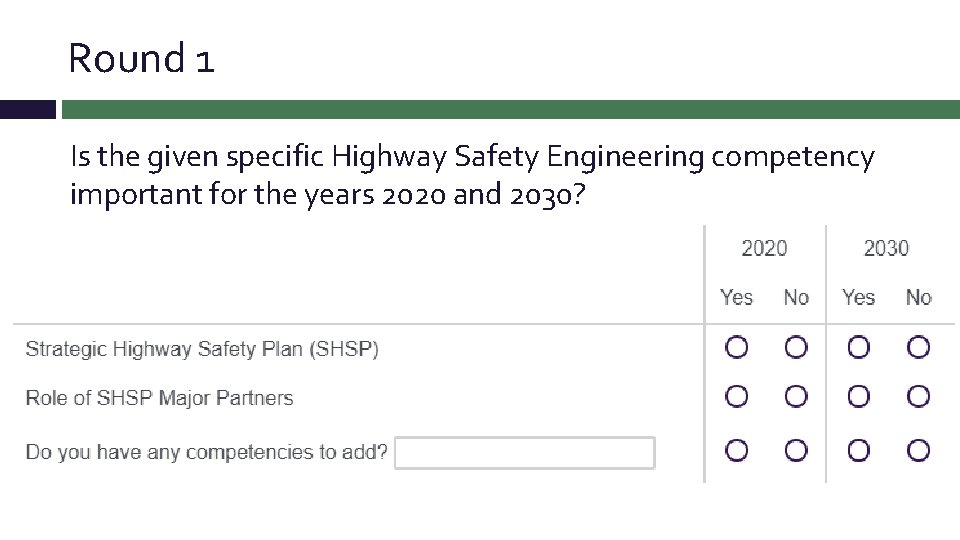
Round 1 Is the given specific Highway Safety Engineering competency important for the years 2020 and 2030?
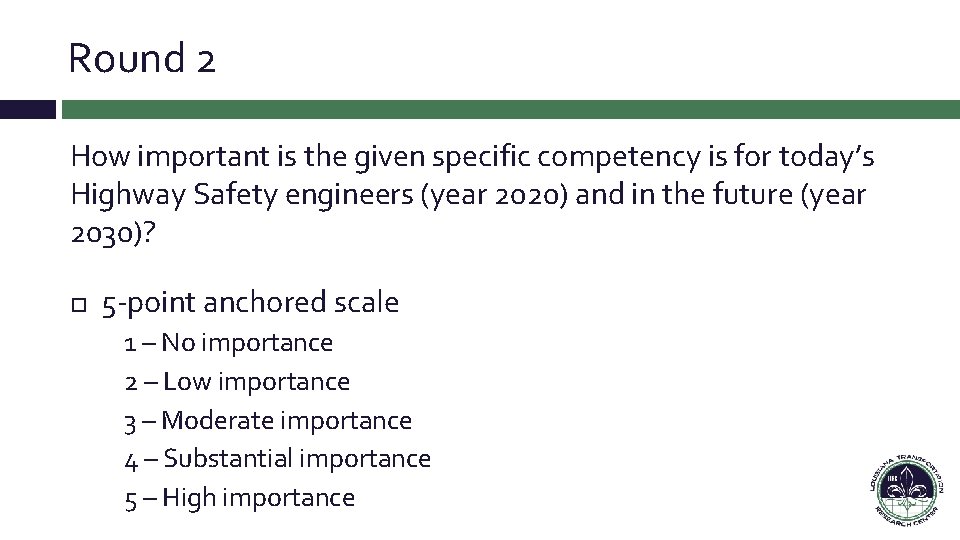
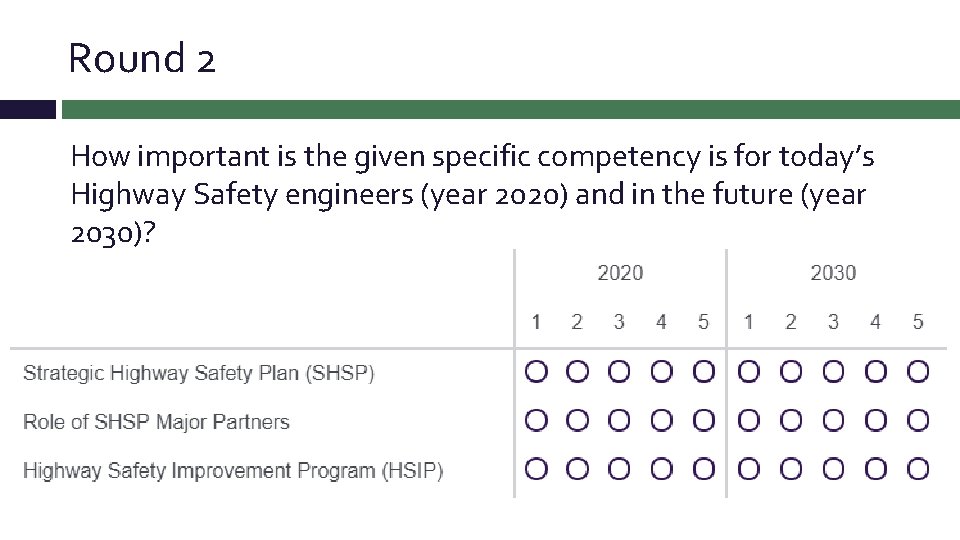
Round 2 How important is the given specific competency is for today’s Highway Safety engineers (year 2020) and in the future (year 2030)? 5 -point anchored scale 1 – No importance 2 – Low importance 3 – Moderate importance 4 – Substantial importance 5 – High importance
Round 2 How important is the given specific competency is for today’s Highway Safety engineers (year 2020) and in the future (year 2030)?
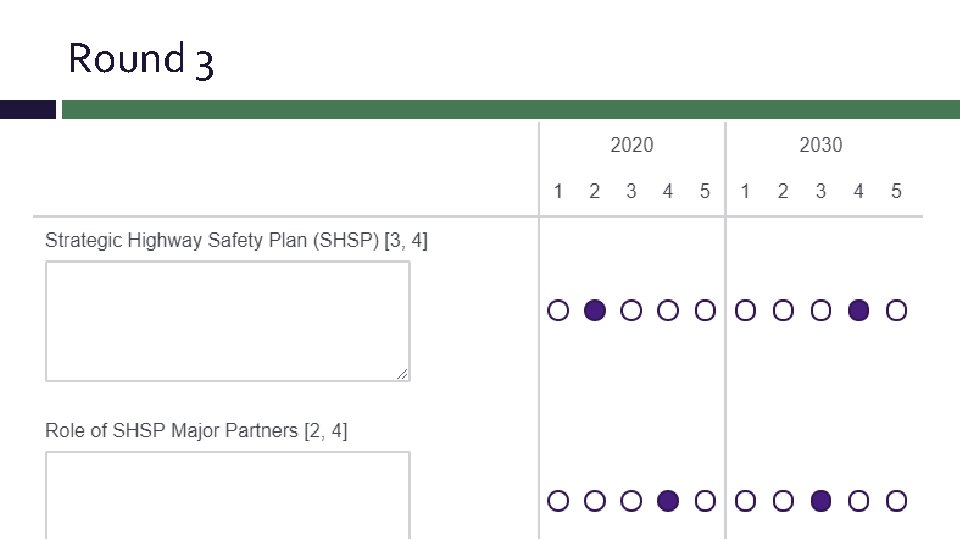
Round 3 Participants were shown the panel’s median score from Round 2 and: If their rating was within 1 point of the median and they wanted to keep it the same (or within one point), make the change accordingly or do nothing If their rating was outside of 1 point of the median, either: Change their rating to within 1 point of the group median OR Justify their answer
Round 3
Data Collection A list of items for the survey was composed The panel members were selected Round 1 survey was sent to the panel Data was collected via Qualtrics Data from Round 1 was used to add or remove items appropriately
Data Collection (continued) An updated Round 2 survey was sent to the panel Data was collected via Qualtrics Data was summarized for each item, including: Mean Median Standard deviation
Data Collection (continued) Data from Round 2 was used to update items An updated Round 3 survey was sent to the panel Data was collected via Qualtrics Data was summarized for each item, including: Mean Median Standard deviation Items were ranked by overall mean panel rating
Objective 1 Identify a list of suggested competencies based on current literature, job descriptions, personal interviews, and matched training objectives that should be necessary for all Highway Safety engineers.
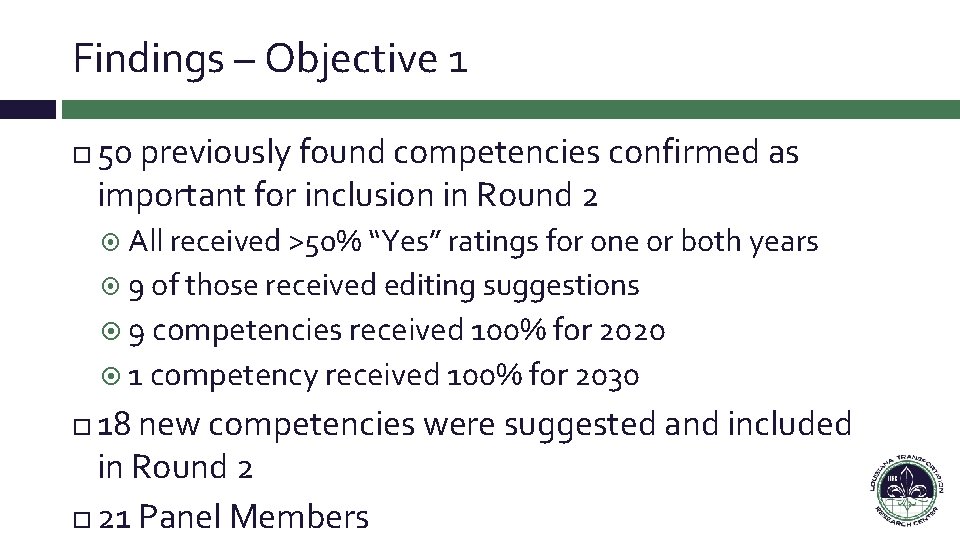
Findings – Objective 1 50 previously found competencies confirmed as important for inclusion in Round 2 All received >50% “Yes” ratings for one or both years 9 of those received editing suggestions 9 competencies received 100% for 2020 1 competency received 100% for 2030 18 new competencies were suggested and included in Round 2 21 Panel Members
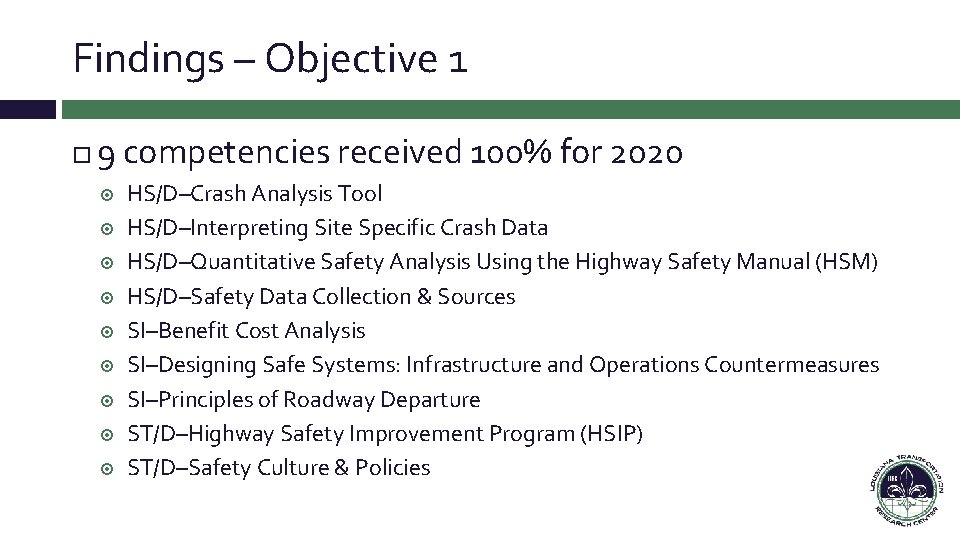
Findings – Objective 1 9 competencies received 100% for 2020 HS/D–Crash Analysis Tool HS/D–Interpreting Site Specific Crash Data HS/D–Quantitative Safety Analysis Using the Highway Safety Manual (HSM) HS/D–Safety Data Collection & Sources SI–Benefit Cost Analysis SI–Designing Safe Systems: Infrastructure and Operations Countermeasures SI–Principles of Roadway Departure ST/D–Highway Safety Improvement Program (HSIP) ST/D–Safety Culture & Policies
Findings – Objective 1 1 competency received 100% for 2030 SI–Designing Safe Systems: Behavioral Countermeasures
Objective 2 Determine the importance of each identified competency for effective job performance of Highway Safety Engineers in the year 2020 as perceived by forward thinking Highway Safety Experts in the U. S.
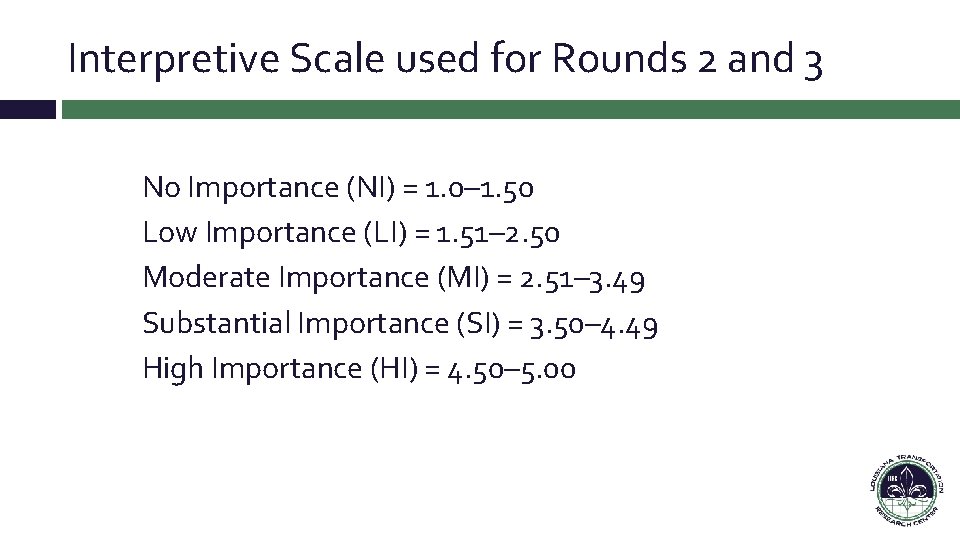
Interpretive Scale used for Rounds 2 and 3 No Importance (NI) = 1. 0– 1. 50 Low Importance (LI) = 1. 51– 2. 50 Moderate Importance (MI) = 2. 51– 3. 49 Substantial Importance (SI) = 3. 50– 4. 49 High Importance (HI) = 4. 50– 5. 00
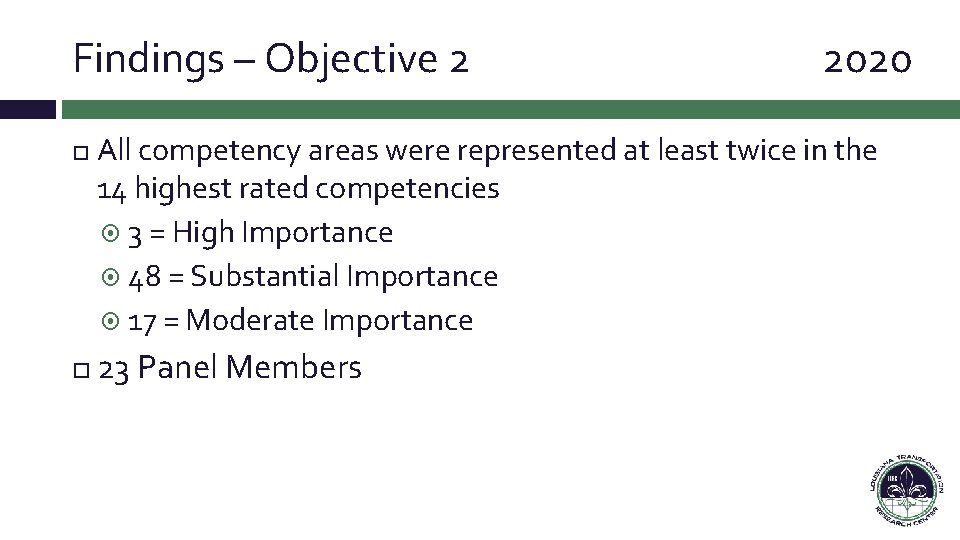
Findings – Objective 2 2020 All competency areas were represented at least twice in the 14 highest rated competencies 3 = High Importance 48 = Substantial Importance 17 = Moderate Importance 23 Panel Members
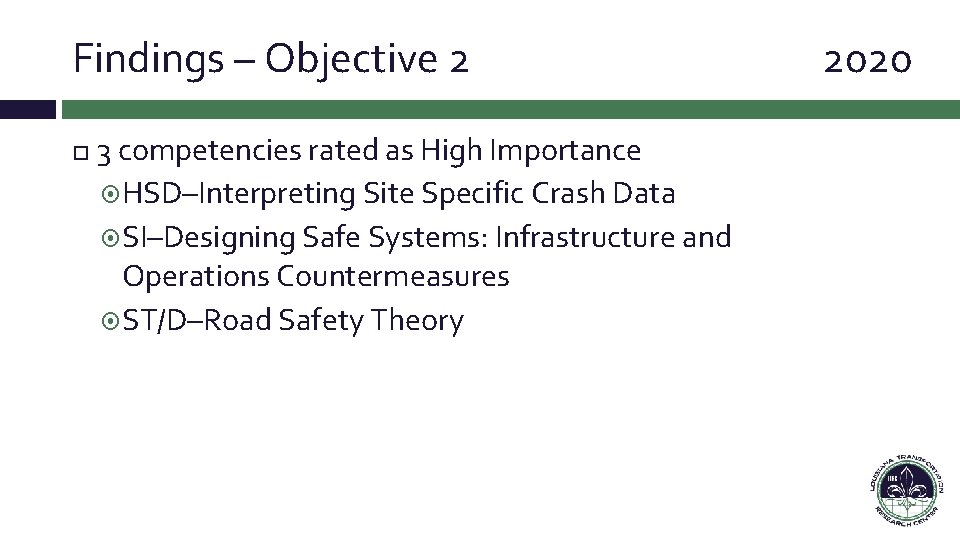
Findings – Objective 2 3 competencies rated as High Importance HSD–Interpreting Site Specific Crash Data SI–Designing Safe Systems: Infrastructure and Operations Countermeasures ST/D–Road Safety Theory 2020
Objective 3 Determine the competencies needed for effective job performance of Highway Safety Engineers in the year 2020 for which consensus of perception among Highway Safety experts can be achieved.
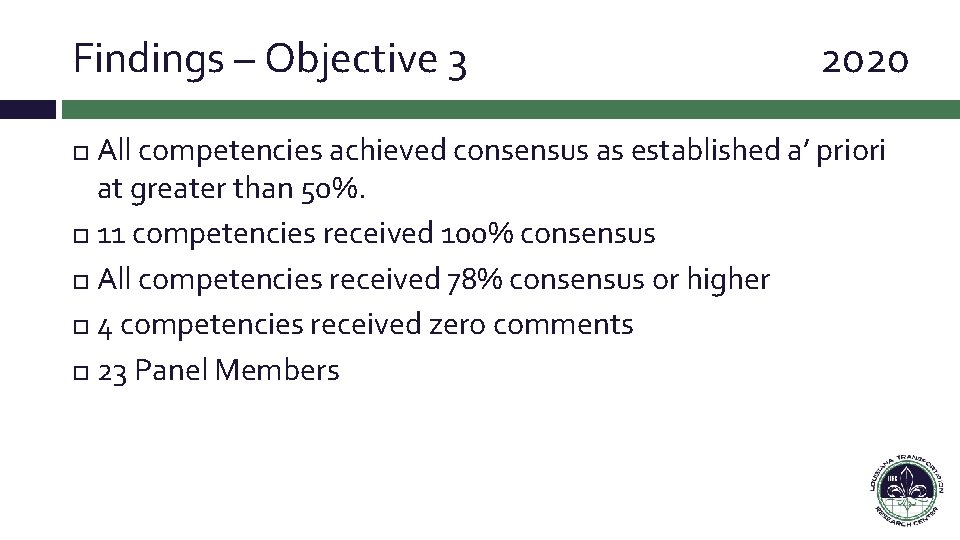
Findings – Objective 3 2020 All competencies achieved consensus as established a’ priori at greater than 50%. 11 competencies received 100% consensus All competencies received 78% consensus or higher 4 competencies received zero comments 23 Panel Members
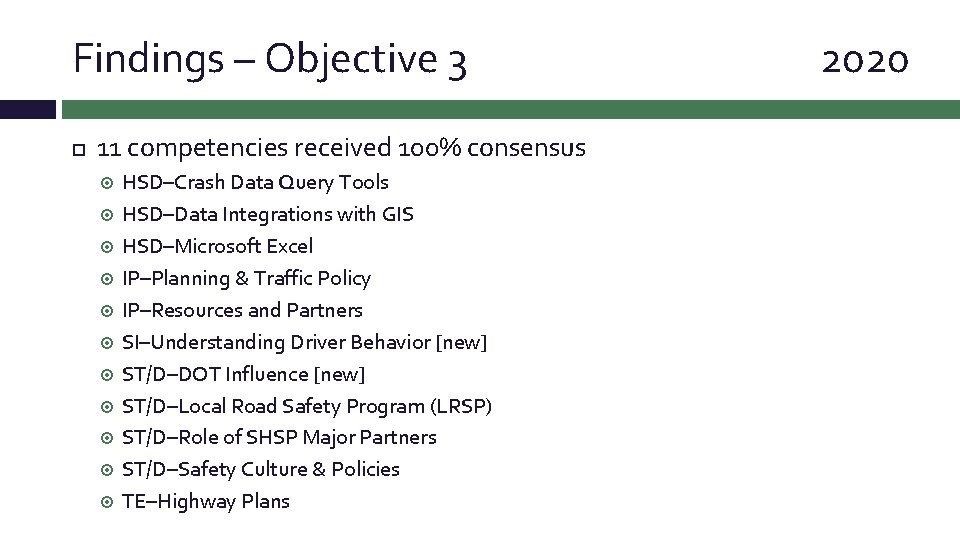
Findings – Objective 3 11 competencies received 100% consensus HSD–Crash Data Query Tools HSD–Data Integrations with GIS HSD–Microsoft Excel IP–Planning & Traffic Policy IP–Resources and Partners SI–Understanding Driver Behavior [new] ST/D–DOT Influence [new] ST/D–Local Road Safety Program (LRSP) ST/D–Role of SHSP Major Partners ST/D–Safety Culture & Policies TE–Highway Plans 2020
Objective 4 Determine the importance of each identified competency for effective job performance of Highway Safety Engineers in the year 2030 as perceived by forward thinking Highway Safety Experts in the U. S.
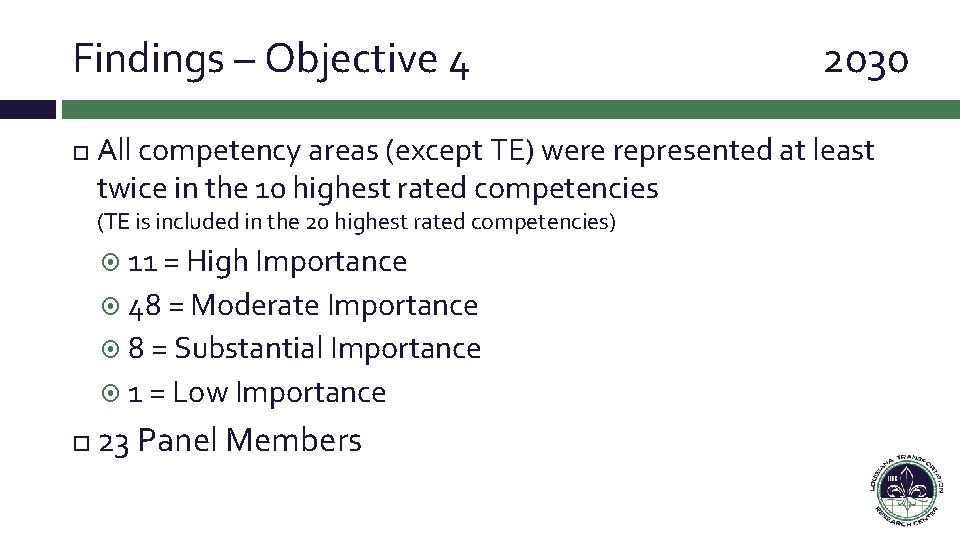
Findings – Objective 4 All competency areas (except TE) were represented at least twice in the 10 highest rated competencies (TE is included in the 20 highest rated competencies) 11 = High Importance 48 = Moderate Importance 8 = Substantial Importance 1 = Low Importance 2030 23 Panel Members
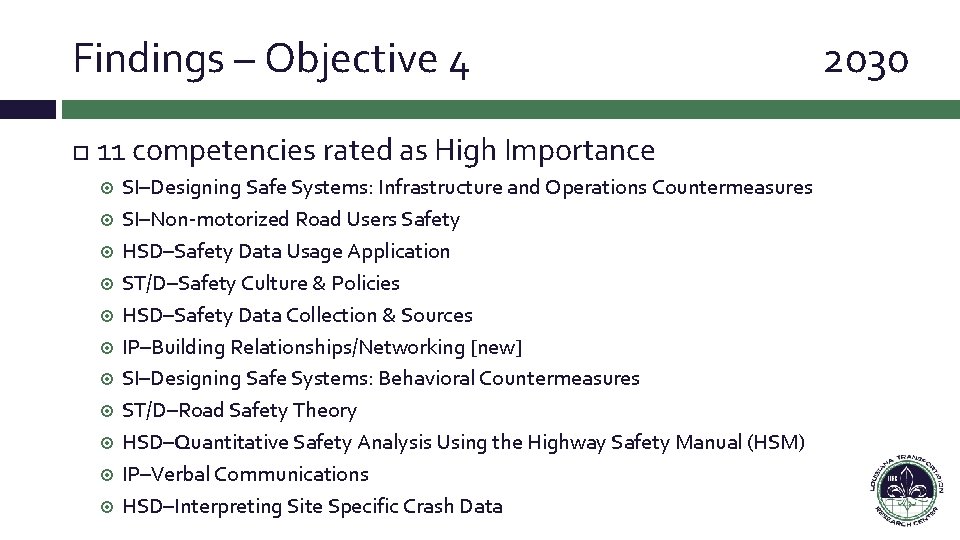
Findings – Objective 4 11 competencies rated as High Importance SI–Designing Safe Systems: Infrastructure and Operations Countermeasures SI–Non-motorized Road Users Safety HSD–Safety Data Usage Application ST/D–Safety Culture & Policies HSD–Safety Data Collection & Sources IP–Building Relationships/Networking [new] SI–Designing Safe Systems: Behavioral Countermeasures ST/D–Road Safety Theory HSD–Quantitative Safety Analysis Using the Highway Safety Manual (HSM) IP–Verbal Communications HSD–Interpreting Site Specific Crash Data 2030
Findings – Objective 4 1 competency rated as Low Importance HSD–Microsoft Access 2030
Objective 5 Determine the competencies needed for effective job performance of Highway Safety Engineers in the year 2030 for which consensus of perception among Highway Safety experts can be achieved.
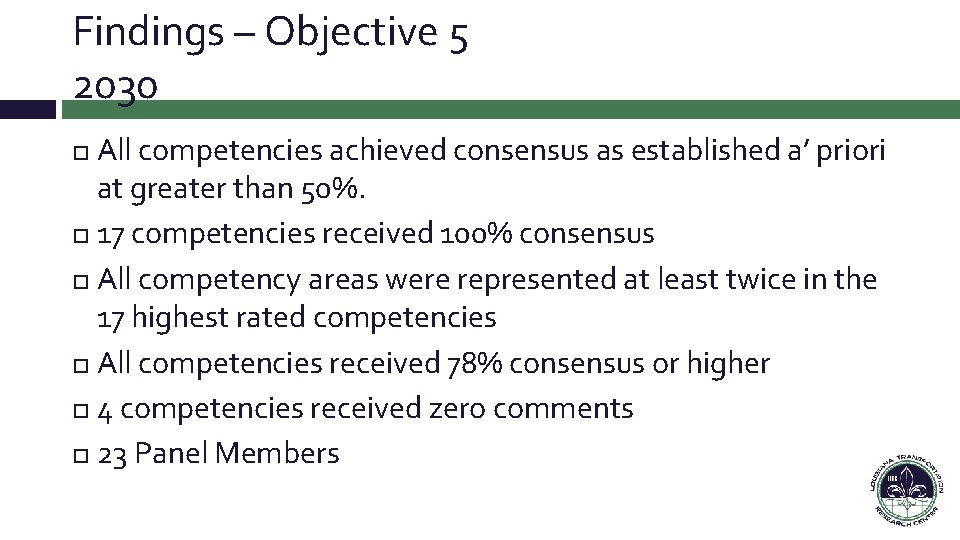
Findings – Objective 5 2030 All competencies achieved consensus as established a’ priori at greater than 50%. 17 competencies received 100% consensus All competency areas were represented at least twice in the 17 highest rated competencies All competencies received 78% consensus or higher 4 competencies received zero comments 23 Panel Members
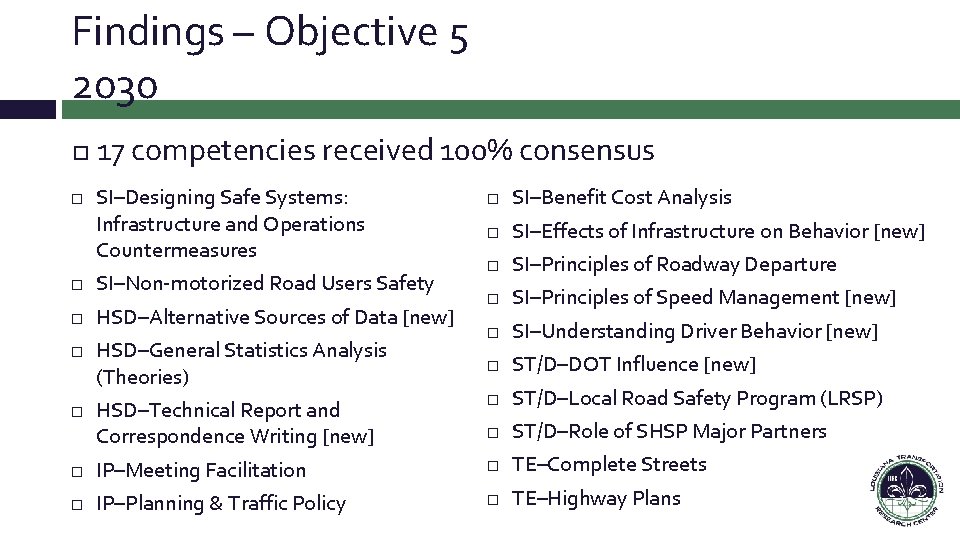
Findings – Objective 5 2030 17 competencies received 100% consensus SI–Benefit Cost Analysis SI–Effects of Infrastructure on Behavior [new] SI–Principles of Roadway Departure SI–Principles of Speed Management [new] SI–Understanding Driver Behavior [new] ST/D–DOT Influence [new] HSD–Technical Report and Correspondence Writing [new] ST/D–Local Road Safety Program (LRSP) ST/D–Role of SHSP Major Partners IP–Meeting Facilitation TE–Complete Streets IP–Planning & Traffic Policy TE–Highway Plans SI–Designing Safe Systems: Infrastructure and Operations Countermeasures SI–Non-motorized Road Users Safety HSD–Alternative Sources of Data [new] HSD–General Statistics Analysis (Theories)
Conclusions and Recommendations A set of core competencies were identified in this study that are essential to the role of a Highway Safety engineer currently and for the future. These competencies are consistent with: a review of current literature interviews conducted by the researcher reviews of job descriptions and duties reviews of professional, state, and national organizational trainings
Conclusions and Recommendations A majority of competencies received a mean rating of 3. 50 or higher: 2020 = 51/68 2030 = 59/68 All competencies received a minimum of 78% consensus
Conclusions and Recommendations Competencies rated high importance and consensus should be included as the employment of practice. State and national highway safety programs should identify or design training programs to fill gaps. FHWA should update the SHSP requiring states to mandate identified training.
Conclusions and Recommendations The panel was shown to be effective and forward-thinking for accomplishing the purpose of the study. The Delphi method allowed these experts to rate, rank, and gain consensus of competencies currently found in the literature and new ones identified by the panel. The Delphi method’s power lies in its ability to provide “the most reliable consensus of opinion of a group of experts” (1996, p. 186).
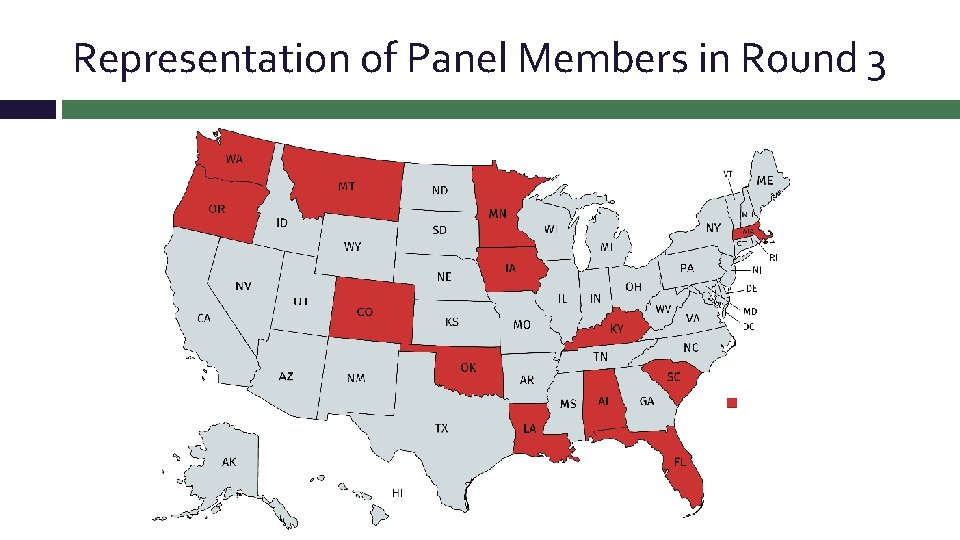
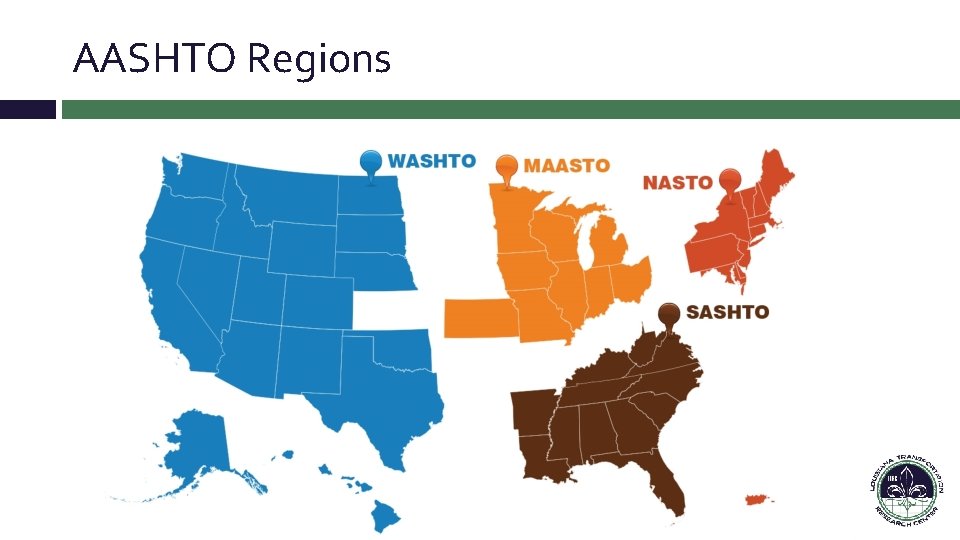
Conclusions and Recommendations Current listed competencies were identified as important. Edits and newly defined competencies were suggested. Repeated items show similar views. Unique items provide forward-thinking ability. Panel was consistent in their ratings. Ratings and rankings changed from the year 2020 to 2030. All items reached consensus. All AASHTO regions were represented.
Representation of Panel Members in Round 3
AASHTO Regions
Thank you! A full copy of the dissertation can be downloaded via: https: //digitalcommons. lsu. edu/gradschool_dissertations/5379/ Garrett Wheat, Ph. D. Garrett. Wheat@la. gov