
Developing a Community Health Worker Training Model for
- Slides: 29
Developing a Community Health Worker Training Model for Latinos in Rural Texas Katharine Nimmons & Angie Alaniz Texas A&M School of Public Health Center for Community Health Development National CHW Training Center
Objectives • Describe the process of developing a community health worker curriculum • Discuss challenges in rural volunteer recruitment and training
Session Overview Who are CHWs? CHWs in Texas – history, numbers, certification Who are we? CCHD & NCHWTC capacity Madisonville, TX - demographics & background Healthcare challenges in rural, underserved populations • CHWs as a potential solution in Madisonville • Development of CHW 101 curriculum • Future directions • • •
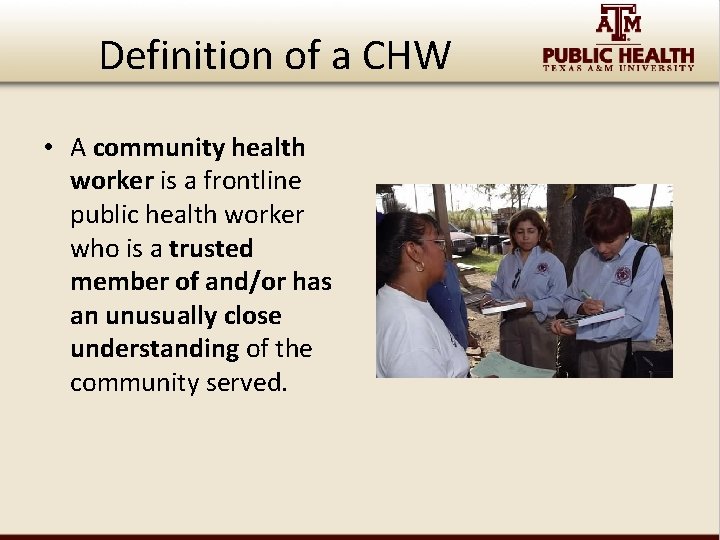
Definition of a CHW • A community health worker is a frontline public health worker who is a trusted member of and/or has an unusually close understanding of the community served.
Definition of a CHW • The trusting relationship between the CHW and the community health worker enables the CHW to serve as a liaison/link/intermediary between health/social services and the community to facilitate access to services and improve the quality and cultural competence of service delivery. • A community health worker also builds individual and community capacity by increasing health knowledge and selfsufficiency through a range of activities such as outreach, community education, informal counseling, social support and advocacy.
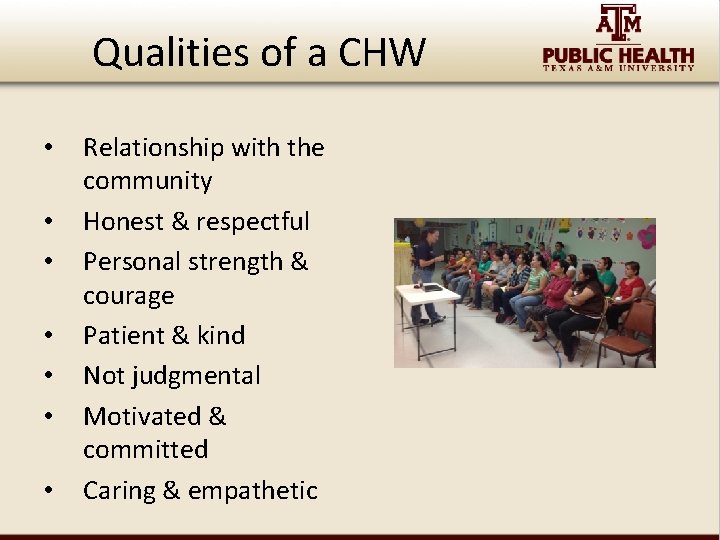
Qualities of a CHW • • Relationship with the community Honest & respectful Personal strength & courage Patient & kind Not judgmental Motivated & committed Caring & empathetic
CHW Roles • Interpretation & translation services • Culturally appropriate health education & information • Assess clients’ needs • Assist clients in accessing needed healthcare • Eligibility screenings • Informal counseling & guidance on health behaviors • Arrangement of transportation • Advocate for individual & community health needs • Provide some direct services (first aid, blood pressure checks) • Refer clients to health & social services • Conduct public health research • Provide of emotional support • Maintain client records
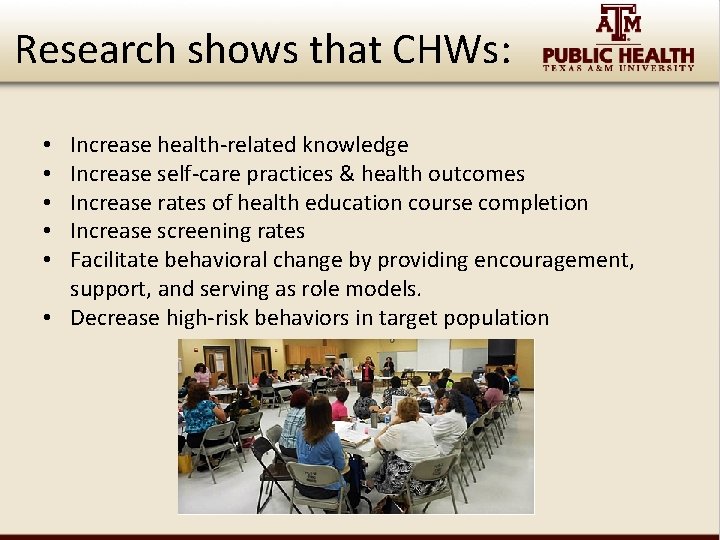
Research shows that CHWs: Increase health-related knowledge Increase self-care practices & health outcomes Increase rates of health education course completion Increase screening rates Facilitate behavioral change by providing encouragement, support, and serving as role models. • Decrease high-risk behaviors in target population • • •
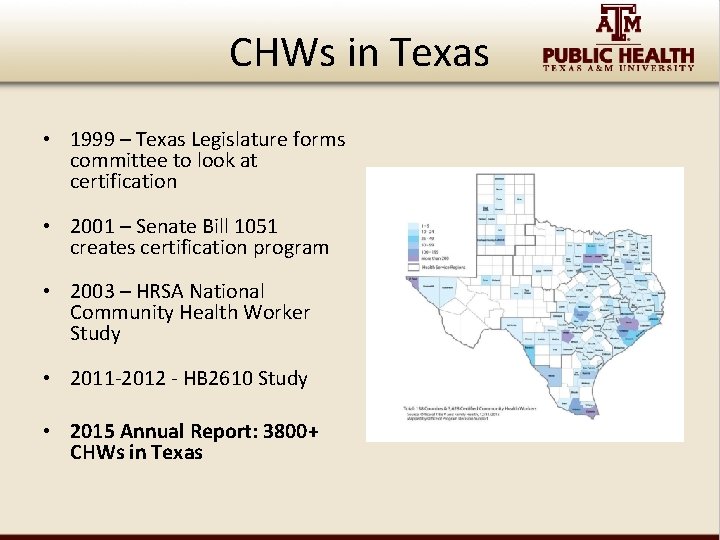
CHWs in Texas • 1999 – Texas Legislature forms committee to look at certification • 2001 – Senate Bill 1051 creates certification program • 2003 – HRSA National Community Health Worker Study • 2011 -2012 - HB 2610 Study • 2015 Annual Report: 3800+ CHWs in Texas
DSHS CHW/Promotora Program • Promotor(a)/Community Health Worker Training and Certification Program • Office of Title V and Family Health • Provides leadership to enhance the development and implementation of statewide training, certification standards, & administrative rules http: //www. dshs. state. tx. us/mch/chw. shtm 512 -776 -2208 or 512 -776 -3860, chw@dshs. state. tx. us
Certification Requirements • • • 18 years of age Reside in the state of Texas Complete the 160 training requirement (must be taught by a certified Instructor who is working with a certified training institute with curriculum approved by the State) OR Submit based on past experience (based on number of hours working in a CHW capacity within a specified time frame, must be verifiable)
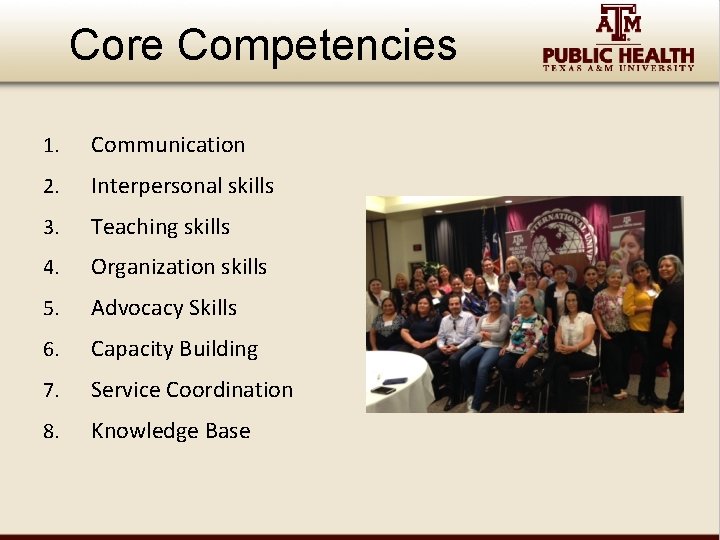
Core Competencies 1. Communication 2. Interpersonal skills 3. Teaching skills 4. Organization skills 5. Advocacy Skills 6. Capacity Building 7. Service Coordination 8. Knowledge Base
Center for Community Health Development • Center for Community Health Development v Research center established in 2001 under the Texas A&M School of Public Health • Working with Communities to Improve Health v CCHD partners with communities to identify health care priorities, develop and pilot strategies to address their priorities, and evaluate the effectiveness of these strategies when implemented. • Building SPH capacity to conduct prevention research v Provide infrastructure to expand the School of Public Health’s capacity to conduct prevention research in conjunction with key community stakeholders including health care providers, non-profit organizations, governmental entities, and community advocates.
Center for Community Health Development • Over $42 million in research funding v Centers for Disease Control and Prevention, American Heart Association, Health Resources and Services Administration, Office of Adolescent Health, Texas Department of State Health Services, Texas Health and Human Services Commission, Hospital and health care providers, nonprofit agencies • The National Community Health Worker Training Center and the Texas A&M Telehealth Counseling Clinic operate under CCHD • Projects areas include community-based participatory research, population health assessments, and program evaluation.
National CHW Training Center • CHW & Instructor Certification – English/Spanish – In-person/Online • CHW & Instructor CEUs (40+) – English/Spanish – In-person/Online • Since 2001, the Center has provided over 89, 000 hours of training to more than 2, 770 CHWs, including 40, 000+ DSHS -certified training hours to 2, 300+ CHWs.
National CHW Training Center • CHW Training – Instructors in Dallas, College Station, Corpus Christi, Mc. Allen, and Brownsville • CHW Curriculum Development • Research • Technical Assistance
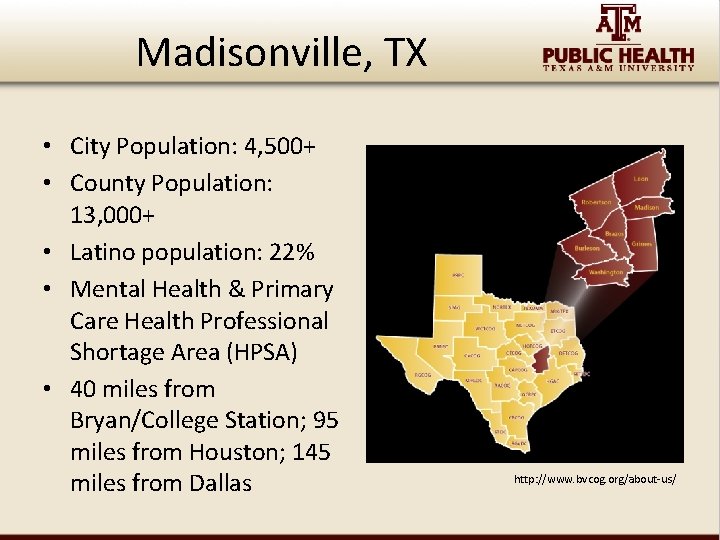
Madisonville, TX • City Population: 4, 500+ • County Population: 13, 000+ • Latino population: 22% • Mental Health & Primary Care Health Professional Shortage Area (HPSA) • 40 miles from Bryan/College Station; 95 miles from Houston; 145 miles from Dallas http: //www. bvcog. org/about-us/
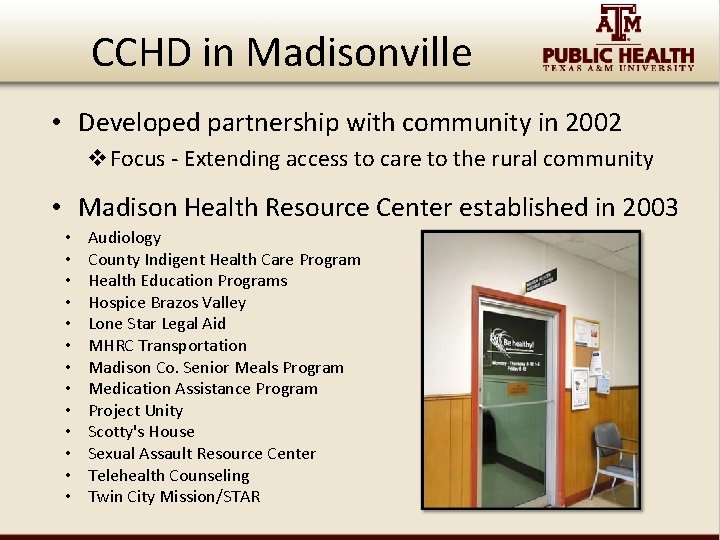
CCHD in Madisonville • Developed partnership with community in 2002 v. Focus - Extending access to care to the rural community • Madison Health Resource Center established in 2003 • • • • Audiology County Indigent Health Care Program Health Education Programs Hospice Brazos Valley Lone Star Legal Aid MHRC Transportation Madison Co. Senior Meals Program Medication Assistance Program Project Unity Scotty's House Sexual Assault Resource Center Telehealth Counseling Twin City Mission/STAR
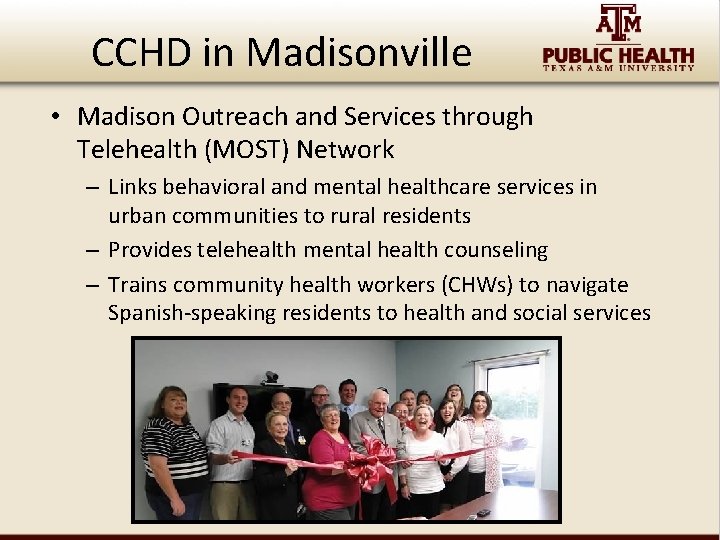
CCHD in Madisonville • Madison Outreach and Services through Telehealth (MOST) Network – Links behavioral and mental healthcare services in urban communities to rural residents – Provides telehealth mental health counseling – Trains community health workers (CHWs) to navigate Spanish-speaking residents to health and social services
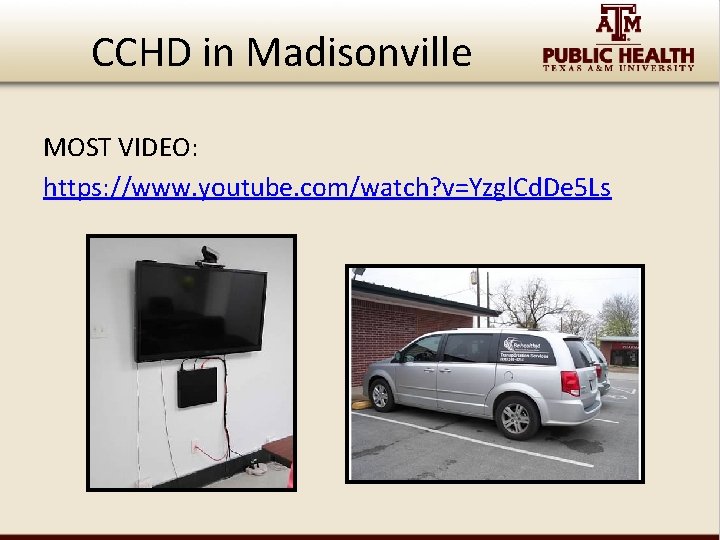
CCHD in Madisonville MOST VIDEO: https: //www. youtube. com/watch? v=Yzgl. Cd. De 5 Ls
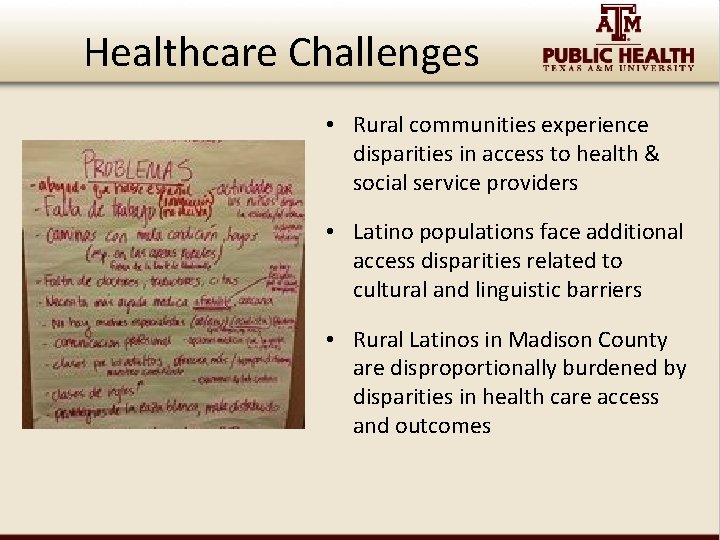
Healthcare Challenges • Rural communities experience disparities in access to health & social service providers • Latino populations face additional access disparities related to cultural and linguistic barriers • Rural Latinos in Madison County are disproportionally burdened by disparities in health care access and outcomes
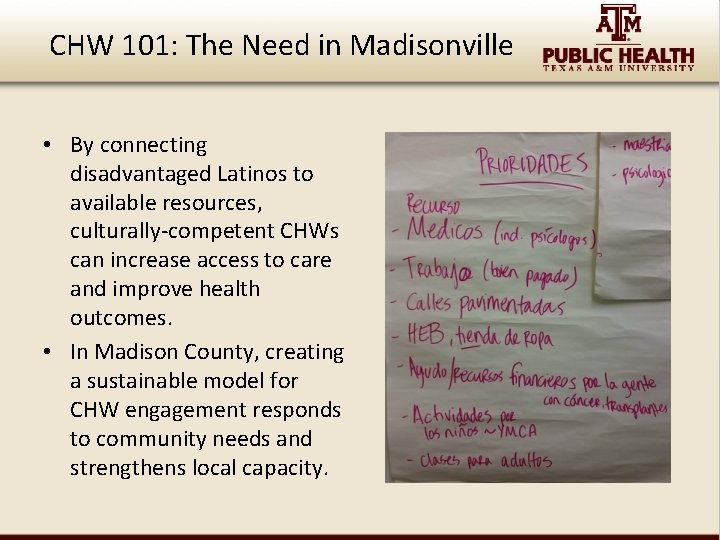
CHW 101: The Need in Madisonville • By connecting disadvantaged Latinos to available resources, culturally-competent CHWs can increase access to care and improve health outcomes. • In Madison County, creating a sustainable model for CHW engagement responds to community needs and strengthens local capacity.
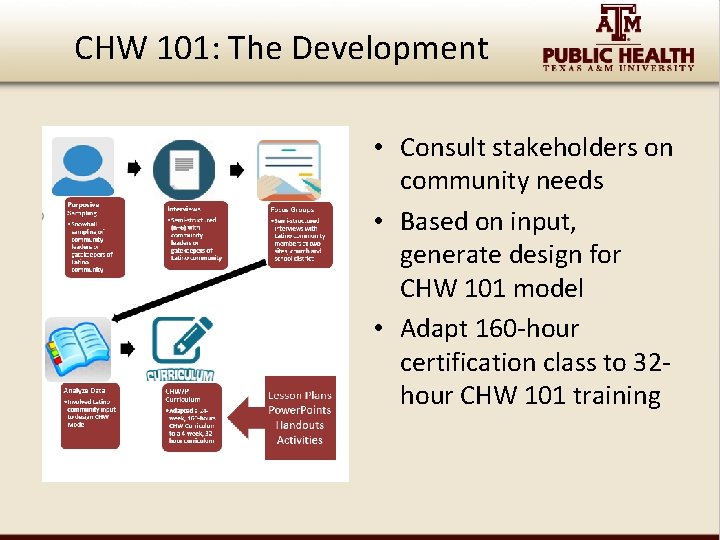
CHW 101: The Development • Consult stakeholders on community needs • Based on input, generate design for CHW 101 model • Adapt 160 -hour certification class to 32 hour CHW 101 training
CHW 101: The Curriculum • 8 classes – Each class includes 4 hours of presentations & hands-on activities • 8 core competencies, one per class: – – – – Communication Interpersonal skills Teaching skills Organization skills Advocacy Skills Capacity Building Service Coordination Knowledge Base • Available in English or Spanish
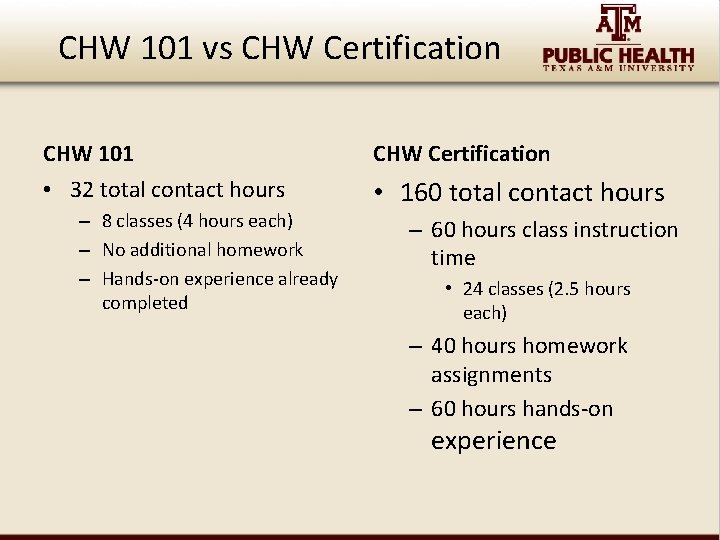
CHW 101 vs CHW Certification CHW 101 CHW Certification • 32 total contact hours • 160 total contact hours – 8 classes (4 hours each) – No additional homework – Hands-on experience already completed – 60 hours class instruction time • 24 classes (2. 5 hours each) – 40 hours homework assignments – 60 hours hands-on experience
Future Directions 1) 2) 3) In partnership with assessment stakeholders, recruit volunteers for the CHW program. Deliver training in adapted CHW curriculum to volunteers. Identify partner organizations to coordinate local management of the program.
Funding was made possible (in part) by the U. S. Department of Health and Human Services Health Resources and Services Administration (HRSA) Office of Rural Health Policy Rural Health Care Services Outreach Grant Program, award number D 04 RH 23593 -01 -02.
Acknowledgements • • • Madison County Madison Health Resource Center Madison Health Resource Commission CHI St. Joseph Madison Health Center St. Elizabeth Ann Seton Catholic Church Madisonville Consolidated Independent School District
Questions?