
Developing a Coaching Culture within Your Team By
Developing a Coaching Culture within Your Team By Creating a Thinking Environment® Facilitated by Rachel Martin Certified Facilitator for Time to Think, Nancy Kline
• How do you inspire your team by coaching and empowering others? Questions for today • How can you encourage individuals within your team to think for themselves and create an environment of trust, commitment and engagement? • How can an understanding of a Thinking Environment® enhance your leadership practice?

Introductions
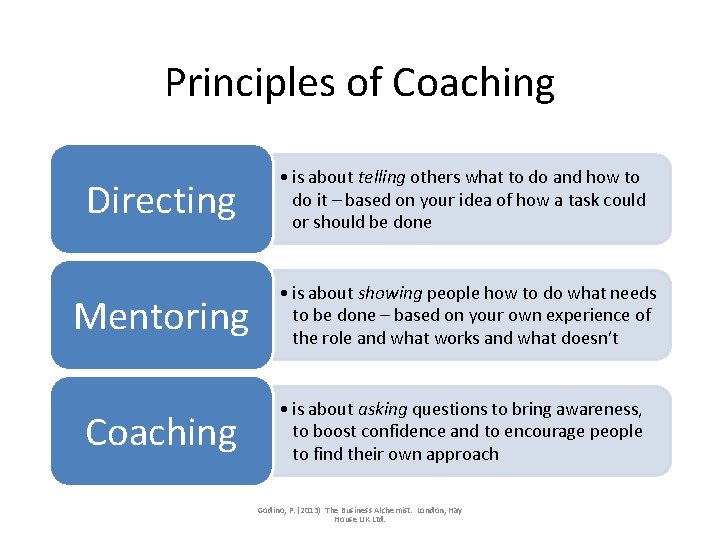
Principles of Coaching Directing • is about telling others what to do and how to do it – based on your idea of how a task could or should be done Mentoring • is about showing people how to do what needs to be done – based on your own experience of the role and what works and what doesn’t Coaching • is about asking questions to bring awareness, to boost confidence and to encourage people to find their own approach Godino, P. (2013) The Business Alchemist. London, Hay House UK Ltd.

• The coachee is resourceful. Principles of Coaching • The coach’s role is to develop the coachee’s resourcefulness through skilful questioning, challenge and support. • Coaching addresses the whole person – past, present and future. • The coachee sets the agenda. • The coach and the coachee are equals. • Coaching is about change and action. Rogers (2008 p. 8)
What does a Coaching Culture look like? • • High levels of trust Listening Mutual respect Ideas encouraged Feedback Questions Reflective environment
Lead with Questions not Answers “Questions open the door to dialogue and discovery. They are an invitation to creativity and breakthrough thinking” Vogt et al. (2003) How do you encourage independent thinking? How do you encourage people to think critically? How do you encourage people to question the status quo?
Personal Story Thinking Environment®

The Thinking Environment® Nancy Kline Everything we do depends for its quality on the thinking we do first. Our thinking depends on the quality of our attention for each other
The Thinking Environment® A set of ten conditions under which human beings can think for themselves – with rigour, imagination, courage and grace Thinking Environment® is not a set of techniques. It is a way of being in the world.
Ten Components of a Thinking Environment® Attention Equality Ease Appreciation Encouragement Feelings Information Diversity Place Incisive Questions™
Applications of a Thinking Environment® • • Thinking Pairs™ Rounds Dialogue Open discussion • Time To Think Council™
• The quality of your attention determines the quality of the other person’s thinking ATTENTION – Listening with respect, interest and fascination – Avoid interruption – Maintain eye contact – Accept silence as valuable thinking time
Thinking Pairs™ • Identify something you would like to think about • Take 3 minutes each way • The Thinking Partner listens and does not interrupt Opening question: “What would you like to think about and what are your thoughts? ” Follow up question (if necessary): “What more do you think, or feel or want to say? ”
• EQUALITY Even in a hierarchy, people can be equals as thinkers – Everyone gets a turn to think out loud and a turn to listen – No one can abdicate responsibility for thinking – Honouring boundaries
A divisional manager set up a forum for ideas: Case Study: • Bi-monthly meeting with all levels of her staff (Max. of 12) • Poses two questions: 1. “What have you noticed that needs attention or change in this company that I might not have noticed? ” 2. "What do you think should be done about it? ” • She sits down and listens without interruption • She promises to think about each idea – she doesn’t promise to implement every idea, but promises to feedback
• Offering freedom from internal rush or urgency – Knowing that you won’t be interrupted – When it comes to helping people think for themselves, sometimes doing means not doing – Ease creates. Urgency destroys Ease • How do you create ease in a busy environment?
Rounds – Decide on the question – Determine the direction of the round – Ask for a volunteer to begin – No interruptions until the Round completed Question: “What do you value most in your organisation? ”
• Appreciation A five-to-one ratio of appreciation to criticism helps people think for themselves – Acknowledging a person’s qualities – Needs to be succinct, sincere and specific
Encouragement • Building courage to go to the unexplored edge of ideas by eliminating competition between thinkers • To be “better than” is not necessarily to be good – Competition stifles encouragement and limits thinking
Closing Round • What 2 key learnings will you take away from the session?
References • Godino, P. (2013) The Business Alchemist. London, Hay House UK Ltd. • Kline, N. (1999) Time to Think: Listening to ignite the Human Mind. London: Octopus Publishing Group. • Kline, N. (2009) More Time to Think. London: Fisher King Publishing. • Mullins, L. (2013) Management and Organisational Behaviour. 10 th Ed. Harlow, Pearson Education. • Rogers, J. (2008) Coaching Skills. 2 nd Ed. London, Open University Press. • Vogt, E. , Brown, J. and Isaacs, D. (2003) The Art of Powerful Questions • Whitmore, J. (2009) Coaching for Performance. 4 th Ed. London, Nicholas Brealey Publishing.
- Slides: 22