
Developed by Kathy Wonderly RN BSPA CPHQ Performance

Developed by: Kathy Wonderly RN, BSPA, CPHQ Performance Improvement Coordinator Developed: October 2009 Most recent update: November 2013
For the first time, there are significant differences in the requirements for Centers for Medicare and Medicaid Services (CMS) and The Joint Commission (TJC) AMI measure set requirements. CMS only has two indicator in their measure set while TJC requires seven measures. Please follow your hospital plan of care for the AMI patient.
To know the value of administering aspirin at arrival for patients with an AMI. To be able to identify the recommended timeframe for fibrinolytic therapy and primary PCI for qualifying AMI patients. Note: changes for January 1, 2014 through September 30, 2014 are in italics.
For TJC hospitals there are 7 required indicators in the AMI measure set. For hospitals only submitting data to CMS, the last two measure sets apply however the last measure applies to those facilities that can provide primary coronary intervention (primary angioplasty) on site for the AMI patient. Patients discharge to Hospice whether with home care or to another facility for hospice care excluded from the requirements for this measure set.
We will cover the measures that are reported to both agencies in the beginning of this presentation then move to the Joint Commission only measures.
The national guidelines recommend that fibrionolytic therapy be given within 30 minutes of hospital arrival for patients with ST-elevation or Left Bundle Branch Block myocardial infraction. Research shows that nearly 2 lives per 1000 patients are lost per hour of delay (Fibrinolytic Therapy, 1994). Remember the time of arrival is the very first time documented on the medical record it could be the triage time, first note, vitals document time or registration time.
Patients who did not receive fibrinolytic therapy within 30 minutes and have a documented Reason for Delay of Fibrinolytic Therapy will be excluded from this measure.
CMS understands this may not be possible in the case of a transfer from another facility so those patients are excluded from this indicator. That said, it is still very important to start fibrinolytic therapy as soon as possible after the transferred patient arrives.
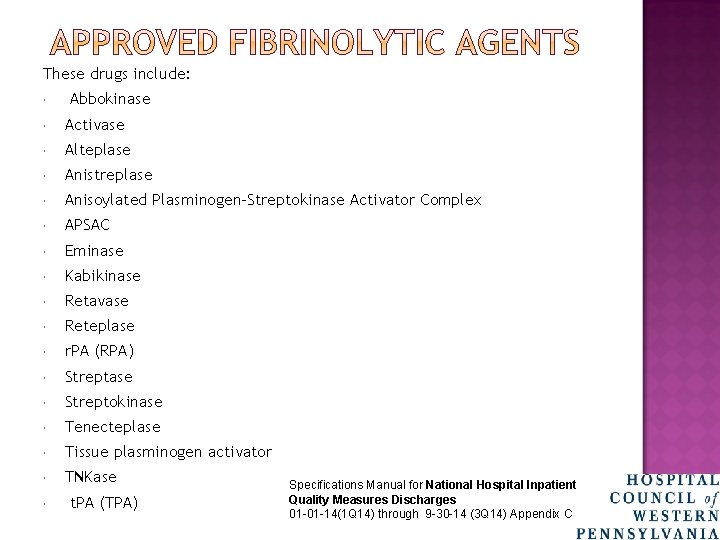
These drugs include: Abbokinase Activase Alteplase Anistreplase Anisoylated Plasminogen-Streptokinase Activator Complex APSAC Eminase Kabikinase Retavase Reteplase r. PA (RPA) Streptase Streptokinase Tenecteplase Tissue plasminogen activator TNKase t. PA (TPA) Specifications Manual for National Hospital Inpatient Quality Measures Discharges 01 -01 -14(1 Q 14) through 9 -30 -14 (3 Q 14) Appendix C
To meet this recommendation, the ED staff and ancillary services must work together and make the AMI patient a top priority. The nurse and practitioner must assess the patient, the EKG must be done, the necessary lab tests drawn and IV lines established before the fibrinolytic therapy is started. There is usually a consultation with a cardiologist either live, via phone or using telemedicine. Respiratory therapy may also play a role in this patients care.

Understandably, this measure is a challenge for all hospitals to meet. The nurse assigned to the AMI patient must coordinate the care to assure that anyone with a ST segment elevation or LBBB on the EKG gets the ordered therapy within the 30 minute window.
If a patient does not receive the fibrinolytic therapy within 30 minutes because of one of the following reason; social or religious issues, initial concern or refusal by the patient or family, cardiopulmonary arrest, balloon pump insertion or respiratory failure requiring intubation and the physician, PA or CRNP documents the reasons the indicator is met.
The next indicator for the AMI core measure set focuses on the time from hospital arrival to primary PCI for patients who present with ST-segment elevation or LBBB.
The early use of primary angioplasty for patients with ST-segment MI (STEMI) has resulted in a significant reduction in mortality and morbidity. CMS has determined the prompt initiation of PCI for the qualifying AMI patients is 90 minutes or less.
Patients who did not receive PCI within 90 minutes and have a documented Reason for Delay of PCI will be excluded from this measure.
CMS understands this may not be possible in the case of a transfer from another facility so those patients are excluded from this indicator. It is still very important to do the primary angioplasty as soon as possible after the transferred patient arrives.
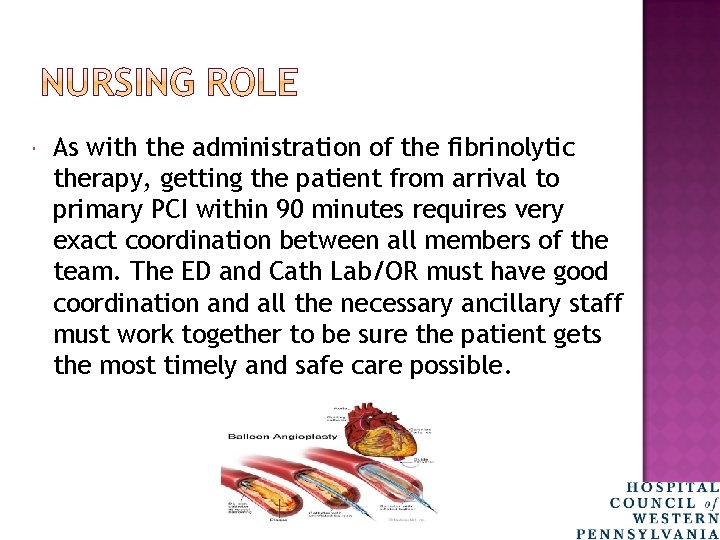
As with the administration of the fibrinolytic therapy, getting the patient from arrival to primary PCI within 90 minutes requires very exact coordination between all members of the team. The ED and Cath Lab/OR must have good coordination and all the necessary ancillary staff must work together to be sure the patient gets the most timely and safe care possible.
The data collected for these measures start with the arrival time (the first time documented in the medical record which could be registration time, triage time or the first note in the medical record) and the time the fibrinolytic therapy is started. This data is compiled and the public report includes the median (the point where half of the cases fall below and half above) time for each facility.
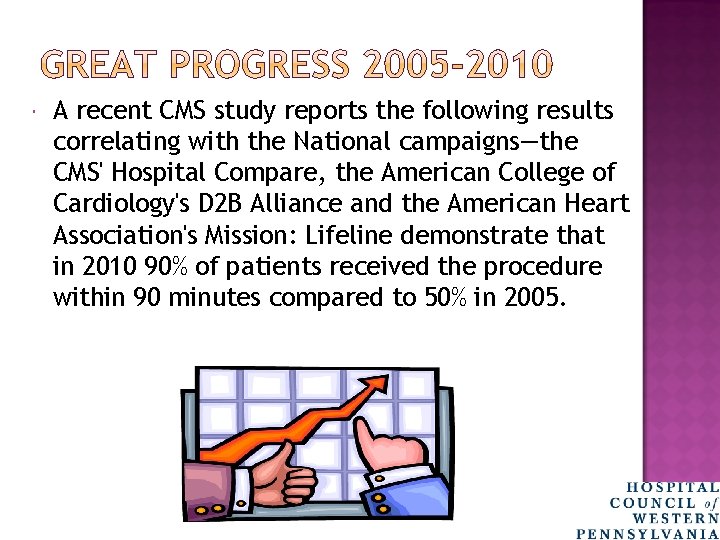
A recent CMS study reports the following results correlating with the National campaigns—the CMS' Hospital Compare, the American College of Cardiology's D 2 B Alliance and the American Heart Association's Mission: Lifeline demonstrate that in 2010 90% of patients received the procedure within 90 minutes compared to 50% in 2005.
This represents a median decrease of 32 minutes from 2005 to 2010 in the time from hospital admission to angioplasty. That is a decrease from 96 minutes to 64 minutes. Reference: Modern. Healthcare. com August 23, 2011
Please note: Many hospitals comply with the Joint Commission AMI measure set in total even though they are not TJC accredited. You will need to become familiar with and follow the plan of care for the AMI patient as approved by your facility.
It has been well documented that the early use of aspirin (ASA) in patients with an AMI results in a significant reduction in adverse events and mortality. To meet this indicator the patient must have received ASA within 24 hours before or after arrival. This information can be obtained from the patient history, EMT (ambulance) record or the MAR.
While the drug Aggrenox contains aspirin, the amount is sub-therapeutic therefore does not meet the criteria for either of the aspirin measures for a patient diagnosed with an AMI.
Studies have demonstrated that long term aspirin therapy for patients who have suffered an AMI can reduce the risk of a future adverse event or mortality by 20%. This core measure requires that AMI patients are prescribed ASA when discharged. The practitioner must make the decision regarding the discharge medications but nursing and case management reminders as well as the use pre-printed discharge instruction guides can improve compliance.

If the patient has a contraindication to taking ASA, such as a true allergy or recent GI bleed, this reason must be clearly documented in the medical record.
Any patient with documented left ventricular systolic dysfunction (LVSD) should have an ACEI or ARB prescribed at discharge. LVSD is defined as a left ventricular ejection fraction of less than 40% or a narrative description of moderate or severe systolic dysfunction by the practitioner. This indicator appears in both the AMI and CHF core measure sets.
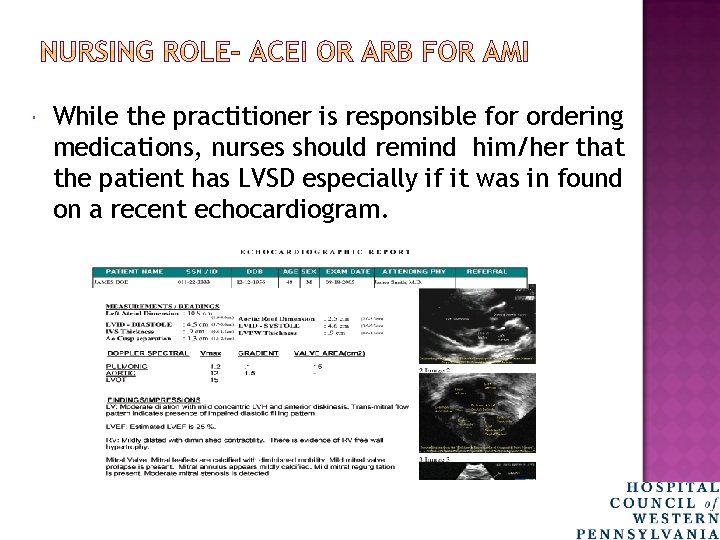
While the practitioner is responsible for ordering medications, nurses should remind him/her that the patient has LVSD especially if it was in found on a recent echocardiogram.
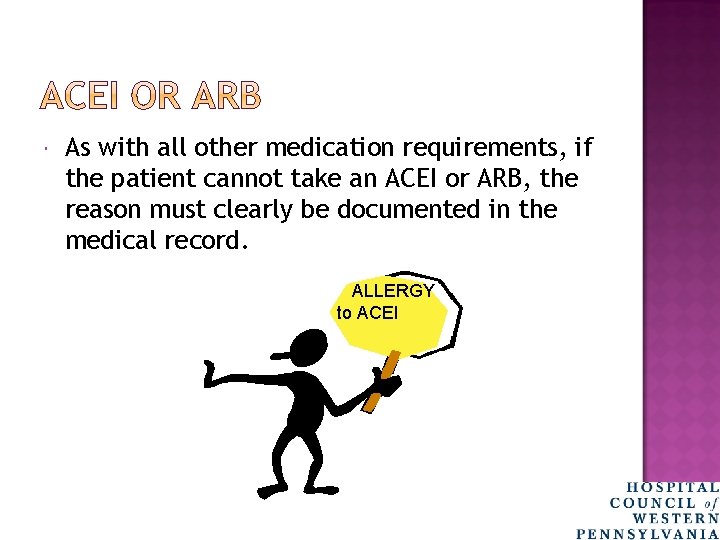
As with all other medication requirements, if the patient cannot take an ACEI or ARB, the reason must clearly be documented in the medical record. ALLERGY to ACEI
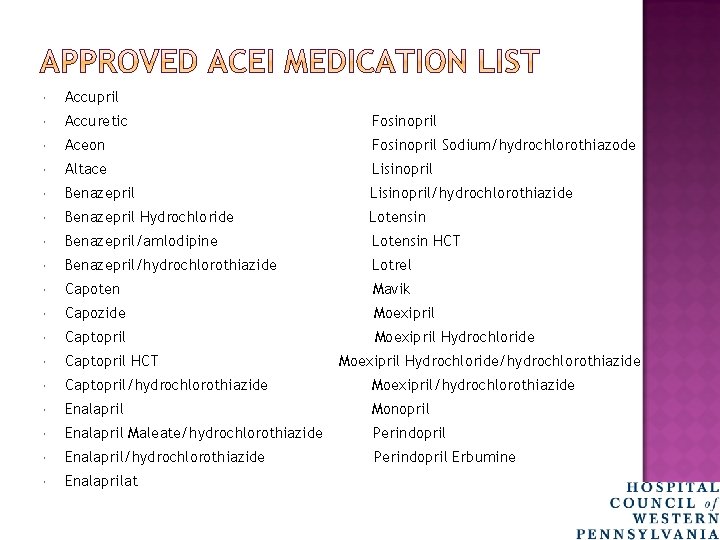
Accupril Accuretic Fosinopril Aceon Fosinopril Sodium/hydrochlorothiazode Altace Lisinopril Benazepril Lisinopril/hydrochlorothiazide Benazepril Hydrochloride Lotensin Benazepril/amlodipine Lotensin HCT Benazepril/hydrochlorothiazide Lotrel Capoten Mavik Capozide Moexipril Captopril Moexipril Hydrochloride Captopril HCT Captopril/hydrochlorothiazide Moexipril/hydrochlorothiazide Enalapril Monopril Enalapril Maleate/hydrochlorothiazide Perindopril Enalapril/hydrochlorothiazide Perindopril Erbumine Enalaprilat Moexipril Hydrochloride/hydrochlorothiazide
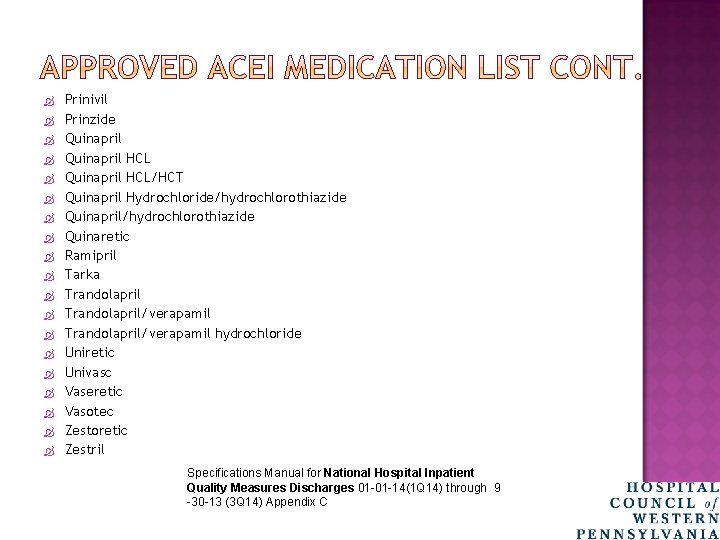
Prinivil Prinzide Quinapril HCL/HCT Quinapril Hydrochloride/hydrochlorothiazide Quinapril/hydrochlorothiazide Quinaretic Ramipril Tarka Trandolapril/verapamil hydrochloride Uniretic Univasc Vaseretic Vasotec Zestoretic Zestril Specifications Manual for National Hospital Inpatient Quality Measures Discharges 01 -01 -14(1 Q 14) through 9 -30 -13 (3 Q 14) Appendix C
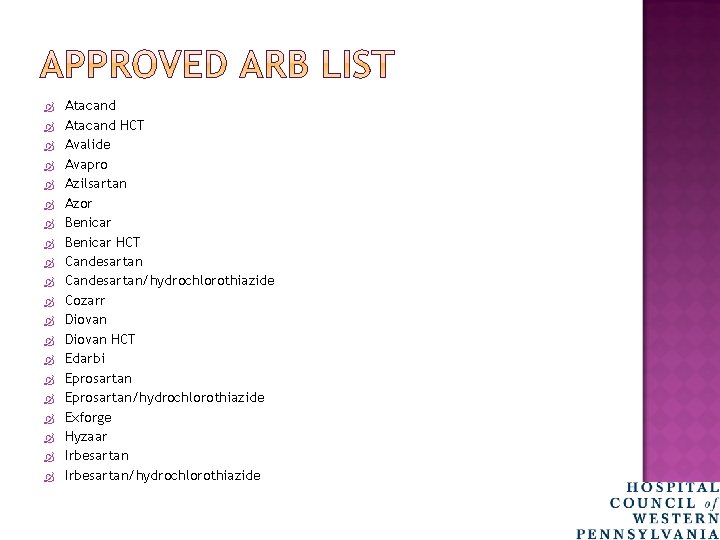
Atacand HCT Avalide Avapro Azilsartan Azor Benicar HCT Candesartan/hydrochlorothiazide Cozarr Diovan HCT Edarbi Eprosartan/hydrochlorothiazide Exforge Hyzaar Irbesartan/hydrochlorothiazide
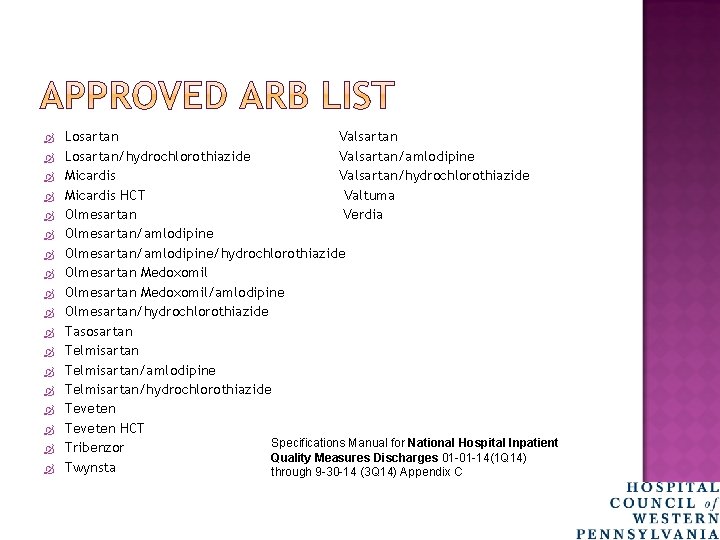
Losartan Valsartan Losartan/hydrochlorothiazide Valsartan/amlodipine Micardis Valsartan/hydrochlorothiazide Micardis HCT Valtuma Olmesartan Verdia Olmesartan/amlodipine/hydrochlorothiazide Olmesartan Medoxomil/amlodipine Olmesartan/hydrochlorothiazide Tasosartan Telmisartan/amlodipine Telmisartan/hydrochlorothiazide Teveten HCT Specifications Manual for National Hospital Inpatient Tribenzor Quality Measures Discharges 01 -01 -14(1 Q 14) Twynsta through 9 -30 -14 (3 Q 14) Appendix C
The Smoking Cessation indicator has been retired from the AMI measure set starting January 1, 2012. CMS feels this should occur for all patients and are considering this as a global measure set for future use. That said, each hospital will need to determine how they will address this change. If your facility chooses to continue to offer smoking cessation the requirements are on the next slide.
Any patient admitted who is a current smoker or has smoked within the past 12 months should be offered smoking cessation advice/counseling. It is the patient’s right to refuses such advice or counseling. Such a refusal must be documented in the medical record. This is a nursing driven measure.
This is another practitioner driven indicator. The long-term use of a beta-blocker for patients who have suffered an AMI can reduce mortality and morbidity by about 20%. The national guidelines from the American College of Cardiology/American Heart Association Task Force strongly recommend long-term beta blocker therapy for the secondary prevention of cardiovascular events in patients discharged after an AMI. (Antman, 2004 & 2008, Anderson, 2007 and Smith, 2011).
Despite the strong recommendations, betablockers remain under-utilized in eligible older patients discharged after suffering an AMI. As with the other medication measures, if beta blockers are not ordered at discharge the practitioner must document a clinical valid reason for the decision. There are many drugs that are classified as betablockers. The next slides contain a list of these approved beta-blockers.
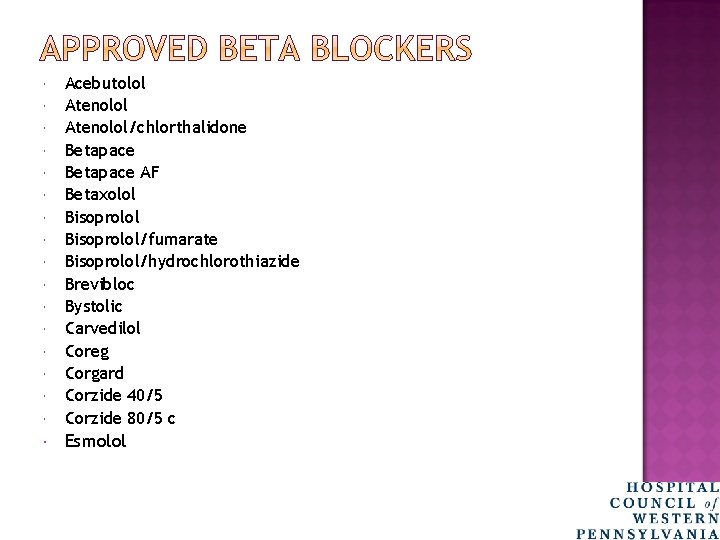
Acebutolol Atenolol/chlorthalidone Betapace AF Betaxolol Bisoprolol/fumarate Bisoprolol/hydrochlorothiazide Brevibloc Bystolic Carvedilol Coreg Corgard Corzide 40/5 Corzide 80/5 c Esmolol
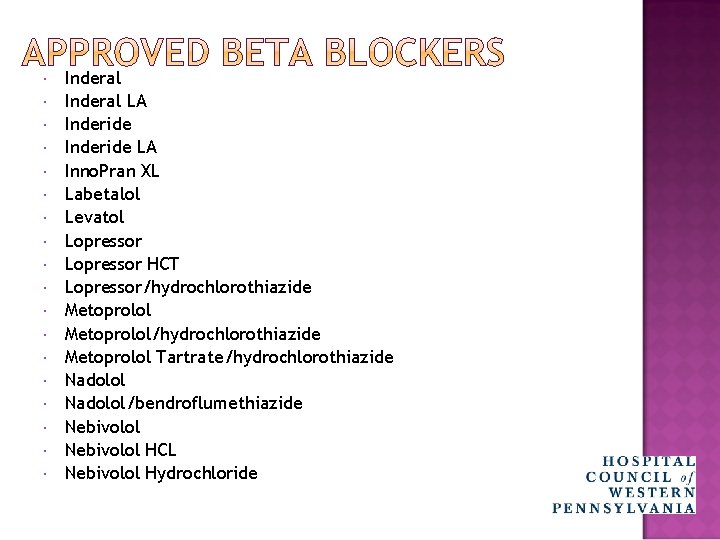
Inderal LA Inderide LA Inno. Pran XL Labetalol Levatol Lopressor HCT Lopressor/hydrochlorothiazide Metoprolol/hydrochlorothiazide Metoprolol Tartrate/hydrochlorothiazide Nadolol/bendroflumethiazide Nebivolol HCL Nebivolol Hydrochloride
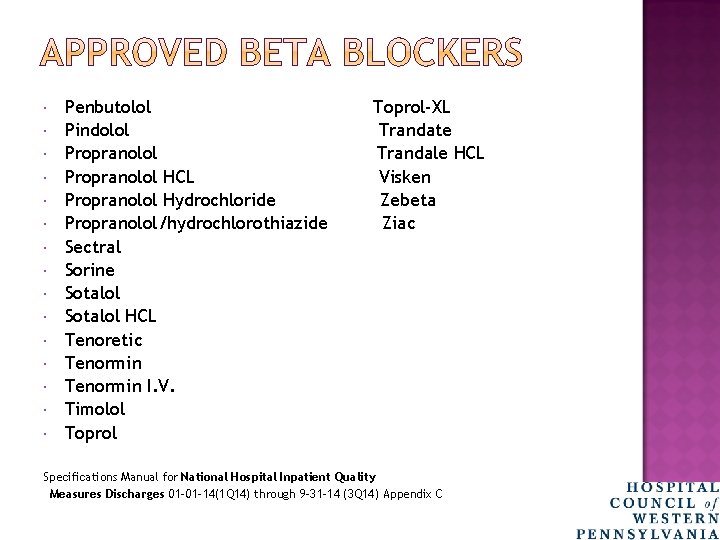
Penbutolol Pindolol Propranolol HCL Propranolol Hydrochloride Propranolol/hydrochlorothiazide Sectral Sorine Sotalol HCL Tenoretic Tenormin I. V. Timolol Toprol-XL Trandate Trandale HCL Visken Zebeta Ziac Specifications Manual for National Hospital Inpatient Quality Measures Discharges 01 -01 -14(1 Q 14) through 9 -31 -14 (3 Q 14) Appendix C
This measure requires that a statin medication be prescribed at the time of hospital discharge. Patients with LDL less than 100 mg/d. L within the first 24 hours after hospital arrival or 30 days prior to arrival are excluded from this indicator.
Research shows that the use of these drugs for AMI patients reduced the risk of death and recurrent cardiovascular events. If a statin is not ordered at discharge, the practitioner must document the reason for not ordering one.
Advicor Lovastatin/niacin Altoprev Mevacor Atorvastatin Pitavastatin Atorvastatin/amlodipine Pravastatin Caduet Rosuvastatin Crestor Simcor Fluvastatin Simvastatin Fluvastatin XL Juvisync Lescol Vytorin Lescol XL Zocor Lipitor Livalo Lovastatin Simvastatin/ezetimibe Simvastatin/ niacin Specifications Manual for National Hospital Inpatient Quality Measures Discharges 01 -01 -13(1 Q 13) through 12 -31 -13 (4 Q 12) Appendix C
While there have been many improvements in the care of the patient with an AMI, the American Heart Association reports that approximately 800, 000 patients suffer an AMI annually. Of these 20% (160, 000) are STEMI and should follow these AMI recommended measures.
1. To reduce the risk of mortality the recommended time from hospital arrival to the administration of a fibrinolytic medication is ______ minutes. A. 15 B. 30 C. 60

2. The recommended time from hospital arrival to primary angioplasty is within 90 minutes. A. True B. False
3. Aspirin given by the paramedic and documented prior to arrival at the hospital does not meet the CMS requirement ASA on arrival for a patient with an AMI. A. True B. False

4. If the patient is allergic to aspirin and the practitioner documents this allergy in the medical record the measure is met. A. True B. False
Fibrinolytic Thearpy Trialists’ Collaborative Group. Indications for fibrinolytic therapy in suspected AMI: collaborative overview of early mortality and major morbidity results form all randomized trials of more than 1000 patients. Lancet. 1994; 343: 311 -22.

- Slides: 49