
Develop an IT Service Desk Strategy ITIL is
- Slides: 12
Develop an IT Service Desk Strategy ITIL is not a strategy. You’ll have to develop your own. Info-Tech Research Group Info-Tech's products and services combine actionable insight and relevant advice with ready-to-use tools and templates that cover the full spectrum of IT concerns. © 1997 - 2012 Info-Tech Research Group 1
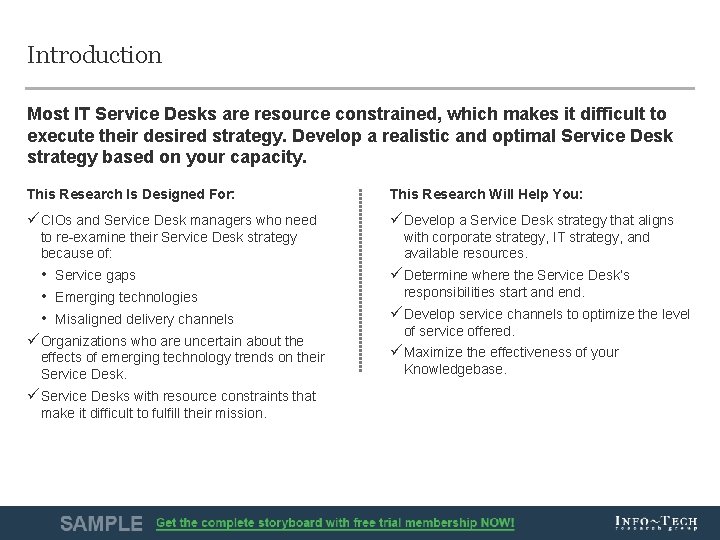
Introduction Most IT Service Desks are resource constrained, which makes it difficult to execute their desired strategy. Develop a realistic and optimal Service Desk strategy based on your capacity. This Research Is Designed For: This Research Will Help You: üCIOs and Service Desk managers who need üDevelop a Service Desk strategy that aligns to re-examine their Service Desk strategy because of: • Service gaps • Emerging technologies • Misaligned delivery channels üOrganizations who are uncertain about the effects of emerging technology trends on their Service Desk. with corporate strategy, IT strategy, and available resources. üDetermine where the Service Desk’s responsibilities start and end. üDevelop service channels to optimize the level of service offered. üMaximize the effectiveness of your Knowledgebase. üService Desks with resource constraints that make it difficult to fulfill their mission. Info-Tech Research Group 2
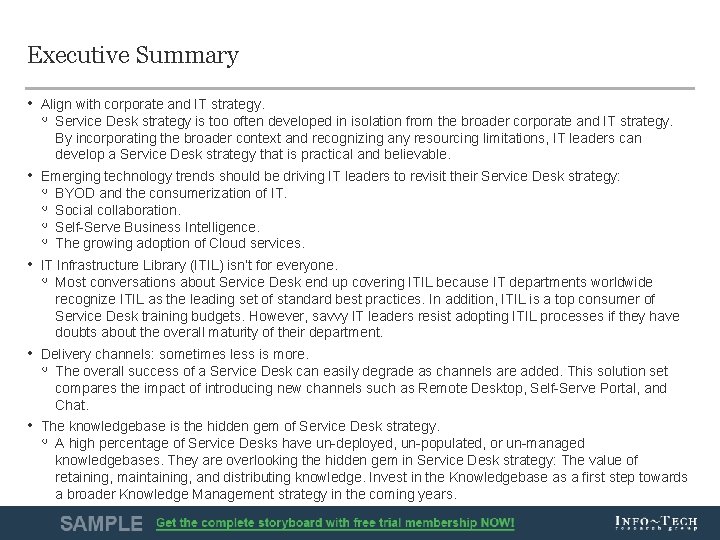
Executive Summary • Align with corporate and IT strategy. ◦ Service Desk strategy is too often developed in isolation from the broader corporate and IT strategy. By incorporating the broader context and recognizing any resourcing limitations, IT leaders can develop a Service Desk strategy that is practical and believable. • Emerging technology trends should be driving IT leaders to revisit their Service Desk strategy: ◦ ◦ BYOD and the consumerization of IT. Social collaboration. Self-Serve Business Intelligence. The growing adoption of Cloud services. • IT Infrastructure Library (ITIL) isn’t for everyone. ◦ Most conversations about Service Desk end up covering ITIL because IT departments worldwide recognize ITIL as the leading set of standard best practices. In addition, ITIL is a top consumer of Service Desk training budgets. However, savvy IT leaders resist adopting ITIL processes if they have doubts about the overall maturity of their department. • Delivery channels: sometimes less is more. ◦ The overall success of a Service Desk can easily degrade as channels are added. This solution set compares the impact of introducing new channels such as Remote Desktop, Self-Serve Portal, and Chat. • The knowledgebase is the hidden gem of Service Desk strategy. ◦ A high percentage of Service Desks have un-deployed, un-populated, or un-managed knowledgebases. They are overlooking the hidden gem in Service Desk strategy: The value of retaining, maintaining, and distributing knowledge. Invest in the Knowledgebase as a first step towards a broader Knowledge Management strategy in the coming years. Info-Tech Research Group 3
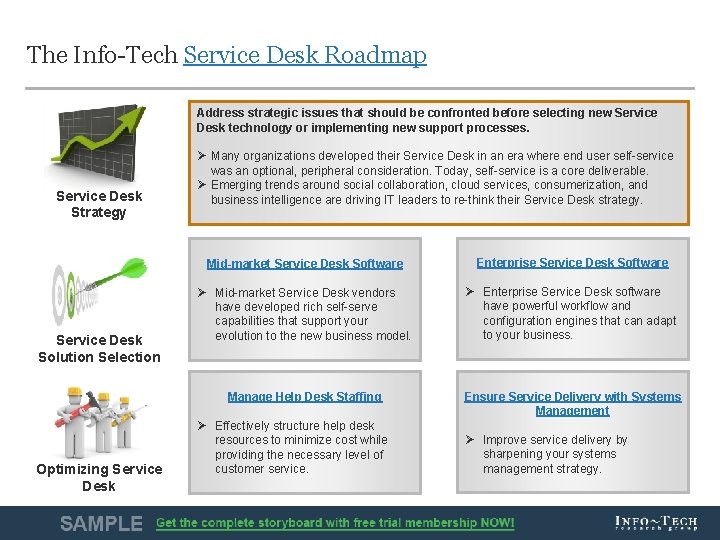
The Info-Tech Service Desk Roadmap Address strategic issues that should be confronted before selecting new Service Desk technology or implementing new support processes. Service Desk Strategy Service Desk Solution Selection Optimizing Service Desk Info-Tech Research Group Ø Many organizations developed their Service Desk in an era where end user self-service was an optional, peripheral consideration. Today, self-service is a core deliverable. Ø Emerging trends around social collaboration, cloud services, consumerization, and business intelligence are driving IT leaders to re-think their Service Desk strategy. Mid-market Service Desk Software Enterprise Service Desk Software Ø Mid-market Service Desk vendors have developed rich self-serve capabilities that support your evolution to the new business model. Ø Enterprise Service Desk software have powerful workflow and configuration engines that can adapt to your business. Manage Help Desk Staffing Ensure Service Delivery with Systems Management Ø Effectively structure help desk resources to minimize cost while providing the necessary level of customer service. Ø Improve service delivery by sharpening your systems management strategy. 4
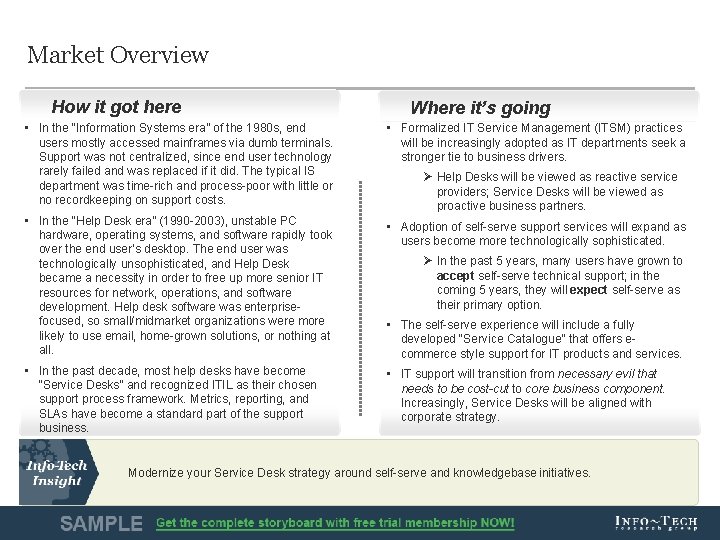
Market Overview How it got here Where it’s going • In the “Information Systems era” of the 1980 s, end users mostly accessed mainframes via dumb terminals. Support was not centralized, since end user technology rarely failed and was replaced if it did. The typical IS department was time-rich and process-poor with little or no recordkeeping on support costs. • Formalized IT Service Management (ITSM) practices will be increasingly adopted as IT departments seek a stronger tie to business drivers. • In the “Help Desk era” (1990 -2003), unstable PC hardware, operating systems, and software rapidly took over the end user’s desktop. The end user was technologically unsophisticated, and Help Desk became a necessity in order to free up more senior IT resources for network, operations, and software development. Help desk software was enterprisefocused, so small/midmarket organizations were more likely to use email, home-grown solutions, or nothing at all. • Adoption of self-serve support services will expand as users become more technologically sophisticated. • In the past decade, most help desks have become “Service Desks” and recognized ITIL as their chosen support process framework. Metrics, reporting, and SLAs have become a standard part of the support business. • IT support will transition from necessary evil that needs to be cost-cut to core business component. Increasingly, Service Desks will be aligned with corporate strategy. Ø Help Desks will be viewed as reactive service providers; Service Desks will be viewed as proactive business partners. Ø In the past 5 years, many users have grown to accept self-serve technical support; in the coming 5 years, they will expect self-serve as their primary option. • The self-serve experience will include a fully developed “Service Catalogue” that offers ecommerce style support for IT products and services. Modernize your Service Desk strategy around self-serve and knowledgebase initiatives. Info-Tech Research Group 5
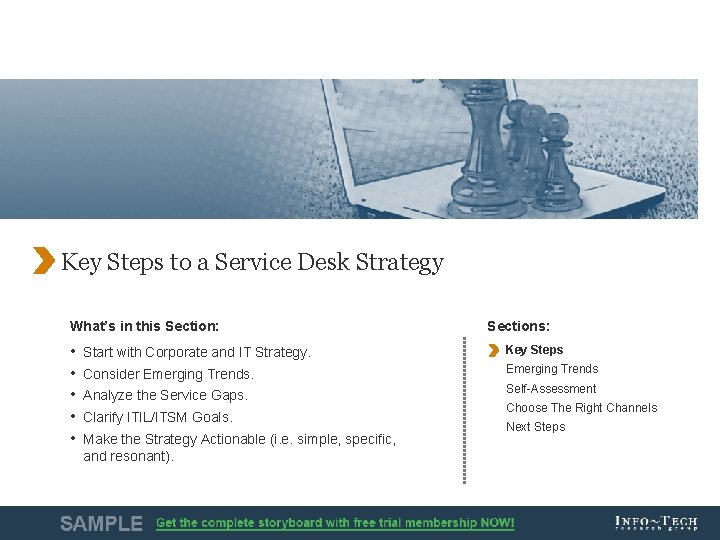
Key Steps to a Service Desk Strategy What’s in this Section: • • • Sections: Start with Corporate and IT Strategy. Key Steps Consider Emerging Trends Analyze the Service Gaps. Self-Assessment Clarify ITIL/ITSM Goals. Make the Strategy Actionable (i. e. simple, specific, and resonant). Info-Tech Research Group Choose The Right Channels Next Steps 6
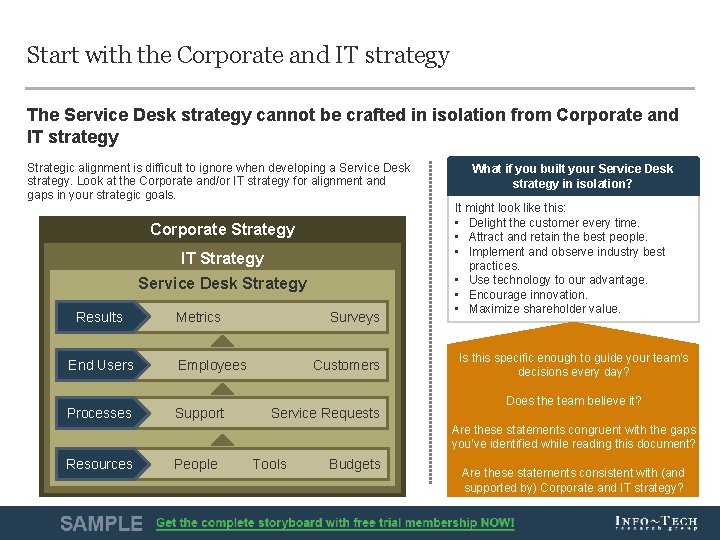
Start with the Corporate and IT strategy The Service Desk strategy cannot be crafted in isolation from Corporate and IT strategy Strategic alignment is difficult to ignore when developing a Service Desk strategy. Look at the Corporate and/or IT strategy for alignment and gaps in your strategic goals. Corporate Strategy IT Strategy Service Desk Strategy Results Metrics End Users Employees Processes Support Surveys Customers Service Requests What if you built your Service Desk strategy in isolation? It might look like this: • Delight the customer every time. • Attract and retain the best people. • Implement and observe industry best practices. • Use technology to our advantage. • Encourage innovation. • Maximize shareholder value. Is this specific enough to guide your team’s decisions every day? Does the team believe it? Are these statements congruent with the gaps you’ve identified while reading this document? Resources Info-Tech Research Group People Tools Budgets Are these statements consistent with (and supported by) Corporate and IT strategy? 7
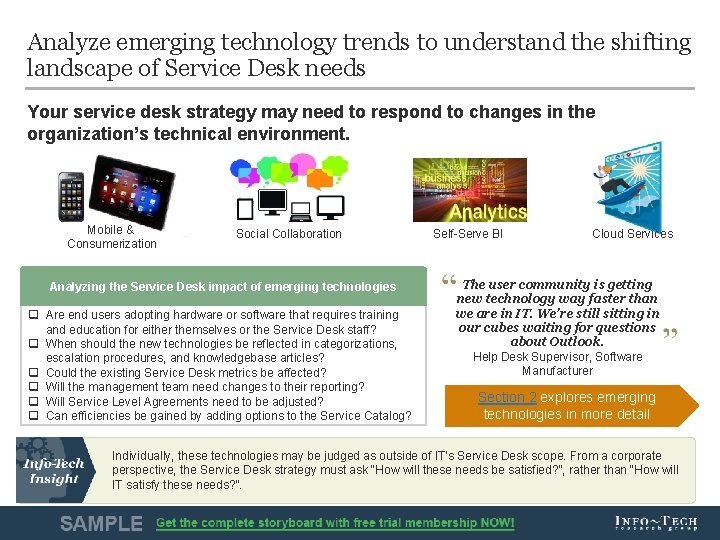
Analyze emerging technology trends to understand the shifting landscape of Service Desk needs Your service desk strategy may need to respond to changes in the organization’s technical environment. Mobile & Consumerization Social Collaboration Analyzing the Service Desk impact of emerging technologies q Are end users adopting hardware or software that requires training and education for either themselves or the Service Desk staff? q When should the new technologies be reflected in categorizations, escalation procedures, and knowledgebase articles? q Could the existing Service Desk metrics be affected? q Will the management team need changes to their reporting? q Will Service Level Agreements need to be adjusted? q Can efficiencies be gained by adding options to the Service Catalog? Self-Serve BI Cloud Services The user community is getting new technology way faster than we are in IT. We’re still sitting in our cubes waiting for questions about Outlook. Help Desk Supervisor, Software Manufacturer Section 2 explores emerging technologies in more detail Individually, these technologies may be judged as outside of IT’s Service Desk scope. From a corporate perspective, the Service Desk strategy must ask “How will these needs be satisfied? ”, rather than “How will IT satisfy these needs? ”. Info-Tech Research Group 8
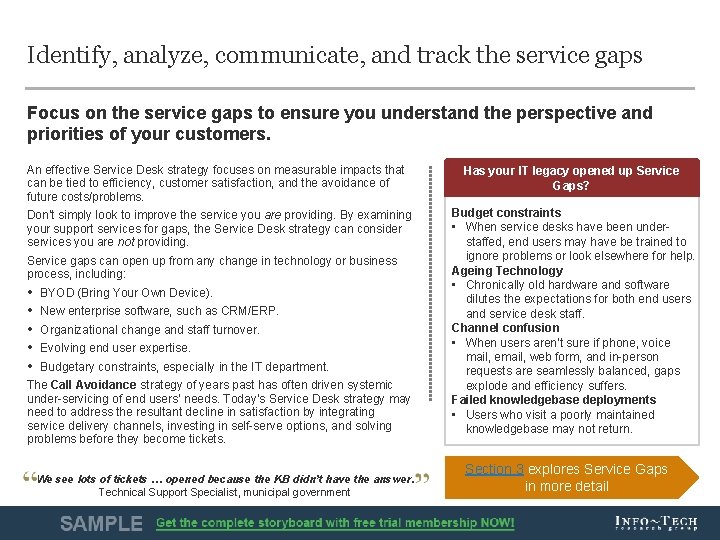
Identify, analyze, communicate, and track the service gaps Focus on the service gaps to ensure you understand the perspective and priorities of your customers. An effective Service Desk strategy focuses on measurable impacts that can be tied to efficiency, customer satisfaction, and the avoidance of future costs/problems. Has your IT legacy opened up Service Gaps? Don’t simply look to improve the service you are providing. By examining your support services for gaps, the Service Desk strategy can consider services you are not providing. Budget constraints • When service desks have been understaffed, end users may have be trained to ignore problems or look elsewhere for help. Ageing Technology • Chronically old hardware and software dilutes the expectations for both end users and service desk staff. Channel confusion • When users aren’t sure if phone, voice mail, email, web form, and in-person requests are seamlessly balanced, gaps explode and efficiency suffers. Failed knowledgebase deployments • Users who visit a poorly maintained knowledgebase may not return. Service gaps can open up from any change in technology or business process, including: • • • BYOD (Bring Your Own Device). New enterprise software, such as CRM/ERP. Organizational change and staff turnover. Evolving end user expertise. Budgetary constraints, especially in the IT department. The Call Avoidance strategy of years past has often driven systemic under-servicing of end users’ needs. Today’s Service Desk strategy may need to address the resultant decline in satisfaction by integrating service delivery channels, investing in self-serve options, and solving problems before they become tickets. We see lots of tickets … opened because the KB didn’t have the answer. Technical Support Specialist, municipal government Info-Tech Research Group Section 3 explores Service Gaps in more detail 9
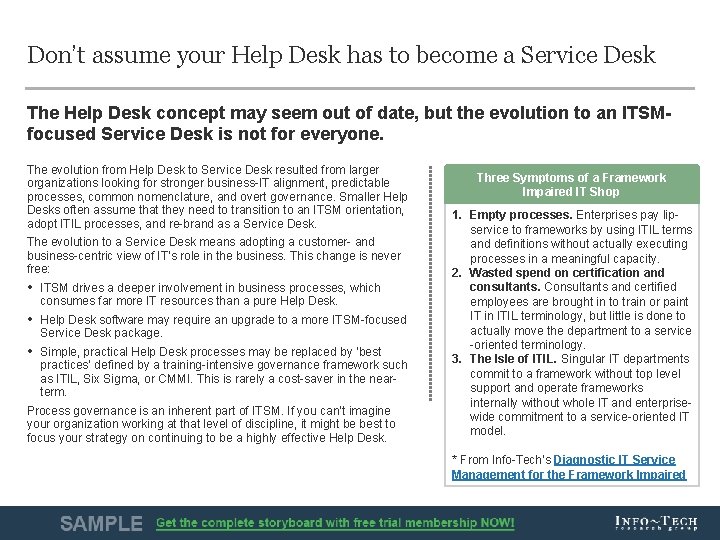
Don’t assume your Help Desk has to become a Service Desk The Help Desk concept may seem out of date, but the evolution to an ITSMfocused Service Desk is not for everyone. The evolution from Help Desk to Service Desk resulted from larger organizations looking for stronger business-IT alignment, predictable processes, common nomenclature, and overt governance. Smaller Help Desks often assume that they need to transition to an ITSM orientation, adopt ITIL processes, and re-brand as a Service Desk. The evolution to a Service Desk means adopting a customer- and business-centric view of IT’s role in the business. This change is never free: • ITSM drives a deeper involvement in business processes, which consumes far more IT resources than a pure Help Desk. • Help Desk software may require an upgrade to a more ITSM-focused Service Desk package. • Simple, practical Help Desk processes may be replaced by ‘best practices’ defined by a training-intensive governance framework such as ITIL, Six Sigma, or CMMI. This is rarely a cost-saver in the nearterm. Process governance is an inherent part of ITSM. If you can’t imagine your organization working at that level of discipline, it might be best to focus your strategy on continuing to be a highly effective Help Desk. Three Symptoms of a Framework Impaired IT Shop 1. Empty processes. Enterprises pay lipservice to frameworks by using ITIL terms and definitions without actually executing processes in a meaningful capacity. 2. Wasted spend on certification and consultants. Consultants and certified employees are brought in to train or paint IT in ITIL terminology, but little is done to actually move the department to a service -oriented terminology. 3. The Isle of ITIL. Singular IT departments commit to a framework without top level support and operate frameworks internally without whole IT and enterprisewide commitment to a service-oriented IT model. * From Info-Tech’s Diagnostic IT Service Management for the Framework Impaired Info-Tech Research Group 10
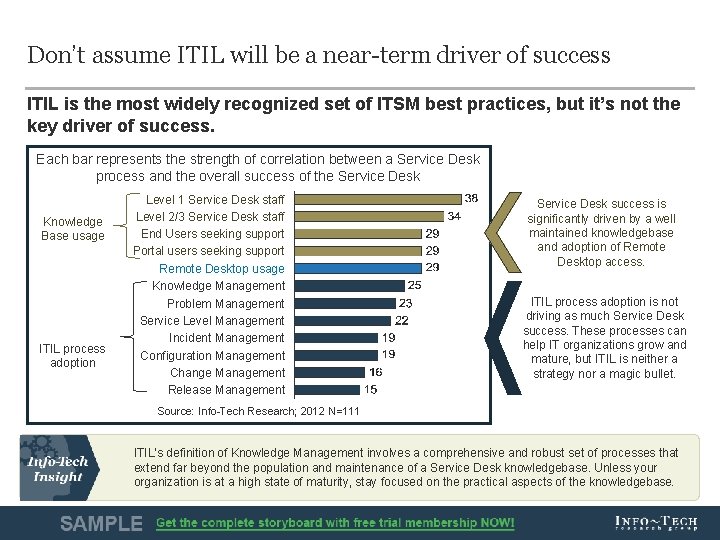
Don’t assume ITIL will be a near-term driver of success ITIL is the most widely recognized set of ITSM best practices, but it’s not the key driver of success. Each bar represents the strength of correlation between a Service Desk process and the overall success of the Service Desk Knowledge Base usage ITIL process adoption Level 1 Service Desk staff Level 2/3 Service Desk staff End Users seeking support Portal users seeking support Remote Desktop usage Knowledge Management Problem Management Service Level Management Incident Management Configuration Management Change Management Release Management Service Desk success is significantly driven by a well maintained knowledgebase and adoption of Remote Desktop access. ITIL process adoption is not driving as much Service Desk success. These processes can help IT organizations grow and mature, but ITIL is neither a strategy nor a magic bullet. Source: Info-Tech Research; 2012 N=111 ITIL’s definition of Knowledge Management involves a comprehensive and robust set of processes that extend far beyond the population and maintenance of a Service Desk knowledgebase. Unless your organization is at a high state of maturity, stay focused on the practical aspects of the knowledgebase. Info-Tech Research Group 11
Info-Tech Research Group Helps IT Professionals To: ü ü ü Quickly get up to speed with new technologies ü Manage business expectations ü Justify IT spending and prove the value of IT ü Train IT staff and effectively manage an IT department Make the right technology purchasing decisions – fast Deliver critical IT projects, on time and within budget Sign up for free trial membership to get practical solutions for your IT challenges • “Info-Tech helps me to be proactive instead of reactive – a cardinal rule in a stable and leading edge IT environment. - ARCS Commercial Mortgage Co. , LP Toll Free: 1 -888 -670 -8889 Info-Tech Research Group www. infotech. com 12