
Develop a Clear and Compelling Vision 1 2
- Slides: 2
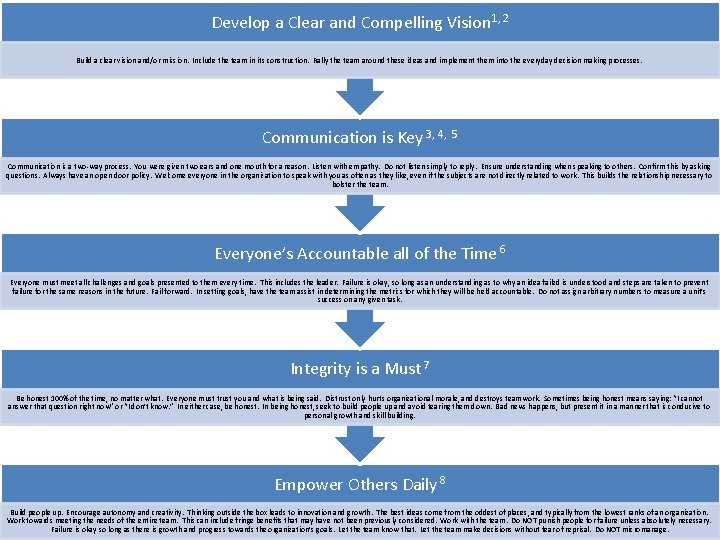
Develop a Clear and Compelling Vision 1, 2 Build a clear vision and/or mission. Include the team in its construction. Rally the team around these ideas and implement them into the everyday decision making processes. Communication is Key 3, 4, 5 Communication is a two-way process. You were given two ears and one mouth for a reason. Listen with empathy. Do not listen simply to reply. Ensure understanding when speaking to others. Confirm this by asking questions. Always have an open door policy. Welcome everyone in the organization to speak with you as often as they like, even if the subjects are not directly related to work. This builds the relationship necessary to bolster the team. Everyone’s Accountable all of the Time 6 Everyone must meet all challenges and goals presented to them every time. This includes the leader. Failure is okay, so long as an understanding as to why an idea failed is understood and steps are taken to prevent failure for the same reasons in the future. Fail forward. In setting goals, have the team assist in determining the metrics for which they will be held accountable. Do not assign arbitrary numbers to measure a unit’s success on any given task. Integrity is a Must 7 Be honest 100% of the time, no matter what. Everyone must trust you and what is being said. Distrust only hurts organizational morale, and destroys teamwork. Sometimes being honest means saying: “I cannot answer that question right now” or “I don’t know. ” In either case, be honest. In being honest, seek to build people up and avoid tearing them down. Bad news happens, but present it in a manner that is conducive to personal growth and skill building. Empower Others Daily 8 Build people up. Encourage autonomy and creativity. Thinking outside the box leads to innovation and growth. The best ideas come from the oddest of places, and typically from the lowest ranks of an organization. Work towards meeting the needs of the entire team. This can include fringe benefits that may have not been previously considered. Work with the team. Do NOT punish people for failure unless absolutely necessary. Failure is okay so long as there is growth and progress towards the organization’s goals. Let the team know that. Let the team make decisions without fear of reprisal. Do NOT micromanage.
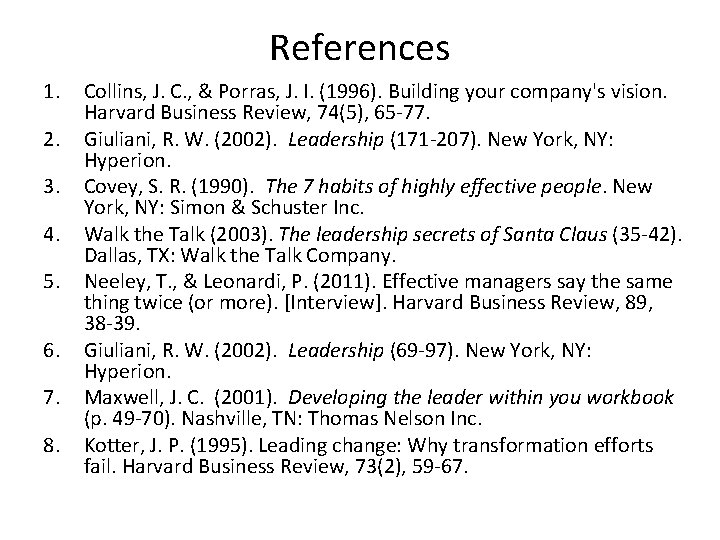
References 1. 2. 3. 4. 5. 6. 7. 8. Collins, J. C. , & Porras, J. I. (1996). Building your company's vision. Harvard Business Review, 74(5), 65 -77. Giuliani, R. W. (2002). Leadership (171 -207). New York, NY: Hyperion. Covey, S. R. (1990). The 7 habits of highly effective people. New York, NY: Simon & Schuster Inc. Walk the Talk (2003). The leadership secrets of Santa Claus (35 -42). Dallas, TX: Walk the Talk Company. Neeley, T. , & Leonardi, P. (2011). Effective managers say the same thing twice (or more). [Interview]. Harvard Business Review, 89, 38 -39. Giuliani, R. W. (2002). Leadership (69 -97). New York, NY: Hyperion. Maxwell, J. C. (2001). Developing the leader within you workbook (p. 49 -70). Nashville, TN: Thomas Nelson Inc. Kotter, J. P. (1995). Leading change: Why transformation efforts fail. Harvard Business Review, 73(2), 59 -67.