
Deterministic methods of operations research Introduction Formal stuff

- Slides: 24
Deterministic methods of operations research Introduction
Formal stuff Webpage: http: //www. sgh. waw. pl/mlewandowski Contact: michal. lewandowski@sgh. waw. pl Office hours : XXX (prior notification by e-mail) Grade policy: 20% Project, 80% Exam Lectures – every two weeks on Thursday 8 AM in room 14 (building S) Exercise sessions: every two weeks on Thursday 8 AM in room 14 (building S)
What is Opreations Research? • • Operations Research or management science II World War: British military leaders asked scientists and engineers to analyze several military problems: – Deployment of radar – Management of convoy, bombing, antisubmarine, and mining operations. • • The result was called Operations Research (O. R. ) is the discipline of applying advanced analytical methods to help make better decisions. http: //www. scienceofbetter. org/ http: //www. orms-today. org/ormsmain. shtml
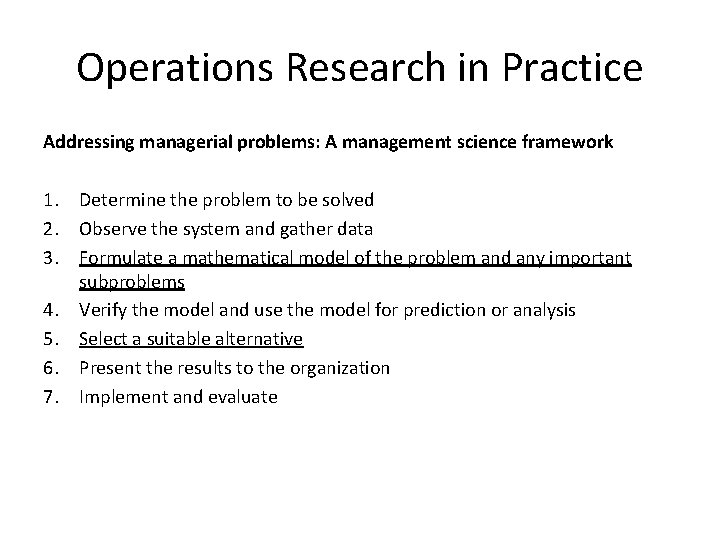
Operations Research in Practice Addressing managerial problems: A management science framework 1. Determine the problem to be solved 2. Observe the system and gather data 3. Formulate a mathematical model of the problem and any important subproblems 4. Verify the model and use the model for prediction or analysis 5. Select a suitable alternative 6. Present the results to the organization 7. Implement and evaluate
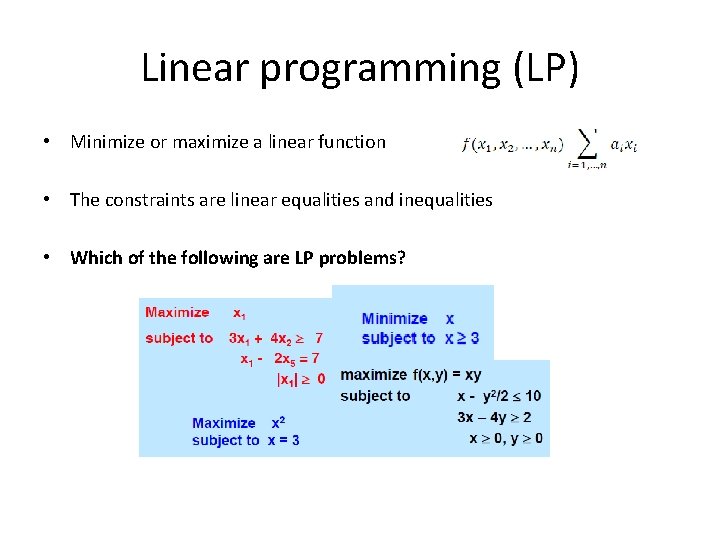
Linear programming (LP) • Minimize or maximize a linear function • The constraints are linear equalities and inequalities • Which of the following are LP problems?
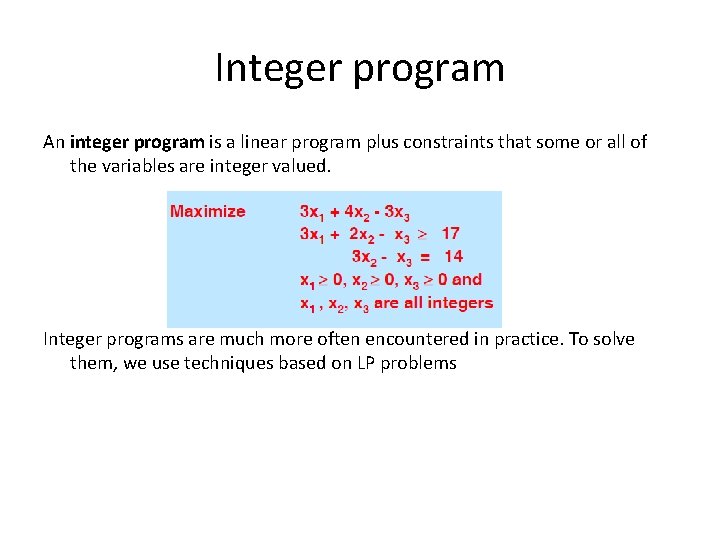
Integer program An integer program is a linear program plus constraints that some or all of the variables are integer valued. Integer programs are much more often encountered in practice. To solve them, we use techniques based on LP problems
Overview Scheduling Postal Workers (5 in 7) • The model • Practical enhancements or modifications • Two non-linear objectives that can be made linear • A non-linear constraint that can be made linear
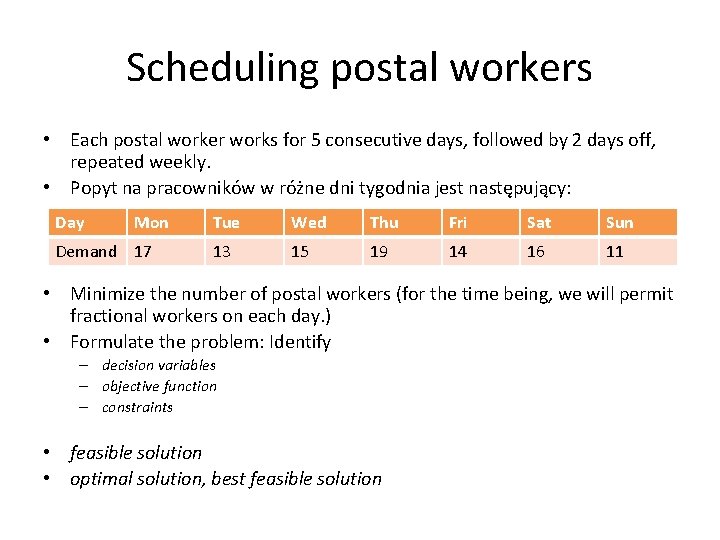
Scheduling postal workers • Each postal worker works for 5 consecutive days, followed by 2 days off, repeated weekly. • Popyt na pracowników w różne dni tygodnia jest następujący: Day Mon Demand 17 Tue Wed Thu Fri Sat Sun 13 15 19 14 16 11 • Minimize the number of postal workers (for the time being, we will permit fractional workers on each day. ) • Formulate the problem: Identify – decision variables – objective function – constraints • feasible solution • optimal solution, best feasible solution
Identifying decision variables • • • Let’s try: yi – number of people working on day i Demand constraints are easy How to formulate constraint „ 5 days at work followed by 2 days off”? – Impossible
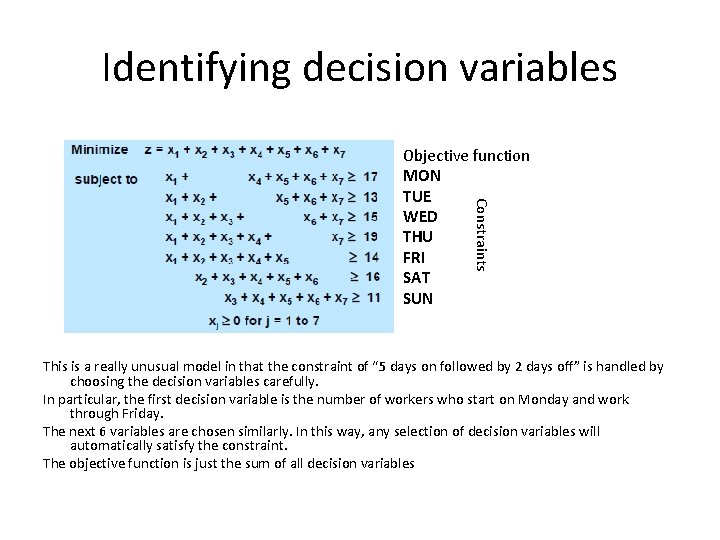
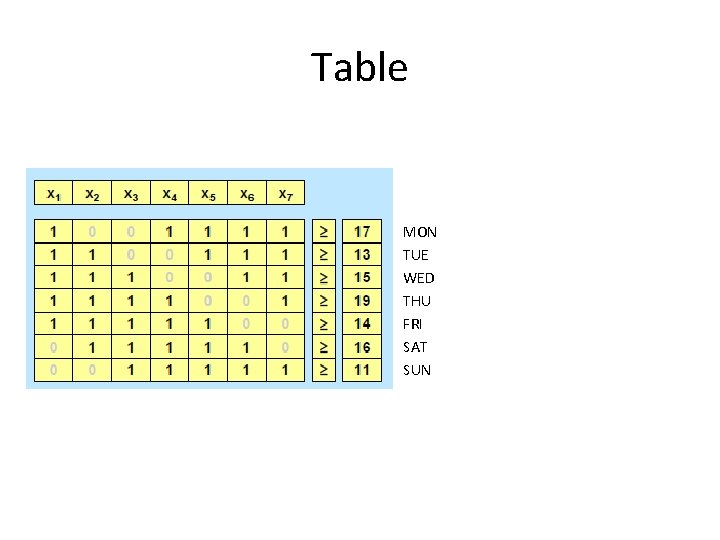
Identifying decision variables Constraints Objective function MON TUE WED THU FRI SAT SUN This is a really unusual model in that the constraint of “ 5 days on followed by 2 days off” is handled by choosing the decision variables carefully. In particular, the first decision variable is the number of workers who start on Monday and work through Friday. The next 6 variables are chosen similarly. In this way, any selection of decision variables will automatically satisfy the constraint. The objective function is just the sum of all decision variables
Table MON TUE WED THU FRI SAT SUN
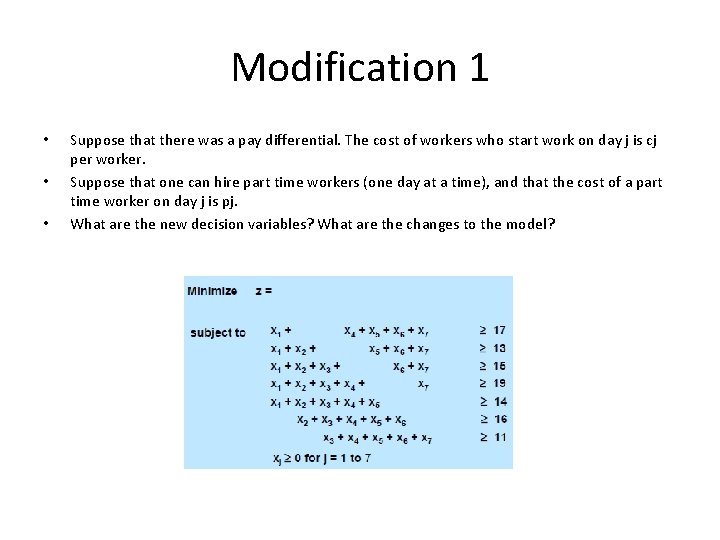
Modification 1 • • • Suppose that there was a pay differential. The cost of workers who start work on day j is cj per worker. Suppose that one can hire part time workers (one day at a time), and that the cost of a part time worker on day j is pj. What are the new decision variables? What are the changes to the model?
Another modification • • Suppose that the desirable number of workers on day j is dj, but it is not required. Let sj be the “excess” number of workers day j. sj > 0 if there are more workers on day j than dj; otherwise sj ≤ 0. What is the minimum cost schedule, where the “cost” of having too many workers on day j is fj(sj), which is a non-linear function? We treat the number of workers on each day as a goal for the day, and penalize not reaching the goal exactly. Having too many workers may be inefficient uses of labor. Having too few workers may make it difficult to handle the tasks for the day. What are the new decision variables? What is the resulting non-linear model?
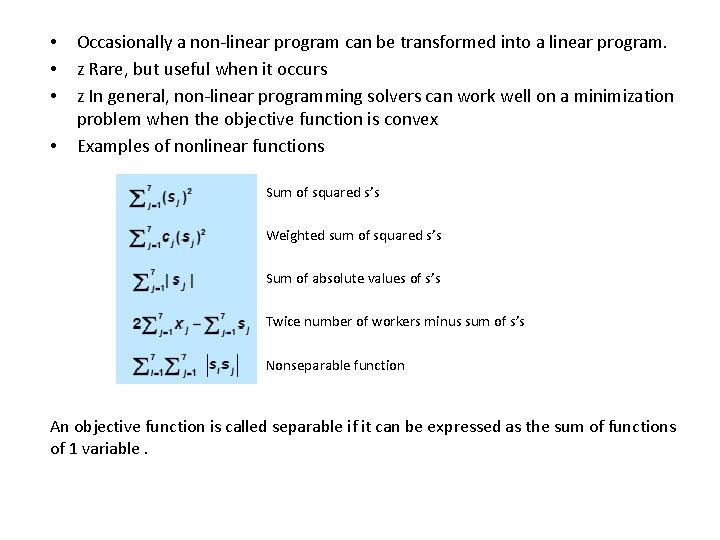
• • Occasionally a non-linear program can be transformed into a linear program. z Rare, but useful when it occurs z In general, non-linear programming solvers can work well on a minimization problem when the objective function is convex Examples of nonlinear functions Sum of squared s’s Weighted sum of squared s’s Sum of absolute values of s’s Twice number of workers minus sum of s’s Nonseparable function An objective function is called separable if it can be expressed as the sum of functions of 1 variable.
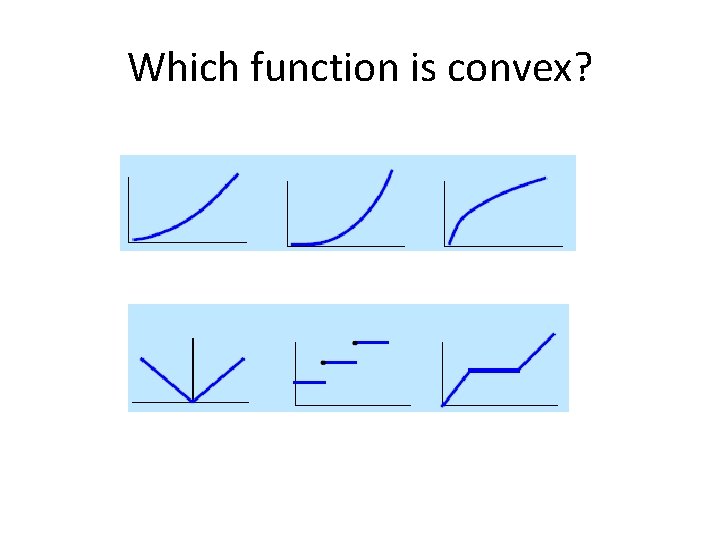
Which function is convex?
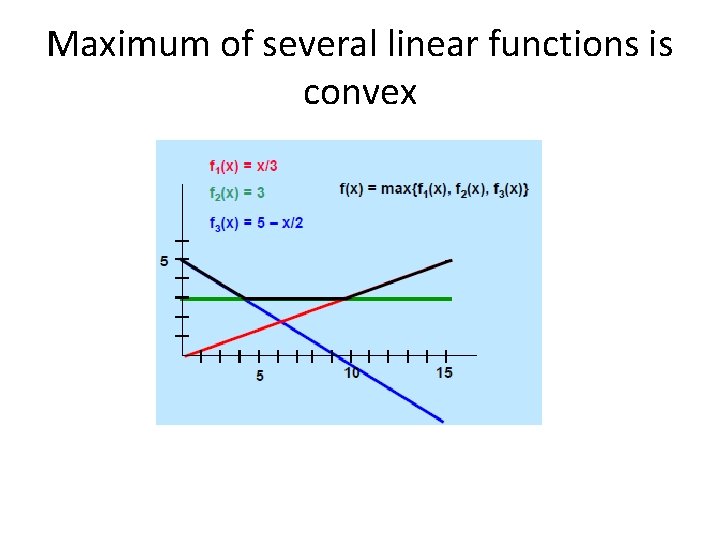
Maximum of several linear functions is convex
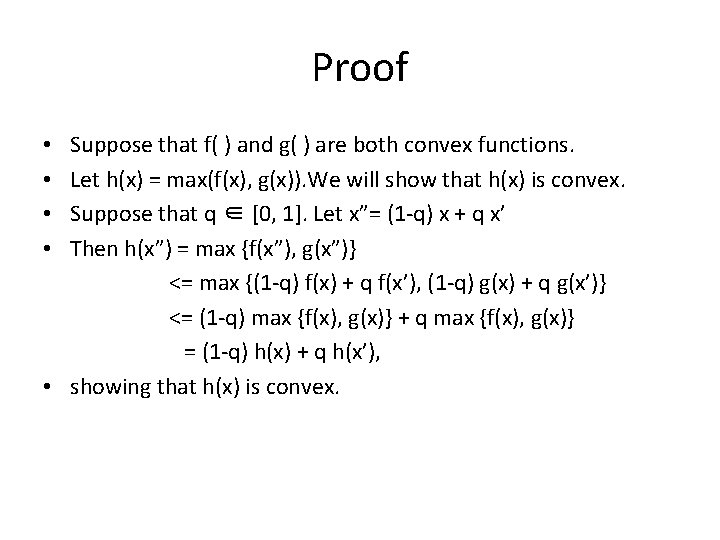
Proof Suppose that f( ) and g( ) are both convex functions. Let h(x) = max(f(x), g(x)). We will show that h(x) is convex. Suppose that q ∈ [0, 1]. Let x”= (1 -q) x + q x’ Then h(x”) = max {f(x”), g(x”)} <= max {(1 -q) f(x) + q f(x’), (1 -q) g(x) + q g(x’)} <= (1 -q) max {f(x), g(x)} + q max {f(x), g(x)} = (1 -q) h(x) + q h(x’), • showing that h(x) is convex. • •
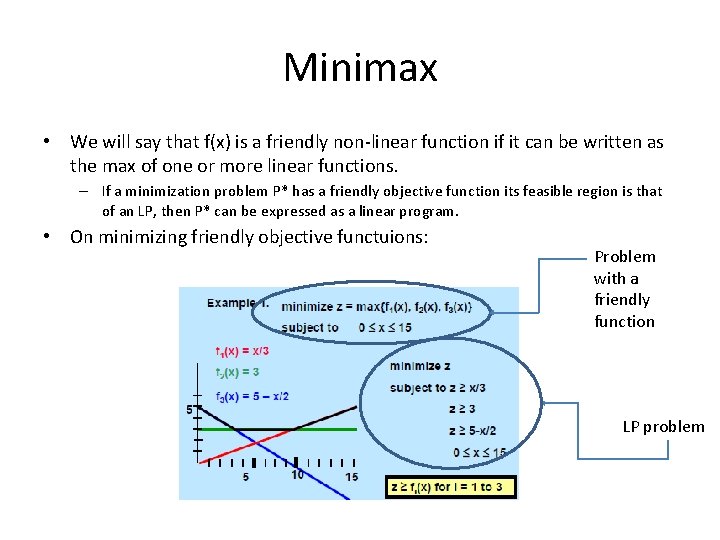
Minimax • We will say that f(x) is a friendly non-linear function if it can be written as the max of one or more linear functions. – If a minimization problem P* has a friendly objective function its feasible region is that of an LP, then P* can be expressed as a linear program. • On minimizing friendly objective functuions: Problem with a friendly function LP problem
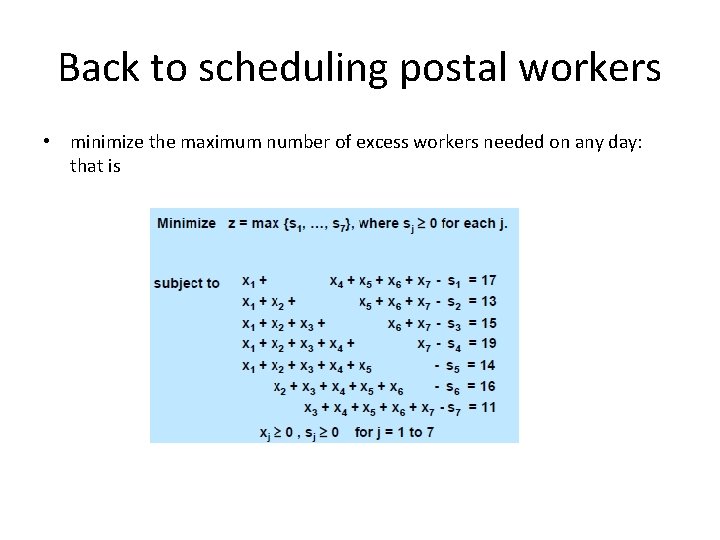
Back to scheduling postal workers • minimize the maximum number of excess workers needed on any day: that is
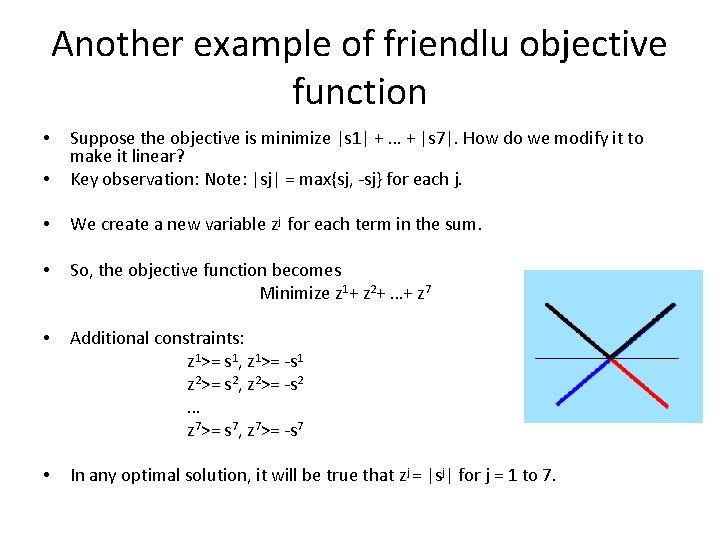
Another example of friendlu objective function • Suppose the objective is minimize |s 1| + … + |s 7|. How do we modify it to make it linear? Key observation: Note: |sj| = max{sj, -sj} for each j. • We create a new variable zj for each term in the sum. • So, the objective function becomes Minimize z 1+ z 2+ …+ z 7 • Additional constraints: z 1>= s 1, z 1>= -s 1 z 2>= s 2, z 2>= -s 2 … z 7>= s 7, z 7>= -s 7 • In any optimal solution, it will be true that zj = |sj| for j = 1 to 7. •
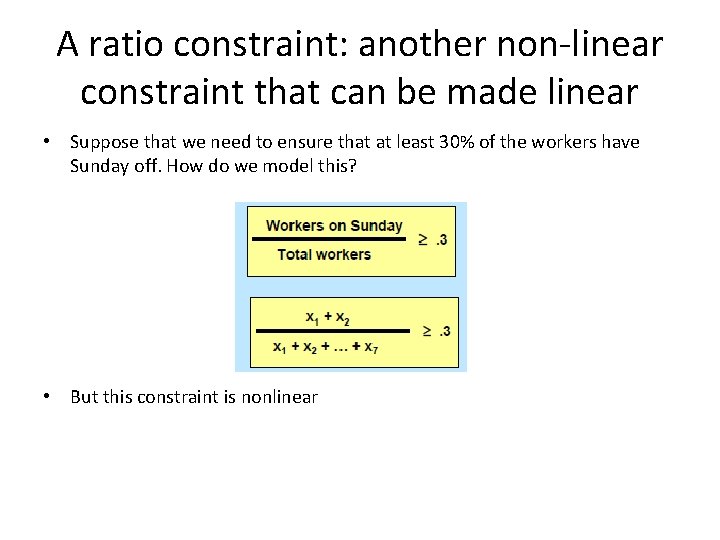
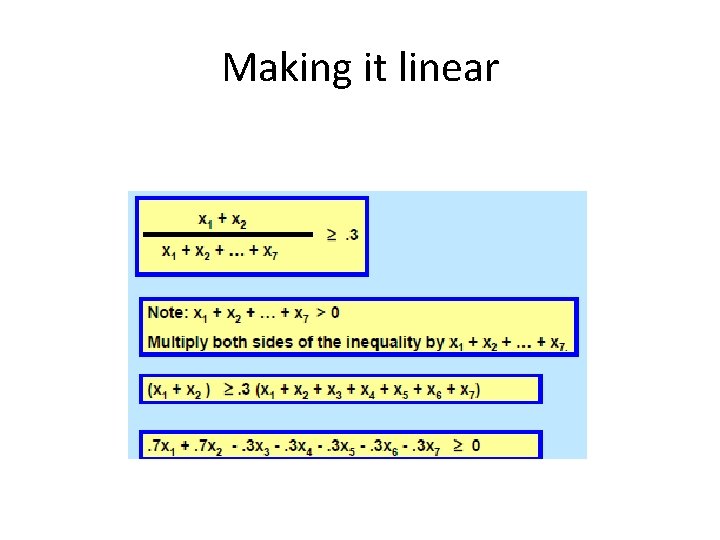
A ratio constraint: another non-linear constraint that can be made linear • Suppose that we need to ensure that at least 30% of the workers have Sunday off. How do we model this? • But this constraint is nonlinear
Making it linear
Other enhancements • Require that each shift has an integral number of workers – integer program • Consider longer term scheduling – model 6 weeks at a time. S • Consider shorter term scheduling – model lunch breaks • Model individual workers – permit worker preferences
Simple optimization problem • You are given a set of numbers. Divide them into two subsets such that the sum of numbers in each subset was as small as possible • Example: 7, 10, 13, 17, 20, 22 • • You can divide them into {20, 22} (sum 42) and {7, 10, 13, 17} (sum 47) The difference in sums equals 5 • Can we do better?