
Deterministic effects of radiation Ch 33 Acute Radiation
- Slides: 54
Deterministic effects of radiation –Ch 33 Acute Radiation Lethality Local Tissue Damage Hematologic Effects Cytogenetic Effects Medical Radiography Program RTMR 284 Winter 2014
Effects of Radiation » Early ~ response within a few hours, days, weeks ~ encountered in diagnostic radiology rarely ~ Deterministic: those that exhibit increasing severity with increasing radiation dose » Late ~ response months or years after irradiation » Pioneers ~ “babes” in the field Medical Radiography Program
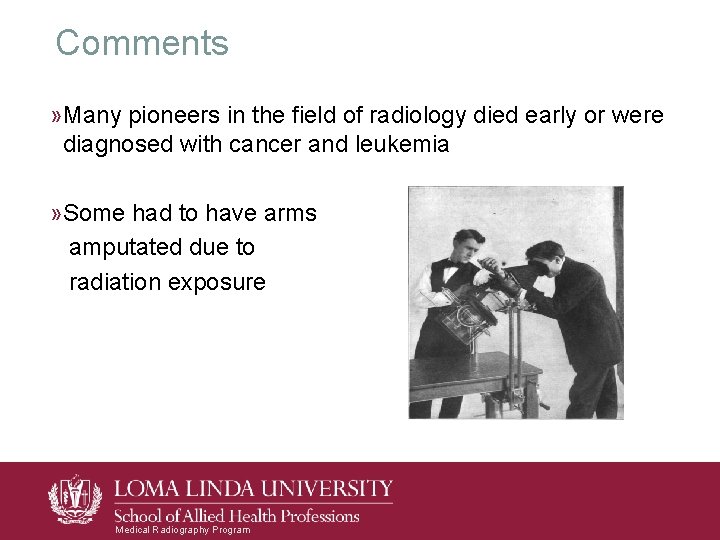
Comments » Many pioneers in the field of radiology died early or were diagnosed with cancer and leukemia » Some had to have arms amputated due to radiation exposure Medical Radiography Program
Acute Radiation Lethality » 3 stages of acute radiation lethality ~1. prodromal (period) syndrome ~2. latent period ~3. manifest illness stage Medical Radiography Program
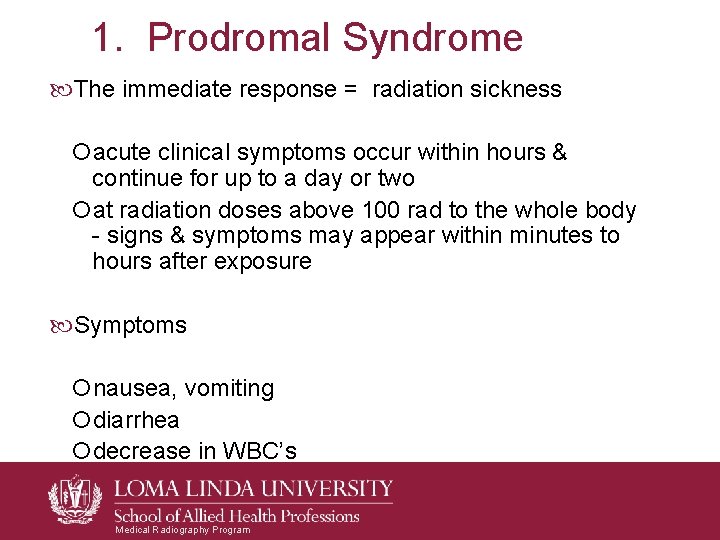
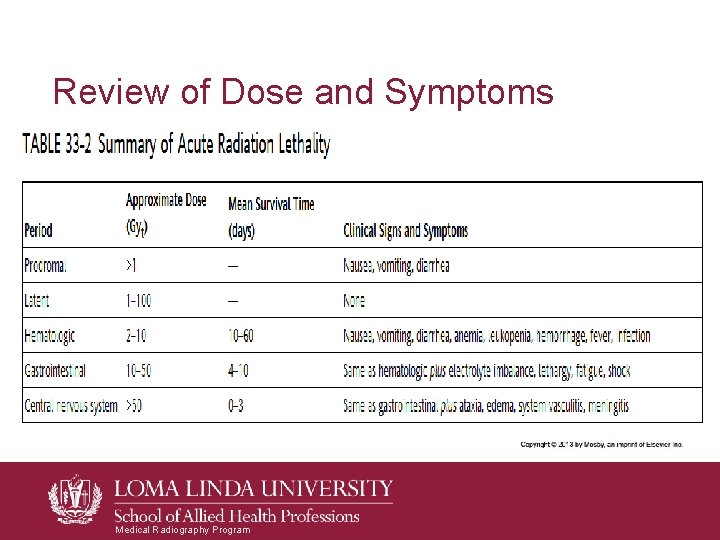
1. Prodromal Syndrome The immediate response = radiation sickness acute clinical symptoms occur within hours & continue for up to a day or two at radiation doses above 100 rad to the whole body - signs & symptoms may appear within minutes to hours after exposure Symptoms nausea, vomiting diarrhea decrease in WBC’s Medical Radiography Program
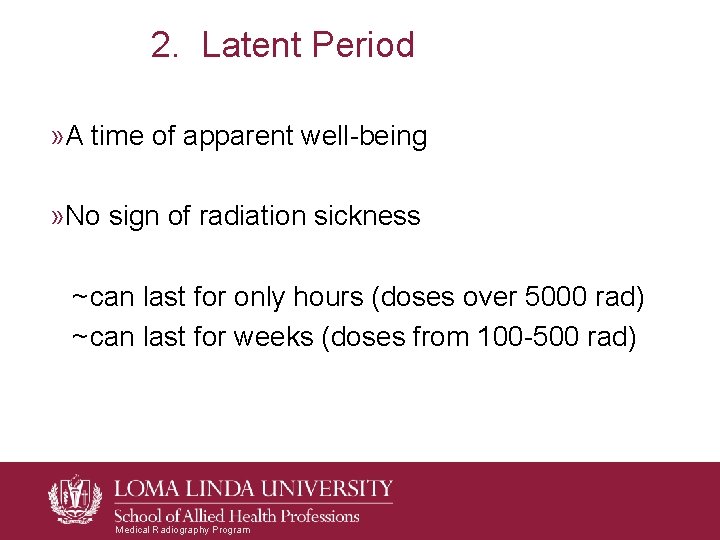
2. Latent Period » A time of apparent well-being » No sign of radiation sickness ~ can last for only hours (doses over 5000 rad) ~ can last for weeks (doses from 100 -500 rad) Medical Radiography Program
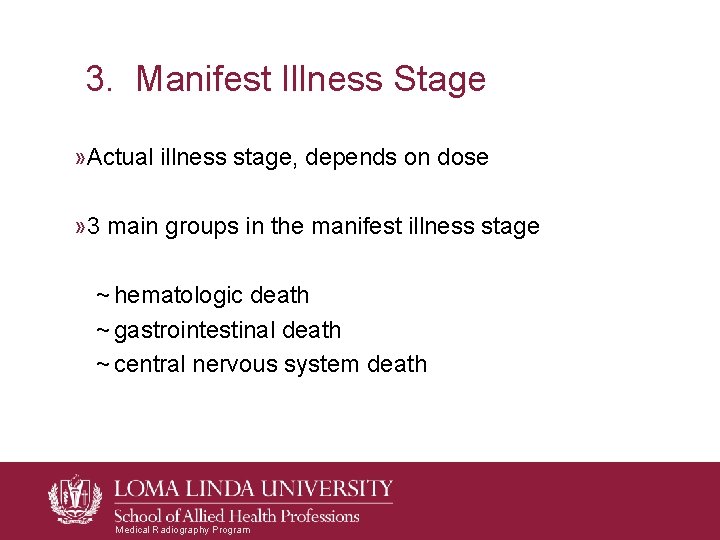
3. Manifest Illness Stage » Actual illness stage, depends on dose » 3 main groups in the manifest illness stage ~ hematologic death ~ gastrointestinal death ~ central nervous system death Medical Radiography Program
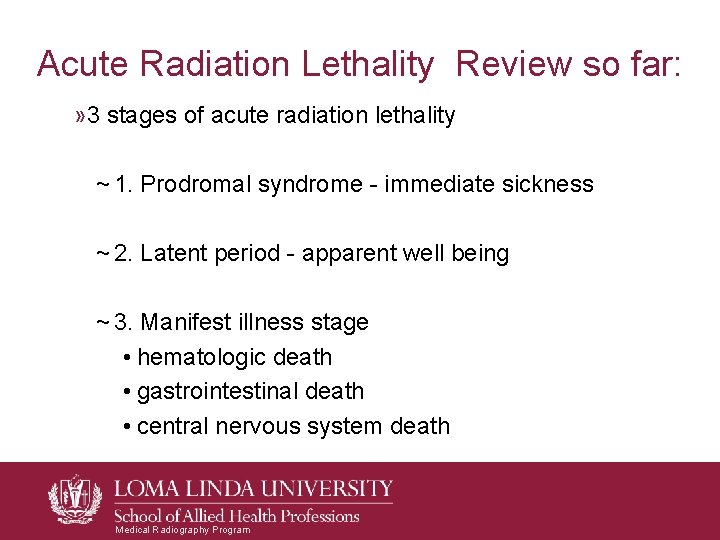
Acute Radiation Lethality Review so far: » 3 stages of acute radiation lethality ~ 1. Prodromal syndrome - immediate sickness ~ 2. Latent period - apparent well being ~ 3. Manifest illness stage • hematologic death • gastrointestinal death • central nervous system death Medical Radiography Program
Review of Dose and Symptoms Medical Radiography Program
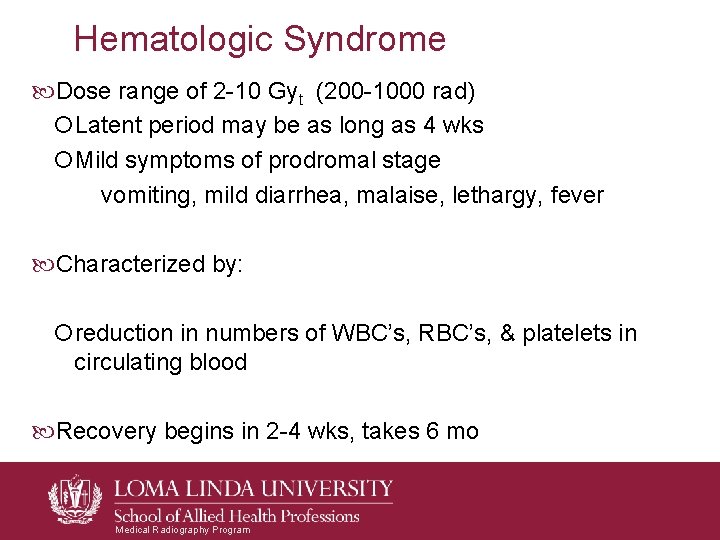
Hematologic Syndrome Dose range of 2 -10 Gyt (200 -1000 rad) Latent period may be as long as 4 wks Mild symptoms of prodromal stage vomiting, mild diarrhea, malaise, lethargy, fever Characterized by: reduction in numbers of WBC’s, RBC’s, & platelets in circulating blood Recovery begins in 2 -4 wks, takes 6 mo Medical Radiography Program
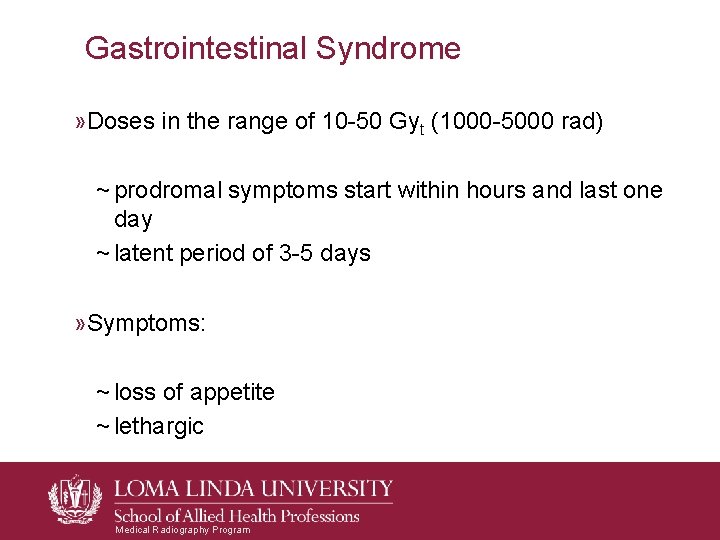
Gastrointestinal Syndrome » Doses in the range of 10 -50 Gyt (1000 -5000 rad) ~ prodromal symptoms start within hours and last one day ~ latent period of 3 -5 days » Symptoms: ~ loss of appetite ~ lethargic Medical Radiography Program
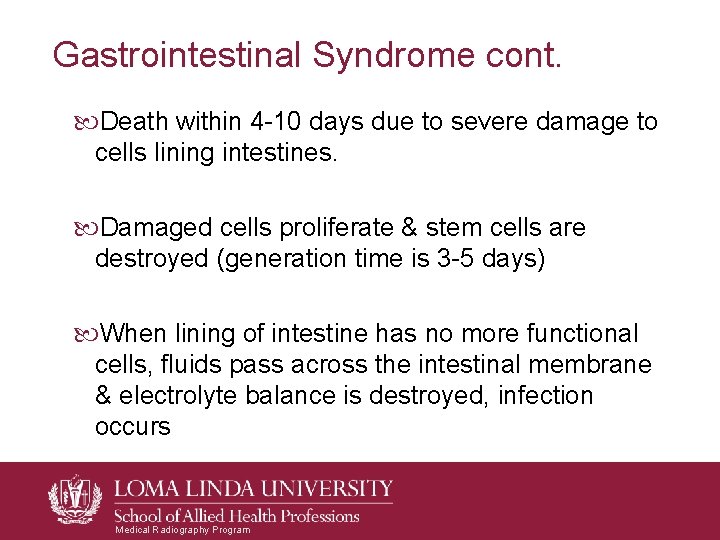
Gastrointestinal Syndrome cont. Death within 4 -10 days due to severe damage to cells lining intestines. Damaged cells proliferate & stem cells are destroyed (generation time is 3 -5 days) When lining of intestine has no more functional cells, fluids pass across the intestinal membrane & electrolyte balance is destroyed, infection occurs Medical Radiography Program
Question? » When the GI syndrome occurs will the Hematologic syndrome also be present? » Why or Why not? Medical Radiography Program
Answer » Yes the GI syndrome can occur with the Hematologic syndrome – there is enough time and dose for both to occur. Medical Radiography Program
Central Nervous System Syndrome Doses over > 50 Gyt (5000 rad) prodromal symptoms within minutes: nervous, confused, lose vision burning sensation in skin lose consciousness within the first hour Latent period up to 6 -12 hours Manifest Illness - CNS symptoms: prodromal symptoms reappear & : person disoriented, has difficulty breathing lose muscle coordination convulsions, seizures, lapses into a coma & dies Medical Radiography Program
Central Nervous System Syndrome » Cause of death: ~ increased fluid content of the brain ~ causes increased ICP’s and ~ inflammation of blood vessels Medical Radiography Program
Another Question? » When the CNS syndrome occurs, will the GI syndrome or the hematological syndrome occur? » Why or Why not? Medical Radiography Program
Answer » No – you would die from the CNS prior to there being enough time for the hematologic or GI syndromes to appear Medical Radiography Program
Question (yes another one!) » What dose response relationship is used for acute human lethality? » Think…. » Medical Radiography Program
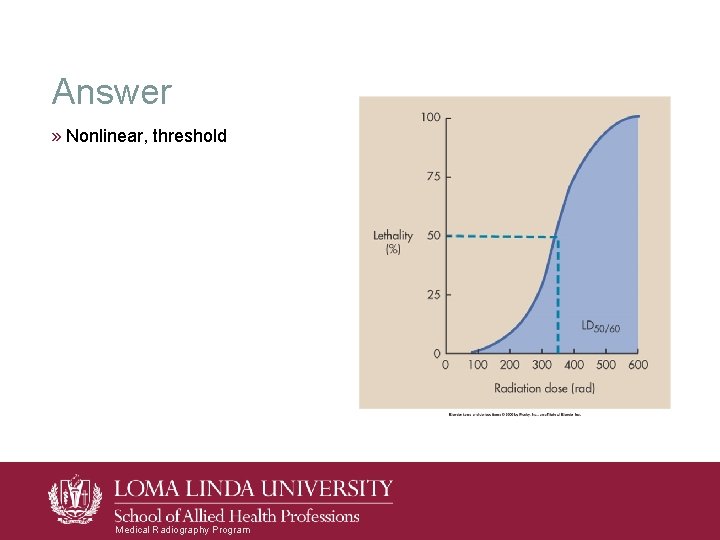
Answer » Nonlinear, threshold Medical Radiography Program
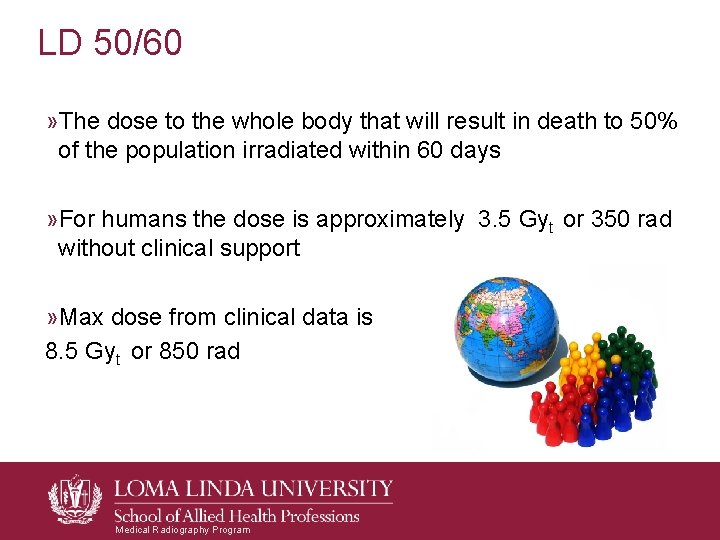
LD 50/60 » The dose to the whole body that will result in death to 50% of the population irradiated within 60 days » For humans the dose is approximately 3. 5 Gyt or 350 rad without clinical support » Max dose from clinical data is 8. 5 Gyt or 850 rad Medical Radiography Program
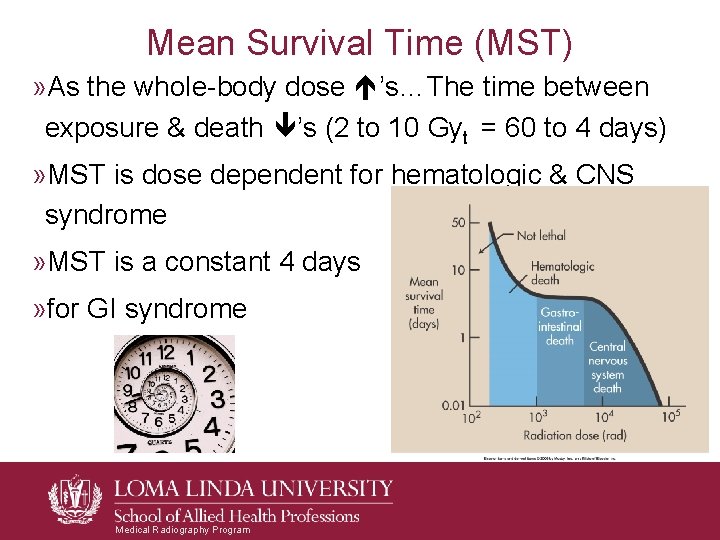
Mean Survival Time (MST) » As the whole-body dose ’s…The time between exposure & death ’s (2 to 10 Gyt = 60 to 4 days) » MST is dose dependent for hematologic & CNS syndrome » MST is a constant 4 days » for GI syndrome Medical Radiography Program
Local Tissue Damage Higher dose is needed to produce a response when only part of the body is irradiated Vs. the whole body Very important that you cone on babies! Every organ/tissue can be affected by local irradiation effect is cell death atrophy non-function or recovery Medical Radiography Program
How Tissues Respond » Depends on 3 things: ~ the inherent radiosensitivity of the tissue ~ cell proliferation rate ~ maturation level of tissue » Sound familiar? ~ The law of B & T? ? ? Medical Radiography Program
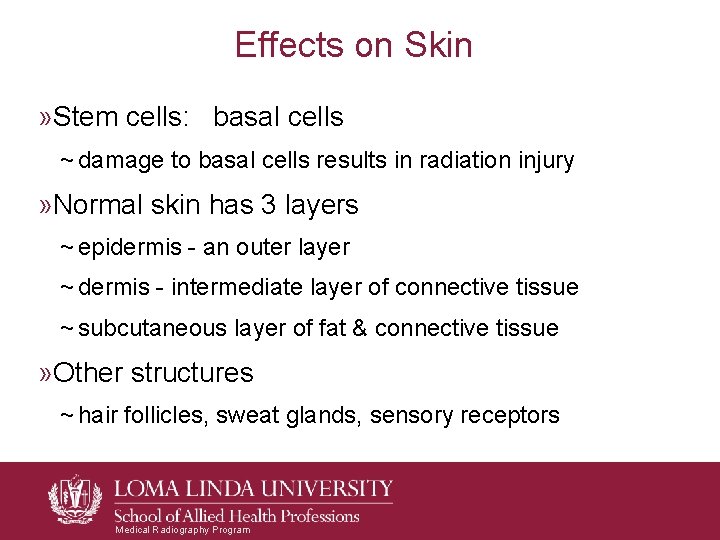
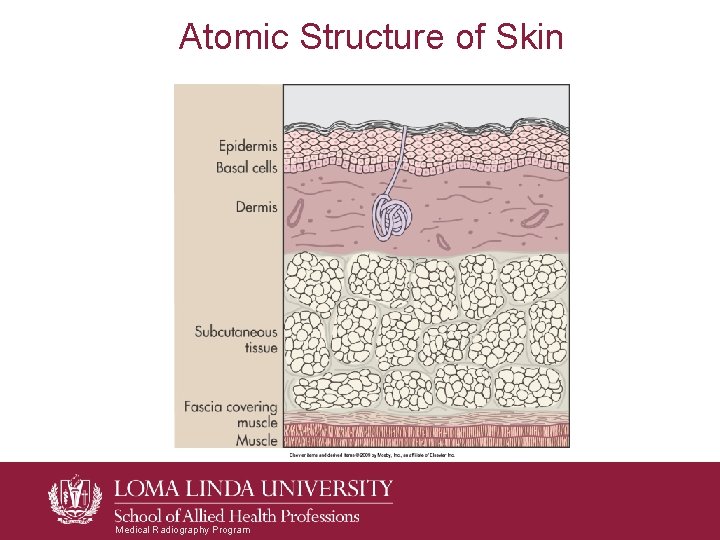
Effects on Skin » Stem cells: basal cells ~ damage to basal cells results in radiation injury » Normal skin has 3 layers ~ epidermis - an outer layer ~ dermis - intermediate layer of connective tissue ~ subcutaneous layer of fat & connective tissue » Other structures ~ hair follicles, sweat glands, sensory receptors Medical Radiography Program
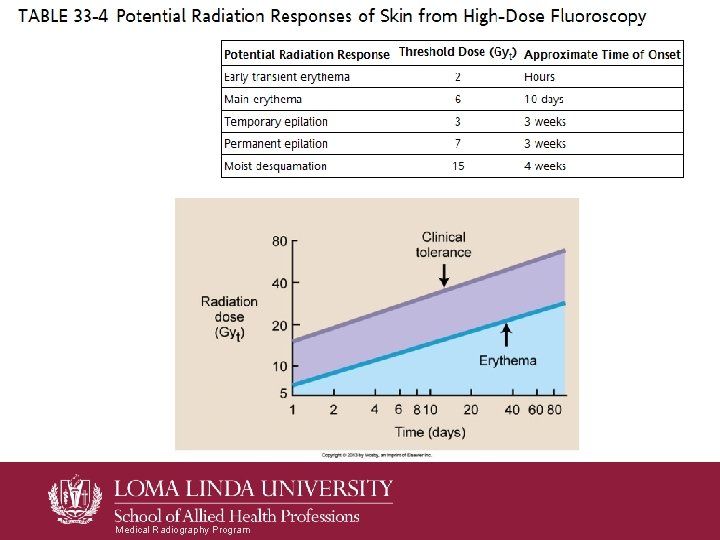
Medical Radiography Program
Atomic Structure of Skin Medical Radiography Program
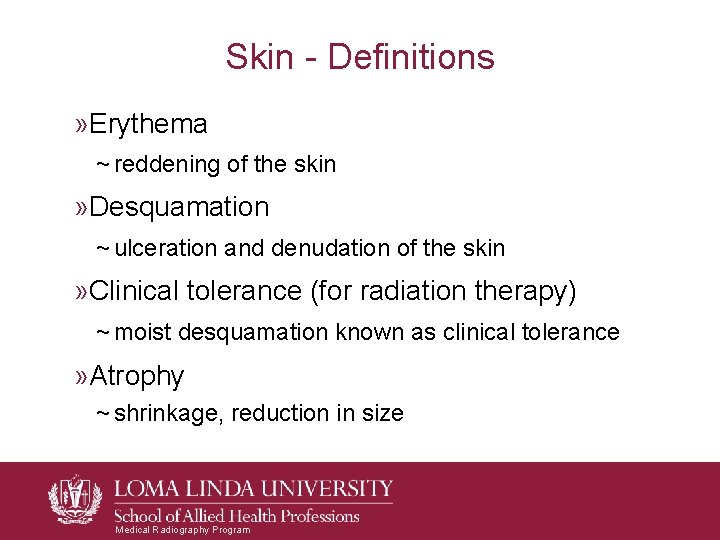
Skin - Definitions » Erythema ~ reddening of the skin » Desquamation ~ ulceration and denudation of the skin » Clinical tolerance (for radiation therapy) ~ moist desquamation known as clinical tolerance » Atrophy ~ shrinkage, reduction in size Medical Radiography Program
Definitions » Epilation ~ loss of hair » Grenz Rays ~ soft X-rays (10 to 20 k. Vp) --old treatment to skin dz-» SED 50 ~ skin erythema dose ~ dose required to affect 50% of the people irradiated • about 600 rad. Medical Radiography Program
Local Tissues Effected Immediately » Gonads » Bone Marrow » Skin Medical Radiography Program
Gonads » Gametogenesis = development of the gametes or germ cells » They are critical target organs ~ Why? » Extremely sensitive to radiation ~ doses as low as 10 rad can cause a response ~ they produce the germ cells that control fertility & heredity Medical Radiography Program
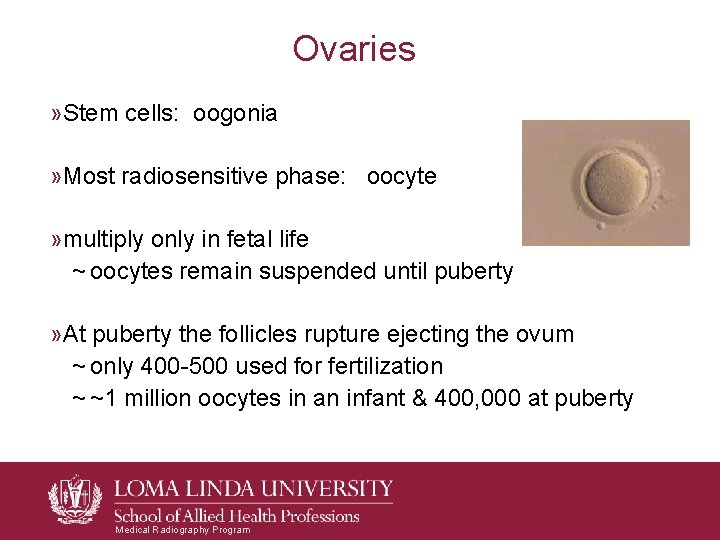
Ovaries » Stem cells: oogonia » Most radiosensitive phase: oocyte » multiply only in fetal life ~ oocytes remain suspended until puberty » At puberty the follicles rupture ejecting the ovum ~ only 400 -500 used for fertilization ~ ~1 million oocytes in an infant & 400, 000 at puberty Medical Radiography Program
Ovaries » Babies & children are the most radiosensitive & germ cells are radiosensitive ~ CONE & SHIELD » Ovaries least sensitive in 20 -30 yr range ~ 100 m. Gyt 10 rad may delay or suppress menstruation ~ 2 Gyt 200 rad will produce temporary sterility ~ 5 Gyt 500 rad could cause permanent sterility Medical Radiography Program
Ovaries - mutations » 250 to 500 m. Gyt (25 -50 rad) can produce ’s in genetic mutations (animals) ~ Surviving oocytes can repair some genetic damage as they mature ~ Women may want to avoid getting pregnant for several months after ovarian doses 10 rad » Abortion NOT indicated for any diagnostic range dose Medical Radiography Program
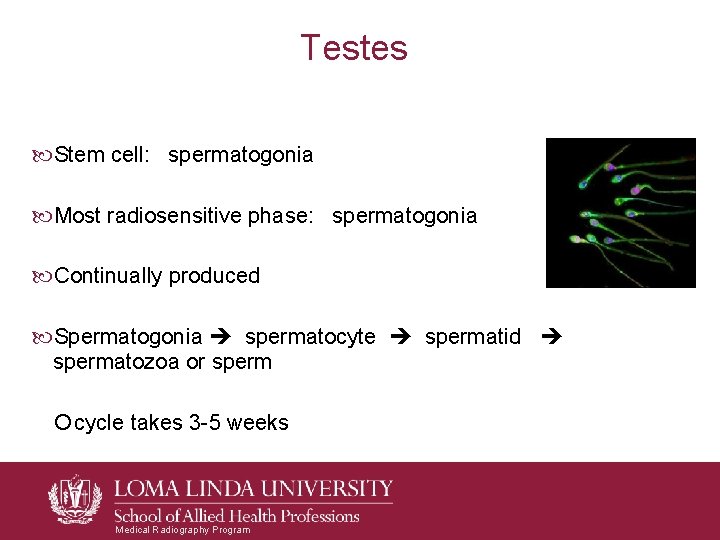
Testes Stem cell: spermatogonia Most radiosensitive phase: spermatogonia Continually produced Spermatogonia spermatocyte spermatid spermatozoa or sperm cycle takes 3 -5 weeks Medical Radiography Program
Testes » 100 m Gyt 10 rad can cause reduction in # of sperm » 2 Gyt 200 rad produces temporary sterility ~ starts ~2 months after irradiation ~ WHY? » 5 Gyt 500 rad to testes produces permanent sterility Medical Radiography Program
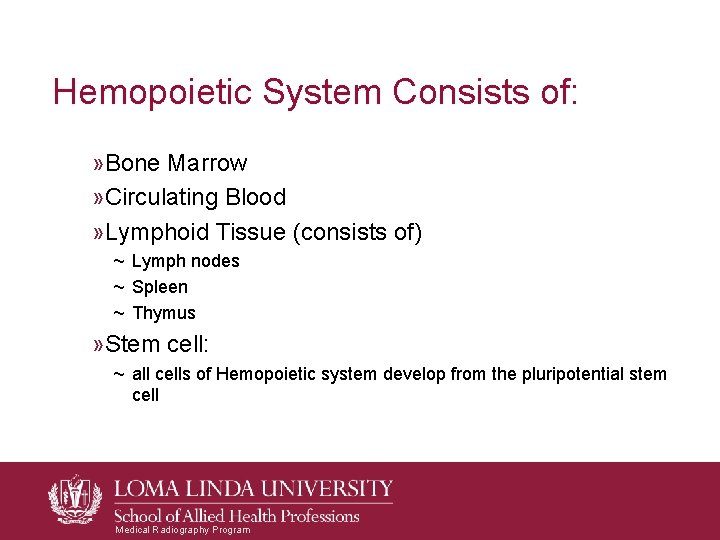
Hemopoietic System Consists of: » Bone Marrow » Circulating Blood » Lymphoid Tissue (consists of) ~ Lymph nodes ~ Spleen ~ Thymus » Stem cell: ~ all cells of Hemopoietic system develop from the pluripotential stem cell Medical Radiography Program
Comments » On the test DO NOT list Lymph nodes, Spleen, Thymus separately for hemopoietic system ~ They are the lymphoid tissue which is one component of the hemopoietic system. Medical Radiography Program
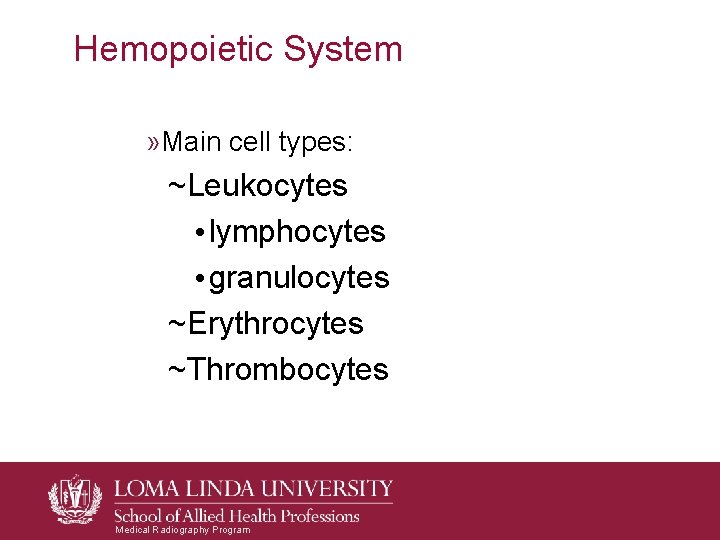
Hemopoietic System » Main cell types: ~Leukocytes • lymphocytes • granulocytes ~Erythrocytes ~Thrombocytes Medical Radiography Program
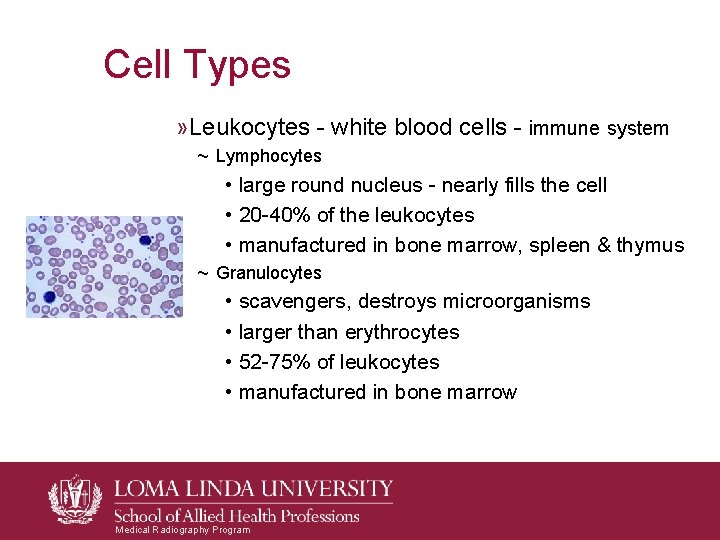
Cell Types » Leukocytes - white blood cells - immune system ~ Lymphocytes • large round nucleus - nearly fills the cell • 20 -40% of the leukocytes • manufactured in bone marrow, spleen & thymus ~ Granulocytes • scavengers, destroys microorganisms • larger than erythrocytes • 52 -75% of leukocytes • manufactured in bone marrow Medical Radiography Program
Comments » Lymphocytes and Granulocytes are both Leukocytes » Know where each of the blood cells are manufactured Medical Radiography Program
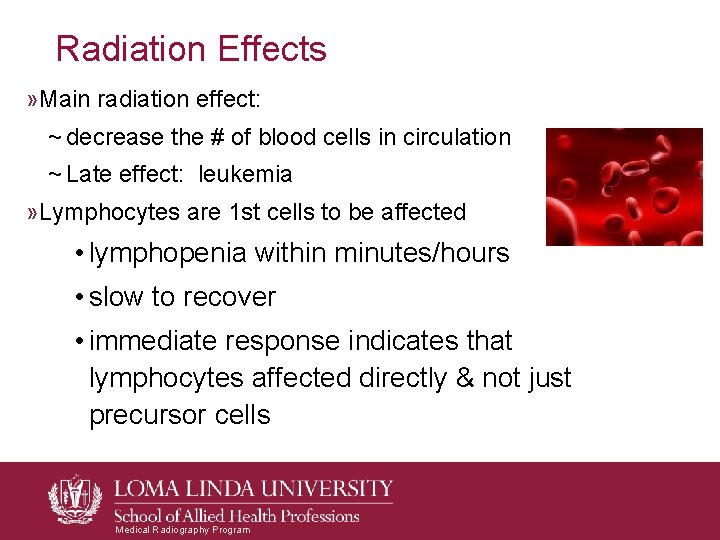
Radiation Effects » Main radiation effect: ~ decrease the # of blood cells in circulation ~ Late effect: leukemia » Lymphocytes are 1 st cells to be affected • lymphopenia within minutes/hours • slow to recover • immediate response indicates that lymphocytes affected directly & not just precursor cells Medical Radiography Program
Radiation Effects » Granulocytes ~ rapid rise in # (granulocytosis) followed by rapid decrease & slower decrease (granulocytopenia) ~ recovery takes ~ 2 months » Platelets ~ thrombocytopenia (decrease in platelets) occurs slowly due to the longer time for precursor cells to reach maturity ~ minimum level in ~ 30 days & recovery in ~ 2 months Medical Radiography Program
Radiation Effects » Erythrocytes ~ less sensitive than other blood cells ~ very long lifetime in peripheral blood ~ injury noticeable for several weeks ~ total recovery (without intervention) may take 6 months to a year Medical Radiography Program
Cytogenetic Effects » Cytogenetics = the study of the genetic aspects of cells, chromosomes in particular » Radiation-induced chromosome aberrations follow a Nonthreshold relationship » High doses of radiation cause chromosome aberrations ~ Unable to see chromosomal aberrations under a dose of 100 m Gyt 10 rad Medical Radiography Program
Cytogenetic Effects » Cytogenetic damage may occur immediately but may not be seen for awhile ~ takes time for that stem cell to reach maturity ~ it can be months and years before damage can be measured. » Chromosome abnormalities can be seen in circulating lymphocytes even 20 years after a radiation accident… Medical Radiography Program
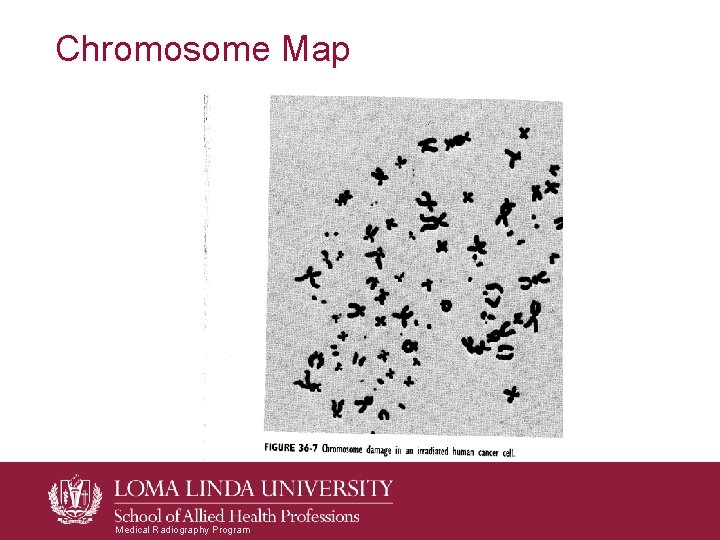
Karyotype » Karyotype = a chromosome map » Photographs of chromosomes are enlarged » Each chromosome is cut out & matched with its “sister” » Chromosomal damage can be observed at this point Medical Radiography Program
Chromosomal Damage » In an inbred population both chromosomes of the pair will usually be the same ~ in a normal population the two chromosomes will usually contain many different genes » When a chromosome is changed the genetic character transmitted is changes ~ these changes are mutations • most mutations are recessive Medical Radiography Program
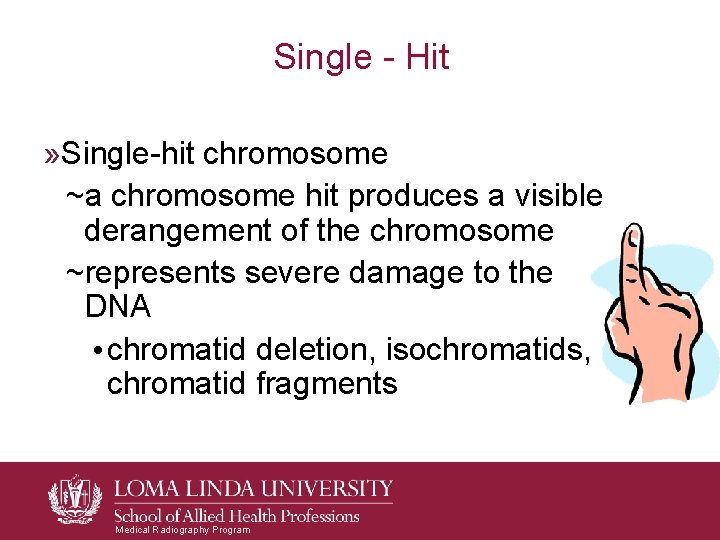
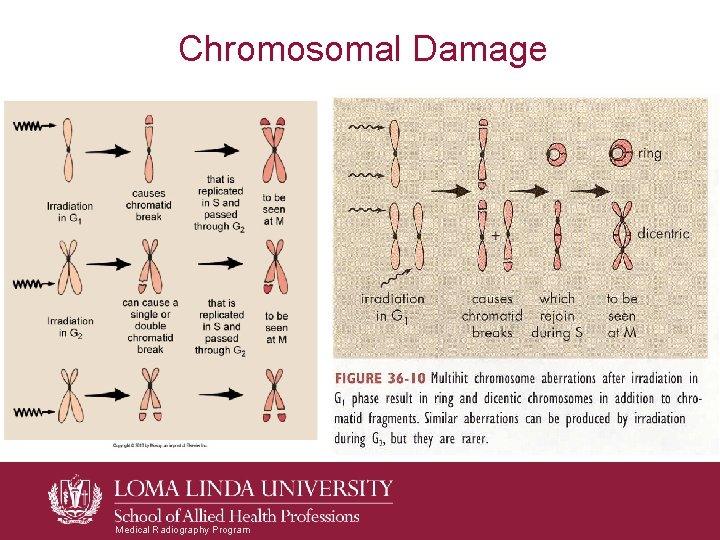
Single - Hit » Single-hit chromosome ~a chromosome hit produces a visible derangement of the chromosome ~represents severe damage to the DNA • chromatid deletion, isochromatids, chromatid fragments Medical Radiography Program
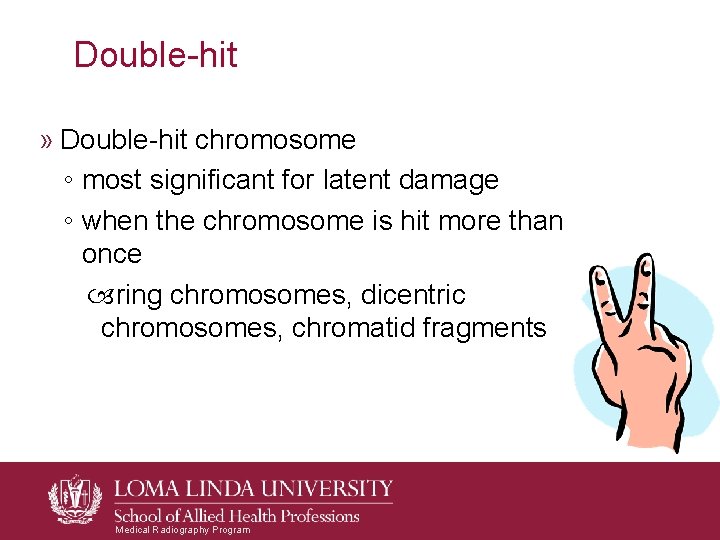
Double-hit » Double-hit chromosome ◦ most significant for latent damage ◦ when the chromosome is hit more than once ring chromosomes, dicentric chromosomes, chromatid fragments Medical Radiography Program
Chromosomal Damage Medical Radiography Program
Chromosome Map Medical Radiography Program
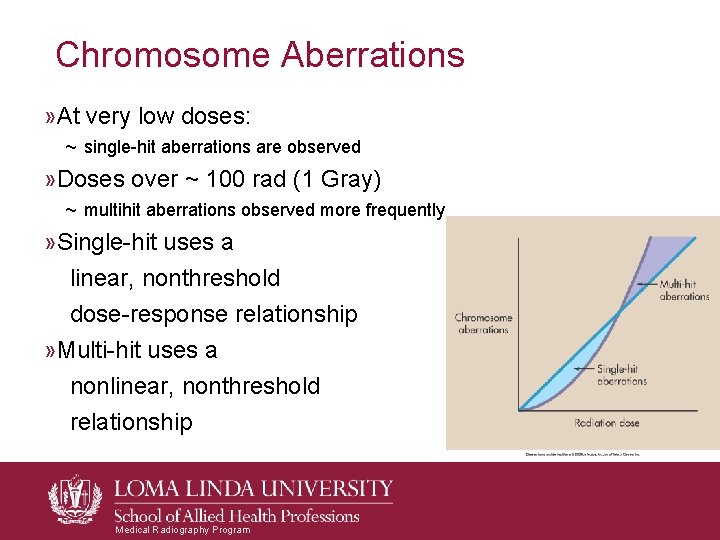
Chromosome Aberrations » At very low doses: ~ single-hit aberrations are observed » Doses over ~ 100 rad (1 Gray) ~ multihit aberrations observed more frequently » Single-hit uses a linear, nonthreshold dose-response relationship » Multi-hit uses a nonlinear, nonthreshold relationship Medical Radiography Program
THE END Medical Radiography Program