
Determining Uses of Water Next Generation Science Common


- Slides: 26
Determining Uses of Water
Next Generation Science / Common Core Standards Addressed! n HS‐ETS 1‐ 2. Design a solution to a complex real‐world problem by breaking it down into smaller, more manageable problems that can be solved through engineering. HS‐ETS 1‐ 3. Evaluate a solution to a complex real‐world problem based on prioritized criteria and trade‐offs that account for a range of constraints, including cost, safety, reliability, and aesthetics, as well as possible social, cultural, and environmental impacts.
Agriculture, Food, and Natural Resource Standards Addressed n NRS. 01. 04. Apply ecological concepts and principles to aquatic natural resource systems. u NRS. 01. 04. 02. a. Examine and describe the importance of groundwater and surface water to natural resources.
Bell Work / Learning Objectives n Explain the importance of water. n Define potable water. n Identify methods of water management.
Terms n Hardness n p. H n Potable water
Does the color of water reflect the quality of water? Ø Observe the samples of water. Ø What makes one sample of water better or worse than another? Ø Which one would you rather drink and why?
Importance of Water n Water is one of the three basic needs for the life of humans. u Without water, we could not survive. n Plants and animals also need it to survive. n There are many uses of water including life processes, daily living, agriculture production, climate, manufacturing, transportation, and recreation.
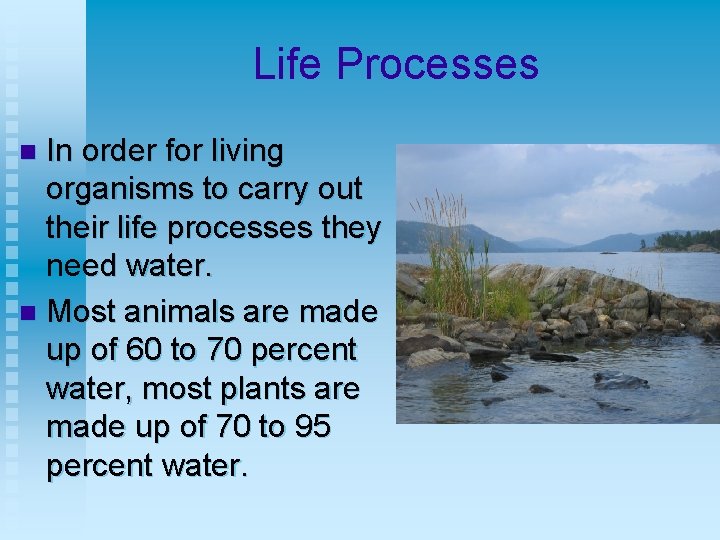
Life Processes In order for living organisms to carry out their life processes they need water. n Most animals are made up of 60 to 70 percent water, most plants are made up of 70 to 95 percent water. n
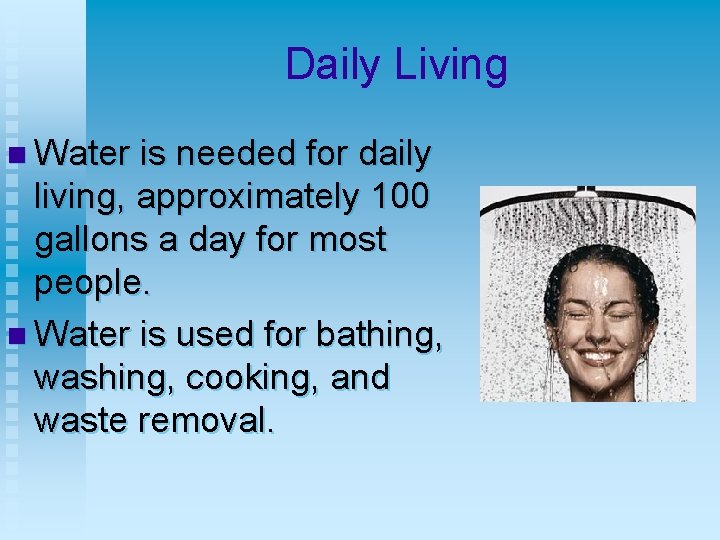
Daily Living n Water is needed for daily living, approximately 100 gallons a day for most people. n Water is used for bathing, washing, cooking, and waste removal.
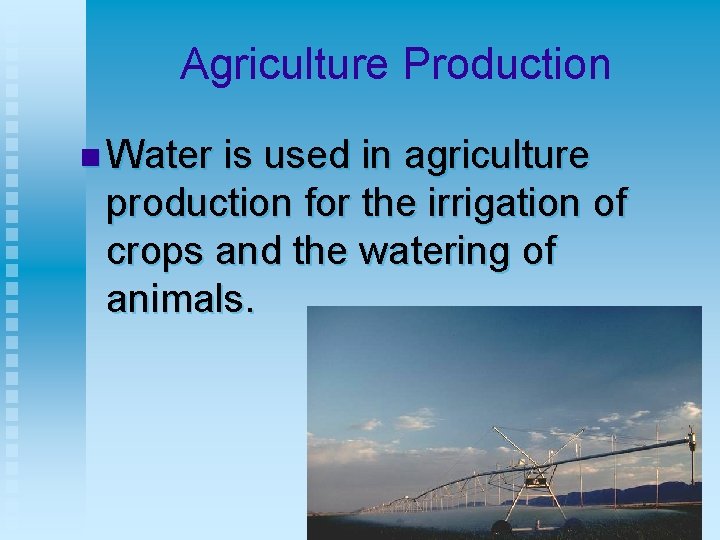
Agriculture Production n Water is used in agriculture production for the irrigation of crops and the watering of animals.
Climate n Water is capable of moderating the climate in the immediate area. n It does so by regulating and transferring heat. n Large bodies of water can also cause storms, high winds, and hurricanes.
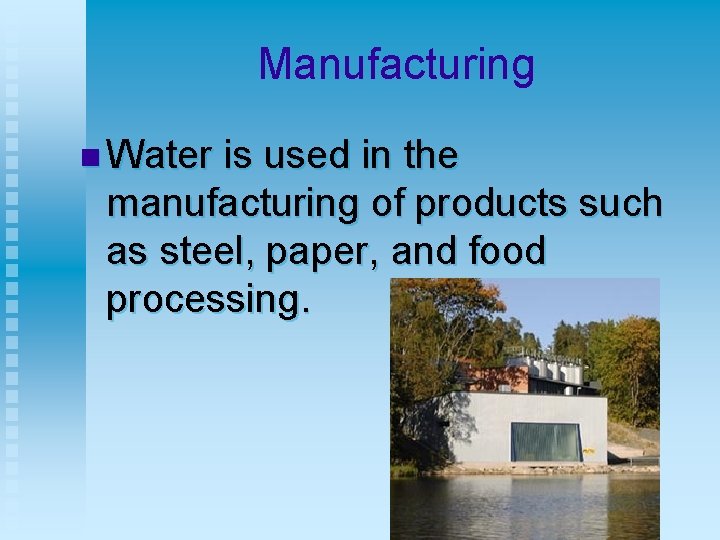
Manufacturing n Water is used in the manufacturing of products such as steel, paper, and food processing.
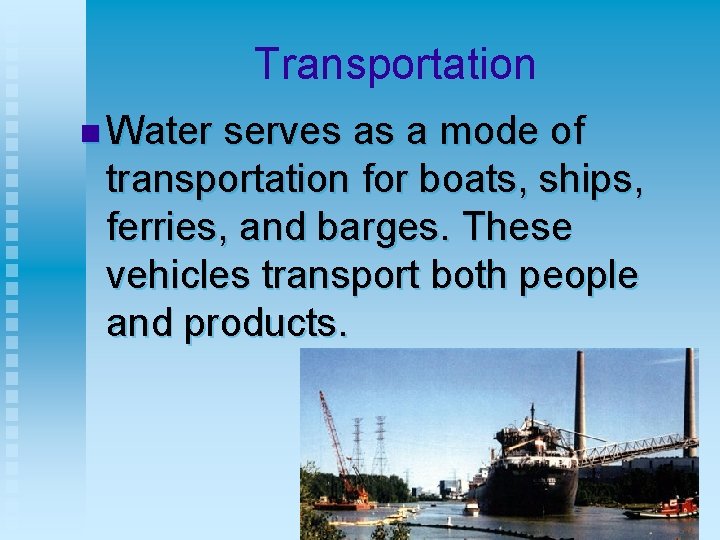
Transportation n Water serves as a mode of transportation for boats, ships, ferries, and barges. These vehicles transport both people and products.
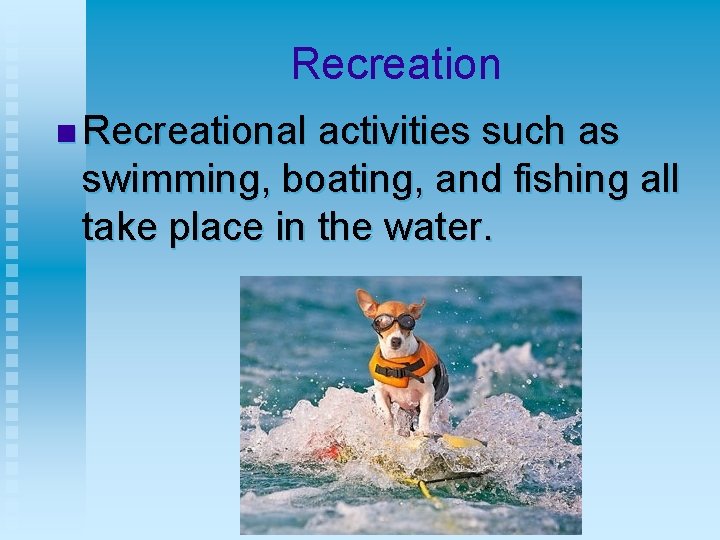
Recreation n Recreational activities such as swimming, boating, and fishing all take place in the water.
Potable Water n Water that is safe for human use and consumption. n Potable water contains minerals so it is not pure. n These minerals can cause variations in the odor, taste, color, p. H, alkalinity, and hardness of the water.
Odor and Taste n Commonly the result of the water source. n Sometimes, they can be the result of the addition of chemical to the water by the local water system. n Other causes are pollution, organic sulfur, and microorganisms.
Color n Colored water may not look appetizing but that doesn’t mean it’s not safe to drink. u However, it may not be useful for activities such as washing clothes. n Colored water may be the result of minerals such as iron and calcium in the water, sediment, organic matter, and plankton. n Larger particles can be easily removed through filtration.
p. H n The measurement of the acidity or alkalinity of water. n Water is often treated so that it remains in the p. H range of 7. 0 to 7. 8, or almost neutral. n Water p. H can be determined using a p. H meter.
Hardness n The concentration of calcium and magnesium ions in water. n The higher the concentration of ions, the harder the water. n Hardness can be reduced through a process referred to as softening.
Methods of Water Management n Before consumption, potable water from some sources needs to be treated, while water from other sources needs little or no treatment. n Often times, water that is being used in the home or business may go through additional treatment before use.
Methods of Water Management n Water pumped from wells usually needs little treatment besides adding chlorine for disinfection and softeners to reduce hardness. n The level of treatment needed should be determined by sending a sample to a laboratory.
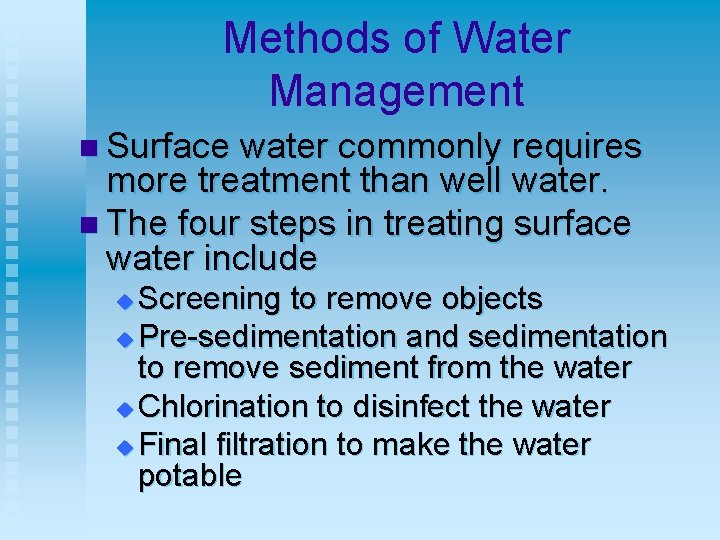
Methods of Water Management n Surface water commonly requires more treatment than well water. n The four steps in treating surface water include Screening to remove objects u Pre-sedimentation and sedimentation to remove sediment from the water u Chlorination to disinfect the water u Final filtration to make the water potable u
Methods of Water Management n Water that is used on homes and businesses may also go through additional filtration processes. n In the home, filters can be placed on the faucet or where the pipes enter the house.
Methods of Water Management n In a business, additional complex filtering may take place before water flows through machines such as ice makers.
Review / Summary n Explain the importance of water. n Define potable water. n Identify methods of water management.
The End!