
Determining the Impact Parameter and CrossSection in Heavy
- Slides: 2
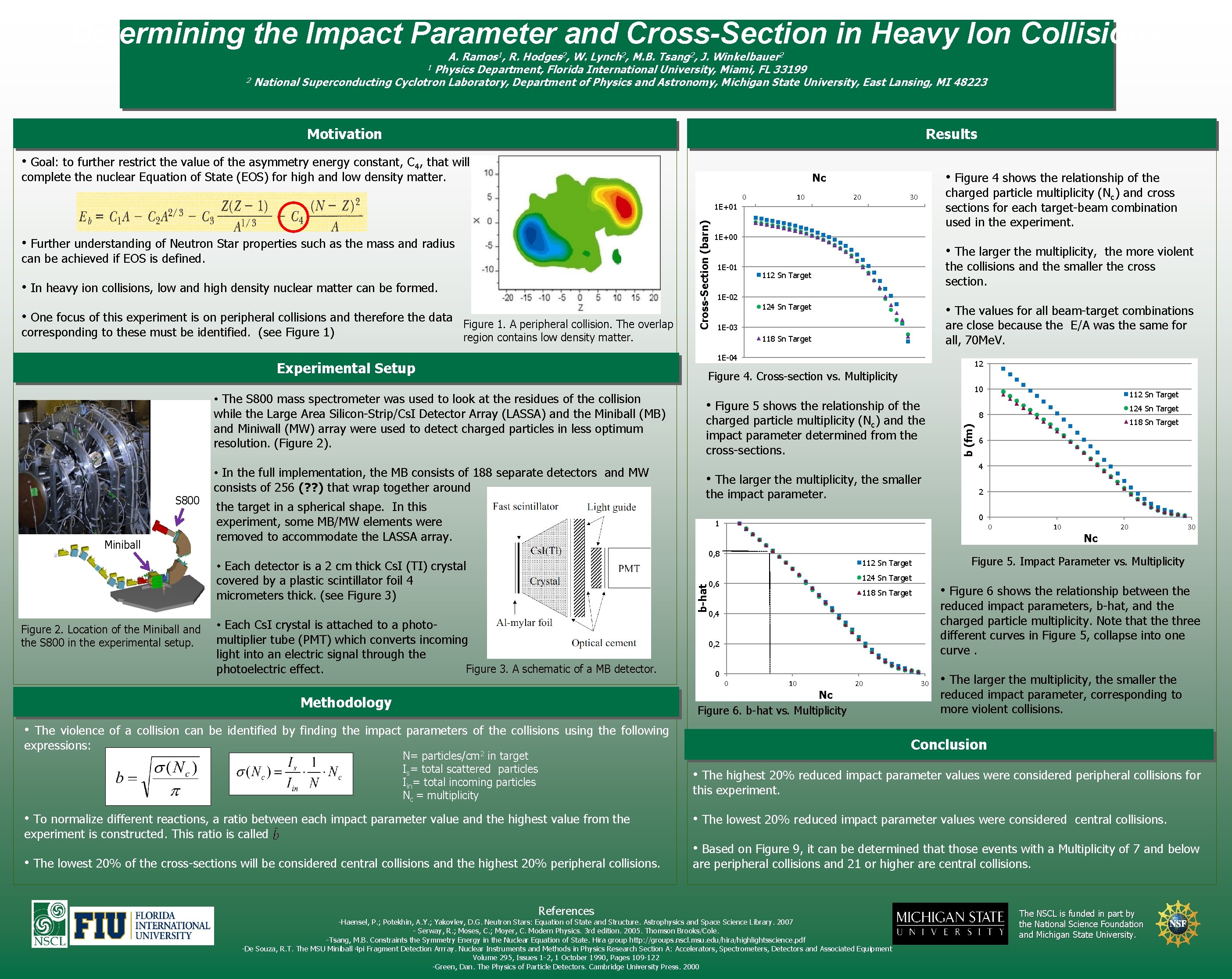
Determining the Impact Parameter and Cross-Section in Heavy Ion Collisions A. Ramos 1, R. Hodges 2, W. Lynch 2, M. B. Tsang 2, J. Winkelbauer 2 1 Physics Department, Florida International University, Miami, FL 33199 2 National Superconducting Cyclotron Laboratory, Department of Physics and Astronomy, Michigan State University, East Lansing, MI 48223 Motivation Results • Goal: to further restrict the value of the asymmetry energy constant, C 4, that will complete the nuclear Equation of State (EOS) for high and low density matter. • Figure 4 shows the relationship of the Nc 0 10 20 charged particle multiplicity (Nc) and cross sections for each target-beam combination used in the experiment. 30 • Further understanding of Neutron Star properties such as the mass and radius can be achieved if EOS is defined. • In heavy ion collisions, low and high density nuclear matter can be formed. corresponding to these must be identified. (see Figure 1) Figure 1. A peripheral collision. The overlap region contains low density matter. • In the full implementation, the MB consists of 188 separate detectors and MW consists of 256 (? ? ) that wrap together around the target in a spherical shape. In this experiment, some MB/MW elements were removed to accommodate the LASSA array. 112 Sn Target the collisions and the smaller the cross section. 124 Sn Target • The values for all beam-target combinations 1 E-02 are close because the E/A was the same for all, 70 Me. V. 1 E-03 118 Sn Target 12 10 • Figure 5 shows the relationship of the charged particle multiplicity (Nc) and the impact parameter determined from the cross-sections. • The larger the multiplicity, the smaller the impact parameter. b-hat • Each Cs. I crystal is attached to a photomultiplier tube (PMT) which converts incoming light into an electric signal through the Figure 3. A schematic of a MB detector. photoelectric effect. Methodology 124 Sn Target 0, 2 0 10 Nc 20 Figure 6. b-hat vs. Multiplicity N= particles/cm 2 in target Is= total scattered particles Iin= total incoming particles Nc = multiplicity 4 0 10 Nc 20 30 reduced impact parameters, b-hat, and the charged particle multiplicity. Note that the three different curves in Figure 5, collapse into one curve. • The violence of a collision can be identified by finding the impact parameters of the collisions using the following expressions: 6 • Figure 6 shows the relationship between the 118 Sn Target 0, 4 0 118 Sn Target Figure 5. Impact Parameter vs. Multiplicity 112 Sn Target 0, 6 124 Sn Target 8 0 0, 8 112 Sn Target 2 1 • Each detector is a 2 cm thick Cs. I (TI) crystal covered by a plastic scintillator foil 4 micrometers thick. (see Figure 3) Figure 2. Location of the Miniball and the S 800 in the experimental setup. 1 E-01 Figure 4. Cross-section vs. Multiplicity • The S 800 mass spectrometer was used to look at the residues of the collision while the Large Area Silicon-Strip/Cs. I Detector Array (LASSA) and the Miniball (MB) and Miniwall (MW) array were used to detect charged particles in less optimum resolution. (Figure 2). Miniball • The larger the multiplicity, the more violent 1 E-04 Experimental Setup S 800 1 E+00 b (fm) • One focus of this experiment is on peripheral collisions and therefore the data Cross-Section (barn) 1 E+01 30 • The larger the multiplicity, the smaller the reduced impact parameter, corresponding to more violent collisions. Conclusion • The highest 20% reduced impact parameter values were considered peripheral collisions for this experiment. • To normalize different reactions, a ratio between each impact parameter value and the highest value from the experiment is constructed. This ratio is called • The lowest 20% of the cross-sections will be considered central collisions and the highest 20% peripheral collisions. References • The lowest 20% reduced impact parameter values were considered central collisions. • Based on Figure 9, it can be determined that those events with a Multiplicity of 7 and below are peripheral collisions and 21 or higher are central collisions. -Haensel, P. ; Potekhin, A. Y. ; Yakovlev, D. G. Neutron Stars: Equation of State and Structure. Astrophysics and Space Science Library. 2007 - Serway, R. ; Moses, C. ; Moyer, C. Modern Physics. 3 rd edition. 2005. Thomson Brooks/Cole. -Tsang, M. B. Constraints the Symmetry Energy in the Nuclear Equation of State. Hira group http: //groups. nscl. msu. edu/hira/highlightsscience. pdf -De Souza, R. T. The MSU Miniball 4 pi Fragment Detection Arrray. Nuclear Instruments and Methods in Physics Research Section A: Accelerators, Spectrometers, Detectors and Associated Equipment Volume 295, Issues 1 -2, 1 October 1990, Pages 109 -122 -Green, Dan. The Physics of Particle Detectors. Cambridge University Press. 2000 The NSCL is funded in part by the National Science Foundation and Michigan State University.
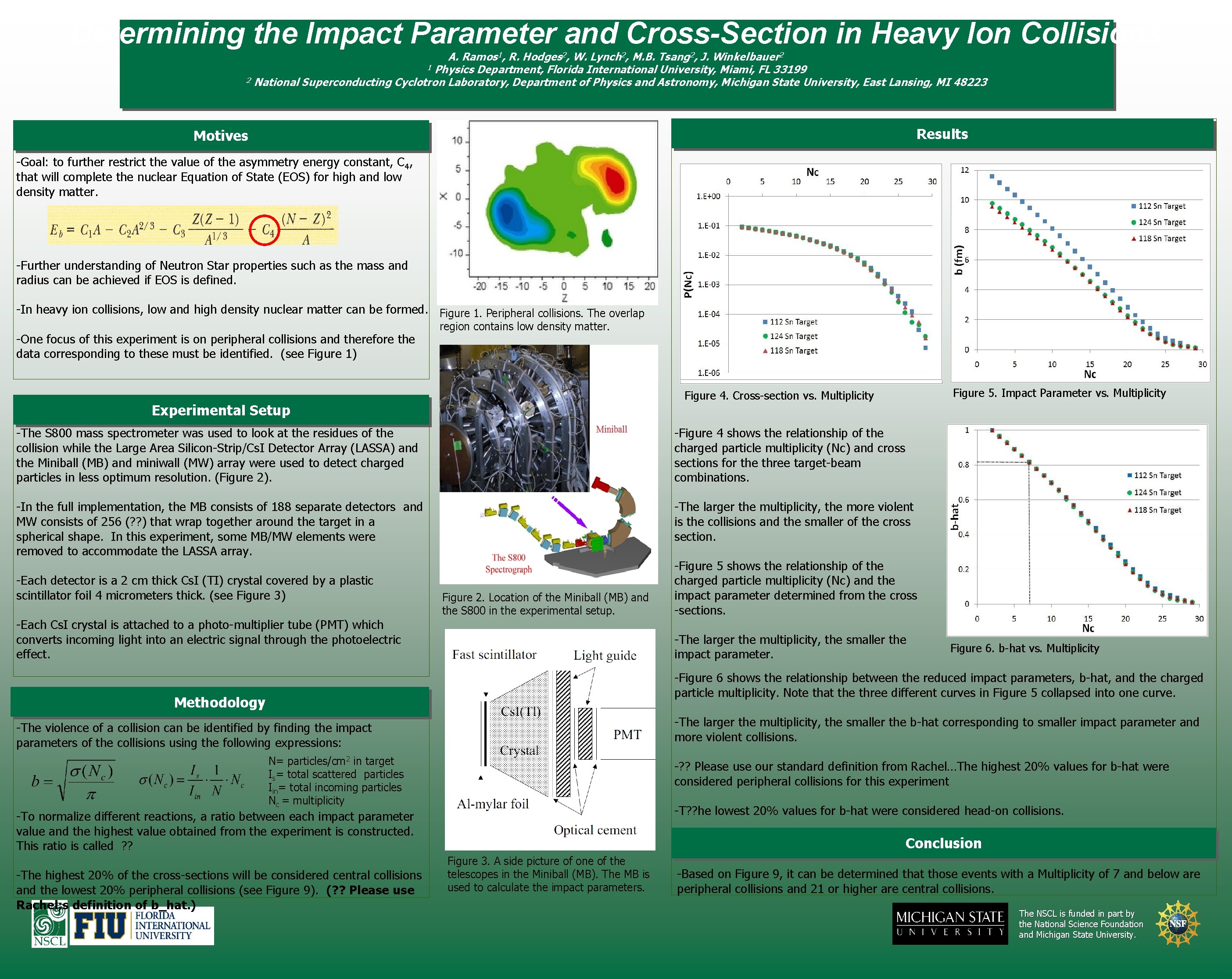
Determining the Impact Parameter and Cross-Section in Heavy Ion Collisions A. Ramos 1, R. Hodges 2, W. Lynch 2, M. B. Tsang 2, J. Winkelbauer 2 1 Physics Department, Florida International University, Miami, FL 33199 2 National Superconducting Cyclotron Laboratory, Department of Physics and Astronomy, Michigan State University, East Lansing, MI 48223 Results Motives -Goal: to further restrict the value of the asymmetry energy constant, C 4, that will complete the nuclear Equation of State (EOS) for high and low density matter. -Further understanding of Neutron Star properties such as the mass and radius can be achieved if EOS is defined. -In heavy ion collisions, low and high density nuclear matter can be formed. Figure 1. Peripheral collisions. The overlap -One focus of this experiment is on peripheral collisions and therefore the data corresponding to these must be identified. (see Figure 1) region contains low density matter. Figure 5. Impact Parameter vs. Multiplicity Figure 4. Cross-section vs. Multiplicity Experimental Setup -The S 800 mass spectrometer was used to look at the residues of the collision while the Large Area Silicon-Strip/Cs. I Detector Array (LASSA) and the Miniball (MB) and miniwall (MW) array were used to detect charged particles in less optimum resolution. (Figure 2). -Figure 4 shows the relationship of the charged particle multiplicity (Nc) and cross sections for the three target-beam combinations. -In the full implementation, the MB consists of 188 separate detectors and MW consists of 256 (? ? ) that wrap together around the target in a spherical shape. In this experiment, some MB/MW elements were removed to accommodate the LASSA array. -The larger the multiplicity, the more violent is the collisions and the smaller of the cross section. -Each detector is a 2 cm thick Cs. I (TI) crystal covered by a plastic scintillator foil 4 micrometers thick. (see Figure 3) -Each Cs. I crystal is attached to a photo-multiplier tube (PMT) which converts incoming light into an electric signal through the photoelectric effect. Figure 2. Location of the Miniball (MB) and the S 800 in the experimental setup. -Figure 5 shows the relationship of the charged particle multiplicity (Nc) and the impact parameter determined from the cross -sections. -The larger the multiplicity, the smaller the impact parameter. Figure 6. b-hat vs. Multiplicity -Figure 6 shows the relationship between the reduced impact parameters, b-hat, and the charged particle multiplicity. Note that the three different curves in Figure 5 collapsed into one curve. Methodology -The larger the multiplicity, the smaller the b-hat corresponding to smaller impact parameter and more violent collisions. -The violence of a collision can be identified by finding the impact parameters of the collisions using the following expressions: N= particles/cm 2 in target Is= total scattered particles Iin= total incoming particles Nc = multiplicity -? ? Please use our standard definition from Rachel…The highest 20% values for b-hat were considered peripheral collisions for this experiment -T? ? he lowest 20% values for b-hat were considered head-on collisions. -To normalize different reactions, a ratio between each impact parameter value and the highest value obtained from the experiment is constructed. This ratio is called ? ? -The highest 20% of the cross-sections will be considered central collisions and the lowest 20% peripheral collisions (see Figure 9). (? ? Please use Rachel; s definition of b_hat. ) Conclusion Figure 3. A side picture of one of the telescopes in the Miniball (MB). The MB is used to calculate the impact parameters. -Based on Figure 9, it can be determined that those events with a Multiplicity of 7 and below are peripheral collisions and 21 or higher are central collisions. The NSCL is funded in part by the National Science Foundation and Michigan State University.