
Determining Text Complexity Day 2 Session 1 Grades

- Slides: 45
Determining Text Complexity Day 2 | Session 1 Grades 9 -12
FACILITATOR INTRODUCTION Insert name here • Tanji Reed Marshall is an expert in teacher development, literacy development, curriculum mapping, student engagement. She is earning a Ph. D. in curriculum and instruction at Virginia Tech.
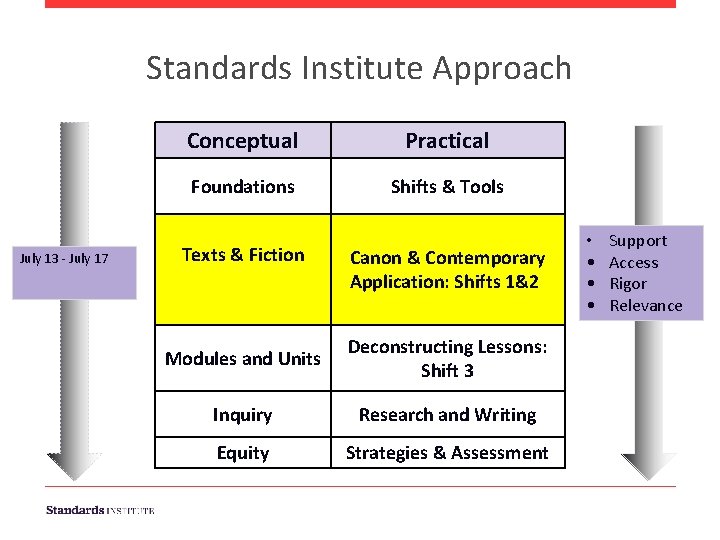
Standards Institute Approach July 13 - July 17 Conceptual Practical Foundations Shifts & Tools Texts & Fiction Canon & Contemporary Application: Shifts 1&2 Modules and Units Deconstructing Lessons: Shift 3 Inquiry Research and Writing Equity Strategies & Assessment • • Support Access Rigor Relevance
Norms that Support Our Learning Take responsibility for yourself as a learner Honor timeframes (start, end, activity) Be an active and hands-on learner Use technology to enhance learning Strive for equity of voice Contribute to a learning environment in which it is “safe to not know”
Today’s Session 1: Determining Text Complexity Session 2: Text Set Design and Practice Session 3: Shifting the Paradigm: A standards- based approach to fiction
Goals and Purpose Session 1: Determining Text Complexity Participants will… • Define three components of text complexity • Analyze texts to determine complexity • Determine text complexity appropriateness
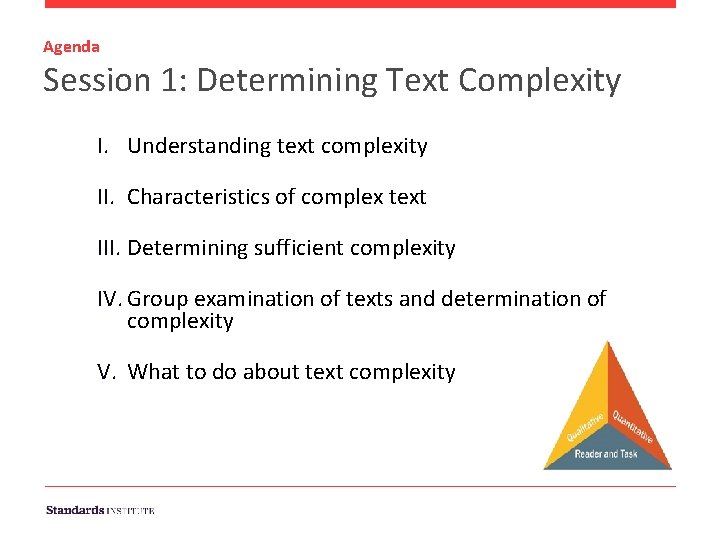
Agenda Session 1: Determining Text Complexity I. Understanding text complexity II. Characteristics of complex text III. Determining sufficient complexity IV. Group examination of texts and determination of complexity V. What to do about text complexity
Agenda Writing into the Day… Please read and choose 1 of the following: • Write a haiku defining text complexity • Develop a mathematical equation defining text complexity • Graphically represent your knowledge of text complexity with an original illustration
Session 1: Determining Text Complexity
Session 1: Determining Text Complexity What Makes a Text Complex? Carousel 1. Begin at your assigned text 2. Read and discuss the text as a group 3. Determine the elements of complexity contained in your text 4. List the components of complexity on the chart paper 5. Rotate and Repeat as directed (use a for repeated ideas)
Let’s Debrief
Session 1: Determining Text Complexity What are the Features of Complex Text? • Subtle and/or frequent transitions • Multiple and/or subtle themes and purposes • Density of information • Unfamiliar settings, topics or events • Lack of repetition, overlap or similarity in words and sentences 12
Session 1: Determining Text Complexity What are the Features of Complex Text? • Complex sentences • Uncommon vocabulary • Lack of words, sentences or paragraphs that review or pull things together for the student • Longer paragraphs • Any text structure which is less narrative and/or mixes structures 13
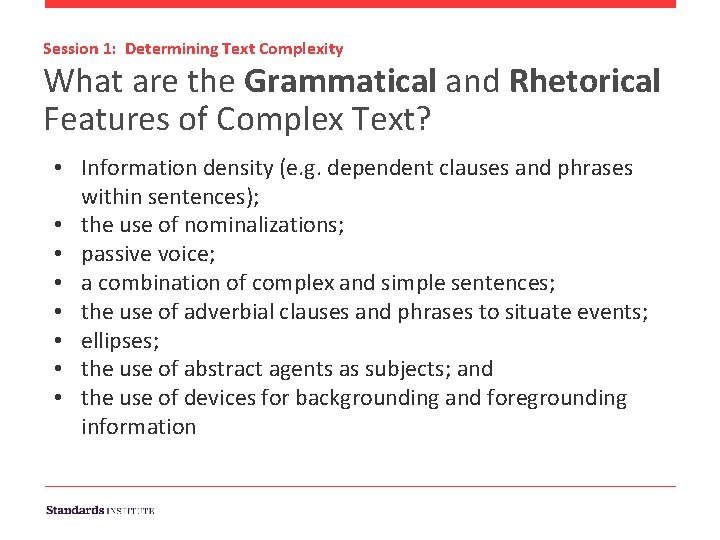
Session 1: Determining Text Complexity What are the Grammatical and Rhetorical Features of Complex Text? • Information density (e. g. dependent clauses and phrases within sentences); • the use of nominalizations; • passive voice; • a combination of complex and simple sentences; • the use of adverbial clauses and phrases to situate events; • ellipses; • the use of abstract agents as subjects; and • the use of devices for backgrounding and foregrounding information
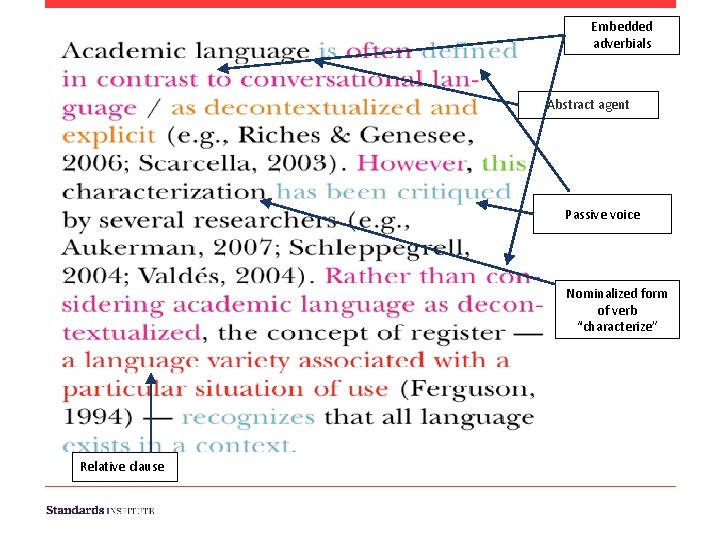
Embedded adverbials Abstract agent Passive voice Nominalized form of verb “characterize” Relative clause
Session 1: Determining Text Complexity
Session 1: Determining Text Complexity CCSS Recommendations Regarding Text Complexity • The CCR (College and Career Readiness) standards anchor the document and define general, cross-disciplinary literacy expectations that must be met for students to be prepared to enter college and workforce training programs ready to succeed. • The K– 12 grade-specific standards define end-of-year expectations and a cumulative progression designed to enable students to meet college and career readiness expectations no later than the end of high school. • The CCR and high school (grades 9– 12) standards work in tandem to define the college and career readiness line—the former providing broad standards, the latter providing additional specificity. 17
Session 1: Determining Text Complexity Why reading complex text is important • Facility with complex text strongly predicts ability to an earn a “B” grade or better) in first year college courses. (ACT, 2006. ) • Students who come to school without a solid base of background knowledge need increasingly complex texts to build their schema about the world. • The texts that students read in K-12 have become easier, but college texts have not (and instruction in College is significantly less scaffolded. ) • The texts that students read in K-12 are often not expository, but the texts that they read in college are mostly expository. • What instruction students have had with complex expository texts has been largely superficial/strategy based (skimming, focusing on details, not forming a full picture/deep understanding. ) 18
Session 1: Determining Text Complexity
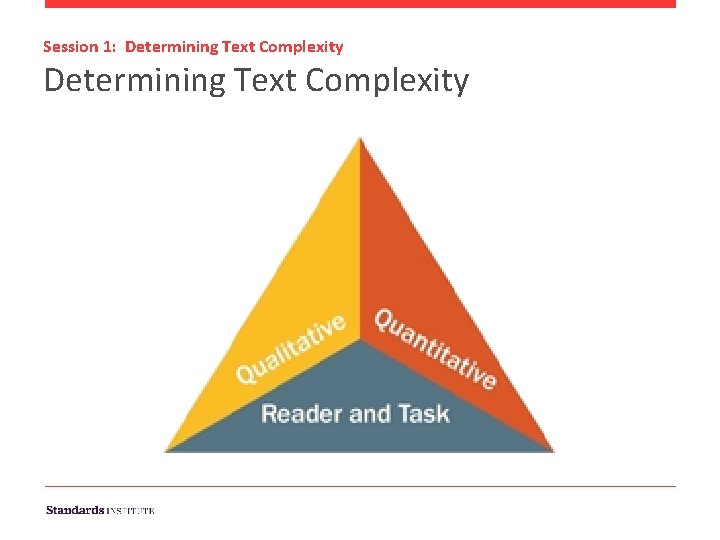
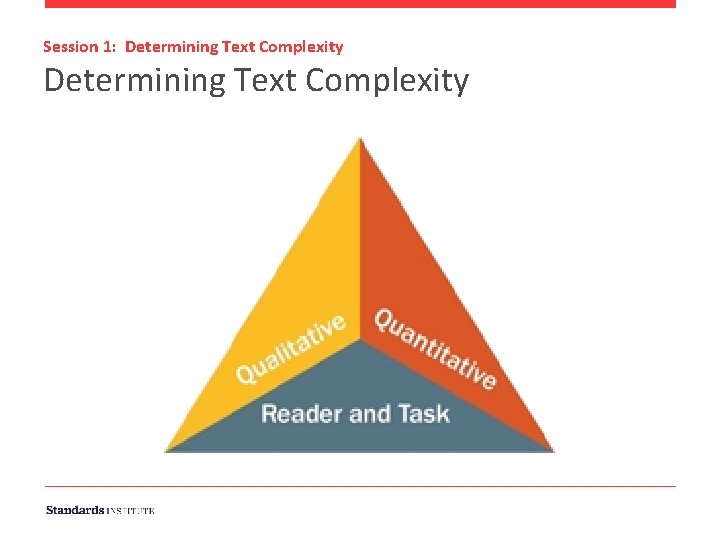
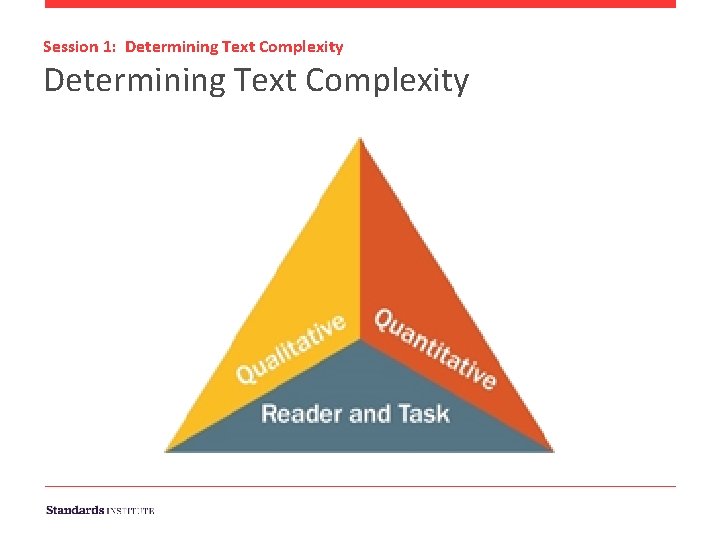
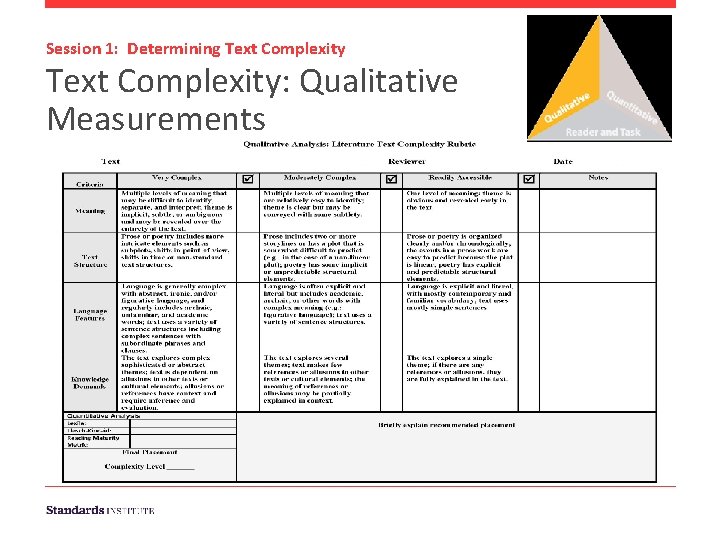
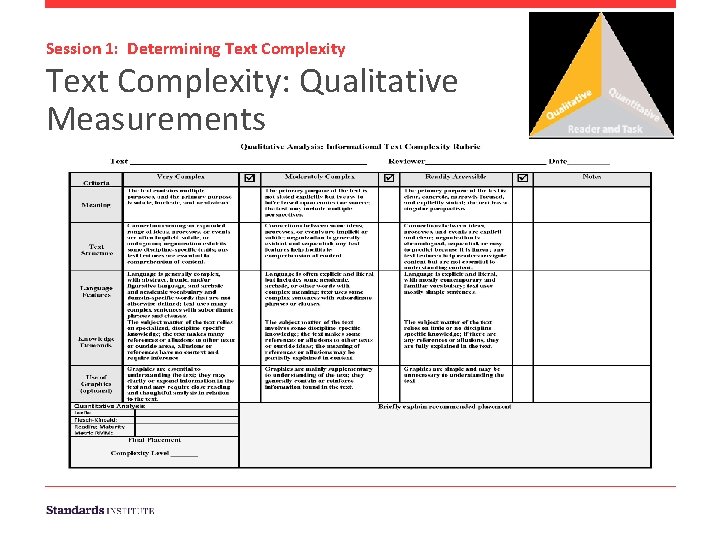
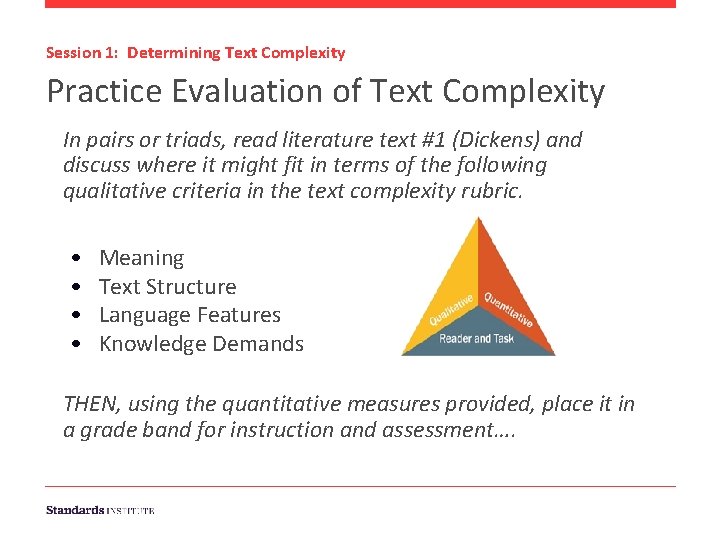
Session 1: Determining Text Complexity Explanation of the Text Complexity Factors Quantitative evaluation of the text • Readability measures and other scores of text complexity Qualitative evaluation of the text • Levels of meaning, structure, language conventionality and clarity, and knowledge demands Matching reader to text and task • Reader variables (such as motivation, knowledge, and experiences) and task variables (such as purpose and the complexity generated by the task assigned and the questions posed)
Session 1: Determining Text Complexity How many ways to determine complexity? Determining text complexity is a complex act! Text complexity does not reside in the text, rather it is the product of the interaction between the text, the reader, and the purpose for reading. The What, the Who, the Why and the Where and When. • What—the characteristics of the text—qualitative/quantitative evaluation • Who—the characteristics of the reader (reading ability/age/experience/ motivation) • Why—the purpose for the reading (assignment/analysis of writer’s craft/ research/pleasure) • Where and When—the conditions of the reading—teacher/parent guided, group discussion/literary circle, independent (classroom/home/library/computer), instruction vs. assessment, etc.
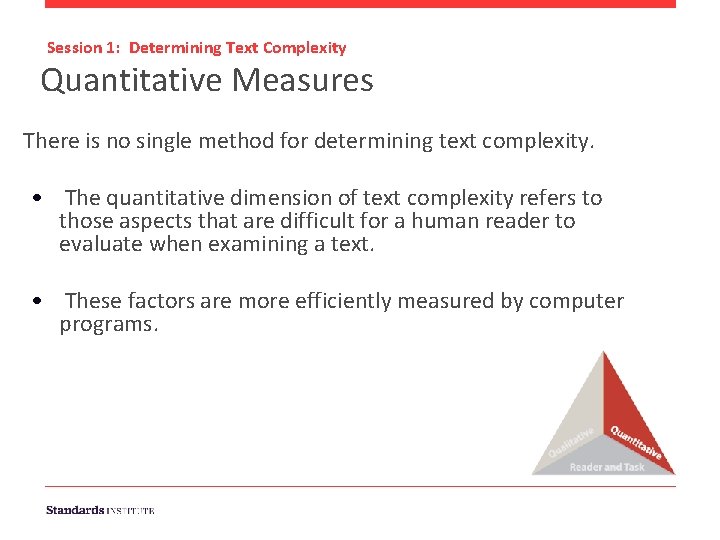
Session 1: Determining Text Complexity Quantitative Measures There is no single method for determining text complexity. • The quantitative dimension of text complexity refers to those aspects that are difficult for a human reader to evaluate when examining a text. • These factors are more efficiently measured by computer programs.
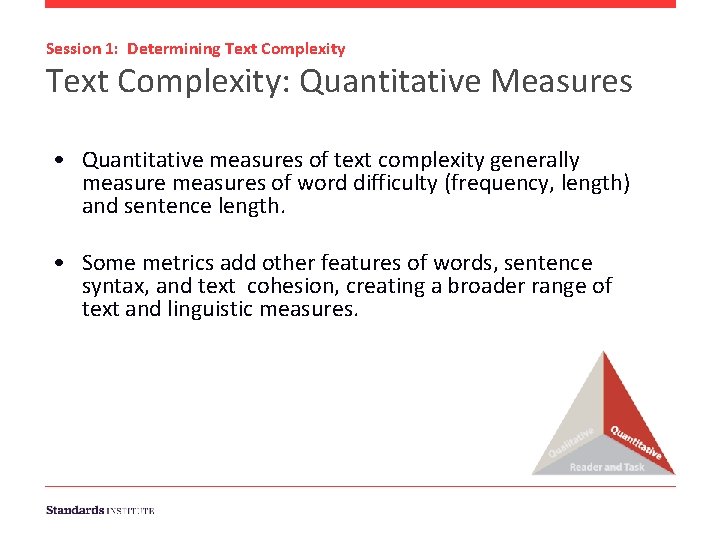
Session 1: Determining Text Complexity: Quantitative Measures • Quantitative measures of text complexity generally measures of word difficulty (frequency, length) and sentence length. • Some metrics add other features of words, sentence syntax, and text cohesion, creating a broader range of text and linguistic measures.
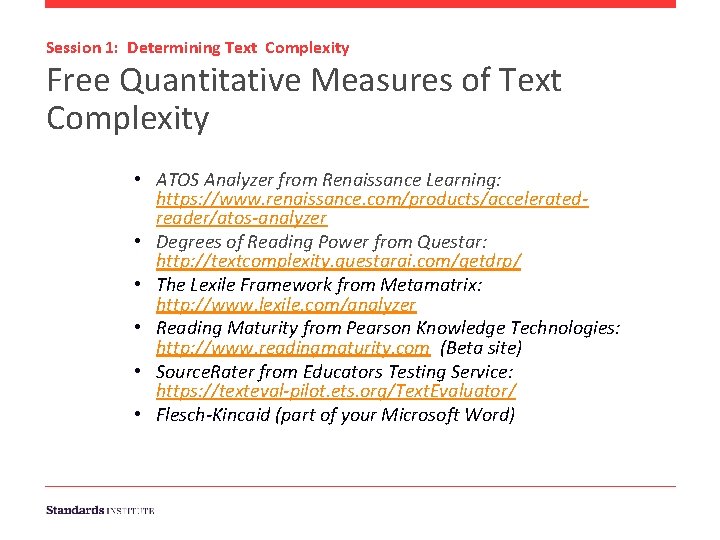
Session 1: Determining Text Complexity Free Quantitative Measures of Text Complexity • ATOS Analyzer from Renaissance Learning: https: //www. renaissance. com/products/acceleratedreader/atos-analyzer • Degrees of Reading Power from Questar: http: //textcomplexity. questarai. com/getdrp/ • The Lexile Framework from Metamatrix: http: //www. lexile. com/analyzer • Reading Maturity from Pearson Knowledge Technologies: http: //www. readingmaturity. com (Beta site) • Source. Rater from Educators Testing Service: https: //texteval-pilot. ets. org/Text. Evaluator/ • Flesch-Kincaid (part of your Microsoft Word)
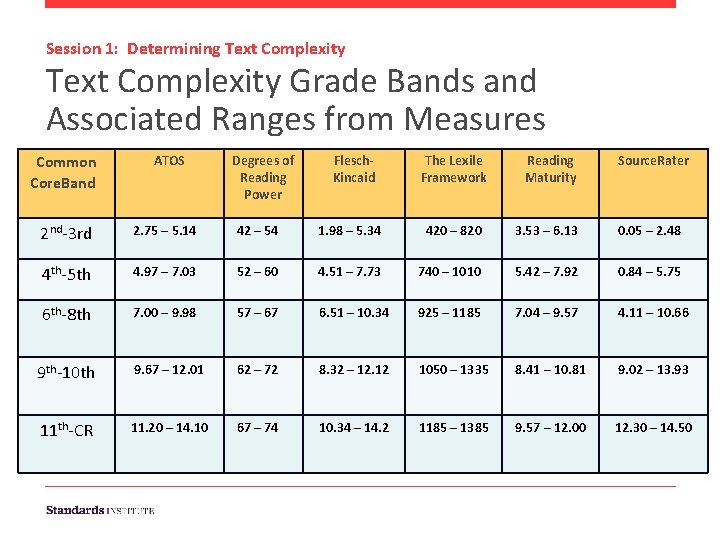
Session 1: Determining Text Complexity Grade Bands and Associated Ranges from Measures Common Core. Band ATOS Degrees of Reading Power Flesch. Kincaid The Lexile Framework Reading Maturity Source. Rater 2 nd-3 rd 2. 75 – 5. 14 42 – 54 1. 98 – 5. 34 420 – 820 3. 53 – 6. 13 0. 05 – 2. 48 4 th-5 th 4. 97 – 7. 03 52 – 60 4. 51 – 7. 73 740 – 1010 5. 42 – 7. 92 0. 84 – 5. 75 6 th-8 th 7. 00 – 9. 98 57 – 67 6. 51 – 10. 34 925 – 1185 7. 04 – 9. 57 4. 11 – 10. 66 9 th-10 th 9. 67 – 12. 01 62 – 72 8. 32 – 12. 12 1050 – 1335 8. 41 – 10. 81 9. 02 – 13. 93 11 th-CR 11. 20 – 14. 10 67 – 74 10. 34 – 14. 2 1185 – 1385 9. 57 – 12. 00 12. 30 – 14. 50
Session 1: Determining Text Complexity: Qualitative Measurements
Session 1: Determining Text Complexity: Qualitative Measurements
Session 1: Determining Text Complexity Practice Evaluation of Text Complexity In pairs or triads, read literature text #1 (Dickens) and discuss where it might fit in terms of the following qualitative criteria in the text complexity rubric. • • Meaning Text Structure Language Features Knowledge Demands THEN, using the quantitative measures provided, place it in a grade band for instruction and assessment….
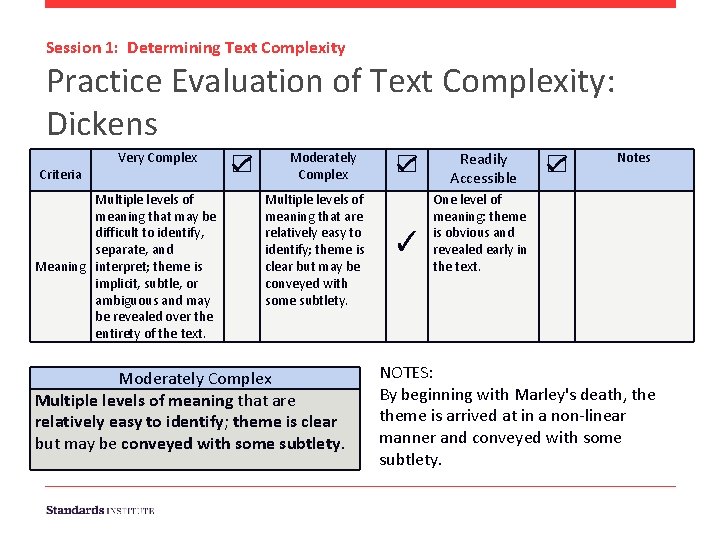
Session 1: Determining Text Complexity Practice Evaluation of Text Complexity: Dickens Criteria Very Complex ☑ Multiple levels of meaning that may be difficult to identify, separate, and Meaning interpret; theme is implicit, subtle, or ambiguous and may be revealed over the entirety of the text. Moderately Complex Multiple levels of meaning that are relatively easy to identify; theme is clear but may be conveyed with some subtlety. ☑ ✓ Readily Accessible ☑ One level of meaning: theme is obvious and revealed early in the text. Notes NOTES: By beginning with Marley's death, theme is arrived at in a non-linear manner and conveyed with some subtlety.
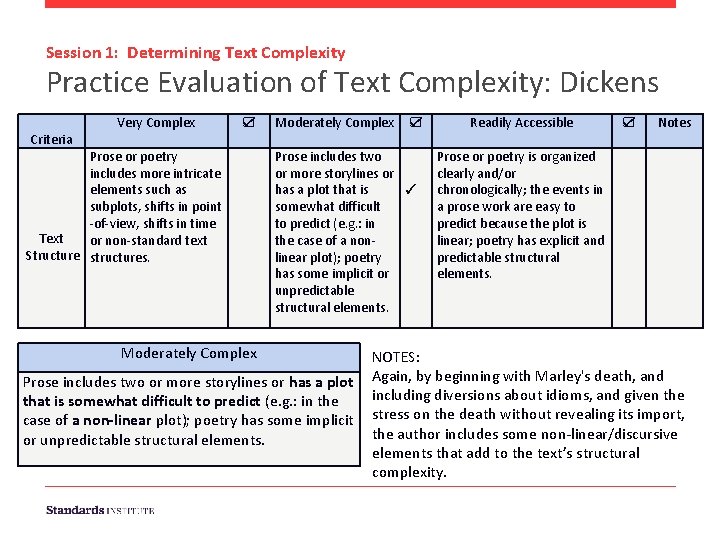
Session 1: Determining Text Complexity Practice Evaluation of Text Complexity: Dickens Criteria Very Complex ☑ Prose or poetry includes more intricate elements such as subplots, shifts in point -of-view, shifts in time Text or non-standard text Structure structures. Moderately Complex ☑ Prose includes two or more storylines or has a plot that is ✓ somewhat difficult to predict (e. g. : in the case of a nonlinear plot); poetry has some implicit or unpredictable structural elements. Readily Accessible ☑ Prose or poetry is organized clearly and/or chronologically; the events in a prose work are easy to predict because the plot is linear; poetry has explicit and predictable structural elements. Notes NOTES: Prose includes two or more storylines or has a plot Again, by beginning with Marley's death, and including diversions about idioms, and given the that is somewhat difficult to predict (e. g. : in the case of a non-linear plot); poetry has some implicit stress on the death without revealing its import, the author includes some non-linear/discursive or unpredictable structural elements that add to the text’s structural complexity.
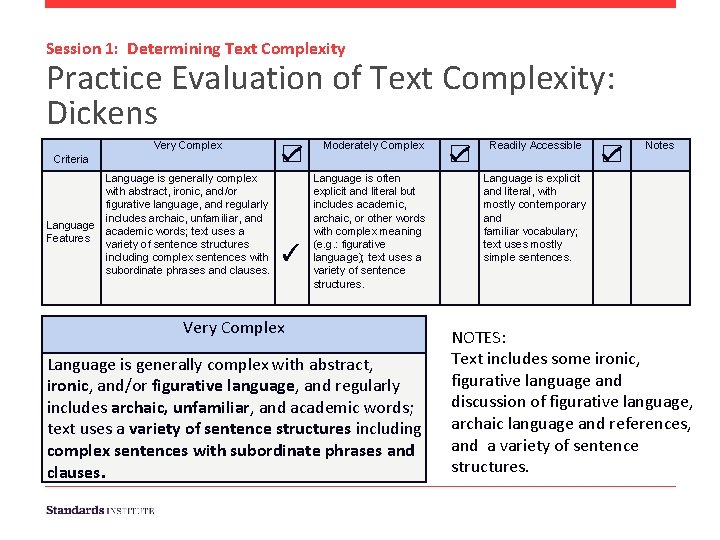
Session 1: Determining Text Complexity Practice Evaluation of Text Complexity: Dickens Criteria Very Complex Language is generally complex with abstract, ironic, and/or figurative language, and regularly includes archaic, unfamiliar, and Language academic words; text uses a Features variety of sentence structures including complex sentences with subordinate phrases and clauses. ☑ ✓ Moderately Complex Language is often explicit and literal but includes academic, archaic, or other words with complex meaning (e. g. : figurative language); text uses a variety of sentence structures. Very Complex Language is generally complex with abstract, ironic, and/or figurative language, and regularly includes archaic, unfamiliar, and academic words; text uses a variety of sentence structures including complex sentences with subordinate phrases and clauses. ☑ Readily Accessible ☑ Notes Language is explicit and literal, with mostly contemporary and familiar vocabulary; text uses mostly simple sentences. NOTES: Text includes some ironic, figurative language and discussion of figurative language, archaic language and references, and a variety of sentence structures.
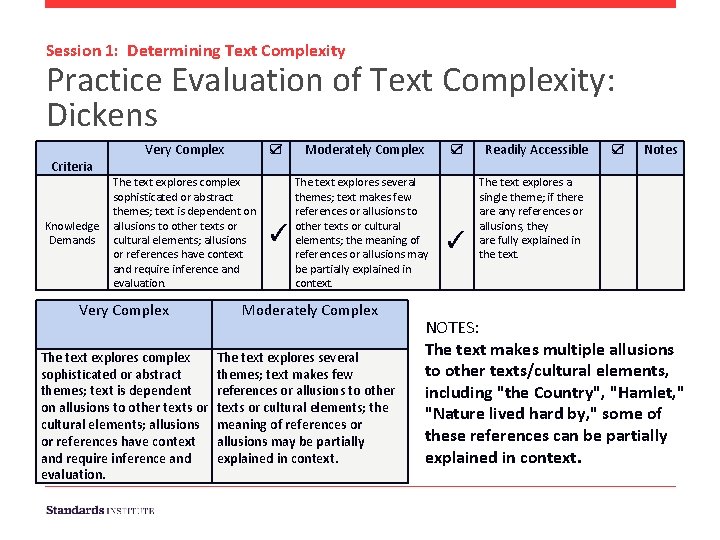
Session 1: Determining Text Complexity Practice Evaluation of Text Complexity: Dickens Criteria Very Complex ☑ The text explores complex sophisticated or abstract themes; text is dependent on Knowledge allusions to other texts or Demands cultural elements; allusions or references have context and require inference and evaluation. ✓ Moderately Complex ☑ The text explores several themes; text makes few references or allusions to other texts or cultural elements; the meaning of references or allusions may be partially explained in context. Very Complex Moderately Complex The text explores complex sophisticated or abstract themes; text is dependent on allusions to other texts or cultural elements; allusions or references have context and require inference and evaluation. The text explores several themes; text makes few references or allusions to other texts or cultural elements; the meaning of references or allusions may be partially explained in context. ✓ Readily Accessible The text explores a single theme; if there any references or allusions, they are fully explained in the text. ☑ Notes NOTES: The text makes multiple allusions to other texts/cultural elements, including "the Country", "Hamlet, " "Nature lived hard by, " some of these references can be partially explained in context.
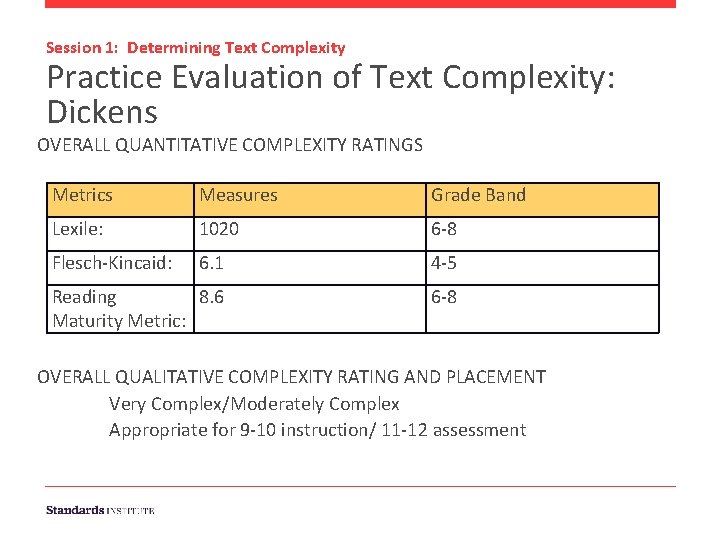
Session 1: Determining Text Complexity Practice Evaluation of Text Complexity: Dickens OVERALL QUANTITATIVE COMPLEXITY RATINGS Metrics Measures Grade Band Lexile: 1020 6 -8 Flesch-Kincaid: 6. 1 4 -5 Reading 8. 6 Maturity Metric: 6 -8 OVERALL QUALITATIVE COMPLEXITY RATING AND PLACEMENT Very Complex/Moderately Complex Appropriate for 9 -10 instruction/ 11 -12 assessment
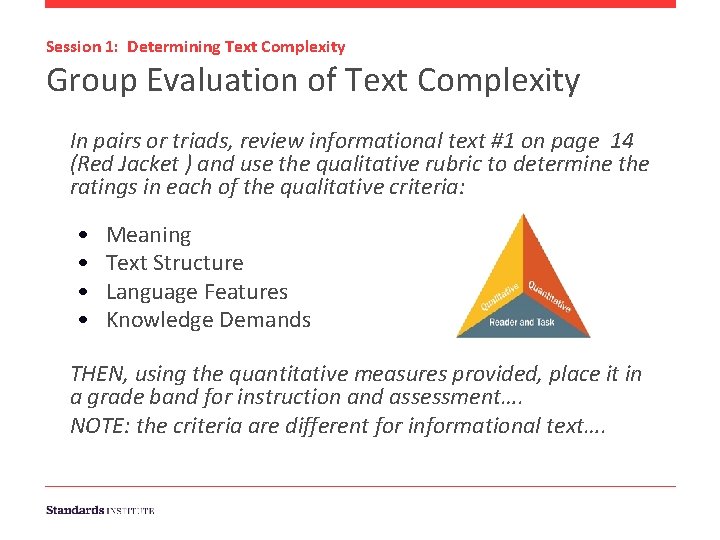
Session 1: Determining Text Complexity Group Evaluation of Text Complexity In pairs or triads, review informational text #1 on page 14 (Red Jacket ) and use the qualitative rubric to determine the ratings in each of the qualitative criteria: • • Meaning Text Structure Language Features Knowledge Demands THEN, using the quantitative measures provided, place it in a grade band for instruction and assessment…. NOTE: the criteria are different for informational text….
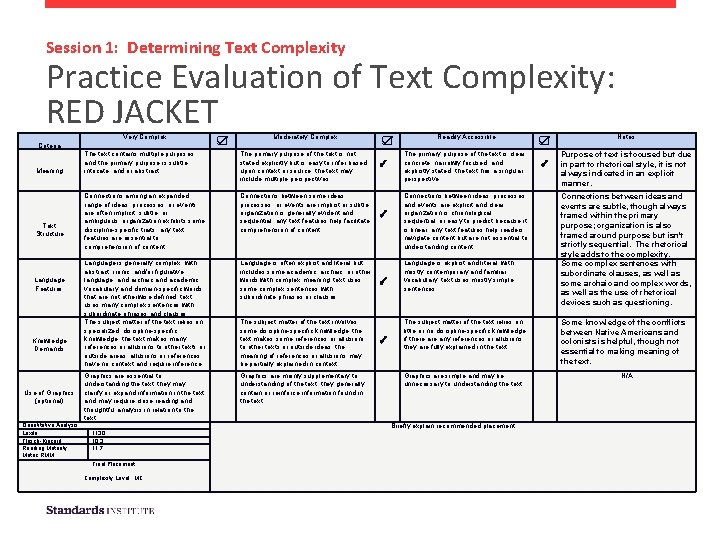
Session 1: Determining Text Complexity Practice Evaluation of Text Complexity: RED JACKET Criteria Meaning Text Structure Language Features Knowledge Demands Use of Graphics (optional) Quantitative Analysis Lexile Flesch-Kincaid: Reading Maturity Metric RMM: Very Complex The text contains multiple purposes, and the primary purpose is subtle, intricate, and or abstract. ☑ Moderately Complex The primary purpose of the text is not stated explicitly but is easy to infer based upon context or source; the text may include multiple perspectives. ☑ ✓ Readily Accessible The primary purpose of the text is clear, concrete, narrowly focused, and explicitly stated; the text has a singular perspective. ☑ Notes Purpose of text is focused but due in part to rhetorical style, it is not always indicated in an explicit manner. ✓ Connections among an expanded range of ideas, processes, or events are often implicit, subtle, or ambiguous; organization exhibits some discipline-specific traits; any text features are essential to comprehension of content. Connections between some ideas, processes, or events are implicit or subtle; organization is generally evident and ✓ sequential; any text features help facilitate comprehension of content. Connections between ideas, processes, and events are explicit and clear; organization is chronological, sequential, or easy to predict because it is linear; any text features help readers navigate content but are not essential to understanding content. Language is generally complex, with abstract, ironic, and/or figurative language, and archaic and academic vocabulary and domain-specific words that are not otherwise defined; text uses many complex sentences with subordinate phrases and clauses. The subject matter of the text relies on specialized, discipline-specific knowledge; the text makes many references or allusions to other texts or outside areas, allusions or references have no context and require inference. Language is often explicit and literal but includes some academic, archaic, or other words with complex meaning; text uses ✓ some complex sentences with subordinate phrases or clauses. Language is explicit and literal, with mostly contemporary and familiar vocabulary; text uses mostly simple sentences. The subject matter of the text involves some discipline-specific knowledge; the text makes some references or allusions to other texts or outside ideas; the meaning of references or allusions may be partially explained in context. The subject matter of the text relies on little or no discipline-specific knowledge; if there any references or allusions, they are fully explained in the text. Graphics are essential to understanding the text; they may clarify or expand information in the text and may require close reading and thoughtful analysis in relation to the text. Graphics are mainly supplementary to understanding of the text; they generally contain or reinforce information found in the text. Graphics are simple and may be unnecessary to understanding the text. 1130 10. 3 11. 7 Final Placement Complexity Level : MC ✓ Briefly explain recommended placement Connections between ideas and events are subtle, though always framed within the primary purpose; organization is also framed around purpose but isn't strictly sequential. The rhetorical style adds to the complexity. Some complex sentences with subordinate clauses, as well as some archaic and complex words, as well as the use of rhetorical devices such as questioning. Some knowledge of the conflicts between Native Americans and colonists is helpful, though not essential to making meaning of the text. N/A
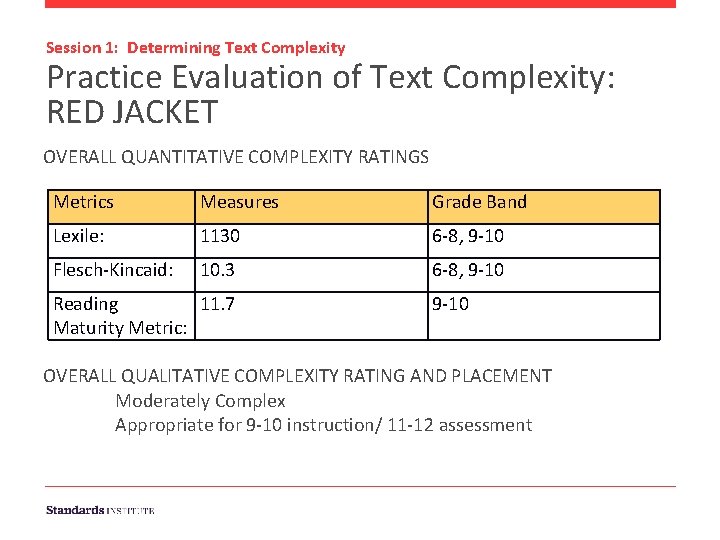
Session 1: Determining Text Complexity Practice Evaluation of Text Complexity: RED JACKET OVERALL QUANTITATIVE COMPLEXITY RATINGS Metrics Measures Grade Band Lexile: 1130 6 -8, 9 -10 Flesch-Kincaid: 10. 3 6 -8, 9 -10 Reading 11. 7 Maturity Metric: 9 -10 OVERALL QUALITATIVE COMPLEXITY RATING AND PLACEMENT Moderately Complex Appropriate for 9 -10 instruction/ 11 -12 assessment
Session 1: Determining Text Complexity Practice Evaluation of Text Complexity What about Literature text # 3 (Kafka) or #5 (Poe)? What about informational text # 3 (Thoreau) or #4 (Sagan? ) How do these texts feature specific aspects of qualitative text complexity ? For example: Kafka in terms of language features; Thoreau in terms of structure and/or meaning
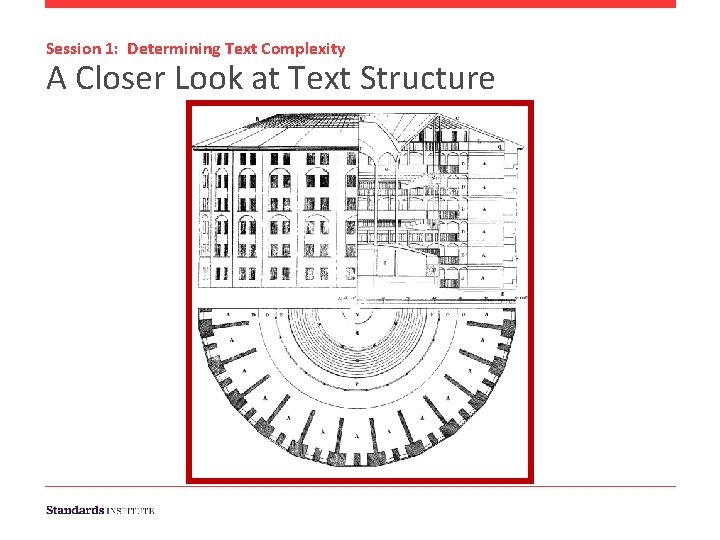
Session 1: Determining Text Complexity A Closer Look at Text Structure
Session 1: Determining Text Complexity Getting to the Sentence Level in high School to Support Reading and Writing Looking at the qualitative rubric, what are the aspects of complexity that are manifested in text structure? e. g Text features? Plot and sub-plot? Connections between ideas and organization?
Session 1: Determining Text Complexity A look at Text Organization Paragraphs/Sentences Overarching Ideas/Texts • Sequence (Process) Structure • Chronology • Events/Description • Compare/Contrast • • • Cause/Effect Problem-Solution Structure Judgment/Critique Structure Proposition- Support Inductive/Deductive Reasoning
Session 1: Determining Text Complexity Proficient vs. Less Experienced Readers Less experienced readers have difficulty organizing and prioritizing text information. Students who can follow a regular narrative can confused by other text structures Proficient readers use awareness of text structures to understand key points of the text. When asked to recall or process what they have read, their summaries reflect the text organization
Session 1: Determining Text Complexity • Teachers need to understand the text complexity of what they provide to students. . . AND FOR STRUGGLING STUDENTS, • Teachers need to demonstrate and make visible to students how literacy operates within a text, helping them learn how content experts use language in characteristic ways to present information, engage in interpretation, and create specialized texts.
Session 1: Determining Text Complexity Rewards and Challenges Turn and discuss: The rewards and challenges to taking students through text at this level. How this fits into tier 1 and tier 2 instruction in the RTI model; who gets this deep dive, and how do we determine?
Session 1: Determining Text Complexity What Next? • What are your key take-aways about complex text? • What are the best ways to prepare students for reading complex text? • volume of reading • modeling/practicing how literate individuals approach complexity • Students must build their academic vocabulary • Students must build their knowledge about the world
Session 1: Determining Text Complexity Reference List Slide Source 20 Snow & Uccelli, 2008; Schleppegrell, 2010, 2007; Wong Fillmore & Fillmore, 2012 21 Alvarez, L. (2012). “Reconsidering academic language in practice: The demands of Spanish expository reading and students’ bilingual resources. ” Bilingual Research Journal, 35, 1, 32 -52