
Determining Shapes of Transparent Objects from Two Polarization
Determining Shapes of Transparent Objects from Two Polarization Images Daisuke Miyazaki Masataka Kagesawa Katsushi Ikeuchi The University of Tokyo, Japan December 11, 2002 MVA 2002 1
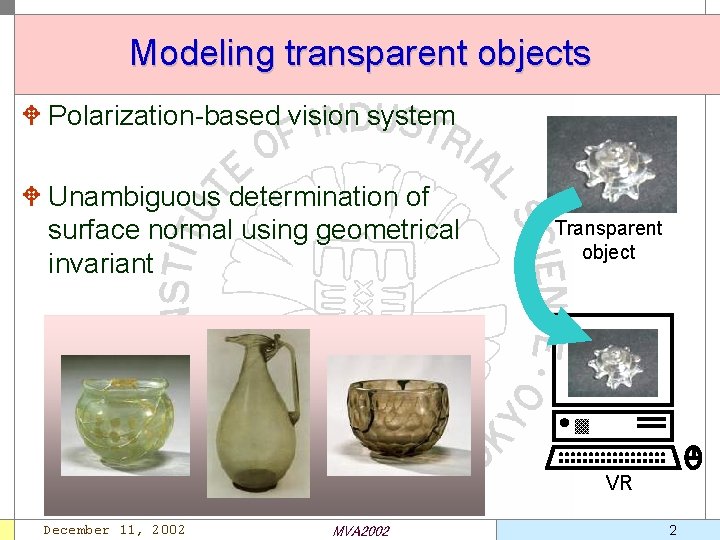
Modeling transparent objects W Polarization-based vision system W Unambiguous determination of surface normal using geometrical invariant Transparent object VR December 11, 2002 MVA 2002 2
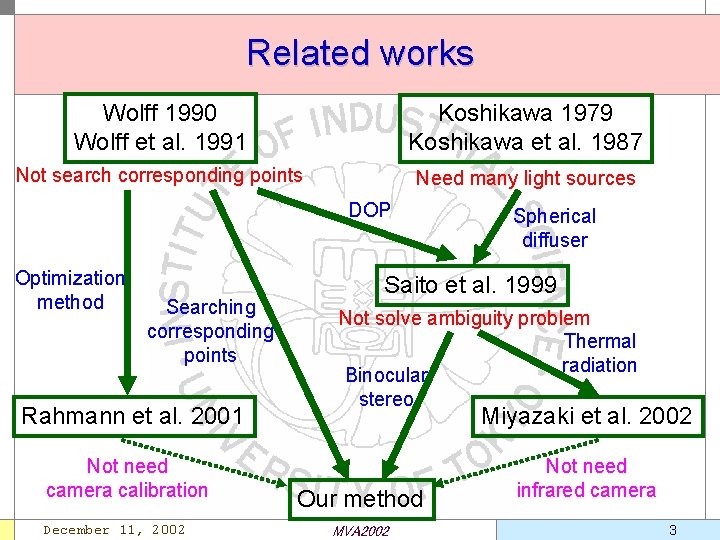
Related works Wolff 1990 Wolff et al. 1991 Koshikawa 1979 Koshikawa et al. 1987 Not search corresponding points Need many light sources DOP Optimization method Searching corresponding points Rahmann et al. 2001 Not need camera calibration December 11, 2002 Spherical diffuser Saito et al. 1999 Not solve ambiguity problem Thermal radiation Binocular stereo Our method MVA 2002 Miyazaki et al. 2002 Not need infrared camera 3
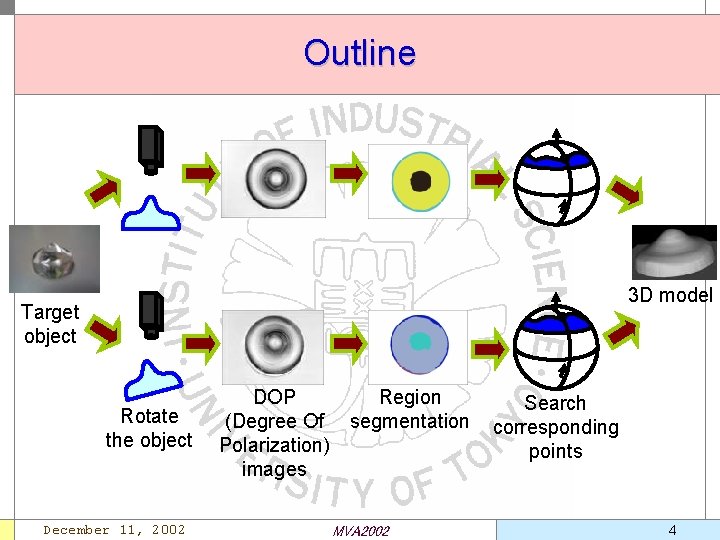
Outline 3 D model Target object Rotate the object December 11, 2002 DOP (Degree Of Polarization) images Region segmentation MVA 2002 Search corresponding points 4
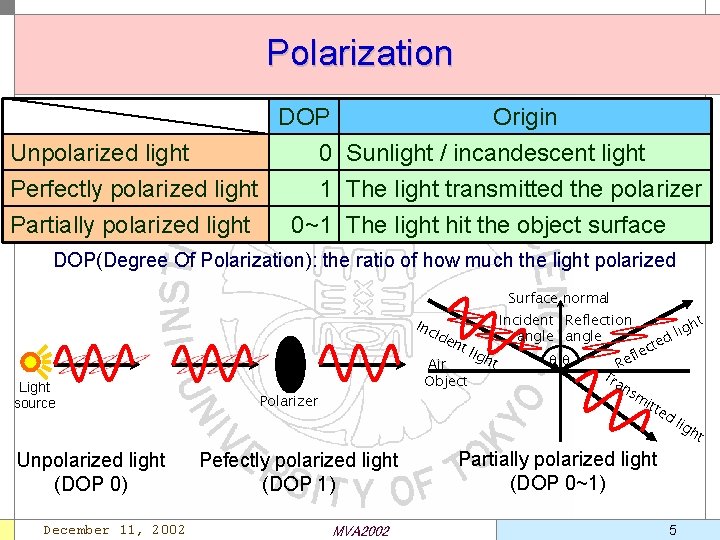
Polarization DOP Origin Unpolarized light 0 Sunlight / incandescent light Perfectly polarized light 1 The light transmitted the polarizer Partially polarized light 0~1 The light hit the object surface DOP(Degree Of Polarization): the ratio of how much the light polarized Surface normal Incident Reflection t gh i l angle nt ted c lig fle ht Air Re Tr Object an sm itt ed lig ht Inc ide Light source Unpolarized light (DOP 0) December 11, 2002 Polarizer Pefectly polarized light (DOP 1) MVA 2002 Partially polarized light (DOP 0~1) 5
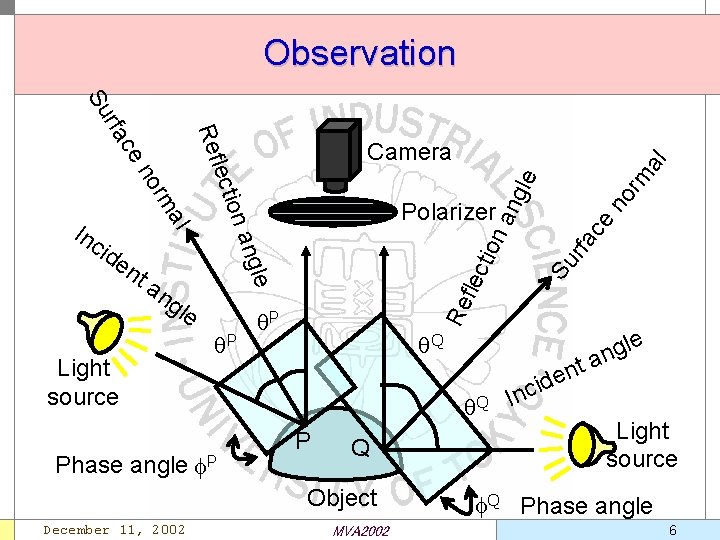
Observation Ref Phase angle P P al m l g n ta n e d ci Q In P ce e Q P Q Object December 11, 2002 rfa tion Re le gle Light source flec ang an no r an g ion nt le lect al rm no ide Polarizer Su ce rfa Su In c Camera MVA 2002 Light source Q Phase angle 6
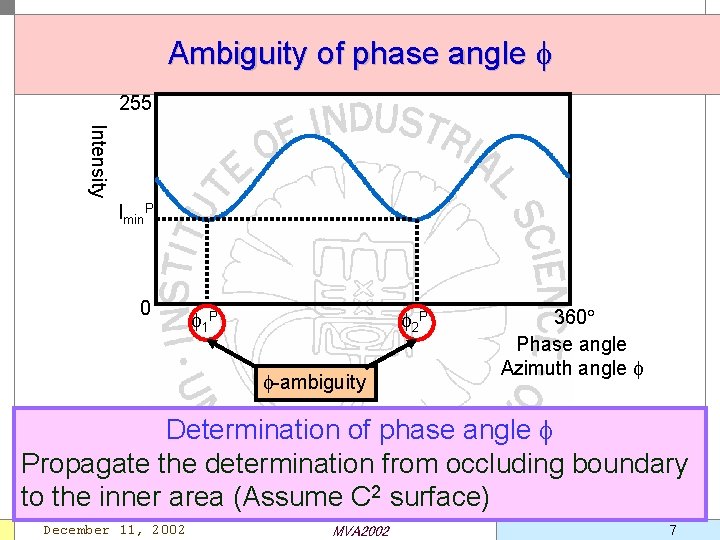
Ambiguity of phase angle 255 Intensity Imin. P 0 1 P 2 P -ambiguity 360 Phase angle Azimuth angle Determination of phase angle Propagate the determination from occluding boundary to the inner area (Assume C 2 surface) December 11, 2002 MVA 2002 7

Ambiguity of reflection angle DOP (Degree Of Polarization) 1 P 0 1 P B Brewster angle 2 P 90 Reflection angle Zenith angle -ambiguity Determination of reflection angle Explain in the following slides December 11, 2002 MVA 2002 8
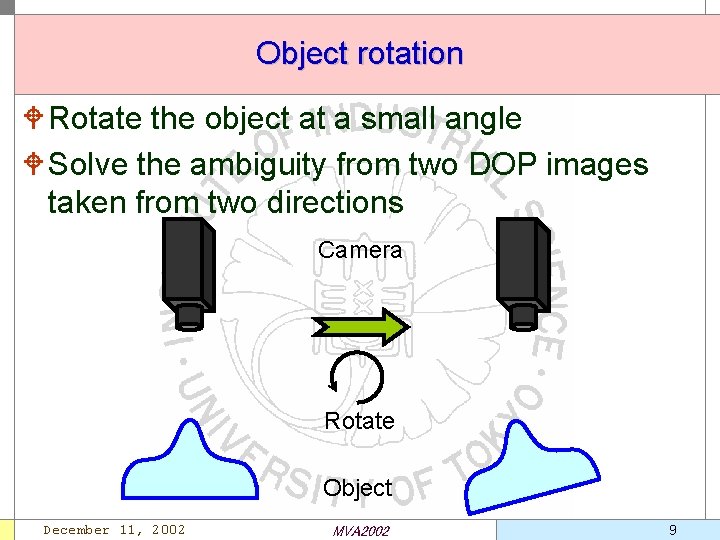
Object rotation W Rotate the object at a small angle W Solve the ambiguity from two DOP images taken from two directions Camera Rotate Object December 11, 2002 MVA 2002 9
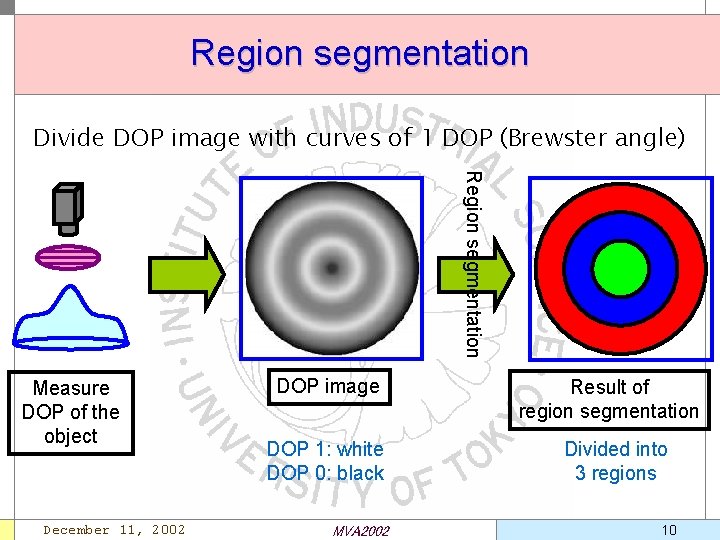
Region segmentation Divide DOP image with curves of 1 DOP (Brewster angle) Region segmentation Measure DOP of the object December 11, 2002 DOP image DOP 1: white DOP 0: black MVA 2002 Result of region segmentation Divided into 3 regions 10
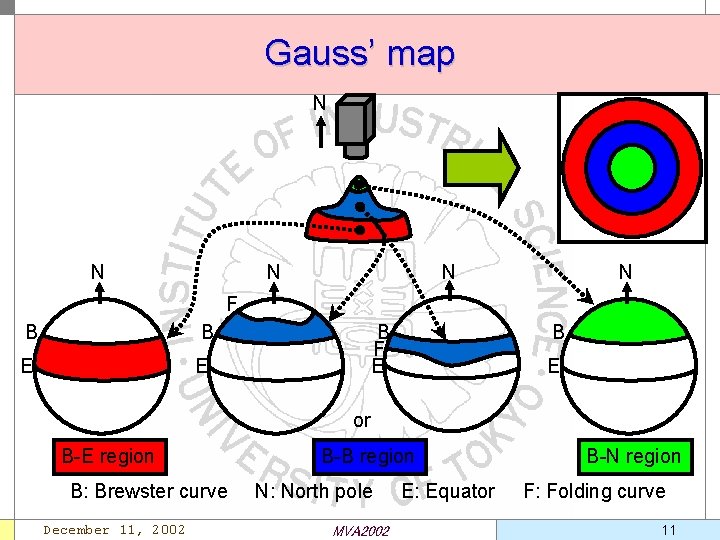
Gauss’ map N N N F B B E E B F E B E or B-E region B: Brewster curve December 11, 2002 B-B region N: North pole MVA 2002 E: Equator B-N region F: Folding curve 11
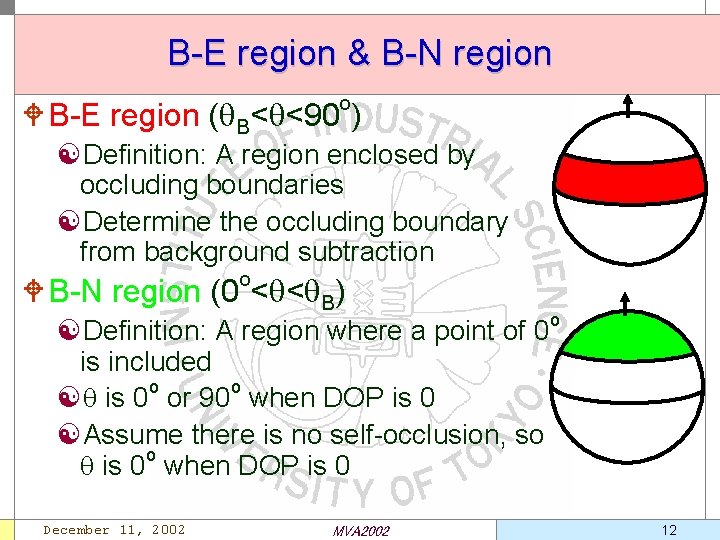
B-E region & B-N region o W B-E region ( B< <90 ) [Definition: A region enclosed by occluding boundaries [Determine the occluding boundary from background subtraction o W B-N region (0 < < B) [Definition: A region where a point of 0 is included [ is 0 o or 90 o when DOP is 0 [Assume there is no self-occlusion, so is 0 o when DOP is 0 December 11, 2002 MVA 2002 o 12

B-B region o o W B-B region (0 < < B or B< <90 ) [Definition: A region which is not the previous two [Apply the following disambiguation method to this region December 11, 2002 MVA 2002 13
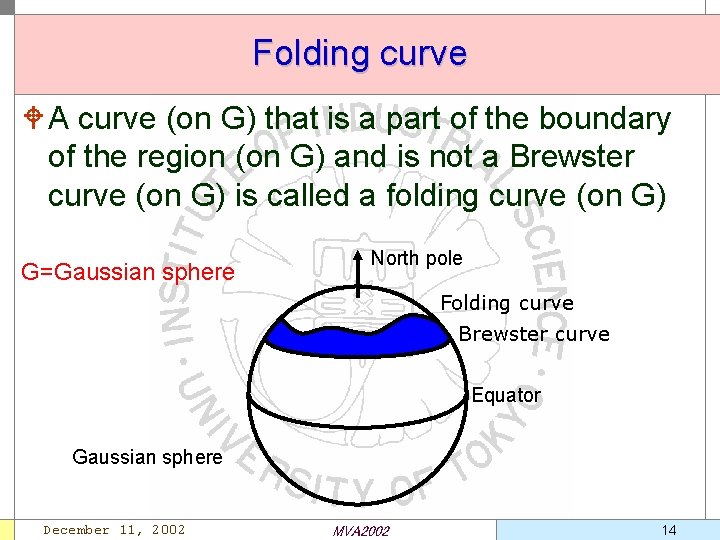
Folding curve W A curve (on G) that is a part of the boundary of the region (on G) and is not a Brewster curve (on G) is called a folding curve (on G) G=Gaussian sphere North pole Folding curve Brewster curve Equator Gaussian sphere December 11, 2002 MVA 2002 14
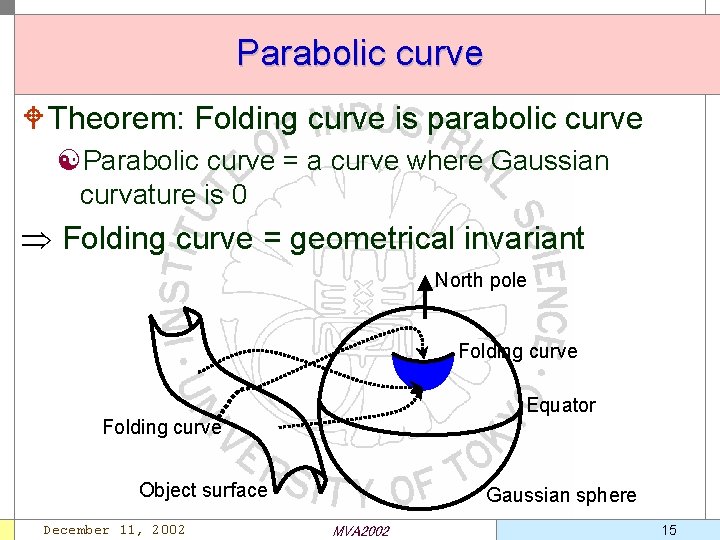
Parabolic curve W Theorem: Folding curve is parabolic curve [Parabolic curve = a curve where Gaussian curvature is 0 Folding curve = geometrical invariant North pole Folding curve Equator Folding curve Object surface December 11, 2002 Gaussian sphere MVA 2002 15
![Corresponding point W Corresponding point folding curve great circle [= rotation direction] arg min](http://slidetodoc.com/presentation_image_h2/e59e742307aabbe03581e49ba0cc5bcb/image-16.jpg "Corresponding point W Corresponding point folding curve great circle [= rotation direction] arg min")
Corresponding point W Corresponding point folding curve great circle [= rotation direction] arg min DOP, s. t. point surface normal // rotation plane Corresponding point Rotate the object North side South side December 11, 2002 MVA 2002 16
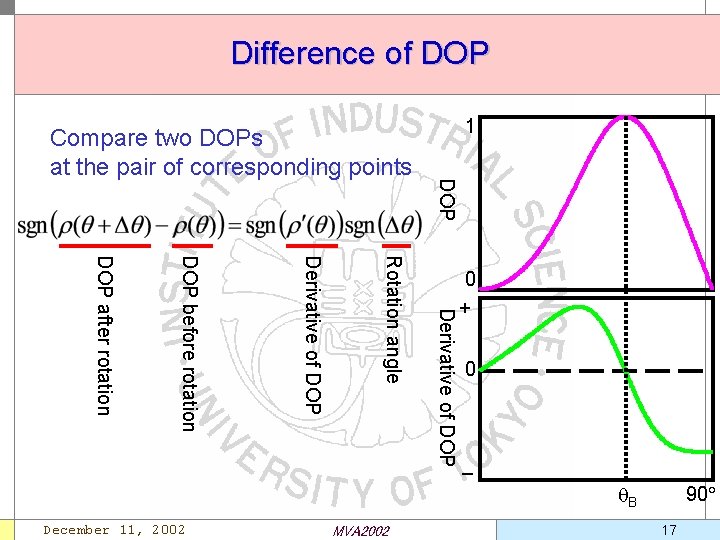
Difference of DOP MVA 2002 Derivative of DOP Rotation angle Derivative of DOP before rotation DOP after rotation December 11, 2002 1 DOP Compare two DOPs at the pair of corresponding points 0 + 0 – B 90 17
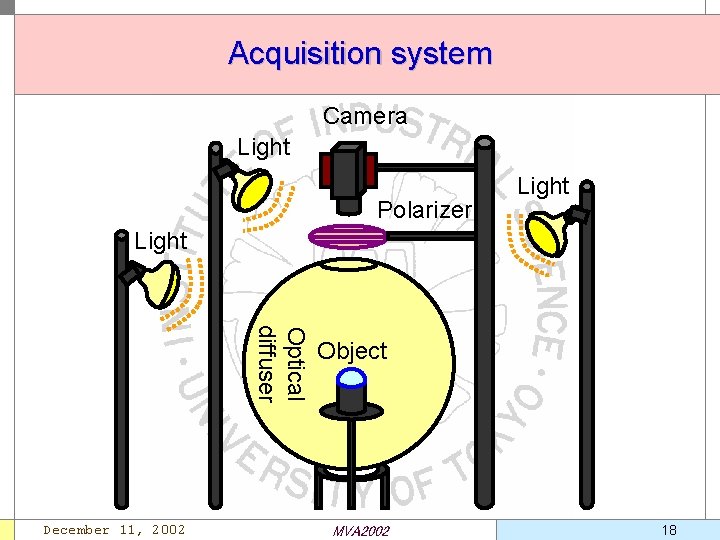
Acquisition system Camera Light Polarizer Light Optical diffuser December 11, 2002 Object MVA 2002 18
![Precision Plastic transparent hemisphere [diameter 3 cm] Estimated shape DOP Result of region segmentation](http://slidetodoc.com/presentation_image_h2/e59e742307aabbe03581e49ba0cc5bcb/image-19.jpg "Precision Plastic transparent hemisphere [diameter 3 cm] Estimated shape DOP Result of region segmentation")
Precision Plastic transparent hemisphere [diameter 3 cm] Estimated shape DOP Result of region segmentation Error DOP 0. 17 Reflection angle 8. 5 Height Reflection angle 2. 6 mm Error (Average absolute difference) December 11, 2002 MVA 2002 Graph of DOP 19
![Target object W Photo [Acrylic bell-shaped object] December 11, 2002 MVA 2002 20](http://slidetodoc.com/presentation_image_h2/e59e742307aabbe03581e49ba0cc5bcb/image-20.jpg "Target object W Photo [Acrylic bell-shaped object] December 11, 2002 MVA 2002 20")
Target object W Photo [Acrylic bell-shaped object] December 11, 2002 MVA 2002 20

DOP images W DOP image when the object is not rotated W DOP image when the object is rotated at a small angle DOP 0: white DOP 1: black Rotation direction We rotate the object about 8° December 11, 2002 MVA 2002 21
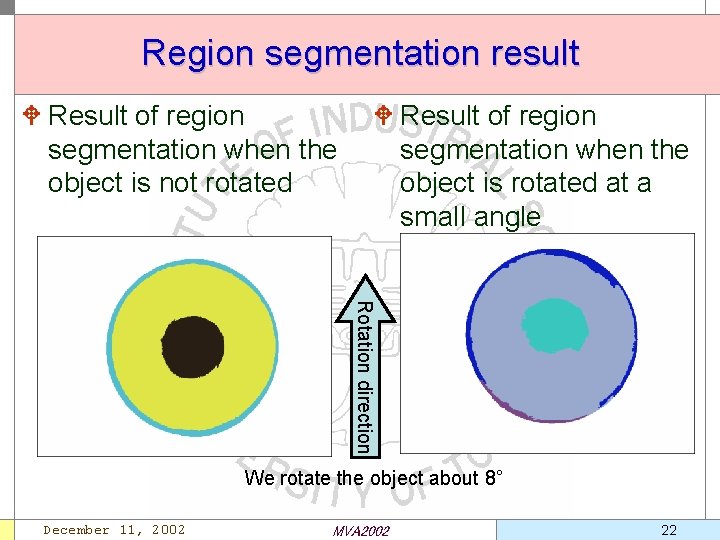
Region segmentation result W Result of region segmentation when the object is not rotated W Result of region segmentation when the object is rotated at a small angle Rotation direction We rotate the object about 8° December 11, 2002 MVA 2002 22

Disambiguation of B-B region Positive 0. 089 Negative Positive December 11, 2002 Surface normal was Rotation direction was Negative MVA 2002 Derivative of DOP 0. 084 0 Negative B 90 23
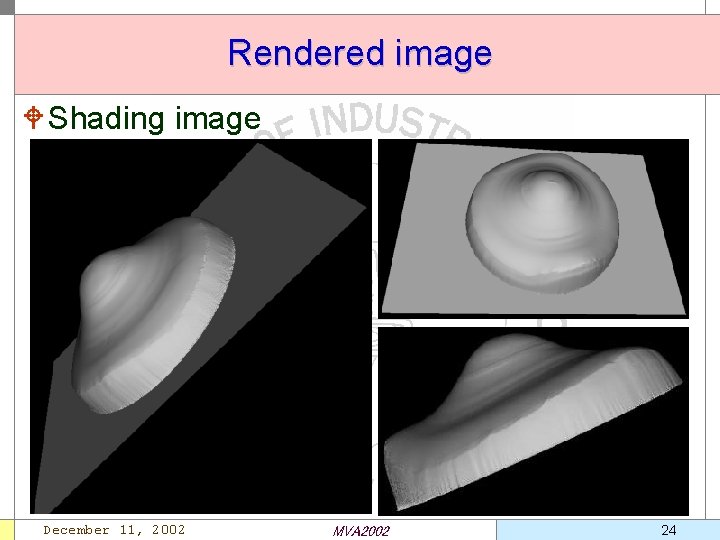
Rendered image W Shading image December 11, 2002 MVA 2002 24

Rendered image W Photo December 11, 2002 W Raytracing image MVA 2002 25

Error W Comparison of true value and estimated value True Estimated The diameter(width) of the object is 24 mm Error is 0. 4 mm (Average of the difference of the height) True value is made by hand December 11, 2002 MVA 2002 26
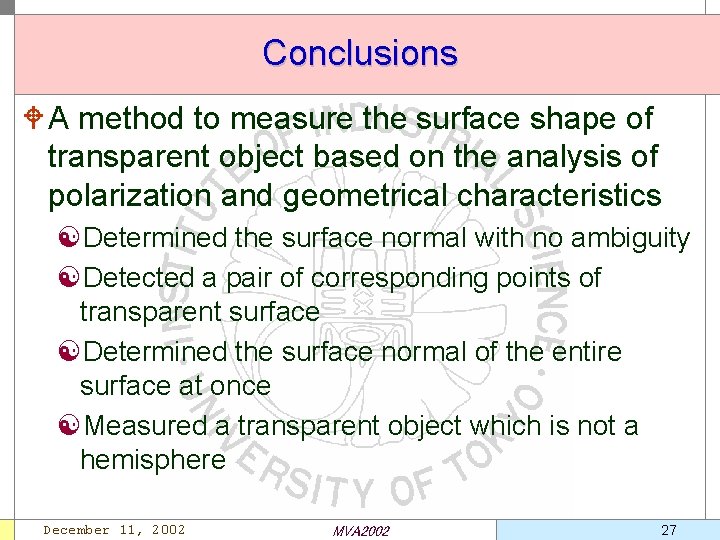
Conclusions W A method to measure the surface shape of transparent object based on the analysis of polarization and geometrical characteristics [Determined the surface normal with no ambiguity [Detected a pair of corresponding points of transparent surface [Determined the surface normal of the entire surface at once [Measured a transparent object which is not a hemisphere December 11, 2002 MVA 2002 27

Future works W Higher precision (dealing with interreflections) W Estimation of refractive index W More elegant method for determining phase angle December 11, 2002 MVA 2002 28

Daisuke Miyazaki 2002 Creative Commons Attribution 4. 0 International License. http: //www. cvl. iis. u-tokyo. ac. jp/ D. Miyazaki, M. Kagesawa, K. Ikeuchi, "Determining Shapes of Transparent Objects from Two Polarization Images, " in Proceedings of IAPR Workshop on Machine Vision Applications, pp. 26 -31, Nara, Japan, 2002. 12 December 11, 2002 MVA 2002 29
- Slides: 29