
Determining Importance Summarizing Informational Text Grade 6 Grade


- Slides: 75
Determining Importance & Summarizing Informational Text Grade 6 − Grade 12 © 2013 Texas Education Agency / The University of Texas System
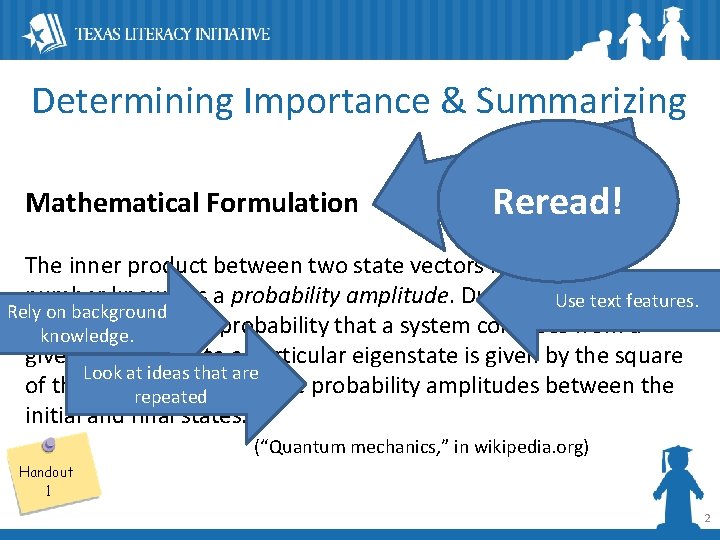
Determining Importance & Summarizing Mathematical Formulation e Iden typ t x e t y tif Reread! The inner product between two state vectors is a complex number known as a probability amplitude. During a Use text features. Rely on background measurement, the probability that a system collapses from a knowledge. given initial state to a particular eigenstate is given by the square Look at ideas that are of the absolute value of the probability amplitudes between the repeated initial and final states. (“Quantum mechanics, ” in wikipedia. org) Handout 1 2
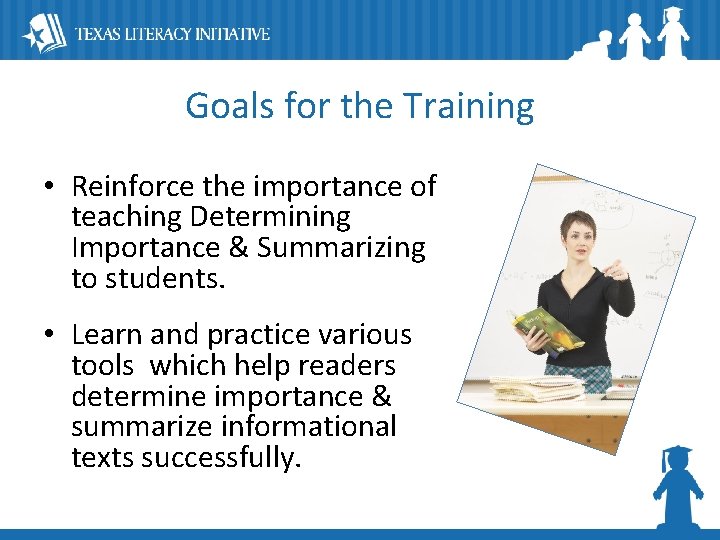
Goals for the Training • Reinforce the importance of teaching Determining Importance & Summarizing to students. • Learn and practice various tools which help readers determine importance & summarize informational texts successfully.
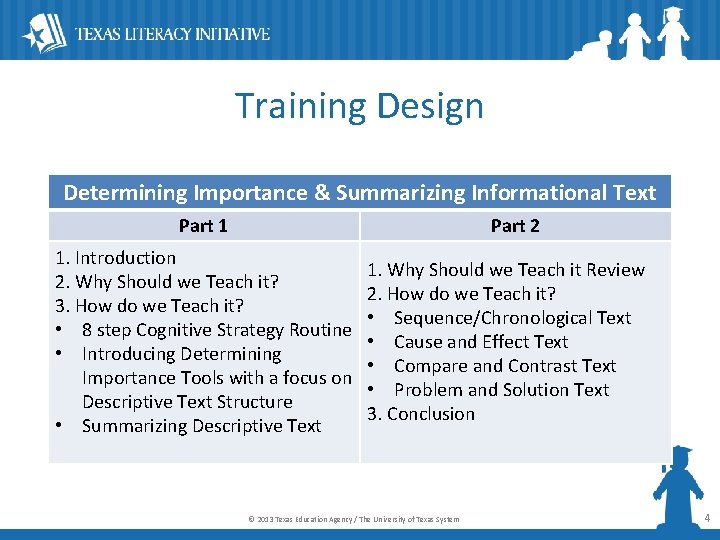
Training Design Determining Importance & Summarizing Informational Text Part 1 Part 2 1. Introduction 2. Why Should we Teach it? 3. How do we Teach it? • 8 step Cognitive Strategy Routine • Introducing Determining Importance Tools with a focus on Descriptive Text Structure • Summarizing Descriptive Text 1. Why Should we Teach it Review 2. How do we Teach it? • Sequence/Chronological Text • Cause and Effect Text • Compare and Contrast Text • Problem and Solution Text 3. Conclusion © 2013 Texas Education Agency / The University of Texas System 4
Why Should We Teach Determining Importance & Summarizing?
Why Should We Teach Determining Importance & Summarizing? It helps readers to… • • • Improve overall comprehension. Manage excessive amounts of information. Focus attention. Extract relevant information. Build relationships among concepts contained in text. (CIERA 2003; Coyne, Chard, Zipoli, & Ruby, 2007; Duke & Pearson, 2002; Keene & Zimmermann, 2007 Silver, Strong, & Perini, 2000; Thiede & Anderson, 2003) )
Why Should We Teach Determining Importance & Summarizing? It helps readers to… • • • Understand author’s purpose. Remember text. Identify theme. Make connections. Monitor understanding. (CIERA 2003; Coyne, Chard, Zipoli, & Ruby, 2007; Duke & Pearson, 2002; Keene & Zimmermann, 2007 Silver, Strong, & Perini, 2000; Thiede & Anderson, 2003)
Why Should We Teach Determining Importance and Summarizing? Students are expected to: • 6. 10(A): summarize the main ideas and supporting details in text, demonstrating an understanding that a summary does not include opinions • English III & IV: 9. 10(A): summarize a text in a manner that captures the author’s viewpoint, its main ideas, and its elements without taking a position or expressing an opinion; • Figure 19(C): reflect on understanding to monitor comprehension (e. g. , summarizing and synthesizing; asking textual, personal, and world connections; creating sensory images); • Figure 19(E): summarize, paraphrase, and synthesize texts in ways that maintain meaning and logical order within a text and across texts; 8
Why Should We Teach Determining Importance and Summarizing? The student is expected to: • Social Studies 7. 21(B): analyze information by sequencing, categorizing, identifying cause-and-effect relationships, comparing, contrasting, finding the main idea, summarizing, making generalizations and predictions, and drawing inferences and conclusions;
Why Should We Determining Importance and Summarizing? ELPS Reading 4(I) demonstrate English comprehension and expand reading skills by employing basic reading skills such as demonstrating understanding of supporting ideas and details in text and graphic sources, summarizing text, and distinguishing main ideas from details commensurate with content area needs;
Why Should We Teach Making Determining Importance & Summarizing? Think about your data. • What does your data indicate regarding our students’ ability to determine importance and summarize? © 2013 Texas Education Agency / The University of Texas System 11
How Should We Teach Determining Importance & Summarizing?
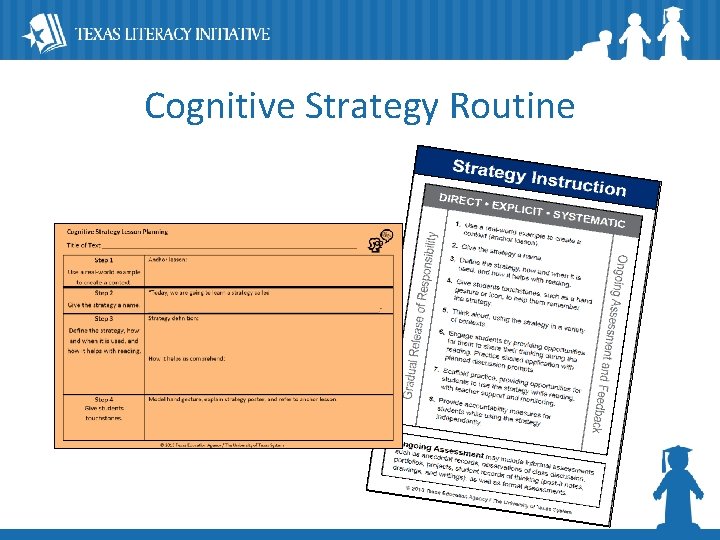
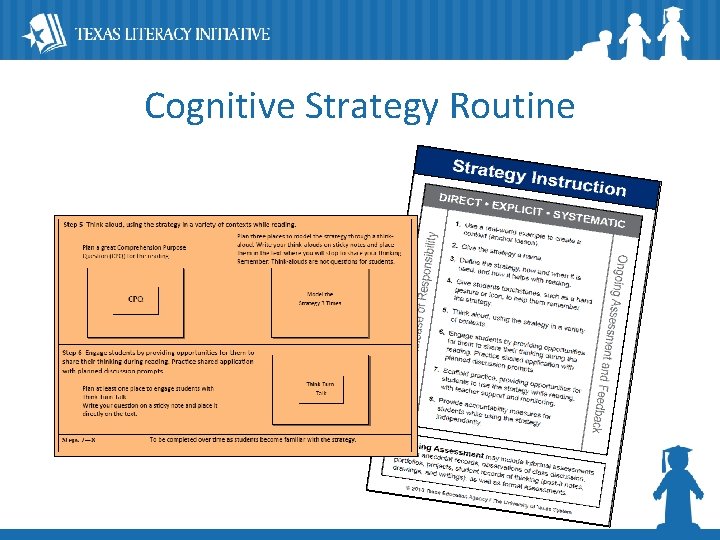
Cognitive Strategy Routine
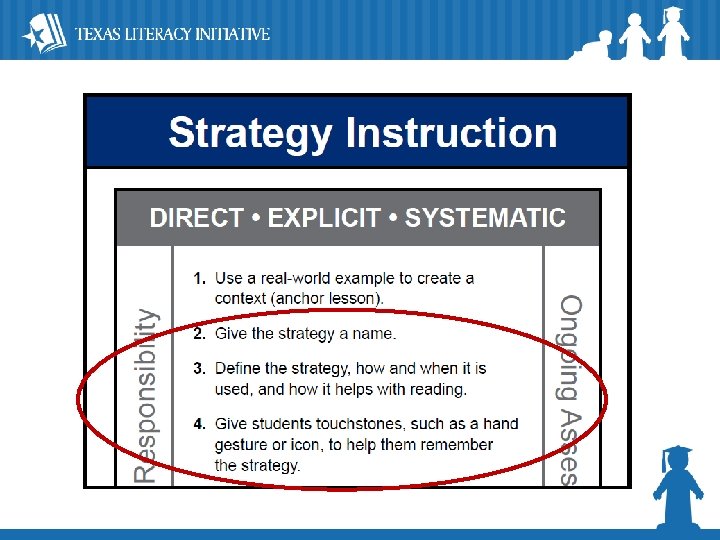
Use a Real-World Example (Step 1) • An anchor lesson is a real-world example used to create context for a cognitive strategy. • It is useful to create a different anchor lesson for each cognitive strategy. • We refer to the anchor lesson to remind students of the cognitive strategy. • Learning is more consistent for students when the same anchor lesson is used within and across grade levels.
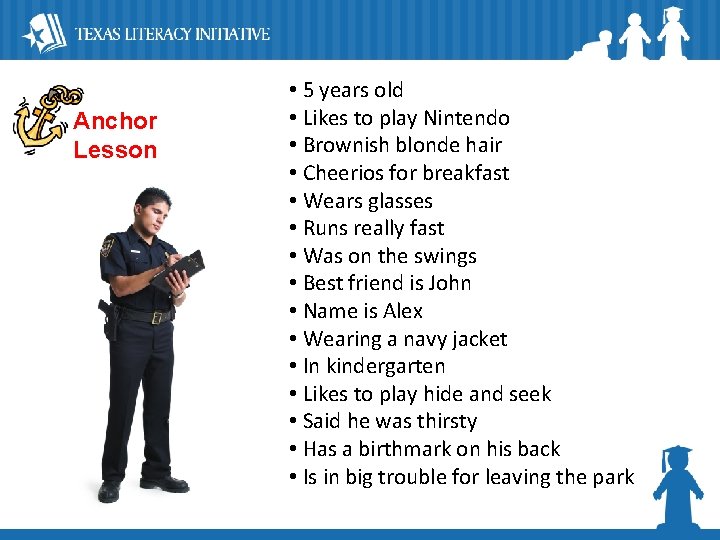
The Babysitter … © 2013 Texas Education Agency / The University of Texas System 15
Anchor Lesson • 5 years old • Likes to play Nintendo • Brownish blonde hair • Cheerios for breakfast • Wears glasses • Runs really fast • Was on the swings • Best friend is John • Name is Alex • Wearing a navy jacket • In kindergarten • Likes to play hide and seek • Said he was thirsty • Has a birthmark on his back • Is in big trouble for leaving the park
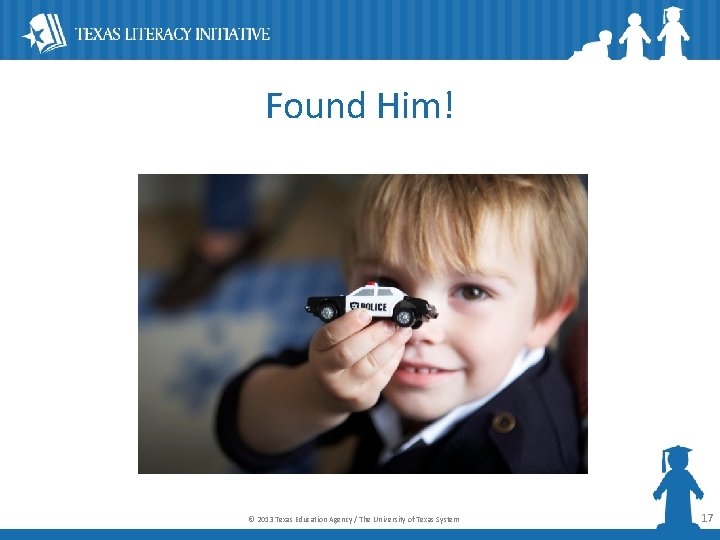
Found Him! © 2013 Texas Education Agency / The University of Texas System 17
Use a Real-World Example (Step 1) Record what you will do for Step 1 on your orange Cognitive Strategy Routine Lesson Planning Card.
Give the Strategy a Name (Step 2) “Today, we’re going to talk about a strategy called Determining Importance & Summarizing. ” Record what you will say for Step 2 on your orange Cognitive Strategy Routine Lesson Planning Card.
Define the Strategy (Step 3) “Have you ever noticed how difficult it is to remember everything that you read? . . . Our brains just can’t seem to hold all of that information at the same time. ” To help us, we need to determine importance and summarize information. In order to summarize, we must be able to identify the topic and main ideas of text, and then, we need to put that information together in our own words as briefly as possible. When we do this, we understand remember informational text better. (Mc. Gregor, 2007, p. 81)
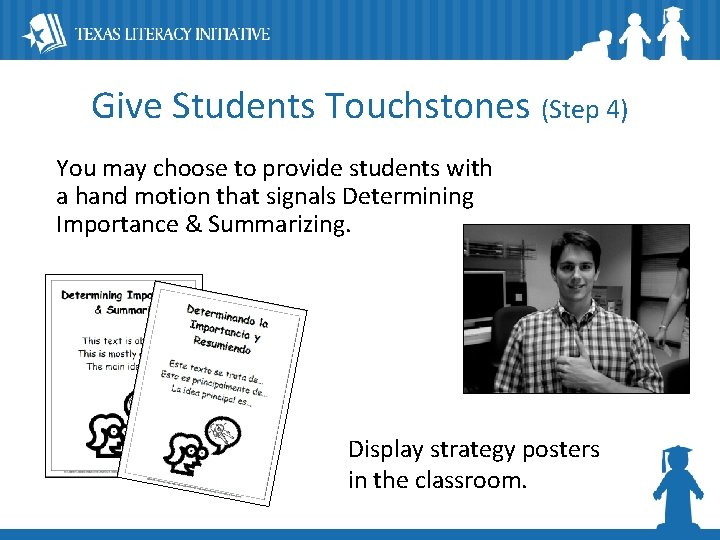
Give Students Touchstones (Step 4) You may choose to provide students with a hand motion that signals Determining Importance & Summarizing. Display strategy posters in the classroom.
Give Students Touchstones (Step 4) Touchstones: Explain the strategy poster and refer to the anchor lesson. Remember when our babysitter lost his brother? We had a long list of details about the little brother. All of my fingers represent those details. We didn’t want to tell the police all of those details, instead, we had to figure out which information was the most important to share – like my thumb here. The unimportant details can hide behind my hand so that only the most important or key information is left. You will know when I am determining importance while reading, because I will show you this thumbs up hand signal.
Think-Aloud (Step 5) “A think-aloud is a way to provide instruction rather than just give instructions. ” (Daniels & Zemelman, 2004, p. 238).
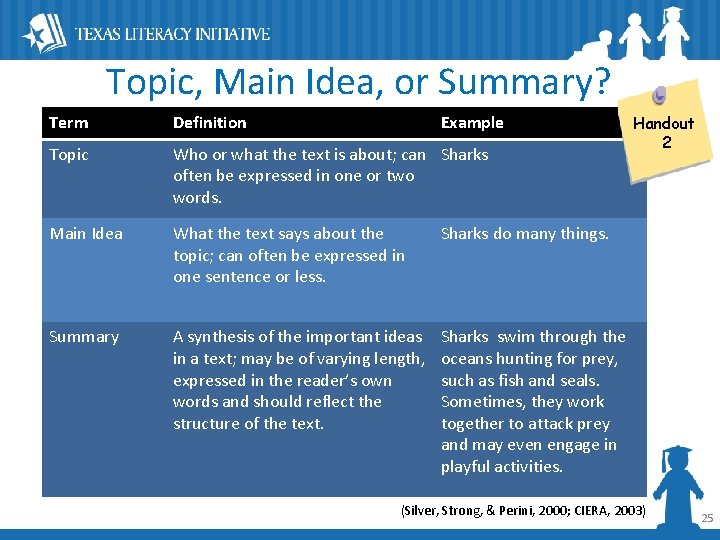
Topic, Main Idea, or Summary? Term Definition Example Topic Who or what the text is about; can Sharks often be expressed in one or two words. Main Idea What the text says about the topic; can often be expressed in one sentence or less. Sharks do many things. Summary A synthesis of the important ideas in a text; may be of varying length, expressed in the reader’s own words and should reflect the structure of the text. Sharks swim through the oceans hunting for prey, such as fish and seals. Sometimes, they work together to attack prey and may even engage in playful activities. Handout 2 (Silver, Strong, & Perini, 2000; CIERA, 2003) 25
Considerations for Teaching Students to IDENTIFY TOPIC © 2013 Texas Education Agency / The University of Texas System 26
Identifying Topic “Usually the topic will be apparent by looking at the title, pictures, or subheadings … Higher level text may confuse students by dancing around the topic instead of stating it directly. In these cases, teach students to look for repeated references to help them find a topic. ” (Kissner, 2006, p. 34) © 2013 Texas Education Agency / The University of Texas System 27
What is the Topic? “You may have a wetland at your house and not even know it. Sometimes, small depressions in the lawn fill up with rain and hold the moisture for days at a time. These ‘potholes’ often come alive at night with creatures like spring peepers (tiny frogs), insects, and birds. When people avoid these wet areas and don’t mow them, they are providing a habitat for animals – without even knowing it!” (Kissner, 2006, p. 34) © 2013 Texas Education Agency / The University of Texas System 28
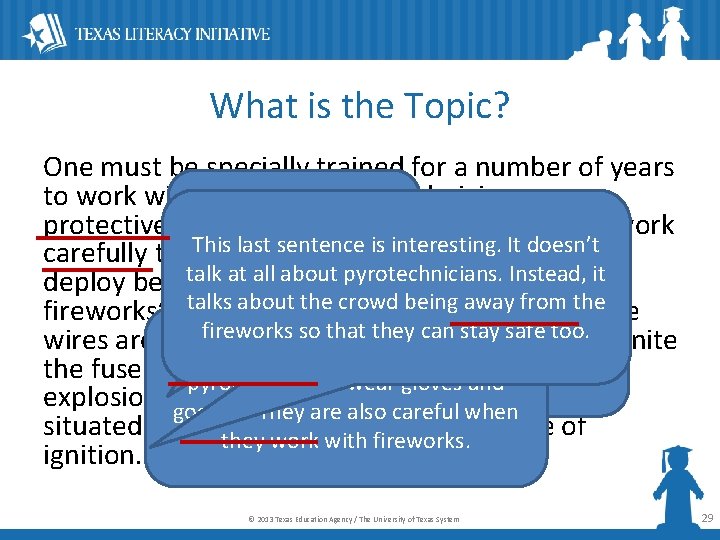
What is the Topic? One must be specially trained for a number of years to work with. These fireworks. Pyrotechnicians wear sentences tell protective gear likethe gloves and goggles as they work me that wires are This last sentence is interesting. It doesn’t carefully to ensure that none of the fireworks long soabout that the talk at all pyrotechnicians. Instead, it deploy before they are intended to do so. The I think this paragraph is technicians staycrowd safe. talks about the being awaywires. from the. The fireworks’ fuses are connected to long going to be about fireworks so that they can stay safe too. wires are long This so that the pyrotechnicians Lettells me me keep reading to can see ifignite sentence that the fuse a safe distance away from the actual I am and right. pyrotechnicians wear gloves explosion. goggles. The crowd watching the show is also They are also careful when situated a fair distance away from the site of they work with fireworks. ignition. © 2013 Texas Education Agency / The University of Texas System 29
Considerations for Teaching Students to DETERMINE IMPORTANCE AND IDENTIFY MAIN IDEA © 2013 Texas Education Agency / The University of Texas System 30
Main Idea • “Finding the main idea has never been fun for most struggling readers. They have been asked to find it countless times and have produced inadequate answers. ” • “Getting the main idea is a complex and challenging habit to develop, and it gets more challenging as texts become more complex in middle school and high school. ” (Zwiers, 210, pp. 31 -32) © 2013 Texas Education Agency / The University of Texas System 31
Main Idea The main idea can usually be stated in one sentence or less. A main idea sentence: • Includes the topic. • Includes the important information that is said about the topic. • Might include a statement about the purpose of the text (Why was the text written? ). © 2013 Texas Education Agency / The University of Texas System 32
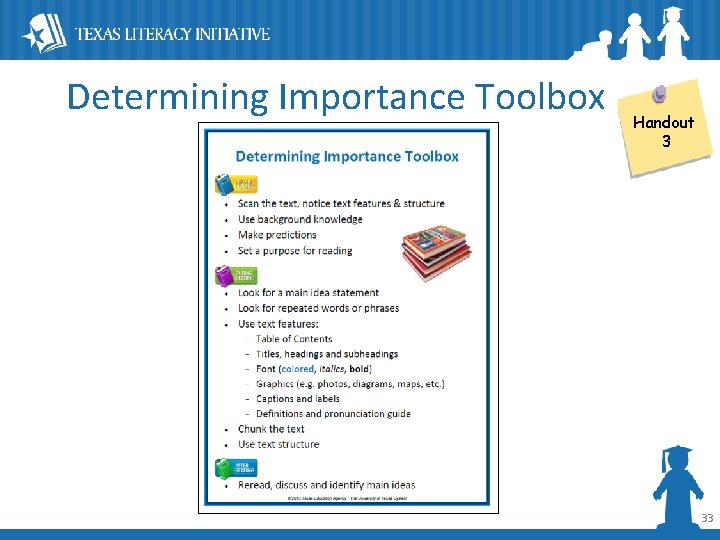
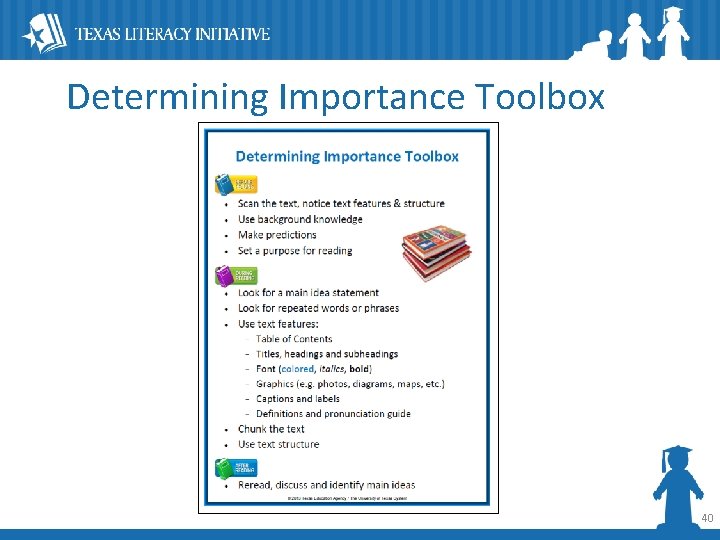
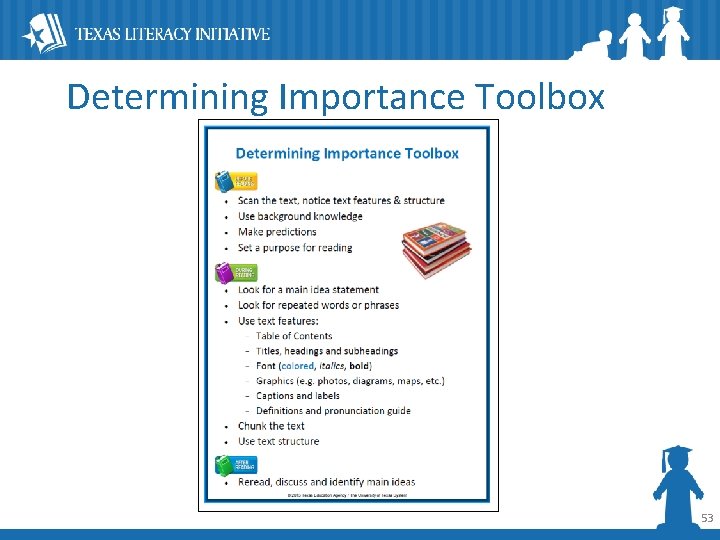
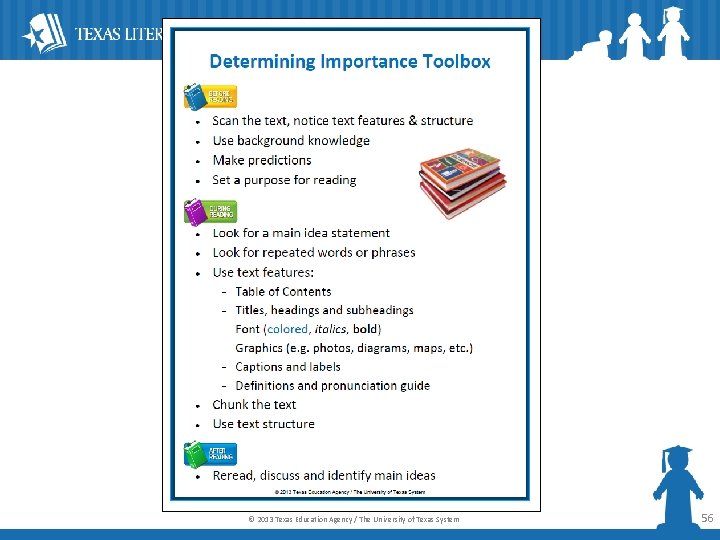
Determining Importance Toolbox Handout 3 33
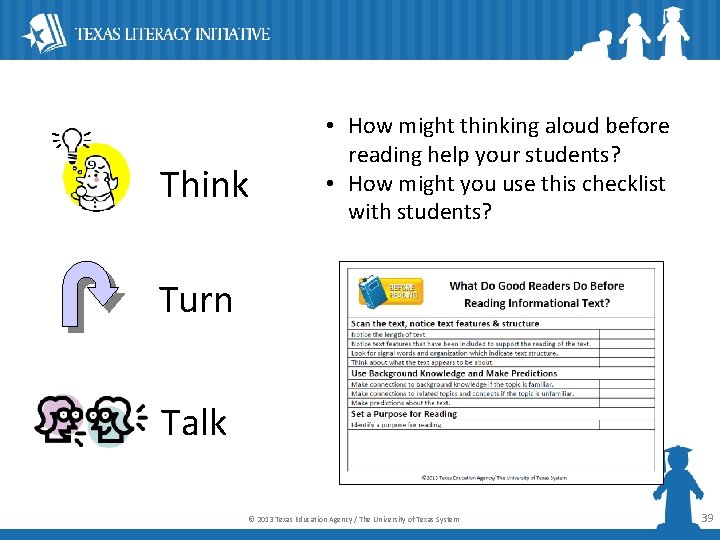
Scan the Text, Notice Text Features & Structure Good readers: • Notice the length of the text. • Notice text features that have been included to support the reading of the text. • Look for signal words and organization which indicate text structure. • Think about what the text appears to be about. © 2013 Texas Education Agency / The University of Texas System 34
Use Background Knowledge and Make Predictions Good readers: • Make connections to background knowledge if the topic is familiar. • Make connections to related topics and concepts if the topic is unfamiliar. – E. g. Spring thaw … ice cubes melting • Make predictions about the text. © 2013 Texas Education Agency / The University of Texas System 35
Set a Purpose for Reading • Good readers identify a purpose for reading. – Teacher CPQ? – Student CPQ? • • Rely on titles or headings. Review test questions. Consider predictions. What do I want to learn from reading this text? © 2013 Texas Education Agency / The University of Texas System 36
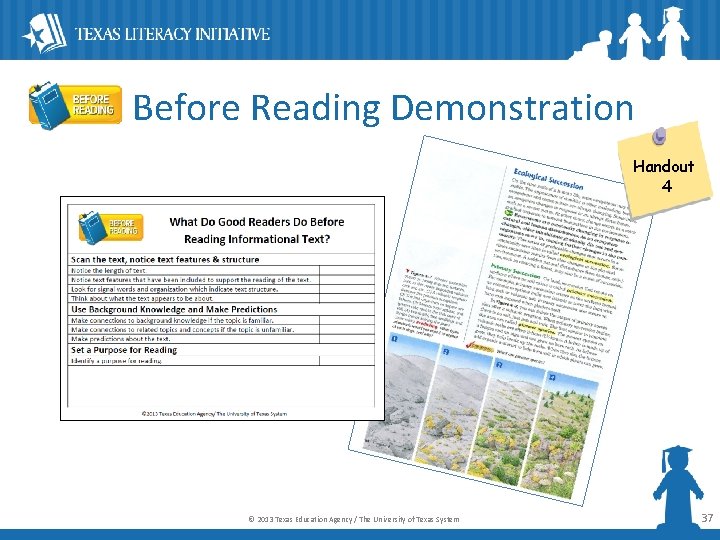
Before Reading Demonstration Handout 4 © 2013 Texas Education Agency / The University of Texas System 37
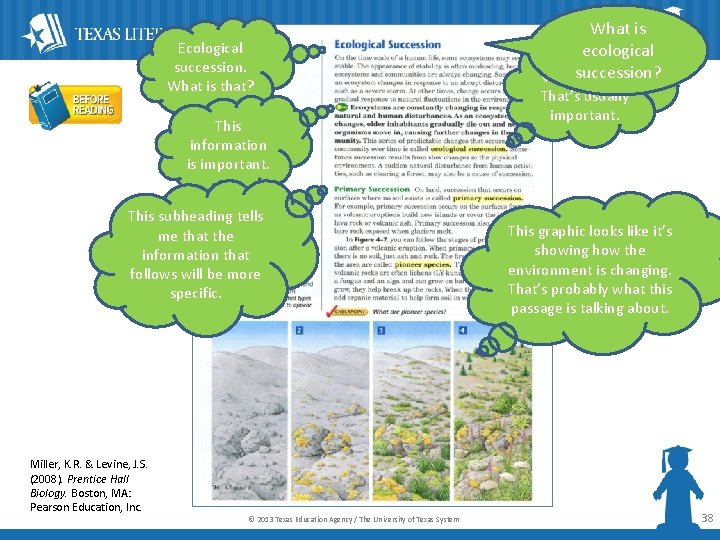
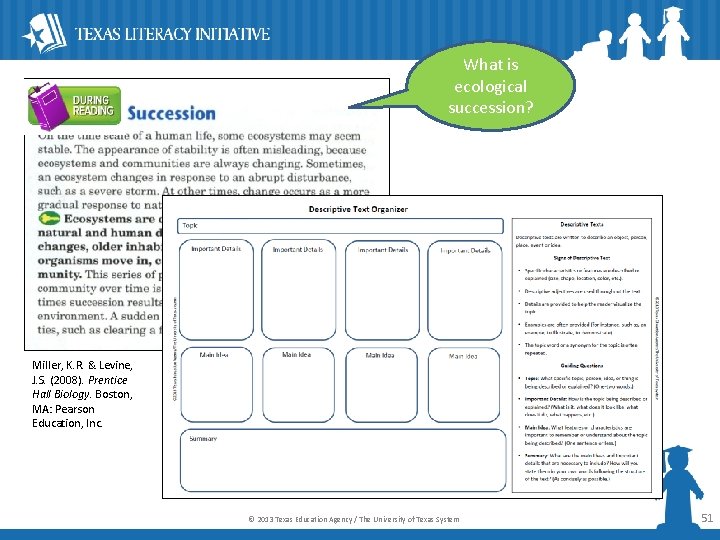
Ecological succession. What is that? This information is important. This subheading tells me that the information that follows will be more specific. Miller, K. R. & Levine, J. S. (2008). Prentice Hall Biology. Boston, MA: Pearson Education, Inc. © 2013 Texas Education Agency / The University of Texas System What is ecological This highlights vocabsuccession? words. That’s usually important. This graphic looks like it’s showing how the environment is changing. That’s probably what this passage is talking about. 38
Think • How might thinking aloud before reading help your students? • How might you use this checklist with students? Turn Talk © 2013 Texas Education Agency / The University of Texas System 39
Determining Importance Toolbox 40
Look for a Main Idea Sentence • Main ideas can be directly stated in the text or inferred. • “Baumann (1986) found that only about 15% of paragraphs in adult expository material have the topic sentence in the initial position. He also found that only 30% of the paragraphs have the main idea explicitly stated anywhere in the paragraph. These findings strongly suggest that we must teach students to overcome the lack of an explicitly stated main idea. ” (Zwiers, 2010, p. 36) © 2013 Texas Education Agency / The University of Texas System 41
Look for a Main Idea Sentence • When students don’t encounter an explicit main idea in the first sentence, they form a guess about the main idea of the passage and then check later sentences against this guess. ” (Kissner, 2006, p. 42) • When main ideas are implicit, readers rely on other “tools” to help them formulate and check their main idea inferences. © 2013 Texas Education Agency / The University of Texas System 42
Look for Repeated Words or Phrases Important information is often repeated. Good readers look for repeated words or phrases that carry similar meaning. If authors are repeating ideas or concepts in various ways, then likely that information is important. © 2013 Texas Education Agency / The University of Texas System 43
Use Text Features • • • Table of Contents Titles, headings and subheadings Font (colored, italics, bold) Graphics (e. g. , photos, diagrams, maps, timelines, etc. ) Captions and labels Definitions and pronunciation guide © 2013 Texas Education Agency / The University of Texas System 44
Chunk the Text “…readers who are unaware of text structure do not approach text with any particular plan of action. Consequently, they tend to retrieve information from the text in a seemingly random way. Students aware of text structure on the other hand, tend to “chunk” or organize the text as they read. ” (Snow, 2002, p. 40) © 2013 Texas Education Agency / The University of Texas System 45
Five Main Text Structures • • • ? Descriptive Sequential/Chronological Cause and Effect Compare and Contrast Problem and Solution © 2013 Texas Education Agency / The University of Texas System 46
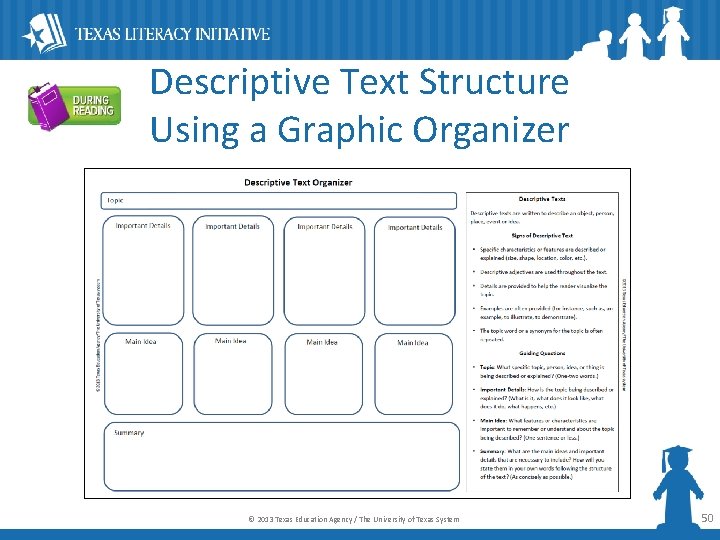
Descriptive Text Structure • Descriptive texts are written to describe an object, person, place, event or idea. • The topic is described by listing or explaining its features or characteristics, often examples are provided. • Descriptive writing is filled with details; some details are interesting and some details are important. Just because a detail is interesting doesn’t make it most important. • The main idea in descriptive text may be implicitly stated. • Creating mental images while reading descriptive text helps to more effectively identify the main idea. (Kissner, 2006, p. 56 -57) © 2013 Texas Education Agency / The University of Texas System 47
Signs of Descriptive Text Structure • Specific characteristics or features are described or explained (size, shape, location, color, etc. ). • Descriptive adjectives are used throughout the text. • Details are provided to help the reader visualize the topic. • Examples are often provided (for instance, such as, an example, to illustrate, to demonstrate). • The topic word or a synonym for the topic is often repeated. © 2013 Texas Education Agency / The University of Texas System 48
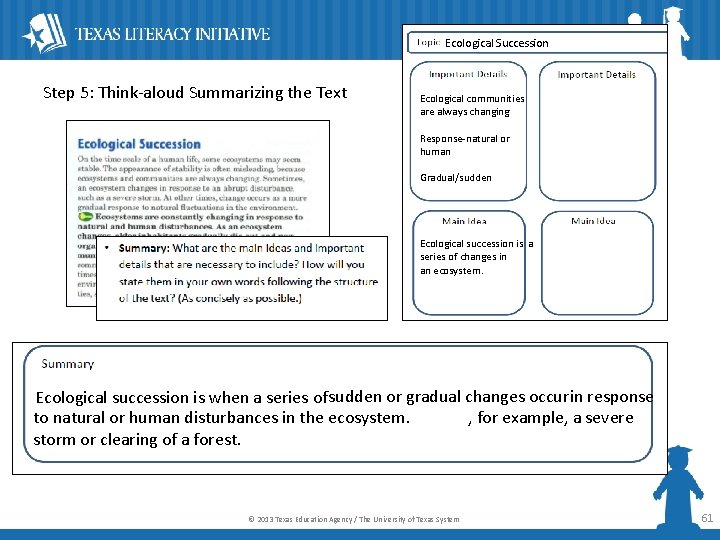
Descriptive Text Structure Guiding Questions • Topic: What specific topic, person, idea, or thing is being described or explained? (One-two words. ) • Important Details: How is the topic being described or explained? (What is it, what does it look like, what does it do, what happens, etc. ) • Main Idea: What features or characteristics are important to remember or understand about the topic being described? (One sentence of less). • Summary: What are the main ideas and important details that are necessary to include? How will you state them in your own words following the structure of the text? (As concisely as possible. ) Adapted from: Orcutt, K. (n. d. ). © 2013 Texas Education Agency / The University of Texas System 49
Descriptive Text Structure Using a Graphic Organizer © 2013 Texas Education Agency / The University of Texas System 50
What is ecological succession? Miller, K. R. & Levine, J. S. (2008). Prentice Hall Biology. Boston, MA: Pearson Education, Inc. © 2013 Texas Education Agency / The University of Texas System 51
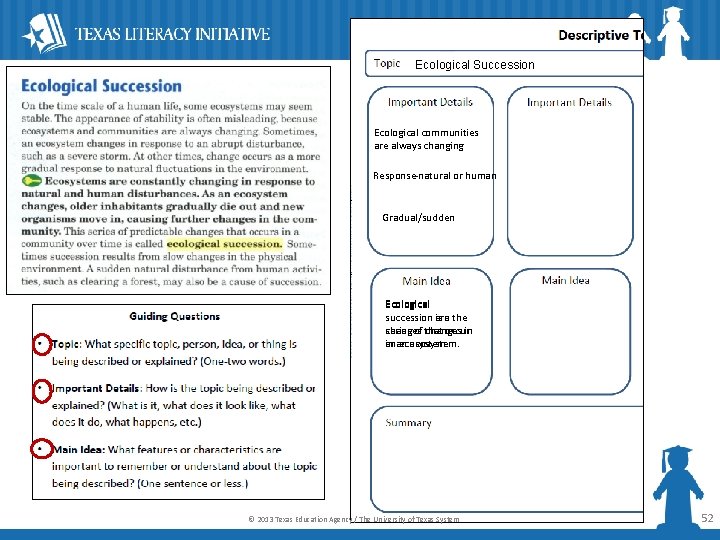
Ecological Succession Ecological communities are always changing Response-natural or human Gradual/sudden Ecological succession is area the series of that changes in changes occur an ecosystem. in an ecosystem. © 2013 Texas Education Agency / The University of Texas System 52
Determining Importance Toolbox 53
Reread and Discuss to Clarify and Identify Main Ideas in the Text “Helping students become conscious and engaged about what they are reading is an important aspect of reading for meaning and summarization. ‘Good readers read text passages at least twice: once to get the general overview and then again to determine what is salient’(Wormeli, 2005, p. 22). Providing them practice and time to reread text will help them have a better understanding of the purpose for the reading. ” (Smith & Zygouris-Coe, 2006, July) © 2013 Texas Education Agency / The University of Texas System 54
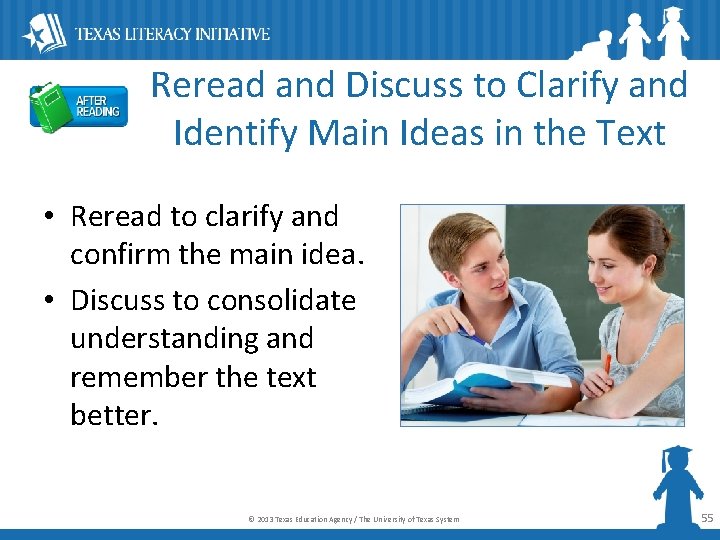
Reread and Discuss to Clarify and Identify Main Ideas in the Text • Reread to clarify and confirm the main idea. • Discuss to consolidate understanding and remember the text better. © 2013 Texas Education Agency / The University of Texas System 55
© 2013 Texas Education Agency / The University of Texas System 56
Considerations for Teaching Students to SUMMARIZE INFORMATIONAL TEXT © 2013 Texas Education Agency / The University of Texas System 57
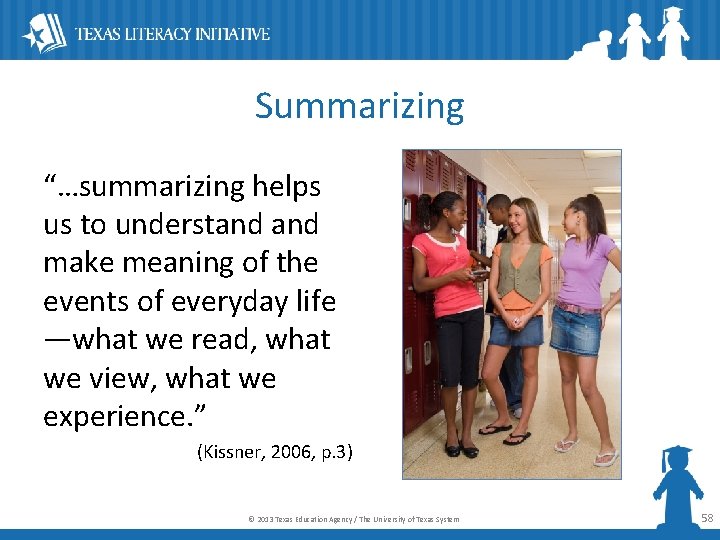
Summarizing “…summarizing helps us to understand make meaning of the events of everyday life —what we read, what we view, what we experience. ” (Kissner, 2006, p. 3) © 2013 Texas Education Agency / The University of Texas System 58
Summarizing “To summarize effectively, students need to recognize main ideas and key details, disregard unimportant or repetitive ideas, construct topic sentences, paraphrase, and collapse or combine lists or events into general statements. ” (Graham, S. , Mac. Arthur, C. , & Fitzgerald, J. , 2013, p. 339) © 2013 Texas Education Agency / The University of Texas System 59
Summarizing A summary should: • Reflect the structure of the text. • Include a topic sentence. • Include the main ideas. • Include important details. • Be paraphrased and shorter than the original text. © 2013 Texas Education Agency / The University of Texas System 60
Ecological Succession Step 5: Think-aloud Summarizing the Text Ecological communities are always changing Response-natural or human Gradual/sudden Ecological succession is a series of changes in an ecosystem. Ecological succession is when a series of sudden or gradual changes occur in response to natural or human disturbances in the ecosystem. , for example, a severe storm or clearing of a forest. © 2013 Texas Education Agency / The University of Texas System 61
Cognitive Strategy Routine
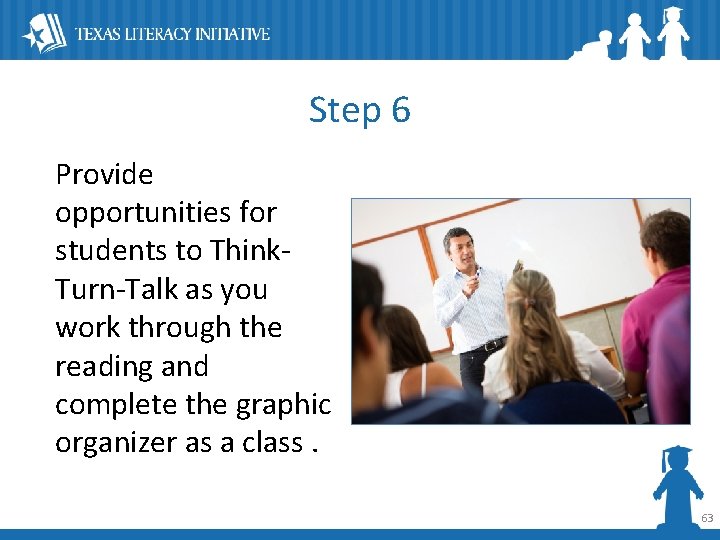
Step 6 Provide opportunities for students to Think. Turn-Talk as you work through the reading and complete the graphic organizer as a class. 63
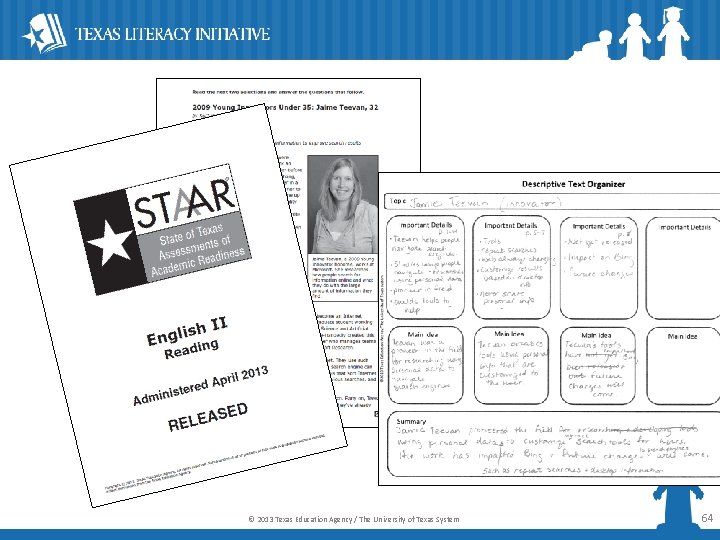
© 2013 Texas Education Agency / The University of Texas System 64
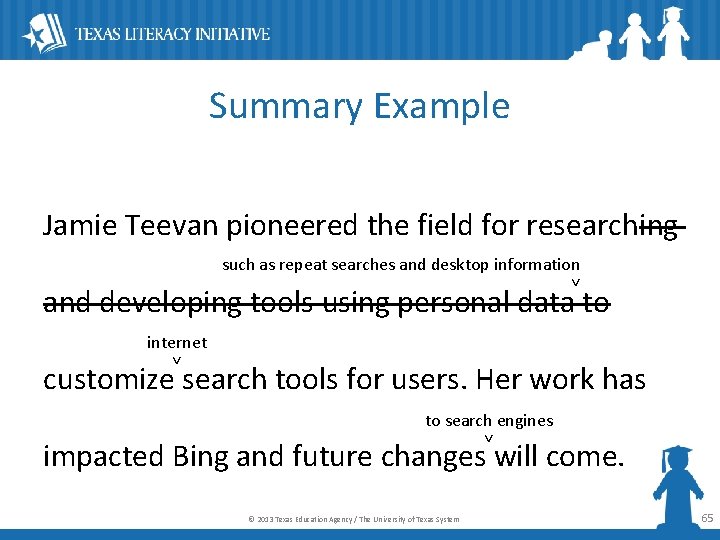
Summary Example Jamie Teevan pioneered the field for researching such as repeat searches and desktop information ˅ and developing tools using personal data to internet ˅ customize search tools for users. Her work has to search engines ˅ impacted Bing and future changes will come. © 2013 Texas Education Agency / The University of Texas System 65
Handout 5 Texas Education Agency, English II STAAR, 2013. © 2013 Texas Education Agency / The University of Texas System 66
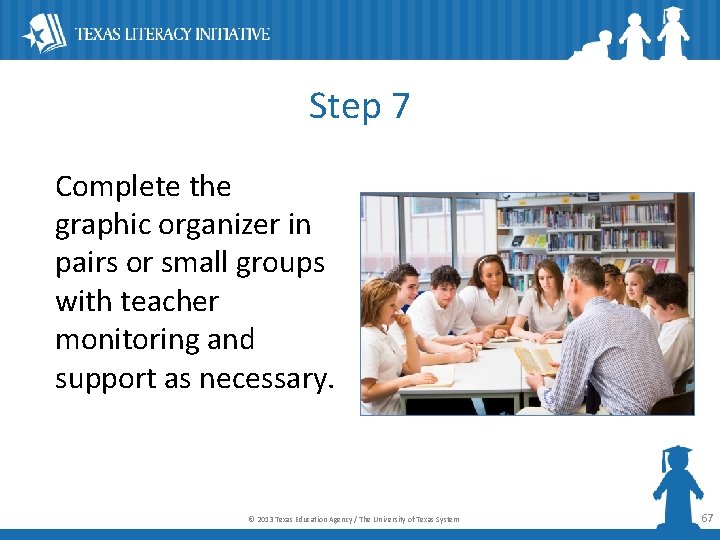
Step 7 Complete the graphic organizer in pairs or small groups with teacher monitoring and support as necessary. © 2013 Texas Education Agency / The University of Texas System 67
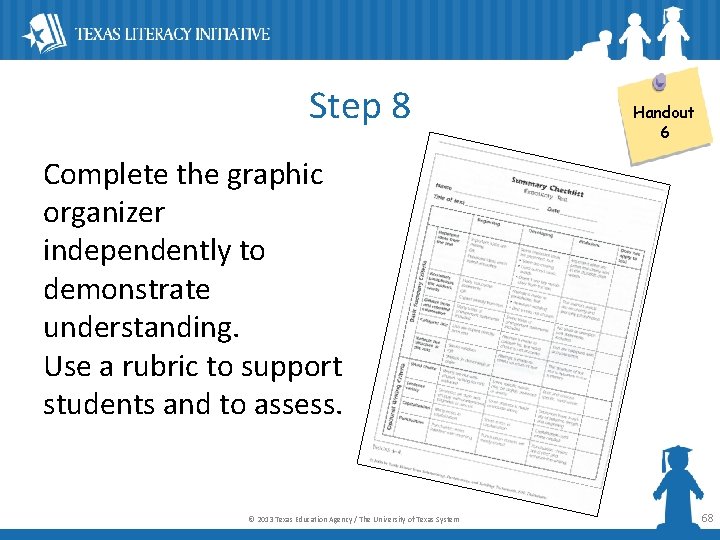
Step 8 Handout 6 Complete the graphic organizer independently to demonstrate understanding. Use a rubric to support students and to assess. © 2013 Texas Education Agency / The University of Texas System 68
Keep in mind that identifying text structure is not the goal. The goal is for students to internalize knowledge about text structure and use it to enhance their reading comprehension and improve their writing organization. (Orcutt, K. , n. d. ) © 2013 Texas Education Agency / The University of Texas System 69
“Given the rapidly changing world in which today’s students operate and given the plethora of information at their fingertips, the importance of modeling how we determine importance has increased ~ Keene & Zimmermann, 2007 dramatically. ” 70
References Armbruster, B. , Anderson, T. H. , & Ostertag, J. (1989, November). Teaching text structure to improve reading and writing. The Reading Teacher, 43(2), 130 -137. Baxendell, B. (2003). Consistent, coherent, creative: The 3 Cs of graphic organizers. Teaching Exceptional Children, 35(3), 46 -53. Bluestein, N. A. (2010, April). Unlocking text features for determining importance in expository: A strategy for struggling readers. The Reading Teacher (63)7, 597 -600. Caccamise, D. (2011). Improved reading comprehension by writing. Perspectives on Language Learning and Education, 18(1), 27 -31. Center for the Improvement of Early Reading Achievement (CIERA). (2003). Put reading first: The research building blocks for teaching children to read. National Institute for Literacy. Ciardiello, A. V. (2002). Helping adolescents understand cause and effect text structure in social studies. Social Studies, 93, 31– 37. Coyne, M. , Chard, D. , Zipoli, R. , & Ruby, M. (2007). Effective strategies for teaching comprehension. In M. Coyne, E. Kame’enui, & D. Carnine (Eds. ), Effective teaching strategies that accommodate diverse learners (pp. 80 -109). Upper Saddle River, NJ: Pearson Education, Inc. Duke, N. K. , & Pearson, P. D. , (2002). Effective practices for developing reading comprehension. In A. E. Farstrup & S. J. Samuels (Eds. ), What research has to say about reading instruction (pp. 205 -242). Newark, DE: International Reading Association, Inc. © 2013 Texas Education Agency / The University of Texas System 71
References Dymock, S. & Nicholson, T. (2007). Teaching Text Structures: A Key to Nonfiction Reading Success. New York, NY: Scholastic, Inc. Fletcher, J. , Lyon, R. , Fuchs, L. , & Barnes, M. (2007). Learning disabilities: From identification to intervention. New York, NY: The Guilford Press. Graham, S. , Mac. Arthur, C. A. , & Fitzgerald, J. (2013). Best practices in writing instruction (2 nd ed. ). New York, NY: Guilford Press. Harvey, S. , & Goudvis, A. (2007). Strategies that work: Teaching comprehension to enhance understanding (3 rd ed. ). Portland, ME: Stenhouse Publishers. Israel, S. E. , & Duffy, G. G. (Eds. ). (2009). Handbook of research on reading comprehension. New York: Routledge. Johnston, P. , & Afflerbach, P. (1985). The process of constructing main ideas from text. Cognition and Instruction, 2(3/4), 207 -232. Keene, E. , & Zimmermann, S. (2007). Mosaic of thought: The power of comprehension strategy instruction (2 nd ed. ). Portsmouth, NH: Heinemann. Kissner, E. , (2006). Summarizing paraphrasing and retelling. Skills for better reading, writing, and test taking. Portsmouth, NH: Heinemann. © 2013 Texas Education Agency / The University of Texas System 72
References Kleiner, K. (2009, September/October). 2009 Young innovators under 35: Jaime Teevan, 32. Texas Education Agency STAAR Released Test Questions. State of Texas Assessments of Academic Readiness English II Reading 2013 Released Selections and Test Questions. Retrieved January 7, 2014 from http: //www. google. com/url? sa=t&rct=j&q=&esrc=s&frm=1&source=web&cd=2&cad=rja&ved=0 CC 8 QFj. AB &url=http%3 A%2 F%2 Fwww. tea. state. tx. us%2 FWork. Area%2 FDownload. Asset. aspx%3 Fid%3 D 25769805979 &ei=u. CPg. Ury. UPKrj 2 w. Wp 44 Hg. DA&usg=AFQj. CNF 4 ENUmaan 22_U_6 bur. Uqr. Tnskwu. A Kosanovich, M. L. , Reed, D. K. , & Miller, D. H. (2010). Bringing literacy strategies into content instruction: Professional learning for secondary-level teachers. Portsmouth, NH: RMC Research Corporation, Center on Instruction. Lapp, D. , Fisher, D. & Grant, M. (2008, February). “You can read this text-I’ll show you how”: Interactive comprehension instruction. Journal od Adolescent and Adult Literacy, (51)5, 372 -382. Mc. Gregor, T. (2007). Comprehension connections: Bridges to strategic reading. Portland, ME: Stenhouse Publishers. Miller, K. R. & Levine, J. S. (2008). Prentice Hall Biology. Boston, MA: Pearson Education, Inc. National Reading Panel. (2000). Report of the National Reading Panel: Teaching children to read. Report of the subgroups. Washington, D. C. : U. S. Department of Health and Human Services, National Institutes of Health. Orcutt, K. (n. d. ). Teaching text structure and more. ESSDACK. Retrieved from http: //www. literacyleader. com/sites/litlead. essdack. org/files/Text%20 Structure%20 GCHS. ppt. pdf © 2013 Texas Education Agency / The University of Texas System 73
References Piccolo, J. (1987). Expository text structure: Teaching and learning strategies, The Reading Teacher, 40(9), 838847. Pressley, M. (2000). What should comprehension instruction be the instruction of? In M. Kamil, P. Mosenthal, P. D. Pearson & R. Barr (Eds. ), Handbook of Reading Research (Vol. III, pp. 545– 561). Mahwah, NJ: Lawrence Erlbaum. Quantum mechanics. (n. d. ). In Wikipedia. org. Retrieved March 27, 2009, from http: //en. wikipedia. org/wiki/Quantum_mechanics RAND Reading Study Group. (2002). Reading for understanding: Toward an R&D program in reading comprehension. Santa Monica, CA: RAND, Office of Educational Research and Improvement, U. S. Department of Education. Shanahan, T. & Shanahan, C. (2008). Teaching disciplinary literacy to adolescents: Rethinking content-area literacy. Harvard Educational Review, 78(1), 40 -59. Silver, H. , Strong, R. , & Perini, M. (2000). Discovering nonfiction: 25 powerful teaching strategies grades 2 -6. Los Angeles, CA: Canter & Associates, Inc. Sjostrom, C. L. , & Hare, V. C. (1984). Teaching high school students to identify main ideas in expository text. Journal of Educational Research, 78(2), 114 -118. Smith, L. & Zygouris-Coe, V. (2006, July). Summarization. Orange County Public Schools. Retrieved from https: //www. ocps. net/cs/services/cs/currareas/read/IR/bestpractices/SZ/Summarization. pdf © 2013 Texas Education Agency / The University of Texas System 74
References Snow, C. (2002). Reading for understanding: Toward an R&D program in reading comprehension. Washington, DC: RAND Reading Study Group. Strong, R. , Silver, H. , Perini, A. , & Tuculescu, G. (2003, September). Boredom and its opposite. Educational Leadership. Building Classroom Relationships. 61(1), 24 -29. Teacher's Curriculum Institute. (n. d. ). History alive! Pursuing American ideals. Retrieved from http: //www. teachtci. com/programs/high-school/history-alive-textbook/pursuing-americanideals/HA_Pursuing. American. Ideals_HS_Sample. Chapter. pdf Thiede, K. W. & Anderson, M. C. M. (2003). Summarizing can improve metacomprehension accuracy. Contemporary Educational Psychology, 28(2), 129 -160. University of Kansas. (n. d. ). Teaching Section Summarization Strategies. Retrieved from http: //www. specialconnections. ku. edu/? q=instruction/reading_comprehension/teacher_tools/teaching_s ection_summarization_strategies University of Texas System/Texas Education Agency. (2009). ELAR/SLAR TEKS handbook. Austin, TX: Texas Education Agency. Zimmermann, S. , & Hutchins, C. (2003). 7 keys to comprehension: How to help your kids read it and get it! New York, NY: Three Rivers Press. Zweirs, J. (2010). Building reading comprehension habits in grades 6 -12: A toolkit of classroom activities (2 nd ed. ). Newark, DE: International Reading Association, Inc. © 2013 Texas Education Agency / The University of Texas System 75