
Determining and Forecasting Load Reductions from Demand Side



- Slides: 48
Determining and Forecasting Load Reductions from Demand Side Programs September 11 -12, 2007 Presented by: Bill Bland, V. P. Consulting, Good. Cents Liza Thompson, Supervisor-Load Research, Good. Cents
Introduction to Sample Design Sample Size • Determining Sample Size • General formula • N=CV 2/(D/Z)2 , where CV is coefficient of variation, D is percent accuracy desired, and Z is the standard normal deviate for the confidence level desired, Z=1. 65 for 90% confidence, 1. 96 for 95% confidence
Introduction to Sample Design Sample Size • Determining Sample Size • Example, 100, 000 AC, estimate connected load CV estimate is 0. 5 • What sample size is necessary to know average connected load to within 10% at 90% confidence? • N=CV 2/(D/Z)2 , N=(0. 5)2/(0. 1/1. 65)2 • N=68
Introduction to Sample Design Sample Size
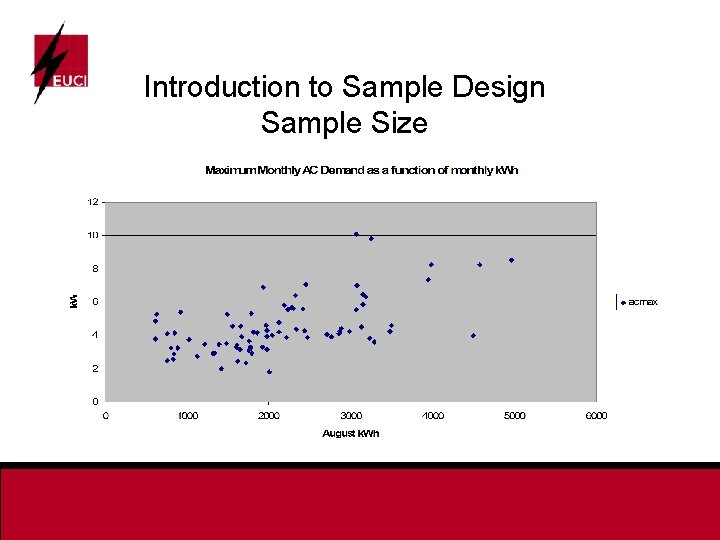
Introduction to Sample Design Sample Size • Determining Sample Size • Problems encountered in Research – No estimate of Population CV available – Solution, Use a correlated readily available variablealmost always billed k. Wh use – For AC load Management, recommend using July or August k. Wh use
Introduction to Sample Design Sample Size • Determining Sample Size • If we have population data available on a correlated variable such as billed k. Wh or AC connected load, we can use an alternate formula for sample size
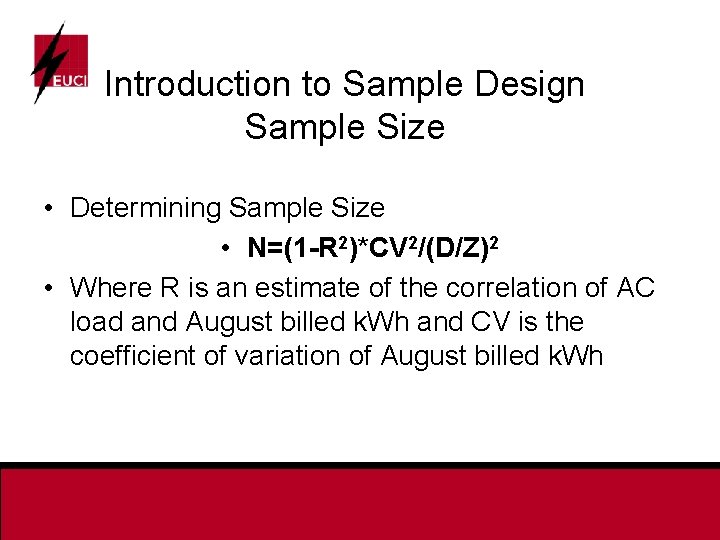
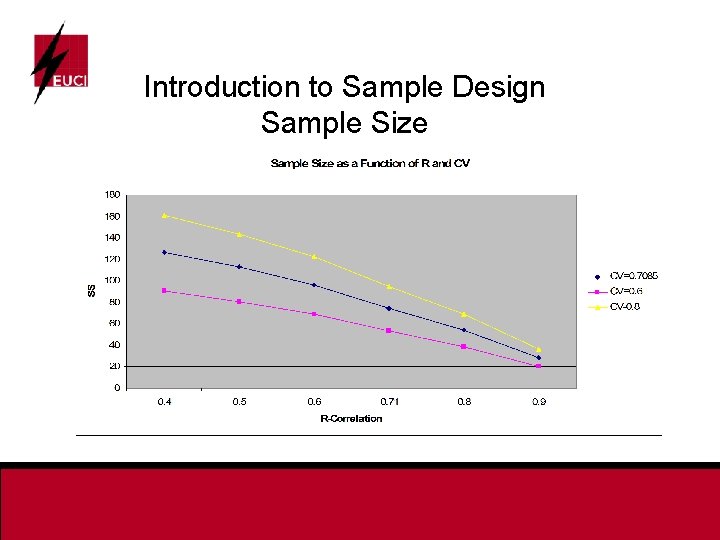
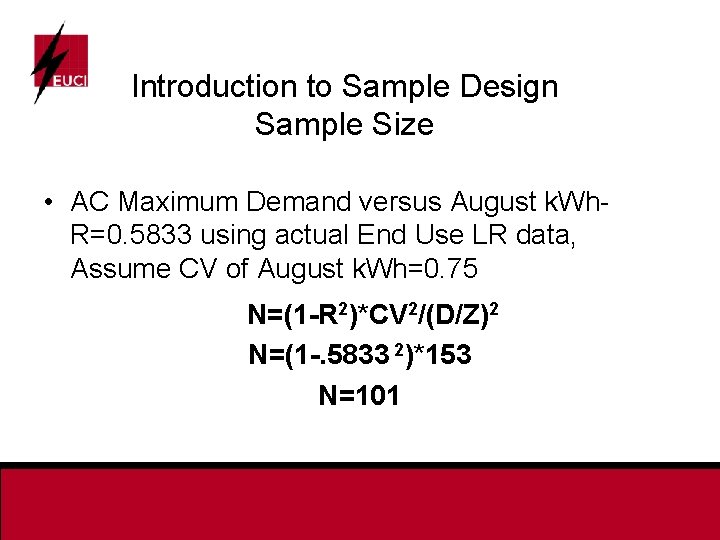
Introduction to Sample Design Sample Size • Determining Sample Size • N=(1 -R 2)*CV 2/(D/Z)2 • Where R is an estimate of the correlation of AC load and August billed k. Wh and CV is the coefficient of variation of August billed k. Wh
Introduction to Sample Design Sample Size
Introduction to Sample Design Sample Size
Introduction to Sample Design Sample Size • AC Maximum Demand versus August k. Wh. R=0. 5833 using actual End Use LR data, Assume CV of August k. Wh=0. 75 N=(1 -R 2)*CV 2/(D/Z)2 N=(1 -. 5833 2)*153 N=101
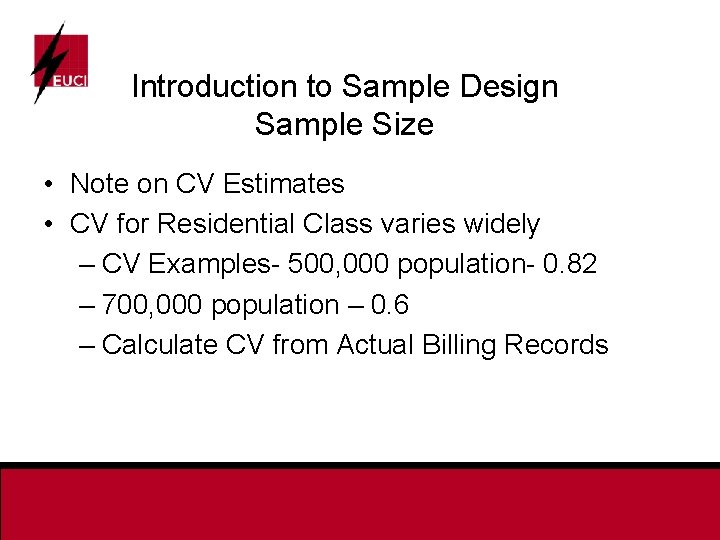
Introduction to Sample Design Sample Size • Note on CV Estimates • CV for Residential Class varies widely – CV Examples- 500, 000 population- 0. 82 – 700, 000 population – 0. 6 – Calculate CV from Actual Billing Records
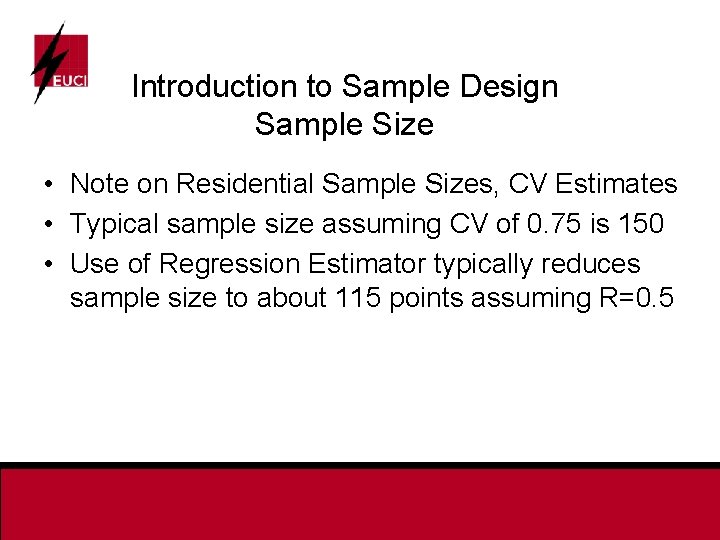
Introduction to Sample Design Sample Size • Note on Residential Sample Sizes, CV Estimates • Typical sample size assuming CV of 0. 75 is 150 • Use of Regression Estimator typically reduces sample size to about 115 points assuming R=0. 5
Introduction to Sample Design Stratification • Stratification- Dividing the population into smaller groups with like variance • We recommend stratification to improve the overall load reduction estimates
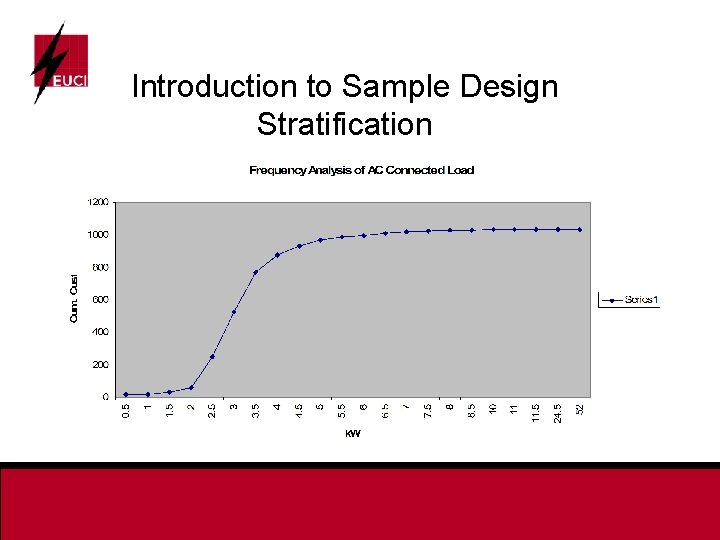
Introduction to Sample Design Stratification • Stratification • How to determine strata boundaries to minimize variance? • Use method of Dalenius and Hodges (DH)
Introduction to Sample Design Stratification
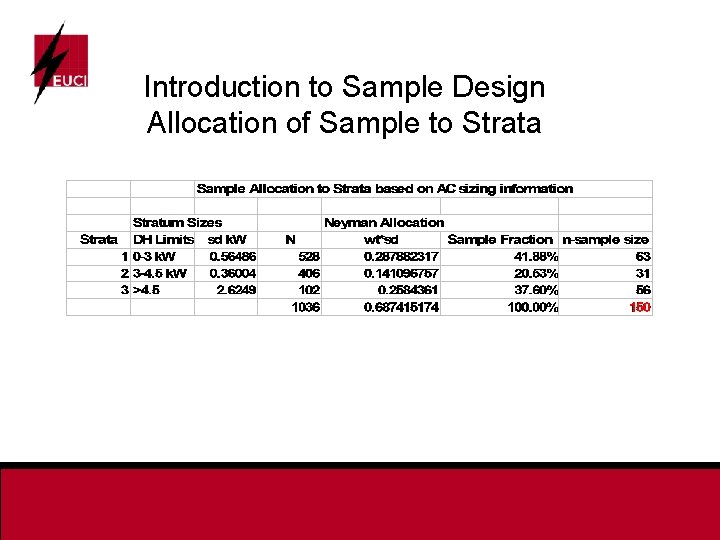
Introduction to Sample Design Allocation of Sample to Strata • We now know our strata and we will assume a sample size of 150 • Do we assume 50 sample points per strata? • We use Neyman allocation to allocate to strata based on σ of design variable and number of units in each strata
Introduction to Sample Design Allocation of Sample to Strata
Introduction to Sample Design Test and Control Groups • Don’t we need a test and control group since this is basically an experiment to see the effects of load control on AC use? • The problems with a test and control group involve cost to do the research and matching up customer demographics and usage patterns to get comparable groups
Introduction to Sample Design Test and Control Groups • We prefer to use the test group as its own control, therefore we do not have to match up demographics and we only need one sample • Customers will be controlled on some days and not controlled on others • Comparison will be of AC or premise loadshapes on control versus no-control days • We will use regression analysis to develop the control estimates from our sample
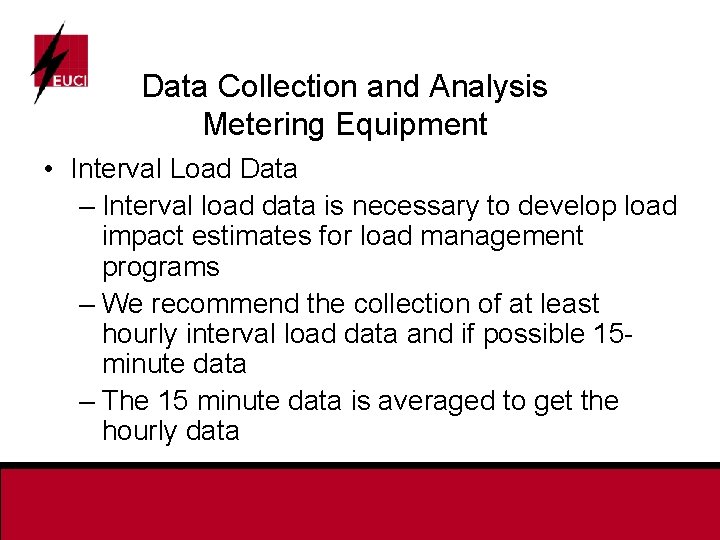
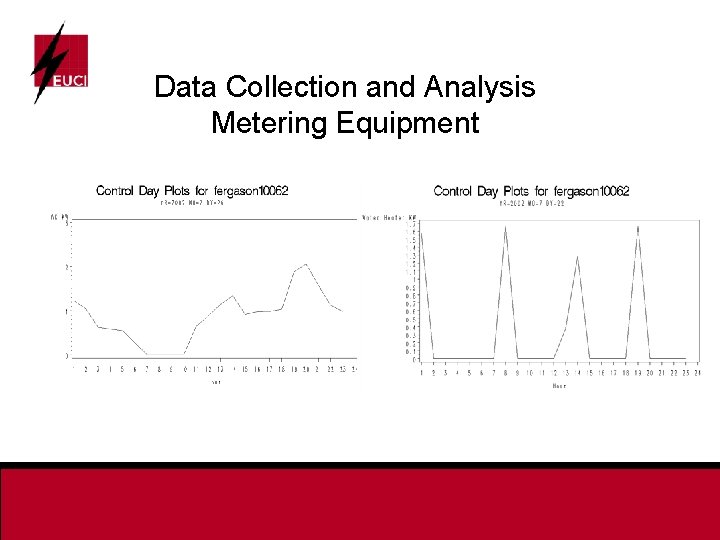
Data Collection and Analysis Metering Equipment • Interval Load Data – Interval load data is necessary to develop load impact estimates for load management programs – We recommend the collection of at least hourly interval load data and if possible 15 minute data – The 15 minute data is averaged to get the hourly data
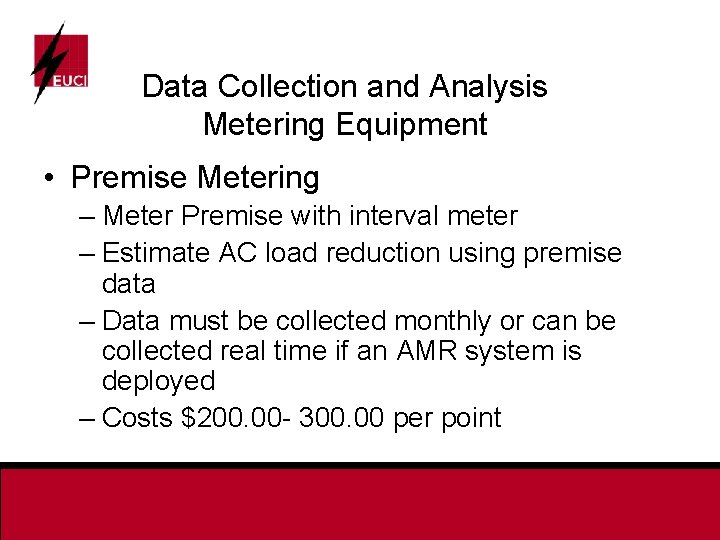
Data Collection and Analysis Metering Equipment • Premise Metering – Meter Premise with interval meter – Estimate AC load reduction using premise data – Data must be collected monthly or can be collected real time if an AMR system is deployed – Costs $200. 00 - 300. 00 per point
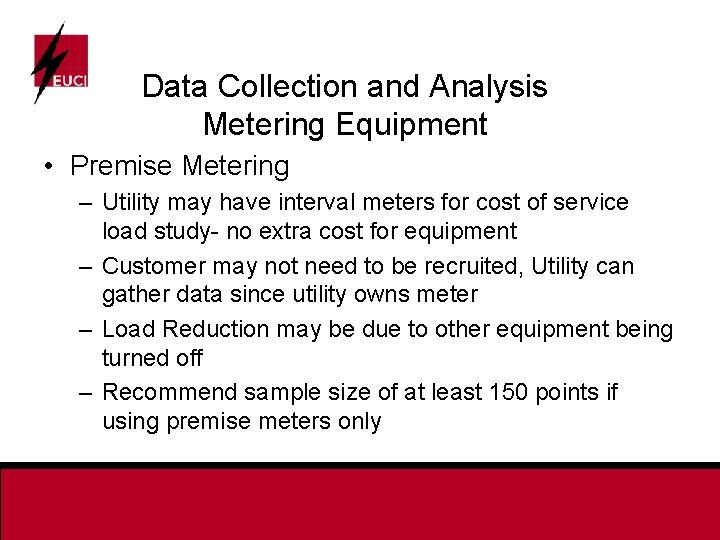
Data Collection and Analysis Metering Equipment • Premise Metering – Utility may have interval meters for cost of service load study- no extra cost for equipment – Customer may not need to be recruited, Utility can gather data since utility owns meter – Load Reduction may be due to other equipment being turned off – Recommend sample size of at least 150 points if using premise meters only
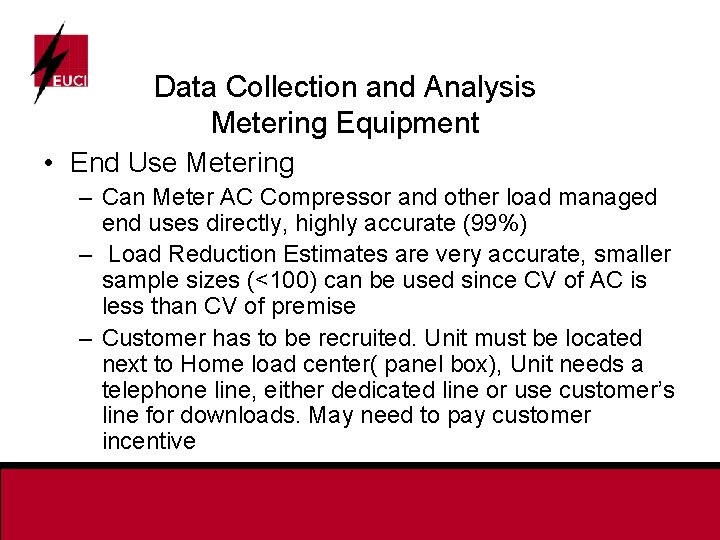
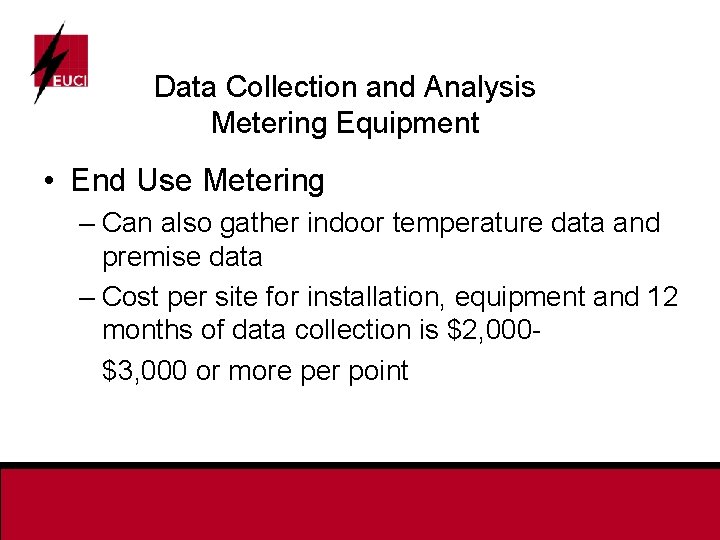
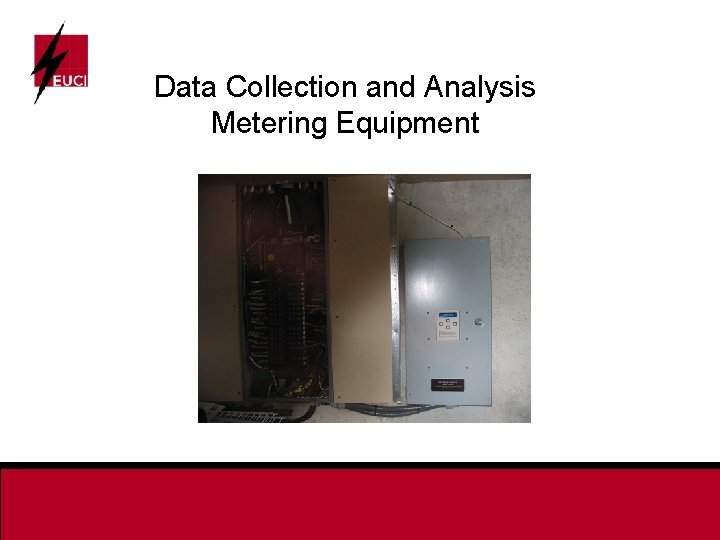
Data Collection and Analysis Metering Equipment • End Use Metering – Can Meter AC Compressor and other load managed end uses directly, highly accurate (99%) – Load Reduction Estimates are very accurate, smaller sample sizes (<100) can be used since CV of AC is less than CV of premise – Customer has to be recruited. Unit must be located next to Home load center( panel box), Unit needs a telephone line, either dedicated line or use customer’s line for downloads. May need to pay customer incentive
Data Collection and Analysis Metering Equipment • End Use Metering – Can also gather indoor temperature data and premise data – Cost per site for installation, equipment and 12 months of data collection is $2, 000$3, 000 or more per point
Data Collection and Analysis Metering Equipment
Data Collection and Analysis Metering Equipment
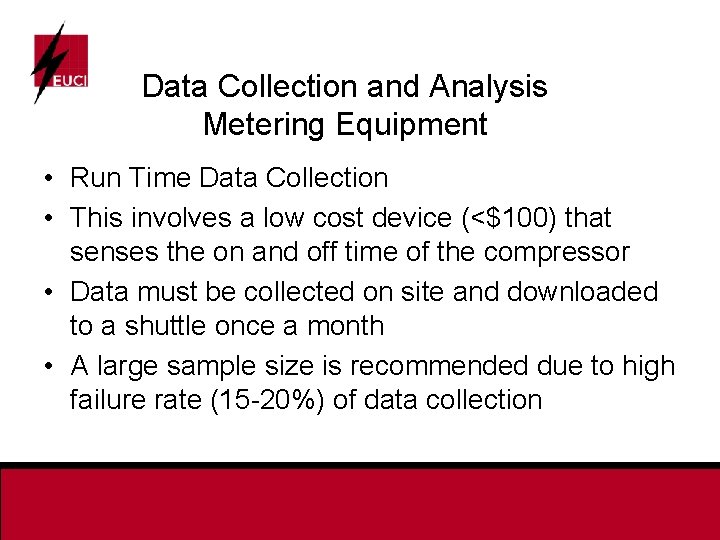
Data Collection and Analysis Metering Equipment • Run Time Data Collection • This involves a low cost device (<$100) that senses the on and off time of the compressor • Data must be collected on site and downloaded to a shuttle once a month • A large sample size is recommended due to high failure rate (15 -20%) of data collection
Data Collection and Analysis Metering Equipment • Run Time Data Collection failure is usually due to improper placement of the equipment or other equipment interfering with the signal • This data requires more analysis time since the on-off time must be converted to k. W, Data is discontinuous
Data Collection and Analysis Characteristics Data • Characteristics data should be collected at each home – Necessary Data • AC/ WH Nameplate, Make, Model, Serial Number • Total Square Footage • Indoor Daytime Thermostat Setting – Like to Have Number of Floors (square footage of each if available) • Number of people in household • Outdoor Construction
Data Collection and Analysis Weather Data • We have found that NWS or CMS data for the nearest station is preferable to data collected at the site. • This is because site data is not collected using NWS/CMS standards. • Daily and Hourly data can be used in the modeling process. • We typically use Daily maximum temperature data. • Indoor temperature Data is useful if end use metered data is available.
Data Collection and Analysis End Use Database • The interval load, weather, control and characteristics data must be combined into one database for analysis. • We recommend careful review of the database to ensure that the various files have been merged correctly before beginning modeling. • Plots of data are helpful in identifying problems. • We recommend and use SAS® for data analysis, graphics and modeling.
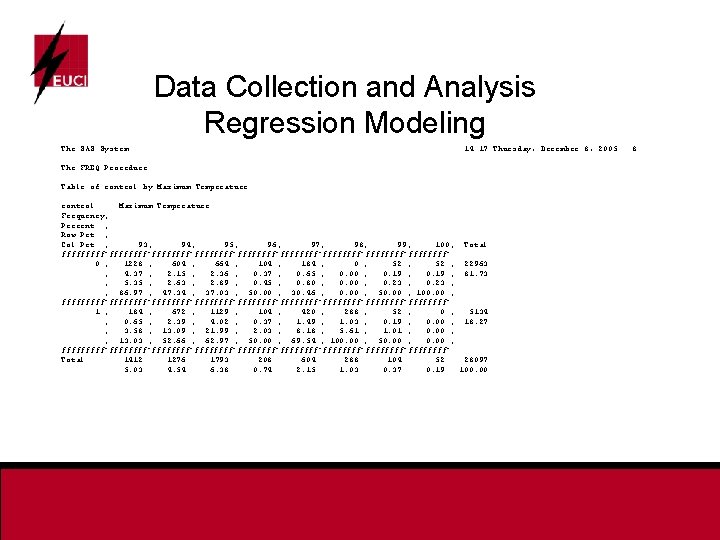
Data Collection and Analysis Regression Modeling • Our methodology is to develop a model from a sample of customers with interval data gathered on control and non-control days. • The model is typically developed by strata and over a maximum outdoor temperature range for which AC load data is available.
Data Collection and Analysis Regression Modeling The SAS System 14: 17 Thursday, December 8, 2005 The FREQ Procedure Table of control by Maximum Temperature control Maximum Temperature Frequency‚ Percent ‚ Row Pct ‚ Col Pct ‚ 93‚ 94‚ 95‚ 96‚ 97‚ 98‚ 99‚ 100‚ Total ƒƒƒƒƒˆƒƒƒƒƒƒƒƒˆƒƒƒƒƒƒƒƒˆƒƒƒƒƒƒƒƒˆƒƒƒƒƒƒƒƒˆ 0 ‚ 1228 ‚ 604 ‚ 664 ‚ 104 ‚ 184 ‚ 0 ‚ 52 ‚ 22963 ‚ 4. 37 ‚ 2. 15 ‚ 2. 36 ‚ 0. 37 ‚ 0. 65 ‚ 0. 00 ‚ 0. 19 ‚ 81. 73 ‚ 5. 35 ‚ 2. 63 ‚ 2. 89 ‚ 0. 45 ‚ 0. 80 ‚ 0. 00 ‚ 0. 23 ‚ ‚ 86. 97 ‚ 47. 34 ‚ 37. 03 ‚ 50. 00 ‚ 30. 46 ‚ 0. 00 ‚ 50. 00 ‚ 100. 00 ‚ ƒƒƒƒƒˆƒƒƒƒƒƒƒƒˆƒƒƒƒƒƒƒƒˆƒƒƒƒƒƒƒƒˆƒƒƒƒƒƒƒƒˆ 1 ‚ 184 ‚ 672 ‚ 1129 ‚ 104 ‚ 420 ‚ 288 ‚ 52 ‚ 0 ‚ 5134 ‚ 0. 65 ‚ 2. 39 ‚ 4. 02 ‚ 0. 37 ‚ 1. 49 ‚ 1. 03 ‚ 0. 19 ‚ 0. 00 ‚ 18. 27 ‚ 3. 58 ‚ 13. 09 ‚ 21. 99 ‚ 2. 03 ‚ 8. 18 ‚ 5. 61 ‚ 1. 01 ‚ 0. 00 ‚ ‚ 13. 03 ‚ 52. 66 ‚ 62. 97 ‚ 50. 00 ‚ 69. 54 ‚ 100. 00 ‚ 50. 00 ‚ ƒƒƒƒƒˆƒƒƒƒƒƒƒƒˆƒƒƒƒƒƒƒƒˆƒƒƒƒƒƒƒƒˆƒƒƒƒƒƒƒƒˆ Total 1412 1276 1793 208 604 288 104 52 28097 5. 03 4. 54 6. 38 0. 74 2. 15 1. 03 0. 37 0. 19 100. 00 8
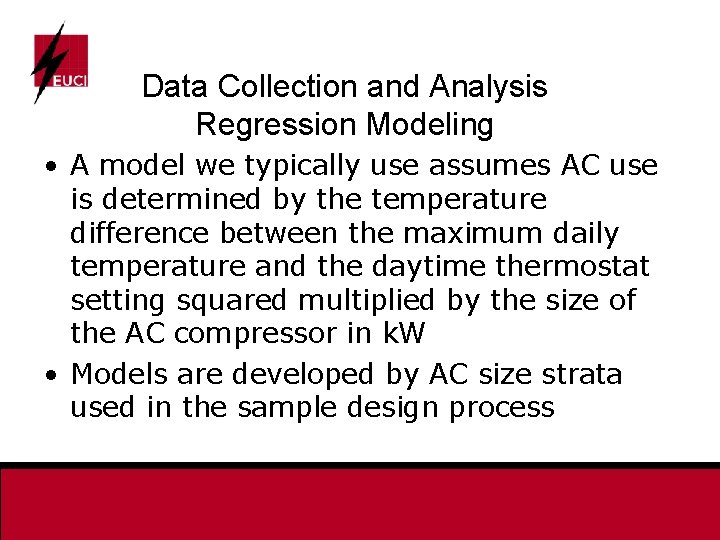
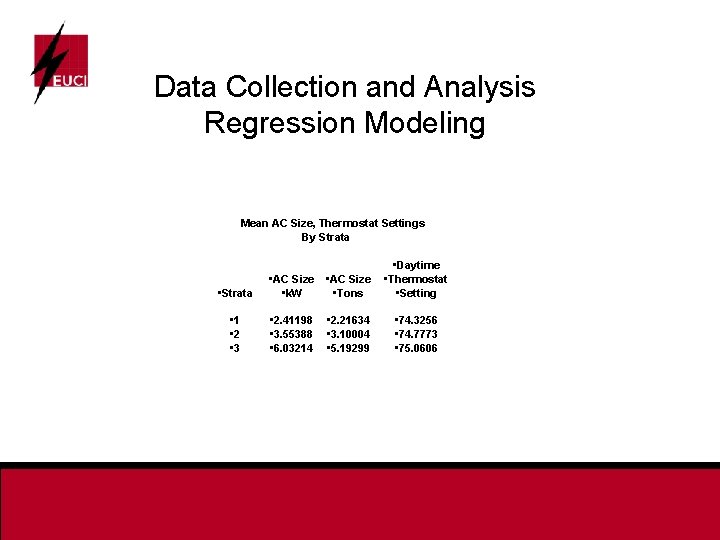
Data Collection and Analysis Regression Modeling • A model we typically use assumes AC use is determined by the temperature difference between the maximum daily temperature and the daytime thermostat setting squared multiplied by the size of the AC compressor in k. W • Models are developed by AC size strata used in the sample design process
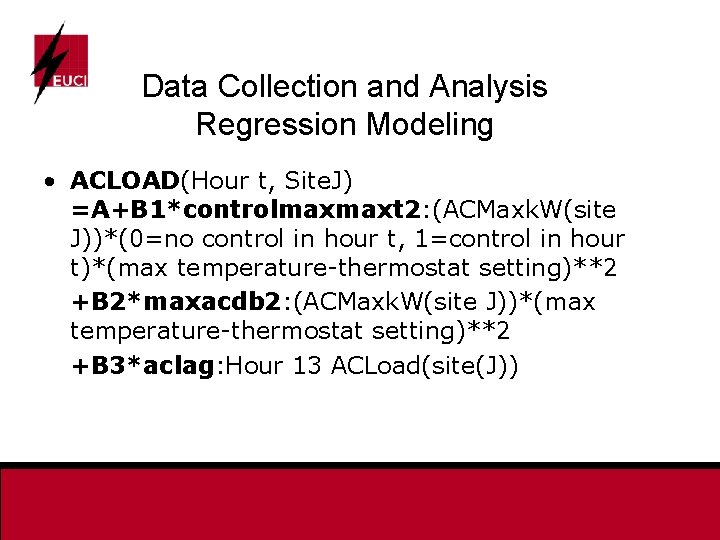
Data Collection and Analysis Regression Modeling • ACLOAD(Hour t, Site. J) =A+B 1*controlmaxmaxt 2: (ACMaxk. W(site J))*(0=no control in hour t, 1=control in hour t)*(max temperature-thermostat setting)**2 +B 2*maxacdb 2: (ACMaxk. W(site J))*(max temperature-thermostat setting)**2 +B 3*aclag: Hour 13 ACLoad(site(J))
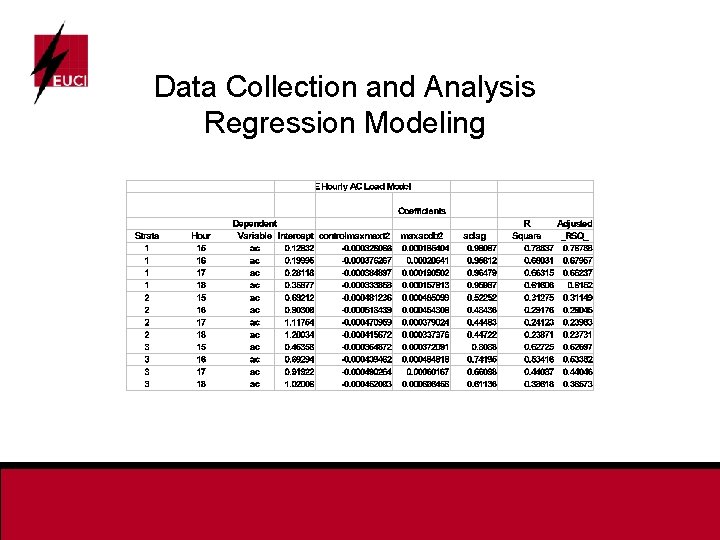
Data Collection and Analysis Regression Modeling • A is the regression intercept and B 1, B 2 and B 3 are regression coefficients determined during the modeling process. The B 1 coefficient is the load reduction estimate for a 1 k. W AC at hour t and a given temperature and thermostat setting. A total of 12 regressions were estimated. These are cross-sectional models and are estimated with all data from all sites for each strata and hour of control.
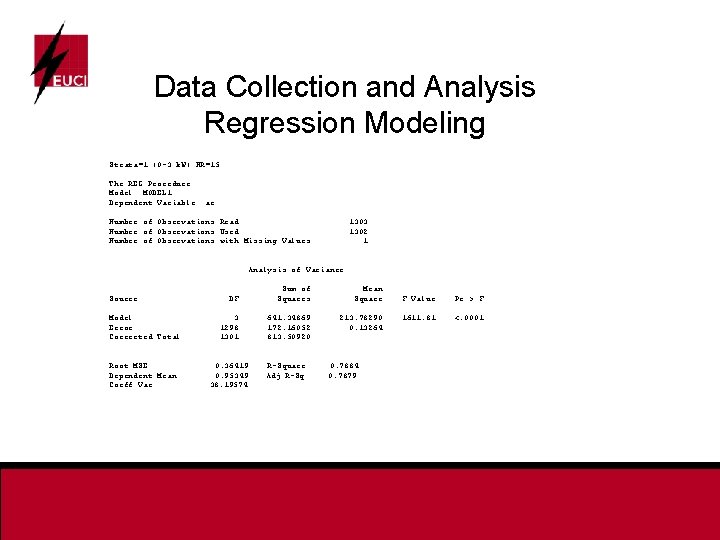
Data Collection and Analysis Regression Modeling Strata=1 (0 -3 k. W) HR=15 The REG Procedure Model: MODEL 1 Dependent Variable: ac Number of Observations Read Number of Observations Used Number of Observations with Missing Values 1303 1302 1 Analysis of Variance Source Model Error Corrected Total Root MSE Dependent Mean Coeff Var DF Sum of Squares Mean Square 3 1298 1301 641. 34869 172. 16052 813. 50920 213. 78290 0. 13264 0. 36419 0. 95349 38. 19574 R-Square Adj R-Sq 0. 7884 0. 7879 F Value Pr > F 1611. 81 <. 0001
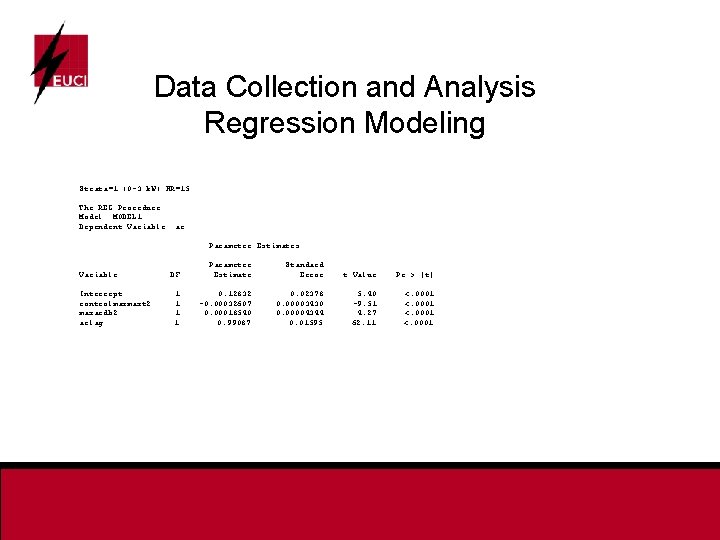
Data Collection and Analysis Regression Modeling Strata=1 (0 -3 k. W) HR=15 The REG Procedure Model: MODEL 1 Dependent Variable: ac Parameter Estimates Variable Intercept controlmaxmaxt 2 maxacdb 2 aclag DF Parameter Estimate Standard Error t Value Pr > |t| 1 1 0. 12832 -0. 00032607 0. 00018540 0. 99087 0. 02378 0. 00003430 0. 00004344 0. 01595 5. 40 -9. 51 4. 27 62. 11 <. 0001
Data Collection and Analysis Regression Modeling
Data Collection and Analysis Regression Modeling Mean AC Size, Thermostat Settings By Strata • AC Size • k. W • AC Size • Tons • Daytime • Thermostat • Setting • 1 • 2 • 3 • 2. 41198 • 3. 55388 • 6. 03214 • 2. 21634 • 3. 10004 • 5. 19299 • 74. 3256 • 74. 7773 • 75. 0606
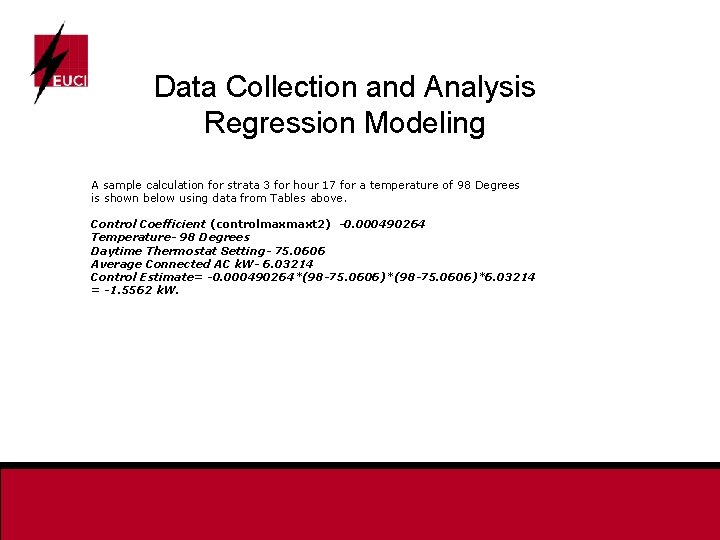
Data Collection and Analysis Regression Modeling A sample calculation for strata 3 for hour 17 for a temperature of 98 Degrees is shown below using data from Tables above. Control Coefficient (controlmaxmaxt 2) -0. 000490264 Temperature- 98 Degrees Daytime Thermostat Setting- 75. 0606 Average Connected AC k. W- 6. 03214 Control Estimate= -0. 000490264*(98 -75. 0606)*6. 03214 = -1. 5562 k. W.
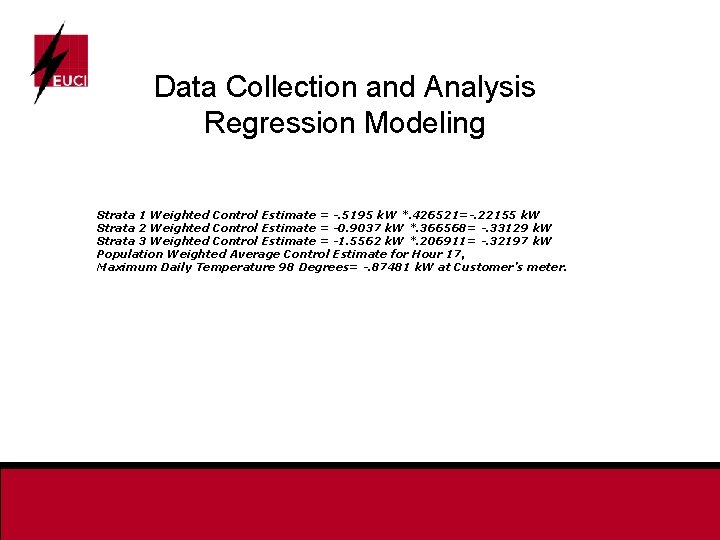
Data Collection and Analysis Regression Modeling Strata 1 Weighted Control Estimate = -. 5195 k. W *. 426521=-. 22155 k. W Strata 2 Weighted Control Estimate = -0. 9037 k. W *. 366568= -. 33129 k. W Strata 3 Weighted Control Estimate = -1. 5562 k. W *. 206911= -. 32197 k. W Population Weighted Average Control Estimate for Hour 17, Maximum Daily Temperature 98 Degrees= -. 87481 k. W at Customer’s meter.
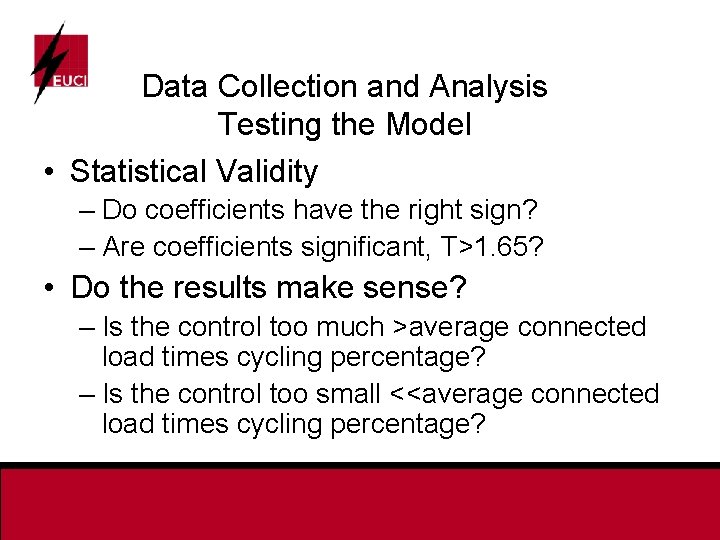
Data Collection and Analysis Testing the Model • Statistical Validity – Do coefficients have the right sign? – Are coefficients significant, T>1. 65? • Do the results make sense? – Is the control too much >average connected load times cycling percentage? – Is the control too small <<average connected load times cycling percentage?
Data Collection and Analysis Model Accuracy • The stratified regression coefficients can be used to develop an estimate of the accuracy of the load reduction estimate by calculating the overall variance of the control estimate.
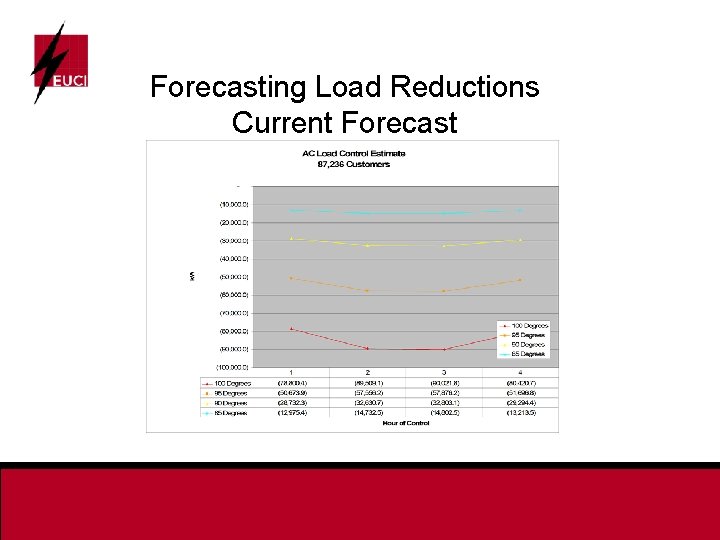
Forecasting Load Reductions Current Forecast • The results of the regression model can be used to forecast current load reductions • The output is typically a time-temperature matrix of load reductions • The weighted load reduction mean estimate for each control hour is multiplied by the number of program participants
Forecasting Load Reductions Current Forecast
Forecasting Load Reductions Current Forecast • The forecast is only valid over the temperature range that the model was estimated over • This may be an issue if you have only one year of history with maximum temperatures of say 93 degrees and you need estimates up to 100 degrees
Forecasting Load Reductions • • • Thank You Contact Information bill. bland@goodcents. com 800 -653 -3445 X 1067 Cell 678 -409 -2798 • liza. thompson@goodcents. com • 800 -653 -3445 X 1059