
Determine what you have Laymans terms source code


- Slides: 16
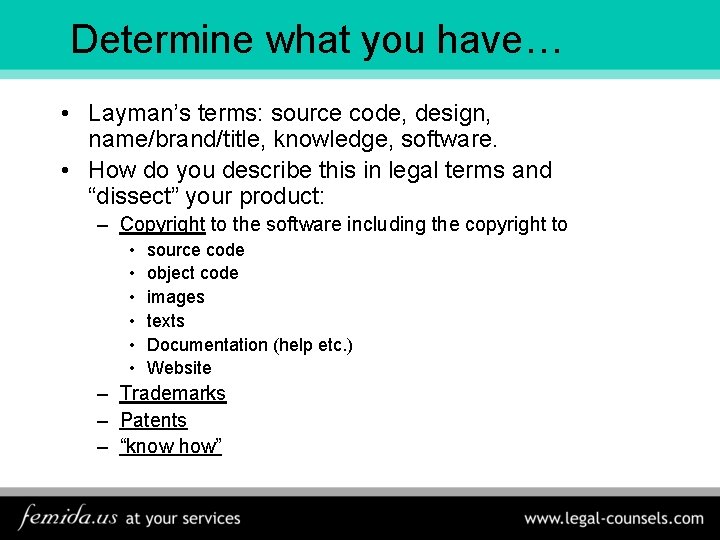
Determine what you have… • Layman’s terms: source code, design, name/brand/title, knowledge, software. • How do you describe this in legal terms and “dissect” your product: – Copyright to the software including the copyright to • • • source code object code images texts Documentation (help etc. ) Website – Trademarks – Patents – “know how”
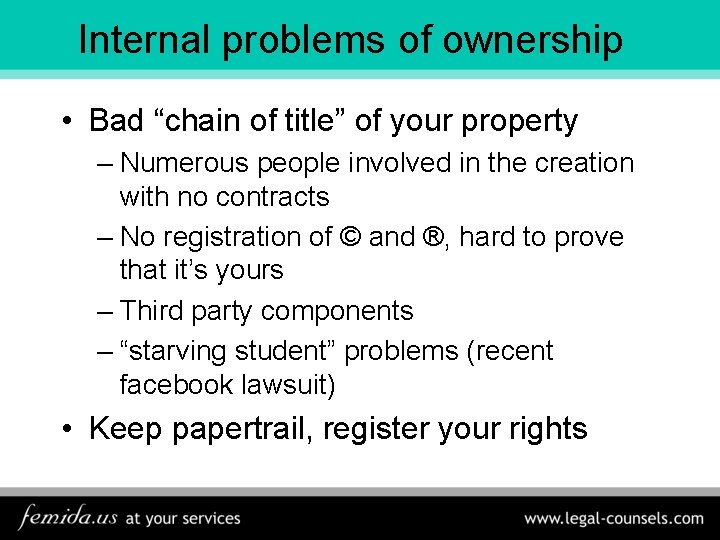
Internal problems of ownership • Bad “chain of title” of your property – Numerous people involved in the creation with no contracts – No registration of © and ®, hard to prove that it’s yours – Third party components – “starving student” problems (recent facebook lawsuit) • Keep papertrail, register your rights
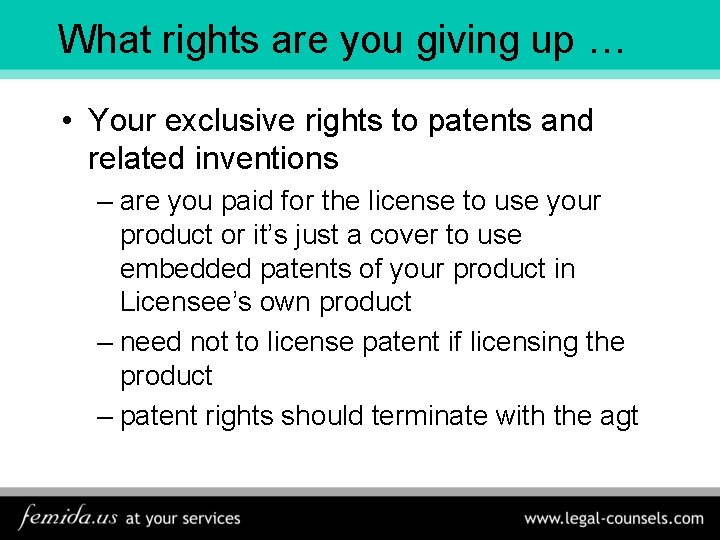
What rights are you giving up … • Your exclusive rights to patents and related inventions – are you paid for the license to use your product or it’s just a cover to use embedded patents of your product in Licensee’s own product – need not to license patent if licensing the product – patent rights should terminate with the agt
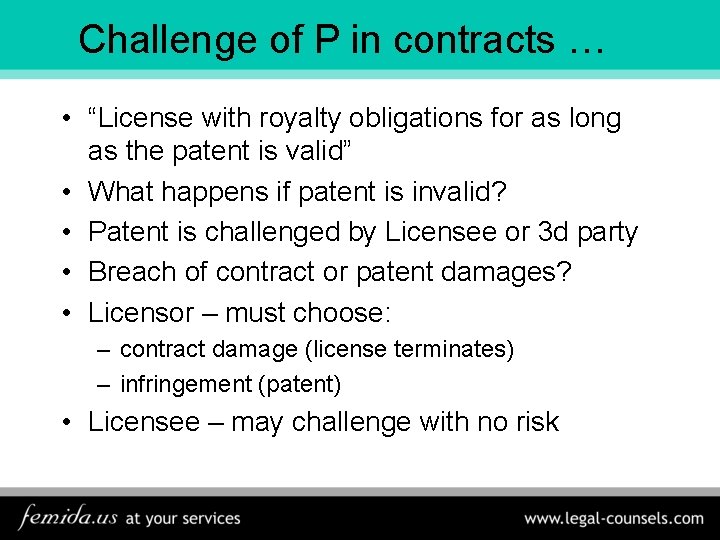
Challenge of P in contracts … • “License with royalty obligations for as long as the patent is valid” • What happens if patent is invalid? • Patent is challenged by Licensee or 3 d party • Breach of contract or patent damages? • Licensor – must choose: – contract damage (license terminates) – infringement (patent) • Licensee – may challenge with no risk
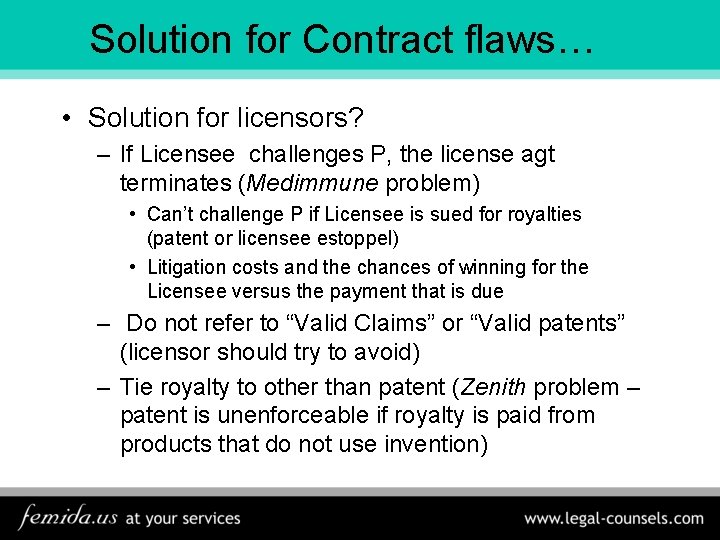
Solution for Contract flaws… • Solution for licensors? – If Licensee challenges P, the license agt terminates (Medimmune problem) • Can’t challenge P if Licensee is sued for royalties (patent or licensee estoppel) • Litigation costs and the chances of winning for the Licensee versus the payment that is due – Do not refer to “Valid Claims” or “Valid patents” (licensor should try to avoid) – Tie royalty to other than patent (Zenith problem – patent is unenforceable if royalty is paid from products that do not use invention)
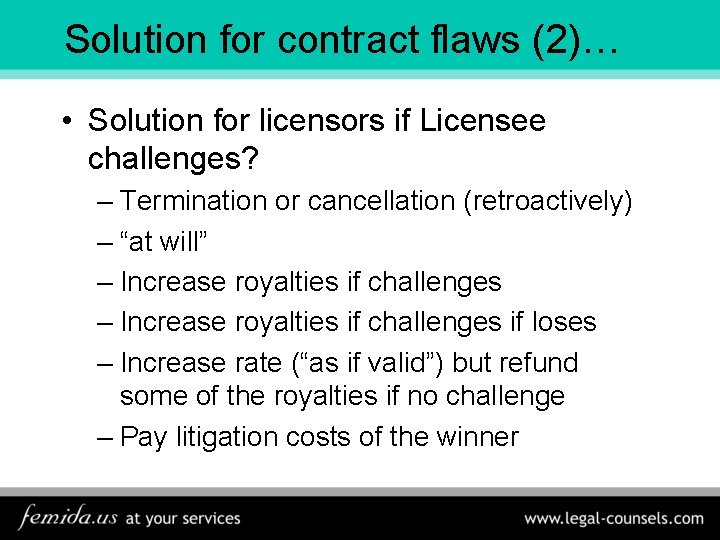
Solution for contract flaws (2)… • Solution for licensors if Licensee challenges? – Termination or cancellation (retroactively) – “at will” – Increase royalties if challenges if loses – Increase rate (“as if valid”) but refund some of the royalties if no challenge – Pay litigation costs of the winner
Solution for contract flaws (3)… • Solution for licensors if Licensee challenges? – Pay all litigation costs – License after the litigation is over – In exchange for the products – License only when there is +Know-How and other Value (copyrights? ) – Sell product (and no license) – Choose licensee carefully
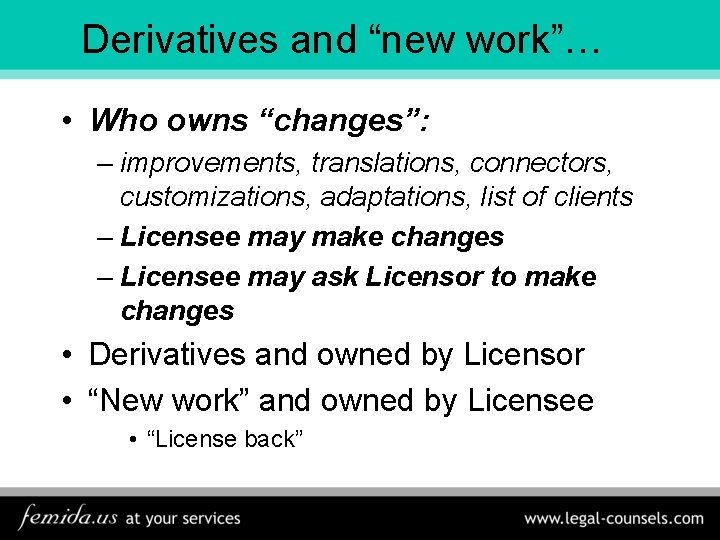
Derivatives and “new work”… • Who owns “changes”: – improvements, translations, connectors, customizations, adaptations, list of clients – Licensee may make changes – Licensee may ask Licensor to make changes • Derivatives and owned by Licensor • “New work” and owned by Licensee • “License back”
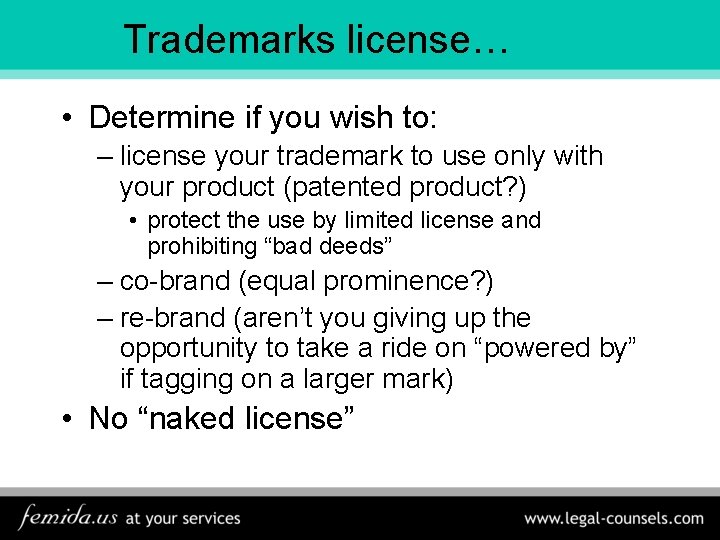
Trademarks license… • Determine if you wish to: – license your trademark to use only with your product (patented product? ) • protect the use by limited license and prohibiting “bad deeds” – co-brand (equal prominence? ) – re-brand (aren’t you giving up the opportunity to take a ride on “powered by” if tagging on a larger mark) • No “naked license”
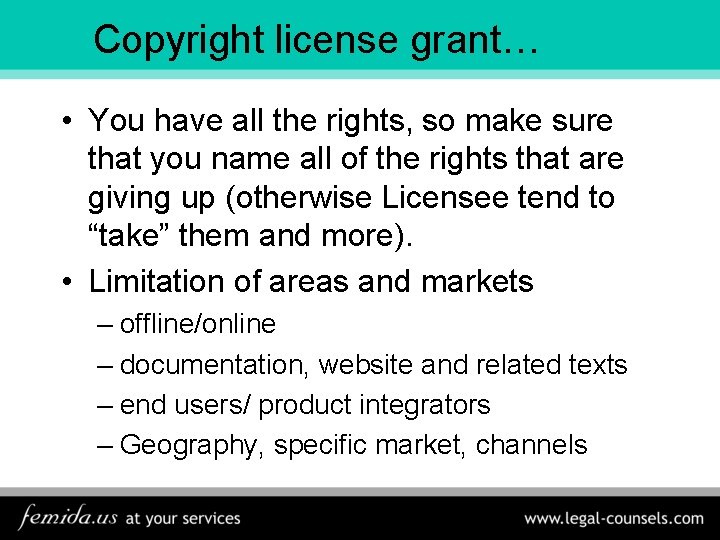
Copyright license grant… • You have all the rights, so make sure that you name all of the rights that are giving up (otherwise Licensee tend to “take” them and more). • Limitation of areas and markets – offline/online – documentation, website and related texts – end users/ product integrators – Geography, specific market, channels
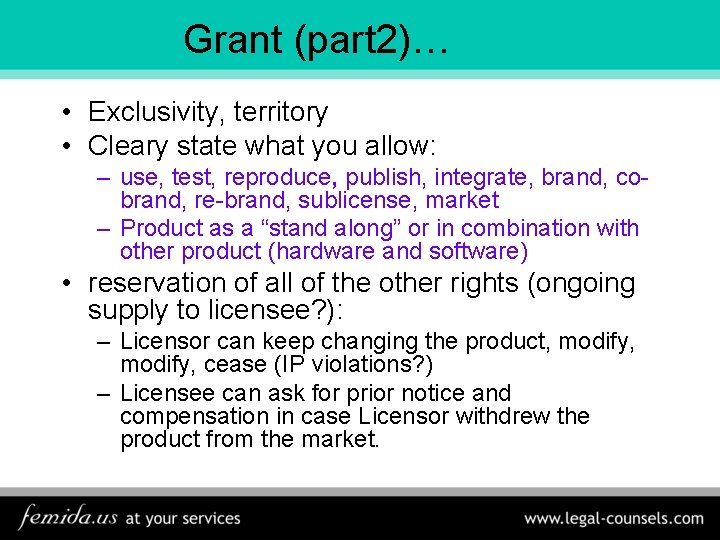
Grant (part 2)… • Exclusivity, territory • Cleary state what you allow: – use, test, reproduce, publish, integrate, brand, cobrand, re-brand, sublicense, market – Product as a “stand along” or in combination with other product (hardware and software) • reservation of all of the other rights (ongoing supply to licensee? ): – Licensor can keep changing the product, modify, cease (IP violations? ) – Licensee can ask for prior notice and compensation in case Licensor withdrew the product from the market.
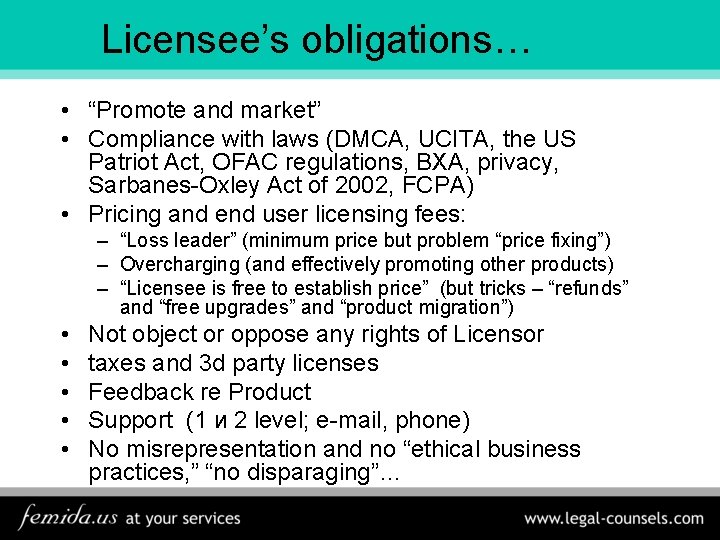
Licensee’s obligations… • “Promote and market” • Compliance with laws (DMCA, UCITA, the US Patriot Act, OFAC regulations, BXA, privacy, Sarbanes-Oxley Act of 2002, FCPA) • Pricing and end user licensing fees: – “Loss leader” (minimum price but problem “price fixing”) – Overcharging (and effectively promoting other products) – “Licensee is free to establish price” (but tricks – “refunds” and “free upgrades” and “product migration”) • • • Not object or oppose any rights of Licensor taxes and 3 d party licenses Feedback re Product Support (1 и 2 level; e-mail, phone) No misrepresentation and no “ethical business practices, ” “no disparaging”…
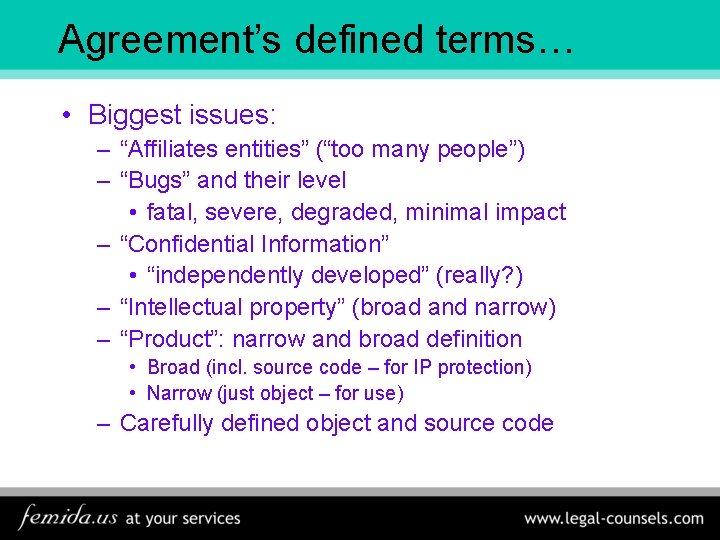
Agreement’s defined terms… • Biggest issues: – “Affiliates entities” (“too many people”) – “Bugs” and their level • fatal, severe, degraded, minimal impact – “Confidential Information” • “independently developed” (really? ) – “Intellectual property” (broad and narrow) – “Product”: narrow and broad definition • Broad (incl. source code – for IP protection) • Narrow (just object – for use) – Carefully defined object and source code
Typical problems with licensing • “Eternal” agreements (resellers etc) – Competition and “stealing” (ideas, people) • • Unintended “sale” to reseller instead of “license” (always keep your IP) Unlimited exclusivity – Fix: time + performance + territory • No way out - no obligations, no milestones, no reps and warranties? – Easy fix: how about termination for breach?
Contact information • Dmitri I. Dubograev • • email: dd@femida. us ph: 1. 202. 835. 0966 1. 877. femida. US • site: