
Determination of water and Loss on drying Herbal
Determination of water and Loss on drying Herbal Medicine Research Division, NIFDS
1. Determination of water Water and volatile matter Ø An excess of water in herbal materials will encourage microbial growth, the presence of fungi or insects, and deterioration following hydrolysis Ø Limits for water content should be set for every given herbal material. Ø The test for loss on drying determines both water and volatile matter. Ø The desiccation method is especially useful for materials that melt to a sticky mass at elevated temperatures.
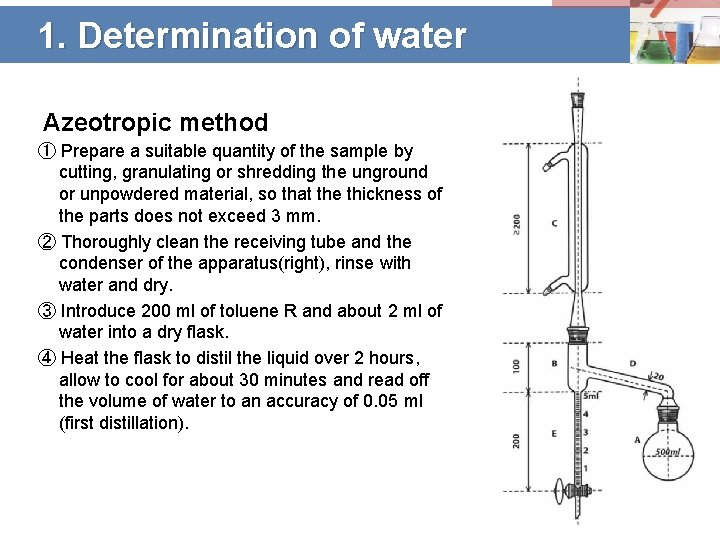
1. Determination of water Azeotropic method ① Prepare a suitable quantity of the sample by cutting, granulating or shredding the unground or unpowdered material, so that the thickness of the parts does not exceed 3 mm. ② Thoroughly clean the receiving tube and the condenser of the apparatus(right), rinse with water and dry. ③ Introduce 200 ml of toluene R and about 2 ml of water into a dry flask. ④ Heat the flask to distil the liquid over 2 hours, allow to cool for about 30 minutes and read off the volume of water to an accuracy of 0. 05 ml (first distillation).
1. Determination of water ⑤ Weigh accurately a quantity of the material expected to give about 2– 3 ml of water and transfer to the flask (For weighing material with a paste-like character, use a boat of metal foil) ⑥ Add a few pieces of porous porcelain and heat the flask gently for 15 minutes ⑦ When boiling begins, distil at a rate of 2 drops per second until most of the water has distilled over, then increase the rate of distillation to about 4 drops per second ⑧ As soon as the water has been completely distilled, rinse the inside of the condenser tube with toluene R ⑨ Continue the distillation for 5 more minutes, remove the heat, allow the receiving tube to cool to room temperature and dislodge any droplets of water adhering to the walls of the receiving tube by tapping the tube ⑩ Allow the water and toluene layers to separate and read off the volume of water (second distillation)

1. Determination of water ⑪ Calculate the content of water as a percentage using the formula:
Loss on Drying Loss on drying (gravimetric determination) ① Place about 2– 5 g of the prepared air-dried material, or the quantity specified in the test procedure for the herbal material concerned, accurately weighed, in a previously dried and tared flat weighing bottle ② Dry the sample by one of the following techniques: — in an oven at 100 -105 °C; — in a desiccator over phosphorus pentoxide R under atmospheric pressure or reduced pressure and at room temperature ③ Dry until two consecutive weighings do not differ by more than 5 mg, unless otherwise specified in the test procedure ④ Calculate the loss of weight in mg per g of air-dried material

Loss on Drying constant mass in KP The term "constant mass" in drying or ignition, unless otherwise specified, means that the mass difference after an additional 1 hour of drying or ignition is not more than 0. 10 percent of the preceding mass of the dried substance or ignited residue. In herbal drugs, the difference is not more than 0. 25 percent. However, when the difference does not exceed 0. 5 mg in a chemical balance, 0. 05 mg in a semi-microbalance, and 0. 005 mg in a microbalance, the constant mass has been attained Pretreatment empty weighing bottle should be dried at the oven to eliminate moisture adhering to the surface of bottle for 1 hr at the set time.
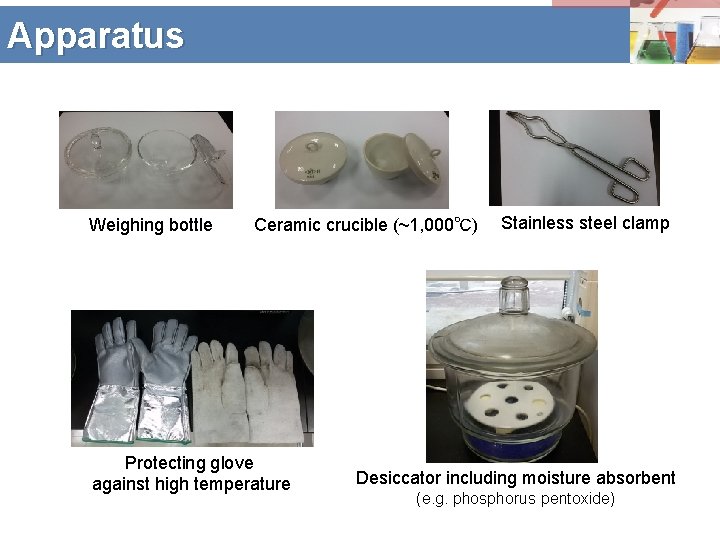
Apparatus Weighing bottle Ceramic crucible (~1, 000℃) Protecting glove against high temperature Stainless steel clamp Desiccator including moisture absorbent (e. g. phosphorus pentoxide)
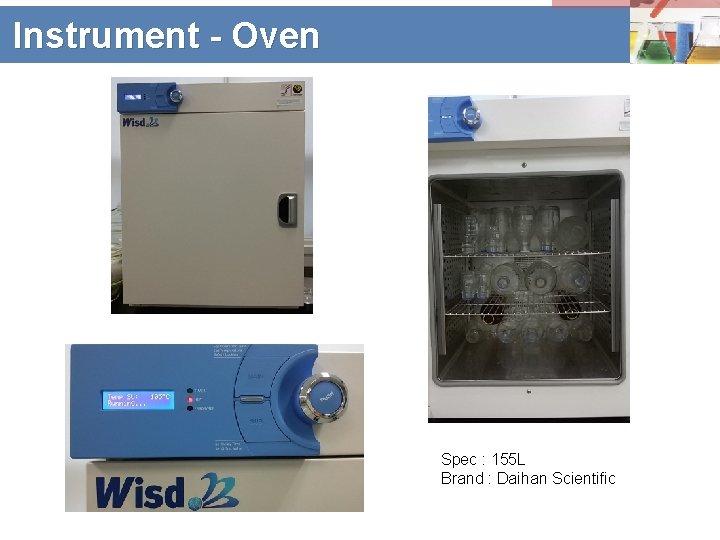
Instrument - Oven Spec : 155 L Brand : Daihan Scientific
- Slides: 9