
DETERMINATION OF THE RATE OF AN ELECTRON TRANSFER



- Slides: 19
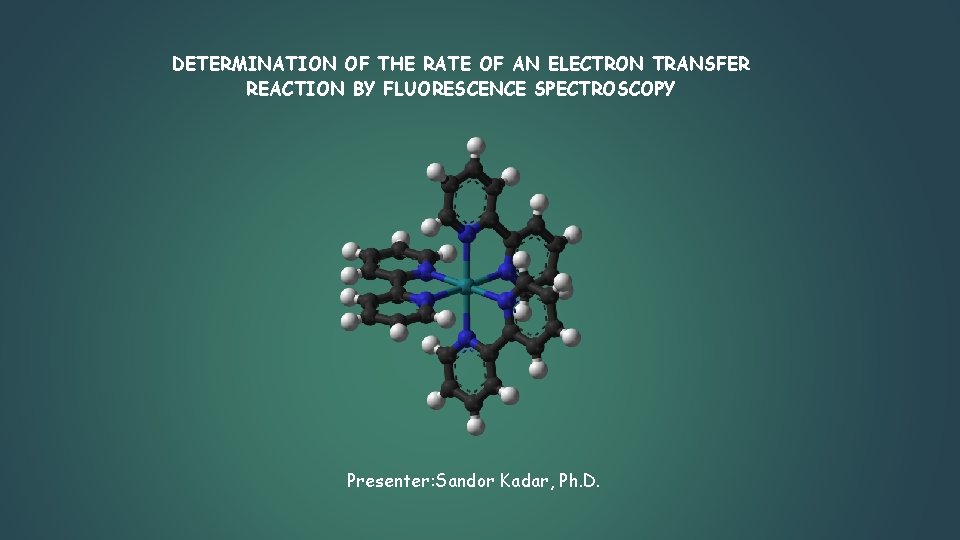
DETERMINATION OF THE RATE OF AN ELECTRON TRANSFER REACTION BY FLUORESCENCE SPECTROSCOPY Presenter: Sandor Kadar, Ph. D.
Objective • to study the relationships among the absorption, fluorescence excitation, and fluorescence emission spectra of Ru(bipyridyl)32+, • to determine the rate of the electron transfer reaction between Ru(bipyridyl) 32+ and Fe 3+ or Cu 2+. • to learn the basics of Fluorescence spectroscopy
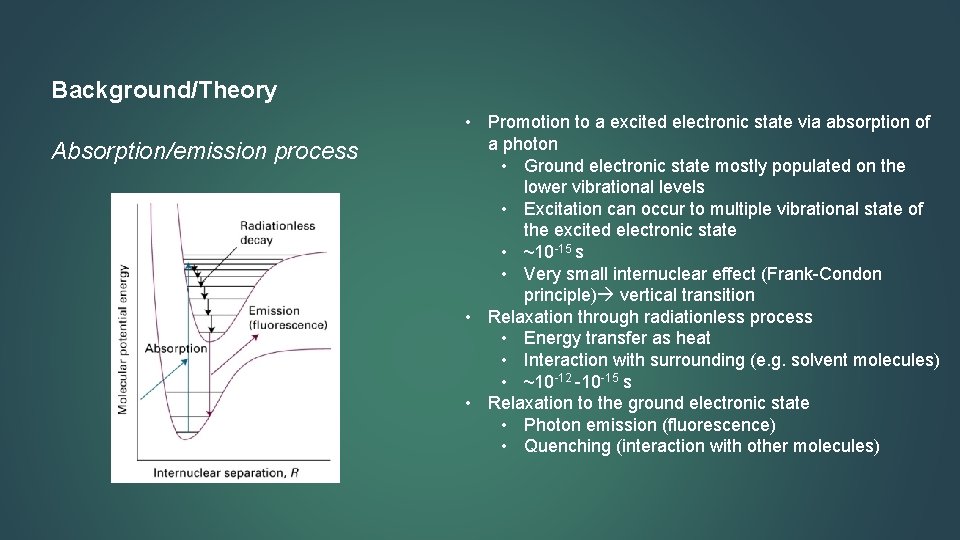
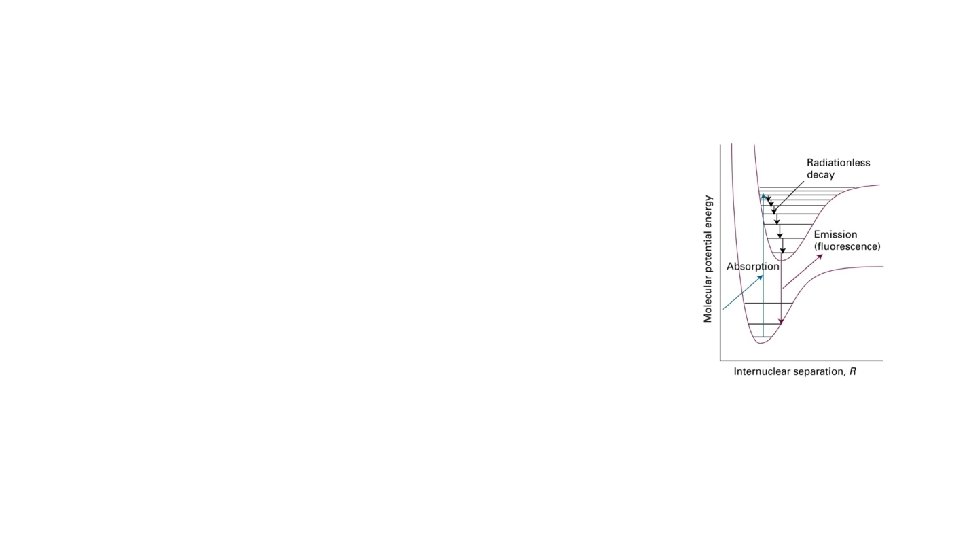
Background/Theory Absorption/emission process • Promotion to a excited electronic state via absorption of a photon • Ground electronic state mostly populated on the lower vibrational levels • Excitation can occur to multiple vibrational state of the excited electronic state • ~10 -15 s • Very small internuclear effect (Frank-Condon principle) vertical transition • Relaxation through radiationless process • Energy transfer as heat • Interaction with surrounding (e. g. solvent molecules) • ~10 -12 -10 -15 s • Relaxation to the ground electronic state • Photon emission (fluorescence) • Quenching (interaction with other molecules)
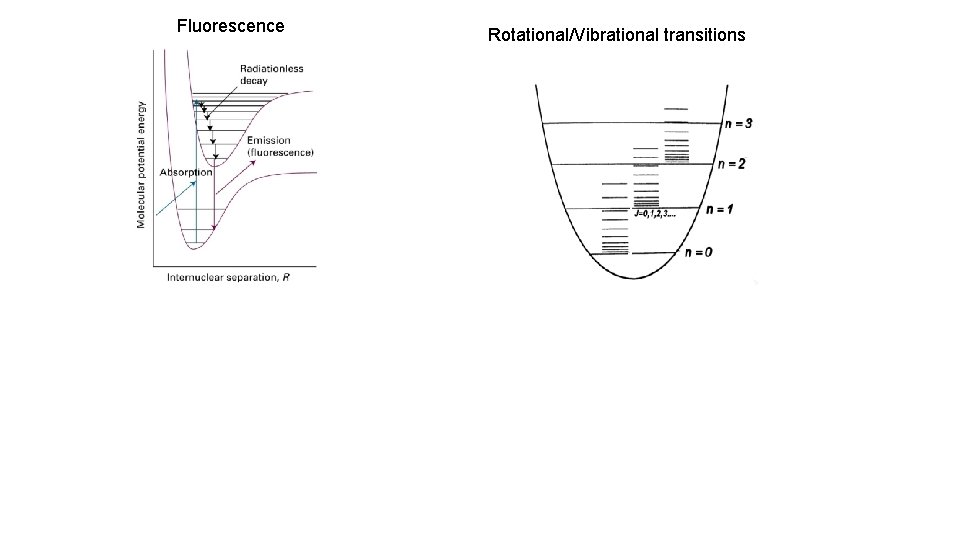
Fluorescence Rotational/Vibrational transitions
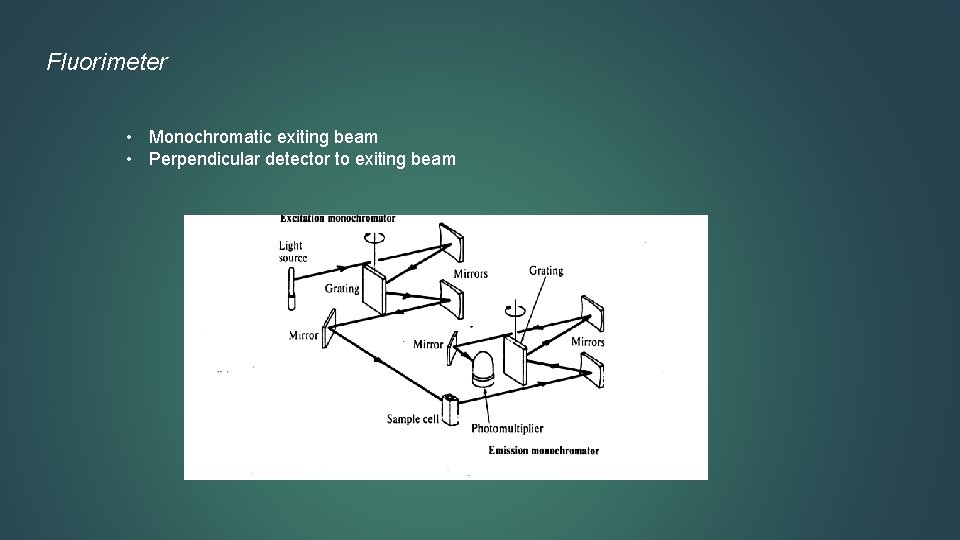
Fluorimeter • Monochromatic exiting beam • Perpendicular detector to exiting beam
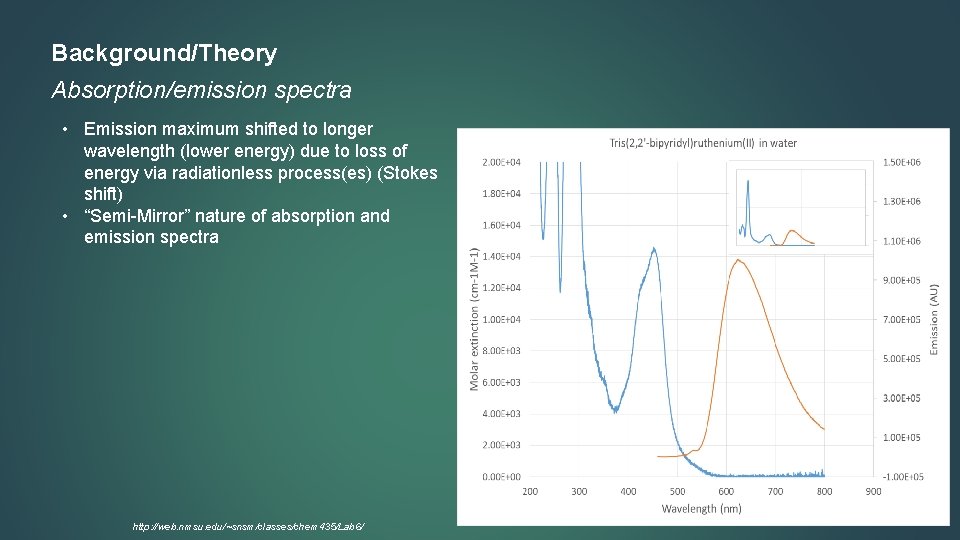
Background/Theory Absorption/emission spectra • Emission maximum shifted to longer wavelength (lower energy) due to loss of energy via radiationless process(es) (Stokes shift) • “Semi-Mirror” nature of absorption and emission spectra http: //web. nmsu. edu/~snsm/classes/chem 435/Lab 6/
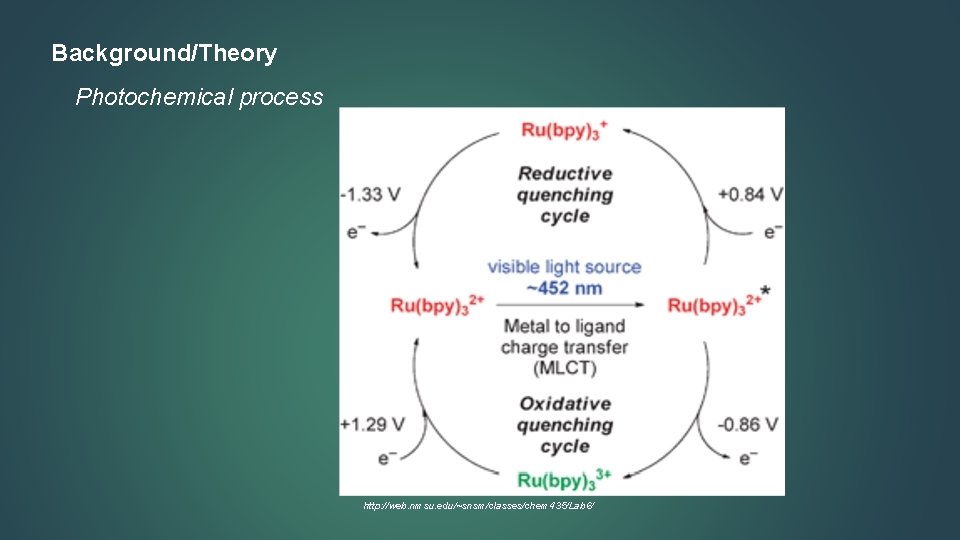
Background/Theory Photochemical process http: //web. nmsu. edu/~snsm/classes/chem 435/Lab 6/
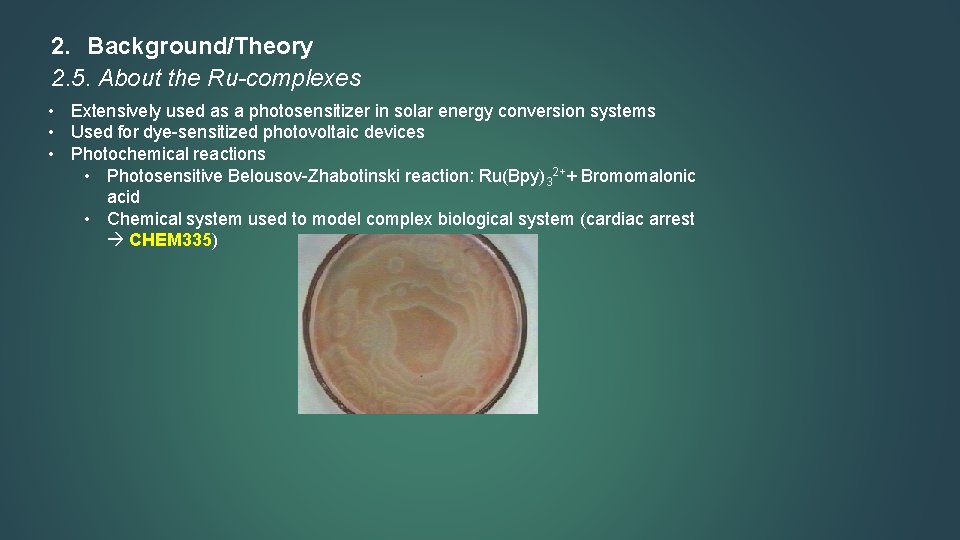
2. Background/Theory 2. 5. About the Ru-complexes • Extensively used as a photosensitizer in solar energy conversion systems • Used for dye-sensitized photovoltaic devices • Photochemical reactions • Photosensitive Belousov-Zhabotinski reaction: Ru(Bpy)32++ Bromomalonic acid • Chemical system used to model complex biological system (cardiac arrest CHEM 335)
Experimental procedure* Step #1: • Prepare 0. 500 L of a stock solution of 1. 00 x 10 -5 M Ru(bipyridyl)32+ in 0. 5 M H 2 SO 4. Step #2: • Prepare 0. 100 L stock solutions of 2 x 10 -3 M Fe 3+ (from Fe. Cl 3 • 6 H 2 O) and 2 x 10 -1 M Cu 2+ (from Cu. SO 4 or Cu. SO 4 • 5 H 2 O), using the Ru 2+/H 2 SO 4 solution prepared above as solvent. • Record the exact mass of the metal salts that are weighed so that you can determine the concentrations of the solutions to 3 significant figures. *Note: Steps are numbered according to the handout
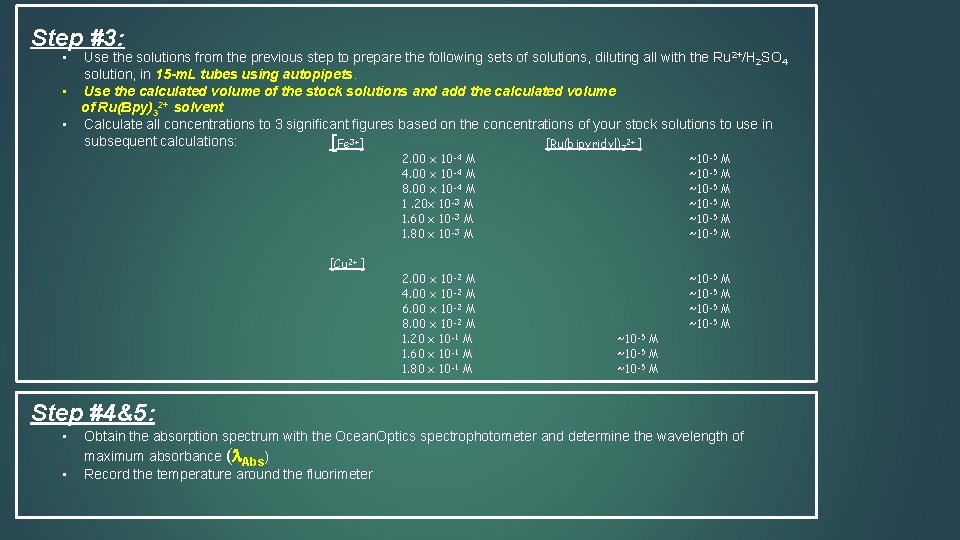
Step #3: • • • Use the solutions from the previous step to prepare the following sets of solutions, diluting all with the Ru 2+/H 2 SO 4 solution, in 15 -m. L tubes using autopipets. Use the calculated volume of the stock solutions and add the calculated volume of Ru(Bpy)32+ solvent Calculate all concentrations to 3 significant figures based on the concentrations of your stock solutions to use in subsequent calculations: [Fe 3+] [Ru(bipyridyl)32+ ] [Cu 2+ ] 2. 00 x 10 -4 M 4. 00 x 10 -4 M 8. 00 x 10 -4 M 1. 20 x 10 -3 M 1. 60 x 10 -3 M 1. 80 x 10 -3 M ~10 -5 M ~10 -5 M 2. 00 x 10 -2 M 4. 00 x 10 -2 M 6. 00 x 10 -2 M 8. 00 x 10 -2 M 1. 20 x 10 -1 M 1. 60 x 10 -1 M 1. 80 x 10 -1 M ~10 -5 M ~10 -5 M Step #4&5: • • Obtain the absorption spectrum with the Ocean. Optics spectrophotometer and determine the wavelength of maximum absorbance ( Abs) Record the temperature around the fluorimeter
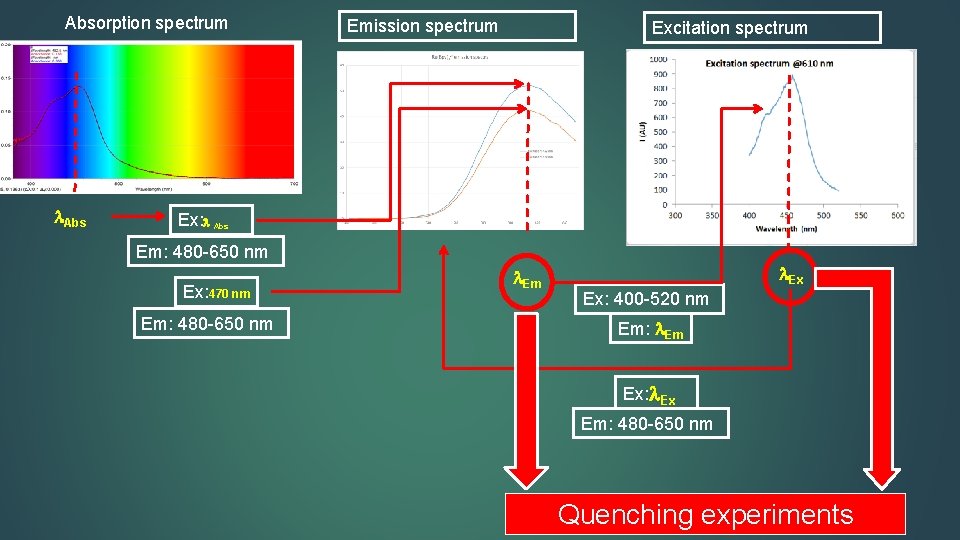
Absorption spectrum Abs Emission spectrum Excitation spectrum Ex: Abs Em: 480 -650 nm Ex: 470 nm Em: 480 -650 nm Ex Ex: 400 -520 nm Em: Em Ex: Ex Em: 480 -650 nm Quenching experiments
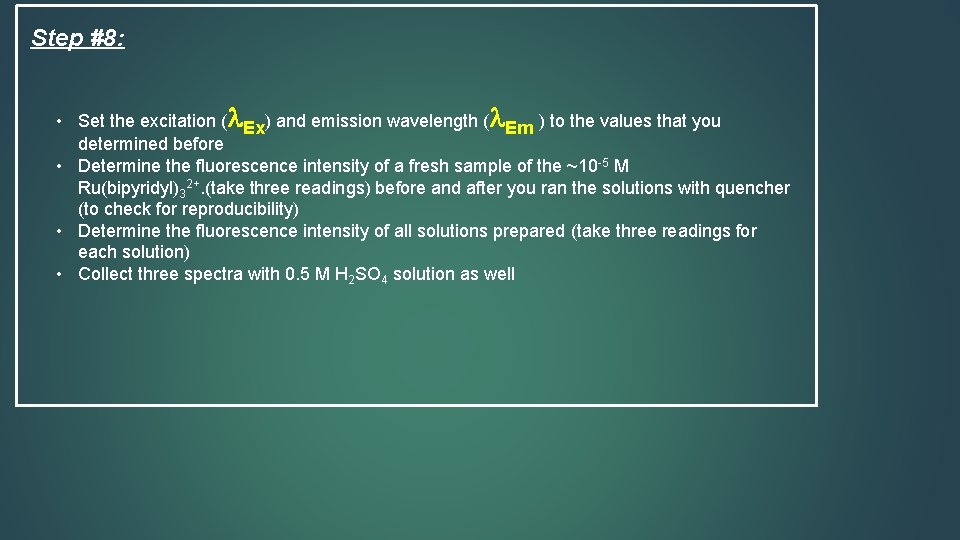
Step #8: • Set the excitation ( Ex) and emission wavelength ( Em ) to the values that you determined before • Determine the fluorescence intensity of a fresh sample of the ~10 -5 M Ru(bipyridyl)32+. (take three readings) before and after you ran the solutions with quencher (to check for reproducibility) • Determine the fluorescence intensity of all solutions prepared (take three readings for each solution) • Collect three spectra with 0. 5 M H 2 SO 4 solution as well
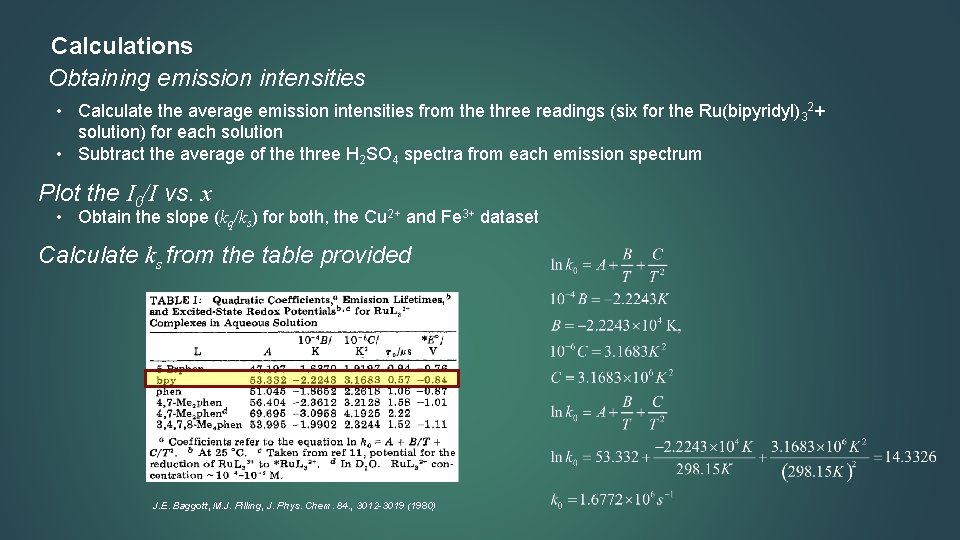
Calculations Obtaining emission intensities • Calculate the average emission intensities from the three readings (six for the Ru(bipyridyl)32+ solution) for each solution • Subtract the average of the three H 2 SO 4 spectra from each emission spectrum Plot the I 0/I vs. x • Obtain the slope (kq/ks) for both, the Cu 2+ and Fe 3+ dataset Calculate ks from the table provided J. E. Baggott, M. J. Pilling, J. Phys. Chem. 84. , 3012 -3019 (1980)
Some questions • Did you get the same emission spectrum with excitation Abs (obtained from the absorption spectrum) and Ex =470 nm? If not, what is the difference between them and what do you think the reason is for the difference (Hint: Consider how the excitation and relaxation occurs in terms of the energy levels) • How is the emission spectrum different, if at all, if a range of photons are used instead of just a single wavelength for excitation? Does the structure of the emission spectrum change? Do the peak intensities change? Why (Hint: In either configuration, what limits how many excitation can occur)? • Do the quenching rate constants for Cu 2+ and Fe 3+ significantly differ? If so, why? Compare your results to the values in the table provided. • Compare your results with literature values: http: //www 3. nd. edu/~ndrlrcdc/Compilations/Quench/RX 1_13 0. htm http: //www 3. nd. edu/~ndrlrcdc/Compilations/Quench/RX 1_11 2. htm
Safety • Ru 2+, Fe 3+, and Cu 2+ solutions are considered heavy metal waste and have to be disposed of accordingly • Use gloves. • Sulfuric acid: remember to add acid to water slowly and not the other way around. If your skin is exposed to sulfuric acid, use running water to wash it off. • Remember where the safety equipment (eye wash station, shower, etc. ) is • Observe the general safety rules that your professor set for the lab!