
Determination of the Equilibrium Constant Ksp for a
Determination of the Equilibrium Constant, Ksp, for a Chemical Reaction By: Bronson Weston

Background Information § Ksp is a particular type of equilibrium constant called the solubility product constant. § Equilibrium is achieved when an ionic solid dissolves to form a saturated solution. The equilibrium exists between the aqueous ions and the precipitate, an undissolved solid.
§ A saturated solution contains the maximum concentration of ions of the substance that can dissolve at the solution's temperature. § As the concentration of solute, dissolved ions, increases, so does the rate of reprecipitation. When the rate of reprecipitation equals the rate of dissolution, and there is no more net dissolution of solid, equilibrium is reached.
Ksp Equation § If given the following reaction: § An. Bm(s) n Am+ (aq) + m Bn-(aq) § The Ksp of the reaction is: § Ksp = [Am+]n[Bn-]m § Ksp = molarity of solution is saturated, no precipitate § Ksp< Molarity of Solution solution is saturated, precipitate is formed § Ksp > Molarity of Solution solution is unsaturated, no precipitate is formed
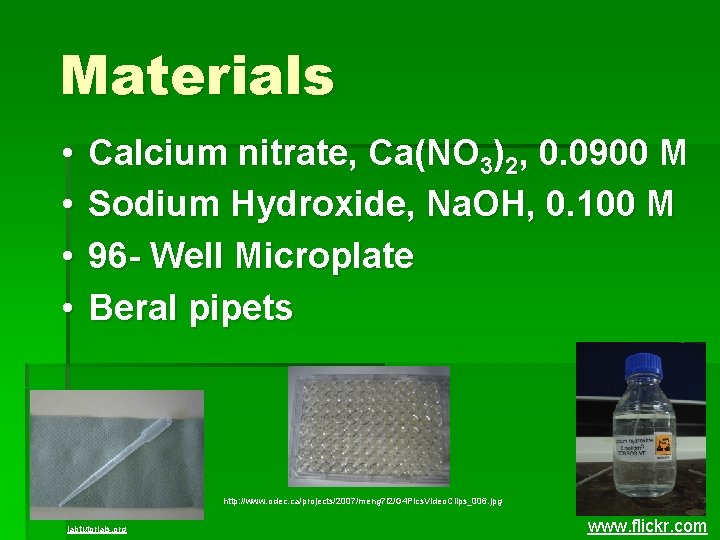
Materials • • Calcium nitrate, Ca(NO 3)2, 0. 0900 M Sodium Hydroxide, Na. OH, 0. 100 M 96 - Well Microplate Beral pipets http: //www. odec. ca/projects/2007/meng 7 l 2/G 4 Pics. Video. Clips_006. jpg labtutorials. org www. flickr. com
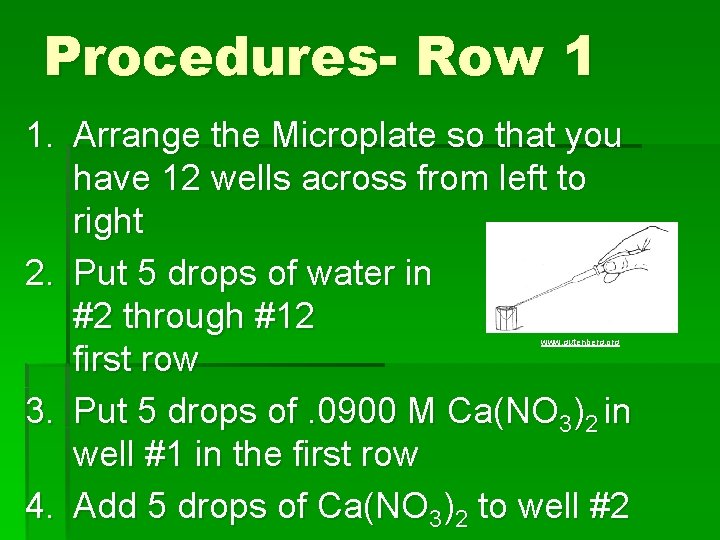
Procedures- Row 1 1. Arrange the Microplate so that you have 12 wells across from left to right 2. Put 5 drops of water in wells #2 through #12 in the first row 3. Put 5 drops of. 0900 M Ca(NO 3)2 in well #1 in the first row 4. Add 5 drops of Ca(NO 3)2 to well #2 www. gutenberg. org
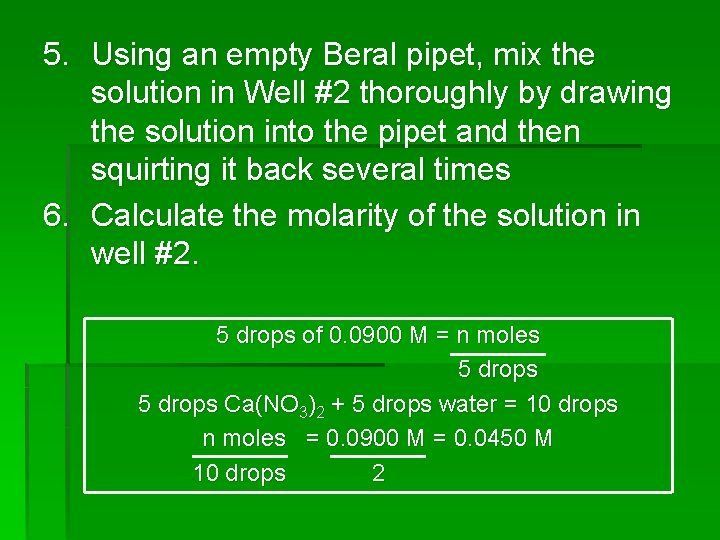
5. Using an empty Beral pipet, mix the solution in Well #2 thoroughly by drawing the solution into the pipet and then squirting it back several times 6. Calculate the molarity of the solution in well #2. 5 drops of 0. 0900 M = n moles 5 drops Ca(NO 3)2 + 5 drops water = 10 drops n moles = 0. 0900 M = 0. 0450 M 10 drops 2
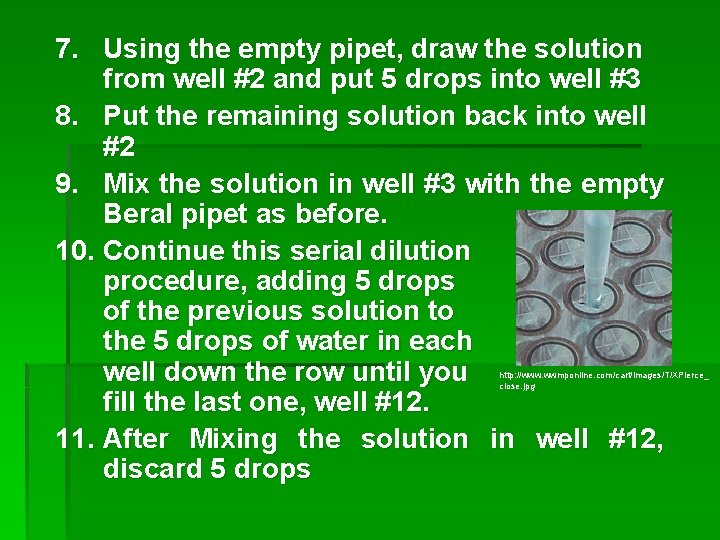
7. Using the empty pipet, draw the solution from well #2 and put 5 drops into well #3 8. Put the remaining solution back into well #2 9. Mix the solution in well #3 with the empty Beral pipet as before. 10. Continue this serial dilution procedure, adding 5 drops of the previous solution to the 5 drops of water in each well down the row until you fill the last one, well #12. 11. After Mixing the solution in well #12, discard 5 drops http: //www. wwmponline. com/cart/images/T/XPierce_ close. jpg
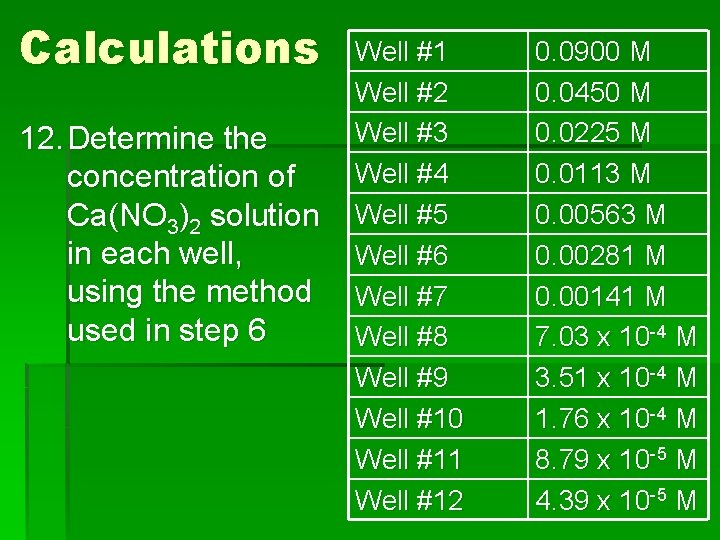
Calculations 12. Determine the concentration of Ca(NO 3)2 solution in each well, using the method used in step 6 Well #1 Well #2 Well #3 Well #4 Well #5 Well #6 Well #7 Well #8 Well #9 Well #10 Well #11 Well #12 0. 0900 M 0. 0450 M 0. 0225 M 0. 0113 M 0. 00563 M 0. 00281 M 0. 00141 M 7. 03 x 10 -4 M 3. 51 x 10 -4 M 1. 76 x 10 -4 M 8. 79 x 10 -5 M 4. 39 x 10 -5 M
More Procedures 13. Place 5 drops of 0. 100 M Na. OH in each well, #1 - #12 14. Use an empty pipet to mix the solution in each well 15. Calculate the concentration of each reactant, Ca+2 and OH-, and record the data on a table.
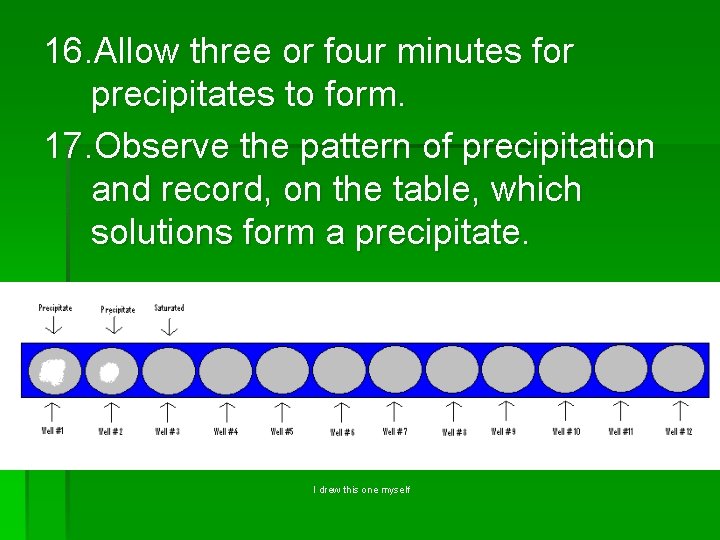
16. Allow three or four minutes for precipitates to form. 17. Observe the pattern of precipitation and record, on the table, which solutions form a precipitate. I drew this one myself
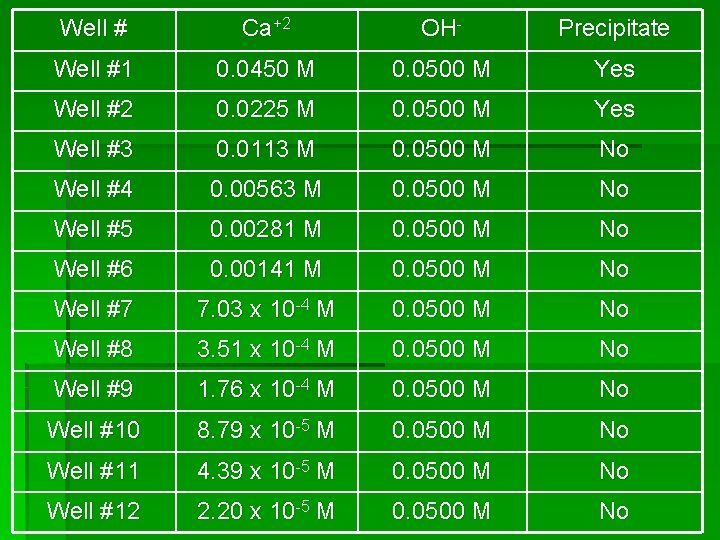
Well # Ca+2 OH- Precipitate Well #1 0. 0450 M 0. 0500 M Yes Well #2 0. 0225 M 0. 0500 M Yes Well #3 0. 0113 M 0. 0500 M No Well #4 0. 00563 M 0. 0500 M No Well #5 0. 00281 M 0. 0500 M No Well #6 0. 00141 M 0. 0500 M No Well #7 7. 03 x 10 -4 M 0. 0500 M No Well #8 3. 51 x 10 -4 M 0. 0500 M No Well #9 1. 76 x 10 -4 M 0. 0500 M No Well #10 8. 79 x 10 -5 M 0. 0500 M No Well #11 4. 39 x 10 -5 M 0. 0500 M No Well #12 2. 20 x 10 -5 M 0. 0500 M No
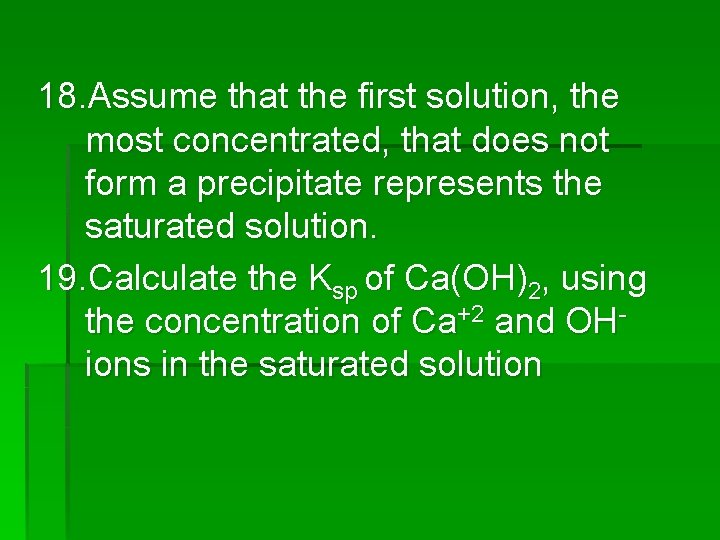
18. Assume that the first solution, the most concentrated, that does not form a precipitate represents the saturated solution. 19. Calculate the Ksp of Ca(OH)2, using the concentration of Ca+2 and OHions in the saturated solution
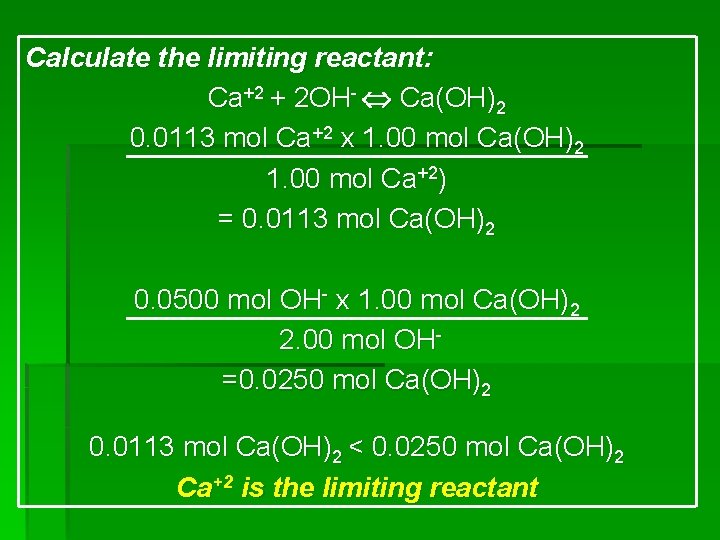
Calculate the limiting reactant: Ca+2 + 2 OH- Ca(OH)2 0. 0113 mol Ca+2 x 1. 00 mol Ca(OH)2 1. 00 mol Ca+2) = 0. 0113 mol Ca(OH)2 0. 0500 mol OH- x 1. 00 mol Ca(OH)2 2. 00 mol OH=0. 0250 mol Ca(OH)2 0. 0113 mol Ca(OH)2 < 0. 0250 mol Ca(OH)2 Ca+2 is the limiting reactant
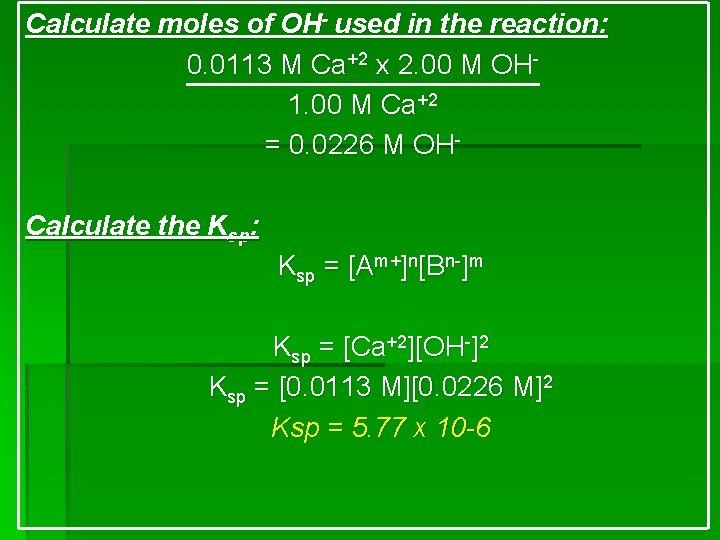
Calculate moles of OH- used in the reaction: 0. 0113 M Ca+2 x 2. 00 M OH 1. 00 M Ca+2 = 0. 0226 M OHCalculate the Ksp: Ksp = [Am+]n[Bn-]m Ksp = [Ca+2][OH-]2 Ksp = [0. 0113 M][0. 0226 M]2 Ksp = 5. 77 x 10 -6

Calculate Percent Error: [(Experimental Value-Actual Value) / Actual Value] x 100 Actual Value Ksp = 6. 5 x 10 -6 Experimental Value Ksp = 5. 77 x 10 -6 ((5. 77 x 10 -6) – (6. 5 x 10 -6)) x 100 6. 5 x 10 -6 = 11% Error
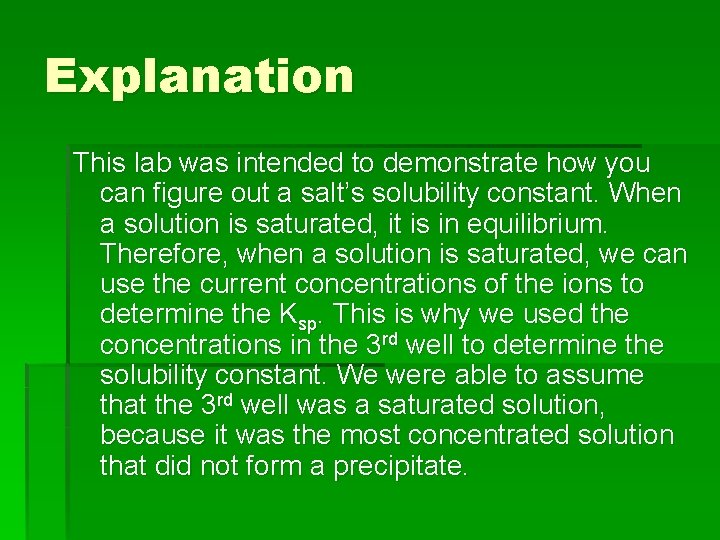
Explanation This lab was intended to demonstrate how you can figure out a salt’s solubility constant. When a solution is saturated, it is in equilibrium. Therefore, when a solution is saturated, we can use the current concentrations of the ions to determine the Ksp. This is why we used the concentrations in the 3 rd well to determine the solubility constant. We were able to assume that the 3 rd well was a saturated solution, because it was the most concentrated solution that did not form a precipitate.

References § http: //faculty. kutztown. edu/vitz/limsport/Lab. Man ual/KSPWeb/KSP. htm § http: //www. jesuitnola. org/upload/clark/aplabs. ht m#Determination%20 of%20 the%20 Solubility% 20 Product%20 of%20 an%20 Ionic%20 Compoun d § http: //mooni. fccj. org/~ethall/2046/ch 19/solubility. htm § Vonderbrink, Sally Ann. Laboratory Experiments for Advanced Placement Chemistry Student Edition. Flinn Scientific, Inc. Batavia, IL. 1995.
- Slides: 18