
Determination of the aggregation propensity of small to

- Slides: 2
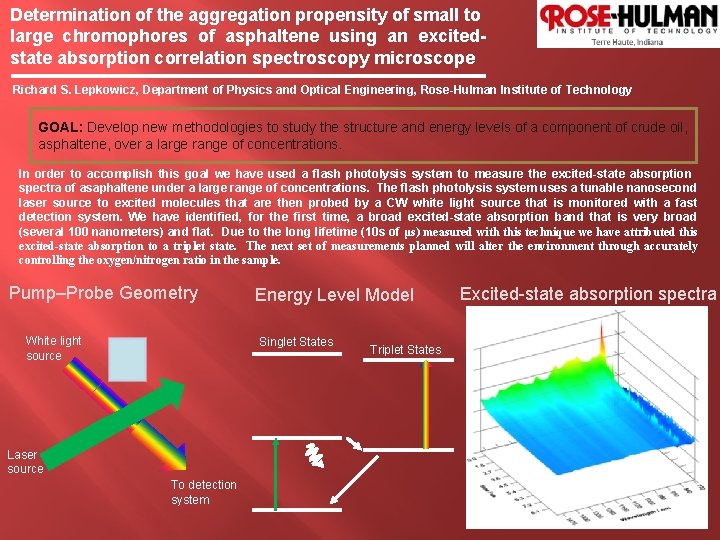
Determination of the aggregation propensity of small to large chromophores of asphaltene using an excitedstate absorption correlation spectroscopy microscope Richard S. Lepkowicz, Department of Physics and Optical Engineering, Rose-Hulman Institute of Technology GOAL: Develop new methodologies to study the structure and energy levels of a component of crude oil, asphaltene, over a large range of concentrations. In order to accomplish this goal we have used a flash photolysis system to measure the excited-state absorption spectra of asaphaltene under a large range of concentrations. The flash photolysis system uses a tunable nanosecond laser source to excited molecules that are then probed by a CW white light source that is monitored with a fast detection system. We have identified, for the first time, a broad excited-state absorption band that is very broad (several 100 nanometers) and flat. Due to the long lifetime (10 s of μs) measured with this technique we have attributed this excited-state absorption to a triplet state. The next set of measurements planned will alter the environment through accurately controlling the oxygen/nitrogen ratio in the sample. Pump–Probe Geometry White light source Energy Level Model Singlet States Laser source To detection system Triplet States Excited-state absorption spectra