
Determination of Soil Acidity Cation Exchange Capacity CEC
![Sample Calculation What is the p. H of a solution with a [H+] concentration](https://slidetodoc.com/presentation_image_h/ab7cf6aeae55c9458cd459660127f7f0/image-9.jpg "Sample Calculation What is the p. H of a solution with a [H+] concentration")


- Slides: 22
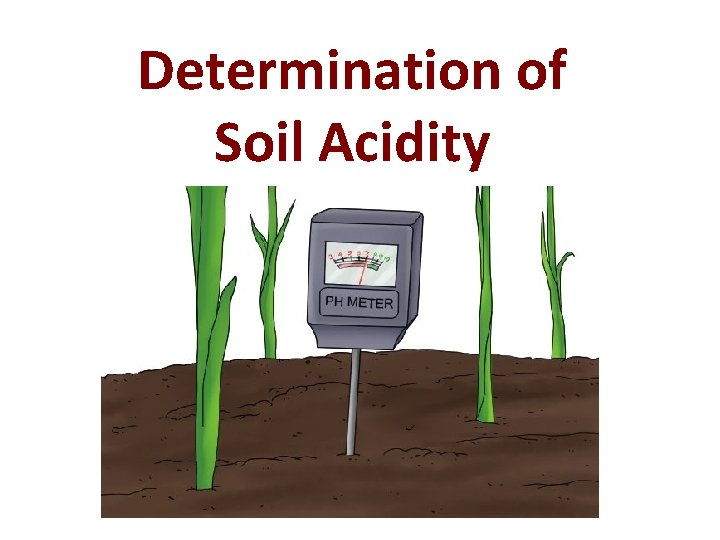
Determination of Soil Acidity
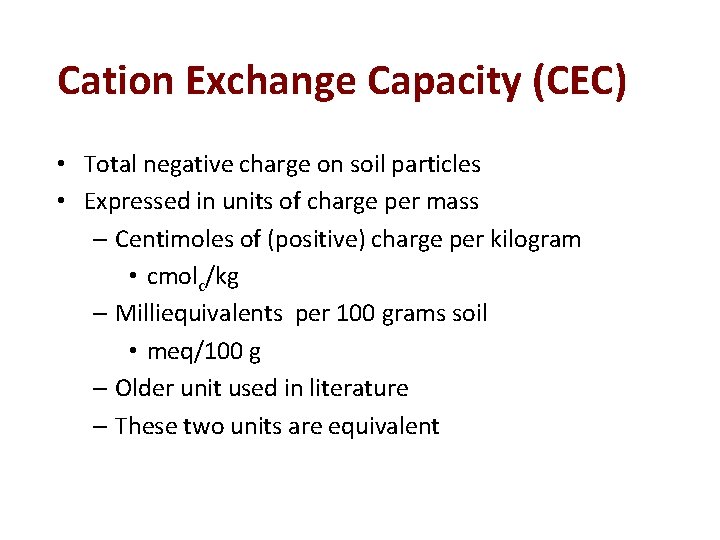
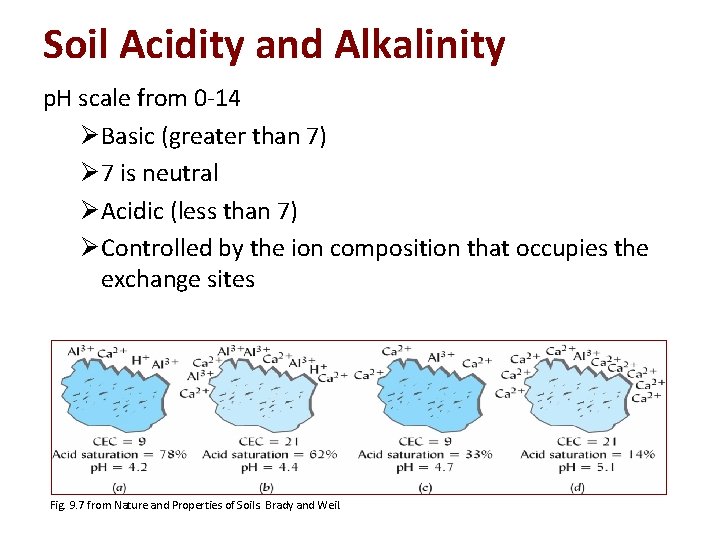
Cation Exchange Capacity (CEC) • Total negative charge on soil particles • Expressed in units of charge per mass – Centimoles of (positive) charge per kilogram • cmolc/kg – Milliequivalents per 100 grams soil • meq/100 g – Older unit used in literature – These two units are equivalent
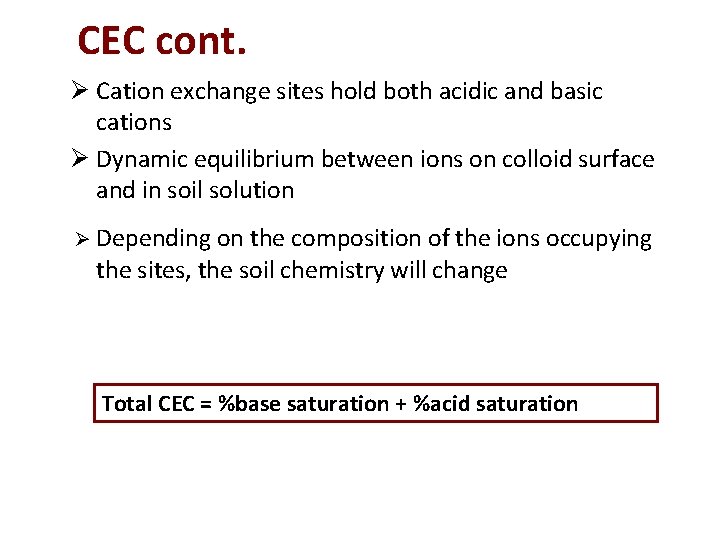
CEC cont. Ø Cation exchange sites hold both acidic and basic cations Ø Dynamic equilibrium between ions on colloid surface and in soil solution Ø Depending on the composition of the ions occupying the sites, the soil chemistry will change Total CEC = %base saturation + %acid saturation
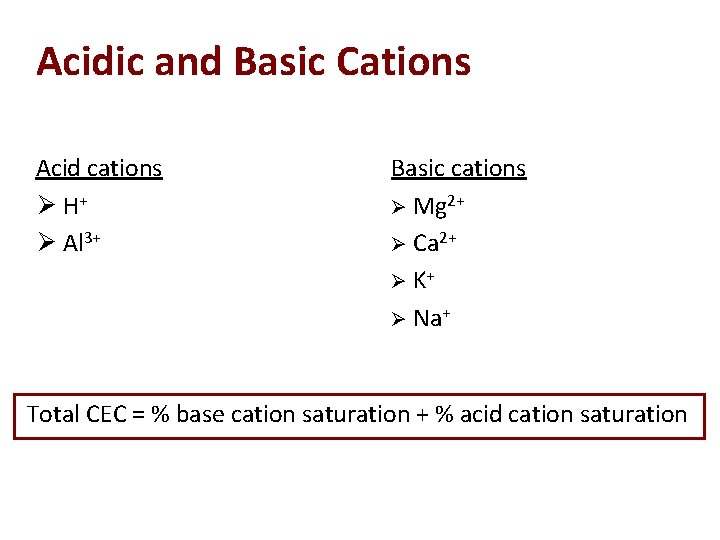
Acidic and Basic Cations Acid cations Ø H+ Ø Al 3+ Basic cations Ø Mg 2+ Ø Ca 2+ Ø K+ Ø Na+ Total CEC = % base cation saturation + % acid cation saturation
Soil Acidity and Alkalinity p. H scale from 0 -14 Ø Basic (greater than 7) Ø 7 is neutral Ø Acidic (less than 7) Ø Controlled by the ion composition that occupies the exchange sites Fig. 9. 7 from Nature and Properties of Soils. Brady and Weil.
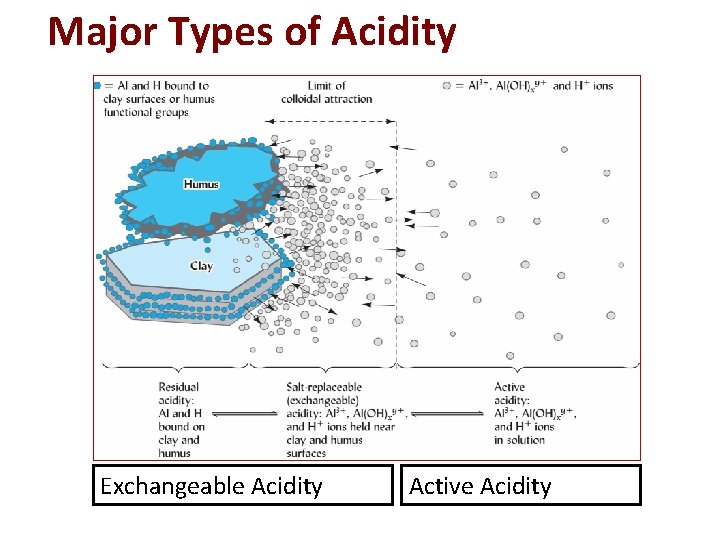
Major Types of Acidity Exchangeable Acidity Active Acidity Fig. 9. 9 from Nature and Properties of Soils. Brady and Weil.
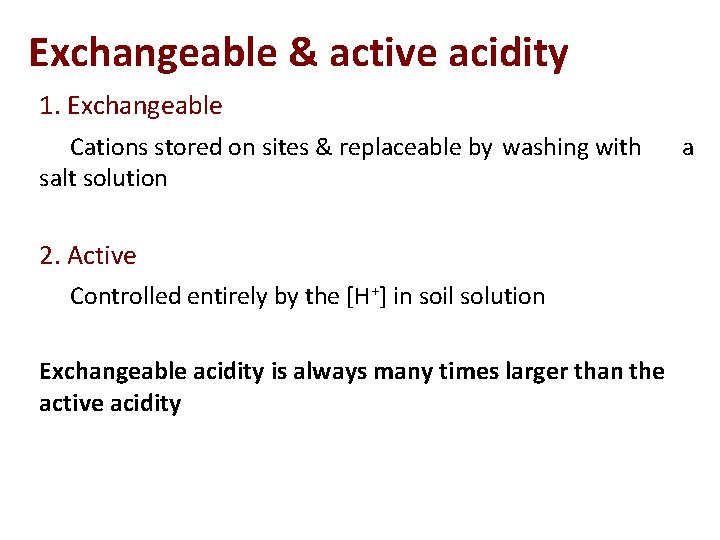
Exchangeable & active acidity p. 1 1. Exchangeable Cations stored on sites & replaceable by washing with salt solution 2. Active Controlled entirely by the [H+] in soil solution Exchangeable acidity is always many times larger than the active acidity a
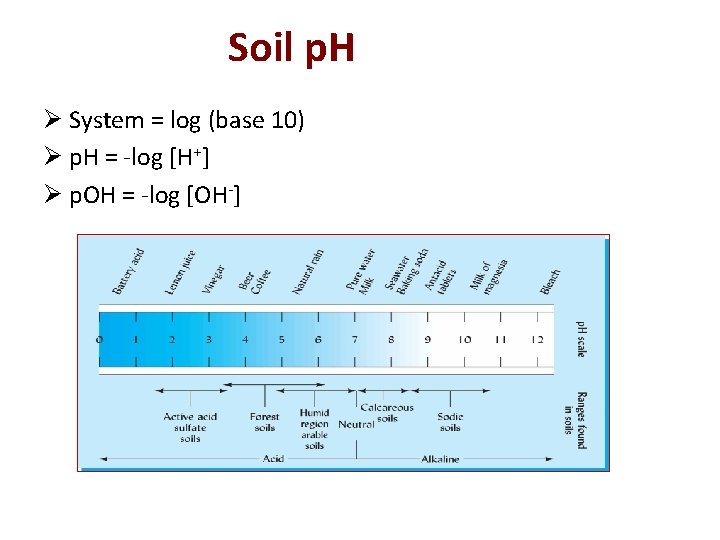
Soil p. H Ø System = log (base 10) Ø p. H = -log [H+] Ø p. OH = -log [OH-] Fig. 9. 2 from Nature and Properties of Soils. Brady & Weil. P 366
Sample Calculation What is the p. H of a solution with a [H+] concentration of 0. 01? [H+] = 0. 01 M (mol/L) Write 0. 01 in scientific notation. 0. 01 = 1 x 10 -2 p. H = - log [H+] = - log [1 x 10 -2] p. H = - (-2) p. H = 2
How soils become acidic? Ø Soils become acidic through weathering and leaching Ø Warm, humid climates speed up weathering Ø Ultisols “ultimate”, most weathered after Oxisols Ø Calcium and other basic cations are replaced on soil colloid by protons/H+ and the basic elements leach away. Ø Lime can replenish these ions
p. 3 Importance of p. H Ø Optimal p. H 5. 8 – 6. 5 Ø Nutrient availability Ø Ions include micro and macronutrients Ø Essential for plant growth Ø Toxic at high levels Ø Availability varies based on p. H Source: Brady and Weil Fig. 9. 22 from Nature and Properties of Soils. Brady and Weil. Source: oak. ppws. vt. edu
Buffering Capacity Ø A well buffered soil will resist changes in p. H if acid is introduced Ø Acid rain Ø Soil amendments Ø Directly related to the CEC Ø Large CEC, high buffering capacity Ø Small CEC, small buffering capacity p. 4 Fig. 9. 16 from Nature and Properties of Soils. Brady and Weil.
Four types of aluminum p. 3 -4 1. Structural Al : within mineral structure; not exchangeable 2. Exchangeable Al : ions in dynamic equilibrium between soil colloid fraction and soil solution 3. Precipitate and polymer Al: found in inner layer of clays; not exchangeable 4. Chelated Al : bound to functional groups like OH-; not exchangeable
Determination of acidity of a soil sample Step 01: Soil extraction and filtration 1. Add 10 g of air-dry soil to 250 ml plastic screw top bottle 2. Add 100 ml of 1 M KCl to the bottle (Note: leave the sample for an overnight for saturation and then go to the next step). 3. Shake the bottle at 220 rpm for 5 minutes 4. Set up the filtration funnel while allowing soil particles to settle 5. Use transfer pipette to slowly drip the soil extract in to the filter paper and 6. Collect 10 ml to a 25 ml volumetric flask
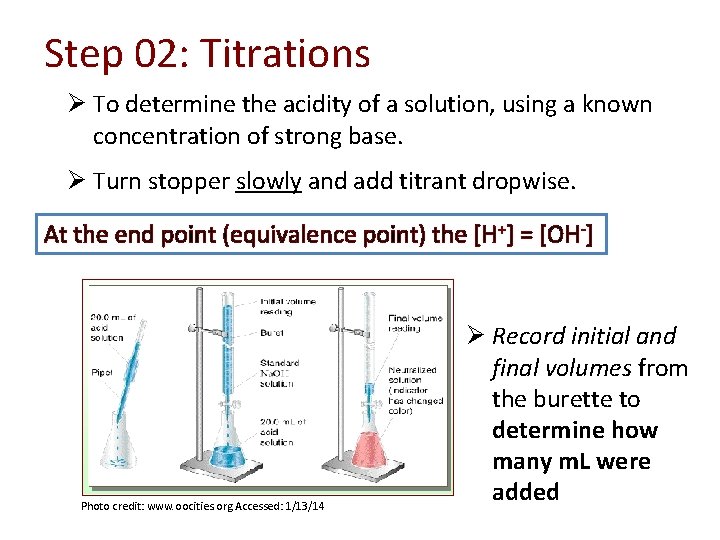
Step 02: Titrations Ø To determine the acidity of a solution, using a known concentration of strong base. Ø Turn stopper slowly and add titrant dropwise. At the end point (equivalence point) the [H+] = [OH-] Photo credit: www. oocities. org Accessed: 1/13/14 Ø Record initial and final volumes from the burette to determine how many m. L were added
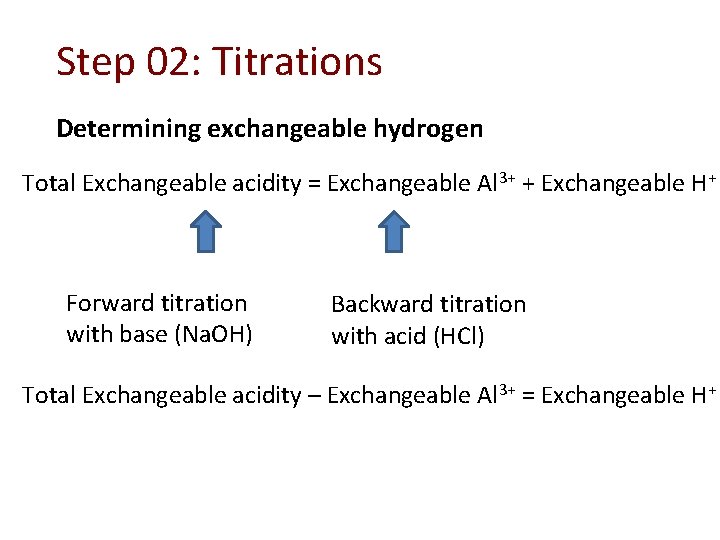
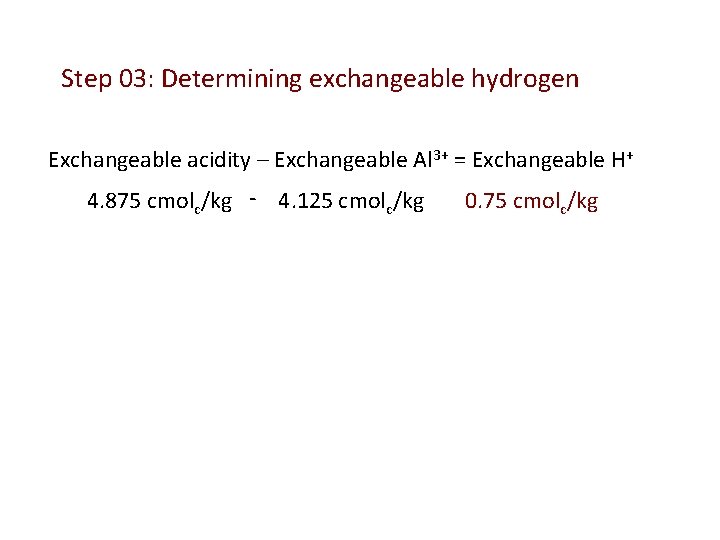
Step 02: Titrations Determining exchangeable hydrogen Total Exchangeable acidity = Exchangeable Al 3+ + Exchangeable H+ Forward titration with base (Na. OH) Backward titration with acid (HCl) Total Exchangeable acidity – Exchangeable Al 3+ = Exchangeable H+
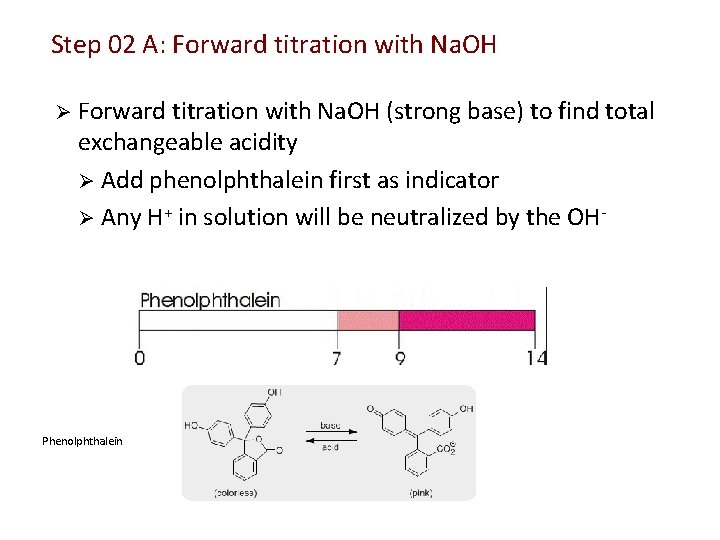
Step 02 A: Forward titration with Na. OH Ø Forward titration with Na. OH (strong base) to find total exchangeable acidity Ø Add phenolphthalein first as indicator Ø Any H+ in solution will be neutralized by the OH- Phenolphthalein
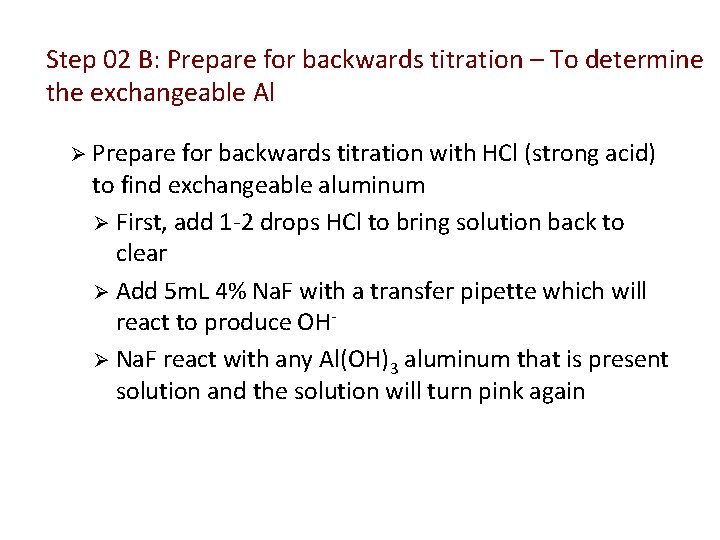
Step 02 B: Prepare for backwards titration – To determine the exchangeable Al Ø Prepare for backwards titration with HCl (strong acid) to find exchangeable aluminum Ø First, add 1 -2 drops HCl to bring solution back to clear Ø Add 5 m. L 4% Na. F with a transfer pipette which will react to produce OHØ Na. F react with any Al(OH)3 aluminum that is present solution and the solution will turn pink again
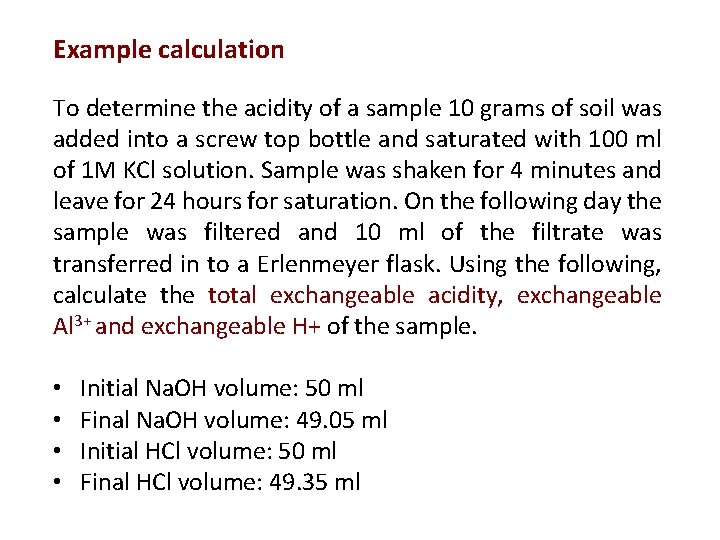
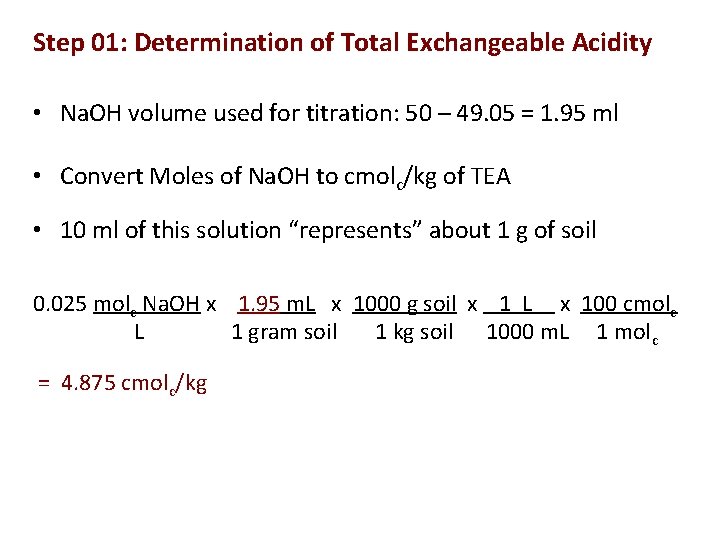
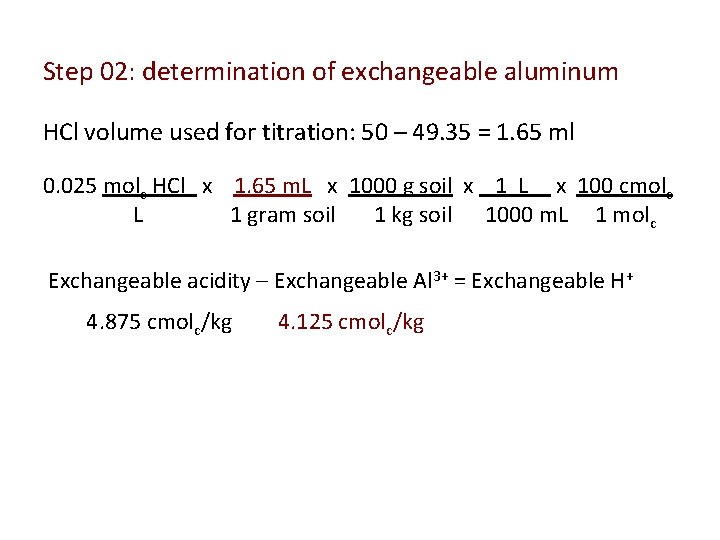
Example calculation To determine the acidity of a sample 10 grams of soil was added into a screw top bottle and saturated with 100 ml of 1 M KCl solution. Sample was shaken for 4 minutes and leave for 24 hours for saturation. On the following day the sample was filtered and 10 ml of the filtrate was transferred in to a Erlenmeyer flask. Using the following, calculate the total exchangeable acidity, exchangeable Al 3+ and exchangeable H+ of the sample. • • Initial Na. OH volume: 50 ml Final Na. OH volume: 49. 05 ml Initial HCl volume: 50 ml Final HCl volume: 49. 35 ml
Step 01: Determination of Total Exchangeable Acidity • Na. OH volume used for titration: 50 – 49. 05 = 1. 95 ml • Convert Moles of Na. OH to cmolc/kg of TEA • 10 ml of this solution “represents” about 1 g of soil 0. 025 molc Na. OH x 1. 95 m. L x 1000 g soil x 1 L x 100 cmolc L 1 gram soil 1 kg soil 1000 m. L 1 molc = 4. 875 cmolc/kg
Step 02: determination of exchangeable aluminum HCl volume used for titration: 50 – 49. 35 = 1. 65 ml 0. 025 molc HCl x 1. 65 m. L x 1000 g soil x 1 L x 100 cmolc L 1 gram soil 1 kg soil 1000 m. L 1 molc Exchangeable acidity – Exchangeable Al 3+ = Exchangeable H+ 4. 875 cmolc/kg - 4. 125 cmolc/kg =
Step 03: Determining exchangeable hydrogen Exchangeable acidity – Exchangeable Al 3+ = Exchangeable H+ 4. 875 cmolc/kg - 4. 125 cmolc/kg = 0. 75 cmolc/kg