
Determination of geometry of heavy ion collisions with

- Slides: 24
Determination of geometry of heavy ion collisions with Forward Hadron Calorimeter (FHCal) at MPD A. Ivashkin, M. Golubeva, F. Guber, S. Morozov, A. Izvestnyy, D. Finogeev (Institute for Nuclear Research RAS, Moscow) 1
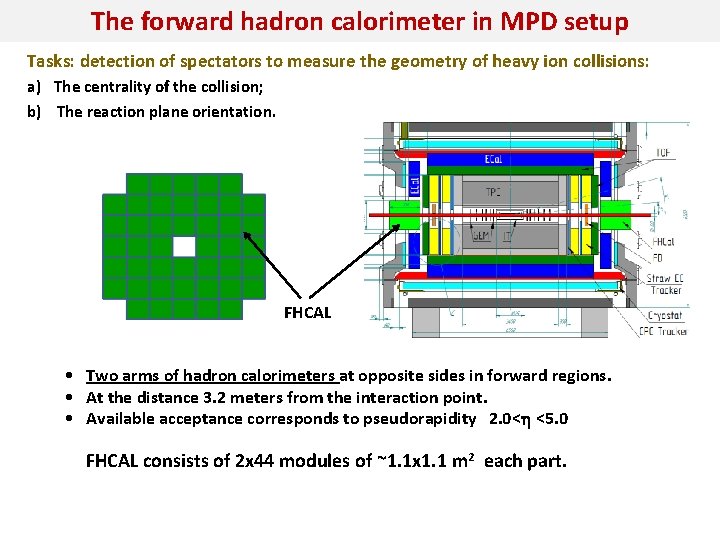
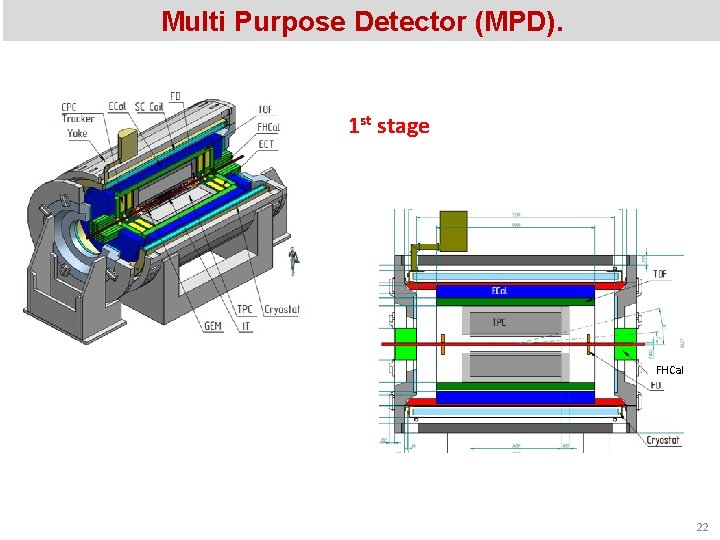
The forward hadron calorimeter in MPD setup Tasks: detection of spectators to measure the geometry of heavy ion collisions: a) The centrality of the collision; b) The reaction plane orientation. FHCAL • Two arms of hadron calorimeters at opposite sides in forward regions. • At the distance 3. 2 meters from the interaction point. • Available acceptance corresponds to pseudorapidity 2. 0< <5. 0 FHCAL consists of 2 x 44 modules of ~1. 1 x 1. 1 m 2 each part.
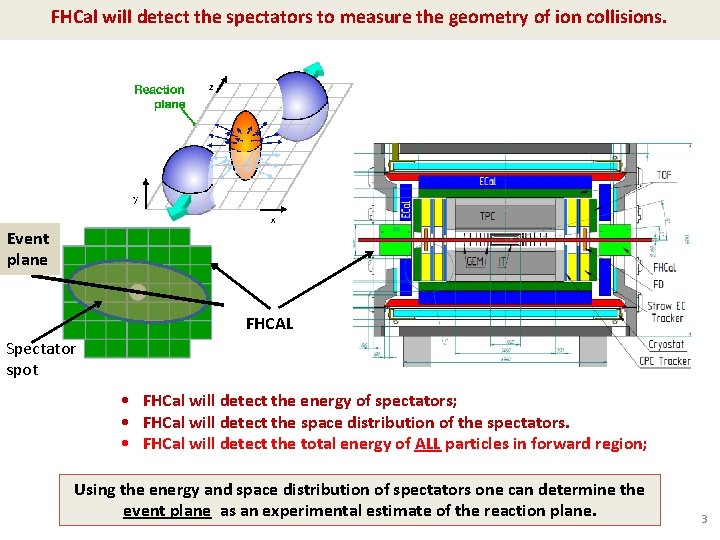
FHCal will detect the spectators to measure the geometry of ion collisions. Event plane FHCAL Spectator spot • FHCal will detect the energy of spectators; • FHCal will detect the space distribution of the spectators. • FHCal will detect the total energy of ALL particles in forward region; Using the energy and space distribution of spectators one can determine the event plane as an experimental estimate of the reaction plane. 3
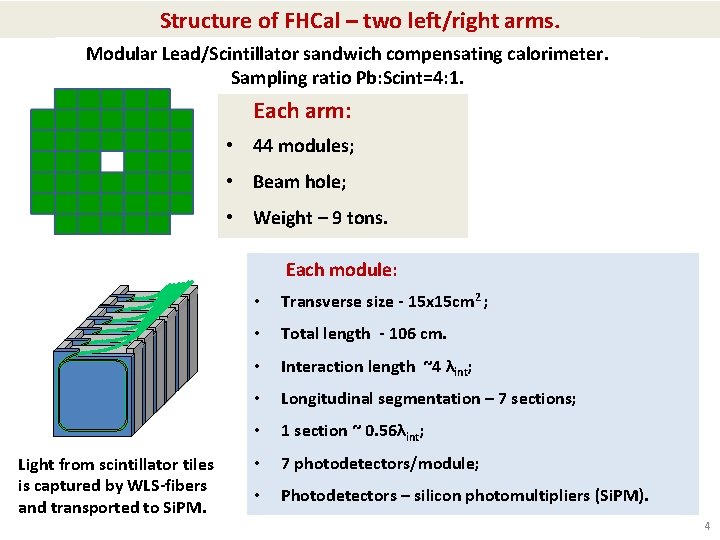
Structure of FHCal – two left/right arms. Modular Lead/Scintillator sandwich compensating calorimeter. Sampling ratio Pb: Scint=4: 1. Each arm: • 44 modules; • Beam hole; • Weight – 9 tons. Each module: Light from scintillator tiles is captured by WLS-fibers and transported to Si. PM. • Transverse size - 15 x 15 cm 2 ; • Total length - 106 cm. • Interaction length ~4 λint; • Longitudinal segmentation – 7 sections; • 1 section ~ 0. 56λint; • 7 photodetectors/module; • Photodetectors – silicon photomultipliers (Si. PM). 4
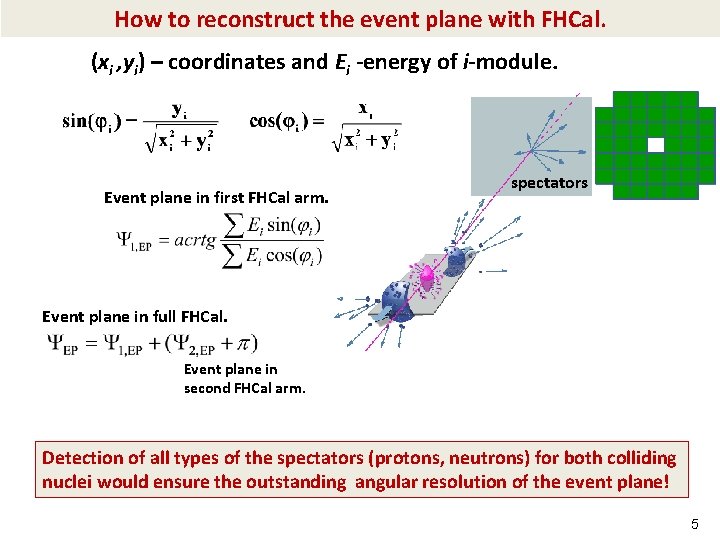
How to reconstruct the event plane with FHCal. (xi , yi) – coordinates and Ei -energy of i-module. Event plane in first FHCal arm. spectators Event plane in full FHCal. Event plane in second FHCal arm. Detection of all types of the spectators (protons, neutrons) for both colliding nuclei would ensure the outstanding angular resolution of the event plane! 5
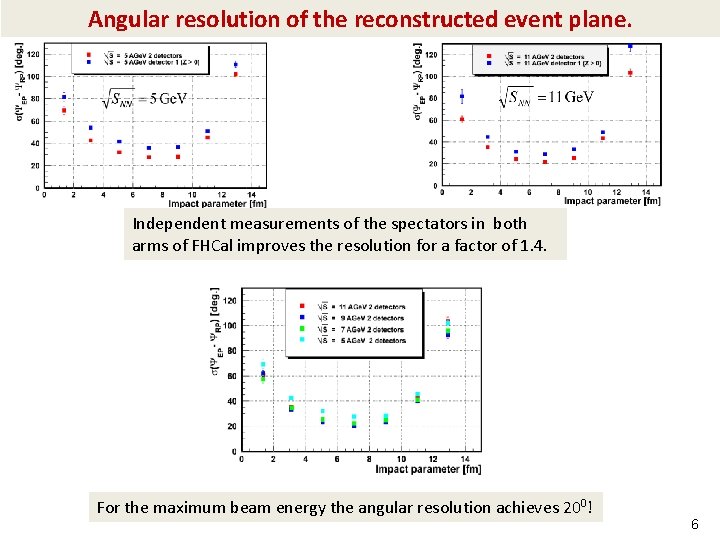
Angular resolution of the reconstructed event plane. Independent measurements of the spectators in both arms of FHCal improves the resolution for a factor of 1. 4. For the maximum beam energy the angular resolution achieves 200! 6
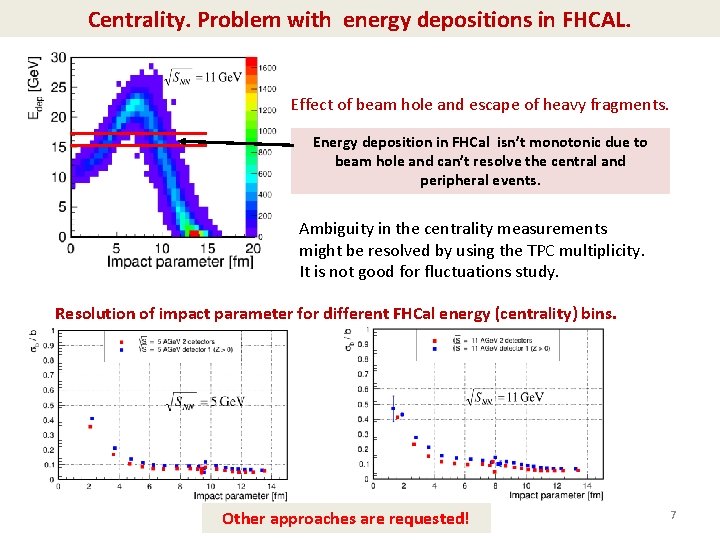
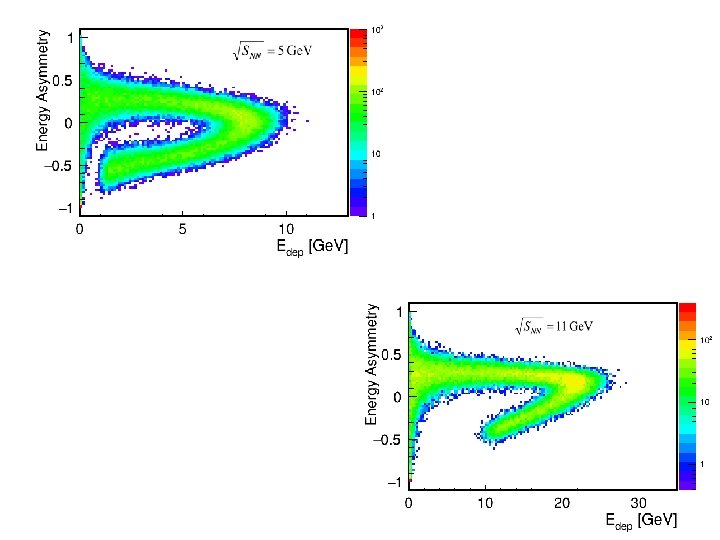
Centrality. Problem with energy depositions in FHCAL. Effect of beam hole and escape of heavy fragments. Energy deposition in FHCal isn’t monotonic due to beam hole and can’t resolve the central and peripheral events. Ambiguity in the centrality measurements might be resolved by using the TPC multiplicity. It is not good for fluctuations study. Resolution of impact parameter for different FHCal energy (centrality) bins. Other approaches are requested! 7
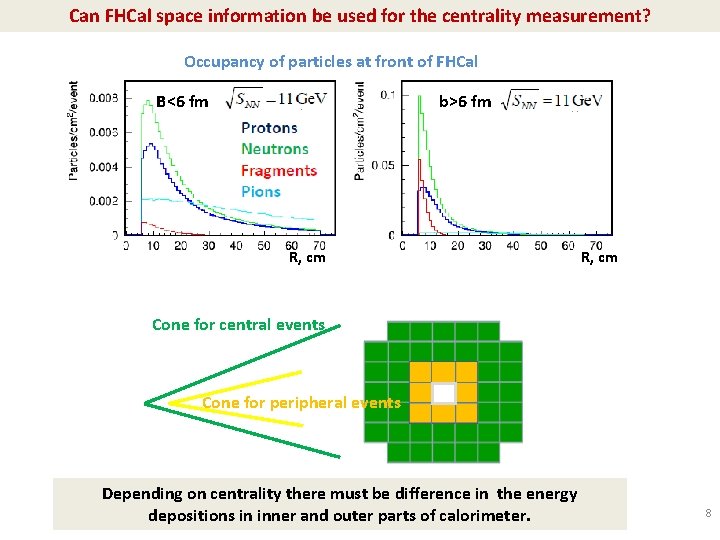
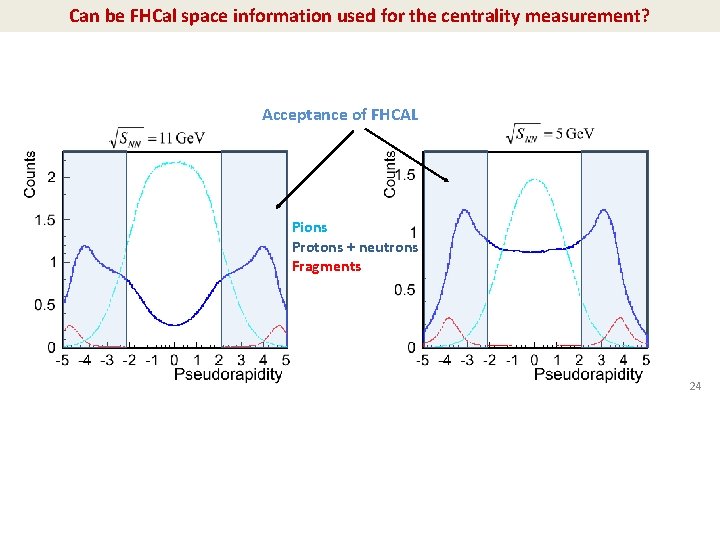
Can FHCal space information be used for the centrality measurement? Occupancy of particles at front of FHCal B<6 fm b>6 fm R, cm Cone for central events Cone for peripheral events Depending on centrality there must be difference in the energy depositions in inner and outer parts of calorimeter. 8
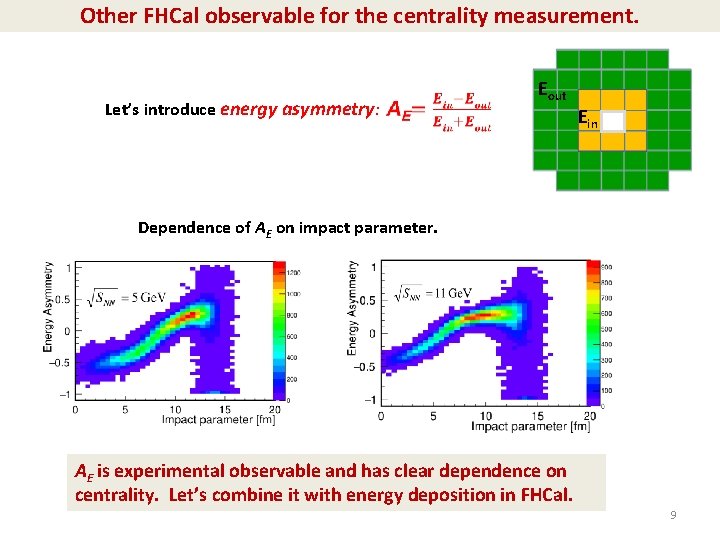
Other FHCal observable for the centrality measurement. Let’s introduce energy asymmetry: Eout Ein Dependence of AE on impact parameter. AE is experimental observable and has clear dependence on centrality. Let’s combine it with energy deposition in FHCal. 9
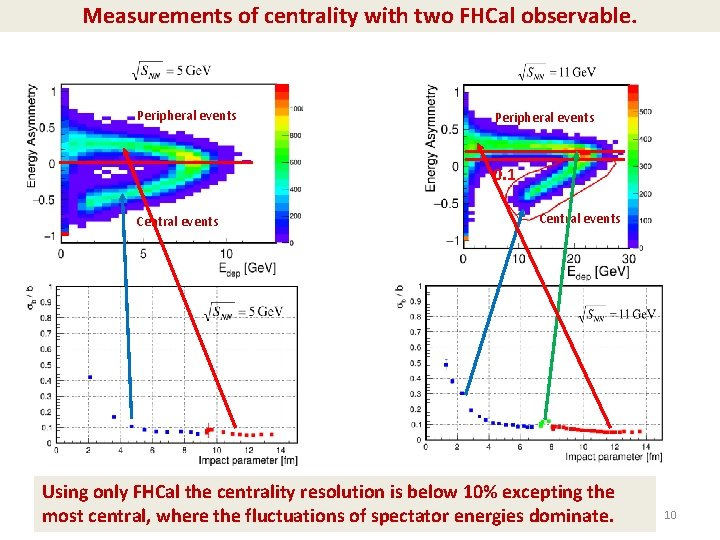
Measurements of centrality with two FHCal observable. Peripheral events 0. 1 Central events Using only FHCal the centrality resolution is below 10% excepting the most central, where the fluctuations of spectator energies dominate. 10
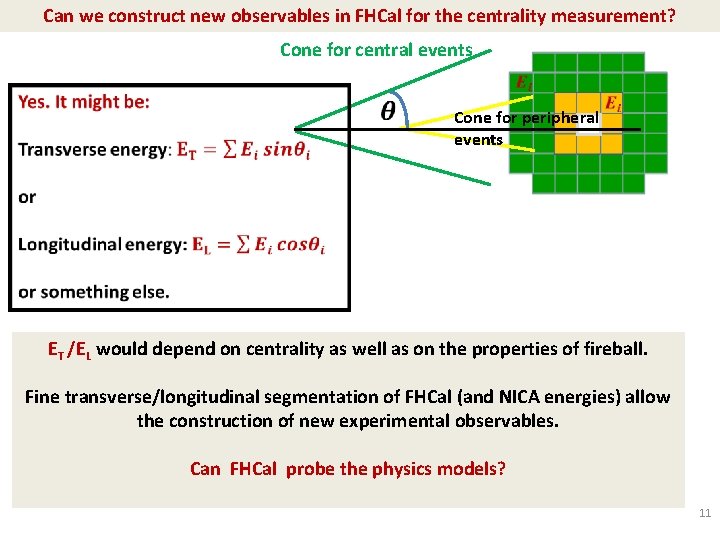
Can we construct new observables in FHCal for the centrality measurement? Cone for central events Cone for peripheral events ET /EL would depend on centrality as well as on the properties of fireball. Fine transverse/longitudinal segmentation of FHCal (and NICA energies) allow the construction of new experimental observables. Can FHCal probe the physics models? 11
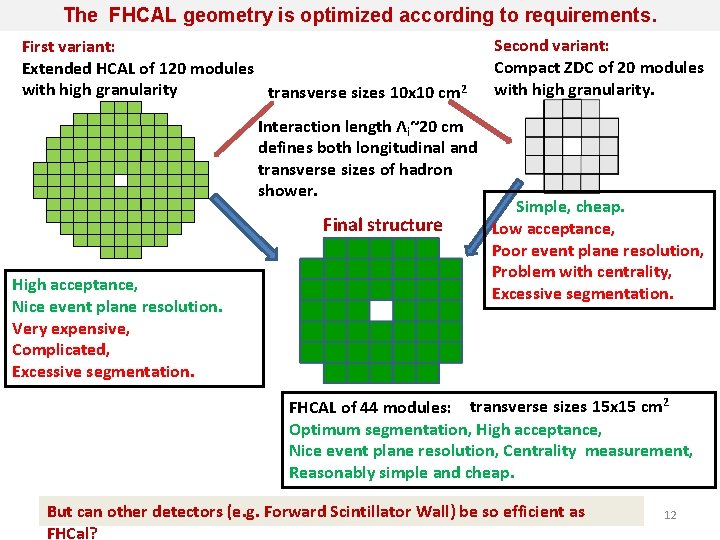
The FHCAL geometry is optimized according to requirements. First variant: Extended HCAL of 120 modules with high granularity transverse sizes 10 x 10 cm 2 Interaction length Λi~20 cm defines both longitudinal and transverse sizes of hadron shower. Final structure High acceptance, Nice event plane resolution. Very expensive, Complicated, Excessive segmentation. Second variant: Compact ZDC of 20 modules with high granularity. Simple, cheap. Low acceptance, Poor event plane resolution, Problem with centrality, Excessive segmentation. FHCAL of 44 modules: transverse sizes 15 x 15 cm 2 Optimum segmentation, High acceptance, Nice event plane resolution, Centrality measurement, Reasonably simple and cheap. But can other detectors (e. g. Forward Scintillator Wall) be so efficient as FHCal? 12
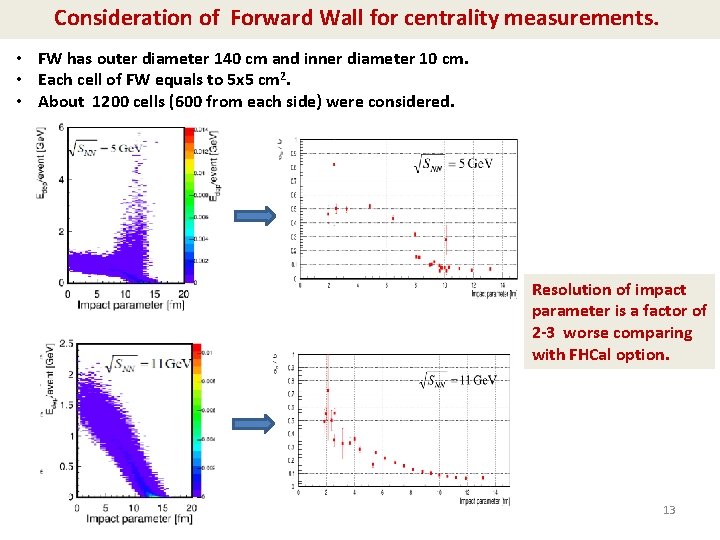
Consideration of Forward Wall for centrality measurements. • FW has outer diameter 140 cm and inner diameter 10 cm. • Each cell of FW equals to 5 x 5 cm 2. • About 1200 cells (600 from each side) were considered. Resolution of impact parameter is a factor of 2 -3 worse comparing with FHCal option. 13
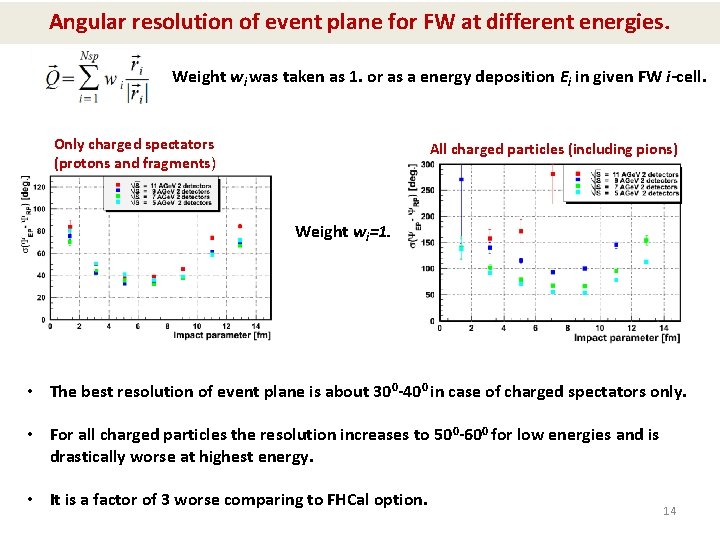
Angular resolution of event plane for FW at different energies. Weight wi was taken as 1. or as a energy deposition Ei in given FW i-cell. Only charged spectators (protons and fragments) All charged particles (including pions) Weight wi=1. • The best resolution of event plane is about 300 -400 in case of charged spectators only. • For all charged particles the resolution increases to 500 -600 for low energies and is drastically worse at highest energy. • It is a factor of 3 worse comparing to FHCal option. 14
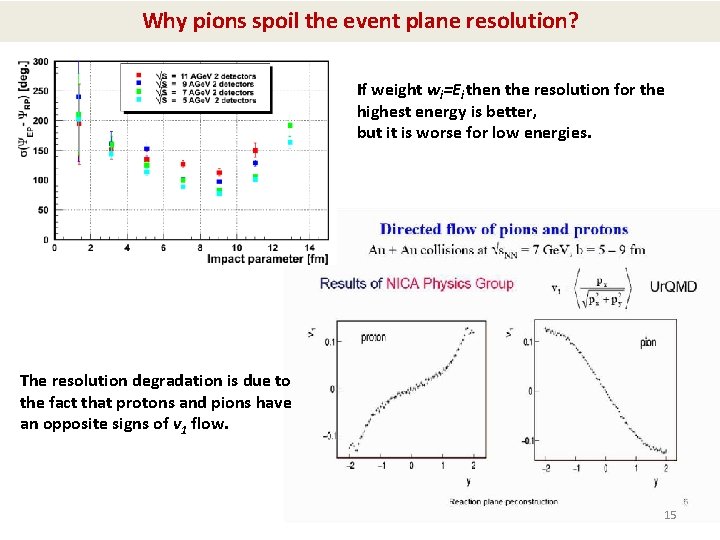
Why pions spoil the event plane resolution? If weight wi=Ei then the resolution for the highest energy is better, but it is worse for low energies. The resolution degradation is due to the fact that protons and pions have an opposite signs of v 1 flow. 15
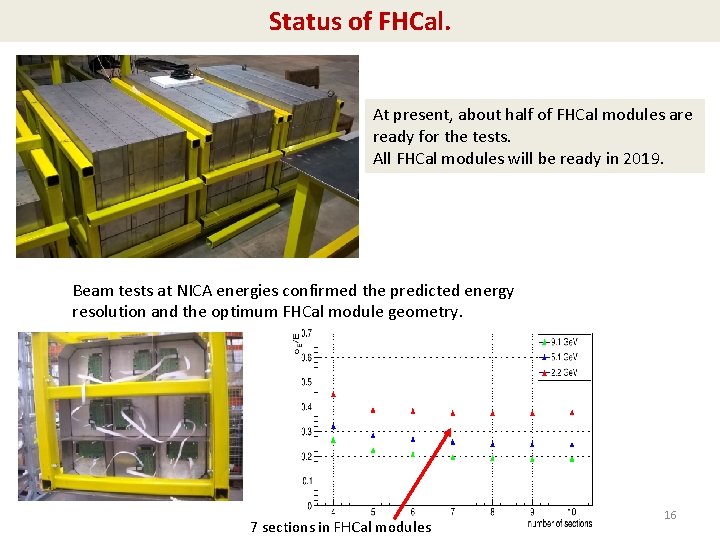
Status of FHCal. At present, about half of FHCal modules are ready for the tests. All FHCal modules will be ready in 2019. Beam tests at NICA energies confirmed the predicted energy resolution and the optimum FHCal module geometry. 7 sections in FHCal modules 16
Conclusion. • FHCal at MPD is unique tool for the measurements of the geometry of heavy ion collisions. • Due to the detection of all spectator types (protons, neutrons, fragments) of both colliding nuclei the angular resolution of the event plane achieves 20 0. • The beam hole in FHCal makes a serious problem with the centrality measurements because of the leak of heavy fragments. • The angular (space) distribution of the spectator deposited energy resolves the ambiguity in the energy deposition for central and peripheral events. • New experimental observables might be constructed to improve the centrality measurements. • As additional function, FHCal will be used for the tuning of heavy ion beams at the earliest stage of MPD operation. 17
Thank you! 18
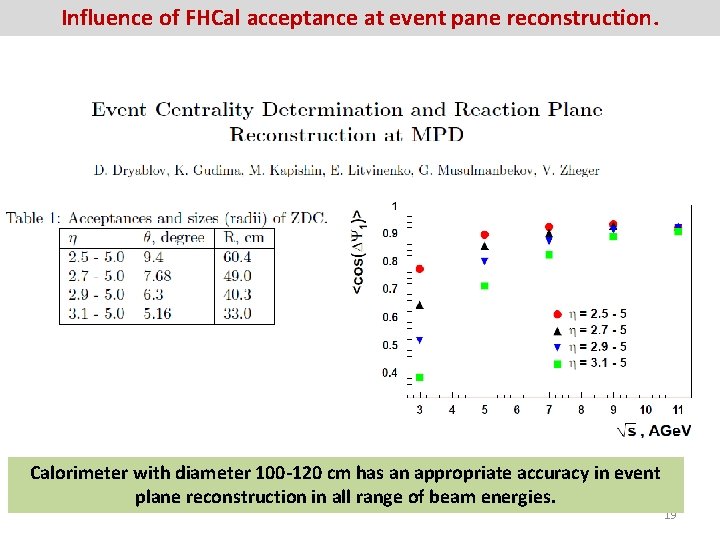
Influence of FHCal acceptance at event pane reconstruction. Calorimeter with diameter 100 -120 cm has an appropriate accuracy in event plane reconstruction in all range of beam energies. 19
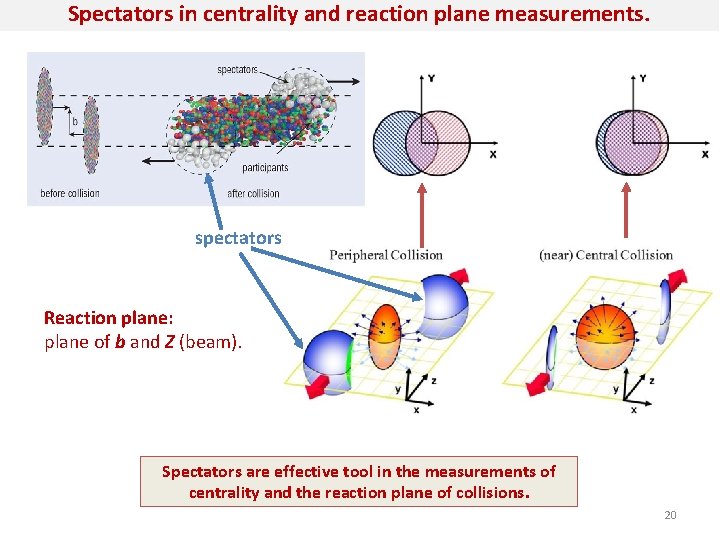
Spectators in centrality and reaction plane measurements. spectators Reaction plane: plane of b and Z (beam). Spectators are effective tool in the measurements of centrality and the reaction plane of collisions. 20
Multi Purpose Detector (MPD). 1 st stage FHCal ITS TPC 22
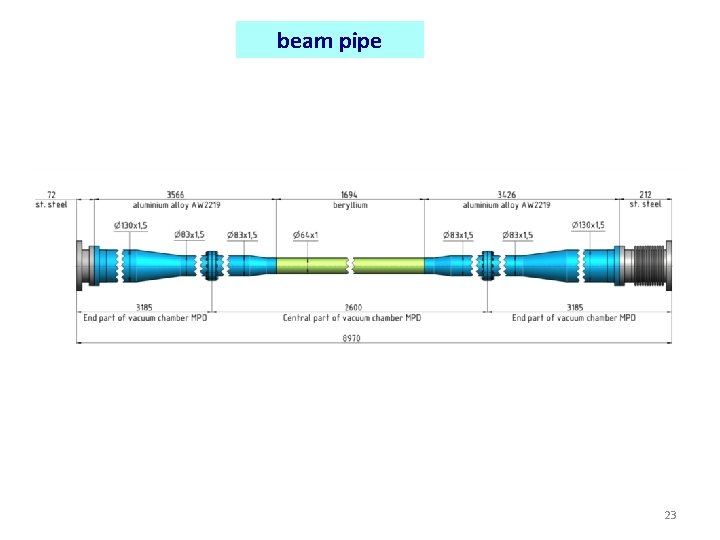
beam pipe 23
Can be FHCal space information used for the centrality measurement? Acceptance of FHCAL Pions Protons + neutrons Fragments 24