
DETERMINATION OF FREE FATTY ACID PEROXIDE NUMBER IN
DETERMINATION OF FREE FATTY ACID & PEROXIDE NUMBER IN FOOD Prepared by: Arş. Gör. Duygu Özmen Lecturer: Dr. Nur ÇEBİ
CONTENTS INTRODUCTION PRINCIPLE OF THE EXPERIMENTAL PROCEDURE CALCULATION OF THE RESULTS
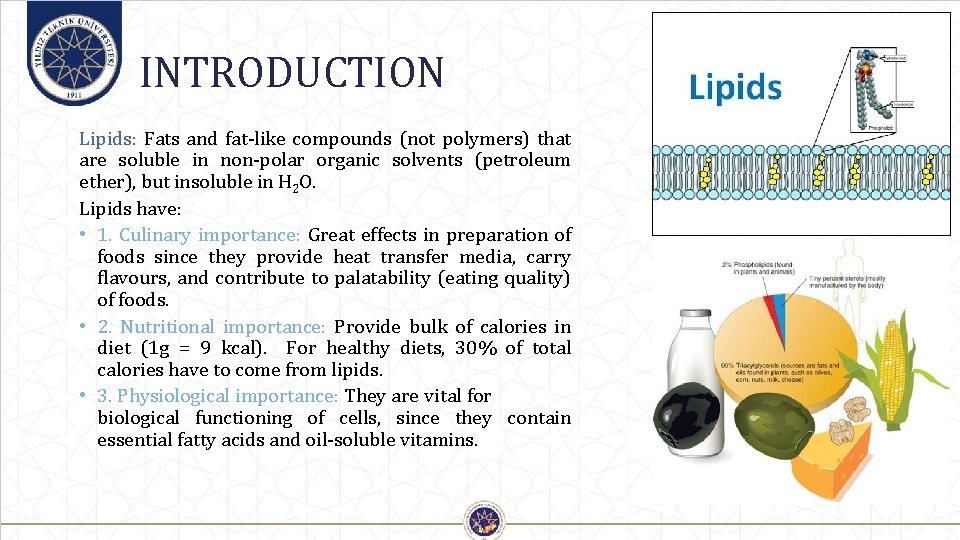
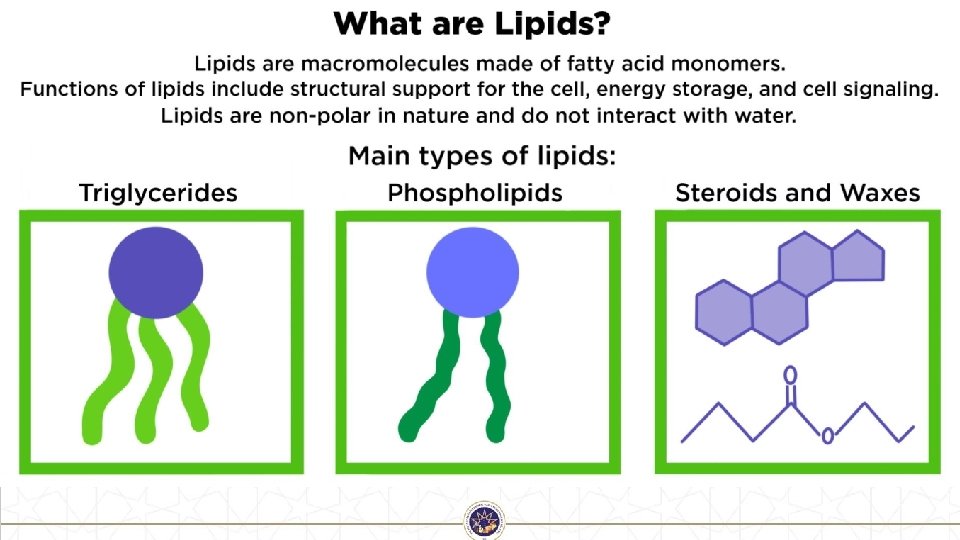
INTRODUCTION Lipids: Fats and fat-like compounds (not polymers) that are soluble in non-polar organic solvents (petroleum ether), but insoluble in H 2 O. Lipids have: • 1. Culinary importance: Great effects in preparation of foods since they provide heat transfer media, carry flavours, and contribute to palatability (eating quality) of foods. • 2. Nutritional importance: Provide bulk of calories in diet (1 g = 9 kcal). For healthy diets, 30% of total calories have to come from lipids. • 3. Physiological importance: They are vital for biological functioning of cells, since they contain essential fatty acids and oil-soluble vitamins.
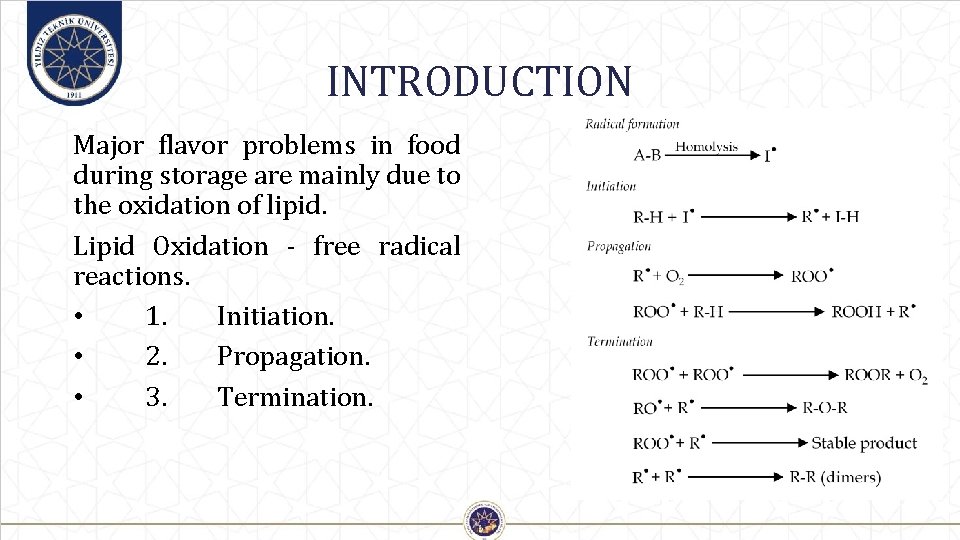
INTRODUCTION Major flavor problems in food during storage are mainly due to the oxidation of lipid. Lipid Oxidation - free radical reactions. • 1. Initiation. • 2. Propagation. • 3. Termination.
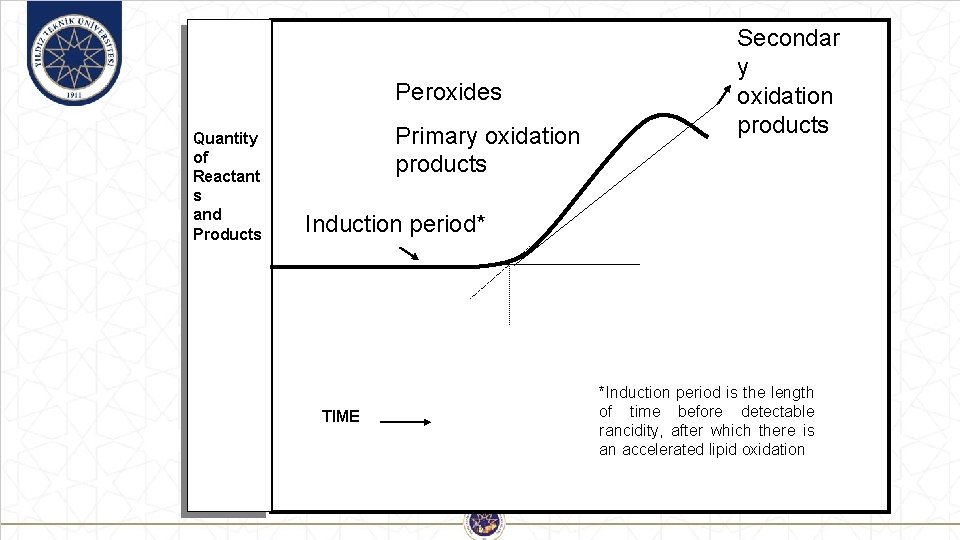
Peroxides Quantity of Reactant s and Products Primary oxidation products Secondar y oxidation products Induction period* TIME *Induction period is the length of time before detectable rancidity, after which there is an accelerated lipid oxidation
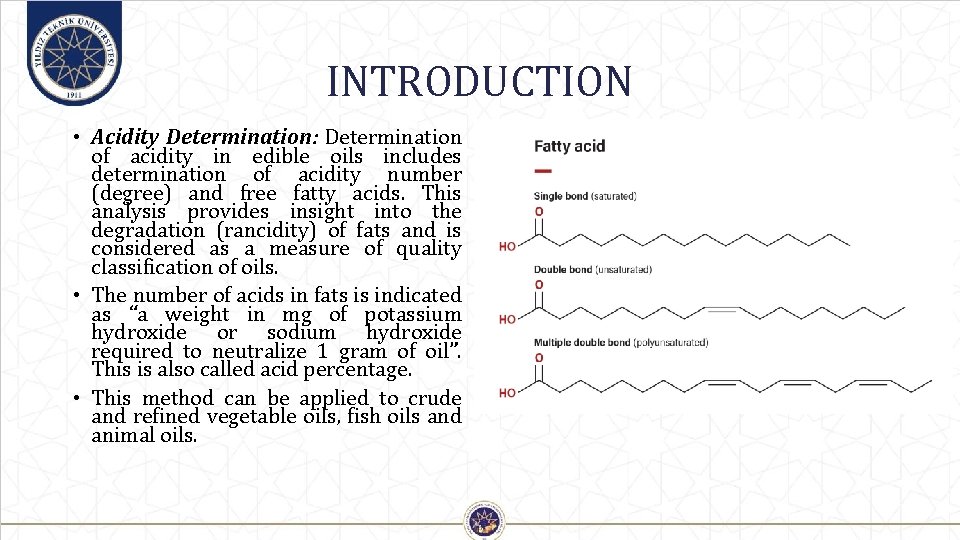
INTRODUCTION • Acidity Determination: Determination of acidity in edible oils includes determination of acidity number (degree) and free fatty acids. This analysis provides insight into the degradation (rancidity) of fats and is considered as a measure of quality classification of oils. • The number of acids in fats is indicated as “a weight in mg of potassium hydroxide or sodium hydroxide required to neutralize 1 gram of oil”. This is also called acid percentage. • This method can be applied to crude and refined vegetable oils, fish oils and animal oils.
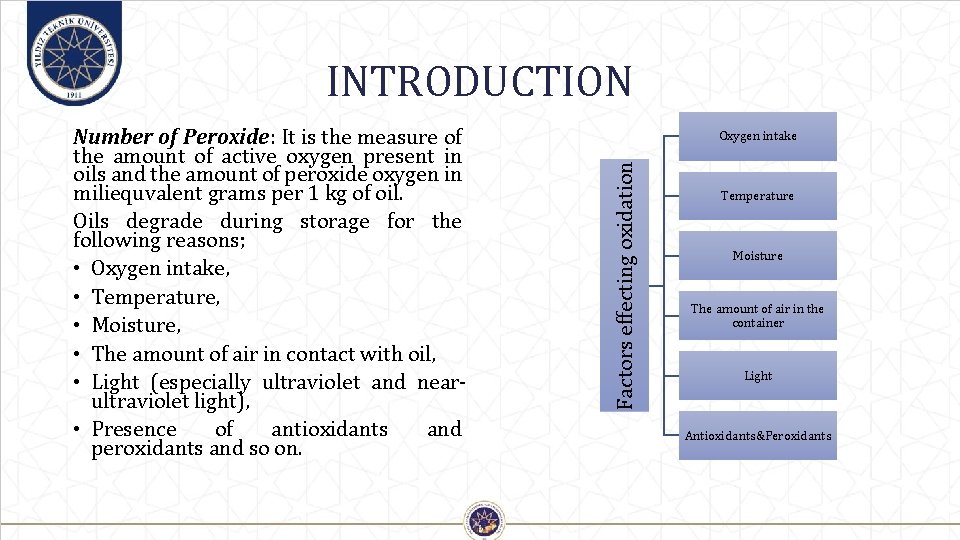
INTRODUCTION Oxygen intake Factors effecting oxidation Number of Peroxide: It is the measure of the amount of active oxygen present in oils and the amount of peroxide oxygen in miliequvalent grams per 1 kg of oil. Oils degrade during storage for the following reasons; • Oxygen intake, • Temperature, • Moisture, • The amount of air in contact with oil, • Light (especially ultraviolet and nearultraviolet light), • Presence of antioxidants and peroxidants and so on. Temperature Moisture The amount of air in the container Light Antioxidants&Peroxidants
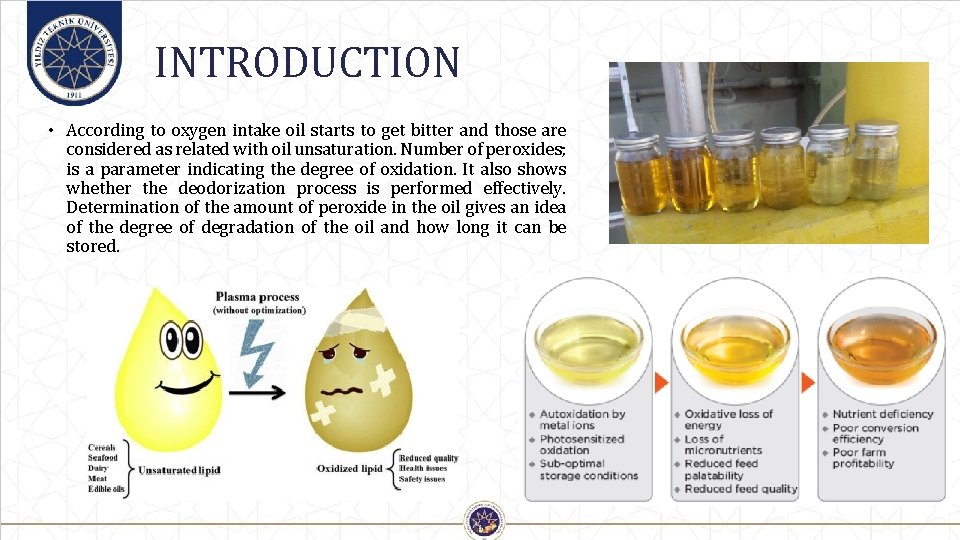
INTRODUCTION • According to oxygen intake oil starts to get bitter and those are considered as related with oil unsaturation. Number of peroxides; is a parameter indicating the degree of oxidation. It also shows whether the deodorization process is performed effectively. Determination of the amount of peroxide in the oil gives an idea of the degree of degradation of the oil and how long it can be stored.
PRINCIPLE OF THE EXPERIMENT • Acidity Determination Principle: It is based on the principle of titration of free fatty acids in the oil which dissolved in alcohol-ether mixture with a calibrated alkali solution using phenolphthalein as an indicator and by calculation of the amount of alkali spent. • Determination of Peroxide Number Principle: It is based on the principle of saturated iodide solution which is weighed and dissolved in acetic acid - chloroform solution, is allowed to react in the dark and at room temperature and released to the free amount of iodine peroxide oxygen and titration of the remaining iodine with thiosulfate.
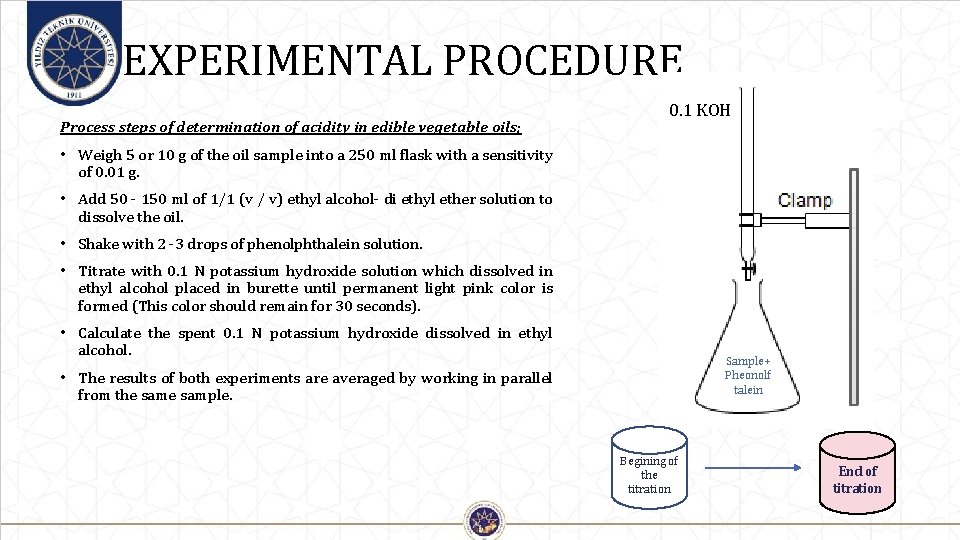
EXPERIMENTAL PROCEDURE Process steps of determination of acidity in edible vegetable oils; 0. 1 KOH • Weigh 5 or 10 g of the oil sample into a 250 ml flask with a sensitivity of 0. 01 g. • Add 50 - 150 ml of 1/1 (v / v) ethyl alcohol- di ethyl ether solution to dissolve the oil. • Shake with 2 -3 drops of phenolphthalein solution. • Titrate with 0. 1 N potassium hydroxide solution which dissolved in ethyl alcohol placed in burette until permanent light pink color is formed (This color should remain for 30 seconds). • Calculate the spent 0. 1 N potassium hydroxide dissolved in ethyl alcohol. Sample+ Pheonolf talein • The results of both experiments are averaged by working in parallel from the sample. Begining of the titration End of titration
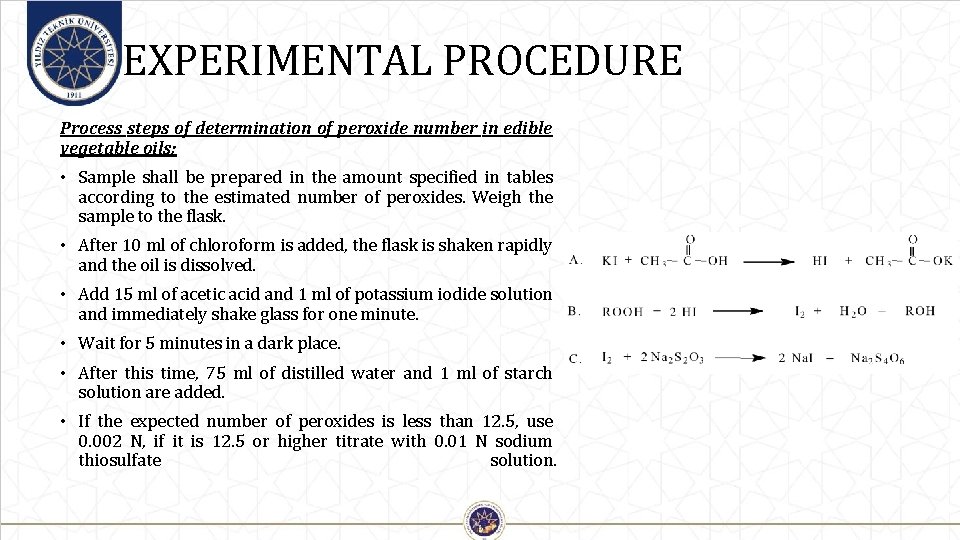
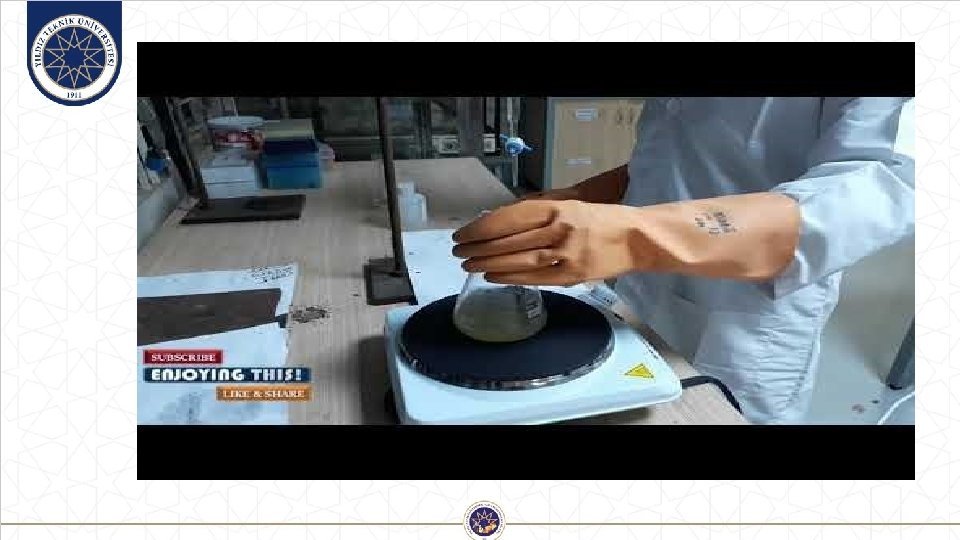
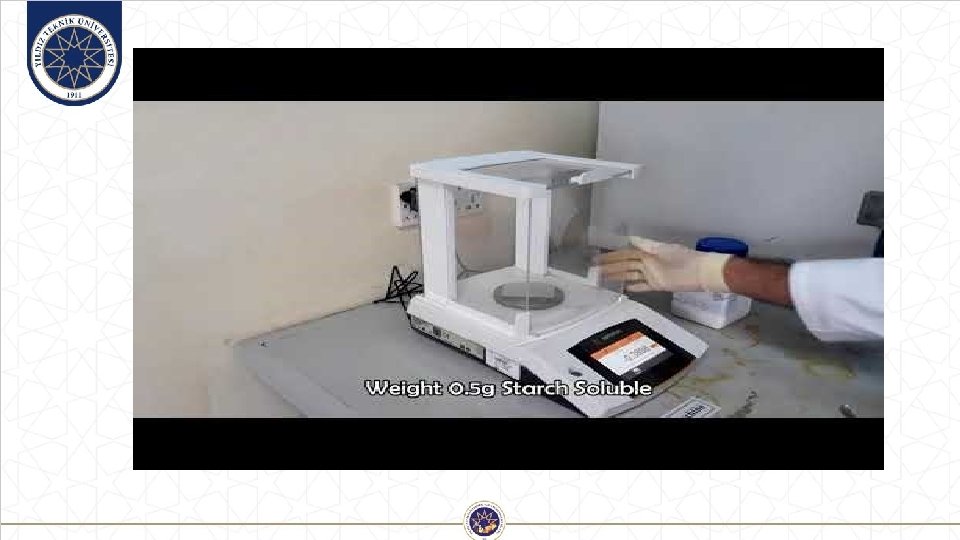
EXPERIMENTAL PROCEDURE Process steps of determination of peroxide number in edible vegetable oils; • Sample shall be prepared in the amount specified in tables according to the estimated number of peroxides. Weigh the sample to the flask. • After 10 ml of chloroform is added, the flask is shaken rapidly and the oil is dissolved. • Add 15 ml of acetic acid and 1 ml of potassium iodide solution and immediately shake glass for one minute. • Wait for 5 minutes in a dark place. • After this time, 75 ml of distilled water and 1 ml of starch solution are added. • If the expected number of peroxides is less than 12. 5, use 0. 002 N, if it is 12. 5 or higher titrate with 0. 01 N sodium thiosulfate solution.
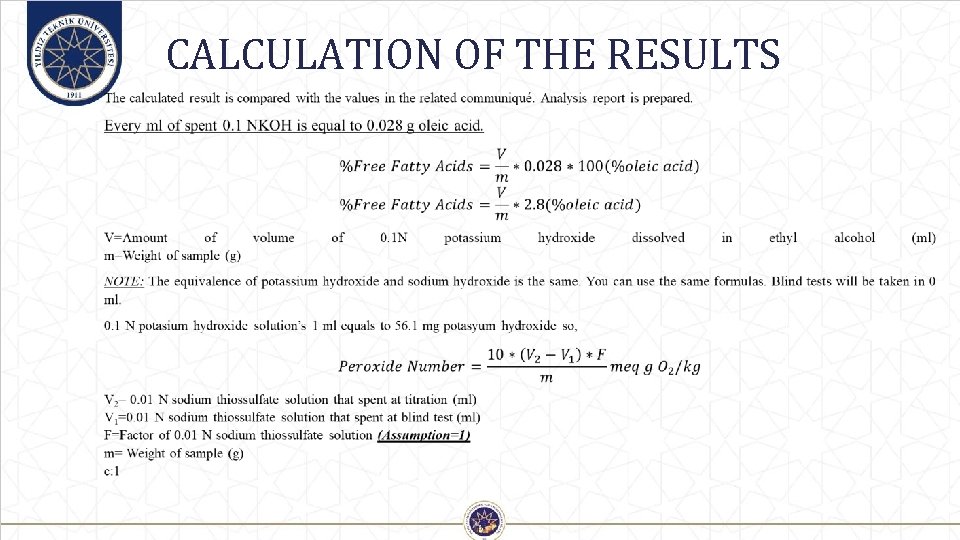
CALCULATION OF THE RESULTS
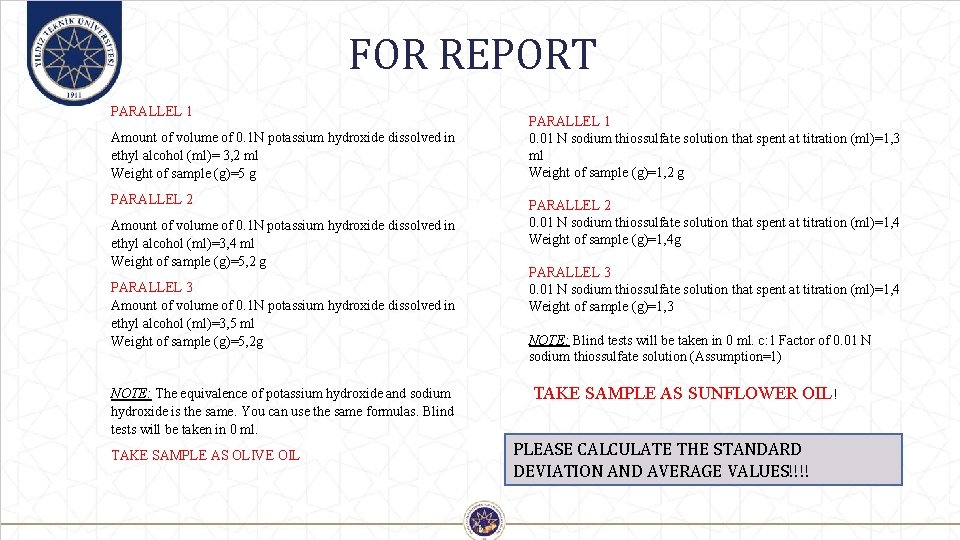
FOR REPORT PARALLEL 1 Amount of volume of 0. 1 N potassium hydroxide dissolved in ethyl alcohol (ml)= 3, 2 ml Weight of sample (g)=5 g PARALLEL 2 Amount of volume of 0. 1 N potassium hydroxide dissolved in ethyl alcohol (ml)=3, 4 ml Weight of sample (g)=5, 2 g PARALLEL 3 Amount of volume of 0. 1 N potassium hydroxide dissolved in ethyl alcohol (ml)=3, 5 ml Weight of sample (g)=5, 2 g NOTE: The equivalence of potassium hydroxide and sodium hydroxide is the same. You can use the same formulas. Blind tests will be taken in 0 ml. TAKE SAMPLE AS OLIVE OIL PARALLEL 1 0. 01 N sodium thiossulfate solution that spent at titration (ml)=1, 3 ml Weight of sample (g)=1, 2 g PARALLEL 2 0. 01 N sodium thiossulfate solution that spent at titration (ml)=1, 4 Weight of sample (g)=1, 4 g PARALLEL 3 0. 01 N sodium thiossulfate solution that spent at titration (ml)=1, 4 Weight of sample (g)=1, 3 NOTE: Blind tests will be taken in 0 ml. c: 1 Factor of 0. 01 N sodium thiossulfate solution (Assumption=1) TAKE SAMPLE AS SUNFLOWER OIL! PLEASE CALCULATE THE STANDARD DEVIATION AND AVERAGE VALUES!!!!

VIDEO SOURCES • https: //www. youtube. com/watch? v=8 Bf 67 tkb. Rms • https: //www. youtube. com/watch? v=Ta. N 1 Cim. Eqf. Y • For more: • https: //www. youtube. com/watch? v=4 Sgo. Dmshhmg • https: //www. youtube. com/watch? v=e. VAVSND 0 D_Q • https: //www. youtube. com/watch? v=3 Wtk. P 12 h. D 00 • https: //www. youtube. com/watch? v=d. Qp. WMIRqti. U • https: //www. youtube. com/watch? v=Hj. Ij 06 Fpzus

THANK YOU FOR YOUR ATTENTION Dr. Nur ÇEBİ
- Slides: 18