
DETERMINATION OF CARBENDAZIM AND THIABENDAZOLE IN VEGETABLES BY
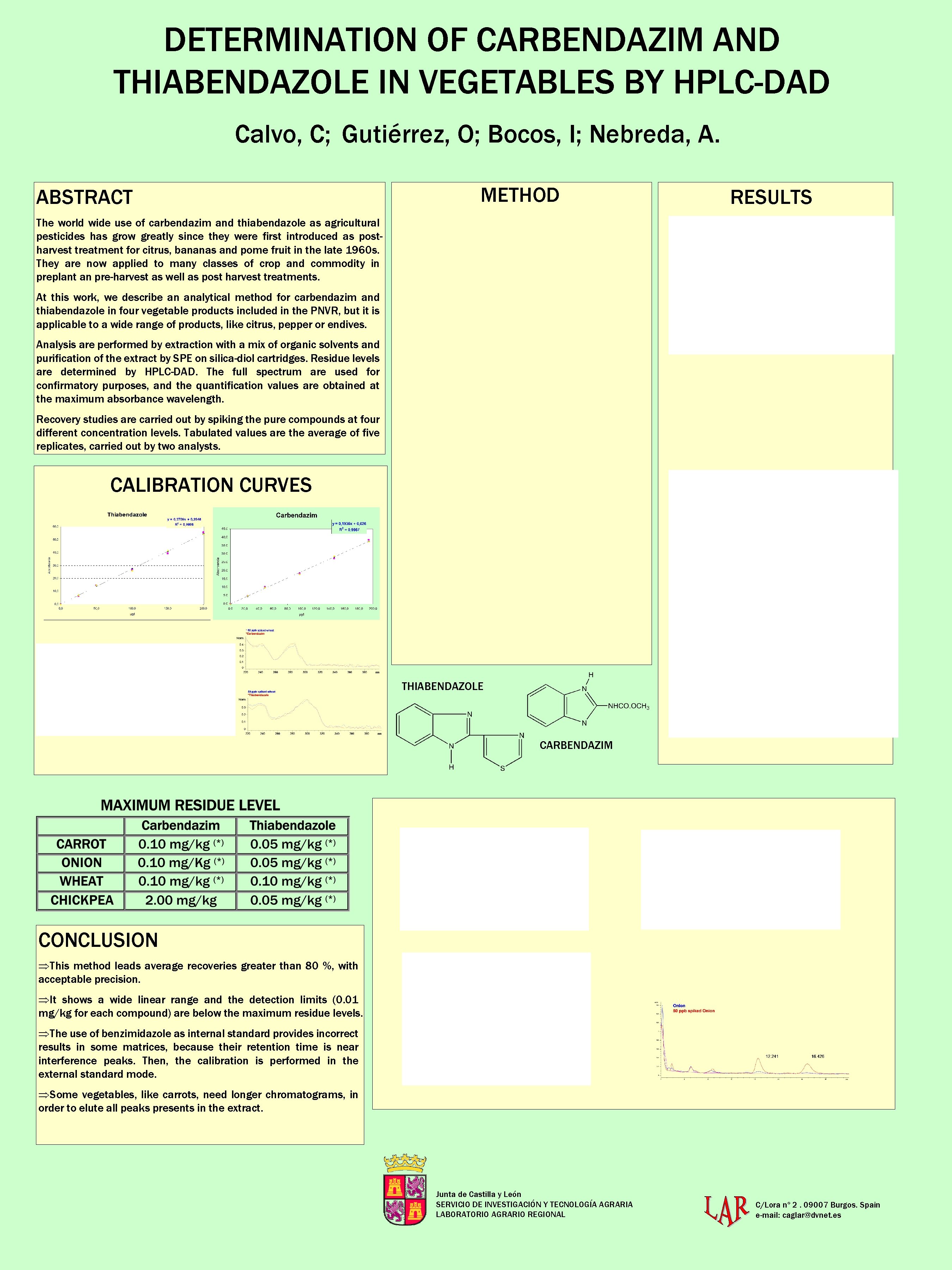
DETERMINATION OF CARBENDAZIM AND THIABENDAZOLE IN VEGETABLES BY HPLC-DAD Calvo, C; Gutiérrez, O; Bocos, I; Nebreda, A. ABSTRACT METHOD RESULTS The world wide use of carbendazim and thiabendazole as agricultural pesticides has grow greatly since they were first introduced as postharvest treatment for citrus, bananas and pome fruit in the late 1960 s. They are now applied to many classes of crop and commodity in preplant an pre-harvest as well as post harvest treatments. At this work, we describe an analytical method for carbendazim and thiabendazole in four vegetable products included in the PNVR, but it is applicable to a wide range of products, like citrus, pepper or endives. Analysis are performed by extraction with a mix of organic solvents and purification of the extract by SPE on silica-diol cartridges. Residue levels are determined by HPLC-DAD. The full spectrum are used for confirmatory purposes, and the quantification values are obtained at the maximum absorbance wavelength. Recovery studies are carried out by spiking the pure compounds at four different concentration levels. Tabulated values are the average of five replicates, carried out by two analysts. CALIBRATION CURVES THIABENDAZOLE CARBENDAZIM CONCLUSION ÞThis method leads average recoveries greater than 80 %, with acceptable precision. ÞIt shows a wide linear range and the detection limits (0. 01 mg/kg for each compound) are below the maximum residue levels. ÞThe use of benzimidazole as internal standard provides incorrect results in some matrices, because their retention time is near interference peaks. Then, the calibration is performed in the external standard mode. ÞSome vegetables, like carrots, need longer chromatograms, in order to elute all peaks presents in the extract. Junta de Castilla y León SERVICIO DE INVESTIGACIÓN Y TECNOLOGÍA AGRARIA LABORATORIO AGRARIO REGIONAL C/Lora nº 2. 09007 Burgos. Spain e-mail: caglar@dvnet. es
- Slides: 1