
Determinants Prepared by Vince Zaccone For Campus Learning

Determinants Prepared by Vince Zaccone For Campus Learning Assistance Services at UCSB
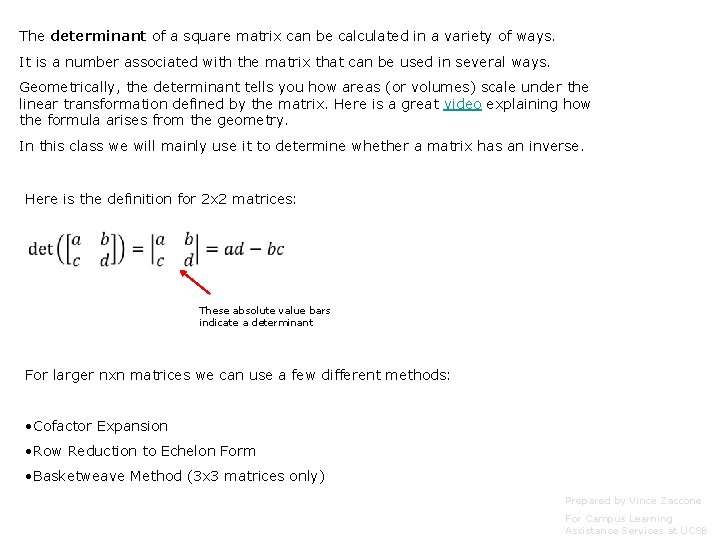
The determinant of a square matrix can be calculated in a variety of ways. It is a number associated with the matrix that can be used in several ways. Geometrically, the determinant tells you how areas (or volumes) scale under the linear transformation defined by the matrix. Here is a great video explaining how the formula arises from the geometry. In this class we will mainly use it to determine whether a matrix has an inverse. Here is the definition for 2 x 2 matrices: These absolute value bars indicate a determinant For larger nxn matrices we can use a few different methods: • Cofactor Expansion • Row Reduction to Echelon Form • Basketweave Method (3 x 3 matrices only) Prepared by Vince Zaccone For Campus Learning Assistance Services at UCSB
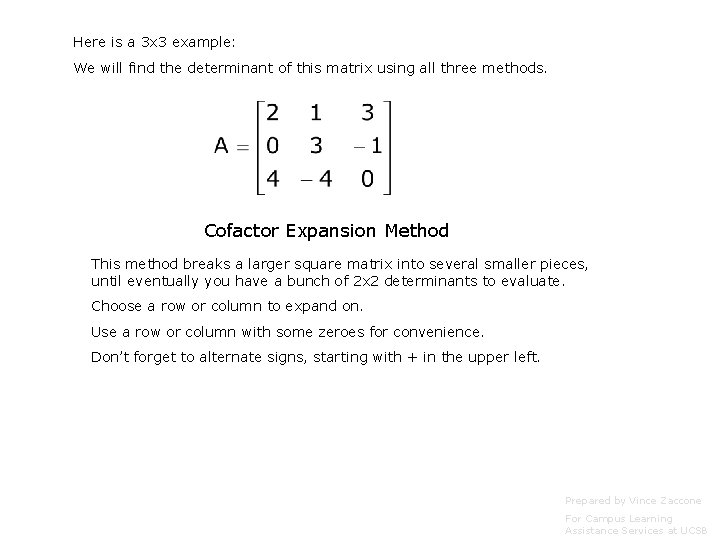
Here is a 3 x 3 example: We will find the determinant of this matrix using all three methods. Cofactor Expansion Method This method breaks a larger square matrix into several smaller pieces, until eventually you have a bunch of 2 x 2 determinants to evaluate. Choose a row or column to expand on. Use a row or column with some zeroes for convenience. Don’t forget to alternate signs, starting with + in the upper left. Prepared by Vince Zaccone For Campus Learning Assistance Services at UCSB
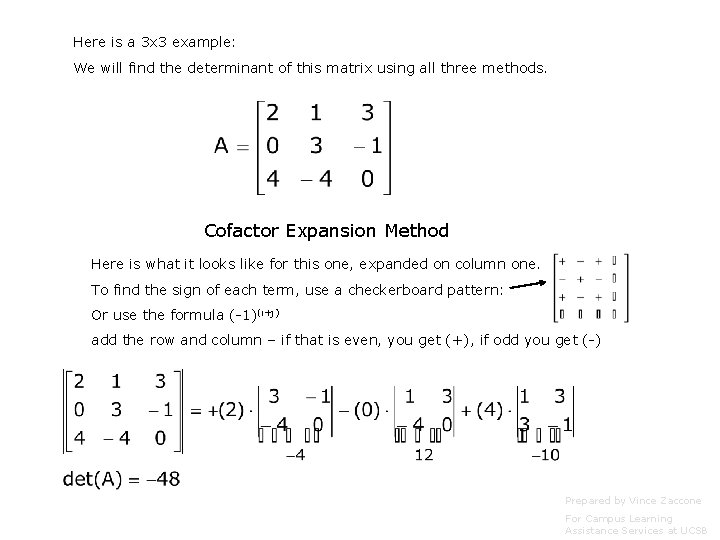
Here is a 3 x 3 example: We will find the determinant of this matrix using all three methods. Cofactor Expansion Method Here is what it looks like for this one, expanded on column one. To find the sign of each term, use a checkerboard pattern: Or use the formula (-1)(i+j) add the row and column – if that is even, you get (+), if odd you get (-) Prepared by Vince Zaccone For Campus Learning Assistance Services at UCSB
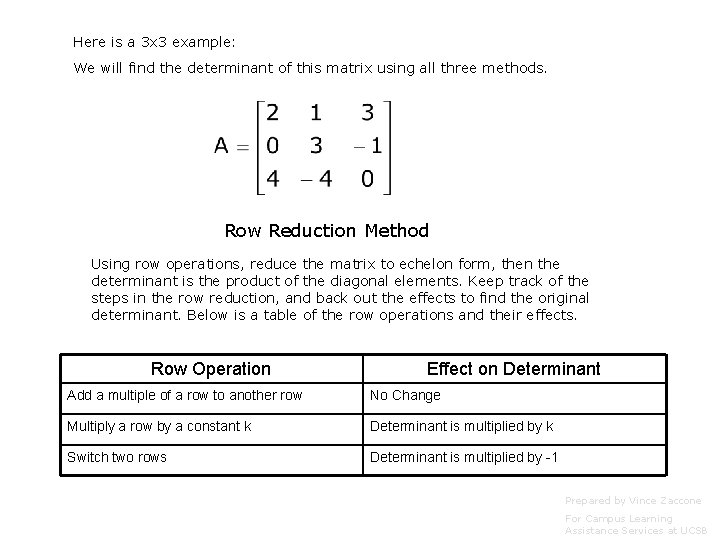
Here is a 3 x 3 example: We will find the determinant of this matrix using all three methods. Row Reduction Method Using row operations, reduce the matrix to echelon form, then the determinant is the product of the diagonal elements. Keep track of the steps in the row reduction, and back out the effects to find the original determinant. Below is a table of the row operations and their effects. Row Operation Effect on Determinant Add a multiple of a row to another row No Change Multiply a row by a constant k Determinant is multiplied by k Switch two rows Determinant is multiplied by -1 Prepared by Vince Zaccone For Campus Learning Assistance Services at UCSB
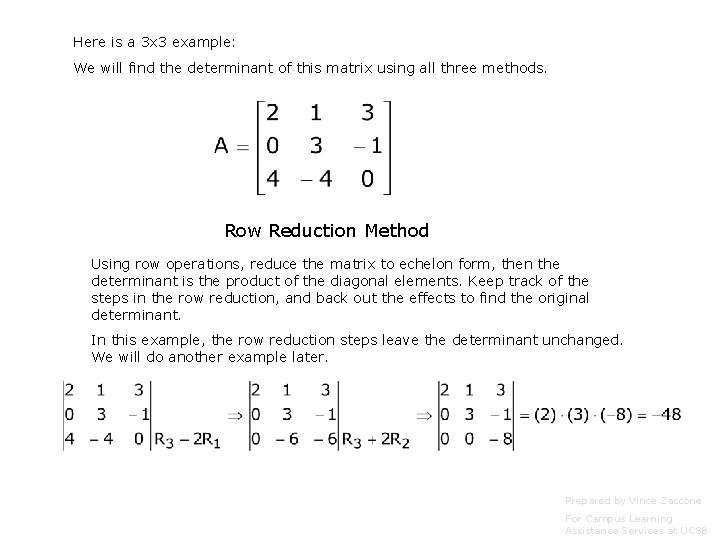
Here is a 3 x 3 example: We will find the determinant of this matrix using all three methods. Row Reduction Method Using row operations, reduce the matrix to echelon form, then the determinant is the product of the diagonal elements. Keep track of the steps in the row reduction, and back out the effects to find the original determinant. In this example, the row reduction steps leave the determinant unchanged. We will do another example later. Prepared by Vince Zaccone For Campus Learning Assistance Services at UCSB
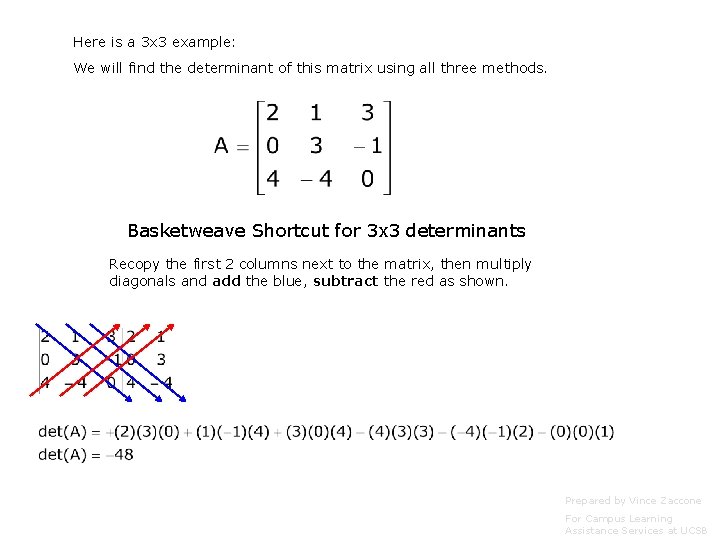
Here is a 3 x 3 example: We will find the determinant of this matrix using all three methods. Basketweave Shortcut for 3 x 3 determinants Recopy the first 2 columns next to the matrix, then multiply diagonals and add the blue, subtract the red as shown. Prepared by Vince Zaccone For Campus Learning Assistance Services at UCSB
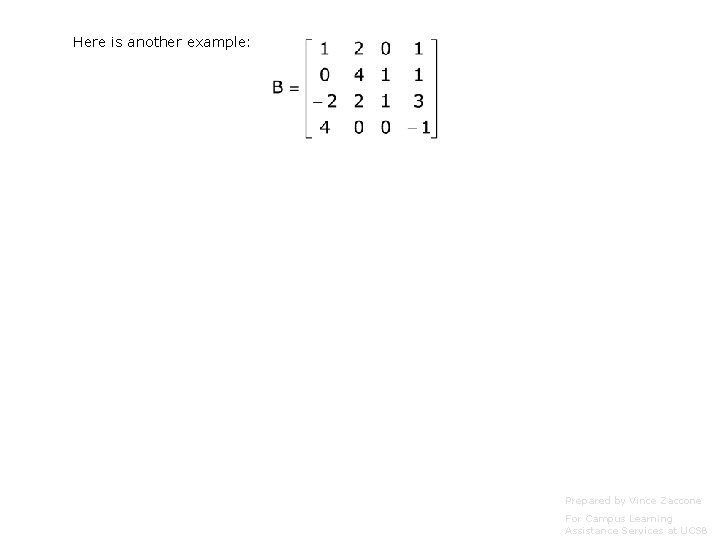
Here is another example: Prepared by Vince Zaccone For Campus Learning Assistance Services at UCSB
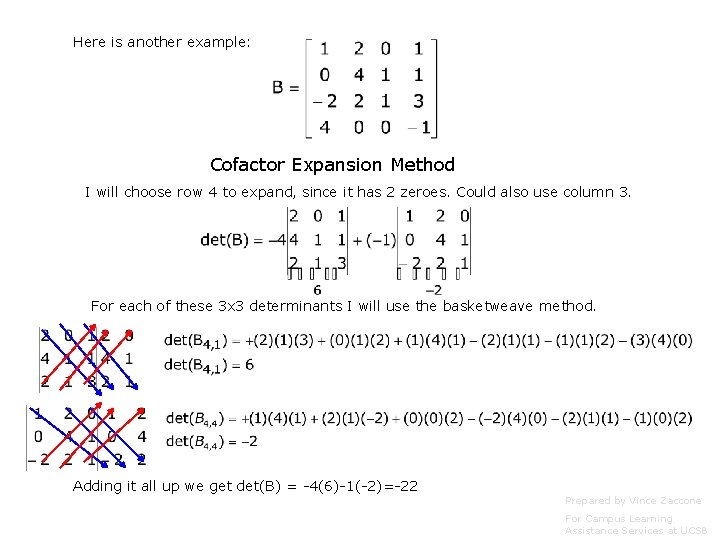
Here is another example: Cofactor Expansion Method I will choose row 4 to expand, since it has 2 zeroes. Could also use column 3. For each of these 3 x 3 determinants I will use the basketweave method. Adding it all up we get det(B) = -4(6)-1(-2)=-22 Prepared by Vince Zaccone For Campus Learning Assistance Services at UCSB
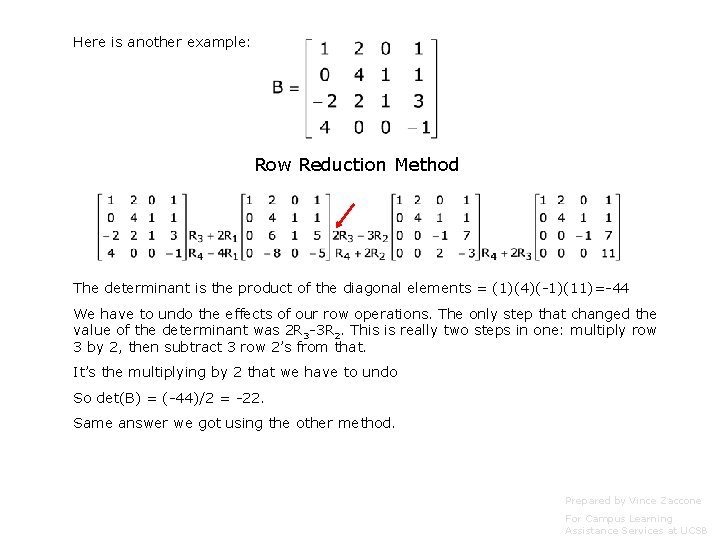
Here is another example: Row Reduction Method The determinant is the product of the diagonal elements = (1)(4)(-1)(11)=-44 We have to undo the effects of our row operations. The only step that changed the value of the determinant was 2 R 3 -3 R 2. This is really two steps in one: multiply row 3 by 2, then subtract 3 row 2’s from that. It’s the multiplying by 2 that we have to undo So det(B) = (-44)/2 = -22. Same answer we got using the other method. Prepared by Vince Zaccone For Campus Learning Assistance Services at UCSB
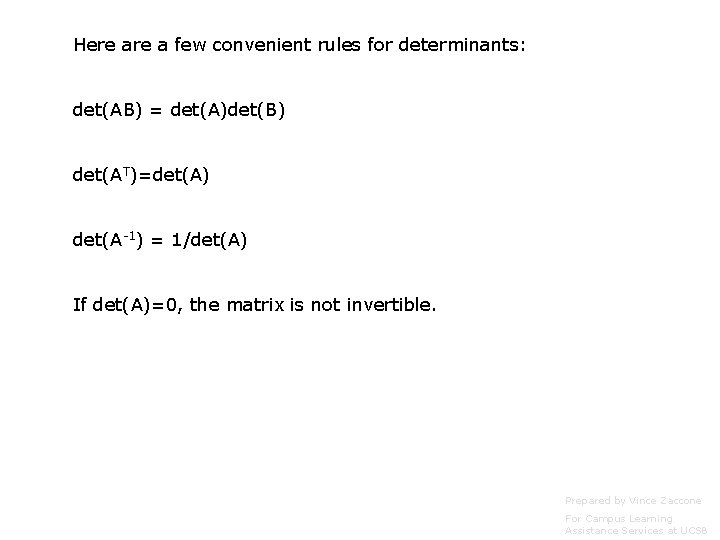
Here a few convenient rules for determinants: det(AB) = det(A)det(B) det(AT)=det(A) det(A-1) = 1/det(A) If det(A)=0, the matrix is not invertible. Prepared by Vince Zaccone For Campus Learning Assistance Services at UCSB
- Slides: 11