
DETERMINANTS OF SATURATION IN A STRATEGIC ISSUE MANAGEMENT




- Slides: 17
DETERMINANTS OF SATURATION IN A STRATEGIC ISSUE MANAGEMENT SYSTEM: A LONGITUDINAL ANALYSIS 26 th Annual International Conference of Strategic Management Society November 1, 2006 Vienna, Austria Peter Kunnas, Nokia Corporation Markus Kajanto, Nokia Corporation Matti Keijola, Helsinki University of Technology Tomi Laamanen, Helsinki University of Technology Markku Maula, Helsinki University of Technology
DETERMINANTS OF SATURATION IN A STRATEGIC ISSUE MANAGEMENT SYSTEM: A LONGITUDINAL ANALYSIS Introduction and motivation Methodology and approach Results of empirical analysis Discussion and conclusions
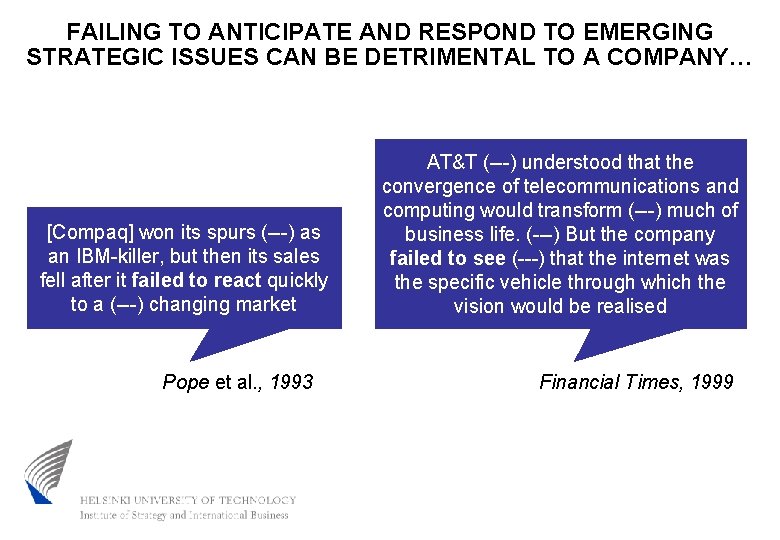
FAILING TO ANTICIPATE AND RESPOND TO EMERGING STRATEGIC ISSUES CAN BE DETRIMENTAL TO A COMPANY… [Compaq] won its spurs (---) as an IBM-killer, but then its sales fell after it failed to react quickly to a (---) changing market Pope et al. , 1993 AT&T (---) understood that the convergence of telecommunications and computing would transform (---) much of business life. (---) But the company failed to see (---) that the internet was the specific vehicle through which the vision would be realised Financial Times, 1999
…WHEREAS A CORRECT INTERPRETATION AND RESPONSE CAN PROVIDE MARKED RESULTS What we thought would be a complete threat, a destroyer of value, resulted in being a value creator. You should never come to conclusions about competition, partnerships, [or] alliances before really looking into them. When this issue came up we thought we knew what it was all about. As people monitored its progress and researched additional issues surrounding it, we began to see other aspects that led to our implementation strategy and in the long-term served us well. VP, Regulatory Issues, Bell. South Corporation in CSB, 1999
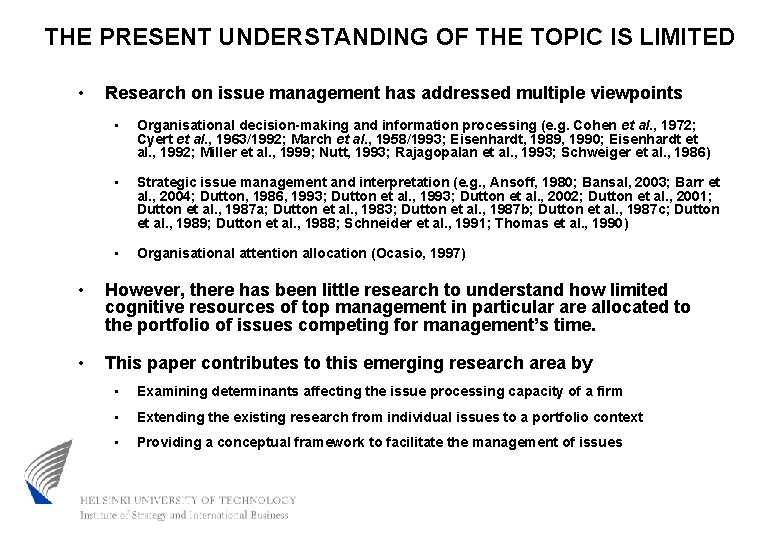
THE PRESENT UNDERSTANDING OF THE TOPIC IS LIMITED • Research on issue management has addressed multiple viewpoints • Organisational decision-making and information processing (e. g. Cohen et al. , 1972; Cyert et al. , 1963/1992; March et al. , 1958/1993; Eisenhardt, 1989, 1990; Eisenhardt et al. , 1992; Miller et al. , 1999; Nutt, 1993; Rajagopalan et al. , 1993; Schweiger et al. , 1986) • Strategic issue management and interpretation (e. g. , Ansoff, 1980; Bansal, 2003; Barr et al. , 2004; Dutton, 1986, 1993; Dutton et al. , 2002; Dutton et al. , 2001; Dutton et al. , 1987 a; Dutton et al. , 1983; Dutton et al. , 1987 b; Dutton et al. , 1987 c; Dutton et al. , 1989; Dutton et al. , 1988; Schneider et al. , 1991; Thomas et al. , 1990) • Organisational attention allocation (Ocasio, 1997) • However, there has been little research to understand how limited cognitive resources of top management in particular are allocated to the portfolio of issues competing for management’s time. • This paper contributes to this emerging research area by • Examining determinants affecting the issue processing capacity of a firm • Extending the existing research from individual issues to a portfolio context • Providing a conceptual framework to facilitate the management of issues
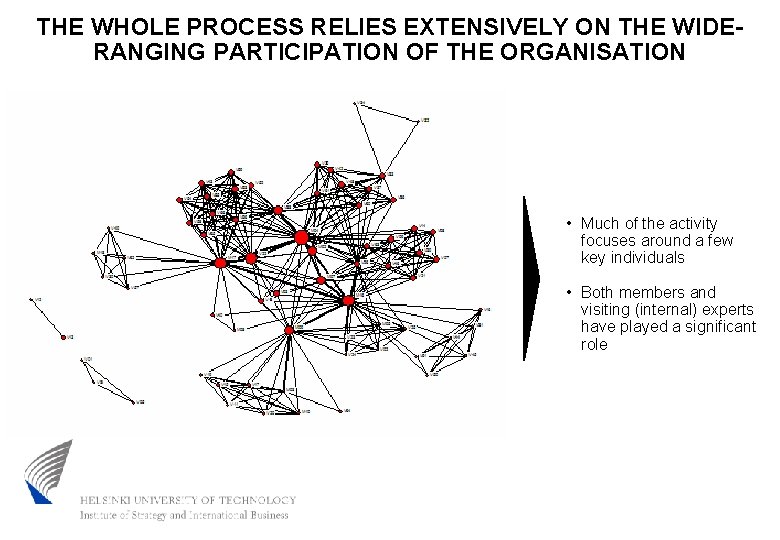
THE WHOLE PROCESS RELIES EXTENSIVELY ON THE WIDERANGING PARTICIPATION OF THE ORGANISATION • Much of the activity focuses around a few key individuals • Both members and visiting (internal) experts have played a significant role
DETERMINANTS OF SATURATION IN A STRATEGIC ISSUE MANAGEMENT SYSTEM: A LONGITUDINAL ANALYSIS Introduction and motivation Methodology and approach Results of empirical analysis Discussion and conclusions
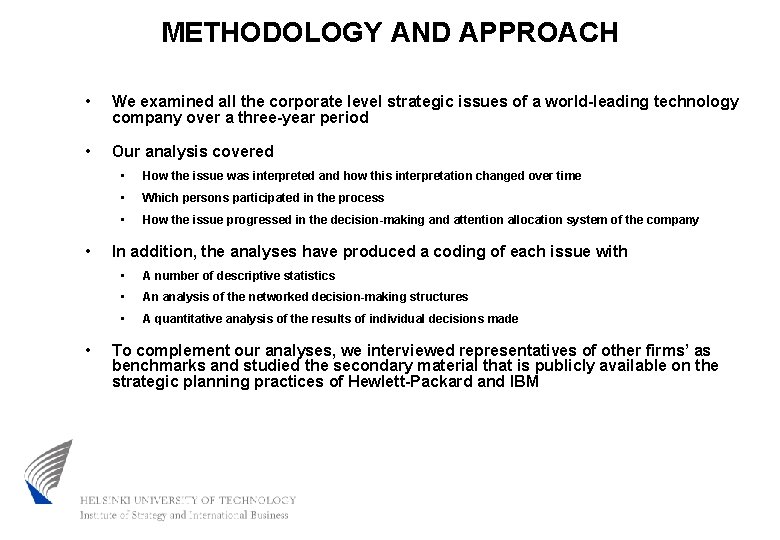
METHODOLOGY AND APPROACH • We examined all the corporate level strategic issues of a world-leading technology company over a three-year period • Our analysis covered • • • How the issue was interpreted and how this interpretation changed over time • Which persons participated in the process • How the issue progressed in the decision-making and attention allocation system of the company In addition, the analyses have produced a coding of each issue with • A number of descriptive statistics • An analysis of the networked decision-making structures • A quantitative analysis of the results of individual decisions made To complement our analyses, we interviewed representatives of other firms’ as benchmarks and studied the secondary material that is publicly available on the strategic planning practices of Hewlett-Packard and IBM
DETERMINANTS OF SATURATION IN A STRATEGIC ISSUE MANAGEMENT SYSTEM: A LONGITUDINAL ANALYSIS Introduction and motivation Methodology and approach Results of empirical analysis Discussion and conclusions
ISSUE MANAGEMENT PROCESS APPEARS TO RUN WITH A STEADY NUMBER OF ISSUES OVER TIME Number of issues Number of concurrently active issues Moving average • Dealing with an issue may be affected by other issues being processed. • Introducing new issues may lead to saturation • Sensitivity to new issues can be reduced • Capacity to process issues can be impaired Period
ISSUES EXHIBITED FUNDAMENTAL DIFFERENCES IN THEIR RESOURCE REQUIREMENTS Value-at-stake Average resourcing Full-time equivalents • “Messy” issues with high valueat-stake needing a long duration and high resourcing form the base load and may cause saturation • “Crash efforts” with short duration and high resourcing emerge sporadically • “Quick-and-easy” issue can be addressed depending on overall workload Duration Months
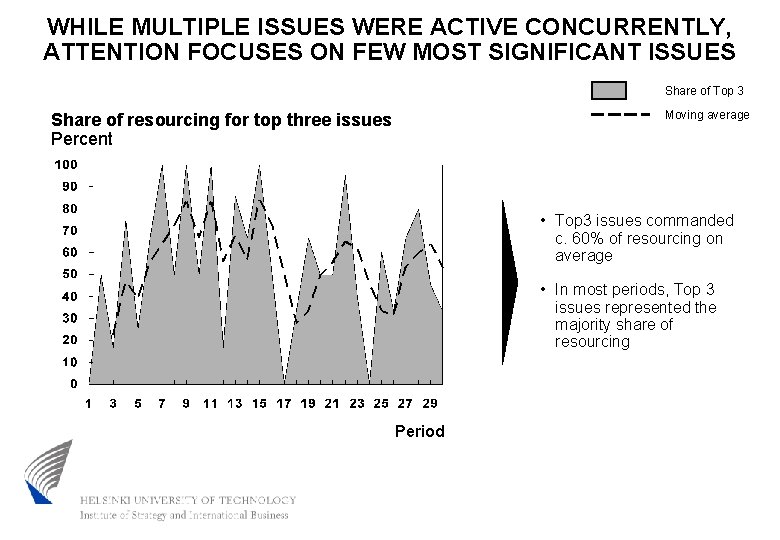
WHILE MULTIPLE ISSUES WERE ACTIVE CONCURRENTLY, ATTENTION FOCUSES ON FEW MOST SIGNIFICANT ISSUES Share of Top 3 Moving average Share of resourcing for top three issues Percent • Top 3 issues commanded c. 60% of resourcing on average • In most periods, Top 3 issues represented the majority share of resourcing Period
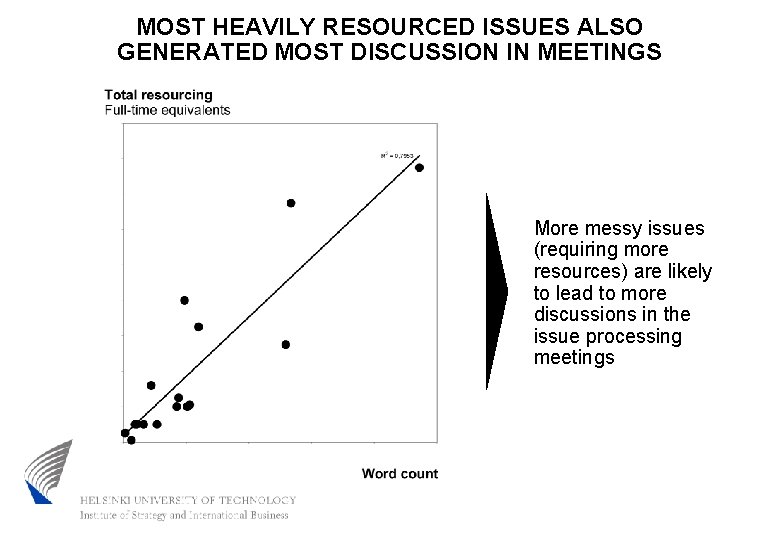
MOST HEAVILY RESOURCED ISSUES ALSO GENERATED MOST DISCUSSION IN MEETINGS More messy issues (requiring more resources) are likely to lead to more discussions in the issue processing meetings
DETERMINANTS OF SATURATION IN A STRATEGIC ISSUE MANAGEMENT SYSTEM: A LONGITUDINAL ANALYSIS Introduction and motivation Methodology and approach Results of empirical analysis Discussion and conclusions
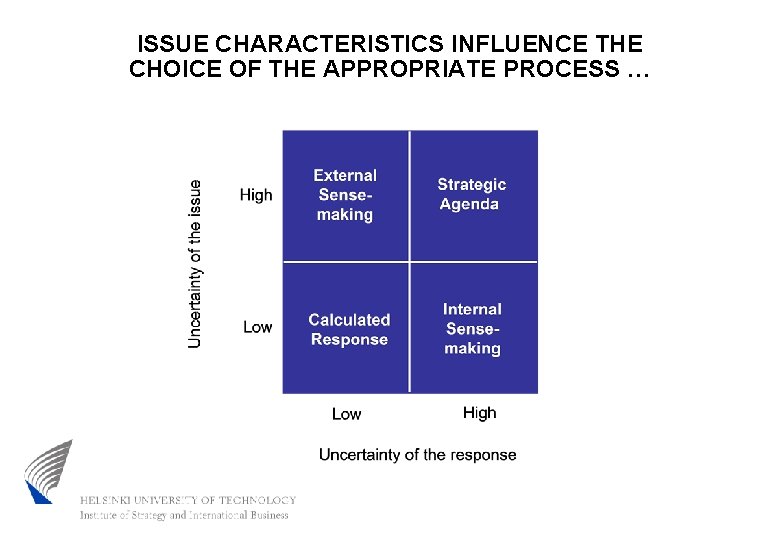
ISSUE CHARACTERISTICS INFLUENCE THE CHOICE OF THE APPROPRIATE PROCESS …
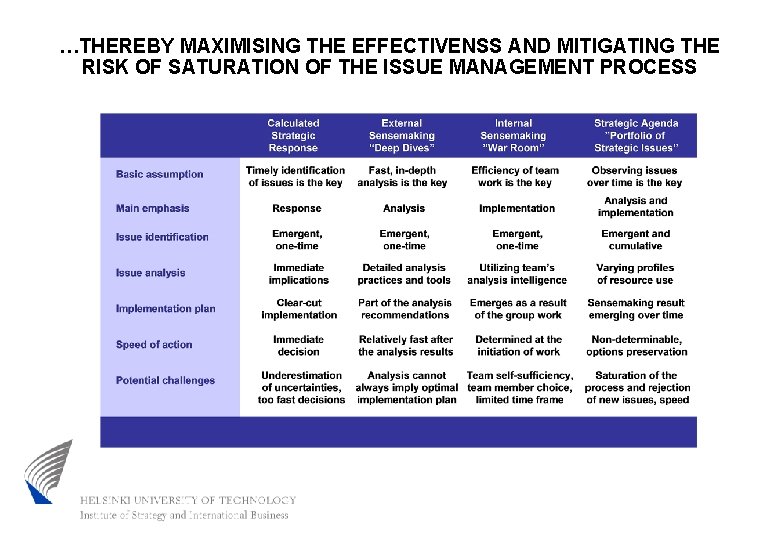
…THEREBY MAXIMISING THE EFFECTIVENSS AND MITIGATING THE RISK OF SATURATION OF THE ISSUE MANAGEMENT PROCESS
DISCUSSION AND CONCLUSIONS • This paper represents one of the first longitudinal, in-depth analyses of strategic issue management processes based on unique data. • The paper puts forward a novel concept: the saturation of a strategic issue processing system. • The primary determinants affecting the issue processing capacity of the company include the networked operating mode of the issue processing staff and the resource consumption intensity of the strategic issues. • Based on these determinants, we propose a conceptual framework of portfolio of approaches for addressing strategic issues. • The nature of work involved in solving the issue is an important determinant of the resource consumption. Future research should examine the linking of issues and initiatives in an analysis of the saturation of a firm’s management capacity and how the transition from strategic issues to strategic initiatives takes place.