
Determinants of new onset diabetes among hypertensive patients
Determinants of new onset diabetes among hypertensive patients randomised in the ASCOT-BPLA Trial Dr Ajay K Gupta International Centre for Circulatory Health NHLI, Imperial College London Presented on behalf of the ASCOT Investigators
Background • Hypertension and diabetes are common co-morbid conditions, and their relationship is complex • Hypertension is an independent risk factor for diabetes development, and increases risk by 2 -3 times • Recent studies have shown that antihypertensive drugs particularly beta-blockers and diuretics - variably potentiate this enhanced risk • Controversy still persists because of methodological criticisms of these studies, and lack of robust evidence for reduction in cardiovascular benefits as a result of new onset diabetes development
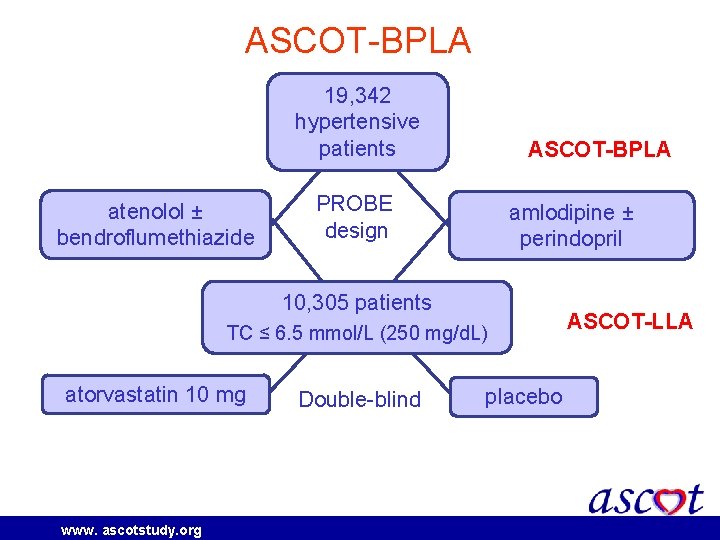
ASCOT-BPLA 19, 342 hypertensive patients atenolol ± bendroflumethiazide ASCOT-BPLA PROBE design amlodipine ± perindopril 10, 305 patients TC ≤ 6. 5 mmol/L (250 mg/d. L) atorvastatin 10 mg www. ascotstudy. org Double-blind placebo ASCOT-LLA
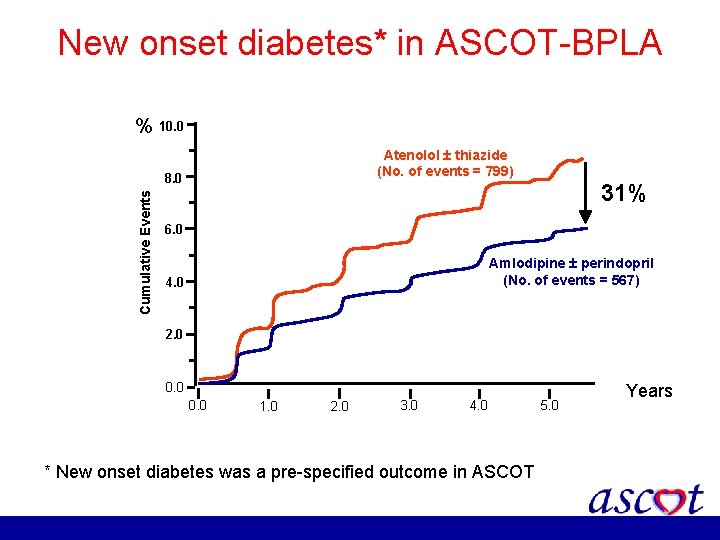
New onset diabetes* in ASCOT-BPLA % 10. 0 Atenolol thiazide (No. of events = 799) Cumulative Events 8. 0 31% 6. 0 Amlodipine perindopril (No. of events = 567) 4. 0 2. 0 0. 0 1. 0 2. 0 3. 0 4. 0 * New onset diabetes was a pre-specified outcome in ASCOT 5. 0 Years
Objectives • To determine the predictors of new onset diabetes (NOD) among hypertensive patients in ASCOT-BPLA • To develop a risk score to identify those at high risk
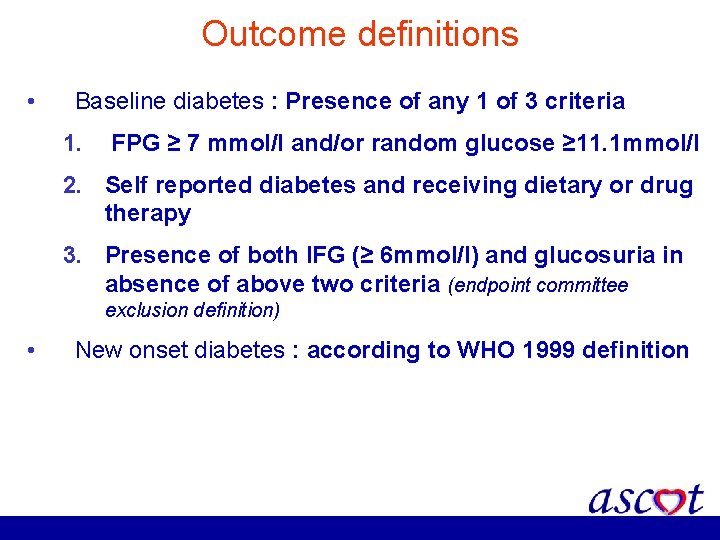
Outcome definitions • Baseline diabetes : Presence of any 1 of 3 criteria 1. FPG ≥ 7 mmol/l and/or random glucose ≥ 11. 1 mmol/l 2. Self reported diabetes and receiving dietary or drug therapy 3. Presence of both IFG (≥ 6 mmol/l) and glucosuria in absence of above two criteria (endpoint committee exclusion definition) • New onset diabetes : according to WHO 1999 definition
Methods • A multivariable Cox proportional hazard regression model was developed using forward stepwise selection (p<0. 05) with age, sex and blood pressure treatment group as covariates. The model was assessed for internal validity and discriminative ability • Based on the Cox model, risk scores for individuals were estimated by summing of the product of the coefficient and the variable value • Risk scores were divided into quartiles and model calibration was evaluated by comparing the observed outcomes with the predicted outcomes
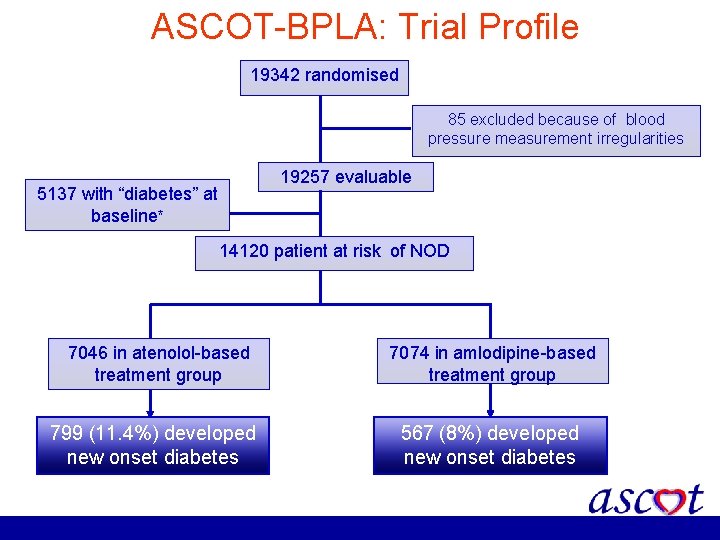
ASCOT-BPLA: Trial Profile 19342 randomised 85 excluded because of blood pressure measurement irregularities 19257 evaluable 5137 with “diabetes” at baseline* 14120 patient at risk of NOD 7046 in atenolol-based treatment group 799 (11. 4%) developed new onset diabetes 7074 in amlodipine-based treatment group 567 (8%) developed new onset diabetes
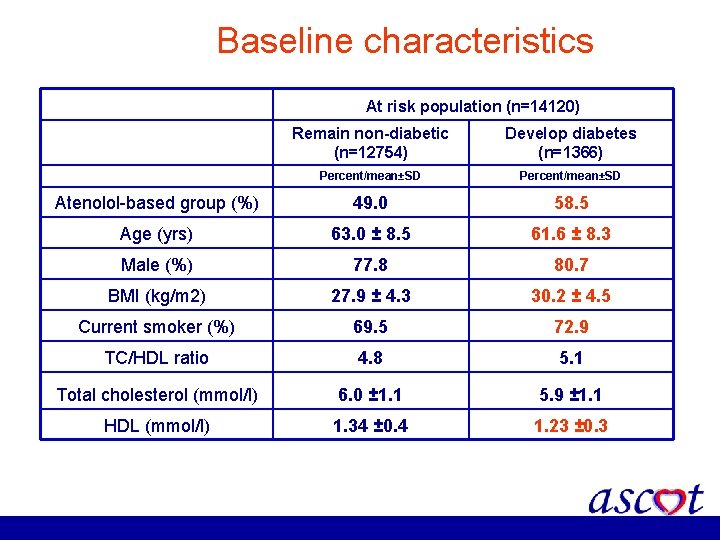
Baseline characteristics At risk population (n=14120) Remain non-diabetic (n=12754) Develop diabetes (n=1366) Percent/mean±SD Atenolol-based group (%) 49. 0 58. 5 Age (yrs) 63. 0 ± 8. 5 61. 6 ± 8. 3 Male (%) 77. 8 80. 7 BMI (kg/m 2) 27. 9 ± 4. 3 30. 2 ± 4. 5 Current smoker (%) 69. 5 72. 9 TC/HDL ratio 4. 8 5. 1 Total cholesterol (mmol/l) 6. 0 ± 1. 1 5. 9 ± 1. 1 HDL (mmol/l) 1. 34 ± 0. 4 1. 23 ± 0. 3
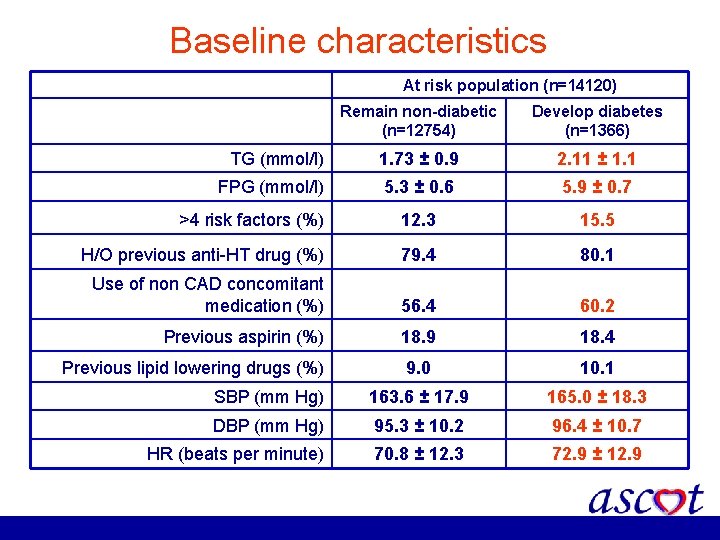
Baseline characteristics At risk population (n=14120) Remain non-diabetic (n=12754) Develop diabetes (n=1366) TG (mmol/l) 1. 73 ± 0. 9 2. 11 ± 1. 1 FPG (mmol/l) 5. 3 ± 0. 6 5. 9 ± 0. 7 >4 risk factors (%) 12. 3 15. 5 H/O previous anti-HT drug (%) 79. 4 80. 1 Use of non CAD concomitant medication (%) 56. 4 60. 2 Previous aspirin (%) 18. 9 18. 4 Previous lipid lowering drugs (%) 9. 0 10. 1 SBP (mm Hg) 163. 6 ± 17. 9 165. 0 ± 18. 3 DBP (mm Hg) 95. 3 ± 10. 2 96. 4 ± 10. 7 HR (beats per minute) 70. 8 ± 12. 3 72. 9 ± 12. 9
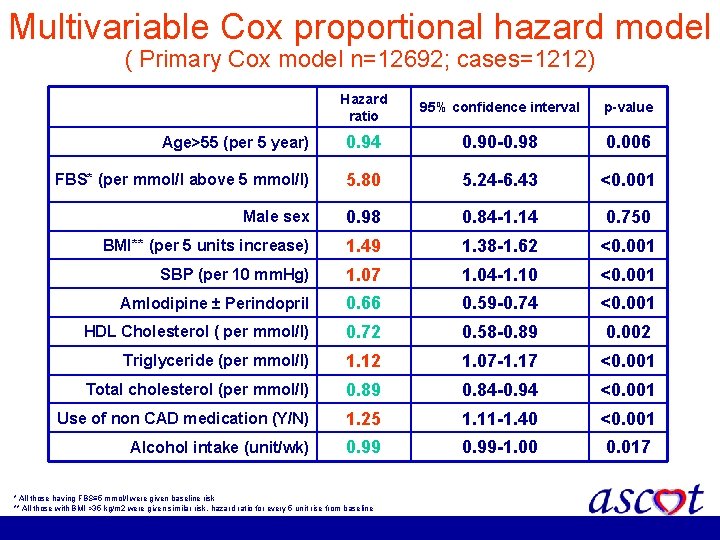
Multivariable Cox proportional hazard model ( Primary Cox model n=12692; cases=1212) Hazard ratio 95% confidence interval p-value Age>55 (per 5 year) 0. 94 0. 90 -0. 98 0. 006 FBS* (per mmol/l above 5 mmol/l) 5. 80 5. 24 -6. 43 <0. 001 Male sex 0. 98 0. 84 -1. 14 0. 750 BMI** (per 5 units increase) 1. 49 1. 38 -1. 62 <0. 001 SBP (per 10 mm. Hg) 1. 07 1. 04 -1. 10 <0. 001 Amlodipine ± Perindopril 0. 66 0. 59 -0. 74 <0. 001 HDL Cholesterol ( per mmol/l) 0. 72 0. 58 -0. 89 0. 002 Triglyceride (per mmol/l) 1. 12 1. 07 -1. 17 <0. 001 Total cholesterol (per mmol/l) 0. 89 0. 84 -0. 94 <0. 001 Use of non CAD medication (Y/N) 1. 25 1. 11 -1. 40 <0. 001 Alcohol intake (unit/wk) 0. 99 -1. 00 0. 017 * All those having FBS≤ 5 mmol/l were given baseline risk ** All those with BMI >35 kg/m 2 were given similar risk, hazard ratio for every 5 unit rise from baseline
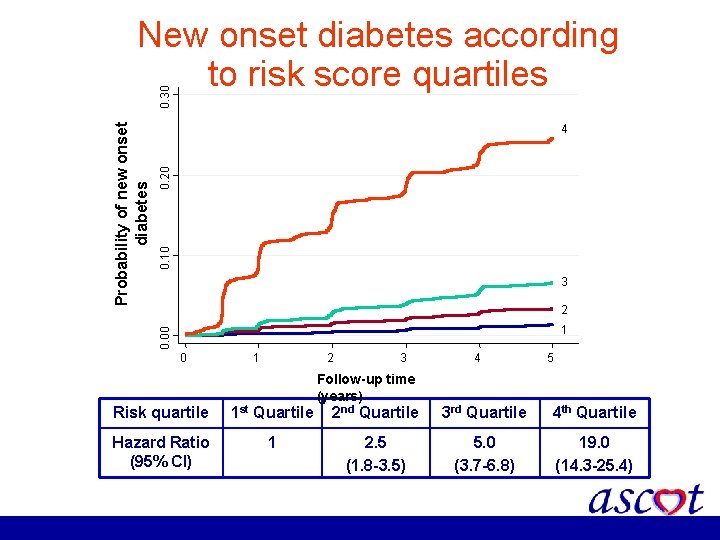
0. 10 0. 20 4 3 2 1 0. 00 Probability of new onset diabetes 0. 30 New onset diabetes according to risk score quartiles 0 1 2 Risk quartile 1 st Quartile Hazard Ratio (95% CI) 1 3 Follow-up time (years) 4 5 2 nd Quartile 3 rd Quartile 4 th Quartile 2. 5 (1. 8 -3. 5) 5. 0 (3. 7 -6. 8) 19. 0 (14. 3 -25. 4)
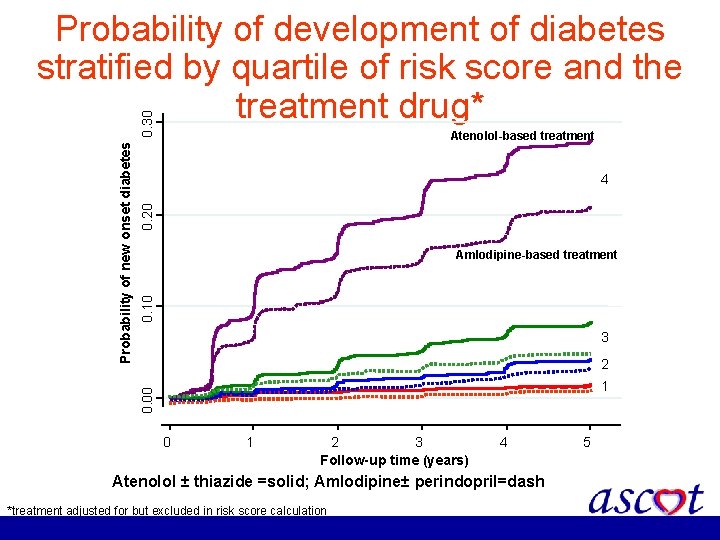
Atenolol-based treatment 0. 20 4 0. 10 Amlodipine-based treatment 3 2 1 0. 00 Probability of new onset diabetes 0. 30 Probability of development of diabetes stratified by quartile of risk score and the treatment drug* 0 1 2 3 Follow-up time (years) 4 Atenolol ± thiazide =solid; Amlodipine± perindopril=dash *treatment adjusted for but excluded in risk score calculation 5
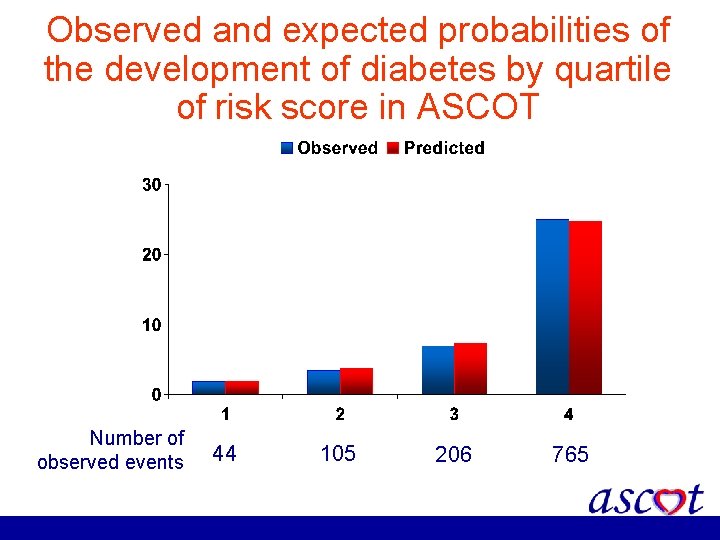
Observed and expected probabilities of the development of diabetes by quartile of risk score in ASCOT Number of observed events 44 105 206 765
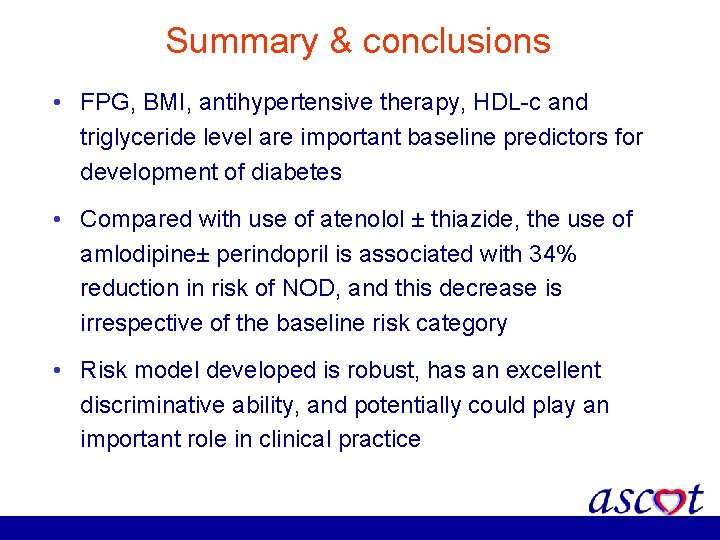
Summary & conclusions • FPG, BMI, antihypertensive therapy, HDL-c and triglyceride level are important baseline predictors for development of diabetes • Compared with use of atenolol ± thiazide, the use of amlodipine± perindopril is associated with 34% reduction in risk of NOD, and this decrease is irrespective of the baseline risk category • Risk model developed is robust, has an excellent discriminative ability, and potentially could play an important role in clinical practice
- Slides: 15